warning light FORD TAURUS 2013 6.G Workshop Manual
[x] Cancel search | Manufacturer: FORD, Model Year: 2013, Model line: TAURUS, Model: FORD TAURUS 2013 6.GPages: 541, PDF Size: 6.11 MB
Page 324 of 541
M.Maximum Permissible Inflation Pressure:Indicates the tire
manufacturers’ maximum permissible pressure and/or the pressure at
which the maximum load can be carried by the tire. This pressure is
normally higher than the manufacturer’s recommended cold inflation
pressure which can be found on the Safety Compliance Certification
Label (affixed to either the door hinge pillar, door-latch post, or the door
edge that meets the door-latch post, next to the driver’s seating
position), or Tire Label which is located on the B-Pillar or the edge of
the driver’s door. The cold inflation pressure should never be set lower
than the recommended pressure on the vehicle label.
The tire suppliers may have additional markings, notes or warnings such
as standard load, radial tubeless, etc.
Additional Information Contained on the Tire Sidewall for “LT ”
Type Tires
“LT” type tires have some additional
information beyond those of “P”
type tires; these differences are
described below.
Note:Tire Quality Grades do not
apply to this type of tire.
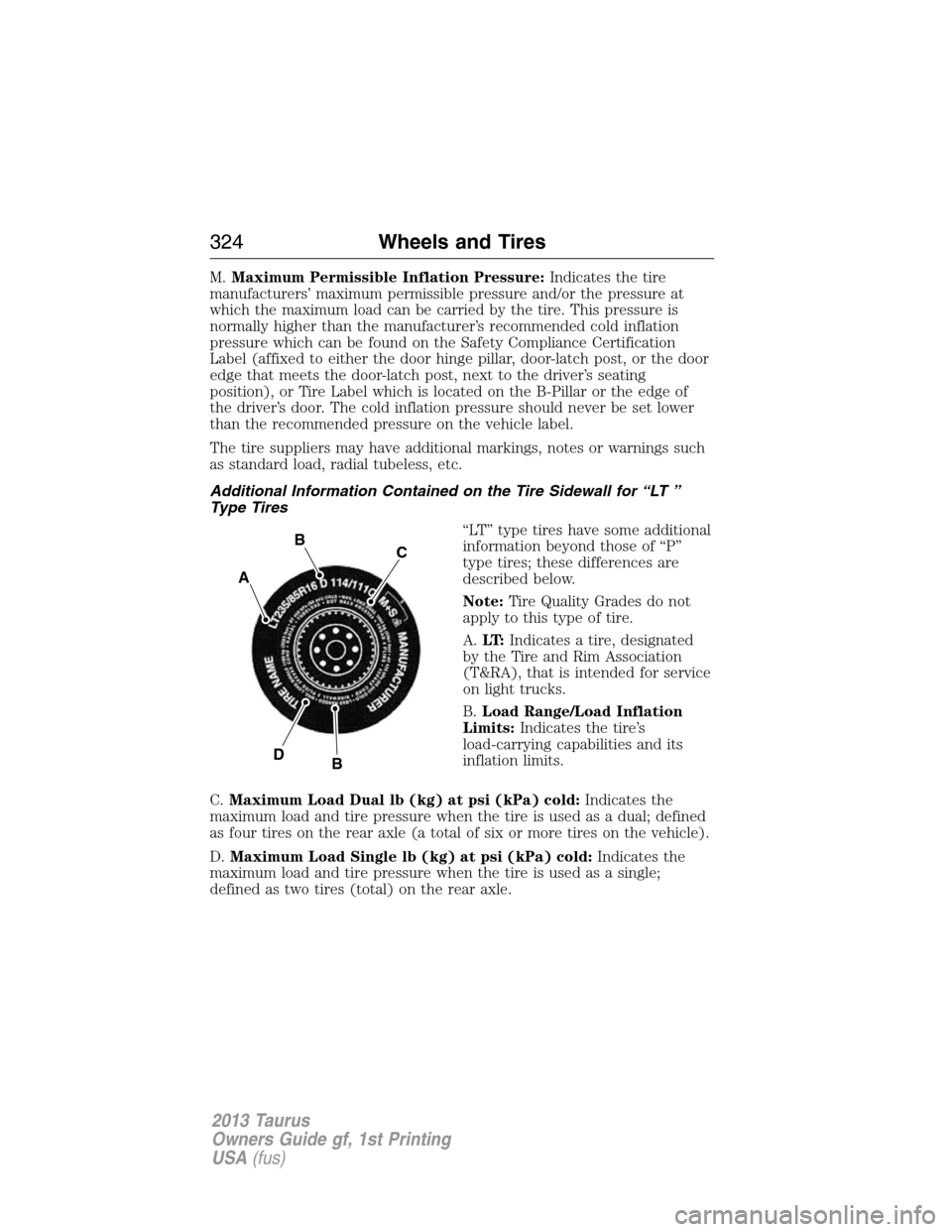
A.LT:Indicates a tire, designated
by the Tire and Rim Association
(T&RA), that is intended for service
on light trucks.
B.Load Range/Load Inflation
Limits:Indicates the tire’s
load-carrying capabilities and its
inflation limits.
C.Maximum Load Dual lb (kg) at psi (kPa) cold:Indicates the
maximum load and tire pressure when the tire is used as a dual; defined
as four tires on the rear axle (a total of six or more tires on the vehicle).
D.Maximum Load Single lb (kg) at psi (kPa) cold:Indicates the
maximum load and tire pressure when the tire is used as a single;
defined as two tires (total) on the rear axle.
A
BC
BD
324Wheels and Tires
2013 Taurus
Owners Guide gf, 1st Printing
USA(fus)
Page 336 of 541
The tire pressure monitoring system complies with part 15 of the FCC
rules and with RSS-210 of Industry Canada. Operation is subject to the
following two conditions: (1) This device may not cause harmful
interference, and (2) This device must accept any interference received,
including interference that may cause undesired operation.
WARNING:The tire pressure monitoring system is NOT a
substitute for manually checking tire pressure. The tire pressure
should be checked periodically (at least monthly) using a tire gauge,
seeInflating your tiresin this chapter. Failure to properly maintain
your tire pressure could increase the risk of tire failure, loss of control,
vehicle rollover and personal injury.
Changing Tires with a TPMS
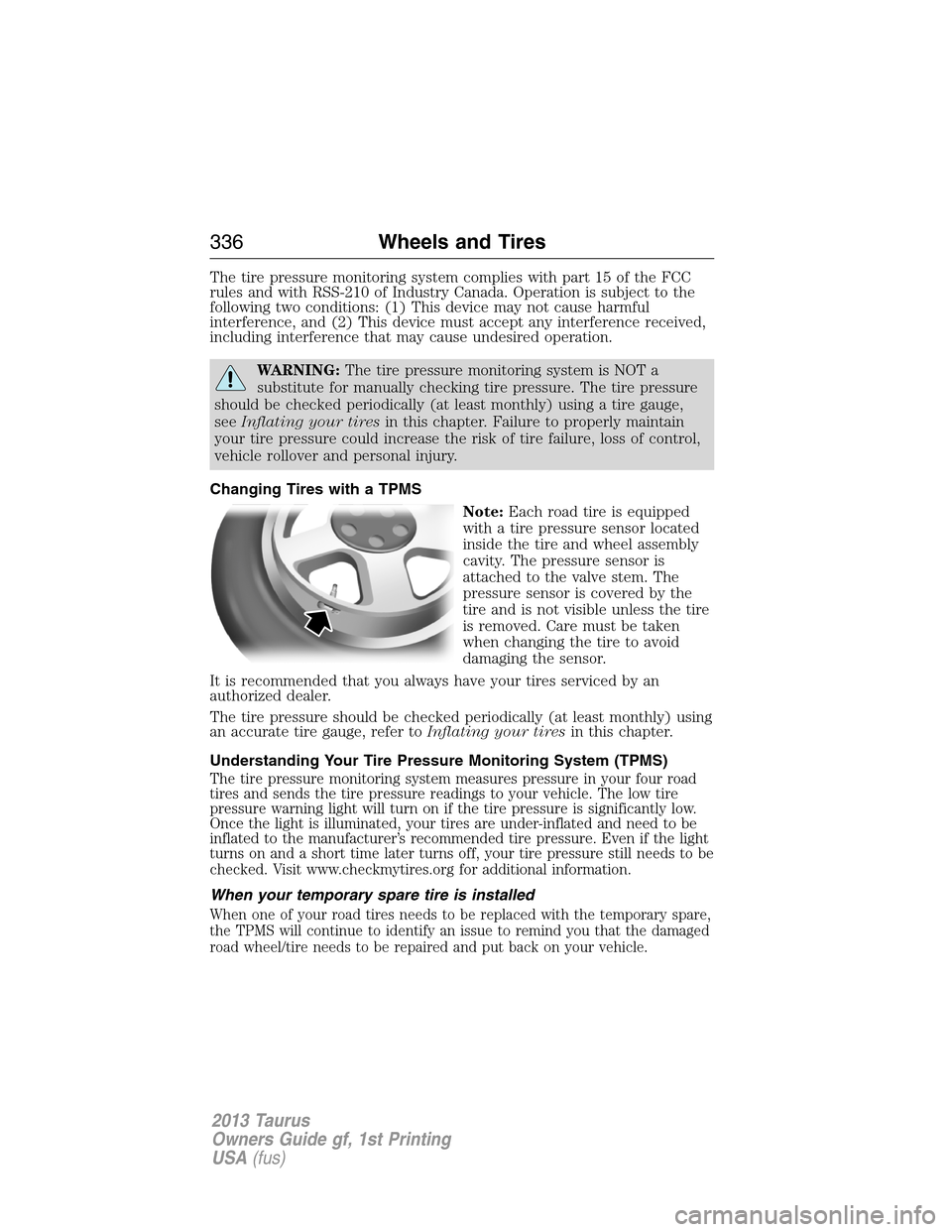
Note:Each road tire is equipped
with a tire pressure sensor located
inside the tire and wheel assembly
cavity. The pressure sensor is
attached to the valve stem. The
pressure sensor is covered by the
tire and is not visible unless the tire
is removed. Care must be taken
when changing the tire to avoid
damaging the sensor.
It is recommended that you always have your tires serviced by an
authorized dealer.
The tire pressure should be checked periodically (at least monthly) using
an accurate tire gauge, refer toInflating your tiresin this chapter.
Understanding Your Tire Pressure Monitoring System (TPMS)
The tire pressure monitoring system measures pressure in your four road
tires and sends the tire pressure readings to your vehicle. The low tire
pressure warning light will turn on if the tire pressure is significantly low.
Once the light is illuminated, your tires are under-inflated and need to be
inflated to the manufacturer’s recommended tire pressure. Even if the light
turns on and a short time later turns off, your tire pressure still needs to be
checked. Visit www.checkmytires.org for additional information.
When your temporary spare tire is installed
When one of your road tires needs to be replaced with the temporary spare,
the TPMS will continue to identify an issue to remind you that the damaged
road wheel/tire needs to be repaired and put back on your vehicle.
336Wheels and Tires
2013 Taurus
Owners Guide gf, 1st Printing
USA(fus)
Page 337 of 541
To restore the full functionality of the tire pressure monitoring system,
have the damaged road wheel/tire repaired and remounted on your
vehicle. For additional information, refer toChanging tires with a
TPMSin this section.
When you believe your system is not operating properly
The main function of the tire pressure monitoring system is to warn you
when your tires need air. It can also warn you in the event the system is no
longer capable of functioning as intended. Please refer to the following
chart for information concerning your tire pressure monitoring system:
Low tire
pressure
warning lightPossible cause Customer action required
Solid warning
lightTire(s)
under-inflated1. Make sure tires are at the proper
pressure. SeeInflating your tires
in this chapter.
2. After inflating your tires to the
manufacturer’s recommended
pressure as shown on the Tire
Label (located on the edge of
driver’s door or the B-Pillar), the
vehicle must be driven for at least
two minutes over 20 mph
(32 km/h) before the light turns
off.
Spare tire in use Repair the damaged road wheel/tire
and reinstall it on the vehicle to
restore system functionality. For a
description on how the system
functions, refer toWhen your
temporary spare tire is installed
in this section.
TPMS
malfunctionIf the tires are properly inflated
and the spare tire is not in use but
the light remains on, contact your
authorized dealer as soon as
possible.
Wheels and Tires337
2013 Taurus
Owners Guide gf, 1st Printing
USA(fus)
Page 338 of 541
Low tire
pressure
warning lightPossible cause Customer action required
Flashing
warning lightSpare tire in use Repair the damaged road wheel/tire
and reinstall it on the vehicle to
restore system functionality. For a
description on how the system
functions, refer toWhen your
temporary spare tire is installed
in this section.
TPMS
malfunctionIf the tires are properly inflated
and the spare tire is not in use but
the light remains on, contact your
authorized dealer as soon as
possible.
When inflating your tires
When putting air into your tires (such as at a gas station or in your
garage), the tire pressure monitoring system may not respond
immediately to the air added to your tires.
It may take up to two minutes of driving over 20 mph (32 km/h) for the
light to turn off after you have filled your tires to the recommended
inflation pressure.
How temperature affects your tire pressure
The tire pressure monitoring system (TPMS) monitors tire pressure in
each pneumatic tire. While driving in a normal manner, a typical
passenger tire inflation pressure may increase approximately 2 to 4 psi
(14 to 28 kPa) from a cold start situation. If the vehicle is stationary
overnight with the outside temperature significantly lower than the
daytime temperature, the tire pressure may decrease approximately 3 psi
(21 kPa) for a drop of 30°F (17°C) in ambient temperature. This lower
pressure value may be detected by the TPMS as being significantly lower
than the recommended inflation pressure and activate the TPMS warning
light for low tire pressure. If the low tire pressure warning light is on,
visually check each tire to verify that no tire is flat. (If one or more tires
are flat, repair as necessary.) Check air pressure in the road tires. If any
tire is under-inflated, carefully drive the vehicle to the nearest location
where air can be added to the tires. Inflate all the tires to the
recommended inflation pressure.
338Wheels and Tires
2013 Taurus
Owners Guide gf, 1st Printing
USA(fus)
Page 339 of 541
CHANGING A ROAD WHEEL
WARNING:The use of tire sealants may damage your tire
pressure monitoring system (TPMS) and should not be used.
However, if you must use a sealant, the TPMS sensor and valve stem on
the wheel must be replaced by an authorized Ford dealer.
WARNING:Refer toTire pressure monitoring system (TPMS)
in this chapter for important information. If the tire pressure
monitor sensor becomes damaged, it will no longer function.
Note:The tire pressure monitoring system (TPMS) indicator light will
illuminate when the spare tire is in use. To restore the full functionality
of the monitoring system, all road wheels equipped with tire pressure
monitoring sensors must be mounted on the vehicle.
If you get a flat tire while driving, do not apply the brake heavily.
Instead, gradually decrease your speed. Hold the steering wheel firmly
and slowly move to a safe place on the side of the road.
Have a flat serviced by an authorized dealer in order to prevent damage
to the TPMS sensors, refer toTire pressure monitoring system (TPMS)
earlier in the chapter. Replace the spare tire with a road tire as soon as
possible. During repairing or replacing of the flat tire, have the
authorized dealer inspect the TPMS sensor for damage.
Dissimilar Spare Tire and Wheel Assembly Information
WARNING:Failure to follow these guidelines could result in an
increased risk of loss of vehicle control, injury or death.
If you have a dissimilar spare tire and wheel assembly , then it is
intended for temporary use only. This means that if you need to use it,
you should replace it as soon as possible with a road tire and wheel
assembly that is the same size and type as the road tires and wheels that
were originally provided by Ford. If the dissimilar spare tire or wheel is
damaged, it should be replaced rather than repaired.
A dissimilar spare tire and wheel assembly is defined as a spare tire or
wheel that is different in brand, size or appearance from the road tires
and wheels and can be one of three types:
1.T-type mini-spare:This spare tire begins with the letter “T” for tire
size and may have “Temporary Use Only” molded in the sidewall
Wheels and Tires339
2013 Taurus
Owners Guide gf, 1st Printing
USA(fus)
Page 346 of 541
General Information
WARNING:Failure to follow these guidelines could result in an
increased risk of loss of vehicle control, injury or death.
Note:Do not use the temporary mobility kit if a tire has become
severely damaged by driving the vehicle with a tire that has insufficient
air pressure. Only punctured areas located within the tire tread can be
sealed with the temporary mobility kit.
Do not attempt to repair punctures larger than
14inch (6.4 mm) or
damage to the tire’s sidewall. The tire may not completely seal.
Loss of air pressure may adversely affect tire performance. For this
reason:
•Note:Do not drive the vehicle above 50 mph (80 km/h).
•Note:Do not drive further than 120 miles (200 km). Drive only to the
closest Ford Motor Company authorized dealer or tire repair shop to
have your tire inspected.
•Drive carefully and avoid abrupt steering maneuvers.
•Periodically monitor tire inflation pressure in the affected tire; if the
tire is losing pressure, have the vehicle towed.
•Read the information in theTips for use of the temporary mobility
kitsection to ensure safe operation of the temporary mobility kit and
your vehicle.
Tips for Use of the Temporary Mobility Kit
Read the following list of tips to ensure safe operation of the temporary
mobility kit:
•Before operating the temporary mobility kit, make sure your vehicle is
safely off the road and away from moving traffic. Turn on the hazard
lights.
•Always set the parking brake to ensure the vehicle doesn’t move
unexpectedly.
•Do not remove any foreign objects, such as nails or screws, from the
tire.
•When using the temporary mobility kit, leave the engine running (only
if the vehicle is outdoors or in a well-ventilated area) so the
compressor doesn’t drain the vehicle’s battery.
•Do not allow the compressor to operate continuously for more than
15 minutes; this will help prevent the compressor from overheating.
346Wheels and Tires
2013 Taurus
Owners Guide gf, 1st Printing
USA(fus)
Page 348 of 541
First Stage: Reinflating the Tire with Sealing Compound and Air
WARNING:Do not stand directly over the temporary mobility kit
while inflating the tire. If you notice any unusual bulges or
deformations in the tire’s sidewall during inflation, stop and call
roadside assistance.
WARNING:If the tire doesn’t inflate to the recommended tire
pressure within 15 minutes, stop and call roadside assistance.
Preparation
Park the vehicle in a safe, level and secure area, away from moving
traffic. Turn the hazard lights on. Apply the parking brake and turn the
engine off. Inspect the flat tire for visible damage.
Sealant compound contains latex. To avoid any allergic reactions, use the
non-latex gloves located in the accessory box on the underside of the
temporary mobility kit housing.
Do not remove any foreign object that has pierced the tire. If a puncture
is located in the tire sidewall, stop and call roadside assistance.
1. Remove the valve cap from the tire valve.
2. Unwrap the clear tube from the compressor housing.
3. Remove the tube cap and fasten the metal connector of the tube to
the tire valve, turning clockwise. Make sure the connection is tightly
fastened.
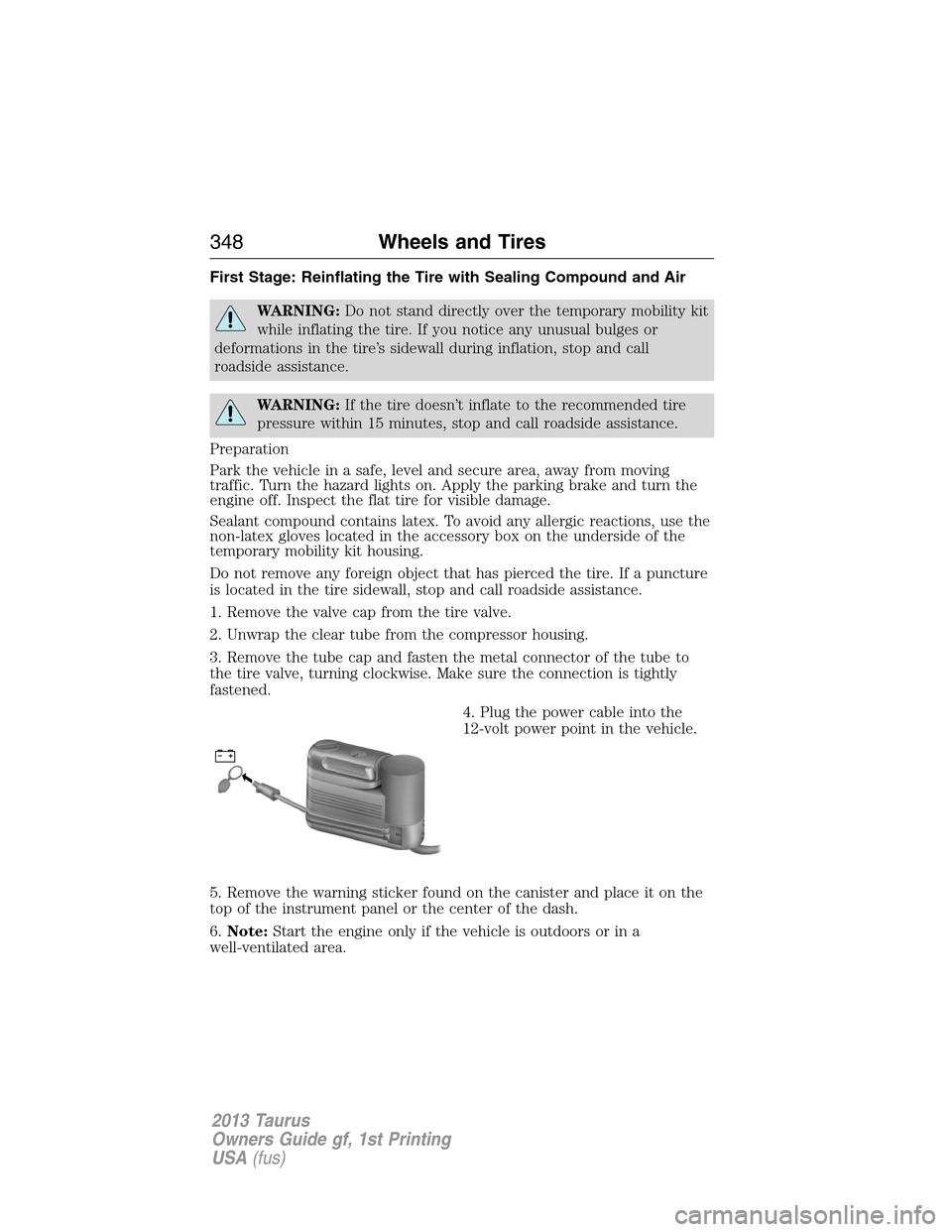
4. Plug the power cable into the
12-volt power point in the vehicle.
5. Remove the warning sticker found on the canister and place it on the
top of the instrument panel or the center of the dash.
6.Note:Start the engine only if the vehicle is outdoors or in a
well-ventilated area.
348Wheels and Tires
2013 Taurus
Owners Guide gf, 1st Printing
USA(fus)
Page 372 of 541
Additives and Chemicals
Ford Motor Company recommended additives and chemicals are listed in
this book and in theWorkshop Manual.Additional chemicals or
additives not approved by Ford and are not recommended as part of
normal maintenance. Please consult yourWarranty Manualfor
complete warranty information.
Oils, Fluids and Flushing
In many cases, fluid discoloration is a normal operating characteristic
and, by itself, does not necessarily indicate a concern or that the fluid
needs to be changed. However, discolored fluids that also show signs of
overheating and/or foreign material contamination should be inspected
immediately by a qualified expert such as the factory-trained technicians
at your dealership. Your vehicle’s oils and fluids should be changed at the
specified intervals or in conjunction with a repair. Flushing is a viable
way to change fluid for many vehicle sub-systems during scheduled
maintenance. It is critical that systems are flushed only with new fluid
that is the same as that required to fill and operate the system, or using
a Ford-approved flushing chemical.
Owner Checks and Services
Certain basic maintenance checks and inspections should be performed
every month or at six months intervals.
Check every month
Engine oil level
Function of all interior and exterior lights
Tires for wear and proper pressure, including spare
Windshield washer fluid level
Check every six months
Battery connections; clean if necessary
Body and door drain holes for obstructions; clean if necessary
Cooling system fluid level and coolant strength
Door weatherstrips for wear; lubricate if necessary
Hinges/latches/outside locks for proper operation; lubricate if necessary
Parking brake for proper operation
Safety belts and seat latches for wear and function
Safety warning lamps (brake, ABS, airbag, safety belt) for operation
Washer spray/wiper operation; clean or replace blades as necessary
372Scheduled Maintenance
2013 Taurus
Owners Guide gf, 1st Printing
USA(fus)
Page 535 of 541
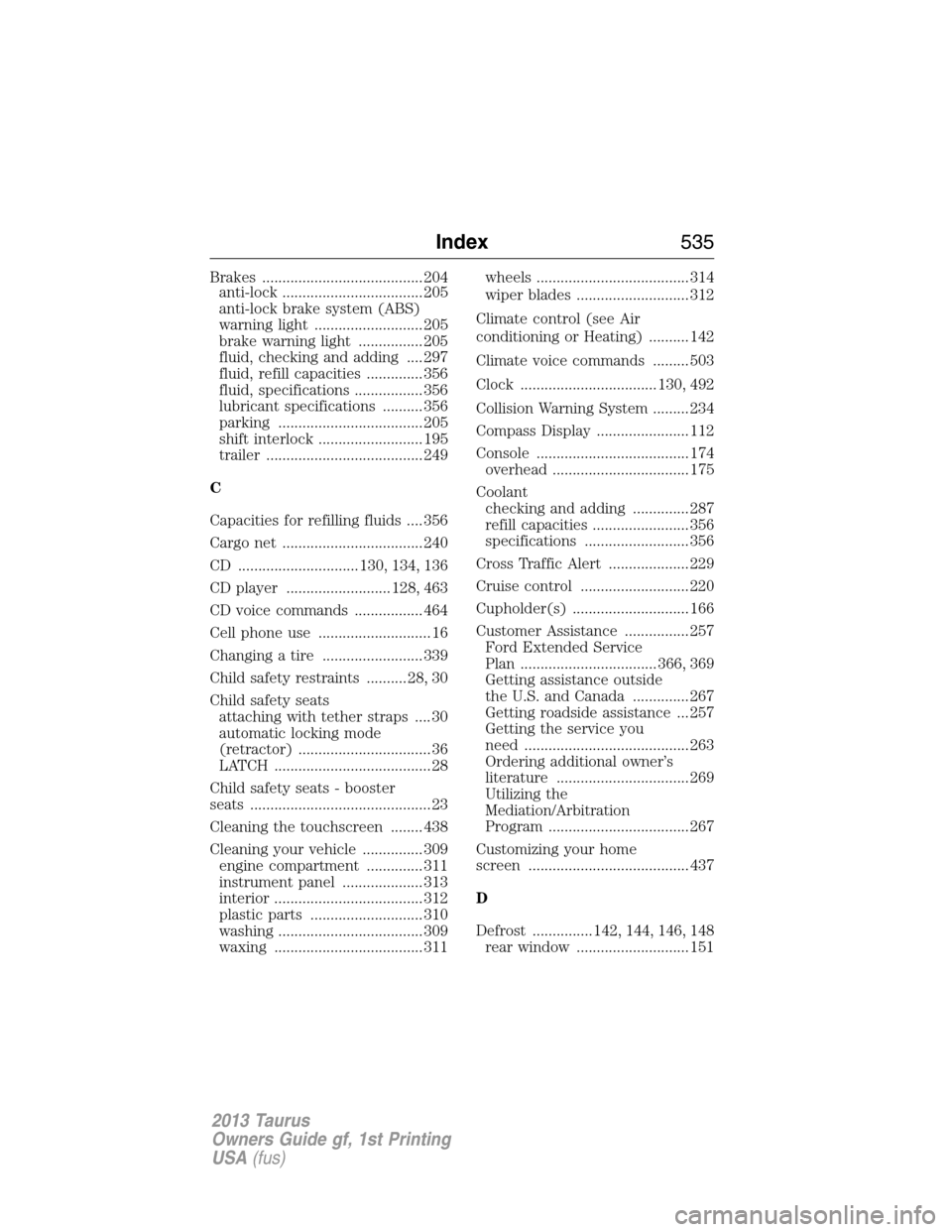
Brakes ........................................ 204
anti-lock ................................... 205
anti-lock brake system (ABS)
warning light ........................... 205
brake warning light ................ 205
fluid, checking and adding .... 297
fluid, refill capacities .............. 356
fluid, specifications ................. 356
lubricant specifications .......... 356
parking .................................... 205
shift interlock .......................... 195
trailer ....................................... 249
C
Capacities for refilling fluids .... 356
Cargo net ................................... 240
CD .............................. 130, 134, 136
CD player .......................... 128, 463
CD voice commands ................. 464
Cell phone use ............................ 16
Changing a tire ......................... 339
Child safety restraints .......... 28, 30
Child safety seats
attaching with tether straps .... 30
automatic locking mode
(retractor) ................................. 36
LATCH ....................................... 28
Child safety seats - booster
seats ............................................. 23
Cleaning the touchscreen ........ 438
Cleaning your vehicle ............... 309
engine compartment .............. 311
instrument panel .................... 313
interior ..................................... 312
plastic parts ............................ 310
washing .................................... 309
waxing ..................................... 311wheels ...................................... 314
wiper blades ............................ 312
Climate control (see Air
conditioning or Heating) .......... 142
Climate voice commands ......... 503
Clock .................................. 130, 492
Collision Warning System ......... 234
Compass Display ....................... 112
Console ...................................... 174
overhead .................................. 175
Coolant
checking and adding .............. 287
refill capacities ........................ 356
specifications .......................... 356
Cross Traffic Alert .................... 229
Cruise control ........................... 220
Cupholder(s) ............................. 166
Customer Assistance ................ 257
Ford Extended Service
Plan .................................. 366, 369
Getting assistance outside
the U.S. and Canada .............. 267
Getting roadside assistance ... 257
Getting the service you
need ......................................... 263
Ordering additional owner’s
literature ................................. 269
Utilizing the
Mediation/Arbitration
Program ................................... 267
Customizing your home
screen ........................................ 437
D
Defrost ............... 142, 144, 146, 148
rear window ............................ 151
Index535
2013 Taurus
Owners Guide gf, 1st Printing
USA(fus)
Page 537 of 541
G
Gas cap (see Fuel cap) ............ 186
Gauges ............................... 102–103
odometer ................................. 112
trip odometer .......................... 112
H
Hazard flashers ......................... 258
HD Radio™ ............................... 451
Headlamps
aiming ...................................... 302
bulb specifications .................. 308
flash to pass .............................. 89
high beam ........................... 89, 91
replacing bulbs ....................... 304
Head restraints ......................... 155
Heated steering wheel .............. 501
Heating .............. 142, 144, 146, 148
Help ............................................ 500
Homelink wireless control
system ........................................ 168
Home screen ............................. 437
Hood .......................................... 281
How to use voice commands ... 443
I
Ignition ............................... 177, 354
Illuminated visor mirror ..... 99–100
Information displays ................. 109
Infotainment display ................. 441
Inspection/maintenance (I/M)
testing ........................................ 191
Instrument panel
cleaning ................................... 313cluster ...................................... 103
Intelligent Access Key ................ 56
J
Jack ............................................ 339
positioning ............................... 339
storage ..................................... 339
Joining two calls
(multiparty/conference call) .... 398
Jump-starting your vehicle ...... 259
K
Keyless entry system
autolock ..................................... 71
keypad ....................................... 74
locking and unlocking doors .... 75
programming entry code ......... 74
Keys ....................................... 56, 77
positions of the ignition ......... 177
L
Lamps
bulb replacement
specifications chart ................ 308
headlamps, flash to pass .......... 89
interior lamps ........................... 94
replacing bulbs ....................... 304
LATCH anchors ........................... 28
Lights, warning and indicator .. 103
Listening to music .................... 449
Loading pictures ....................... 492
Load limits ................................. 240
Locks
autolock ..................................... 71
childproof .................................. 32
doors .......................................... 69
Index537
2013 Taurus
Owners Guide gf, 1st Printing
USA(fus)