brake sensor FORD TAURUS 2016 6.G User Guide
[x] Cancel search | Manufacturer: FORD, Model Year: 2016, Model line: TAURUS, Model: FORD TAURUS 2016 6.GPages: 424, PDF Size: 4.04 MB
Page 229 of 424
Protected components
Fuse amp rating
Fuse or relay number
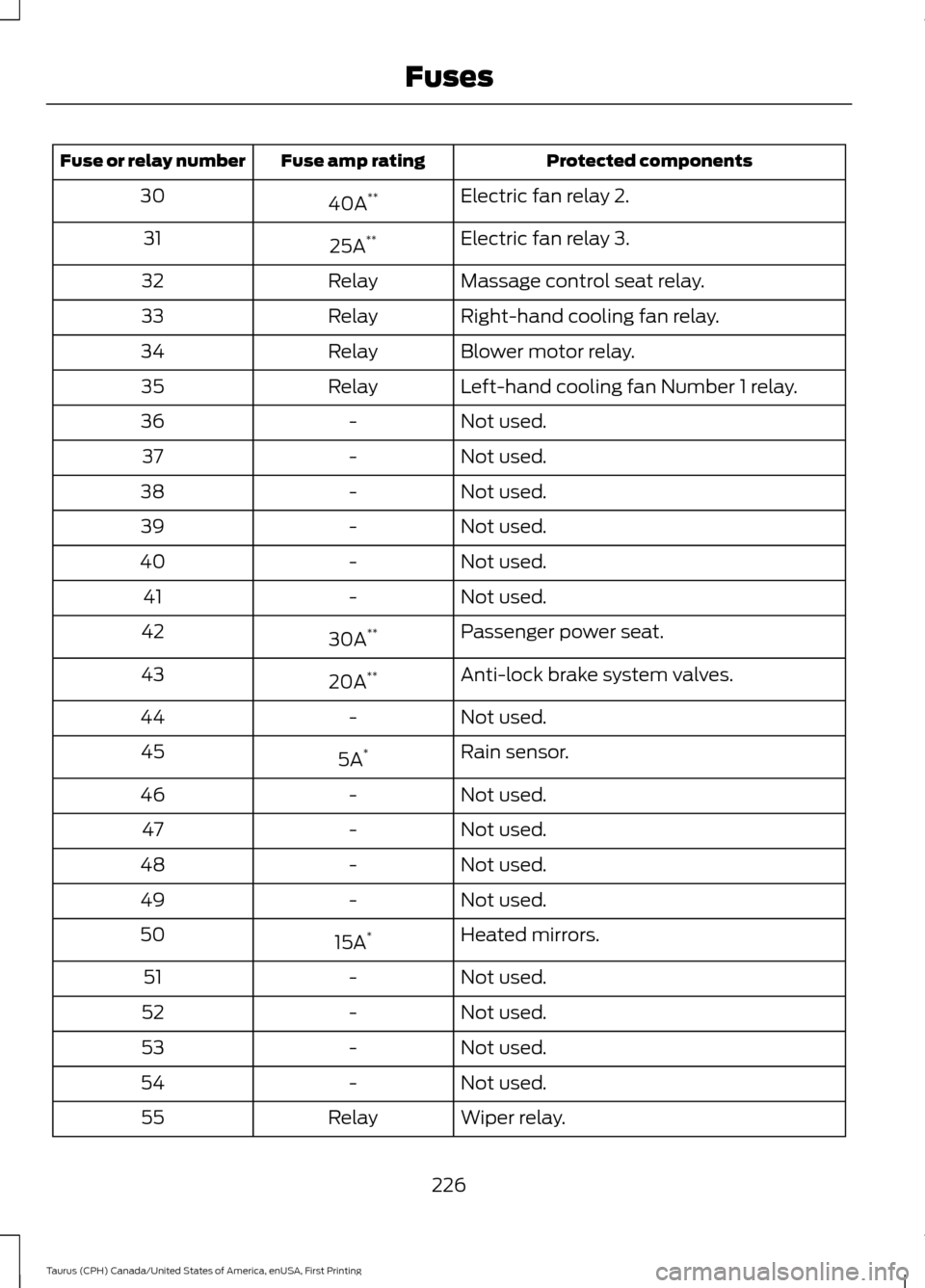
Electric fan relay 2.
40A **
30
Electric fan relay 3.
25A **
31
Massage control seat relay.
Relay
32
Right-hand cooling fan relay.
Relay
33
Blower motor relay.
Relay
34
Left-hand cooling fan Number 1 relay.
Relay
35
Not used.
-
36
Not used.
-
37
Not used.
-
38
Not used.
-
39
Not used.
-
40
Not used.
-
41
Passenger power seat.
30A **
42
Anti-lock brake system valves.
20A **
43
Not used.
-
44
Rain sensor.
5A *
45
Not used.
-
46
Not used.
-
47
Not used.
-
48
Not used.
-
49
Heated mirrors.
15A *
50
Not used.
-
51
Not used.
-
52
Not used.
-
53
Not used.
-
54
Wiper relay.
Relay
55
226
Taurus (CPH) Canada/United States of America, enUSA, First Printing Fuses
Page 230 of 424
Protected components
Fuse amp rating
Fuse or relay number
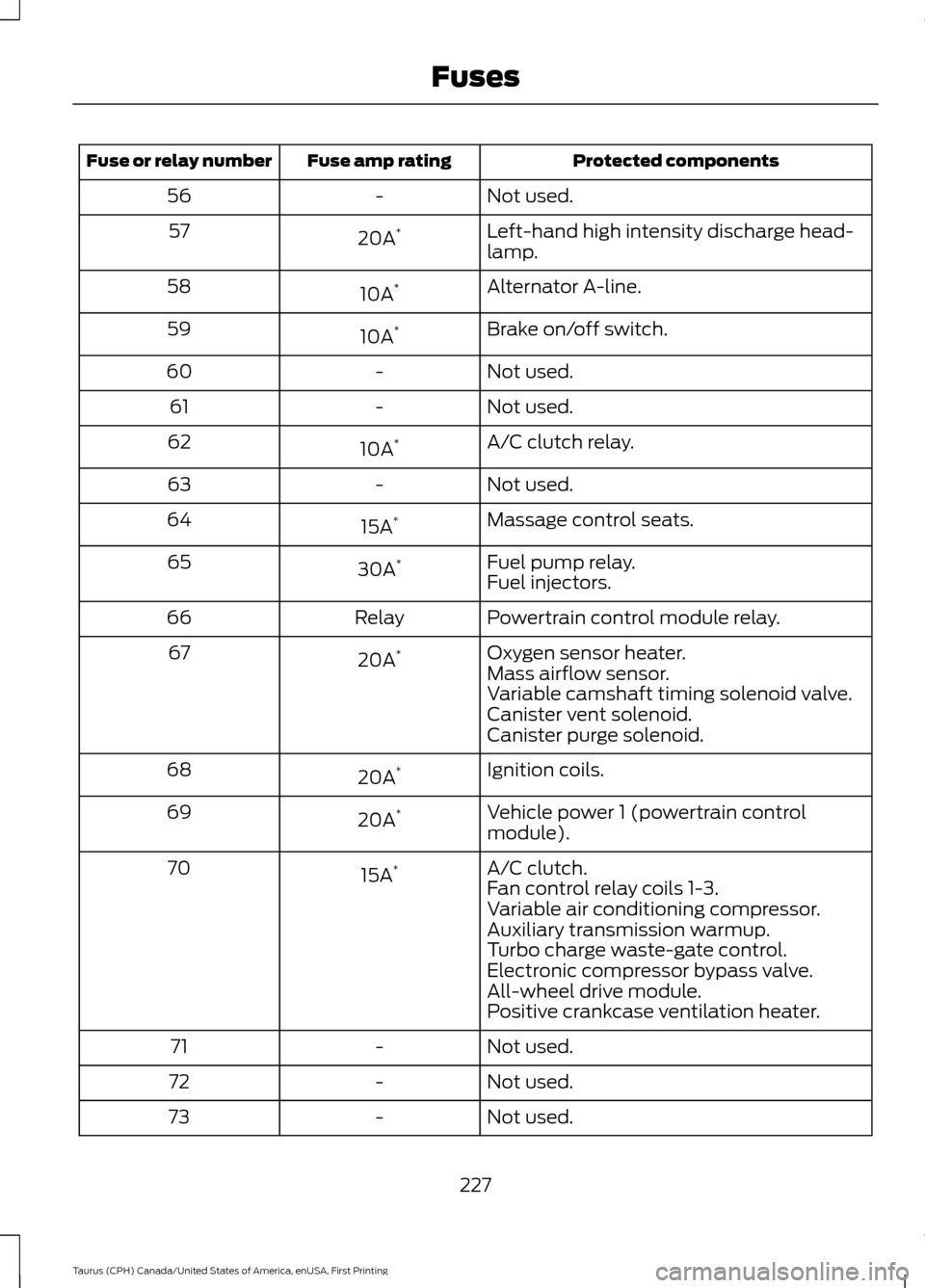
Not used.
-
56
Left-hand high intensity discharge head-
lamp.
20A
*
57
Alternator A-line.
10A *
58
Brake on/off switch.
10A *
59
Not used.
-
60
Not used.
-
61
A/C clutch relay.
10A *
62
Not used.
-
63
Massage control seats.
15A *
64
Fuel pump relay.
30A *
65
Fuel injectors.
Powertrain control module relay.
Relay
66
Oxygen sensor heater.
20A *
67
Mass airflow sensor.
Variable camshaft timing solenoid valve.
Canister vent solenoid.
Canister purge solenoid.
Ignition coils.
20A *
68
Vehicle power 1 (powertrain control
module).
20A
*
69
A/C clutch.
15A *
70
Fan control relay coils 1-3.
Variable air conditioning compressor.
Auxiliary transmission warmup.
Turbo charge waste-gate control.
Electronic compressor bypass valve.
All-wheel drive module.
Positive crankcase ventilation heater.
Not used.
-
71
Not used.
-
72
Not used.
-
73
227
Taurus (CPH) Canada/United States of America, enUSA, First Printing Fuses
Page 268 of 424
General Information
WARNING
Failure to follow these guidelines
could result in an increased risk of
loss of vehicle control, injury or death.
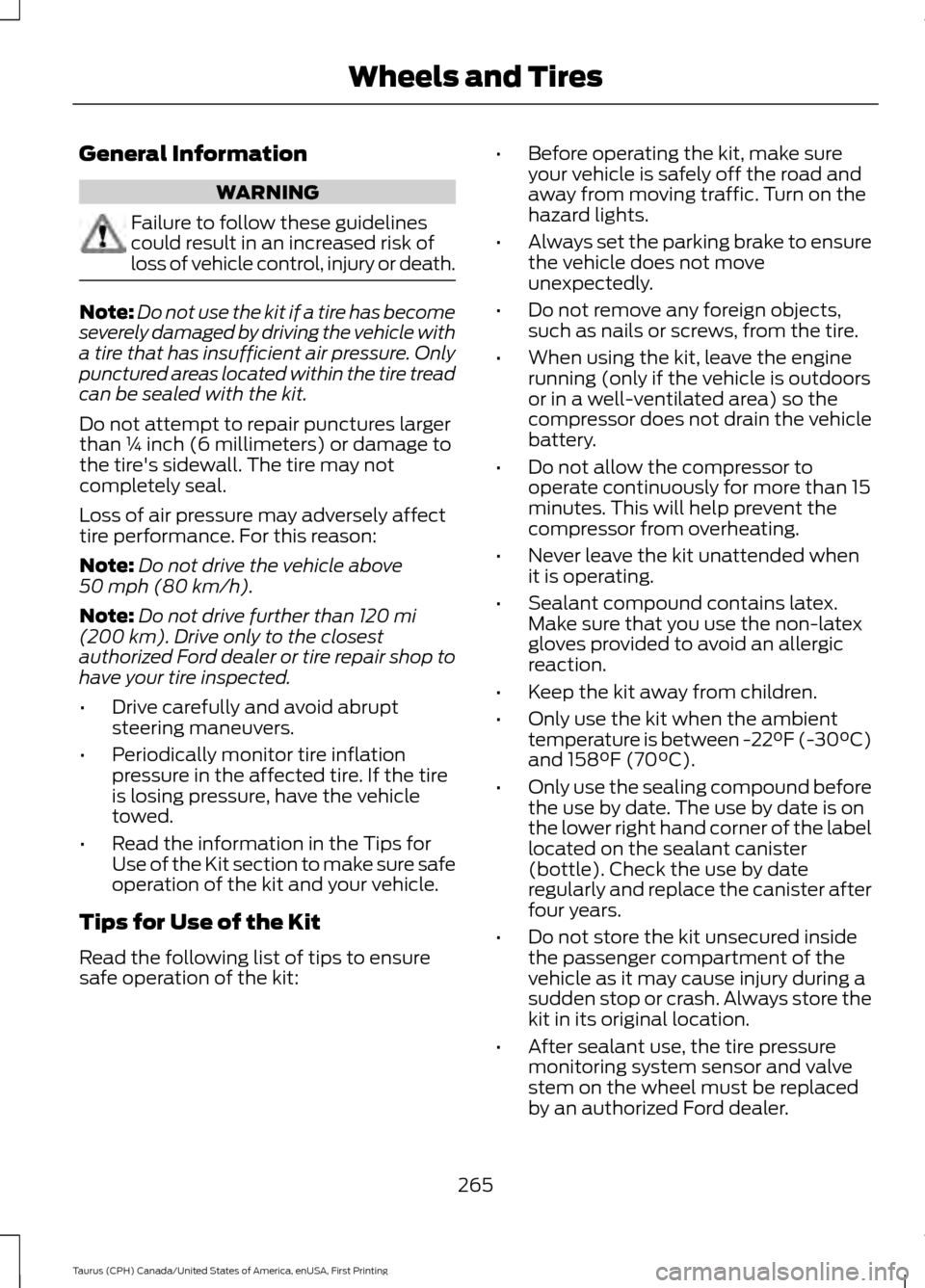
Note:
Do not use the kit if a tire has become
severely damaged by driving the vehicle with
a tire that has insufficient air pressure. Only
punctured areas located within the tire tread
can be sealed with the kit.
Do not attempt to repair punctures larger
than ¼ inch (6 millimeters) or damage to
the tire's sidewall. The tire may not
completely seal.
Loss of air pressure may adversely affect
tire performance. For this reason:
Note: Do not drive the vehicle above
50 mph (80 km/h).
Note: Do not drive further than
120 mi
(200 km). Drive only to the closest
authorized Ford dealer or tire repair shop to
have your tire inspected.
• Drive carefully and avoid abrupt
steering maneuvers.
• Periodically monitor tire inflation
pressure in the affected tire. If the tire
is losing pressure, have the vehicle
towed.
• Read the information in the Tips for
Use of the Kit section to make sure safe
operation of the kit and your vehicle.
Tips for Use of the Kit
Read the following list of tips to ensure
safe operation of the kit: •
Before operating the kit, make sure
your vehicle is safely off the road and
away from moving traffic. Turn on the
hazard lights.
• Always set the parking brake to ensure
the vehicle does not move
unexpectedly.
• Do not remove any foreign objects,
such as nails or screws, from the tire.
• When using the kit, leave the engine
running (only if the vehicle is outdoors
or in a well-ventilated area) so the
compressor does not drain the vehicle
battery.
• Do not allow the compressor to
operate continuously for more than 15
minutes. This will help prevent the
compressor from overheating.
• Never leave the kit unattended when
it is operating.
• Sealant compound contains latex.
Make sure that you use the non-latex
gloves provided to avoid an allergic
reaction.
• Keep the kit away from children.
• Only use the kit when the ambient
temperature is between
-22°F (-30°C)
and 158°F (70°C).
• Only use the sealing compound before
the use by date. The use by date is on
the lower right hand corner of the label
located on the sealant canister
(bottle). Check the use by date
regularly and replace the canister after
four years.
• Do not store the kit unsecured inside
the passenger compartment of the
vehicle as it may cause injury during a
sudden stop or crash. Always store the
kit in its original location.
• After sealant use, the tire pressure
monitoring system sensor and valve
stem on the wheel must be replaced
by an authorized Ford dealer.
265
Taurus (CPH) Canada/United States of America, enUSA, First Printing Wheels and Tires
Page 291 of 424
How Temperature Affects Your Tire
Pressure
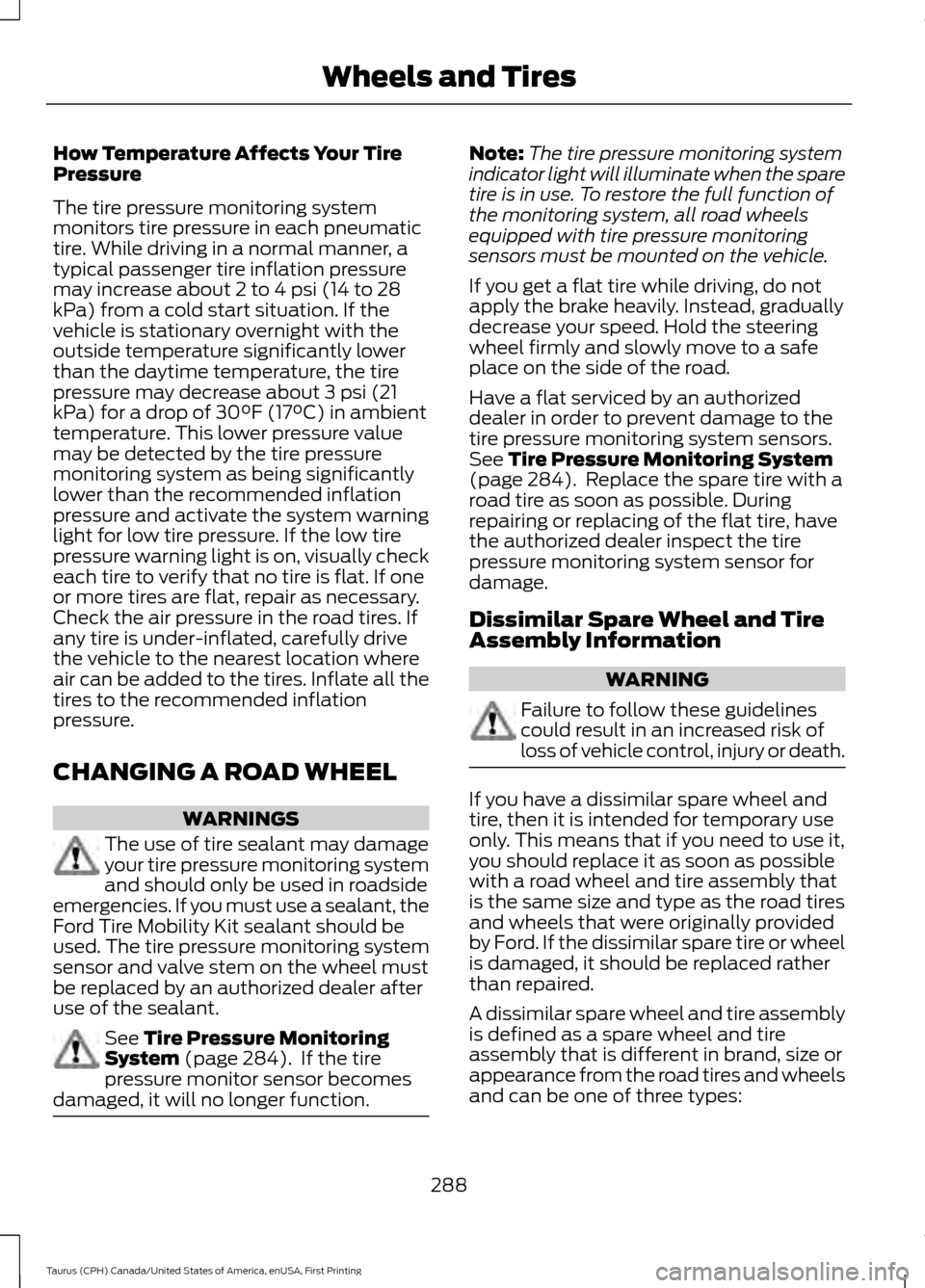
The tire pressure monitoring system
monitors tire pressure in each pneumatic
tire. While driving in a normal manner, a
typical passenger tire inflation pressure
may increase about 2 to 4 psi (14 to 28
kPa) from a cold start situation. If the
vehicle is stationary overnight with the
outside temperature significantly lower
than the daytime temperature, the tire
pressure may decrease about 3 psi (21
kPa) for a drop of 30°F (17°C) in ambient
temperature. This lower pressure value
may be detected by the tire pressure
monitoring system as being significantly
lower than the recommended inflation
pressure and activate the system warning
light for low tire pressure. If the low tire
pressure warning light is on, visually check
each tire to verify that no tire is flat. If one
or more tires are flat, repair as necessary.
Check the air pressure in the road tires. If
any tire is under-inflated, carefully drive
the vehicle to the nearest location where
air can be added to the tires. Inflate all the
tires to the recommended inflation
pressure.
CHANGING A ROAD WHEEL
WARNINGS
The use of tire sealant may damage
your tire pressure monitoring system
and should only be used in roadside
emergencies. If you must use a sealant, the
Ford Tire Mobility Kit sealant should be
used. The tire pressure monitoring system
sensor and valve stem on the wheel must
be replaced by an authorized dealer after
use of the sealant. See Tire Pressure Monitoring
System (page 284). If the tire
pressure monitor sensor becomes
damaged, it will no longer function. Note:
The tire pressure monitoring system
indicator light will illuminate when the spare
tire is in use. To restore the full function of
the monitoring system, all road wheels
equipped with tire pressure monitoring
sensors must be mounted on the vehicle.
If you get a flat tire while driving, do not
apply the brake heavily. Instead, gradually
decrease your speed. Hold the steering
wheel firmly and slowly move to a safe
place on the side of the road.
Have a flat serviced by an authorized
dealer in order to prevent damage to the
tire pressure monitoring system sensors.
See
Tire Pressure Monitoring System
(page 284). Replace the spare tire with a
road tire as soon as possible. During
repairing or replacing of the flat tire, have
the authorized dealer inspect the tire
pressure monitoring system sensor for
damage.
Dissimilar Spare Wheel and Tire
Assembly Information WARNING
Failure to follow these guidelines
could result in an increased risk of
loss of vehicle control, injury or death.
If you have a dissimilar spare wheel and
tire, then it is intended for temporary use
only. This means that if you need to use it,
you should replace it as soon as possible
with a road wheel and tire assembly that
is the same size and type as the road tires
and wheels that were originally provided
by Ford. If the dissimilar spare tire or wheel
is damaged, it should be replaced rather
than repaired.
A dissimilar spare wheel and tire assembly
is defined as a spare wheel and tire
assembly that is different in brand, size or
appearance from the road tires and wheels
and can be one of three types:
288
Taurus (CPH) Canada/United States of America, enUSA, First Printing Wheels and Tires
Page 416 of 424
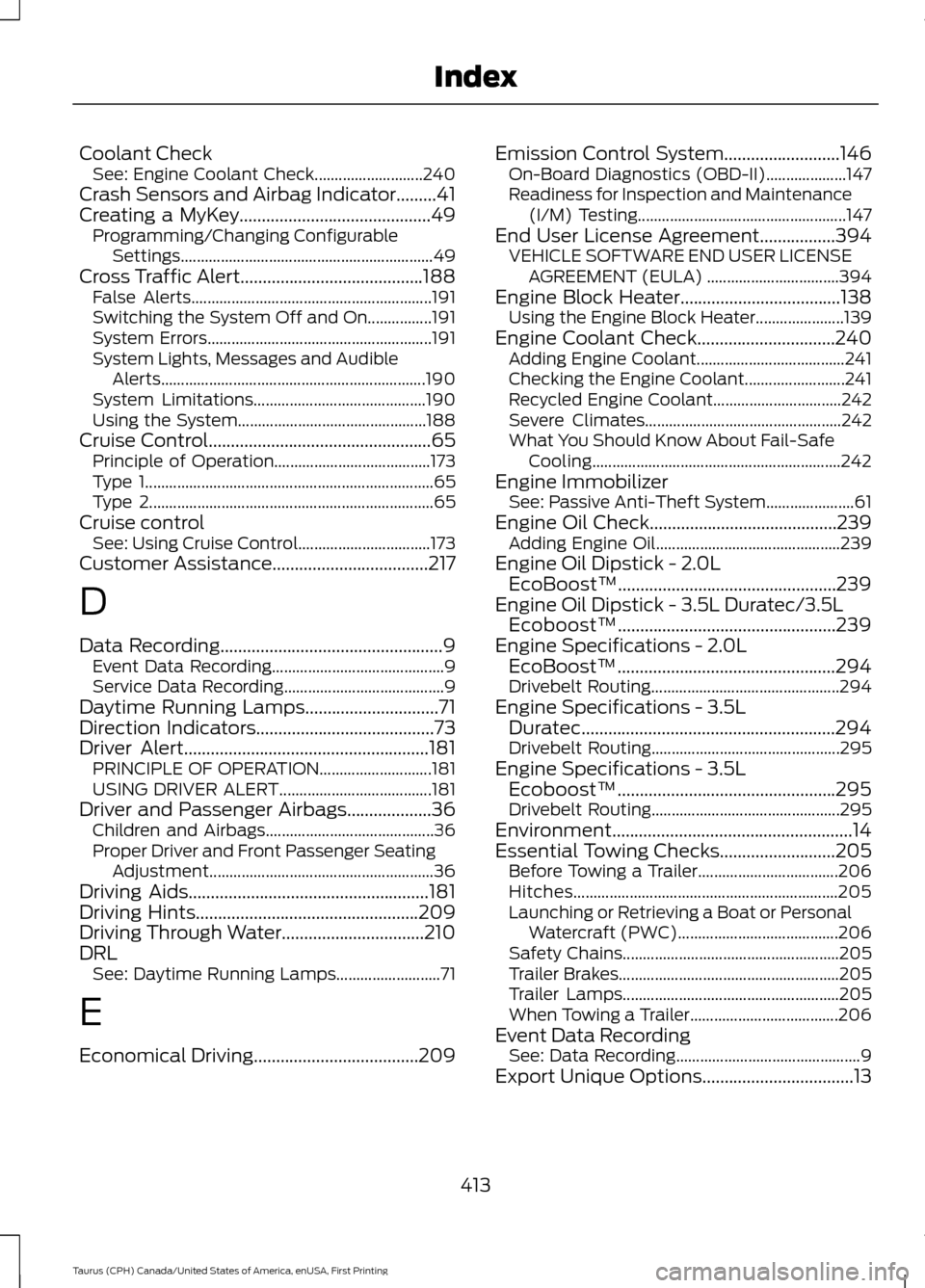
Coolant Check
See: Engine Coolant Check........................... 240
Crash Sensors and Airbag Indicator.........41
Creating a MyKey...........................................49
Programming/Changing Configurable
Settings............................................................... 49
Cross Traffic Alert.........................................188 False Alerts............................................................ 191
Switching the System Off and On................191
System Errors........................................................ 191
System Lights, Messages and Audible Alerts.................................................................. 190
System Limitations........................................... 190
Using the System............................................... 188
Cruise Control..................................................65 Principle of Operation....................................... 173
Type 1........................................................................\
65
Type 2....................................................................... 65
Cruise control See: Using Cruise Control................................. 173
Customer Assistance
...................................217
D
Data Recording
..................................................9
Event Data Recording........................................... 9
Service Data Recording........................................ 9
Daytime Running Lamps..............................71
Direction Indicators
........................................73
Driver Alert.......................................................181 PRINCIPLE OF OPERATION............................ 181
USING DRIVER ALERT...................................... 181
Driver and Passenger Airbags...................36 Children and Airbags.......................................... 36
Proper Driver and Front Passenger Seating Adjustment........................................................ 36
Driving Aids......................................................181
Driving Hints
..................................................209
Driving Through Water................................210
DRL See: Daytime Running Lamps.......................... 71
E
Economical Driving
.....................................209 Emission Control System..........................146
On-Board Diagnostics (OBD-II).................... 147
Readiness for Inspection and Maintenance (I/M) Testing.................................................... 147
End User License Agreement.................394 VEHICLE SOFTWARE END USER LICENSE
AGREEMENT (EULA) ................................. 394
Engine Block Heater....................................138 Using the Engine Block Heater...................... 139
Engine Coolant Check...............................240 Adding Engine Coolant..................................... 241
Checking the Engine Coolant......................... 241
Recycled Engine Coolant................................ 242
Severe Climates................................................. 242
What You Should Know About Fail-Safe Cooling.............................................................. 242
Engine Immobilizer See: Passive Anti-Theft System...................... 61
Engine Oil Check
..........................................239
Adding Engine Oil.............................................. 239
Engine Oil Dipstick - 2.0L EcoBoost™.................................................239
Engine Oil Dipstick - 3.5L Duratec/3.5L Ecoboost™.................................................239
Engine Specifications - 2.0L EcoBoost™.................................................294
Drivebelt Routing............................................... 294
Engine Specifications - 3.5L Duratec.........................................................294
Drivebelt Routing............................................... 295
Engine Specifications - 3.5L Ecoboost™.................................................295
Drivebelt Routing............................................... 295
Environment......................................................14
Essential Towing Checks
..........................205
Before Towing a Trailer................................... 206
Hitches.................................................................. 205
Launching or Retrieving a Boat or Personal Watercraft (PWC)........................................ 206
Safety Chains...................................................... 205
Trailer Brakes....................................................... 205
Trailer Lamps...................................................... 205
When Towing a Trailer..................................... 206
Event Data Recording See: Data Recording.............................................. 9
Export Unique Options..................................13
413
Taurus (CPH) Canada/United States of America, enUSA, First Printing Index