brake FORD TAURUS 2019 Repair Manual
[x] Cancel search | Manufacturer: FORD, Model Year: 2019, Model line: TAURUS, Model: FORD TAURUS 2019Pages: 515, PDF Size: 17.29 MB
Page 227 of 515
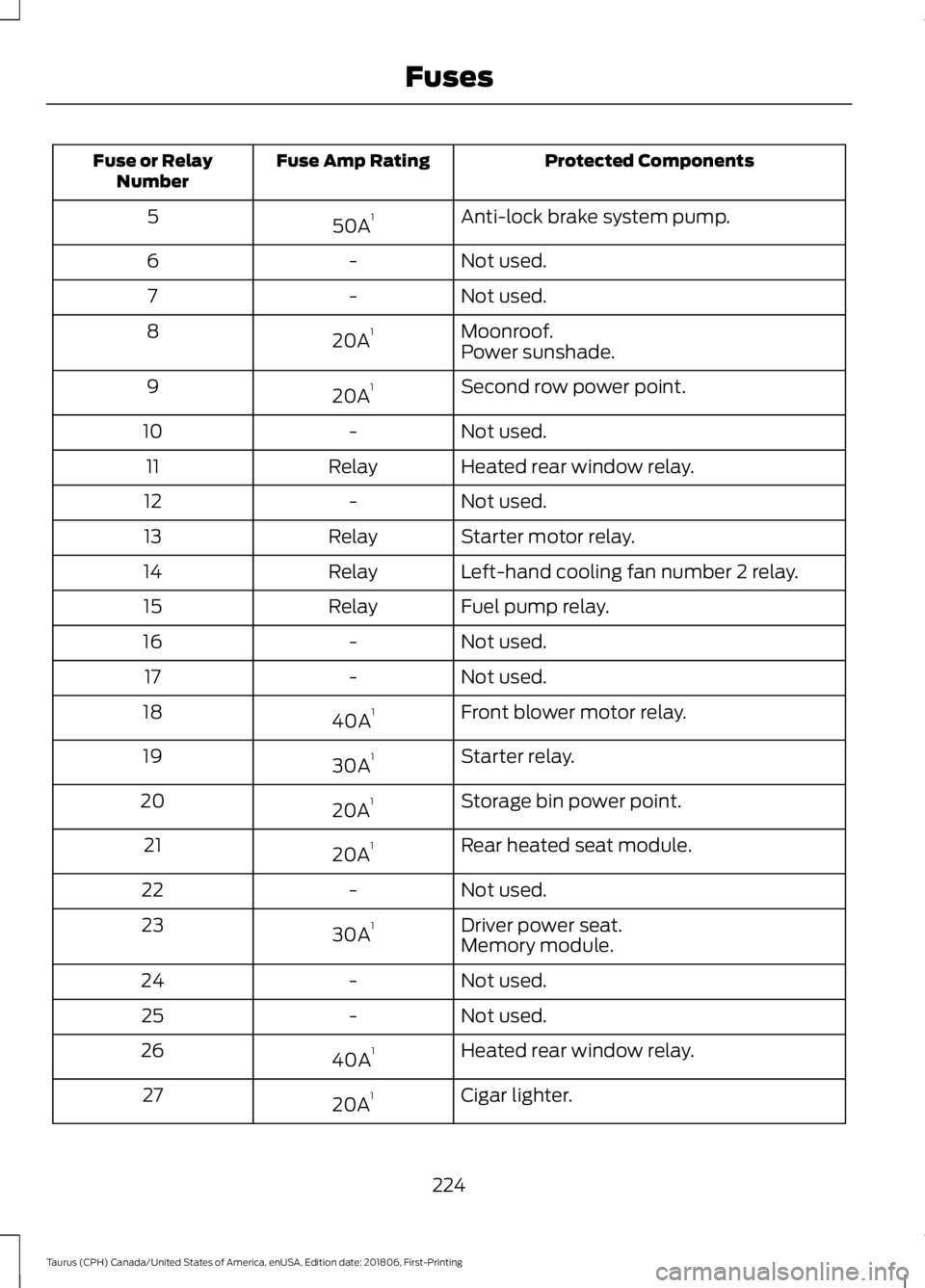
Protected Components
Fuse Amp Rating
Fuse or Relay
Number
Anti-lock brake system pump.
50A 1
5
Not used.
-
6
Not used.
-
7
Moonroof.
20A 1
8
Power sunshade.
Second row power point.
20A 1
9
Not used.
-
10
Heated rear window relay.
Relay
11
Not used.
-
12
Starter motor relay.
Relay
13
Left-hand cooling fan number 2 relay.
Relay
14
Fuel pump relay.
Relay
15
Not used.
-
16
Not used.
-
17
Front blower motor relay.
40A 1
18
Starter relay.
30A 1
19
Storage bin power point.
20A 1
20
Rear heated seat module.
20A 1
21
Not used.
-
22
Driver power seat.
30A 1
23
Memory module.
Not used.
-
24
Not used.
-
25
Heated rear window relay.
40A 1
26
Cigar lighter.
20A 1
27
224
Taurus (CPH) Canada/United States of America, enUSA, Edition date: 201806, First-Printing Fuses
Page 228 of 515
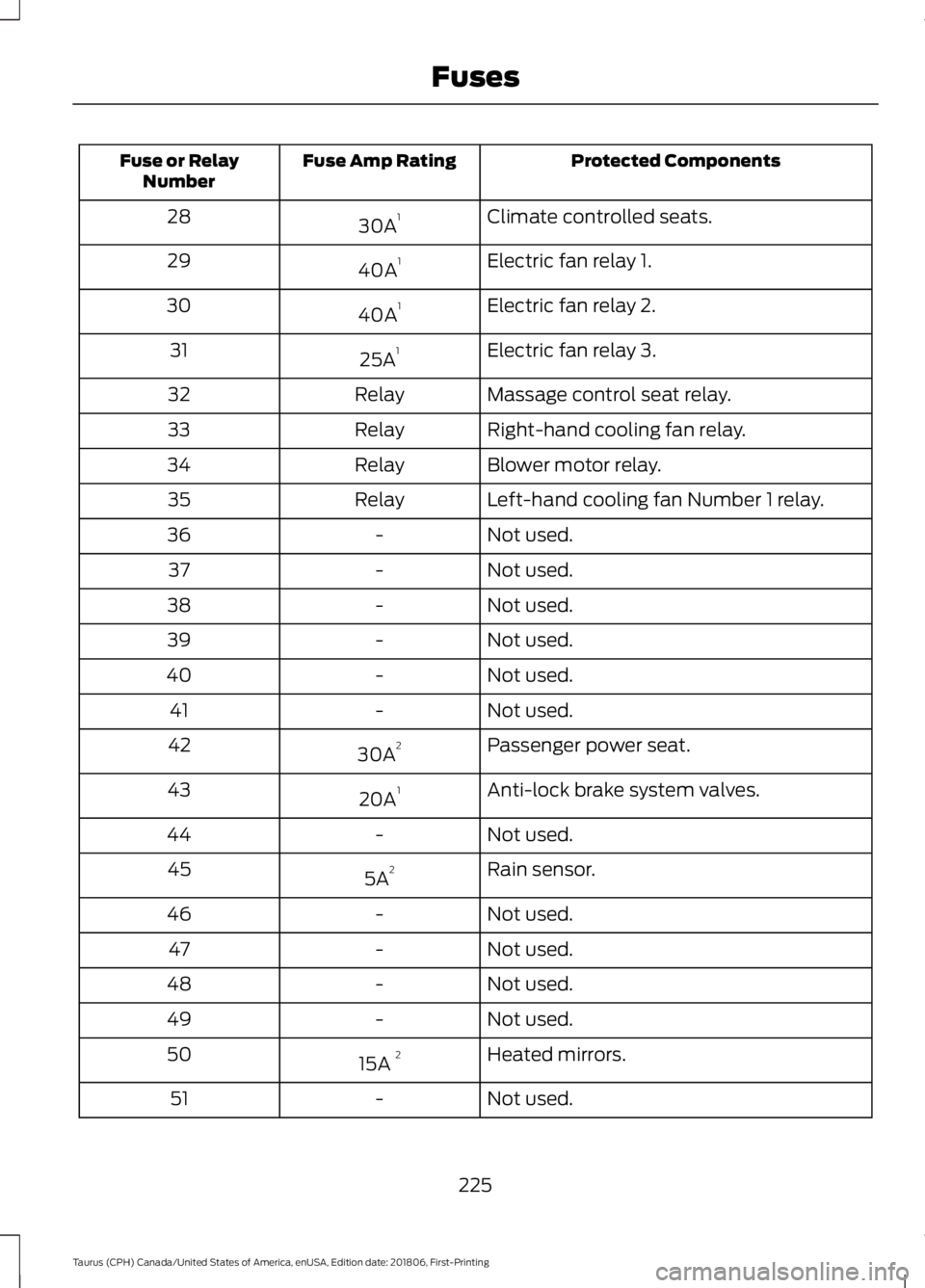
Protected Components
Fuse Amp Rating
Fuse or Relay
Number
Climate controlled seats.
30A 1
28
Electric fan relay 1.
40A 1
29
Electric fan relay 2.
40A 1
30
Electric fan relay 3.
25A 1
31
Massage control seat relay.
Relay
32
Right-hand cooling fan relay.
Relay
33
Blower motor relay.
Relay
34
Left-hand cooling fan Number 1 relay.
Relay
35
Not used.
-
36
Not used.
-
37
Not used.
-
38
Not used.
-
39
Not used.
-
40
Not used.
-
41
Passenger power seat.
30A 2
42
Anti-lock brake system valves.
20A 1
43
Not used.
-
44
Rain sensor.
5A 2
45
Not used.
-
46
Not used.
-
47
Not used.
-
48
Not used.
-
49
Heated mirrors.
15A 2
50
Not used.
-
51
225
Taurus (CPH) Canada/United States of America, enUSA, Edition date: 201806, First-Printing Fuses
Page 229 of 515
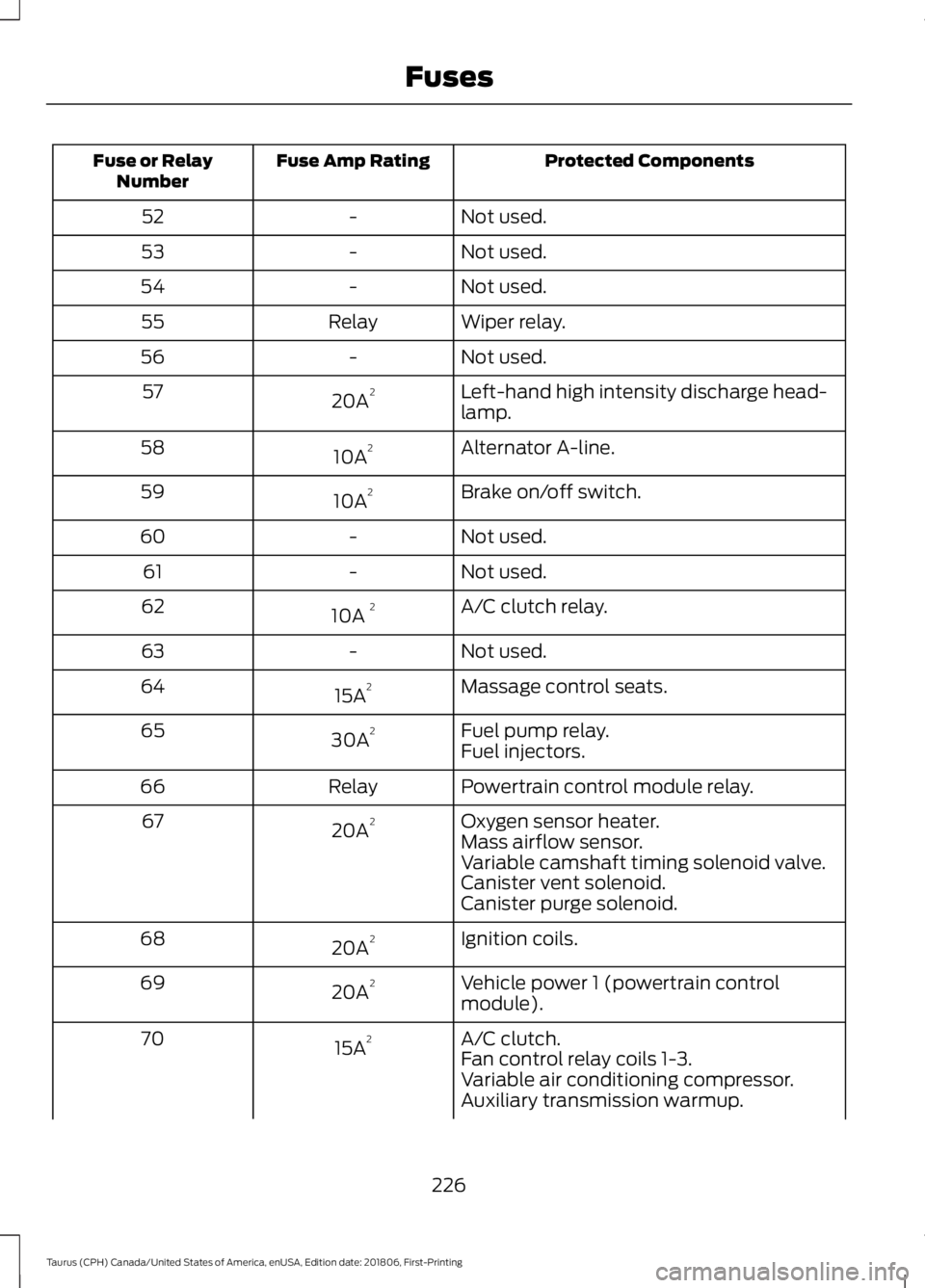
Protected Components
Fuse Amp Rating
Fuse or Relay
Number
Not used.
-
52
Not used.
-
53
Not used.
-
54
Wiper relay.
Relay
55
Not used.
-
56
Left-hand high intensity discharge head-
lamp.
20A 2
57
Alternator A-line.
10A 2
58
Brake on/off switch.
10A 2
59
Not used.
-
60
Not used.
-
61
A/C clutch relay.
10A 2
62
Not used.
-
63
Massage control seats.
15A 2
64
Fuel pump relay.
30A 2
65
Fuel injectors.
Powertrain control module relay.
Relay
66
Oxygen sensor heater.
20A 2
67
Mass airflow sensor.
Variable camshaft timing solenoid valve.
Canister vent solenoid.
Canister purge solenoid.
Ignition coils.
20A 2
68
Vehicle power 1 (powertrain control
module).
20A 2
69
A/C clutch.
15A 2
70
Fan control relay coils 1-3.
Variable air conditioning compressor.
Auxiliary transmission warmup.
226
Taurus (CPH) Canada/United States of America, enUSA, Edition date: 201806, First-Printing Fuses
Page 231 of 515
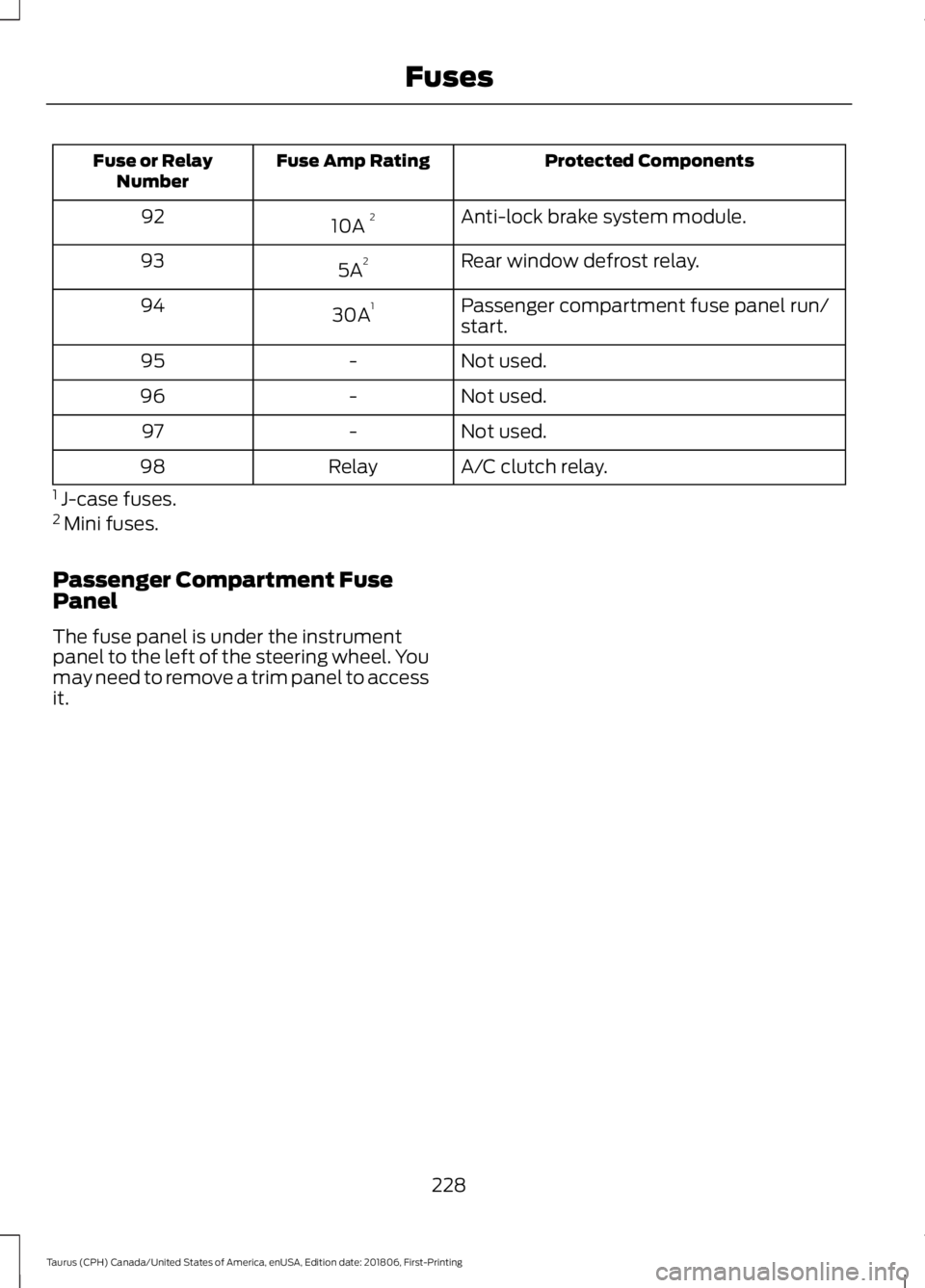
Protected Components
Fuse Amp Rating
Fuse or Relay
Number
Anti-lock brake system module.
10A 2
92
Rear window defrost relay.
5A 2
93
Passenger compartment fuse panel run/
start.
30A 1
94
Not used.
-
95
Not used.
-
96
Not used.
-
97
A/C clutch relay.
Relay
98
1 J-case fuses.
2 Mini fuses.
Passenger Compartment Fuse
Panel
The fuse panel is under the instrument
panel to the left of the steering wheel. You
may need to remove a trim panel to access
it.
228
Taurus (CPH) Canada/United States of America, enUSA, Edition date: 201806, First-Printing Fuses
Page 233 of 515
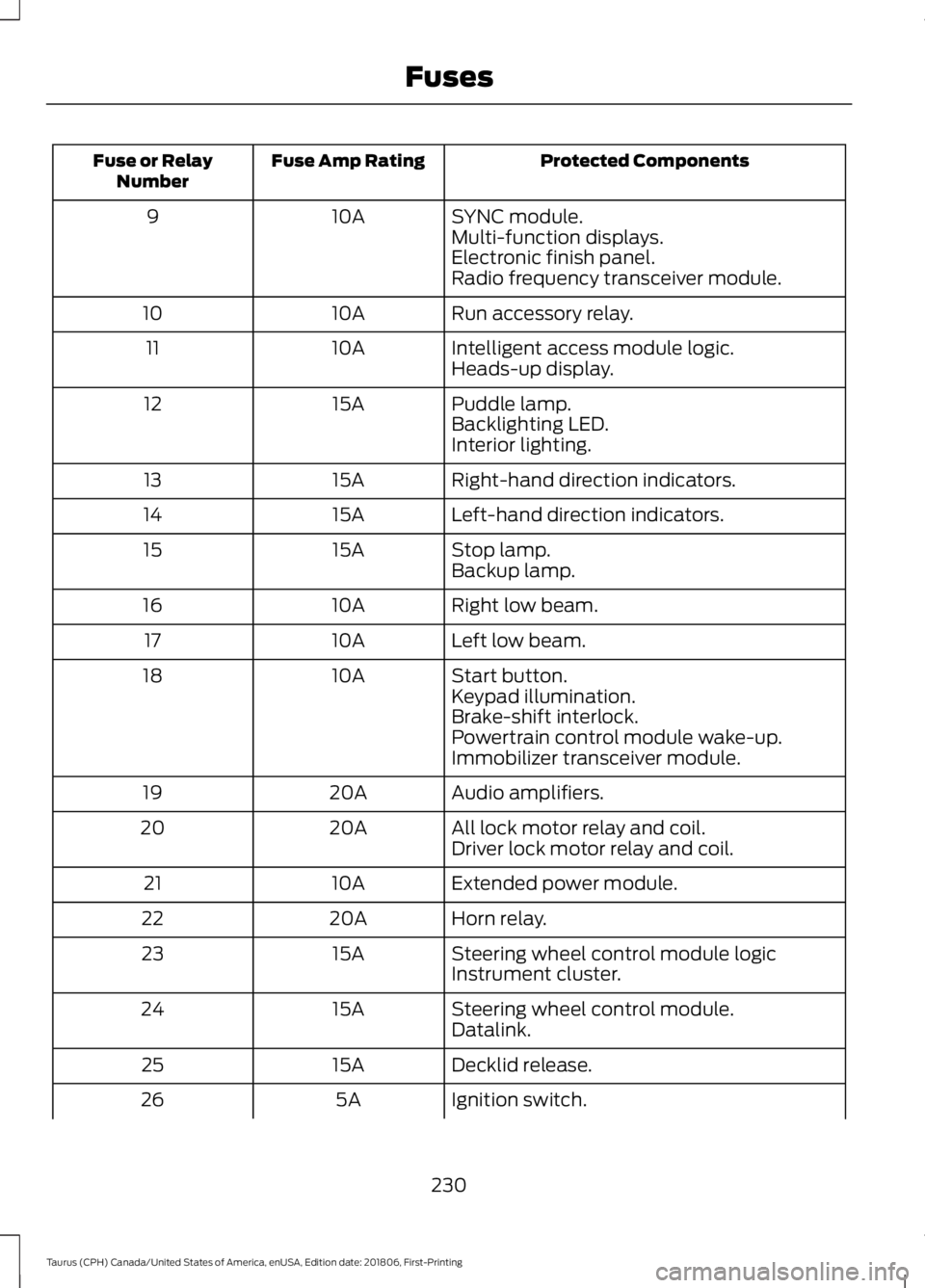
Protected Components
Fuse Amp Rating
Fuse or Relay
Number
SYNC module.
10A
9
Multi-function displays.
Electronic finish panel.
Radio frequency transceiver module.
Run accessory relay.
10A
10
Intelligent access module logic.
10A
11
Heads-up display.
Puddle lamp.
15A
12
Backlighting LED.
Interior lighting.
Right-hand direction indicators.
15A
13
Left-hand direction indicators.
15A
14
Stop lamp.
15A
15
Backup lamp.
Right low beam.
10A
16
Left low beam.
10A
17
Start button.
10A
18
Keypad illumination.
Brake-shift interlock.
Powertrain control module wake-up.
Immobilizer transceiver module.
Audio amplifiers.
20A
19
All lock motor relay and coil.
20A
20
Driver lock motor relay and coil.
Extended power module.
10A
21
Horn relay.
20A
22
Steering wheel control module logic
15A
23
Instrument cluster.
Steering wheel control module.
15A
24
Datalink.
Decklid release.
15A
25
Ignition switch.
5A
26
230
Taurus (CPH) Canada/United States of America, enUSA, Edition date: 201806, First-Printing Fuses
Page 237 of 515
GENERAL INFORMATION
Have your vehicle serviced regularly to help
maintain its roadworthiness and resale
value. There is a large network of
authorized dealers that are there to help
you with their professional servicing
expertise. We believe that their specially
trained technicians are best qualified to
service your vehicle properly and expertly.
They are supported by a wide range of
highly specialized tools developed
specifically for servicing your vehicle.
If your vehicle requires professional service,
an authorized dealer can provide the
necessary parts and service. Check your
warranty information to find out which
parts and services are covered.
Use only recommended fuels, lubricants,
fluids and service parts conforming to
specifications. Motorcraft® parts are
designed and built to provide the best
performance in your vehicle.
Precautions
•
Do not work on a hot engine.
• Make sure that nothing gets caught in
moving parts.
• Do not work on a vehicle with the
engine running in an enclosed space,
unless you are sure you have enough
ventilation.
• Keep all open flames and other burning
material (such as cigarettes) away
from the battery and all fuel related
parts.
Working with the Engine Off
1. Set the parking brake and shift the transmission to park (P).
2. Switch off the engine.
3. Block the wheels. Working with the Engine On WARNING: To reduce the risk of
vehicle damage and personal burn
injuries, do not start your engine with the
air cleaner removed and do not remove
it while the engine is running.
1. Set the parking brake and shift the transmission to park (P).
2. Block the wheels.
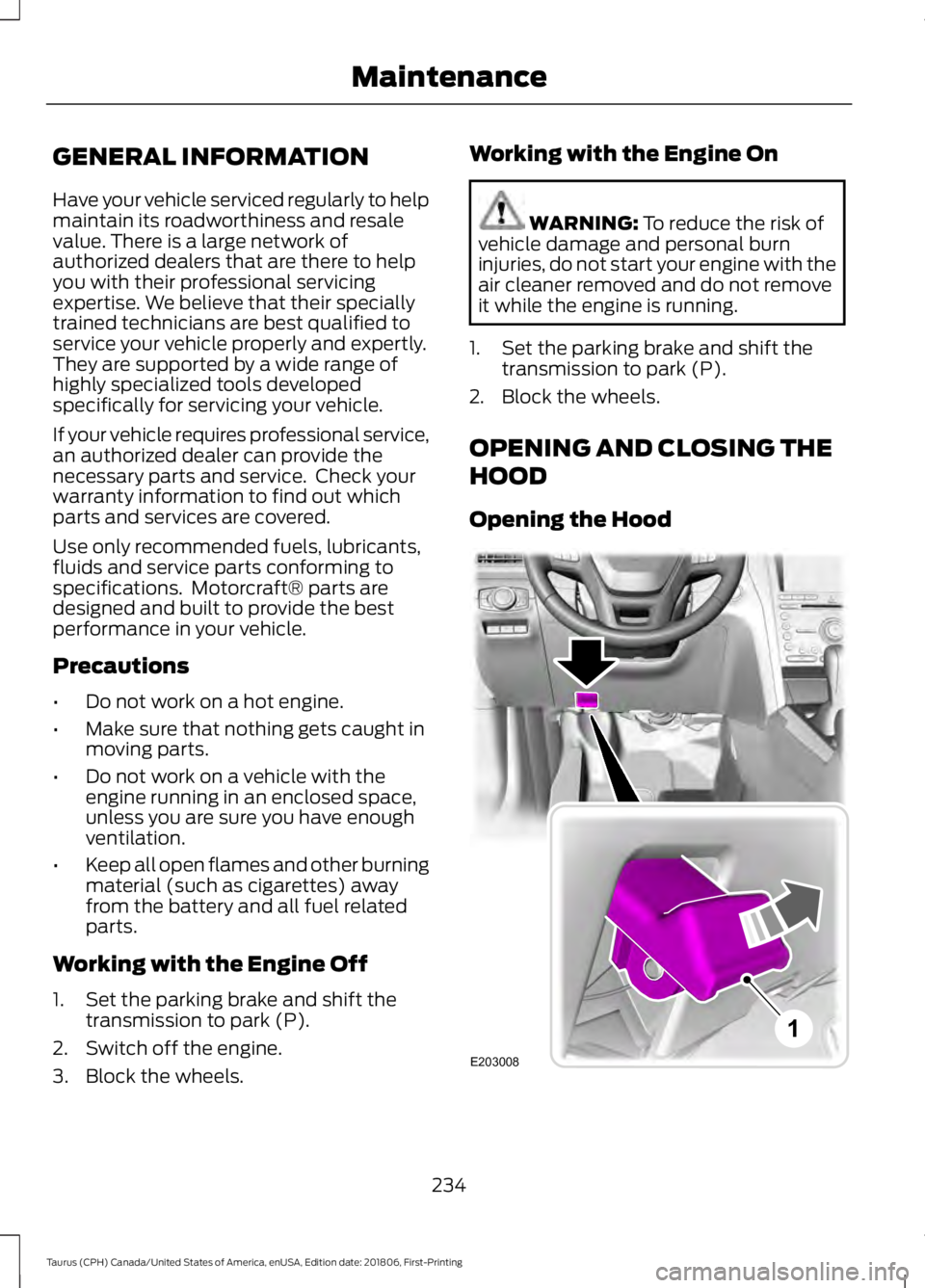
OPENING AND CLOSING THE
HOOD
Opening the Hood 234
Taurus (CPH) Canada/United States of America, enUSA, Edition date: 201806, First-Printing MaintenanceE203008
1
Page 239 of 515
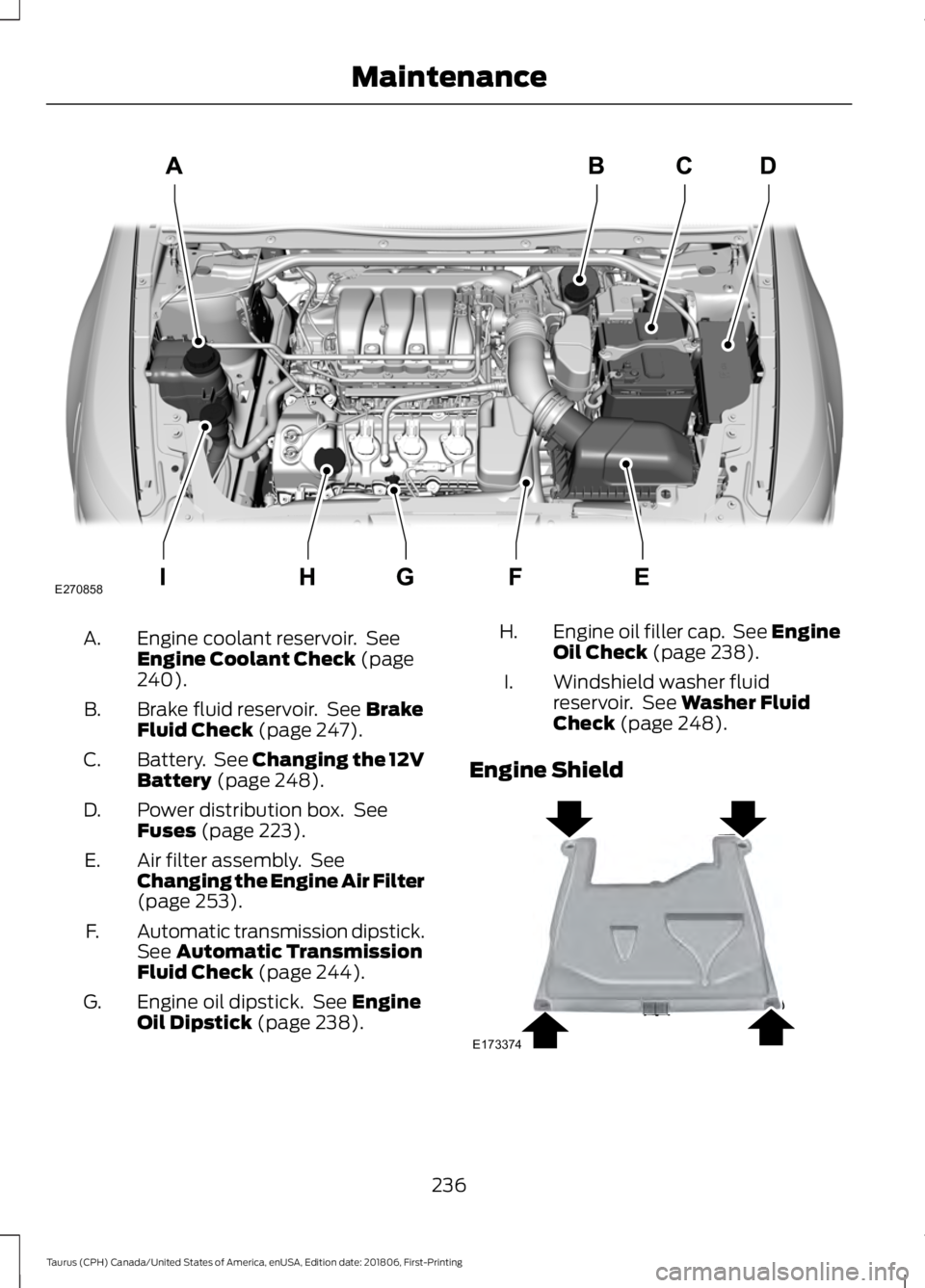
Engine coolant reservoir. See
Engine Coolant Check (page
240).
A.
Brake fluid reservoir. See
Brake
Fluid Check (page 247).
B.
Battery. See
Changing the 12V
Battery (page 248).
C.
Power distribution box. See
Fuses
(page 223).
D.
Air filter assembly. See
Changing the Engine Air Filter
(page
253).
E.
Automatic transmission dipstick.
See
Automatic Transmission
Fluid Check (page 244).
F.
Engine oil dipstick. See
Engine
Oil Dipstick (page 238).
G. Engine oil filler cap. See Engine
Oil Check
(page 238).
H.
Windshield washer fluid
reservoir. See
Washer Fluid
Check (page 248).
I.
Engine Shield 236
Taurus (CPH) Canada/United States of America, enUSA, Edition date: 201806, First-Printing MaintenanceE270858 E173374
Page 240 of 515
Some vehicles may be equipped with an
aero-shield under the engine. This shield
needs to be removed for service, including
oil and filter changes. The shield has four
quick-release fasteners to secure it in
place.
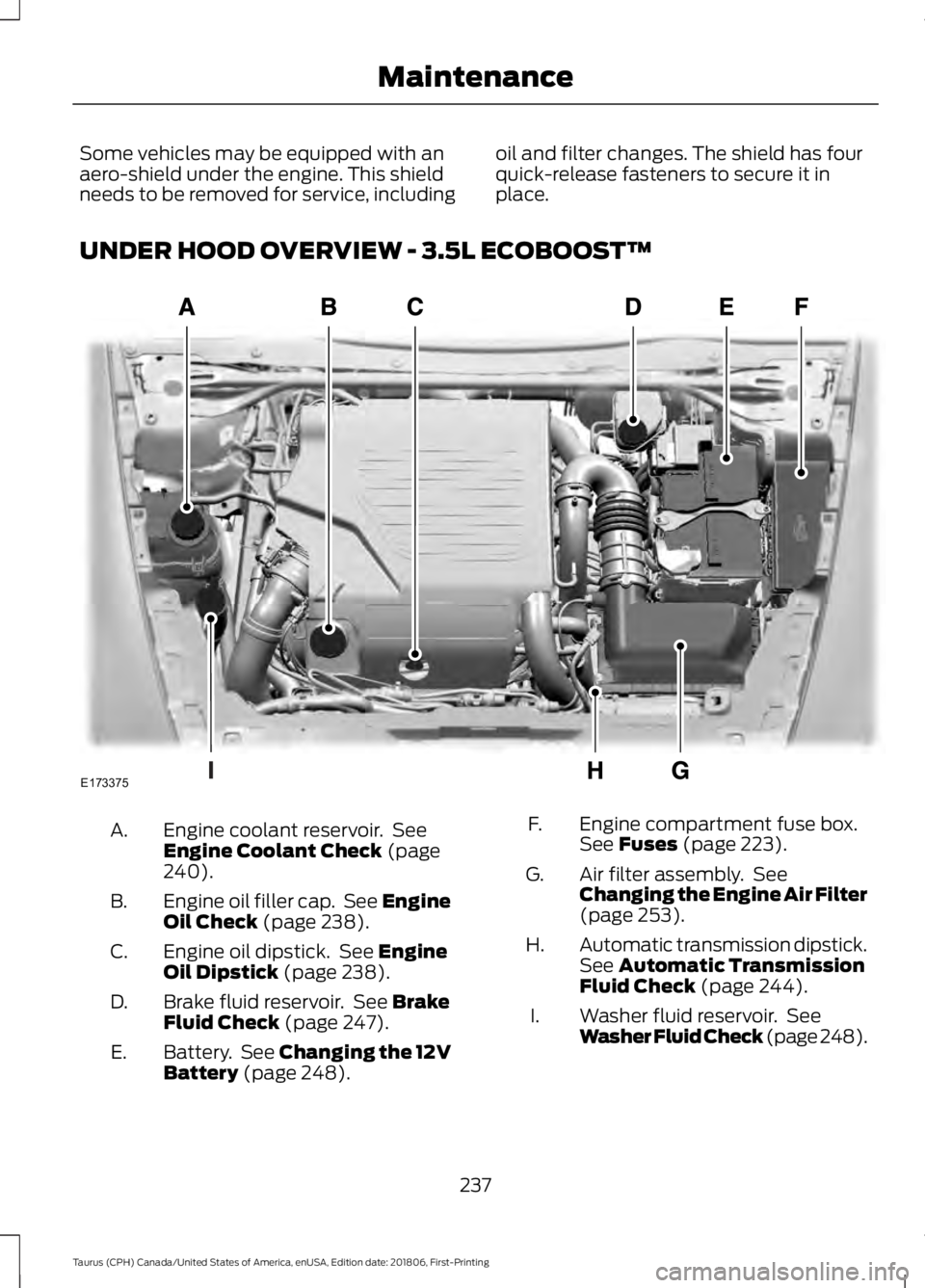
UNDER HOOD OVERVIEW - 3.5L ECOBOOST™ Engine coolant reservoir. See
Engine Coolant Check (page
240).
A.
Engine oil filler cap. See Engine
Oil Check
(page 238).
B.
Engine oil dipstick. See
Engine
Oil Dipstick (page 238).
C.
Brake fluid reservoir. See
Brake
Fluid Check (page 247).
D.
Battery. See
Changing the 12V
Battery (page 248).
E. Engine compartment fuse box.
See
Fuses (page 223).
F.
Air filter assembly. See
Changing the Engine Air Filter
(page
253).
G.
Automatic transmission dipstick.
See
Automatic Transmission
Fluid Check (page 244).
H.
Washer fluid reservoir. See
Washer Fluid Check
(page 248).
I.
237
Taurus (CPH) Canada/United States of America, enUSA, Edition date: 201806, First-Printing MaintenanceE173375
Page 241 of 515
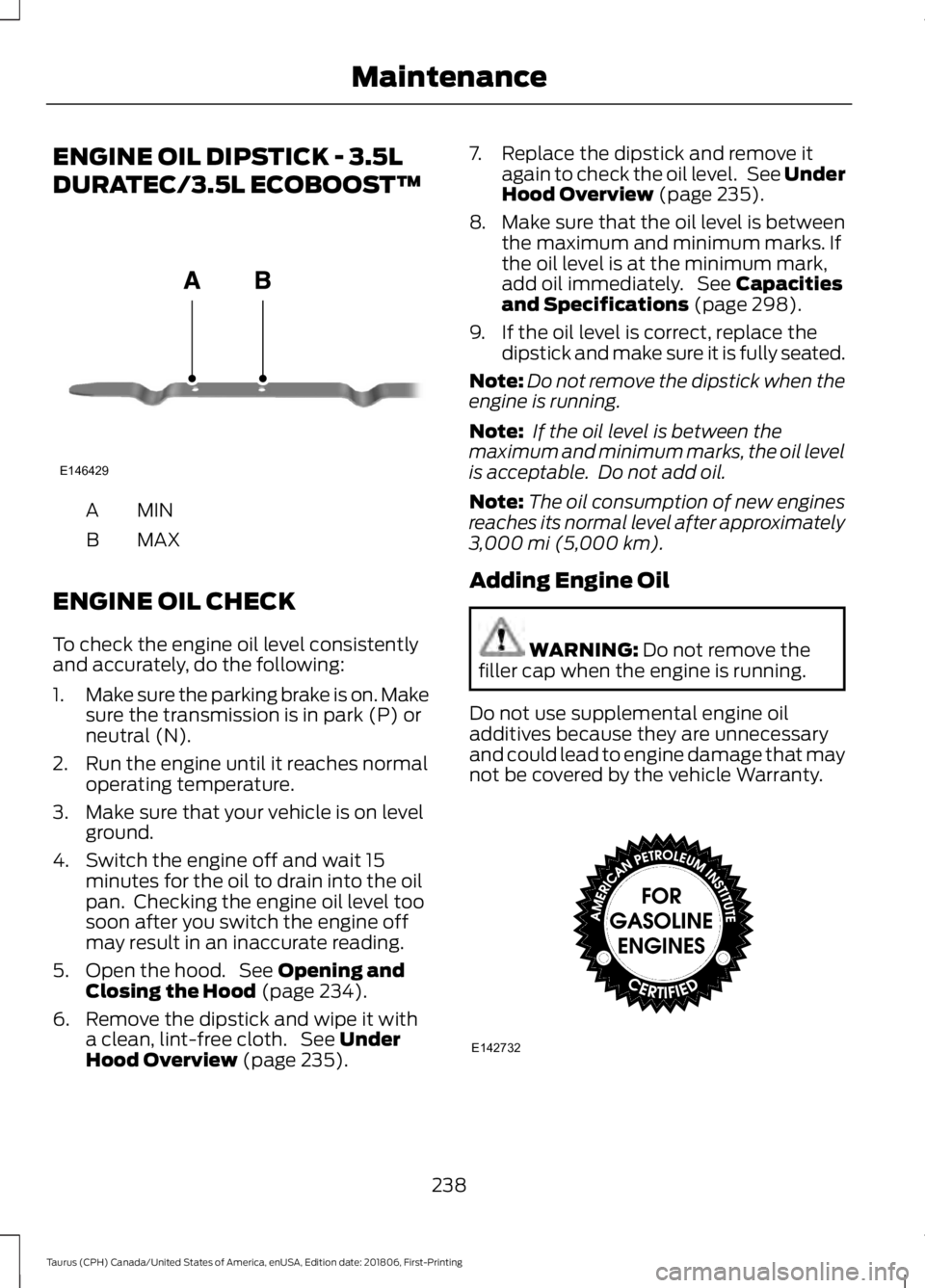
ENGINE OIL DIPSTICK - 3.5L
DURATEC/3.5L ECOBOOST™
MINA
MAX
B
ENGINE OIL CHECK
To check the engine oil level consistently
and accurately, do the following:
1. Make sure the parking brake is on. Make
sure the transmission is in park (P) or
neutral (N).
2. Run the engine until it reaches normal operating temperature.
3. Make sure that your vehicle is on level ground.
4. Switch the engine off and wait 15 minutes for the oil to drain into the oil
pan. Checking the engine oil level too
soon after you switch the engine off
may result in an inaccurate reading.
5. Open the hood. See Opening and
Closing the Hood (page 234).
6. Remove the dipstick and wipe it with a clean, lint-free cloth. See
Under
Hood Overview (page 235). 7. Replace the dipstick and remove it
again to check the oil level. See Under
Hood Overview
(page 235).
8. Make sure that the oil level is between
the maximum and minimum marks. If
the oil level is at the minimum mark,
add oil immediately. See
Capacities
and Specifications (page 298).
9. If the oil level is correct, replace the dipstick and make sure it is fully seated.
Note: Do not remove the dipstick when the
engine is running.
Note: If the oil level is between the
maximum and minimum marks, the oil level
is acceptable. Do not add oil.
Note: The oil consumption of new engines
reaches its normal level after approximately
3,000 mi (5,000 km)
.
Adding Engine Oil WARNING:
Do not remove the
filler cap when the engine is running.
Do not use supplemental engine oil
additives because they are unnecessary
and could lead to engine damage that may
not be covered by the vehicle Warranty. 238
Taurus (CPH) Canada/United States of America, enUSA, Edition date: 201806, First-Printing MaintenanceE146429 E142732
Page 246 of 515
When Fail-Safe Mode Is Activated
WARNING: Fail-safe mode is for
use during emergencies only. Operate
your vehicle in fail-safe mode only as
long as necessary to bring your vehicle
to rest in a safe location and seek
immediate repairs. When in fail-safe
mode, your vehicle will have limited
power, will not be able to maintain
high-speed operation, and may
completely shut down without warning,
potentially losing engine power, power
steering assist, and power brake assist,
which may increase the possibility of a
crash resulting in serious injury. WARNING:
Do not remove the
coolant reservoir cap when the engine is
on or the cooling system is hot. Wait 10
minutes for the cooling system to cool
down. Cover the coolant reservoir cap
with a thick cloth to prevent the
possibility of scalding and slowly remove
the cap. Failure to follow this instruction
could result in personal injury.
Your vehicle has limited engine power
when in the fail-safe mode, drive your
vehicle with caution. Your vehicle does not
maintain high-speed operation and the
engine may operate poorly.
Remember that the engine is capable of
automatically shutting down to prevent
engine damage. In this situation:
1. Pull off the road as soon as safely possible and switch the engine off.
2. If you are a member of a roadside assistance program, we recommend
that you contact your roadside
assistance service provider.
3. If this is not possible, wait for a short period of time for the engine to cool. 4. Check the coolant level. If the coolant
level is at or below the minimum mark,
add prediluted coolant immediately.
5. When the engine temperature cools, you can re-start the engine. Have your
vehicle checked as soon as possible to
minimize engine damage.
Note: Driving your vehicle without repair
increases the chance of engine damage.
Engine Coolant Temperature
Management
(If Equipped) WARNING:
To reduce the risk of
crash and injury, be prepared that the
vehicle speed may reduce and the
vehicle may not be able to accelerate
with full power until the coolant
temperature reduces.
If you tow a trailer with your vehicle, the
engine may temporarily reach a higher
temperature during severe operating
conditions, for example ascending a long
or steep grade in high ambient
temperatures.
At this time, you may notice the coolant
temperature gauge moves toward the red
zone and a message may appear in the
information display.
You may notice a reduction in vehicle
speed caused by reduced engine power in
order to manage the engine coolant
temperature. Your vehicle may enter this
mode if certain high-temperature and
high-load conditions take place. The
amount of speed reduction depends on
vehicle loading, grade and ambient
temperature. If this occurs, there is no
need to stop your vehicle. You can
continue to drive.
243
Taurus (CPH) Canada/United States of America, enUSA, Edition date: 201806, First-Printing Maintenance