air condition FORD THUNDERBIRD 2002 11.G Owner's Manual
[x] Cancel search | Manufacturer: FORD, Model Year: 2002, Model line: THUNDERBIRD, Model: FORD THUNDERBIRD 2002 11.GPages: 248, PDF Size: 2.1 MB
Page 207 of 248
![FORD THUNDERBIRD 2002 11.G Owners Manual Severe climates
If you drive in extremely cold climates (less than ±36É C [±34É F]), it
may be necessary to increase the coolant concentration above 50%.
Refer to the chart on the coolant containe](/img/11/5384/w960_5384-206.png "FORD THUNDERBIRD 2002 11.G Owners Manual Severe climates
If you drive in extremely cold climates (less than ±36É C [±34É F]), it
may be necessary to increase the coolant concentration above 50%.
Refer to the chart on the coolant containe")
Severe climates
If you drive in extremely cold climates (less than ±36É C [±34É F]), it
may be necessary to increase the coolant concentration above 50%.
Refer to the chart on the coolant container to ensure the coolant
concentration in your vehicle will provide adequate freeze protection.
Never increase the engine coolant concentration above 60%
(protection to ±60ÉF). At a level over 60%, your engine could overheat
and become damaged.
If you drive in extremely hot climates, it is still necessary to maintain the
coolant concentration at 50/50 coolant and water.Do not allow the
coolant concentration to fall below 40% coolant.At a concentration
less than 40%, the corrosion protection to your engine and cooling
components may be compromised and permanent damage may result.
What you should know about fail-safe cooling
If the engine coolant supply is depleted, this feature allows the vehicle to
be driven temporarily before incremental component damage is incurred.
The ªfail-safeº distance depends on ambient temperatures, vehicle load
and terrain.
How fail-safe cooling works
If the engine begins to overheat:
²The engine coolant temperature
gauge will move to the H (hot)
area.
²The
symbol will
illuminate.
²The
symbol will illuminate.
²The
symbol will illuminate.
If the engine reaches a preset over-temperature condition, the engine
will automatically switch to alternating cylinder operation. Each disabled
cylinder acts as an air pump and cools the engine.
When this occurs the vehicle will still operate. However:
²The engine power will be limited.
²The air conditioning system will be disabled.
Continued operation will increase the engine temperature and the engine
will completely shut down, causing steering and braking effort to increase.
H
C
Maintenance and specifications
207
Page 212 of 248
If you must replace the fuel filler cap, replace it with a fuel filler
cap that is designed for your vehicle. The customer warranty may
be void for any damage to the fuel tank or fuel system if the
correct genuine Ford or Motorcraft fuel filler cap is not used.
The fuel system may be under pressure. If the fuel filler cap is
venting vapor or if you hear a hissing sound, wait until it stops
before completely removing the fuel filler cap. Otherwise, fuel may
spray out and injure you or others.
If you do not use the proper fuel filler cap, excessive pressure or
vacuum in the fuel tank may damage the fuel system or cause
the fuel cap to disengage in a collision, which may result in possible
personal injury.
Choosing the right fuel
Use only UNLEADED FUEL. The use of leaded fuel is prohibited by law
and could damage your vehicle.
Do not use fuel containing methanol. It can damage critical fuel system
components.
Your vehicle was not designed to use fuel or fuel additives with metallic
compounds, including manganese-based compounds containing MMT.
Repairs to correct the effects of using a fuel for which your vehicle was
not designed may not be covered by your warranty.
Octane recommendations
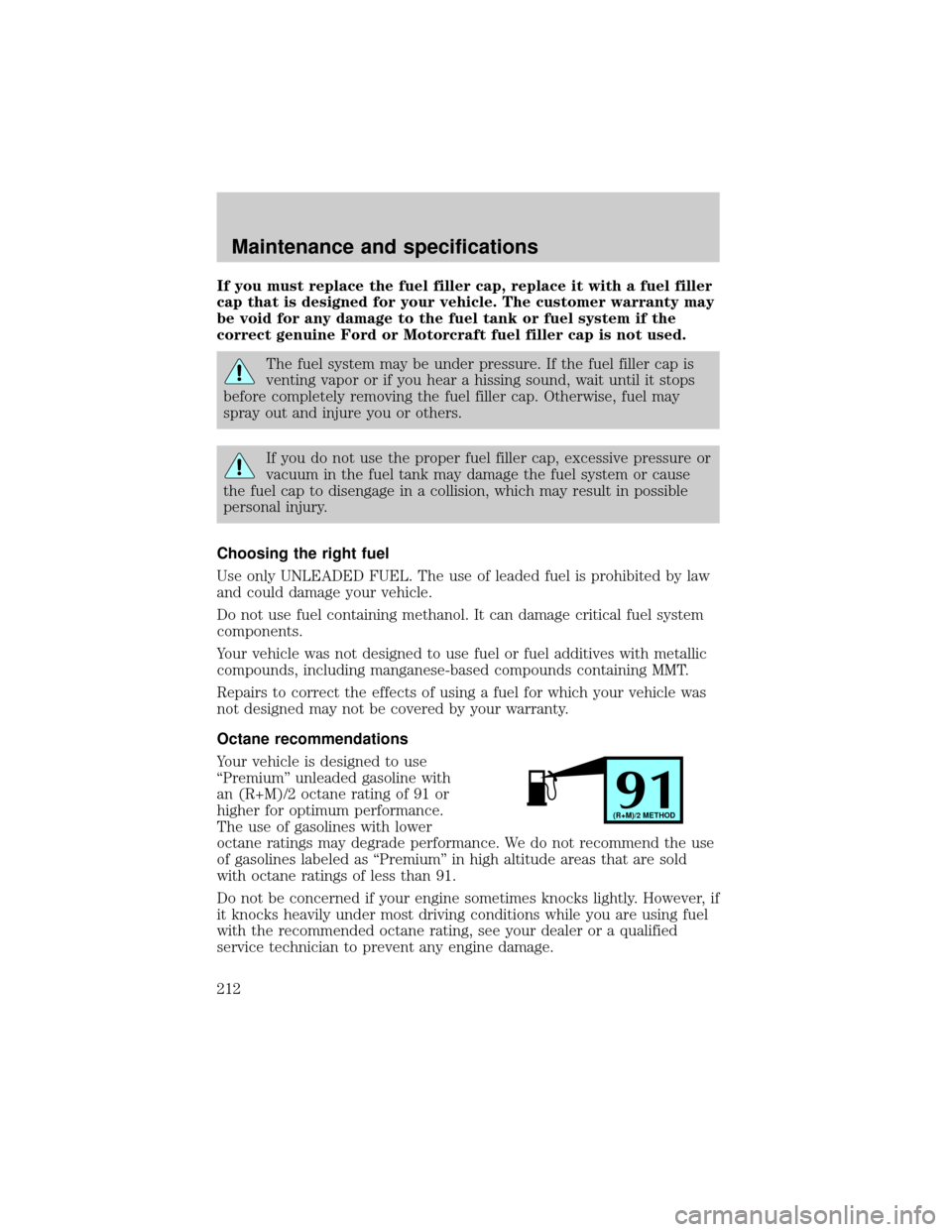
Your vehicle is designed to use
ªPremiumº unleaded gasoline with
an (R+M)/2 octane rating of 91 or
higher for optimum performance.
The use of gasolines with lower
octane ratings may degrade performance. We do not recommend the use
of gasolines labeled as ªPremiumº in high altitude areas that are sold
with octane ratings of less than 91.
Do not be concerned if your engine sometimes knocks lightly. However, if
it knocks heavily under most driving conditions while you are using fuel
with the recommended octane rating, see your dealer or a qualified
service technician to prevent any engine damage.
91(R+M)/2 METHOD
Maintenance and specifications
212
Page 216 of 248

²Idling for long periods of time (greater than one minute) may waste
fuel.
²Anticipate stopping; slowing down may eliminate the need to stop.
²Sudden or hard accelerations may reduce fuel economy.
²Slow down gradually.
²Driving at reasonable speeds (traveling at 88 km/h [55 mph] uses 15%
less fuel than traveling at 105 km/h [65 mph]).
²Revving the engine before turning it off may reduce fuel economy.
²Using the air conditioner or defroster may reduce fuel economy.
²You may want to turn off the speed control in hilly terrain if
unnecessary shifting between fourth and fifth gear occurs.
Unnecessary shifting of this type could result in reduced fuel
economy.
²Warming up a vehicle on cold mornings is not required and may
reduce fuel economy.
²Resting your foot on the brake pedal while driving may reduce fuel
economy.
²Combine errands and minimize stop-and-go driving.
Maintenance
²Keep tires properly inflated and use only recommended size.
²Operating a vehicle with the wheels out of alignment will reduce fuel
economy.
²Use recommended engine oil. Refer toLubricant specificationsin
this chapter.
²Perform all regularly scheduled maintenance items. Follow the
recommended maintenance schedule and owner maintenance checks
found in your vehicle scheduled maintenance guide.
Conditions
²Heavily loading a vehicle or towing a trailer may reduce fuel economy
at any speed.
²Carrying unnecessary weight may reduce fuel economy (approximately
0.4 km/L [1 mpg] is lost for every 180 kg [400 lb] of weight carried).
Maintenance and specifications
216
Page 227 of 248
Failure to follow these precautions may adversely affect the
handling of the vehicle and make it easier for the driver to lose
control and roll over.
Tires that are larger or smaller than your vehicle's original tires may also
affect the accuracy of your speedometer.
SNOW TIRES AND CHAINS
Driving too fast for conditions creates the possibility of loss of
vehicle control. Driving at very high speeds for extended periods
of time may result in damage to vehicle components.
Snow tires must be the same size and grade as the tires you
currently have on your vehicle.
The tires on your vehicle have all-weather treads that provide traction in
rain or snow.
The use of snow cables is not recommended for this vehicle, as damage
to your vehicle may occur under extreme handling or rough road
conditions. However, if you choose to operate the vehicle with snow
cables, avoid these conditions and follow the manufacturer's
recommendations.
Do not use any type of tire chains, as this will likely cause damage to
your vehicle.
MOTORCRAFT PART NUMBERS
Component 3.9L-4V V8 engine
Air filter element FA-1679
Fuel filter FG-986
Battery BXT-66-650
Oil filter FL-2008
PCV valve N/A
Spark plugs* AGSP-32F
* Refer to Vehicle Emissions Control Information (VECI) decal for spark
plug information.
Maintenance and specifications
227
Page 237 of 248

A
Accessory delay ..........................64
Air bag supplemental restraint
system ................................109, 119
and child safety seats ............110
description ......................109, 119
disposal ....................................122
driver air bag ..................111, 120
indicator light ...........12, 113, 121
operation .........................111, 120
passenger air bag ...........111, 120
passenger deactivation
switch ......................................114
side air bag ..............................119
Air cleaner filter .......221±222, 227
Air conditioning ..........................35
Air filter, cabin ............................48
Antifreeze
(see Engine coolant) ................202
Anti-lock brake system
(see Brakes) ......................136±137
Anti-theft system ........................94
arming the system ....................94
disarming a triggered system ..94
Automatic transmission
driving an automatic
overdrive .................................141
fluid, adding ............................221
fluid, checking ........................221
fluid, refill capacities ..............228
fluid, specification ..................231
Auxiliary power point .................63
Axle
lubricant specifications ..229, 231
refill capacities ........................228B
Battery .......................................200
acid, treating emergencies .....200
charging system warning
light ............................................13
jumping a disabled battery ....169
maintenance-free ....................200
replacement, specifications ...227
servicing ..................................200
Belt minder ...............................104
Brakes ........................................136
anti-lock ...........................136±137
anti-lock brake system
(ABS) warning light .........12, 137
brake warning light ..................12
fluid, checking and adding ....220
fluid, refill capacities ..............228
fluid, specifications .........229, 231
lubricant specifications ..229, 231
parking ....................................138
shift interlock ..........................140
Break-in period .............................6
C
Capacities for refilling fluids ....228
Cassette tape player ...................19
Certification Label ....................233
Child safety restraints ..............122
child safety belts ....................122
Child safety seats ......................123
attaching with tether straps ..127
in front seat ............................125
in rear seat ..............................125
LATCH .....................................130
Cleaning your vehicle
engine compartment ..............188
exterior ....................................192
Index
237