parking brake FORD THUNDERBIRD 2004 11.G User Guide
[x] Cancel search | Manufacturer: FORD, Model Year: 2004, Model line: THUNDERBIRD, Model: FORD THUNDERBIRD 2004 11.GPages: 216, PDF Size: 5.69 MB
Page 137 of 216
When driving with the temporary spare tiredo not:
• exceed 80 km/h (50 mph)
• load the vehicle beyond maximum vehicle load rating listed on the
Safety Compliance Label
• tow a trailer
• use tire chains
• drive through an automatic car wash, because of the vehicle ’s reduced
ground clearance
• try to repair the temporary spare tire or remove it from its wheel
• drive for long distances when the temporary-use spare is on
• use the wheel for any other type of vehicle
• use more than one temporary spare tire at a time
Use of a temporary spare tire at any one wheel location can lead to
impairment of the following:
• Handling, stability and braking performance
• Comfort and noise
• Ground clearance and parking at curbs
• Winter driving capability
Tire change procedure
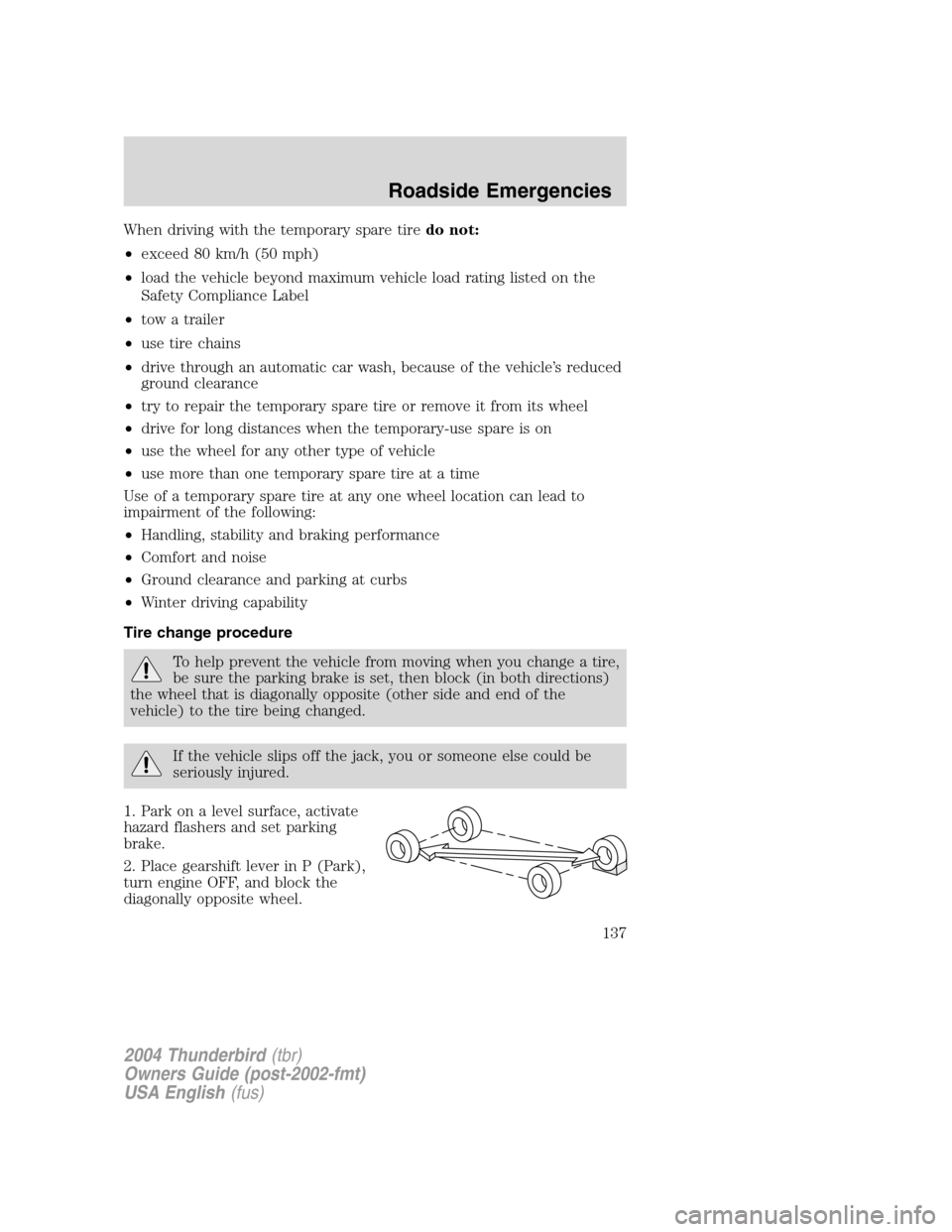
To help prevent the vehicle from moving when you change a tire,
be sure the parking brake is set, then block (in both directions)
the wheel that is diagonally opposite (other side and end of the
vehicle) to the tire being changed.
If the vehicle slips off the jack, you or someone else could be
seriously injured.
1. Park on a level surface, activate
hazard flashers and set parking
brake.
2. Place gearshift lever in P (Park),
turn engine OFF, and block the
diagonally opposite wheel.
2004 Thunderbird (tbr)
Owners Guide (post-2002-fmt)
USA English (fus)
Roadside Emergencies
137
Page 142 of 216
1.Use only a 12 –volt supply to start your vehicle.
2. Do not disconnect the battery of your disabled vehicle as this could
damage the vehicle ’s electrical system. Keep the battery vent hose
attached at all times.
3. Park the booster vehicle close to the trunk of your disabled vehicle
making sure the two vehicles do nottouch. Set the parking brake on
both vehicles and stay clear of the engine cooling fan and other moving
parts.
4. Check all battery terminals and remove any excessive corrosion before
you attach the battery cables. Ensure the vent caps are tight and level.
5. Turn the heater fan on in both vehicles to protect any electrical
surges. Turn all other accessories off.
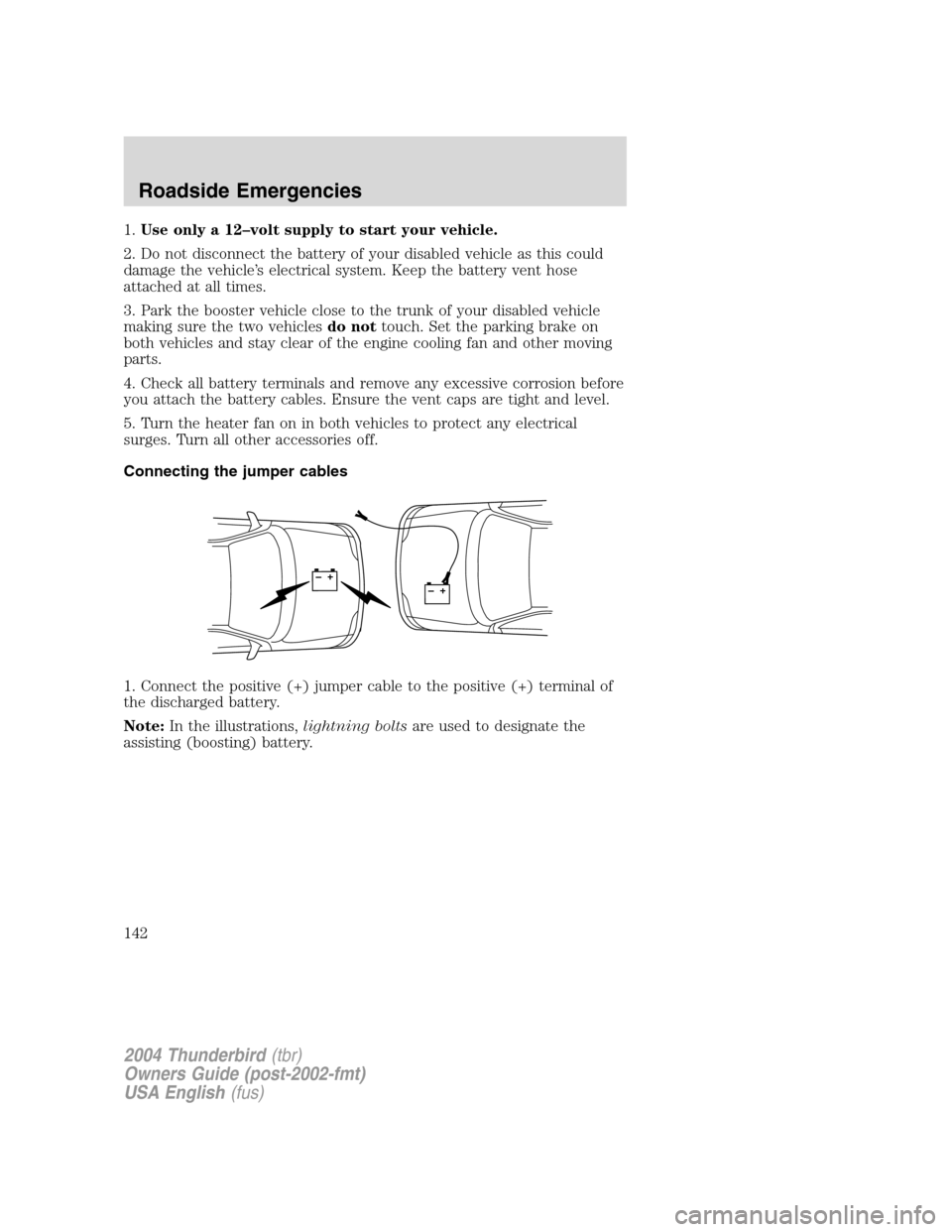
Connecting the jumper cables
1. Connect the positive (+) jumper cable to the positive (+) terminal of
the discharged battery.
Note: In the illustrations, lightning boltsare used to designate the
assisting (boosting) battery.
+–+–
2004 Thunderbird (tbr)
Owners Guide (post-2002-fmt)
USA English (fus)
Roadside Emergencies
142
Page 163 of 216
SERVICE RECOMMENDATIONS
To help you service your vehicle:
•We highlight do-it-yourself items in the engine compartment for easy
location.
• We provide a scheduled maintenance guide which makes tracking
routine service easy.
If your vehicle requires professional service, your dealership can provide
the necessary parts and service. Check your Warranty Guide/Owner
Information Guide to find out which parts and services are covered.
Use only recommended fuels, lubricants, fluids and service parts
conforming to specifications. Motorcraft parts are designed and built to
provide the best performance in your vehicle.
PRECAUTIONS WHEN SERVICING YOUR VEHICLE
• Do not work on a hot engine.
• Make sure that nothing gets caught in moving parts.
• Do not work on a vehicle with the engine running in an enclosed
space, unless you are sure you have enough ventilation.
• Keep all open flames and other burning (cigarettes) material away
from the battery and all fuel related parts.
Working with the engine off
1. Set the parking brake and ensure the gearshift is securely latched in P
(Park).
2. Turn off the engine and remove the key.
3. Block the wheels to prevent the vehicle from moving unexpectedly.
Working with the engine on
1. Set the parking brake and shift to P (Park).
2. Block the wheels.
Note: Do not start your engine with the air cleaner removed and do not
remove it while the engine is running.
2004 Thunderbird (tbr)
Owners Guide (post-2002-fmt)
USA English (fus)
Maintenance and Specifications
Maintenance and Specifications
163
Page 165 of 216
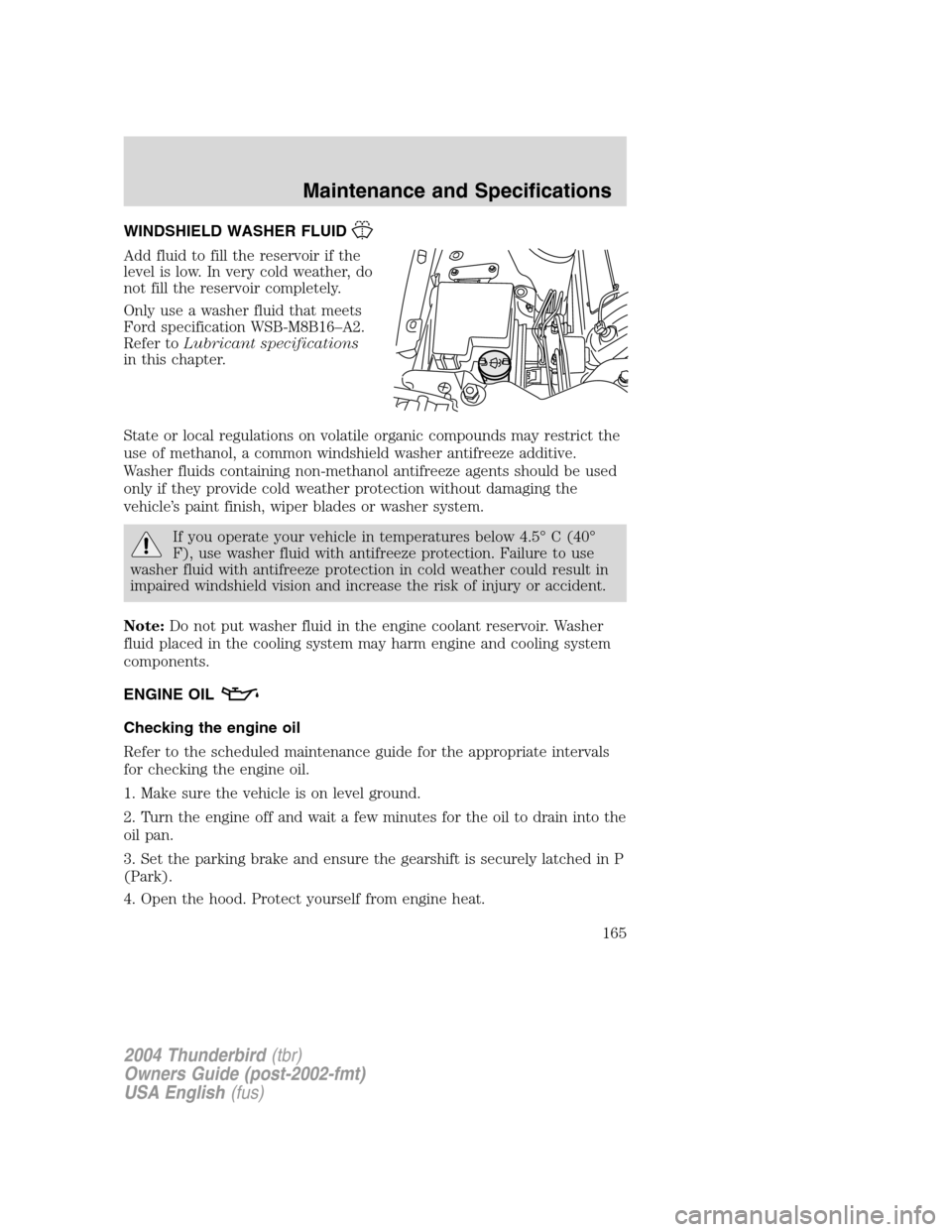
WINDSHIELD WASHER FLUID
Add fluid to fill the reservoir if the
level is low. In very cold weather, do
not fill the reservoir completely.
Only use a washer fluid that meets
Ford specification WSB-M8B16–A2.
Refer to Lubricant specifications
in this chapter.
State or local regulations on volatile organic compounds may restrict the
use of methanol, a common windshield washer antifreeze additive.
Washer fluids containing non-methanol antifreeze agents should be used
only if they provide cold weather protection without damaging the
vehicle ’s paint finish, wiper blades or washer system.
If you operate your vehicle in temperatures below 4.5 °C (40 °
F), use washer fluid with antifreeze protection. Failure to use
washer fluid with antifreeze protection in cold weather could result in
impaired windshield vision and increase the risk of injury or accident.
Note: Do not put washer fluid in the engine coolant reservoir. Washer
fluid placed in the cooling system may harm engine and cooling system
components.
ENGINE OIL
Checking the engine oil
Refer to the scheduled maintenance guide for the appropriate intervals
for checking the engine oil.
1. Make sure the vehicle is on level ground.
2. Turn the engine off and wait a few minutes for the oil to drain into the
oil pan.
3. Set the parking brake and ensure the gearshift is securely latched in P
(Park).
4. Open the hood. Protect yourself from engine heat.
2004 Thunderbird (tbr)
Owners Guide (post-2002-fmt)
USA English (fus)
Maintenance and Specifications
165
Page 169 of 216
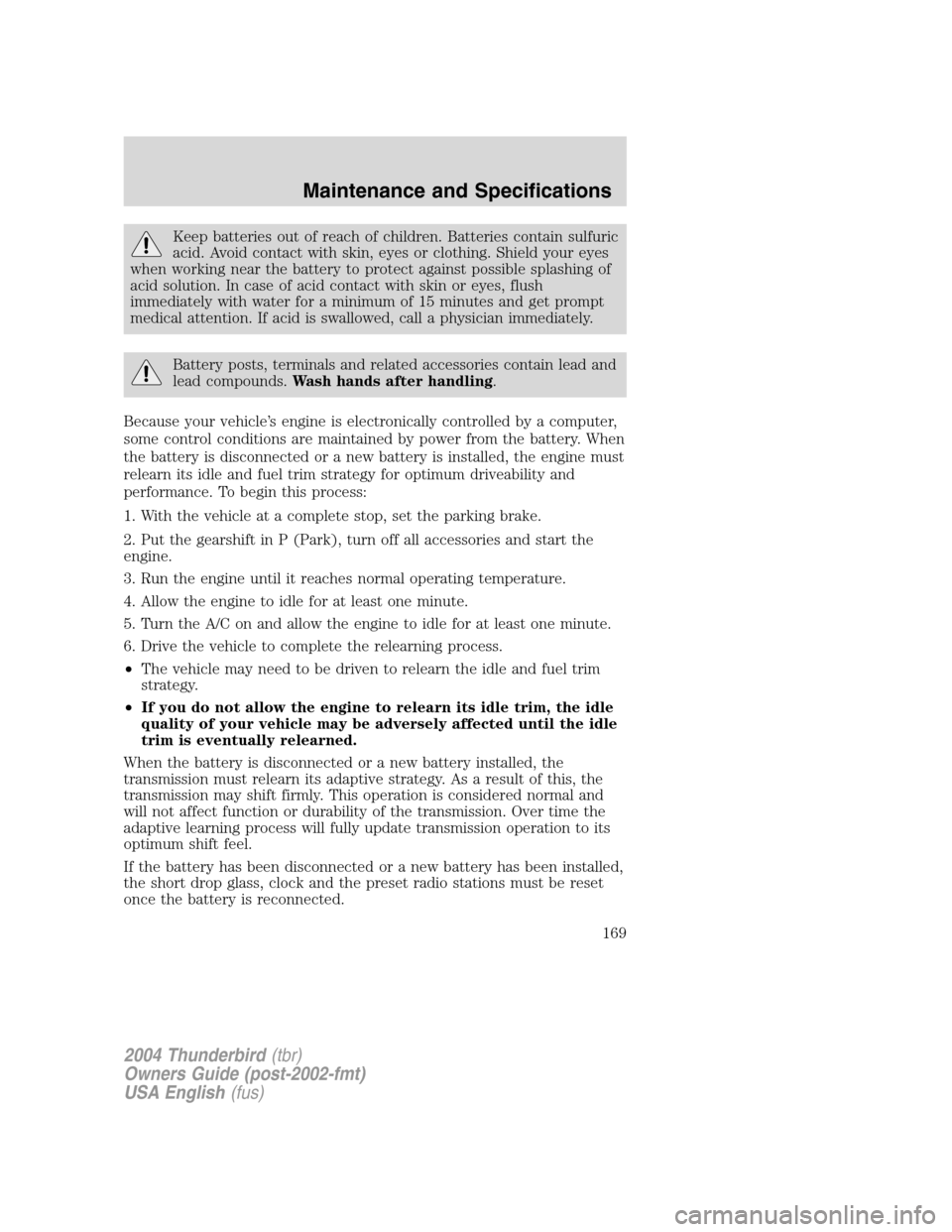
Keep batteries out of reach of children. Batteries contain sulfuric
acid. Avoid contact with skin, eyes or clothing. Shield your eyes
when working near the battery to protect against possible splashing of
acid solution. In case of acid contact with skin or eyes, flush
immediately with water for a minimum of 15 minutes and get prompt
medical attention. If acid is swallowed, call a physician immediately.
Battery posts, terminals and related accessories contain lead and
lead compounds. Wash hands after handling .
Because your vehicle ’s engine is electronically controlled by a computer,
some control conditions are maintained by power from the battery. When
the battery is disconnected or a new battery is installed, the engine must
relearn its idle and fuel trim strategy for optimum driveability and
performance. To begin this process:
1. With the vehicle at a complete stop, set the parking brake.
2. Put the gearshift in P (Park), turn off all accessories and start the
engine.
3. Run the engine until it reaches normal operating temperature.
4. Allow the engine to idle for at least one minute.
5. Turn the A/C on and allow the engine to idle for at least one minute.
6. Drive the vehicle to complete the relearning process.
• The vehicle may need to be driven to relearn the idle and fuel trim
strategy.
• If you do not allow the engine to relearn its idle trim, the idle
quality of your vehicle may be adversely affected until the idle
trim is eventually relearned.
When the battery is disconnected or a new battery installed, the
transmission must relearn its adaptive strategy. As a result of this, the
transmission may shift firmly. This operation is considered normal and
will not affect function or durability of the transmission. Over time the
adaptive learning process will fully update transmission operation to its
optimum shift feel.
If the battery has been disconnected or a new battery has been installed,
the short drop glass, clock and the preset radio stations must be reset
once the battery is reconnected.
2004 Thunderbird (tbr)
Owners Guide (post-2002-fmt)
USA English (fus)
Maintenance and Specifications
169
Page 212 of 216
A
Accessory delay ..........................40
Air bag supplemental restraint
system ....................................86, 94and child safety seats ..............87
description ..........................86, 94
disposal ......................................97
driver air bag ......................88, 95
indicator light .....................89, 96
operation .............................88, 95
passenger air bag ...............88, 95
passenger deactivation
switch ........................................90
side air bag ................................94
Air cleaner filter .......186 –187, 201
Air conditioning ..........................22
Antifreeze
(see Engine coolant) ................170
Anti-lock brake system
(see Brakes) ......................112 –113
Anti-theft system ........................72 arming the system ....................72
disarming a triggered system ..72
Audio system (see Radio) .........16
Automatic transmission driving an automatic
overdrive .................................116
fluid, adding ............................186
fluid, checking ........................186
fluid, refill capacities ..............201
fluid, specification ..................205
Auxiliary power point .................39
Axle lubricant specifications ..203, 205
refill capacities ........................201
B
Battery .......................................168 acid, treating emergencies .....168
jumping a disabled battery ....141
maintenance-free ....................168
replacement, specifications ...201
servicing ..................................168
BeltMinder ...................................81
Brakes ........................................112 anti-lock ...........................112 –113
anti-lock brake system (ABS)
warning light ...........................112
fluid, checking and adding ....186
fluid, refill capacities ..............201
fluid, specifications .........203, 205
lubricant specifications ..203, 205
parking ....................................113
shift interlock ..........................115
Bulbs ............................................30
C
Capacities for refilling fluids ....201
Cassette tape player ...................16
Cell phone use ............................60
Certification Label ....................206
Changing a tire .........................136
Child safety restraints ................97 child safety belts ......................97
Child safety seats ......................100 attaching with tether straps ..104
in front seat ............................101
in rear seat ..............................101
LATCH .....................................107
Cleaning your vehicle engine compartment ..............158
instrument panel ....................160
interior .....................................161
interior trim ............................160
plastic parts ............................159
washing ....................................157
2004 Thunderbird (tbr)
Owners Guide (post-2002-fmt)
USA English (fus)
Index
Index
212
Page 215 of 216
K
Keyless entry systemautolock .....................................68
Keys positions of the ignition .........109
L
Lamps autolamp system .......................27
bulb replacement
specifications chart ..................31
daytime running light ...............27
headlamps .................................27
headlamps, flash to pass ..........28
instrument panel, dimming .....28
interior lamps .....................30 –31
replacing bulbs .......30, 32, 34 –37
Lane change indicator
(see Turn signal) ........................30
Lights, warning and indicator ....10 anti-lock brakes (ABS) ..........112
Load limits .................................121
Locks autolock .....................................68
doors ..........................................61
Lubricant specifications ...203, 205
Lumbar support, seats ...............74
M
Manual transmission fluid capacities ........................201
lubricant specifications ..........205
Master lighting switch ................27
Mirrors .........................................41 side view mirrors (power) .......41
Motorcraft parts ................179, 201 O
Octane rating ............................178
Oil (see Engine oil) ..................165
P
Parking brake ............................113
Parts (see Motorcraft parts) ....201
Power distribution box
(see Fuses) .......................131, 134
Power door locks ........................61
Power point .................................39
Power steering ..................114
–115
fluid, checking and adding ....185
fluid, refill capacity ................201
fluid, specifications .........203, 205
Power Windows ...........................40
R
Radio ............................................16
Rear window defroster ...............25
Relays ........................................127
Remote entry system .................64 illuminated entry ......................67
locking/unlocking doors ...........61
opening the trunk .....................65
Roadside assistance ..................125
S
Safety Belt Maintenance ............85
Safety belts
(see Safety restraints) .........76 –80
Safety defects, reporting ..........156
Safety restraints ....................76 –80
2004 Thunderbird (tbr)
Owners Guide (post-2002-fmt)
USA English (fus)
Index
215