transmission FORD THUNDERBIRD 2004 11.G User Guide
[x] Cancel search | Manufacturer: FORD, Model Year: 2004, Model line: THUNDERBIRD, Model: FORD THUNDERBIRD 2004 11.GPages: 216, PDF Size: 5.69 MB
Page 119 of 216
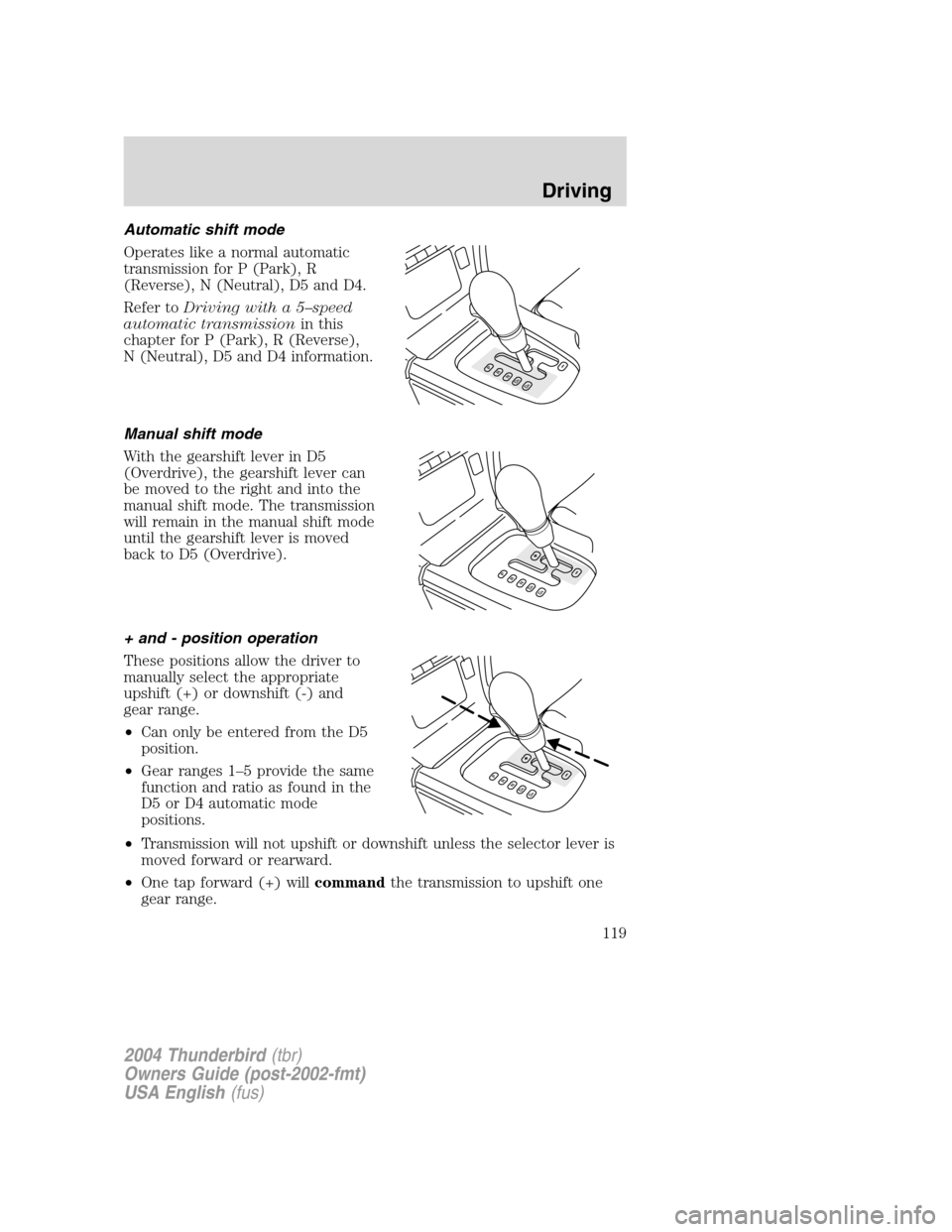
Automatic shift mode
Operates like a normal automatic
transmission for P (Park), R
(Reverse), N (Neutral), D5 and D4.
Refer toDriving with a 5 –speed
automatic transmission in this
chapter for P (Park), R (Reverse),
N (Neutral), D5 and D4 information.
Manual shift mode
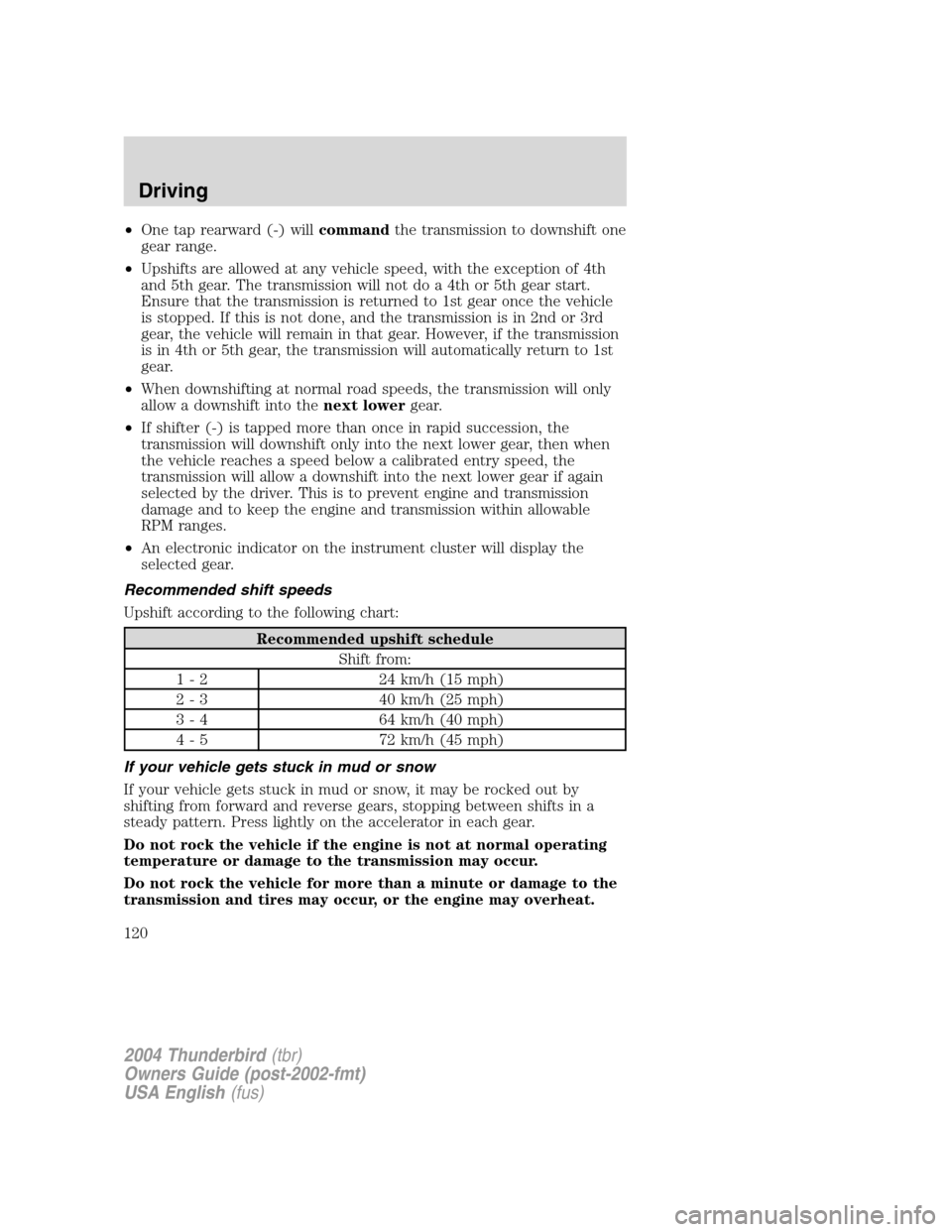
With the gearshift lever in D5
(Overdrive), the gearshift lever can
be moved to the right and into the
manual shift mode. The transmission
will remain in the manual shift mode
until the gearshift lever is moved
back to D5 (Overdrive).
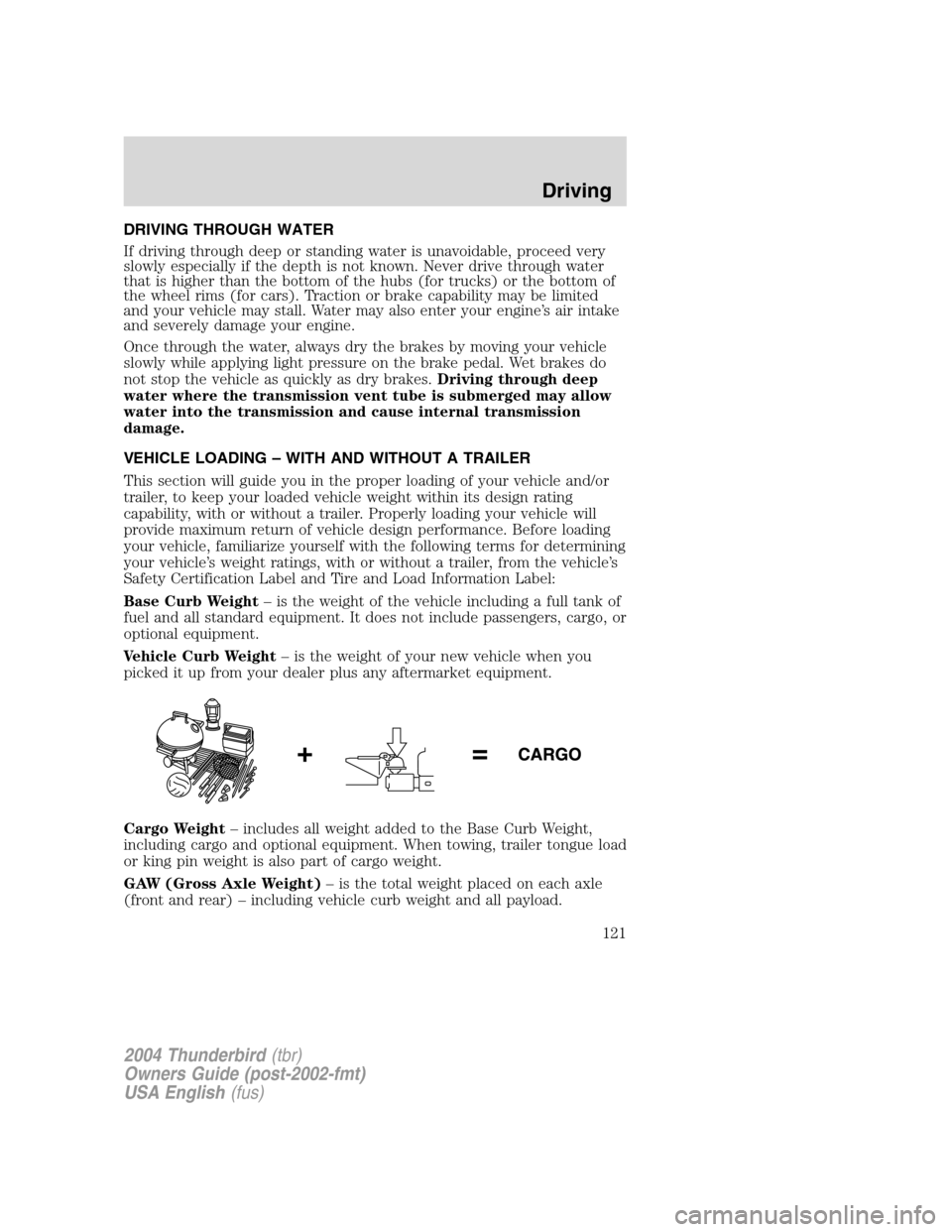
+ and - position operation
These positions allow the driver to
manually select the appropriate
upshift (+) or downshift (-) and
gear range.
• Can only be entered from the D5
position.
• Gear ranges 1 –5 provide the same
function and ratio as found in the
D5 or D4 automatic mode
positions.
• Transmission will not upshift or downshift unless the selector lever is
moved forward or rearward.
• One tap forward (+) will commandthe transmission to upshift one
gear range.
2004 Thunderbird (tbr)
Owners Guide (post-2002-fmt)
USA English (fus)
Driving
119
Page 120 of 216
•One tap rearward (-) will commandthe transmission to downshift one
gear range.
• Upshifts are allowed at any vehicle speed, with the exception of 4th
and 5th gear. The transmission will not do a 4th or 5th gear start.
Ensure that the transmission is returned to 1st gear once the vehicle
is stopped. If this is not done, and the transmission is in 2nd or 3rd
gear, the vehicle will remain in that gear. However, if the transmission
is in 4th or 5th gear, the transmission will automatically return to 1st
gear.
• When downshifting at normal road speeds, the transmission will only
allow a downshift into the next lowergear.
• If shifter (-) is tapped more than once in rapid succession, the
transmission will downshift only into the next lower gear, then when
the vehicle reaches a speed below a calibrated entry speed, the
transmission will allow a downshift into the next lower gear if again
selected by the driver. This is to prevent engine and transmission
damage and to keep the engine and transmission within allowable
RPM ranges.
• An electronic indicator on the instrument cluster will display the
selected gear.
Recommended shift speeds
Upshift according to the following chart:
Recommended upshift schedule Shift from:
1 - 2 24 km/h (15 mph)
2 - 3 40 km/h (25 mph)
3 - 4 64 km/h (40 mph)
4 - 5 72 km/h (45 mph)
If your vehicle gets stuck in mud or snow
If your vehicle gets stuck in mud or snow, it may be rocked out by
shifting from forward and reverse gears, stopping between shifts in a
steady pattern. Press lightly on the accelerator in each gear.
Do not rock the vehicle if the engine is not at normal operating
temperature or damage to the transmission may occur.
Do not rock the vehicle for more than a minute or damage to the
transmission and tires may occur, or the engine may overheat.
2004 Thunderbird (tbr)
Owners Guide (post-2002-fmt)
USA English (fus)
Driving
120
Page 121 of 216
DRIVING THROUGH WATER
If driving through deep or standing water is unavoidable, proceed very
slowly especially if the depth is not known. Never drive through water
that is higher than the bottom of the hubs (for trucks) or the bottom of
the wheel rims (for cars). Traction or brake capability may be limited
and your vehicle may stall. Water may also enter your engine’s air intake
and severely damage your engine.
Once through the water, always dry the brakes by moving your vehicle
slowly while applying light pressure on the brake pedal. Wet brakes do
not stop the vehicle as quickly as dry brakes. Driving through deep
water where the transmission vent tube is submerged may allow
water into the transmission and cause internal transmission
damage.
VEHICLE LOADING –WITH AND WITHOUT A TRAILER
This section will guide you in the proper loading of your vehicle and/or
trailer, to keep your loaded vehicle weight within its design rating
capability, with or without a trailer. Properly loading your vehicle will
provide maximum return of vehicle design performance. Before loading
your vehicle, familiarize yourself with the following terms for determining
your vehicle ’s weight ratings, with or without a trailer, from the vehicle ’s
Safety Certification Label and Tire and Load Information Label:
Base Curb Weight –is the weight of the vehicle including a full tank of
fuel and all standard equipment. It does not include passengers, cargo, or
optional equipment.
Vehicle Curb Weight –is the weight of your new vehicle when you
picked it up from your dealer plus any aftermarket equipment.
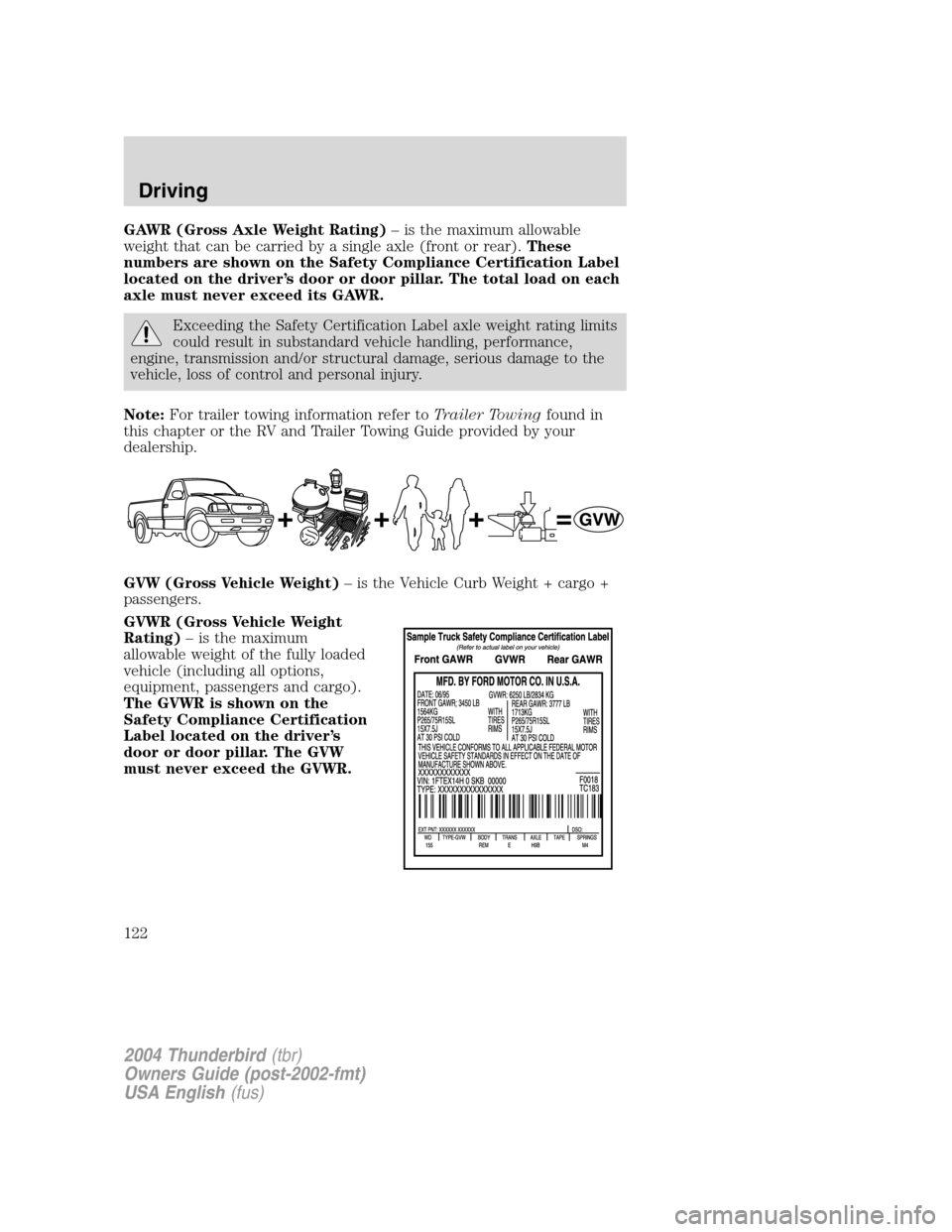
Cargo Weight –includes all weight added to the Base Curb Weight,
including cargo and optional equipment. When towing, trailer tongue load
or king pin weight is also part of cargo weight.
GAW (Gross Axle Weight) –is the total weight placed on each axle
(front and rear) –including vehicle curb weight and all payload.
2004 Thunderbird (tbr)
Owners Guide (post-2002-fmt)
USA English (fus)
Driving
121
Page 122 of 216
GAWR (Gross Axle Weight Rating)–is the maximum allowable
weight that can be carried by a single axle (front or rear). These
numbers are shown on the Safety Compliance Certification Label
located on the driver ’s door or door pillar. The total load on each
axle must never exceed its GAWR.
Exceeding the Safety Certification Label axle weight rating limits
could result in substandard vehicle handling, performance,
engine, transmission and/or structural damage, serious damage to the
vehicle, loss of control and personal injury.
Note: For trailer towing information refer to Trailer Towingfound in
this chapter or the RV and Trailer Towing Guide provided by your
dealership.
GVW (Gross Vehicle Weight) –is the Vehicle Curb Weight + cargo +
passengers.
GVWR (Gross Vehicle Weight
Rating) –is the maximum
allowable weight of the fully loaded
vehicle (including all options,
equipment, passengers and cargo).
The GVWR is shown on the
Safety Compliance Certification
Label located on the driver ’s
door or door pillar. The GVW
must never exceed the GVWR.
2004 Thunderbird (tbr)
Owners Guide (post-2002-fmt)
USA English (fus)
Driving
122
Page 123 of 216
Exceeding the Safety Certification Label axle weight rating limits
could result in substandard vehicle handling, performance,
engine, transmission and/or structural damage, serious damage to the
vehicle, loss of control and personal injury.
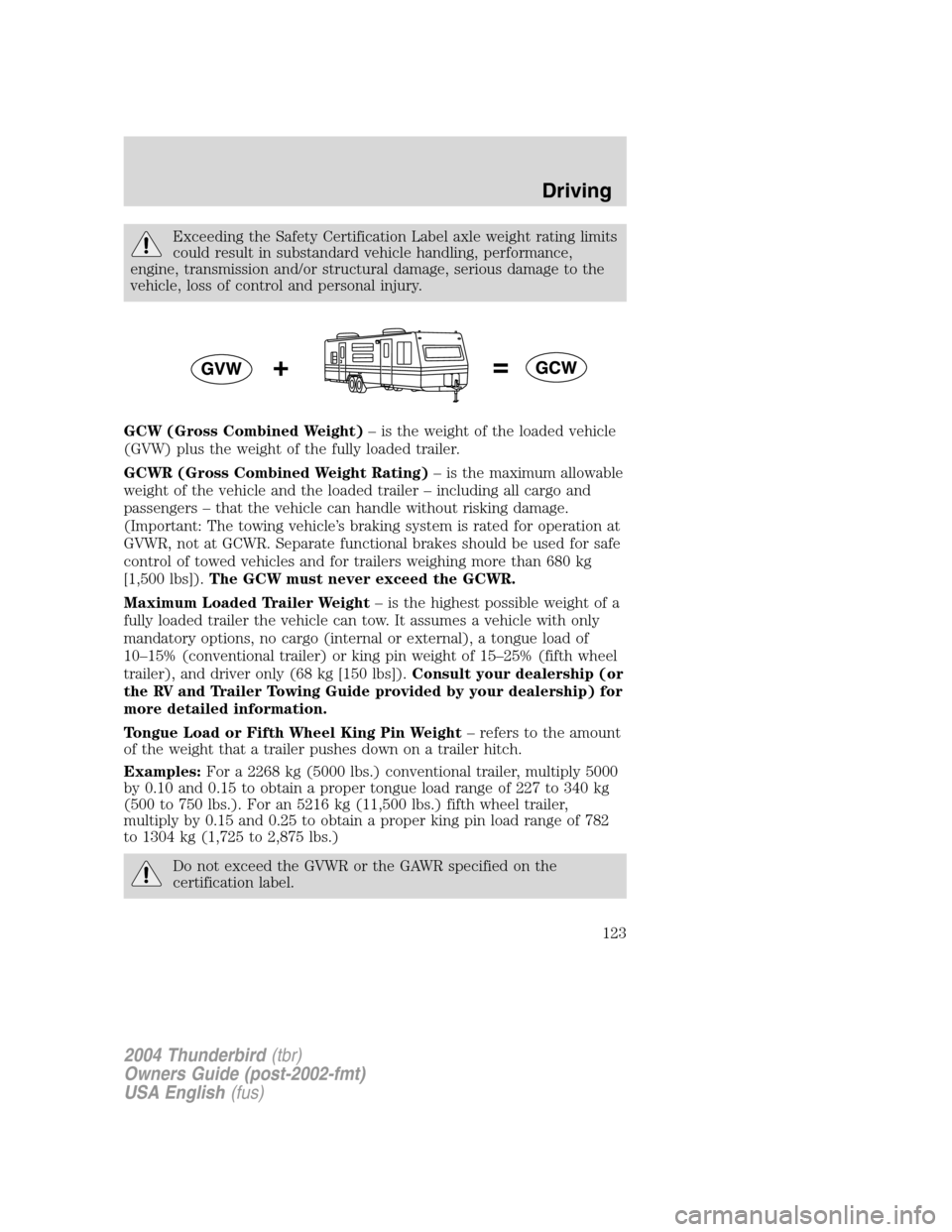
GCW (Gross Combined Weight) –is the weight of the loaded vehicle
(GVW) plus the weight of the fully loaded trailer.
GCWR (Gross Combined Weight Rating) –is the maximum allowable
weight of the vehicle and the loaded trailer –including all cargo and
passengers –that the vehicle can handle without risking damage.
(Important: The towing vehicle ’s braking system is rated for operation at
GVWR, not at GCWR. Separate functional brakes should be used for safe
control of towed vehicles and for trailers weighing more than 680 kg
[1,500 lbs]). The GCW must never exceed the GCWR.
Maximum Loaded Trailer Weight –is the highest possible weight of a
fully loaded trailer the vehicle can tow. It assumes a vehicle with only
mandatory options, no cargo (internal or external), a tongue load of
10 –15% (conventional trailer) or king pin weight of 15 –25% (fifth wheel
trailer), and driver only (68 kg [150 lbs]). Consult your dealership (or
the RV and Trailer Towing Guide provided by your dealership) for
more detailed information.
Tongue Load or Fifth Wheel King Pin Weight –refers to the amount
of the weight that a trailer pushes down on a trailer hitch.
Examples: For a 2268 kg (5000 lbs.) conventional trailer, multiply 5000
by 0.10 and 0.15 to obtain a proper tongue load range of 227 to 340 kg
(500 to 750 lbs.). For an 5216 kg (11,500 lbs.) fifth wheel trailer,
multiply by 0.15 and 0.25 to obtain a proper king pin load range of 782
to 1304 kg (1,725 to 2,875 lbs.)
Do not exceed the GVWR or the GAWR specified on the
certification label.
2004 Thunderbird (tbr)
Owners Guide (post-2002-fmt)
USA English (fus)
Driving
123
Page 124 of 216
Do not use replacement tires with lower load carrying capacities
than the originals because they may lower the vehicle’s GVWR
and GAWR limitations. Replacement tires with a higher limit than the
originals do not increase the GVWR and GAWR limitations.
Exceeding any vehicle weight rating limitation could result in
serious damage to the vehicle and/or personal injury.
TRAILER TOWING
Your vehicle is not equipped to tow. No towing packages are available
through Ford or Lincoln/Mercury dealers.
RECREATIONAL TOWING (ALL WHEELS ON THE GROUND)
Follow these guidelines for your specific powertrain combination to tow
your vehicle with all four wheels on the ground (such as behind a
recreational vehicle).
These guidelines are designed to ensure that your transmission is not
damaged due to insufficient lubrication.
All Rear Wheel Drive (RWD) vehicles:
This applies to all cars and 4x2 trucks/sport utilities with rear wheel
drive capability.
• Place the transmission in N (Neutral)
• Maximum speed is 56 km/h (35 mph)
• Maximum distance is 80 km (50 miles)
If a distance of 80 km (50 miles) or a speed of 56 km/h (35 mph) must
be exceeded, you must disconnect the driveshaft.
Ford recommends the driveshaft be removed/installed only by a
qualified technician. Improper removal/installation of the
driveshaft may cause damage to the driveshaft and internal
transmission components. See your local dealer for driveshaft
removal/installation.
2004 Thunderbird (tbr)
Owners Guide (post-2002-fmt)
USA English (fus)
Driving
124
Page 129 of 216
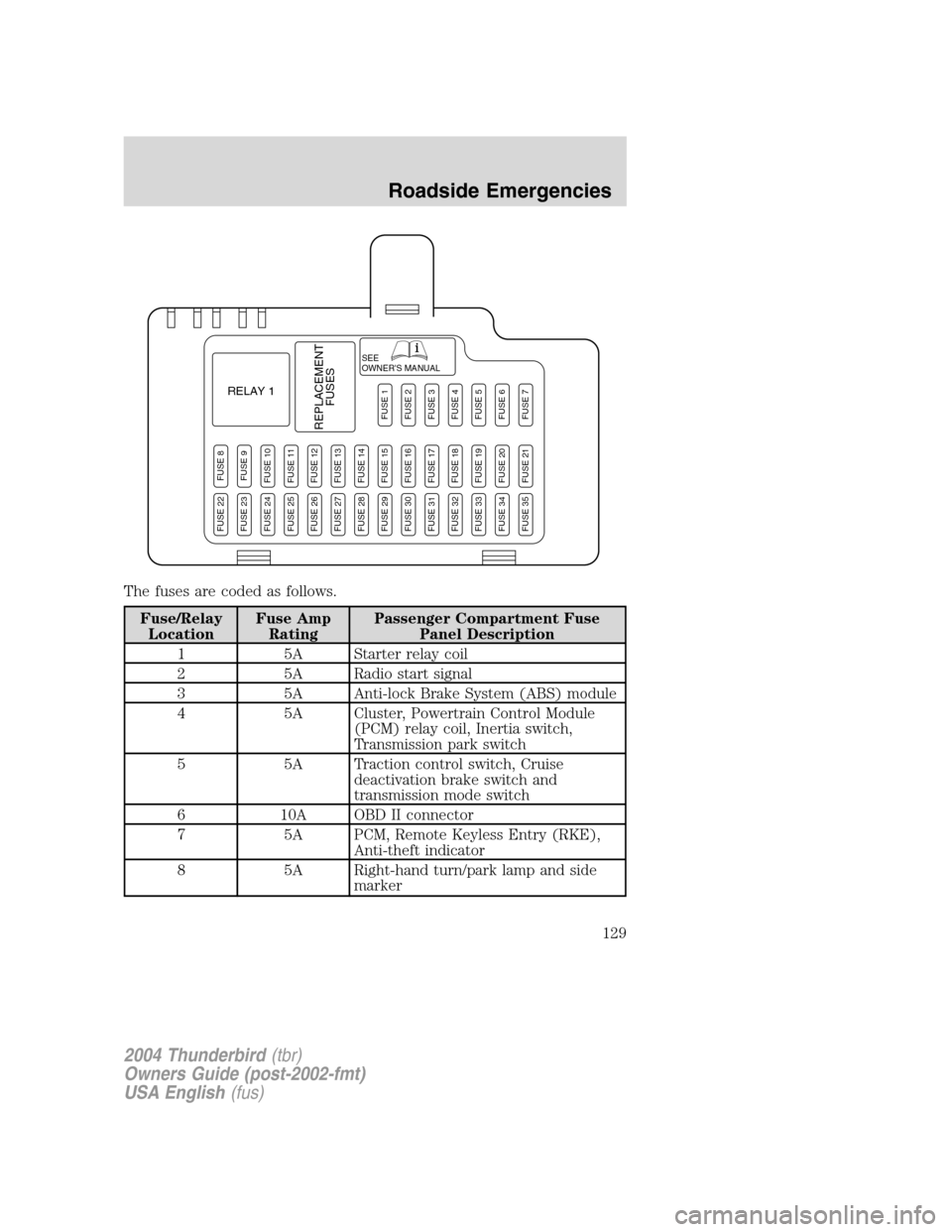
The fuses are coded as follows.
Fuse/RelayLocation Fuse Amp
Rating Passenger Compartment Fuse
Panel Description
1 5A Starter relay coil
2 5A Radio start signal
3 5A Anti-lock Brake System (ABS) module
4 5A Cluster, Powertrain Control Module (PCM) relay coil, Inertia switch,
Transmission park switch
5 5A Traction control switch, Cruise deactivation brake switch and
transmission mode switch
6 10A OBD II connector
7 5A PCM, Remote Keyless Entry (RKE), Anti-theft indicator
8 5A Right-hand turn/park lamp and side marker
SEE
OWNER'S MANUAL
RELAY 1
REPLACEMENTFUSES
FUSE 8FUSE 9FUSE 10FUSE 11FUSE 12FUSE 13FUSE 14FUSE 15FUSE 16FUSE 17FUSE 18FUSE 19FUSE 20FUSE 21
FUSE 1FUSE 2FUSE 3FUSE 4FUSE 5FUSE 6FUSE 7
FUSE 22FUSE 23FUSE 24FUSE 25FUSE 26FUSE 27FUSE 28FUSE 29FUSE 30FUSE 31FUSE 32FUSE 33FUSE 34FUSE 35
2004 Thunderbird (tbr)
Owners Guide (post-2002-fmt)
USA English (fus)
Roadside Emergencies
129
Page 132 of 216
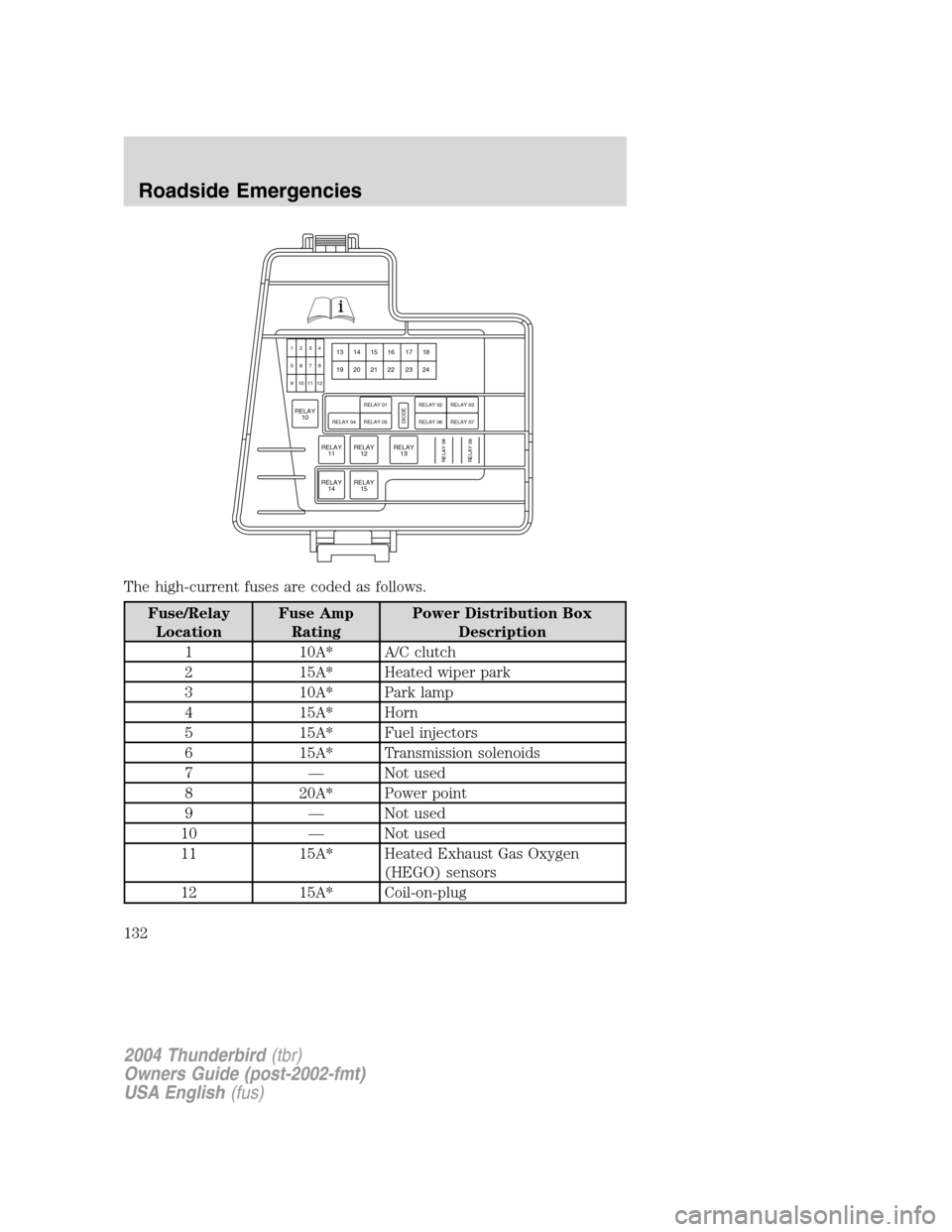
The high-current fuses are coded as follows.
Fuse/RelayLocation Fuse Amp
Rating Power Distribution Box
Description
1 10A* A/C clutch
2 15A* Heated wiper park
3 10A* Park lamp
4 15A* Horn
5 15A* Fuel injectors
6 15A* Transmission solenoids
7 —Not used
8 20A* Power point
9 —Not used
10 —Not used
11 15A* Heated Exhaust Gas Oxygen (HEGO) sensors
12 15A* Coil-on-plug
RELAY 14 RELAY
15
RELAY11 RELAY
12
RELAY10 13
1234
5678
9 10111214 15 16 17 18
19 20 21 22 23 24
RELAY 13RELAY 08 DIODE
RELAY 04 RELAY 05
RELAY 01
RELAY 09
RELAY 06 RELAY 02RELAY 07
RELAY 03
2004 Thunderbird
(tbr)
Owners Guide (post-2002-fmt)
USA English (fus)
Roadside Emergencies
132
Page 141 of 216
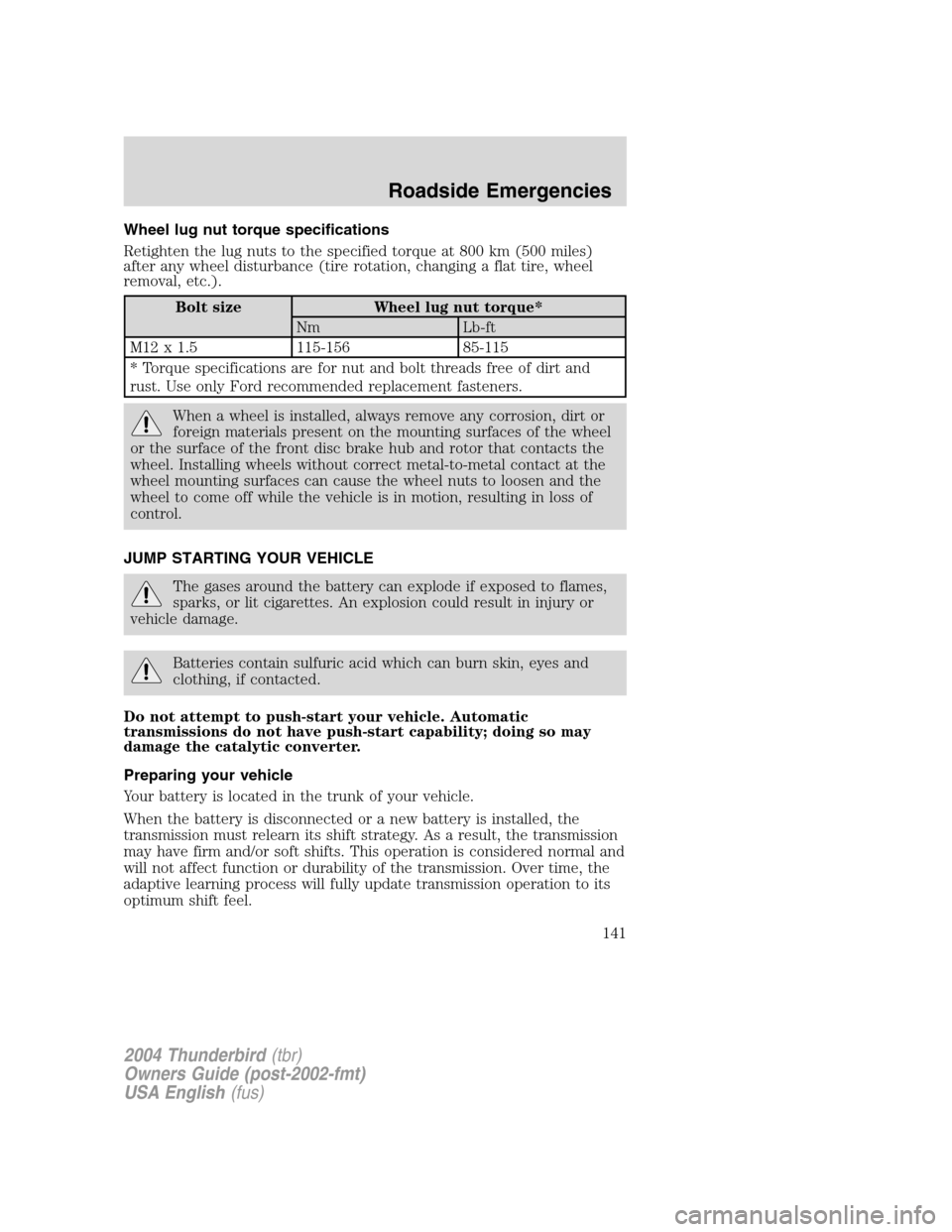
Wheel lug nut torque specifications
Retighten the lug nuts to the specified torque at 800 km (500 miles)
after any wheel disturbance (tire rotation, changing a flat tire, wheel
removal, etc.).
Bolt size Wheel lug nut torque*Nm Lb-ft
M12 x 1.5 115-156 85-115
* Torque specifications are for nut and bolt threads free of dirt and
rust. Use only Ford recommended replacement fasteners.
When a wheel is installed, always remove any corrosion, dirt or
foreign materials present on the mounting surfaces of the wheel
or the surface of the front disc brake hub and rotor that contacts the
wheel. Installing wheels without correct metal-to-metal contact at the
wheel mounting surfaces can cause the wheel nuts to loosen and the
wheel to come off while the vehicle is in motion, resulting in loss of
control.
JUMP STARTING YOUR VEHICLE
The gases around the battery can explode if exposed to flames,
sparks, or lit cigarettes. An explosion could result in injury or
vehicle damage.
Batteries contain sulfuric acid which can burn skin, eyes and
clothing, if contacted.
Do not attempt to push-start your vehicle. Automatic
transmissions do not have push-start capability; doing so may
damage the catalytic converter.
Preparing your vehicle
Your battery is located in the trunk of your vehicle.
When the battery is disconnected or a new battery is installed, the
transmission must relearn its shift strategy. As a result, the transmission
may have firm and/or soft shifts. This operation is considered normal and
will not affect function or durability of the transmission. Over time, the
adaptive learning process will fully update transmission operation to its
optimum shift feel.
2004 Thunderbird (tbr)
Owners Guide (post-2002-fmt)
USA English (fus)
Roadside Emergencies
141
Page 169 of 216
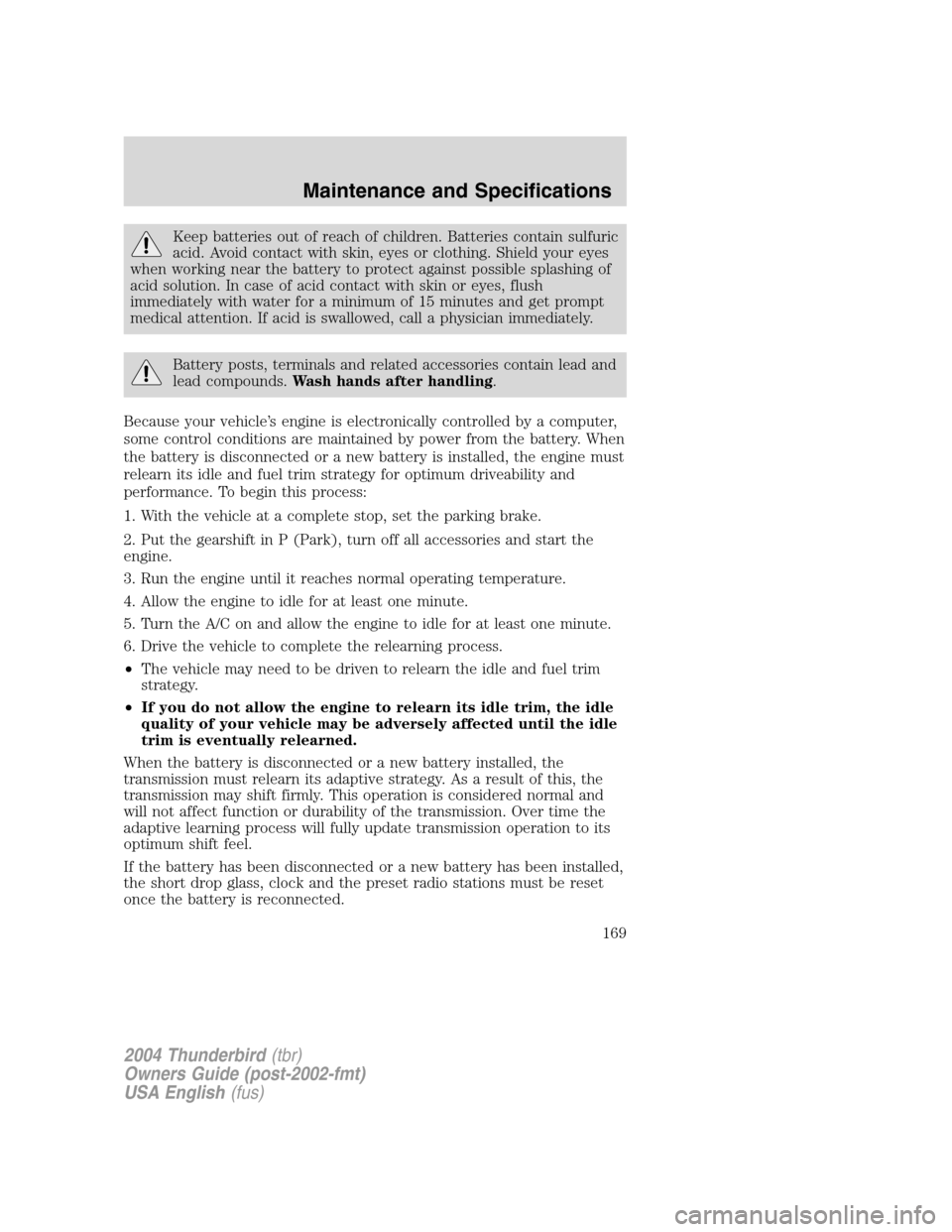
Keep batteries out of reach of children. Batteries contain sulfuric
acid. Avoid contact with skin, eyes or clothing. Shield your eyes
when working near the battery to protect against possible splashing of
acid solution. In case of acid contact with skin or eyes, flush
immediately with water for a minimum of 15 minutes and get prompt
medical attention. If acid is swallowed, call a physician immediately.
Battery posts, terminals and related accessories contain lead and
lead compounds. Wash hands after handling .
Because your vehicle ’s engine is electronically controlled by a computer,
some control conditions are maintained by power from the battery. When
the battery is disconnected or a new battery is installed, the engine must
relearn its idle and fuel trim strategy for optimum driveability and
performance. To begin this process:
1. With the vehicle at a complete stop, set the parking brake.
2. Put the gearshift in P (Park), turn off all accessories and start the
engine.
3. Run the engine until it reaches normal operating temperature.
4. Allow the engine to idle for at least one minute.
5. Turn the A/C on and allow the engine to idle for at least one minute.
6. Drive the vehicle to complete the relearning process.
• The vehicle may need to be driven to relearn the idle and fuel trim
strategy.
• If you do not allow the engine to relearn its idle trim, the idle
quality of your vehicle may be adversely affected until the idle
trim is eventually relearned.
When the battery is disconnected or a new battery installed, the
transmission must relearn its adaptive strategy. As a result of this, the
transmission may shift firmly. This operation is considered normal and
will not affect function or durability of the transmission. Over time the
adaptive learning process will fully update transmission operation to its
optimum shift feel.
If the battery has been disconnected or a new battery has been installed,
the short drop glass, clock and the preset radio stations must be reset
once the battery is reconnected.
2004 Thunderbird (tbr)
Owners Guide (post-2002-fmt)
USA English (fus)
Maintenance and Specifications
169