airbag FORD THUNDERBIRD 2004 11.G Owners Manual
[x] Cancel search | Manufacturer: FORD, Model Year: 2004, Model line: THUNDERBIRD, Model: FORD THUNDERBIRD 2004 11.GPages: 216, PDF Size: 5.69 MB
Page 39 of 216
POWER TILT/TELESCOPE STEERING COLUMN
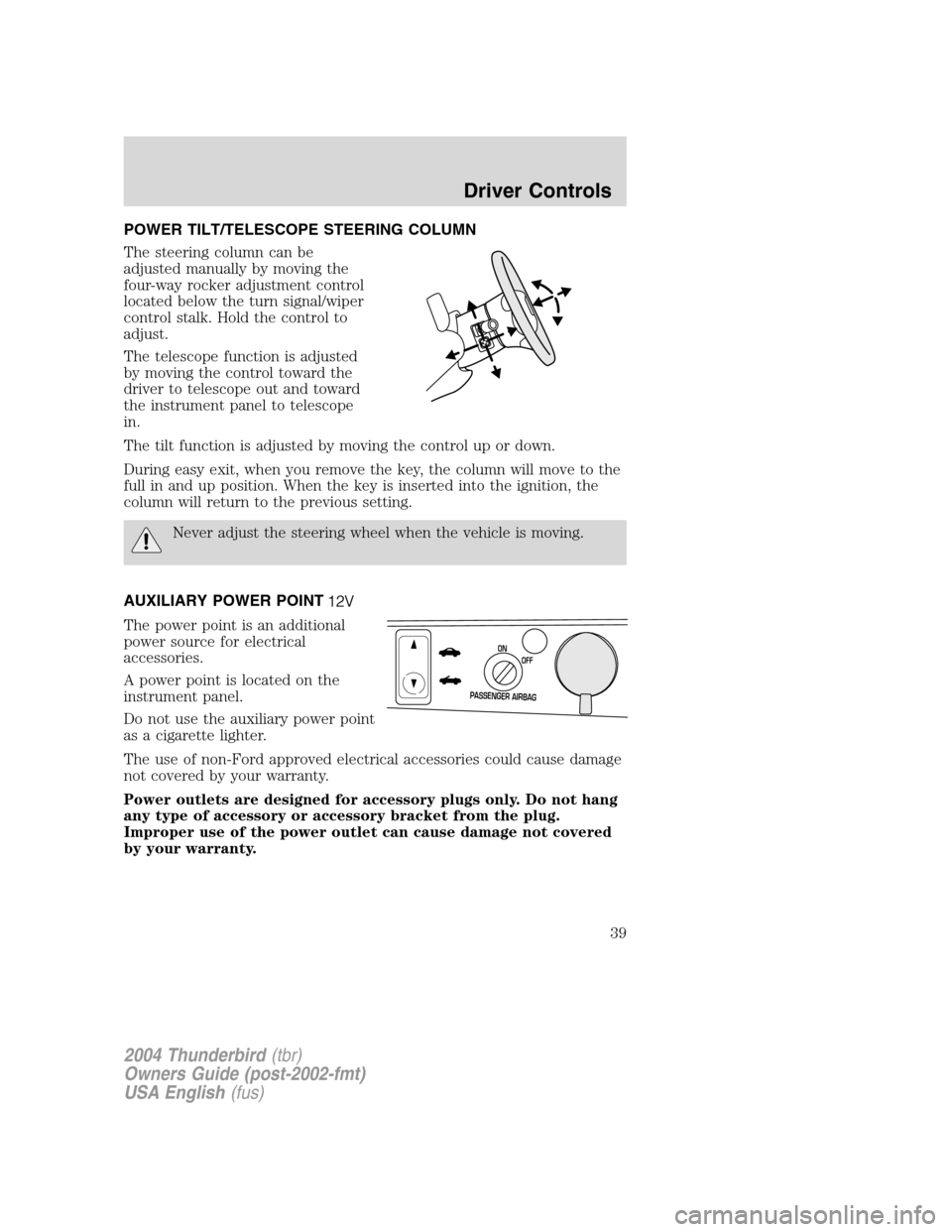
The steering column can be
adjusted manually by moving the
four-way rocker adjustment control
located below the turn signal/wiper
control stalk. Hold the control to
adjust.
The telescope function is adjusted
by moving the control toward the
driver to telescope out and toward
the instrument panel to telescope
in.
The tilt function is adjusted by moving the control up or down.
During easy exit, when you remove the key, the column will move to the
full in and up position. When the key is inserted into the ignition, the
column will return to the previous setting.
Never adjust the steering wheel when the vehicle is moving.
AUXILIARY POWER POINT
The power point is an additional
power source for electrical
accessories.
A power point is located on the
instrument panel.
Do not use the auxiliary power point
as a cigarette lighter.
The use of non-Ford approved electrical accessories could cause damage
not covered by your warranty.
Power outlets are designed for accessory plugs only. Do not hang
any type of accessory or accessory bracket from the plug.
Improper use of the power outlet can cause damage not covered
by your warranty.
PASSENGER AIRBAG
OFF
ON
2004 Thunderbird
(tbr)
Owners Guide (post-2002-fmt)
USA English (fus)
Driver Controls
39
Page 83 of 216
Reasons given... Consider...
“I was in a hurry ” Prime time for an accident.
BeltMinder reminds us to take a few
seconds to buckle up.
“ Safety belts don ’t work ” Safety belts, when used properly,
reduce risk of death to front seat
occupants by 45% in cars, and by
60% in light trucks.
“ Traffic is light ” Nearly 1 of 2 deaths occur in
single-vehicle crashes, many when
no other vehicles are around.
“ Belts wrinkle my clothes ”Possibly, but a serious crash can do
much more than wrinkle your clothes,
particularly if you are unbelted.
“ The people I ’m with don ’t
wear belts ” Set the example, teen deaths occur 4
times more often in vehicles with
TWO or MORE people. Children and
younger brothers/sisters imitate
behavior they see.
“ I have an air bag ”Air bags offer greater protection when
used with safety belts. Frontal airbags
are not designed to inflate in rear and
side crashes or rollovers.
“ I’d rather be thrown clear ”Not a good idea. Peoplewho are
ejected are 40 times more likely
to DIE. Safety belts help prevent
ejection, WE CAN ’T “PICK OUR
CRASH ”.
Do not sit on top of a buckled safety belt to avoid the Belt
Minder chime. Sitting on the safety belt will increase the risk of
injury in an accident. To disable (one-time) or deactivate the Belt
Minder feature please follow the directions stated below.
2004 Thunderbird (tbr)
Owners Guide (post-2002-fmt)
USA English (fus)
Seating and Safety Restraints
83
Page 90 of 216
Passenger front and side air bag ON/OFF switch
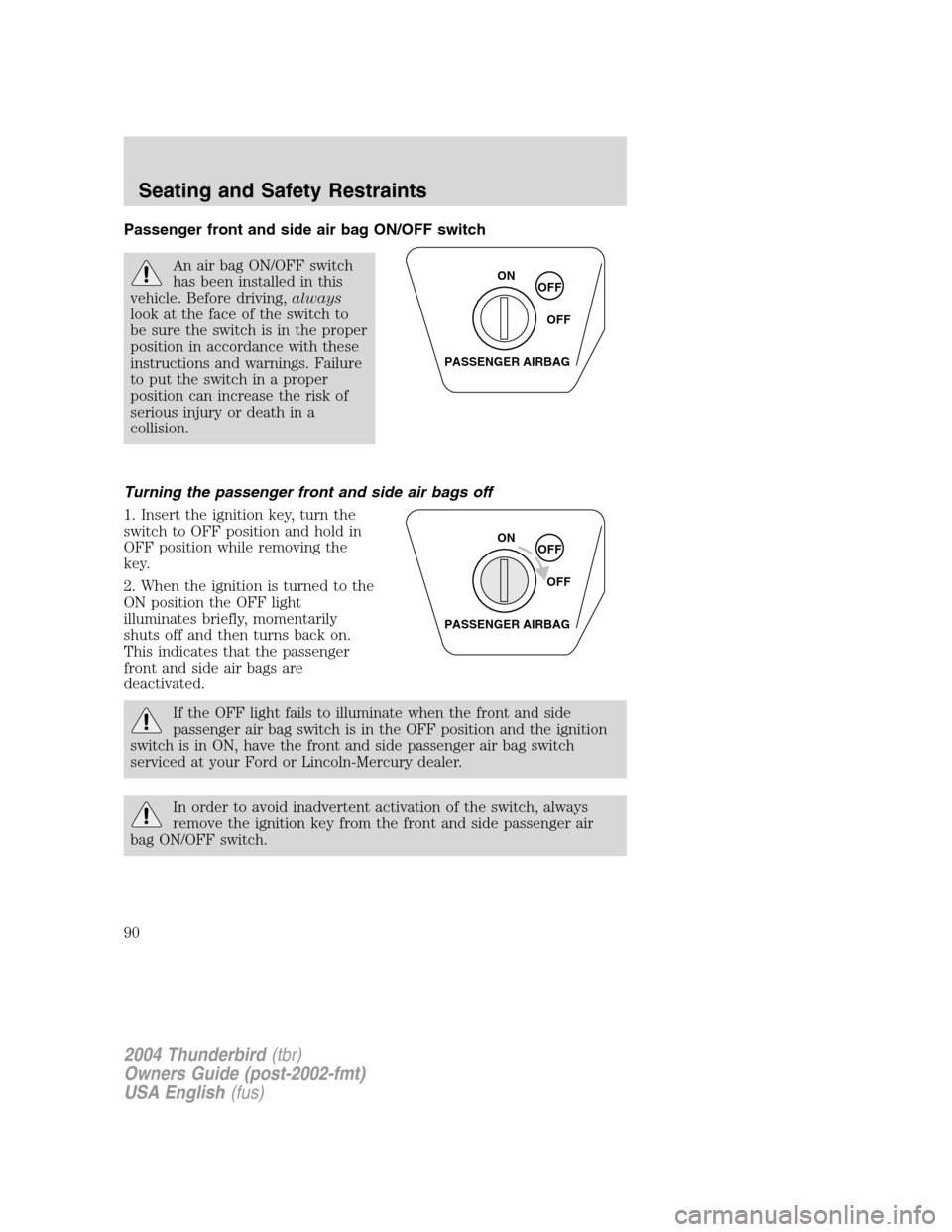
An air bag ON/OFF switch
has been installed in this
vehicle. Before driving, always
look at the face of the switch to
be sure the switch is in the proper
position in accordance with these
instructions and warnings. Failure
to put the switch in a proper
position can increase the risk of
serious injury or death in a
collision.
Turning the passenger front and side air bags off
1. Insert the ignition key, turn the
switch to OFF position and hold in
OFF position while removing the
key.
2. When the ignition is turned to the
ON position the OFF light
illuminates briefly, momentarily
shuts off and then turns back on.
This indicates that the passenger
front and side air bags are
deactivated.
If the OFF light fails to illuminate when the front and side
passenger air bag switch is in the OFF position and the ignition
switch is in ON, have the front and side passenger air bag switch
serviced at your Ford or Lincoln-Mercury dealer.
In order to avoid inadvertent activation of the switch, always
remove the ignition key from the front and side passenger air
bag ON/OFF switch.
ON OFF
OFF
PASSENGER AIRBAG
ON OFF
OFF
PASSENGER AIRBAG
2004 Thunderbird (tbr)
Owners Guide (post-2002-fmt)
USA English (fus)
Seating and Safety Restraints
90
Page 91 of 216
Turning the front and side passenger air bags back on
The front and side passenger air bags remain OFF until you turn them
back ON.
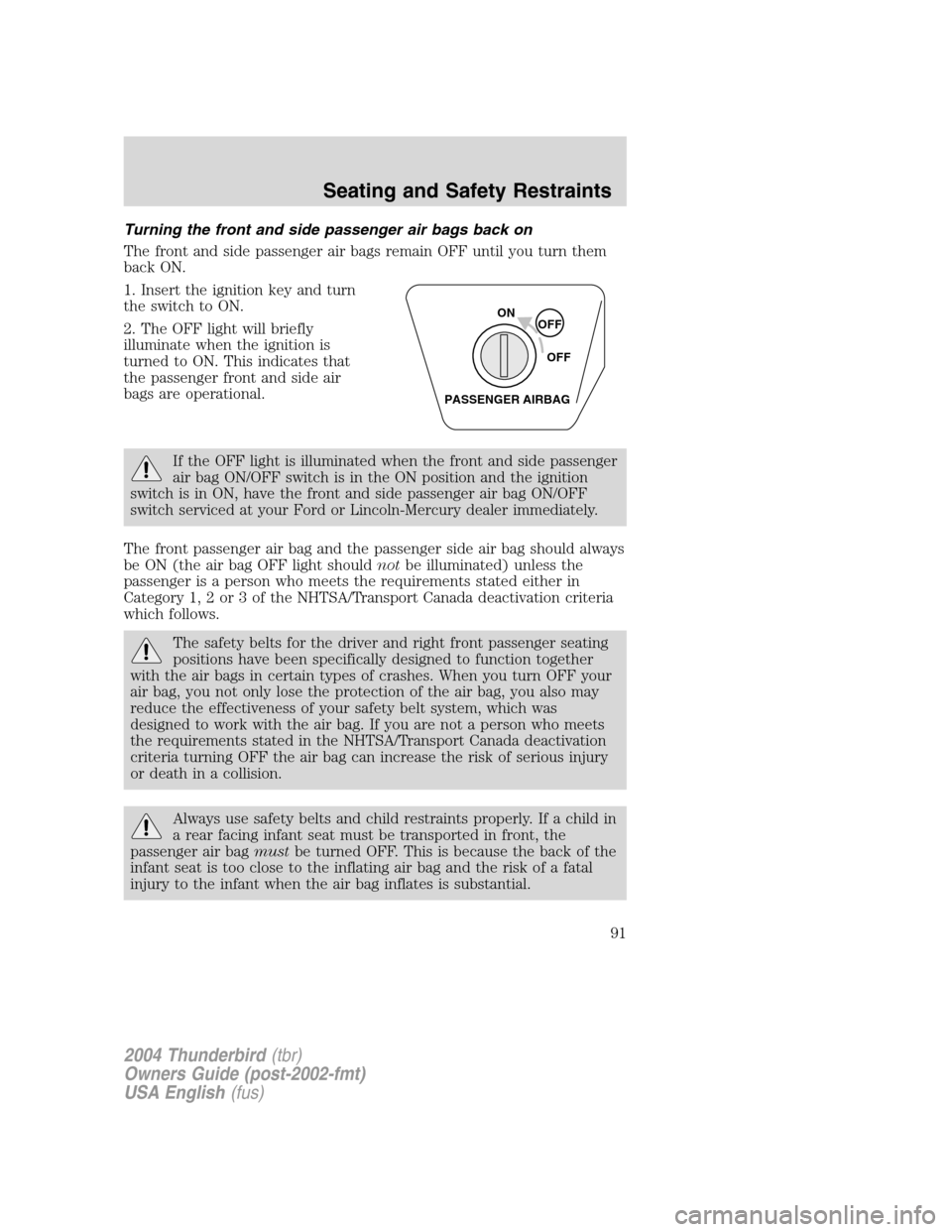
1. Insert the ignition key and turn
the switch to ON.
2. The OFF light will briefly
illuminate when the ignition is
turned to ON. This indicates that
the passenger front and side air
bags are operational.
If the OFF light is illuminated when the front and side passenger
air bag ON/OFF switch is in the ON position and the ignition
switch is in ON, have the front and side passenger air bag ON/OFF
switch serviced at your Ford or Lincoln-Mercury dealer immediately.
The front passenger air bag and the passenger side air bag should always
be ON (the air bag OFF light should notbe illuminated) unless the
passenger is a person who meets the requirements stated either in
Category 1, 2 or 3 of the NHTSA/Transport Canada deactivation criteria
which follows.
The safety belts for the driver and right front passenger seating
positions have been specifically designed to function together
with the air bags in certain types of crashes. When you turn OFF your
air bag, you not only lose the protection of the air bag, you also may
reduce the effectiveness of your safety belt system, which was
designed to work with the air bag. If you are not a person who meets
the requirements stated in the NHTSA/Transport Canada deactivation
criteria turning OFF the air bag can increase the risk of serious injury
or death in a collision.
Always use safety belts and child restraints properly. If a child in
a rear facing infant seat must be transported in front, the
passenger air bag mustbe turned OFF. This is because the back of the
infant seat is too close to the inflating air bag and the risk of a fatal
injury to the infant when the air bag inflates is substantial.
ON OFF
OFF
PASSENGER AIRBAG
2004 Thunderbird (tbr)
Owners Guide (post-2002-fmt)
USA English (fus)
Seating and Safety Restraints
91
Page 99 of 216
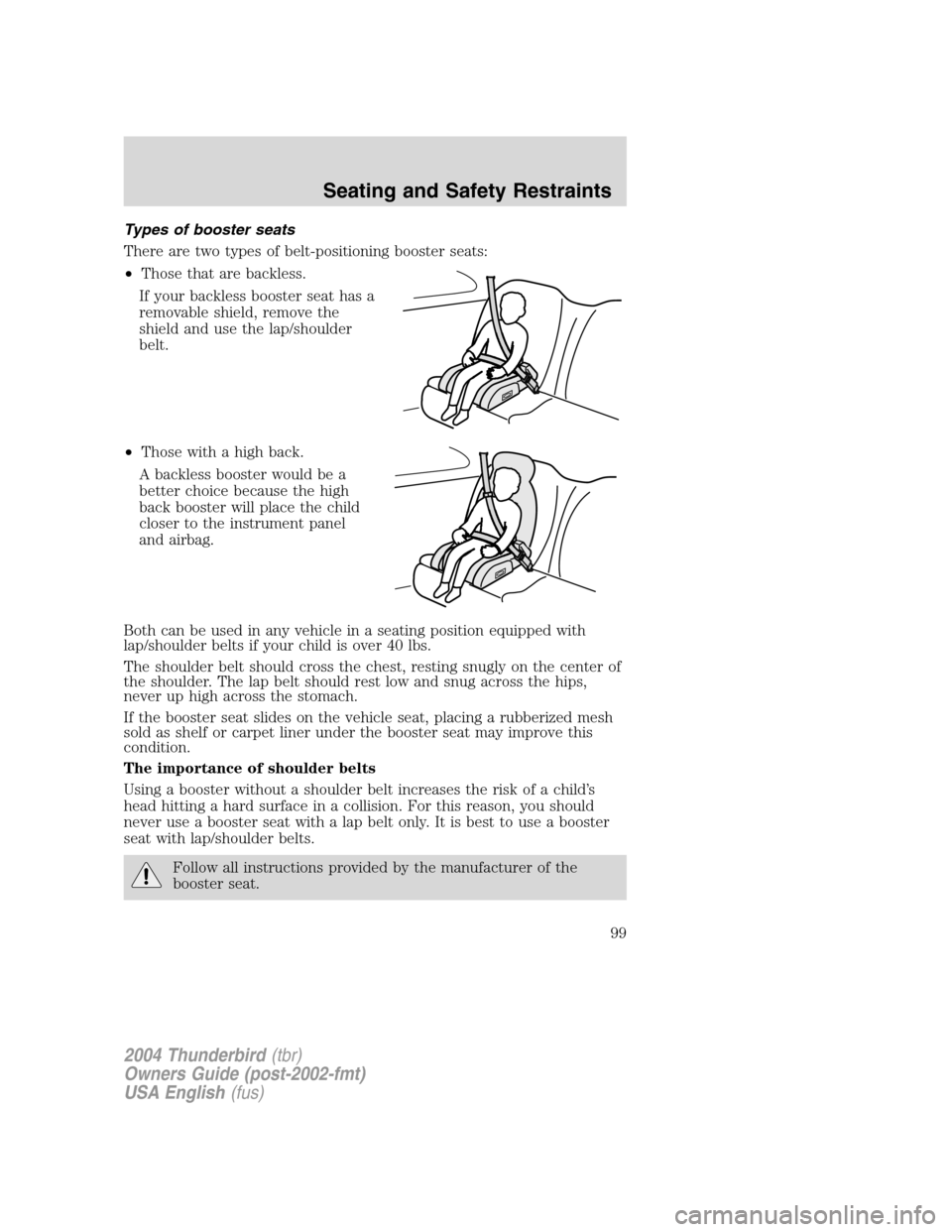
Types of booster seats
There are two types of belt-positioning booster seats:
•Those that are backless.
If your backless booster seat has a
removable shield, remove the
shield and use the lap/shoulder
belt.
• Those with a high back.
A backless booster would be a
better choice because the high
back booster will place the child
closer to the instrument panel
and airbag.
Both can be used in any vehicle in a seating position equipped with
lap/shoulder belts if your child is over 40 lbs.
The shoulder belt should cross the chest, resting snugly on the center of
the shoulder. The lap belt should rest low and snug across the hips,
never up high across the stomach.
If the booster seat slides on the vehicle seat, placing a rubberized mesh
sold as shelf or carpet liner under the booster seat may improve this
condition.
The importance of shoulder belts
Using a booster without a shoulder belt increases the risk of a child ’s
head hitting a hard surface in a collision. For this reason, you should
never use a booster seat with a lap belt only. It is best to use a booster
seat with lap/shoulder belts.
Follow all instructions provided by the manufacturer of the
booster seat.
2004 Thunderbird (tbr)
Owners Guide (post-2002-fmt)
USA English (fus)
Seating and Safety Restraints
99
Page 101 of 216
•Keep the buckle release button pointing up and away from the safety
seat, with the tongue between the child seat and the release button,
to prevent accidental unbuckling.
• Place seat back in upright position.
• Put the safety belt in the automatic locking mode. Refer to Automatic
locking mode.
•
LATCH lower anchors are recommended for use by children up to 22 kg
(48 pounds) in a child restraint. Top tether anchors can be used for
children up to 27 kg (60 pounds) in a child restraint, and to provide
upper torso restraint for children up to 36 kg (80 pounds) using an
upper torso harness and a belt-positioning booster.
Ford recommends the use of a child safety seat having a top tether
strap. Install the child safety seat in a seating position with LATCH and
tether anchors. For more information on top tether straps and anchors,
refer to Attaching safety seats with tether straps in this chapter. For
more information of LATCH anchors refer to Attaching safety seats with
LATCH (Lower Anchors and Tethers for Children) attachments in this
chapter.
Carefully follow all of the manufacturer ’s instructions included
with the safety seat you put in your vehicle. If you do not install
and use the safety seat properly, the child may be injured in a sudden
stop or collision.
Rear-facing child seats or infant carriers should never be placed
in the front seat unless the airbag On/Off switch is in the Off
position.
Installing child safety seats with combination lap and shoulder
belts
Air bags can kill or injure a child in a child seat. NEVERplace a
rear-facing child seat in front of an active air bag. If you must
use a forward-facing child seat in the front seat, move the seat all the
way back and turn the passenger air bags OFF.
2004 Thunderbird (tbr)
Owners Guide (post-2002-fmt)
USA English (fus)
Seating and Safety Restraints
101
Page 211 of 216
Floor mats
Interior trim kits
Leather wrapped steering wheels
Scuff plates
Speed control
Lifestyle
Bike racks
Cargo organization and management
Engine block heaters and blankets
Peace of mind
Airbag anti-theft locks
First aid and safety kits
Full vehicle covers
Locking gas cap
Navigation systems
Remote start
Vehicle security systems
For maximum vehicle performance, keep the following information in
mind when adding accessories or equipment to your vehicle:
•When adding accessories, equipment, passengers and luggage to your
vehicle, do not exceed the total weight capacity of the vehicle or of
the front or rear axle (GVWR or GAWR as indicated on the Safety
Compliance Certification label). Consult your dealer for specific weight
information.
• The Federal Communications Commission (FCC) and Canadian Radio
Telecommunications Commission (CRTC) regulate the use of mobile
communications systems —such as two-way radios, telephones and
theft alarms - that are equipped with radio transmitters. Any such
equipment installed in your vehicle should comply with FCC or CRTC
regulations and should be installed only by a qualified service
technician.
• Mobile communications systems may harm the operation of your
vehicle, particularly if they are not properly designed for automotive
use.
2004 Thunderbird (tbr)
Owners Guide (post-2002-fmt)
USA English (fus)
Accessories
211