weight FORD TRANSIT 2011 Owner's Manual
[x] Cancel search | Manufacturer: FORD, Model Year: 2011, Model line: TRANSIT, Model: FORD TRANSIT 2011Pages: 295, PDF Size: 2.23 MB
Page 261 of 295
Vehicle identification number (VIN)
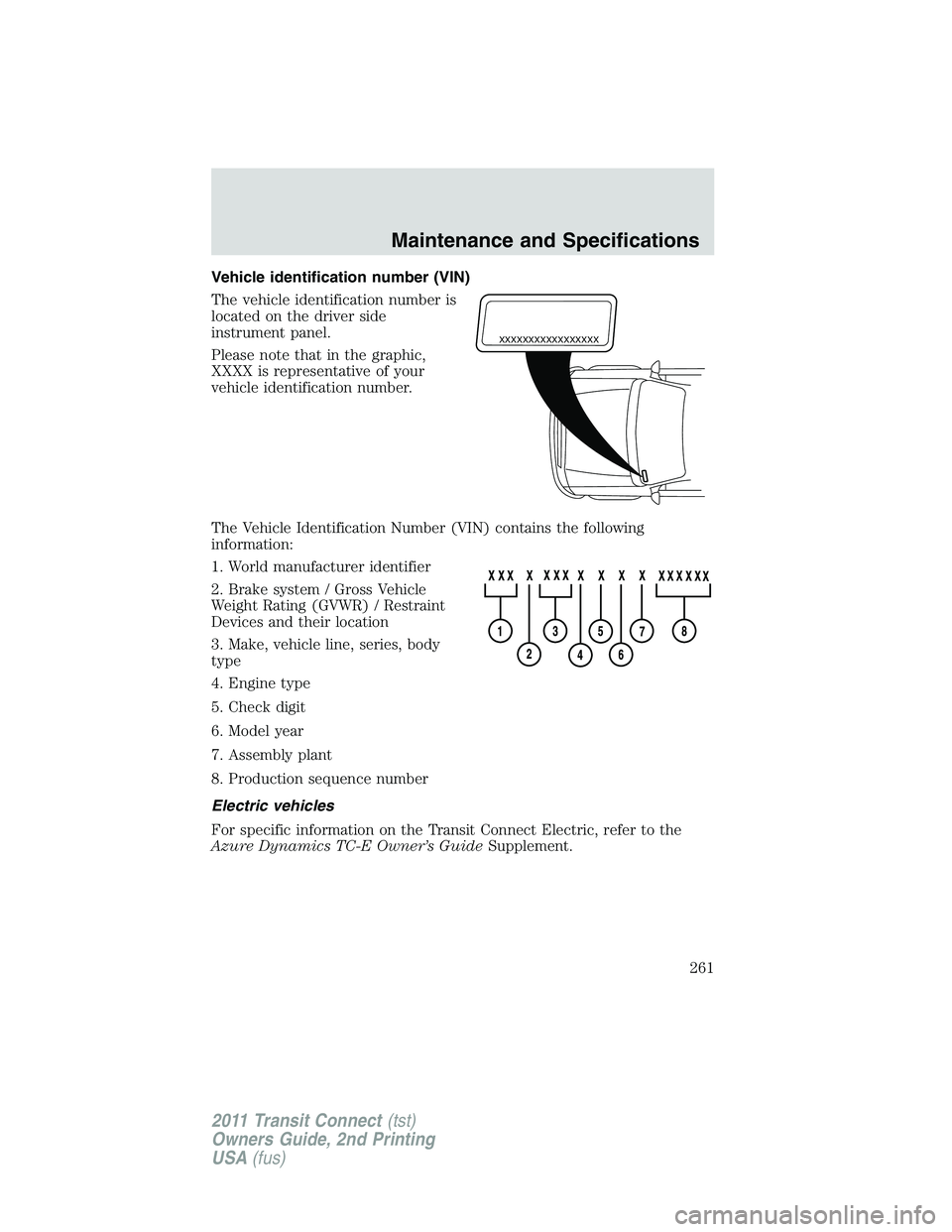
The vehicle identification number is
located on the driver side
instrument panel.
Please note that in the graphic,
XXXX is representative of your
vehicle identification number.
The Vehicle Identification Number (VIN) contains the following
information:
1. World manufacturer identifier
2. Brake system / Gross Vehicle
Weight Rating (GVWR) / Restraint
Devices and their location
3. Make, vehicle line, series, body
type
4. Engine type
5. Check digit
6. Model year
7. Assembly plant
8. Production sequence number
Electric vehicles
For specific information on the Transit Connect Electric, refer to the
Azure Dynamics TC-E Owner’s GuideSupplement.
XXXXXXXXXXXXXXXXX
Maintenance and Specifications
261
2011 Transit Connect(tst)
Owners Guide, 2nd Printing
USA(fus)
Page 264 of 295
*Ford Licensed Accessories (FLA) are warranted by the accessory
manufacturer’s warranty. Ford Licensed Accessories are fully designed
and developed by the accessory manufacturer and have not been
designed or tested to Ford Motor Company engineering requirements.
Contact your Ford dealer for details regarding the manufacturer’s limited
warranty and/or a copy of the FLA product limited warranty offered by
the accessory manufacturer.
For maximum vehicle performance, keep the following information in
mind when adding accessories or equipment to your vehicle:
•When adding accessories, equipment, passengers and luggage to your
vehicle, do not exceed the total weight capacity of the vehicle or of
the front or rear axle (GVWR or GAWR as indicated on the Safety
Compliance Certification label). Consult your authorized dealer for
specific weight information.
•The Federal Communications Commission (FCC) and Canadian Radio
Telecommunications Commission (CRTC) regulate the use of mobile
communications systems — such as two-way radios, telephones and
theft alarms - that are equipped with radio transmitters. Any such
equipment installed in your vehicle should comply with FCC or CRTC
regulations and should be installed only by a qualified service
technician.
•Mobile communications systems may harm the operation of your
vehicle, particularly if they are not properly designed for automotive
use.
•To avoid interference with other vehicle functions, such as anti-lock
braking systems, amateur radio users who install radios and antennas
onto their vehicle should not locate the Amateur Radio Antennas in
the area of the driver’s side hood.
•Electrical or electronic accessories or components that are added to
the vehicle by the authorized dealer or the owner, may adversely
affect battery performance and durability, and may also adversely
affect the performance of other electrical systems in the vehicle.
Accessories
264
2011 Transit Connect(tst)
Owners Guide, 2nd Printing
USA(fus)
Page 287 of 295
EXCEPTIONS
In addition, there are several exceptions to the Normal Schedule. They
are listed below:
Normal vehicle axle maintenance
❑Rear axles and power take-off (PTO) units containing synthetic fluid and light duty trucks equipped with Ford-design axles
are lubricated for life. These fluids are not to be checked or changed unless a leak is suspected, service is required or the
axle assembly has been submerged in water. The axle and PTO fluids should be changed anytime the axle and PTO have
been submerged in water. During extended trailer tow operation above 70°F (21°C) ambient and wide open throttle for
extended periods above 45 mph (72 km/h), non-synthetic rear axle fluids should be changed every 3,000 miles
(4,800 km) or 3 months, whichever occurs first. The 3,000 mile (4,800 km) fluid change interval may be waived if the
axle was filled with 75W140 synthetic gear fluid meeting Ford specification WSL-M2C192-A, part number F1TZ-19580-B or
equivalent. Add friction modifier XL-3 (EST-M2C118-A) or equivalent for complete refill of Traction-Lok rear axles (refer to
Maintenance product and specificationsin theMaintenance and Specificationschapter for details). The axle fluid should be
changed anytime an axle has been submerged in water.
Police/Taxi/Livery vehicle axle maintenance
❑Change rear axle fluid every 100,000 miles (160,000 km). Rear axle fluid change may be waived if the axle was filled
with 75W140 synthetic gear fluid meeting Ford specification WSL-M2C192-A, part number FITZ-19580-B or equivalent. Add
four ounces (118 mL) of additive friction modifier XL-3 (EST-M2C118-A) or equivalent for complete refill of Traction-Lok rear
axles. The axle fluid should be changed anytime the axle has been submerged in water.
E–450 and F–450/550 axle maintenance
❑Change rear axle fluid every 100,000 miles (160,000 km) under normal driving conditions. For vehicles operated at or
near maximum Gross Vehicle Weights, the rear axle fluid should be changed every 50,000 miles (80,000 km). In addition,
this 50,000 mile (80,000 km) schedule should be observed when the vehicles are operated under the Special Operating
Conditions.
California fuel filter replacement
❑If the vehicle is registered in California, the California Air Resources Board has determined that the failure to perform this
maintenance item will not nullify the emission warranty or limit recall liability prior to the completion of the vehicle’s useful
life. Ford Motor Company, however, urges you to have all recommended maintenance services performed at the specified
intervals and to record all vehicle service.
Class A Motorhome
❑Change brake fluid every two years
Scheduled Maintenance
287
2011 Transit Connect(tst)
Owners Guide, 2nd Printing
USA(fus)