flat tire FORD TRANSIT 2017 5.G Owner's Guide
[x] Cancel search | Manufacturer: FORD, Model Year: 2017, Model line: TRANSIT, Model: FORD TRANSIT 2017 5.GPages: 484, PDF Size: 11.45 MB
Page 282 of 484

4. Fully tighten all of the lug nuts in the
sequence shown.
5. Install the wheel trim.
Note: Make sure that the cones on the lug
nuts are against the wheel.
Note: Alloy wheel lug nuts are suitable for
use on a steel spare wheel.
Note: If the spare wheel is not the same
type and size as your vehicle road wheel
replace it as soon as possible.
Note: Check the lug nuts for correct
tightness and check the tire pressure as
soon as possible.
Stowing the Wheel and Vehicle
Jack
Note: Do not raise the spare wheel bracket
without a wheel attached. Damage can
occur to the winch mechanism if the spare
wheel bracket is lowered without a wheel
attached. 1. Attach the spare wheel bracket to the
wheel using the retaining nut.
2. Slide the cable through the slot and attach the spare wheel bracket to the
winch.
3. Rotate the cable through 90 degrees and lower the cable end cover.
4. Insert the flat end of the lug wrench into the socket. Turn it clockwise until
you feel a strong resistance. Make sure
the wheel is secure.
5. Stow the vehicle jack, jack handle and lug wrench in their correct locations
and secure them with the straps.
TECHNICAL SPECIFICATIONS
Wheel Lug Nut Torque Specifications WARNING
When a wheel is installed, always remove any corrosion, dirt or foreign materials
present on the mounting surfaces of the wheel or the surface of the wheel hub,
brake drum or brake disc that contacts the wheel. Make sure that any fasteners
that attach the rotor to the hub are secured so they do not interfere with the mounting
surfaces of the wheel. Installing wheels without correct metal-to-metal contact at the
wheel mounting surfaces can cause the wheel nuts to loosen and the wheel to come off
while your vehicle is in motion, resulting in loss of control. Ib-ft (Nm)
*
Bolt size
148 lb.ft (200 Nm)
M14 x 1.5
* Torque specifications are for nut and bolt threads free of dirt and rust. Use only Ford
recommended replacement fasteners.
Retighten the lug nuts to the specified torque within 100 miles (160 kilometers) after any
wheel disturbance, for example tire rotation, changing a flat tire or wheel removal.
279
Transit (TTH) Canada/United States of America, HK3J 19A321 AA enUSA, Edition date: 04/2016, First Printing Wheels and Tires
Page 428 of 484
PROTECT YOURSELF FROM THE RISING
COST OF VEHICLE REPAIRS WITH A FORD
PROTECT EXTENDED SERVICE PLAN.
Ford Protect Extended Service
Plans (U.S. Only)
Ford Protect means peace of mind. It’
s the
extended service plan backed by Ford
Motor Company, and provides more
protection beyond the New Vehicle Limited
Warranty coverage. When you visit your
Ford Dealer, Insist on genuine Ford Protect
extended service plans!
Ford Protect Can Quickly Pay for Itself
One trip to the Service Center could easily
exceed the price of your Ford Protect
Extended Service Plan. With Ford Protect
you minimize your risk for unexpected
repair bills and rising repair costs.
Up to 1,000+ Covered Vehicle
Components
There are four mechanical Ford Protect
with different levels of coverage. Ask your
authorized dealer for details.
1. PremiumCARE - Our most comprehensive coverage. With over
1,000 covered components, this plan
is so complete it’ s probably easier to
list what’ s not covered.
2. ExtraCARE - Covers 113 components, and includes many high-tech items.
3. BaseCARE - Covers 84 components.
4. PowertrainCARE - Covers 29 critical components.
Ford Protect Extended Service Plans are
honored by all authorized Ford dealers in
the U.S., Canada and Mexico. That means you get:
•
Reliable, quality service at any Ford or
Lincoln dealership.
• Repairs performed by factory trained
technicians, using genuine parts.
Rental Car Reimbursement
1st day Rental Benefit
If you bring your car into your dealer for
service, we ’ll give you a loaner to use for
the day.
Extended Rental Benefits
If your vehicle is kept overnight for covered
repairs, you are eligible for rental car
coverage, including bumper to bumper
warranty repairs, and Field Service Actions.
Roadside Assistance
Exclusive 24/7 roadside assistance,
including:
• Towing, flat-tire change and battery
jump starts.
• Out of fuel and lock-out assistance.
• Travel expense reimbursement for
lodging, meals and rental car.
• Assistance for taxi, shuttle, rental car
coverage or other transportation.
Transferable Coverage
If you sell your vehicle before your Ford
Protect plan coverage expires, you can
transfer any remaining coverage to the new
owner. Which should give you and your
potential buyer a little more peace of mind.
425
Transit (TTH) Canada/United States of America, HK3J 19A321 AA enUSA, Edition date: 04/2016, First Printing Ford Protect
Page 433 of 484
NORMAL SCHEDULED
MAINTENANCE
Intelligent Oil-Life Monitor™
Your vehicle is equipped with an Intelligent
Oil-Life Monitor that determines when you
should change the engine oil based on how
your vehicle is used. By using several
important factors in its calculations, the
monitor helps reduce the cost of owning
your vehicle and reduces environmental
waste at the same time.
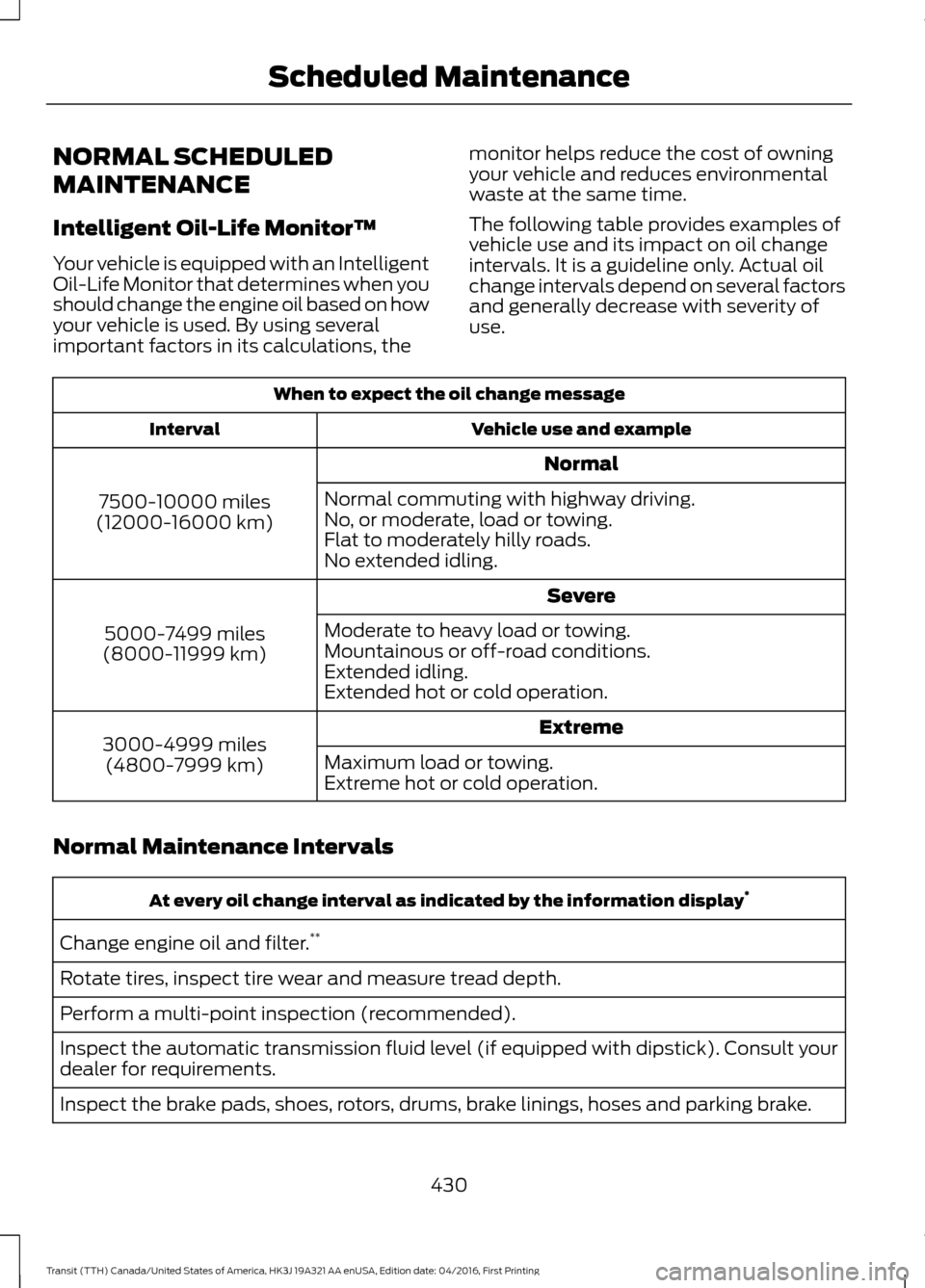
The following table provides examples of
vehicle use and its impact on oil change
intervals. It is a guideline only. Actual oil
change intervals depend on several factors
and generally decrease with severity of
use.When to expect the oil change message
Vehicle use and example
Interval
Normal
7500-10000 miles
(12000-16000 km) Normal commuting with highway driving.
No, or moderate, load or towing.
Flat to moderately hilly roads.
No extended idling.
Severe
5000-7499 miles
(8000-11999 km) Moderate to heavy load or towing.
Mountainous or off-road conditions.
Extended idling.
Extended hot or cold operation.
Extreme
3000-4999 miles
(4800-7999 km) Maximum load or towing.
Extreme hot or cold operation.
Normal Maintenance Intervals At every oil change interval as indicated by the information display
*
Change engine oil and filter. **
Rotate tires, inspect tire wear and measure tread depth.
Perform a multi-point inspection (recommended).
Inspect the automatic transmission fluid level (if equipped with dipstick). Consult your
dealer for requirements.
Inspect the brake pads, shoes, rotors, drums, brake linings, hoses and parking brake.
430
Transit (TTH) Canada/United States of America, HK3J 19A321 AA enUSA, Edition date: 04/2016, First Printing Scheduled Maintenance
Page 482 of 484
SYNC™ Troubleshooting.........................345
T
Technical Specifications
See: Capacities and Specifications.............281
The Better Business Bureau (BBB) Auto Line Program (U.S. Only).........................191
Tire Care..........................................................248
Glossary of Tire Terminology........................ 250
Inflating the Tires................................................ 257
Information About Uniform Tire Quality Grades.............................................................. 248
Information Contained on the Tire Sidewall............................................................. 251
Inspecting the Tires and Wheel Valve Stems............................................................... 260
Location of the Tire Label............................... 257
Tire Age................................................................... 261
Tire and Wheel Alignment............................. 263
Tire Damage........................................................ 260
Tire Pressure Monitoring System.................262
Tire Replacement Requirements.................. 261
Tire Rotation........................................................ 264
Tire Safety Practices......................................... 263
Tire Wear.............................................................. 260
United States Department of Transportation Tire Quality
Grades............................................................... 249
Tire Pressure Monitoring System..........266 Changing Tires With a Tire Pressure
Monitoring System....................................... 267
Tire Pressure Monitoring System Reset Procedure........................................................ 269
Understanding the Tire Pressure Monitoring System ............................................................. 267
Tires See: Wheels and Tires...................................... 247
Towing a Trailer
.............................................169
Load Placement................................................. 169
Towing the Vehicle on Four Wheels
...........................................................178
Emergency Towing............................................. 178
Recreational Towing.......................................... 179
Towing..............................................................169
Traction Control
............................................149
Principle of Operation....................................... 149
Trailer Sway Control
....................................170 Transmission Code Designation............287
Transmission...................................................141
Transmission
See: Transmission............................................... 141
Transporting the Vehicle............................187
Trip Computer
.................................................88
All Values................................................................ 88
Average Fuel Consumption............................. 88
Digital Speedometer.......................................... 88
Distance to Empty............................................... 88
Outside Air Temperature.................................. 88
Resetting the Trip Computer........................... 88
Trip Odometer....................................................... 88
Trip Timer................................................................ 88
U
Under Hood Overview - 3.2L Power Stroke Diesel................................................215
Under Hood Overview - 3.5L Ecoboost™..................................................213
Under Hood Overview - 3.7L.....................214
USB Port
...........................................................313
Using Cruise Control....................................157 Switching Cruise Control Off......................... 158
Switching Cruise Control On........................... 157
Using MyKey With Remote Start Systems..........................................................55
Using Power Running Boards....................64 Automatic Power Deploy.................................. 64
Automatic Power Stow..................................... 64
Bounce-back......................................................... 65
Enabling and Disabling...................................... 65
Manual Operation............................................... 66
Manual Power Deploy........................................ 64
Resetting the System......................................... 66
Using Snow Chains
.....................................265
Using Stability Control.................................151
Using SYNC™ With Your Media Player............................................................336
Accessing Your USB Song Library...............340
Bluetooth Devices and System Settings............................................................ 342
Connecting Your Digital Media Player to the USB Port.......................................................... 336
Media Menu Features...................................... 339
Media Voice Commands................................. 337
USB 2...................................................................... 342
479
Transit (TTH) Canada/United States of America, HK3J 19A321 AA enUSA, Edition date: 04/2016, First Printing Index