horn FORD TRANSIT 2019 User Guide
[x] Cancel search | Manufacturer: FORD, Model Year: 2019, Model line: TRANSIT, Model: FORD TRANSIT 2019Pages: 529, PDF Size: 8.57 MB
Page 217 of 529
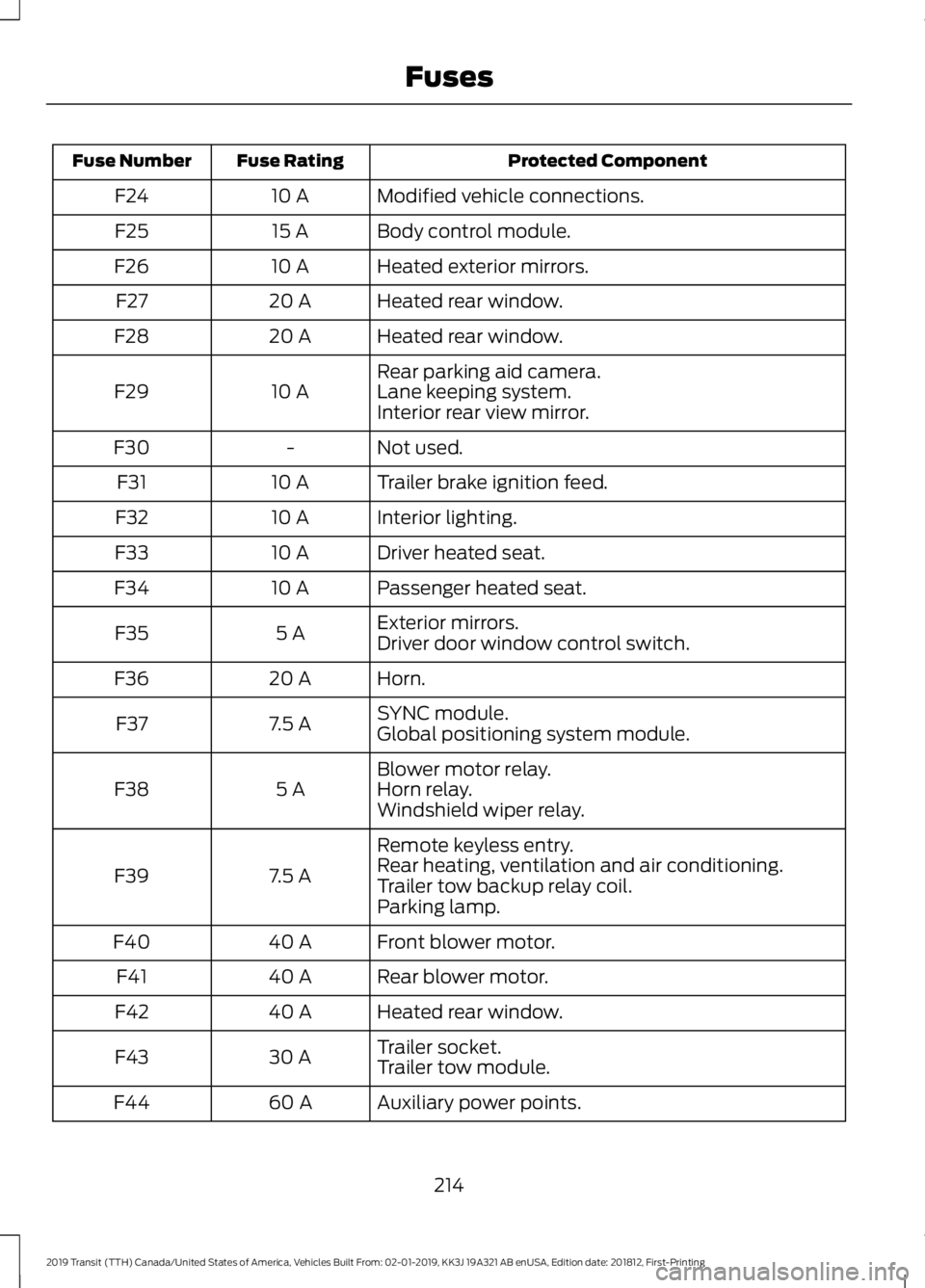
Protected Component
Fuse Rating
Fuse Number
Modified vehicle connections.
10 A
F24
Body control module.
15 A
F25
Heated exterior mirrors.
10 A
F26
Heated rear window.
20 A
F27
Heated rear window.
20 A
F28
Rear parking aid camera.
10 A
F29 Lane keeping system.
Interior rear view mirror.
Not used.
-
F30
Trailer brake ignition feed.
10 A
F31
Interior lighting.
10 A
F32
Driver heated seat.
10 A
F33
Passenger heated seat.
10 A
F34
Exterior mirrors.
5 A
F35
Driver door window control switch.
Horn.
20 A
F36
SYNC module.
7.5 A
F37
Global positioning system module.
Blower motor relay.
5 A
F38 Horn relay.
Windshield wiper relay.
Remote keyless entry.
7.5 A
F39 Rear heating, ventilation and air conditioning.
Trailer tow backup relay coil.
Parking lamp.
Front blower motor.
40 A
F40
Rear blower motor.
40 A
F41
Heated rear window.
40 A
F42
Trailer socket.
30 A
F43
Trailer tow module.
Auxiliary power points.
60 A
F44
214
2019 Transit (TTH) Canada/United States of America, Vehicles Built From: 02-01-2019, KK3J 19A321 AB enUSA, Edition date: 201812, First-Printing Fuses
Page 218 of 529
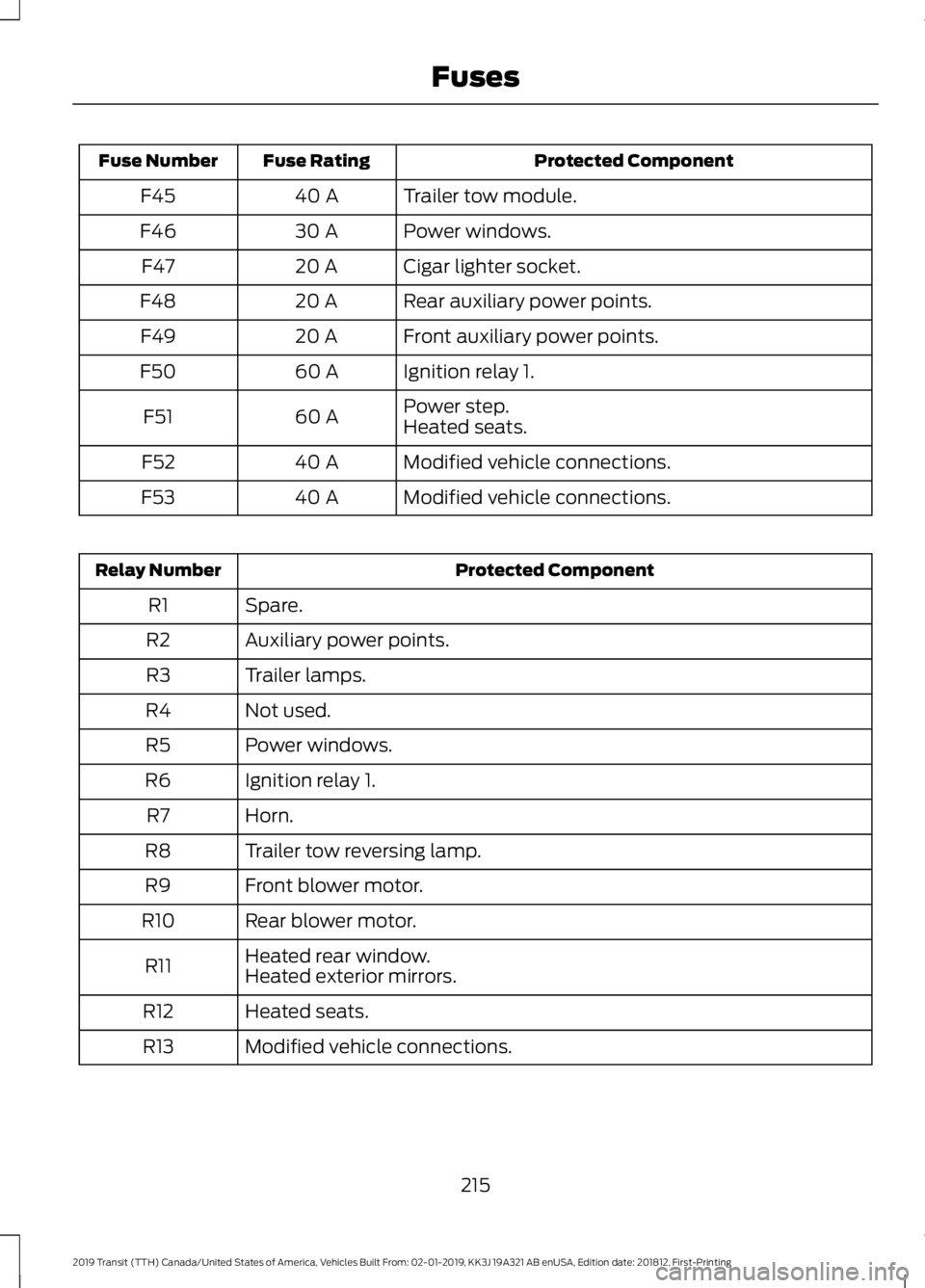
Protected Component
Fuse Rating
Fuse Number
Trailer tow module.
40 A
F45
Power windows.
30 A
F46
Cigar lighter socket.
20 A
F47
Rear auxiliary power points.
20 A
F48
Front auxiliary power points.
20 A
F49
Ignition relay 1.
60 A
F50
Power step.
60 A
F51
Heated seats.
Modified vehicle connections.
40 A
F52
Modified vehicle connections.
40 A
F53 Protected Component
Relay Number
Spare.
R1
Auxiliary power points.
R2
Trailer lamps.
R3
Not used.
R4
Power windows.
R5
Ignition relay 1.
R6
Horn.
R7
Trailer tow reversing lamp.
R8
Front blower motor.
R9
Rear blower motor.
R10
Heated rear window.
R11 Heated exterior mirrors.
Heated seats.
R12
Modified vehicle connections.
R13
215
2019 Transit (TTH) Canada/United States of America, Vehicles Built From: 02-01-2019, KK3J 19A321 AB enUSA, Edition date: 201812, First-Printing Fuses
Page 226 of 529
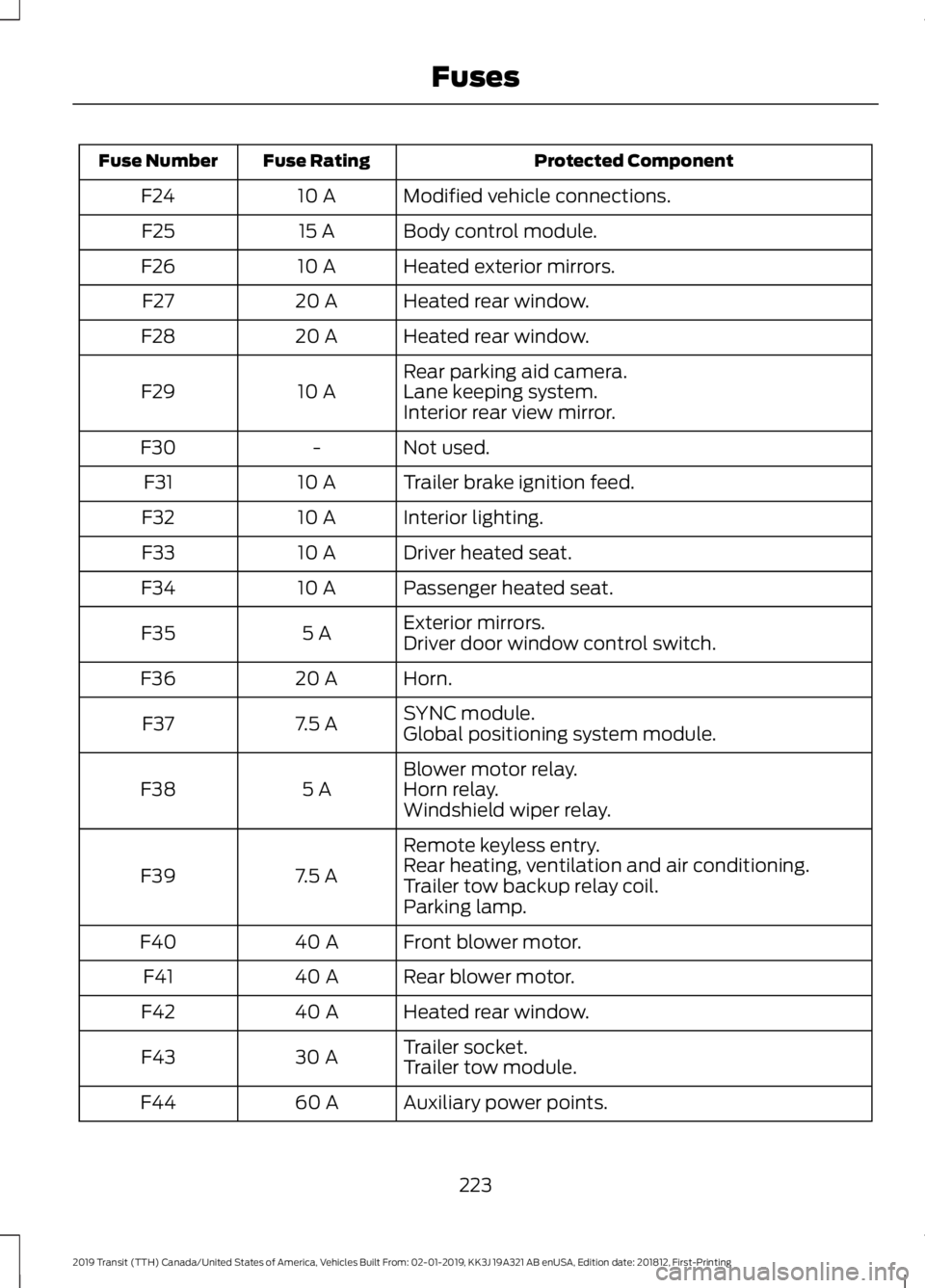
Protected Component
Fuse Rating
Fuse Number
Modified vehicle connections.
10 A
F24
Body control module.
15 A
F25
Heated exterior mirrors.
10 A
F26
Heated rear window.
20 A
F27
Heated rear window.
20 A
F28
Rear parking aid camera.
10 A
F29 Lane keeping system.
Interior rear view mirror.
Not used.
-
F30
Trailer brake ignition feed.
10 A
F31
Interior lighting.
10 A
F32
Driver heated seat.
10 A
F33
Passenger heated seat.
10 A
F34
Exterior mirrors.
5 A
F35
Driver door window control switch.
Horn.
20 A
F36
SYNC module.
7.5 A
F37
Global positioning system module.
Blower motor relay.
5 A
F38 Horn relay.
Windshield wiper relay.
Remote keyless entry.
7.5 A
F39 Rear heating, ventilation and air conditioning.
Trailer tow backup relay coil.
Parking lamp.
Front blower motor.
40 A
F40
Rear blower motor.
40 A
F41
Heated rear window.
40 A
F42
Trailer socket.
30 A
F43
Trailer tow module.
Auxiliary power points.
60 A
F44
223
2019 Transit (TTH) Canada/United States of America, Vehicles Built From: 02-01-2019, KK3J 19A321 AB enUSA, Edition date: 201812, First-Printing Fuses
Page 227 of 529
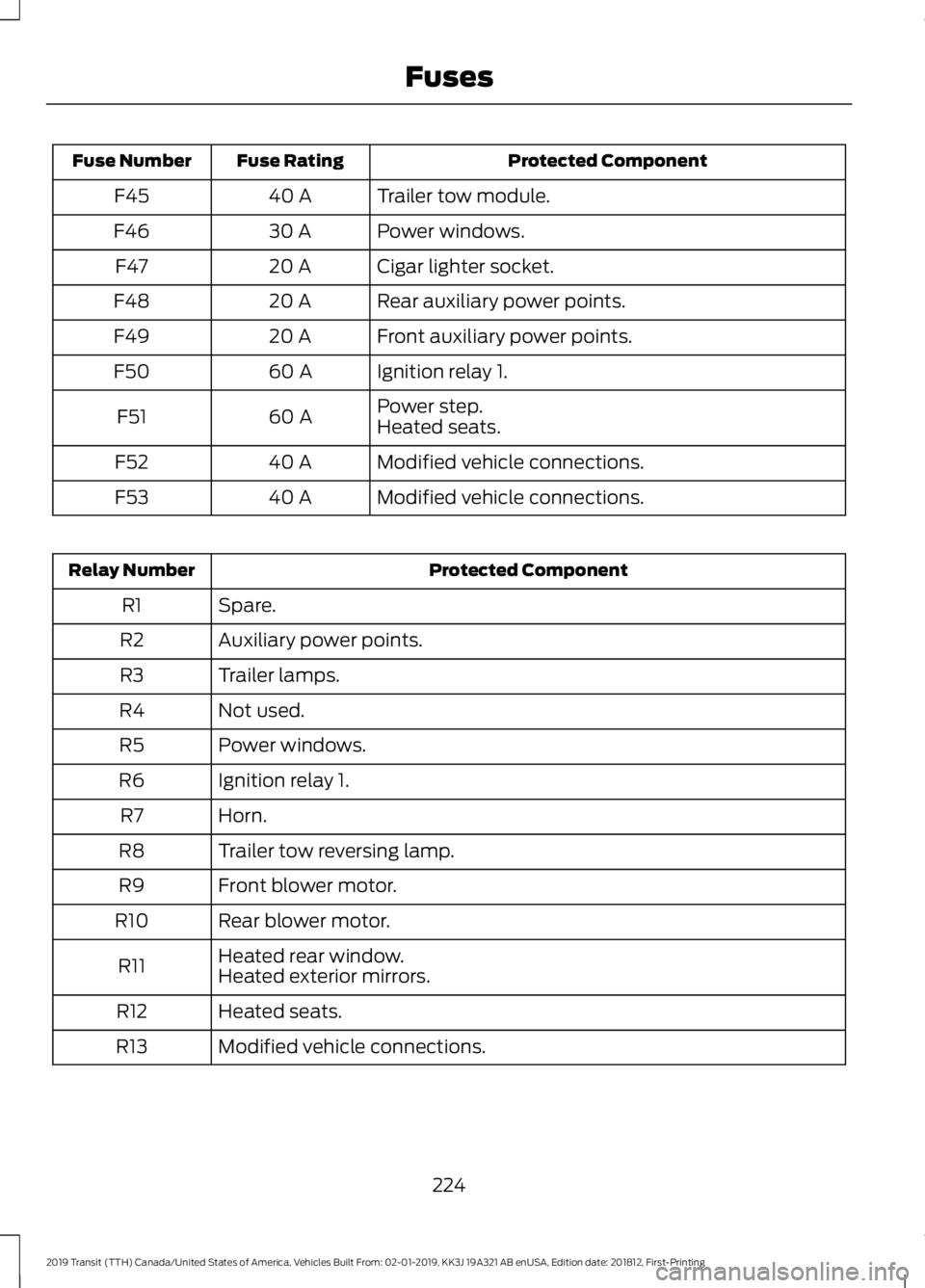
Protected Component
Fuse Rating
Fuse Number
Trailer tow module.
40 A
F45
Power windows.
30 A
F46
Cigar lighter socket.
20 A
F47
Rear auxiliary power points.
20 A
F48
Front auxiliary power points.
20 A
F49
Ignition relay 1.
60 A
F50
Power step.
60 A
F51
Heated seats.
Modified vehicle connections.
40 A
F52
Modified vehicle connections.
40 A
F53 Protected Component
Relay Number
Spare.
R1
Auxiliary power points.
R2
Trailer lamps.
R3
Not used.
R4
Power windows.
R5
Ignition relay 1.
R6
Horn.
R7
Trailer tow reversing lamp.
R8
Front blower motor.
R9
Rear blower motor.
R10
Heated rear window.
R11 Heated exterior mirrors.
Heated seats.
R12
Modified vehicle connections.
R13
224
2019 Transit (TTH) Canada/United States of America, Vehicles Built From: 02-01-2019, KK3J 19A321 AB enUSA, Edition date: 201812, First-Printing Fuses
Page 295 of 529
How Temperature Affects the Tire
Pressures
While driving in a normal manner, tire
pressures may increase up to 4 psi
(30 kPa) from a cold start situation. If the
vehicle is stationary overnight and the
temperature significantly lower than the
daytime temperature, tire pressures may
decrease up to 3 psi (20 kPa) for a drop of
30°F (17°C) in ambient temperature. This
lower pressure value will be detected by
the system as being significantly lower
than the correct inflation pressure and the
warning light will illuminate.
If the warning light is on:
• Check each tire to verify that none are
flat.
• If one or more tires are flat, repair as
necessary.
• Check the tire pressures and Inflate all
the tires to the correct pressure.
Tire Pressure Monitoring System
Reset Procedure
Carry out the tire pressure monitoring
system reset procedure after:
• Every tire rotation.
• Each tire replacement, only when the
sensor stays the same and does not
change.
Note: The tire pressure monitoring system
reset procedure will not work with a new
sensor until an authorized dealer programs
the new sensor. Overview WARNING:
To determine the
required pressure(s) for your vehicle, see
the Safety Compliance Certification
Label (on the door hinge pillar,
door-latch post or the door edge that
meets the door-latch post, next to the
driver seat) or the Tire Label on the
B-Pillar or the edge of the driver door.
To maintain your vehicle ’s load carrying
capability, this vehicle requires different
tire pressures in the front tires compared
to the rear tires. The system on your vehicle
is designed to illuminate the warning light
at different pressures for the front and rear
tires.
The tires need to be periodically rotated
to provide consistent performance and
maximum tire life, the system needs to
know when the tires have been rotated to
determine which set of tires are on the
front and rear axles. With this information,
the system can detect and correctly warn
of low tire pressures.
System Reset Tips:
• To reduce the chance of interference
from another vehicle, the system reset
procedure should be carried out at
least three feet (one meter) away from
another Ford vehicle undergoing the
system reset procedure.
• Do not wait more than two minutes
between resetting each tire sensor or
the system will time-out and the entire
procedure will have to be repeated on
all four wheels. A double horn chirp
indicates the need to repeat the
procedure.
Carrying Out the System Reset
Procedure
Read the entire procedure before carrying
out a system reset.
292
2019 Transit (TTH) Canada/United States of America, Vehicles Built From: 02-01-2019, KK3J 19A321 AB enUSA, Edition date: 201812, First-Printing Wheels and Tires
Page 296 of 529
1. Drive your vehicle above 20 mph
(32 km/h) for at least two minutes and
then park in a safe location where you
can easily get to all four tires and have
access to a tire inflation pump.
2. Switch the ignition off.
3. Switch the ignition on with the engine off.
4. Turn the hazard flashers on then off three times, this must be completed
within 10 seconds. If the reset mode
has been entered successfully, the horn
will chirp once and the system indicator
will flash. If this does not occur, repeat
the procedure from step 2. If after
repeated attempts to enter the reset
mode, the horn does not chirp and the
system indicator does not flash, have
your vehicle checked by an authorized
dealer as soon as possible.
5. Train the system sensors in the tires using the following reset sequence
starting with the left front tire and
following a clockwise order: Left front,
right front, right rear, left rear.
6. Remove the valve cap from the valve stem on the left front tire. Decrease the
air pressure until the horn chirps.
Note: The single horn chirp confirms that
the sensor identification code has been
learned by your vehicle for this position. If a
double horn chirp is heard, the reset
procedure was unsuccessful and must be
repeated.
7. Remove the valve cap from the valve stem on the right front tire. Decrease
the air pressure until the horn chirps.
8. Remove the valve cap from the valve stem on the right rear tire. Decrease the
air pressure until the horn chirps. 9. Remove the valve cap from the valve
stem on the left rear tire. Decrease the
air pressure until the horn chirps.
Training is complete when the horn
chirps after the last system sensor (left
rear) has been trained and the system
indicator stops flashing.
10. Switch the ignition off. If two short horn chirps are heard, the reset
procedure was unsuccessful and
must be repeated.
Note: If after repeating the procedure two
short horn chirps are heard again, have your
vehicle checked by an authorized dealer as
soon as possible.
11. Set all four tires to the correct pressure
See Maintenance (page
229). or the tire inflation pressure label
(located on the edge of driver door or
the B-Pillar).
CHANGING A ROAD WHEEL WARNING:
Do not use tire
sealants as they may damage the tire
pressure monitoring system. WARNING:
If the tire pressure
monitor sensor becomes damaged it
may not function.
Note: The tire pressure monitoring system
indicator light will illuminate when the spare
tire is in use. To restore the full function of
the monitoring system, all road wheels
equipped with tire pressure monitoring
sensors must be mounted on this vehicle.
If you get a flat tire while driving, do not
apply the brake heavily. Instead, gradually
decrease your speed. Hold the steering
wheel firmly and slowly move to a safe
place on the side of the road.
293
2019 Transit (TTH) Canada/United States of America, Vehicles Built From: 02-01-2019, KK3J 19A321 AB enUSA, Edition date: 201812, First-Printing Wheels and Tires
Page 472 of 529
Multi-point inspection
Horn operation.
Radiator, cooler, heater and A/C hoses.
Suspension component for leaks or
damage.
Steering and linkage.
Tires (including spare) for wear and
correct pressure **
.
Windshield for cracks, chips or pits.
Washer spray and wiper operation.
* Brake, coolant recovery reservoir,
automatic transmission, power steering (if
equipped with hydraulic power assist
steering) and window washer.
** If your vehicle is equipped with a
temporary mobility kit, check the tire
sealant expiration Use By date on the
canister. Replace as needed. Be sure to ask your dealership service
advisor or technician about the multi-point
vehicle inspection. It is a comprehensive
way to perform a thorough inspection of
your vehicle. Your checklist gives you
immediate feedback on the overall
condition of your vehicle.
NORMAL SCHEDULED
MAINTENANCE
Intelligent Oil-Life Monitor™
Your vehicle is equipped with an Intelligent
Oil-Life Monitor that determines when you
should change the engine oil based on how
your vehicle is used. By using several
important factors in its calculations, the
monitor helps reduce the cost of owning
your vehicle and reduces environmental
waste at the same time.
The following table provides examples of
vehicle use and its impact on oil change
intervals. It is a guideline only. Actual oil
change intervals depend on several factors
and generally decrease with severity of
use.
When to expect the oil change message
Vehicle use and example
Interval
Normal
7500-10000 miles
(12000-16000 km) Normal commuting with highway driving.
No, or moderate, load or towing.
Flat to moderately hilly roads.
No extended idling.
Severe
5000-7499 miles
(8000-11999 km) Moderate to heavy load or towing.
Mountainous or off-road conditions.
Extended idling.
469
2019 Transit (TTH) Canada/United States of America, Vehicles Built From: 02-01-2019, KK3J 19A321 AB enUSA, Edition date: 201812, First-Printing Scheduled Maintenance
Page 523 of 529
H
Handbrake
See: Parking Brake - Vehicles With:
Mechanical Parking Brake.......................... 156
See: Parking Brake - Vehicles With: Push Down Parking Brake..................................... 156
Hazard Flashers............................................195
Headlamp Adjusting See: Adjusting the Headlamps..................... 247
Headlamp Removal See: Removing a Headlamp.......................... 248
Headrest See: Head Restraints........................................... 111
Head Restraints...............................................111
Adjusting the Head Restraint.......................... 112
Installing the Head Restraint .......................... 112
Removing the Head Restraint......................... 112
Heated Seats
..................................................119
Heated Windows and Mirrors..................109 Heated Exterior Mirrors..................................... 110
Heated Rear Window....................................... 109
Heating See: Climate Control......................................... 107
Hill Start Assist
..............................................157
Switching the System On and Off...............158
Using Hill Start Assist........................................ 157
Hints on Controlling the Interior Climate ..........................................................
108
Cooling the Interior Quickly............................ 108
General Hints....................................................... 108
Heating the Interior Quickly........................... 108
Maximum Cooling Performance in Instrument Panel or Instrument Panel
and Footwell Positions............................... 109
Recommended Settings for Cooling .........108
Recommended Settings for Heating..........108
Side Window Defogging in Cold Weather............................................................ 109
Vehicle Stationary for Extended Periods During Extreme High Ambient
Temperatures................................................. 108
Hints on Driving With Anti-Lock Brakes
............................................................155
Home Screen.................................................401
Hood Lock See: Opening and Closing the Hood..........229
Horn.....................................................................79 I
Ignition Switch
...............................................124
In California (U.S. Only)............................202
Information Displays.....................................97 General Information............................................ 97
Information Messages
.................................101
Installing Child Restraints............................19 Child Safety Restraint.......................................... 19
Using Lap and Shoulder Belts......................... 20
Using Lower Anchors and Tethers for Children (LATCH)............................................ 22
Using Tether Straps............................................. 28
Instrument Cluster
..........................................91
Instrument Lighting Dimmer.....................84
Interior Lamps
.................................................85
Courtesy Lamp...................................................... 85
Entrance Lamps................................................... 85
Reading Lamps..................................................... 85
Interior Mirror...................................................89 Automatic Dimming Mirror.............................. 89
Manual Dimming Mirror..................................... 89
Introduction.........................................................7
J
Jump Starting the Vehicle.........................196 Connecting the Jumper Cables..................... 197
Jump Starting....................................................... 197
Preparing Your Vehicle..................................... 196
Removing the Jumper Cables........................ 197
K
Keys and Remote Controls.........................67 Principle of Operation......................................... 67
L
Lane Keeping System.................................170 Lane Keeping Alert............................................. 170
Lighting Control..............................................82 Flashing High Beam Headlamps.................... 83
Lighting Control Positions................................. 82
Switching All of the Parking Lamps On........................................................................\
.. 82
Switching High Beam Headlamps On and Off........................................................................\
. 83
520
2019 Transit (TTH) Canada/United States of America, Vehicles Built From: 02-01-2019, KK3J 19A321 AB enUSA, Edition date: 201812, First-Printing Index