roof rack FORD TRANSIT 2021 Owners Manual
[x] Cancel search | Manufacturer: FORD, Model Year: 2021, Model line: TRANSIT, Model: FORD TRANSIT 2021Pages: 509, PDF Size: 8.21 MB
Page 8 of 509
Cruise Control
Principle of Operation
...............................198
Using Cruise Control ..................................
198
Using Adaptive Cruise Control ...............
199
Driving Aids
Speed Limiter ..............................................
206
Driver Alert .....................................................
207
Lane Keeping System ...............................
208
Blind Spot Information System ..............
212
Cross Traffic Alert ........................................
216
Eco .....................................................................
219
Steering ..........................................................
220
Pre-Collision Assist .....................................
221
Front View Camera ....................................
225
Drive Control .................................................
226
Load Carrying
Roof Racks and Load Carriers - Bus .....
228
Roof Racks and Load Carriers - Van ........................................................................\
228
Load Retaining Fixtures ............................
228
Load Limit ......................................................
229
Towing
Towing a Trailer ...........................................
234
Recommended Towing Weights - Chassis Cab/Crew Van/Cutaway/Van
........................................................................\
235
Recommended Towing Weights - M2 Bus ................................................................
237
Essential Towing Checks .........................
239
Towing the Vehicle on Four Wheels .....
245
Driving Hints
Reduced Engine Performance ...............
246
Economical Driving ....................................
246
Cold Weather Precautions ......................
246
Breaking-In ....................................................
247
Driving Through Water ..............................
247Floor Mats
......................................................
247
Roadside Emergencies
Roadside Assistance .................................
249
Hazard Flashers ..........................................
250
Emergency Exit - M2 Bus .........................
250
Fuel Shutoff ..................................................
250
Jump Starting the Vehicle ........................
251
Transporting the Vehicle ..........................
253
Towing Points ...............................................
254
Crash and Breakdown Information
Post-Crash Alert System .........................
255
Customer Assistance
Ford Credit ....................................................
256
Getting the Services You Need ..............
256
In California (U.S. Only) ............................
257
The Better Business Bureau (BBB) Auto Line Program (U.S. Only) ....................
258
Utilizing the Mediation/Arbitration Program (Canada Only) ......................
259
Getting Assistance Outside the U.S. and Canada .......................................................
259
Ordering Additional Owner's Literature ........................................................................\
.
261
Reporting Safety Defects (U.S. Only) ........................................................................\
.
261
Reporting Safety Defects (Canada Only) ........................................................................\
262
Fuses
Fuse Box Locations ....................................
263
Fuse Specification Chart .........................
264
Changing a Fuse ..........................................
276
Maintenance
General Information ..................................
278
Opening and Closing the Hood .............
278
5
2021 Transit (TTH) Canada/United States of America, MK3J 19A321 AA enUSA, Edition date: 202010, Second-Printing Table of Contents
Page 184 of 509
PRINCIPLE OF OPERATION
WARNING: Vehicle modifications
involving braking system, aftermarket
roof racks, suspension, steering system,
tire construction and wheel and tire size
may change the handling characteristics
of your vehicle and may adversely affect
the performance of the electronic
stability control system. In addition,
installing any stereo loudspeakers may
interfere with and adversely affect the
electronic stability control system. Install
any aftermarket stereo loudspeaker as
far as possible from the front center
console, the tunnel, and the front seats
in order to minimize the risk of interfering
with the electronic stability control
sensors. Reducing the effectiveness of
the electronic stability control system
could lead to an increased risk of loss of
vehicle control, vehicle rollover, personal
injury and death. WARNING:
Remember that even
advanced technology cannot defy the
laws of physics. It's always possible to
lose control of a vehicle due to
inappropriate driver input for the
conditions. Aggressive driving on any
road condition can cause you to lose
control of your vehicle increasing the risk
of personal injury or property damage.
Activation of the electronic stability
control system is an indication that at
least some of the tires have exceeded
their ability to grip the road; this could
reduce the operator's ability to control
the vehicle potentially resulting in a loss
of vehicle control, vehicle rollover,
personal injury and death. If your
electronic stability control system
activates, SLOW DOWN.
The system automatically turns on each
time you switch the ignition on. If the stability control or traction control
system detects a fault, the following may
occur:
•
The stability and traction control light
illuminates steadily.
• The stability control and traction
control systems do not enhance your
vehicle's ability to maintain traction of
the wheels.
If the stability control or traction control
system activates, the following may occur:
• The stability and traction control light
flashes.
• Your vehicle slows down.
• Reduced engine power.
• A vibration in the brake pedal.
• The brake pedal is stiffer than usual.
• If the driving condition is severe and
your foot is not on the brake pedal, the
pedal may move as the system applies
higher brake force.
The stability control system has several
features built into it to help you maintain
control of your vehicle.
Electronic Stability Control
The system helps to prevent your vehicle
skidding or laterally sliding by individually
applying the brakes to one or more wheels
and, if necessary, reducing engine power.
Roll Stability Control
The system helps to prevent rollovers by
detecting your vehicle's roll motion, and
individually applying the brakes to one or
more wheels.
181
2021 Transit (TTH) Canada/United States of America, MK3J 19A321 AA enUSA, Edition date: 202010, Second-Printing Stability Control
Page 231 of 509
ROOF RACKS AND LOAD
CARRIERS - BUS
WARNING: Your vehicle is not
approved for roof racks. Never install a
roof rack to your vehicle.
ROOF RACKS AND LOAD
CARRIERS - VAN WARNING:
When loading the roof
racks, we recommend you evenly
distribute the load, as well as maintain
a low center of gravity. Loaded vehicles,
with higher centers of gravity, may
handle differently than unloaded
vehicles. Take extra precautions, such
as slower speeds and increased stopping
distance, when driving a heavily loaded
vehicle. WARNING:
Do not exceed the
maximum front and rear axle loads for
your vehicle. WARNING:
Read and follow the
manufacturer's instructions when you
are fitting a roof rack.
Maximum Roof Load lb (kg)
Variant
419 (190)
Low-Roof.
331 (150)
Medium-Roof.
220 (100)
High-Roof.
Make sure that you securely fasten the
load. Check that the straps are secure
before driving and at each fuel stop. We recommend that you use genuine Ford
accessory crossbars specifically designed
for your vehicle.
Never place loads directly on the roof
panel.
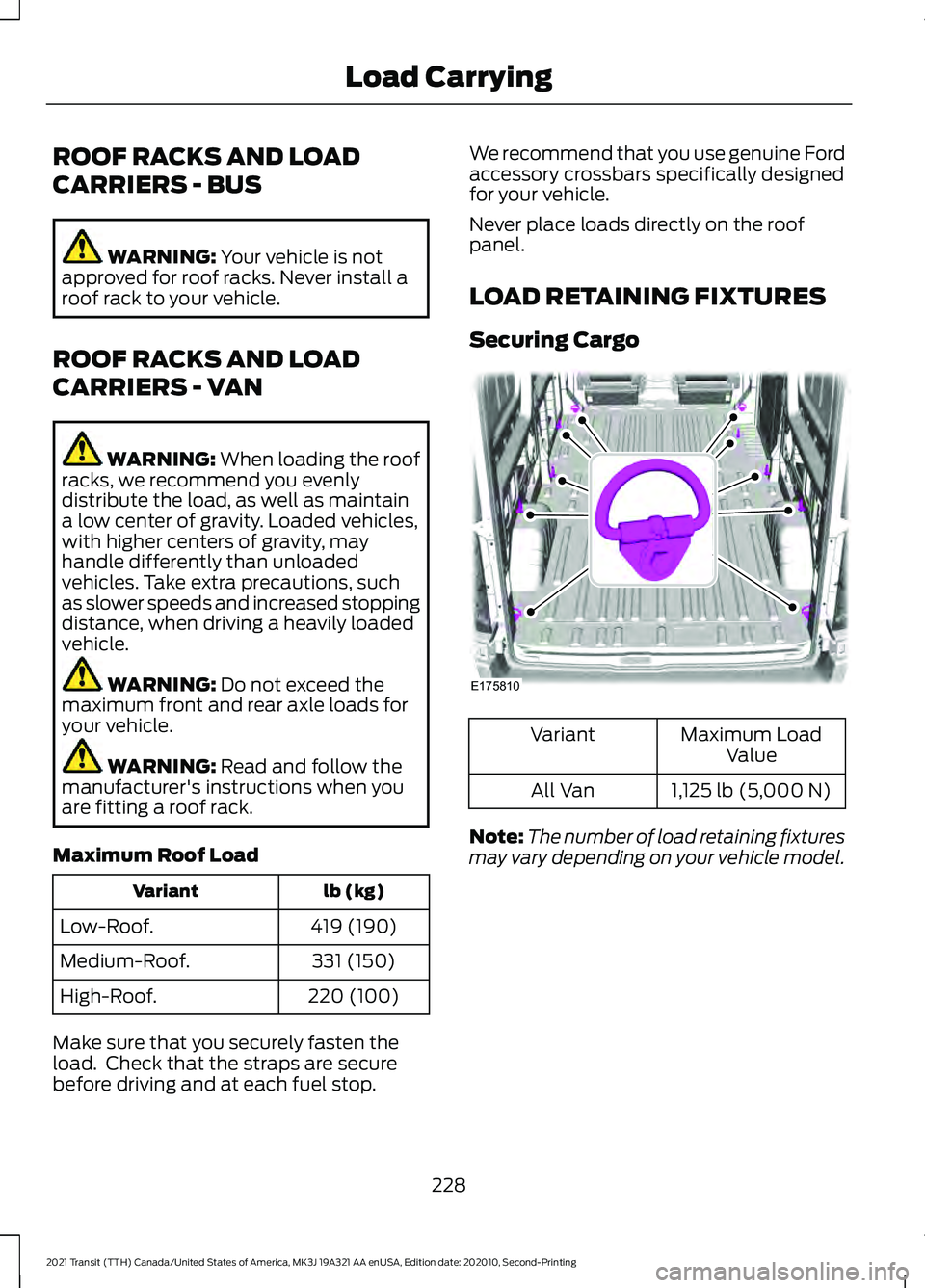
LOAD RETAINING FIXTURES
Securing Cargo
Maximum Load
Value
Variant
1,125 lb (5,000 N)
All Van
Note: The number of load retaining fixtures
may vary depending on your vehicle model.
228
2021 Transit (TTH) Canada/United States of America, MK3J 19A321 AA enUSA, Edition date: 202010, Second-Printing Load CarryingE175810
Page 236 of 509
- 1200 = - 240 pounds. No, you do
not have enough cargo capacity
to carry that much weight. In
metric units, the calculation would
be: 635 kilograms - (2 x 99
kilograms) - (12 x 45 kilograms) =
635 - 198 - 540 = -103 kilograms.
You will need to reduce the load
weight by at least 240 pounds
(104 kilograms). If you remove
three 100-pound (45-kilogram)
cement bags, then the load
calculation would be:1400 - (2 x
220) - (9 x 100) = 1400 - 440 -
900 = 60 pounds. Now you have
the load capacity to transport the
cement and your friend home. In
metric units, the calculation would
be: 635 kilograms - (2 x 99
kilograms) - (9 x 45 kilograms) =
635 - 198 - 405 = 32 kilograms.
The above calculations also
assume that the loads are
positioned in your vehicle in a
manner that does not overload
the front or the rear gross axle
weight rating specified for your
vehicle on the Safety Compliance
Certification label.
Special Loading Instructions
for Owners of Pick-up Trucks
and Utility-type Vehicles
WARNING: When loading
the roof racks, we recommend
you evenly distribute the load,
as well as maintain a low center
of gravity. Loaded vehicles, with
higher centers of gravity, may handle differently than unloaded
vehicles. Take extra precautions,
such as slower speeds and
increased stopping distance,
when driving a heavily loaded
vehicle.
233
2021 Transit (TTH) Canada/United States of America, MK3J 19A321 AA enUSA, Edition date: 202010, Second-Printing Load Carrying
Page 249 of 509
REDUCED ENGINE
PERFORMANCE
WARNING: If you continue to drive
your vehicle when the engine is
overheating, the engine could stop
without warning. Failure to follow this
instruction could result in the loss of
control of your vehicle.
If the engine coolant temperature gauge
needle moves to the upper limit position,
the engine is overheating. See Gauges
(page 110).
You must only drive your vehicle for a short
distance if the engine overheats. The
distance you can travel depends on
ambient temperature, vehicle load and
terrain. The engine continues to operate
with limited power for a short period of
time.
If the engine temperature continues to rise,
the fuel supply to the engine reduces. The
air conditioning switches off and the engine
cooling fan operates continually.
1. Gradually reduce your speed and stop your vehicle as soon as it is safe to do
so.
2. Immediately switch the engine off to prevent severe engine damage.
3. Wait for the engine to cool down.
4. Check the coolant level. See
Engine
Coolant Check (page 285).
5. Have your vehicle checked as soon as possible. ECONOMICAL DRIVING
The following helps to improve fuel
consumption:
•
Regularly check your tire pressures and
make sure that they are inflated to the
correct pressure.
• Follow the recommended maintenance
schedule and carry out the
recommended checks.
• Plan your journey and check the traffic
before you set off.
• Avoid idling the engine in cold weather
or for extended periods. Start the
engine only when you are ready to set
off.
• Do not carry unnecessary weight in your
vehicle as extra weight wastes fuel.
• Do not add unnecessary accessories
to the exterior of your vehicle, for
example running boards. If you use a
roof rack, remember to fold it down or
remove it when not in use.
• Drive smoothly, accelerate gently and
anticipate the road ahead to avoid
heavy braking.
• Switch off all electric systems when
not in use, for example air conditioning.
Make sure that you unplug any
accessories from the auxiliary power
points when not in use.
COLD WEATHER
PRECAUTIONS
The functional operation of some
components and systems can be affected
at temperatures below approximately
-13°F (-25°C)
.
246
2021 Transit (TTH) Canada/United States of America, MK3J 19A321 AA enUSA, Edition date: 202010, Second-Printing Driving Hints
Page 307 of 509
Body Paintwork Preservation
Frequently remove particles such as bird
droppings, tree sap, insect deposits, tar
spots, road salt and industrial fallout to
avoid paint surface damage.
Frequently wash the underbody of your
vehicle if salt is applied on the road.
We recommend that you wax the
paintwork once or twice a year.
Note:
Do not apply polish in strong sunlight
as this dries the polish too quickly.
Note: Do not allow polish to come in
contact with unpainted plastic surfaces as
it can be difficult to remove.
Note: Do not apply polish to the windshield
or rear window. A contaminated windshield
or contaminated wiper blades may lead to
increased wiper noise, reduced wipe quality
or reduced rain sensor performance.
Sliding Door Tracks WARNING: Do not open or close
the sliding doors when your hands are
near the tracks or rollers.
To clean the sliding door tracks, wipe the
surface using a clean, cotton cloth with a
mild soap and water solution.
Do not use a commercial or high-pressure
washer.
WAXING
Regular waxing is necessary to protect your
car's paint from the elements. We
recommend that you wash and wax the
painted surface once or twice a year.
When washing and waxing, park your
vehicle in a shaded area out of direct
sunlight. Always wash your vehicle before
applying wax. •
Use a quality wax that does not contain
abrasives.
• Follow the manufacturer ’s instructions
to apply and remove the wax.
• Apply a small amount of wax in a
back-and-forth motion, not in circles.
• Do not allow wax to come in contact
with any non-body (low-gloss black)
colored trim. The wax will discolor or
stain the parts over time.
•Roof racks.
• Bumpers.
• Grained door handles.
• Side moldings.
• Mirror housings.
• Windshield cowl area.
• Do not apply wax to glass areas.
• After waxing, your car's paint should
feel smooth, and be free of streaks and
smudges.
CLEANING THE ENGINE
Engines are more efficient when they are
clean because grease and dirt buildup keep
the engine warmer than normal.
When washing:
• Take care when using a power washer
to clean the engine. The high-pressure
fluid could penetrate the sealed parts
and cause damage.
• Do not spray a hot engine with cold
water to avoid cracking the engine
block or other engine components.
• Spray Motorcraft Engine Shampoo and
Degreaser on all parts that require
cleaning and pressure rinse clean. In
Canada, use Motorcraft Engine
Shampoo.
304
2021 Transit (TTH) Canada/United States of America, MK3J 19A321 AA enUSA, Edition date: 202010, Second-Printing Vehicle Care
Page 501 of 509
Keys and Remote Controls.........................63
Principle of Operation........................................ 63
L
Lane Keeping System................................208 Lane Keeping System Display....................... 210
Lane Keeping System Messages................... 211
Lane Keeping System Settings.................... 209
Lane Keeping System Warning Lamps and Indicators........................................................... 211
Switching Lane Keeping System On or Off...................................................................... 209
Lighting Control............................................100 Exterior Lamps On Audible Warning............101
Flashing High Beam Headlamps................... 101
High Beam Headlamp Indicator.................... 101
Lamps On Indicator............................................ 101
Lighting Control Positions.............................. 100
Switching High Beam Headlamps On and Off........................................................................\
101
Switching the Parking Lamps On................100
Lighting............................................................100 General Information......................................... 100
Load Carriers See: Roof Racks and Load Carriers -
Bus...................................................................... 228
See: Roof Racks and Load Carriers - Van..................................................................... 228
Load Carrying................................................228
Load Limit.......................................................229 Special Loading Instructions for Owners of
Pick-up Trucks and Utility-type
Vehicles............................................................. 233
Vehicle Loading - with and without a Trailer................................................................. 229
Load Retaining Fixtures
.............................228
Securing Cargo................................................... 228
Locating the Cabin Air Filter.....................125
Locating the Keyless Entry Keypad.........87
Locking and Unlocking.................................76 Autolock................................................................... 78
Autounlock.............................................................. 79
Configurable Unlocking...................................... 79
Locking..................................................................... 76
Locking and Unlocking the Doors From Inside.................................................................... 76
One-Stage Unlocking......................................... 79Opening the Double Rear Doors.....................
77
Rear Emergency Exit........................................... 78
Two-Stage Unlocking......................................... 79
Unlocking................................................................. 76
Zone Re-Locking................................................... 79
Locking and Unlocking the Doors Using Keyless Entry
................................................88
Locking the Doors................................................ 88
Unlocking the Doors........................................... 88
Locking the Steering Wheel.......................96 Unlocking the Steering Wheel........................ 96
Lug Nuts See: Changing a Road Wheel....................... 339
Lug Nuts
..........................................................350
Locking Lug Nuts................................................. 351
Lug Nut Torque................................................... 350
M
Maintenance..................................................278 General Information.......................................... 278
Manual Climate Control
.............................122
Directing Air to the Footwell Air Vents........122
Directing Air to the Instrument Panel Air
Vents................................................................... 122
Directing Air to the Windshield Air Vents................................................................... 122
Setting the Blower Motor Speed................... 122
Setting the Temperature.................................. 123
Switching Maximum Cooling On and Off........................................................................\
122
Switching Maximum Defrost On and Off........................................................................\
122
Switching the Air Conditioning On and Off........................................................................\
122
Switching the Climate Control On and Off........................................................................\
122
Switching the Recirculated Air On and Off........................................................................\
122
Manually Releasing the Electric Parking Brake...............................................................177
........................................................................\
............ 177
Manual Seats - Vehicles With: 2-Way Manual Seat.................................................127
Adjusting the Armrest....................................... 128
Adjusting the Lumbar Support...................... 128
Adjusting the Seat Backrest........................... 128
498
2021 Transit (TTH) Canada/United States of America, MK3J 19A321 AA enUSA, Edition date: 202010, Second-Printing Index
Page 504 of 509
System Settings..................................................
195
Using the Rear View Camera......................... 194
Recommended Towing Weights - Chassis Cab/Crew Van/Cutaway/
Van.................................................................235
Calculating the Maximum Loaded Trailer Weight for Your Vehicle............................... 237
Recommended Towing Weights - M2 Bus..................................................................237
Calculating the Maximum Loaded Trailer Weight for Your Vehicle.............................. 239
Reduced Engine Performance................246
Refueling..........................................................155 System Warnings............................................... 156
Releasing the Electric Parking Brake if the Vehicle Battery Has Run Out of
Charge
............................................................178
Releasing the Parking Brake.....................174
Remote Control - Vehicles With: Passive Anti-Theft System (PATS)......................65
Changing the Remote Control Battery........66
Integrated Keyhead Transmitter.................... 65
Locating Your Vehicle......................................... 66
Programming a New Remote Control.........66
Switching the Panic Alarm On and Off........67
Remote Control - Vehicles With: Power Sliding Door...................................................67
Changing the Remote Control Battery.........67
Locating Your Vehicle......................................... 68
Remote Control Information Messages........................................................... 69
Remote Control - Vehicles Without: Passive Anti-Theft System
(PATS).............................................................64
Changing the Remote Control Battery........64
Integrated Keyhead Transmitter.................... 64
Locating Your Vehicle......................................... 65
Programming a New Remote Control.........64
Switching the Panic Alarm On and Off........................................................................\
. 65
Remotely Starting and Stopping the Vehicle...........................................................120
Remote Start Limitations..........................120
Remote Start
.................................................120
Remote Start Settings................................120
Climate Control Settings................................. 120
Heated Seat Settings......................................... 121
Setting the Remote Start Duration...............121 Removing a Headlamp..............................295
Repairing Minor Paint Damage..............308
Replacement Parts
Recommendation....................................459
Collision Repairs................................................ 459
Scheduled Maintenance and Mechanical Repairs.............................................................. 459
Warranty on Replacement Parts.................459
Replacing a Lost Key or Remote Control............................................................69
Replacing the Cabin Air Filter...................125
Reporting Safety Defects (Canada Only)..............................................................262
Reporting Safety Defects (U.S. Only)...............................................................261
Resetting the Power Sliding Door...........84
Restarting the Engine.................................148
Roadside Assistance
..................................249
Vehicles Sold in Canada: Getting Roadside
Assistance....................................................... 250
Vehicles Sold in the United States: Getting Roadside Assistance................................... 249
Vehicles Sold in the United States: Using Roadside Assistance................................... 249
Roadside Emergencies..............................249
Roof Racks and Load Carriers - Bus
..................................................................228
Roof Racks and Load Carriers - Van.................................................................228
Running-In See: Breaking-In.................................................. 247
Running Out of Fuel.....................................153 Adding Fuel From a Portable Fuel
Container.......................................................... 154
Filling a Portable Fuel Container.................. 154
S
Safety Canopy ™
............................................58
Safety Precautions........................................151
Scheduled Maintenance
..........................446
Seatbelt Extensions......................................49
Seatbelt Height Adjustment
.....................46
Seatbelt Reminder.........................................47
Belt-Minder™........................................................ 47
Seatbelts...........................................................43 Principle of Operation........................................ 43
501
2021 Transit (TTH) Canada/United States of America, MK3J 19A321 AA enUSA, Edition date: 202010, Second-Printing Index