wheel FORD TRANSIT 2021 Owners Manual
[x] Cancel search | Manufacturer: FORD, Model Year: 2021, Model line: TRANSIT, Model: FORD TRANSIT 2021Pages: 509, PDF Size: 8.21 MB
Page 5 of 509
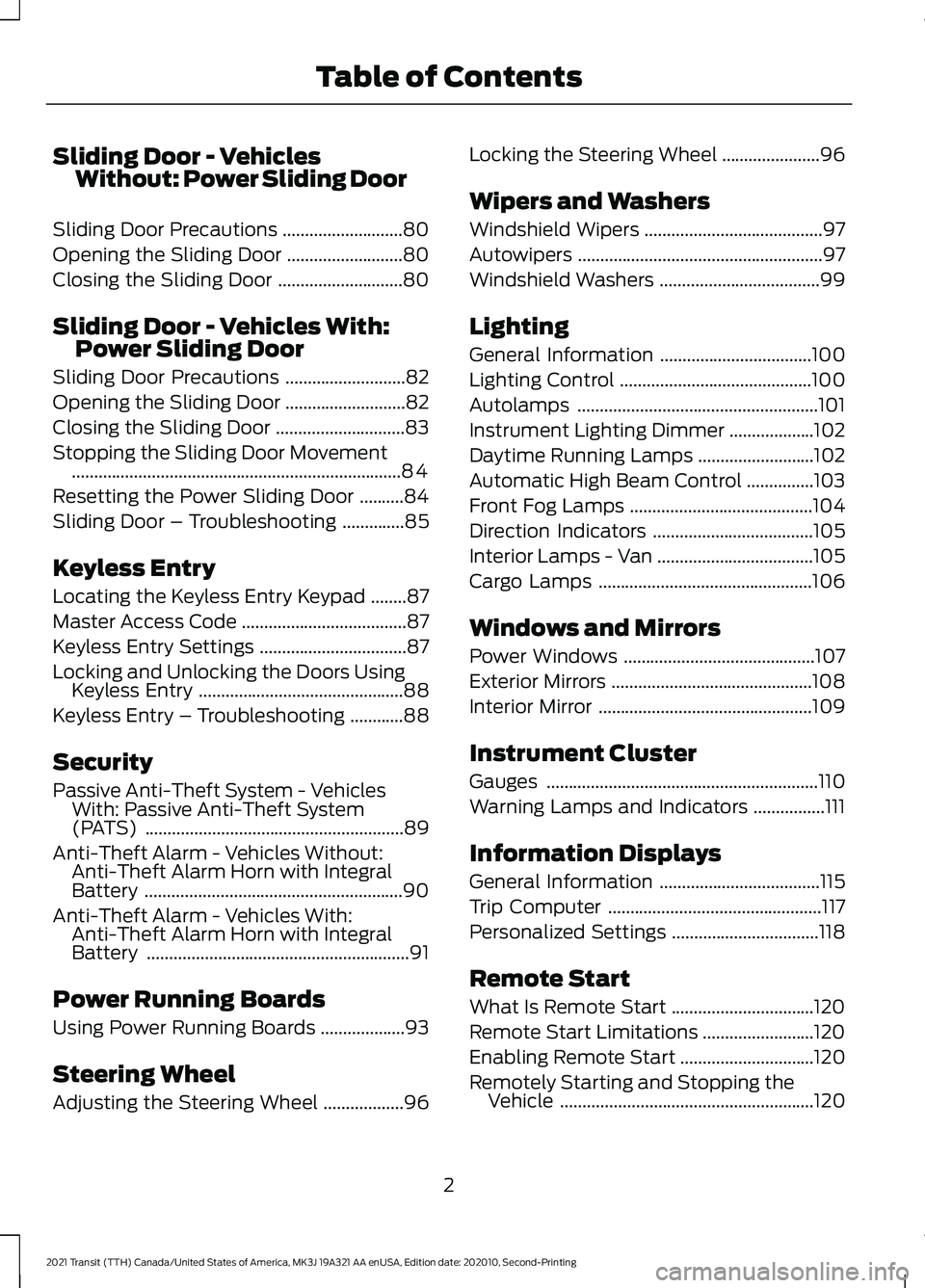
Sliding Door - Vehicles
Without: Power Sliding Door
Sliding Door Precautions ...........................80
Opening the Sliding Door ..........................
80
Closing the Sliding Door ............................
80
Sliding Door - Vehicles With: Power Sliding Door
Sliding Door Precautions ...........................
82
Opening the Sliding Door ...........................
82
Closing the Sliding Door .............................
83
Stopping the Sliding Door Movement ........................................................................\
..
84
Resetting the Power Sliding Door ..........
84
Sliding Door – Troubleshooting ..............
85
Keyless Entry
Locating the Keyless Entry Keypad ........
87
Master Access Code .....................................
87
Keyless Entry Settings .................................
87
Locking and Unlocking the Doors Using Keyless Entry ..............................................
88
Keyless Entry – Troubleshooting ............
88
Security
Passive Anti-Theft System - Vehicles With: Passive Anti-Theft System
(PATS) ..........................................................
89
Anti-Theft Alarm - Vehicles Without: Anti-Theft Alarm Horn with Integral
Battery ..........................................................
90
Anti-Theft Alarm - Vehicles With: Anti-Theft Alarm Horn with Integral
Battery ...........................................................
91
Power Running Boards
Using Power Running Boards ...................
93
Steering Wheel
Adjusting the Steering Wheel ..................
96Locking the Steering Wheel
......................
96
Wipers and Washers
Windshield Wipers ........................................
97
Autowipers .......................................................
97
Windshield Washers ....................................
99
Lighting
General Information ..................................
100
Lighting Control ...........................................
100
Autolamps ......................................................
101
Instrument Lighting Dimmer ...................
102
Daytime Running Lamps ..........................
102
Automatic High Beam Control ...............
103
Front Fog Lamps .........................................
104
Direction Indicators ....................................
105
Interior Lamps - Van ...................................
105
Cargo Lamps ................................................
106
Windows and Mirrors
Power Windows ...........................................
107
Exterior Mirrors .............................................
108
Interior Mirror ................................................
109
Instrument Cluster
Gauges .............................................................
110
Warning Lamps and Indicators ................
111
Information Displays
General Information ....................................
115
Trip Computer ................................................
117
Personalized Settings .................................
118
Remote Start
What Is Remote Start ................................
120
Remote Start Limitations .........................
120
Enabling Remote Start ..............................
120
Remotely Starting and Stopping the Vehicle .........................................................
120
2
2021 Transit (TTH) Canada/United States of America, MK3J 19A321 AA enUSA, Edition date: 202010, Second-Printing Table of Contents
Page 7 of 509
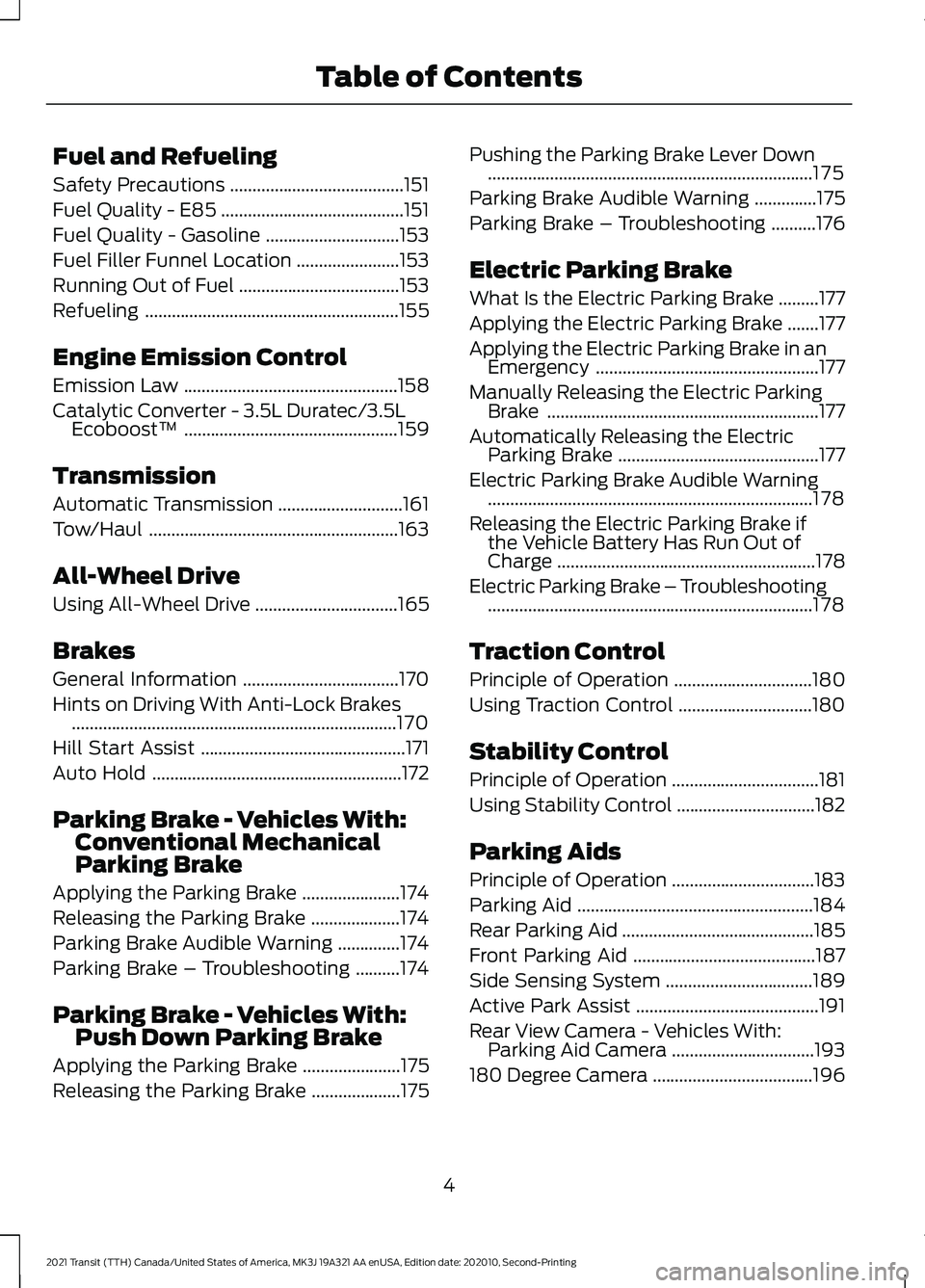
Fuel and Refueling
Safety Precautions
.......................................151
Fuel Quality - E85 .........................................
151
Fuel Quality - Gasoline ..............................
153
Fuel Filler Funnel Location .......................
153
Running Out of Fuel ....................................
153
Refueling .........................................................
155
Engine Emission Control
Emission Law ................................................
158
Catalytic Converter - 3.5L Duratec/3.5L Ecoboost™ ................................................
159
Transmission
Automatic Transmission ............................
161
Tow/Haul ........................................................
163
All-Wheel Drive
Using All-Wheel Drive ................................
165
Brakes
General Information ...................................
170
Hints on Driving With Anti-Lock Brakes ........................................................................\
.
170
Hill Start Assist ..............................................
171
Auto Hold ........................................................
172
Parking Brake - Vehicles With: Conventional Mechanical
Parking Brake
Applying the Parking Brake ......................
174
Releasing the Parking Brake ....................
174
Parking Brake Audible Warning ..............
174
Parking Brake – Troubleshooting ..........
174
Parking Brake - Vehicles With: Push Down Parking Brake
Applying the Parking Brake ......................
175
Releasing the Parking Brake ....................
175Pushing the Parking Brake Lever Down
........................................................................\
.
175
Parking Brake Audible Warning ..............
175
Parking Brake – Troubleshooting ..........
176
Electric Parking Brake
What Is the Electric Parking Brake .........
177
Applying the Electric Parking Brake .......
177
Applying the Electric Parking Brake in an Emergency ..................................................
177
Manually Releasing the Electric Parking Brake .............................................................
177
Automatically Releasing the Electric Parking Brake .............................................
177
Electric Parking Brake Audible Warning ........................................................................\
.
178
Releasing the Electric Parking Brake if the Vehicle Battery Has Run Out of
Charge ..........................................................
178
Electric Parking Brake – Troubleshooting ........................................................................\
.
178
Traction Control
Principle of Operation ...............................
180
Using Traction Control ..............................
180
Stability Control
Principle of Operation .................................
181
Using Stability Control ...............................
182
Parking Aids
Principle of Operation ................................
183
Parking Aid .....................................................
184
Rear Parking Aid ...........................................
185
Front Parking Aid .........................................
187
Side Sensing System .................................
189
Active Park Assist .........................................
191
Rear View Camera - Vehicles With: Parking Aid Camera ................................
193
180 Degree Camera ....................................
196
4
2021 Transit (TTH) Canada/United States of America, MK3J 19A321 AA enUSA, Edition date: 202010, Second-Printing Table of Contents
Page 8 of 509
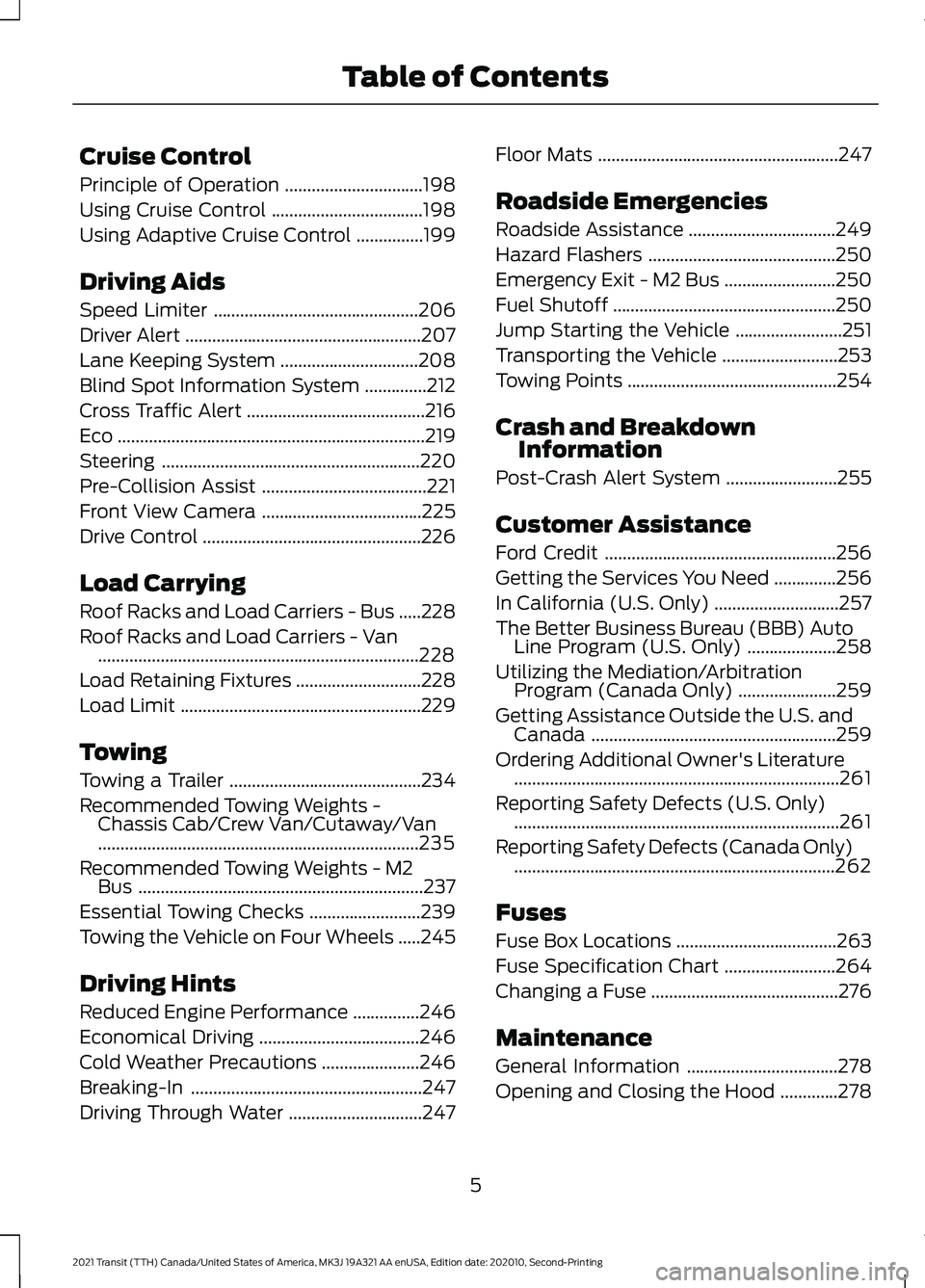
Cruise Control
Principle of Operation
...............................198
Using Cruise Control ..................................
198
Using Adaptive Cruise Control ...............
199
Driving Aids
Speed Limiter ..............................................
206
Driver Alert .....................................................
207
Lane Keeping System ...............................
208
Blind Spot Information System ..............
212
Cross Traffic Alert ........................................
216
Eco .....................................................................
219
Steering ..........................................................
220
Pre-Collision Assist .....................................
221
Front View Camera ....................................
225
Drive Control .................................................
226
Load Carrying
Roof Racks and Load Carriers - Bus .....
228
Roof Racks and Load Carriers - Van ........................................................................\
228
Load Retaining Fixtures ............................
228
Load Limit ......................................................
229
Towing
Towing a Trailer ...........................................
234
Recommended Towing Weights - Chassis Cab/Crew Van/Cutaway/Van
........................................................................\
235
Recommended Towing Weights - M2 Bus ................................................................
237
Essential Towing Checks .........................
239
Towing the Vehicle on Four Wheels .....
245
Driving Hints
Reduced Engine Performance ...............
246
Economical Driving ....................................
246
Cold Weather Precautions ......................
246
Breaking-In ....................................................
247
Driving Through Water ..............................
247Floor Mats
......................................................
247
Roadside Emergencies
Roadside Assistance .................................
249
Hazard Flashers ..........................................
250
Emergency Exit - M2 Bus .........................
250
Fuel Shutoff ..................................................
250
Jump Starting the Vehicle ........................
251
Transporting the Vehicle ..........................
253
Towing Points ...............................................
254
Crash and Breakdown Information
Post-Crash Alert System .........................
255
Customer Assistance
Ford Credit ....................................................
256
Getting the Services You Need ..............
256
In California (U.S. Only) ............................
257
The Better Business Bureau (BBB) Auto Line Program (U.S. Only) ....................
258
Utilizing the Mediation/Arbitration Program (Canada Only) ......................
259
Getting Assistance Outside the U.S. and Canada .......................................................
259
Ordering Additional Owner's Literature ........................................................................\
.
261
Reporting Safety Defects (U.S. Only) ........................................................................\
.
261
Reporting Safety Defects (Canada Only) ........................................................................\
262
Fuses
Fuse Box Locations ....................................
263
Fuse Specification Chart .........................
264
Changing a Fuse ..........................................
276
Maintenance
General Information ..................................
278
Opening and Closing the Hood .............
278
5
2021 Transit (TTH) Canada/United States of America, MK3J 19A321 AA enUSA, Edition date: 202010, Second-Printing Table of Contents
Page 9 of 509
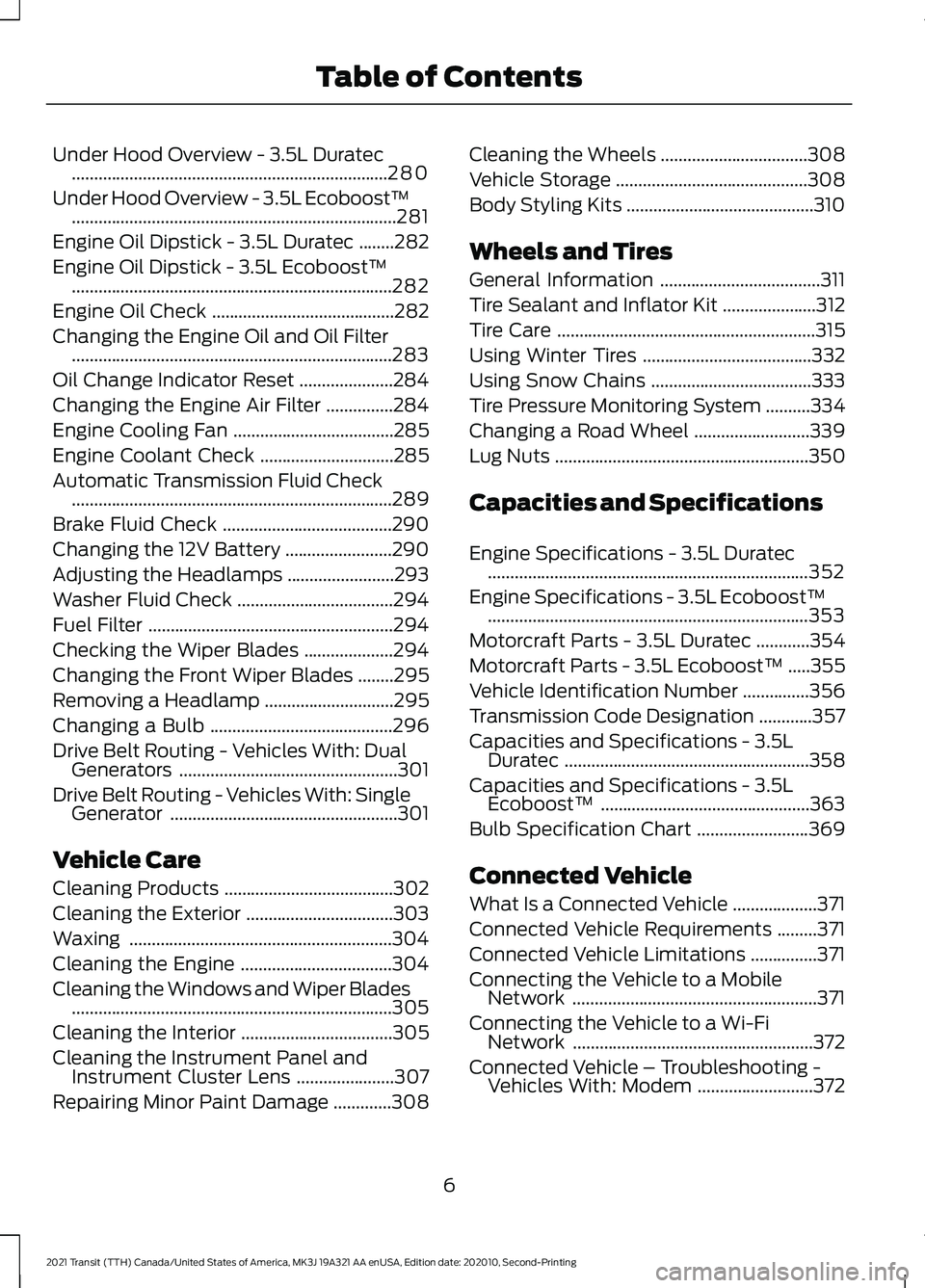
Under Hood Overview - 3.5L Duratec
.......................................................................280
Under Hood Overview - 3.5L Ecoboost™ ........................................................................\
.
281
Engine Oil Dipstick - 3.5L Duratec ........
282
Engine Oil Dipstick - 3.5L Ecoboost™ ........................................................................\
282
Engine Oil Check .........................................
282
Changing the Engine Oil and Oil Filter ........................................................................\
283
Oil Change Indicator Reset .....................
284
Changing the Engine Air Filter ...............
284
Engine Cooling Fan ....................................
285
Engine Coolant Check ..............................
285
Automatic Transmission Fluid Check ........................................................................\
289
Brake Fluid Check ......................................
290
Changing the 12V Battery ........................
290
Adjusting the Headlamps ........................
293
Washer Fluid Check ...................................
294
Fuel Filter .......................................................
294
Checking the Wiper Blades ....................
294
Changing the Front Wiper Blades ........
295
Removing a Headlamp .............................
295
Changing a Bulb .........................................
296
Drive Belt Routing - Vehicles With: Dual Generators .................................................
301
Drive Belt Routing - Vehicles With: Single Generator ...................................................
301
Vehicle Care
Cleaning Products ......................................
302
Cleaning the Exterior .................................
303
Waxing ...........................................................
304
Cleaning the Engine ..................................
304
Cleaning the Windows and Wiper Blades ........................................................................\
305
Cleaning the Interior ..................................
305
Cleaning the Instrument Panel and Instrument Cluster Lens ......................
307
Repairing Minor Paint Damage .............
308Cleaning the Wheels
.................................
308
Vehicle Storage ...........................................
308
Body Styling Kits ..........................................
310
Wheels and Tires
General Information ....................................
311
Tire Sealant and Inflator Kit .....................
312
Tire Care ..........................................................
315
Using Winter Tires ......................................
332
Using Snow Chains ....................................
333
Tire Pressure Monitoring System ..........
334
Changing a Road Wheel ..........................
339
Lug Nuts .........................................................
350
Capacities and Specifications
Engine Specifications - 3.5L Duratec ........................................................................\
352
Engine Specifications - 3.5L Ecoboost™ ........................................................................\
353
Motorcraft Parts - 3.5L Duratec ............
354
Motorcraft Parts - 3.5L Ecoboost™ .....
355
Vehicle Identification Number ...............
356
Transmission Code Designation ............
357
Capacities and Specifications - 3.5L Duratec .......................................................
358
Capacities and Specifications - 3.5L Ecoboost™ ...............................................
363
Bulb Specification Chart .........................
369
Connected Vehicle
What Is a Connected Vehicle ...................
371
Connected Vehicle Requirements .........
371
Connected Vehicle Limitations ...............
371
Connecting the Vehicle to a Mobile Network .......................................................
371
Connecting the Vehicle to a Wi-Fi Network ......................................................
372
Connected Vehicle – Troubleshooting - Vehicles With: Modem ..........................
372
6
2021 Transit (TTH) Canada/United States of America, MK3J 19A321 AA enUSA, Edition date: 202010, Second-Printing Table of Contents
Page 17 of 509
WARNING: Do not connect
wireless plug-in devices to the data link
connector. Unauthorized third parties
could gain access to vehicle data and
impair the performance of safety related
systems. Only allow repair facilities that
follow our service and repair instructions
to connect their equipment to the data
link connector.
We respect your privacy and are
committed to protecting it. The
information contained in this manual was
correct at the time of publication, but as
technology rapidly changes, we
recommend that you visit the local Ford
website for the latest information.
Your vehicle has electronic control units
that have data recording functionality and
the ability to permanently or temporarily
store data. This data could include
information on the condition and status of
your vehicle, vehicle maintenance
requirements, events and malfunctions.
The types of data that can be recorded are
described in this section. Some of the data
recorded is stored in event logs or error
logs.
Note: Error logs are reset following a service
or repair.
Note: We may provide information in
response to requests from law enforcement,
other government authorities and third
parties acting with lawful authority or
through a legal process. Such information
could be used by them in legal proceedings.
Data recorded includes, for example:
• Operating states of system
components, for example fuel level,
tire pressure and battery charge level.
• Vehicle and component status, for
example wheel speed, deceleration,
lateral acceleration and seatbelt
status. •
Events or errors in essential systems,
for example headlamps and brakes.
• System responses to driving situations,
for example airbag deployment and
stability control.
• Environmental conditions, for example
temperature.
Some of this data, when used in
combination with other information, for
example an accident report, damage to a
vehicle or eyewitness statements, could
be associated with a specific person.
Services That We Provide
If you use our services, we collect and use
data, for example account information,
vehicle location and driving characteristics,
that could identify you. We transmit this
data through a dedicated, protected
connection. We only collect and use data
to enable your use of our services to which
you have subscribed, with your consent or
where permitted by law. For additional
information, see the terms and conditions
of the services to which you have
subscribed.
For additional information about our
privacy policy, refer to the local Ford
website.
Services That Third Parties
Provide
We recommend that you review the terms
and conditions and data privacy
information for any services equipped with
your vehicle or to which you subscribe. We
take no responsibility for services that third
parties provide.
14
2021 Transit (TTH) Canada/United States of America, MK3J 19A321 AA enUSA, Edition date: 202010, Second-Printing Data Privacy
Page 18 of 509
SERVICE DATA
Service data recorders in your vehicle are
capable of collecting and storing
diagnostic information about your vehicle.
This potentially includes information about
the performance or status of various
systems and modules in the vehicle, such
as engine, throttle, steering or brake
systems. In order to properly diagnose and
service your vehicle, Ford Motor Company
(Ford of Canada in Canada), and service
and repair facilities may access or share
among them vehicle diagnostic
information received through a direct
connection to your vehicle when
diagnosing or servicing your vehicle.
Additionally, Ford Motor Company (Ford
of Canada, in Canada) may, where
permitted by law, use vehicle diagnostic
information for vehicle improvement or
with other information we may have about
you, for example, your contact information,
to offer you products or services that may
interest you. Data may be provided to our
service providers such as part suppliers
that may help diagnose malfunctions, and
who are similarly obligated to protect data.
We retain this data only as long as
necessary to perform these functions or to
comply with law. We may provide
information where required in response to
official requests to law enforcement or
other government authorities or third
parties acting with lawful authority or court
order, and such information may be used
in legal proceedings. For U.S. only (if
equipped), if you choose to use connected
apps and services, you consent that certain
diagnostic information may also be
accessed electronically by Ford Motor
Company and Ford authorized service
facilities, and that the diagnostic
information may be used to provide
services to you, personalizing your
experience, troubleshoot, and to improve
products and services and offer you
products and services that may interest
you, where permitted by law. For Canada
only, for more information, please review
the Ford of Canada privacy policy at
www.ford.ca, including our U.S. data
storage and use of service providers in
other jurisdictions who may be subject to
legal requirements in Canada, the United
States and other countries applicable to
them, for example, lawful requirements to
disclose personal information to
governmental authorities in those
countries.
EVENT DATA
This vehicle is equipped with an event data
recorder. The main purpose of an event
data recorder is to record, in certain crash
or near crash-like situations, such as an
airbag deployment or hitting a road
obstacle; this data will assist in
understanding how a vehicle
’s systems
performed. The event data recorder is
designed to record data related to vehicle
dynamics and safety systems for a short
period of time, typically 30 seconds or less.
The event data recorder in this vehicle is
designed to record such data as:
• How various systems in your vehicle
were operating.
• Whether or not the driver and
passenger seatbelts were
buckled/fastened.
• How far (if at all) the driver was
depressing the accelerator and/or the
brake pedal.
• How fast the vehicle was traveling.
• Where the driver was positioning the
steering wheel.
This data can help provide a better
understanding of the circumstances in
which crashes and injuries occur.
15
2021 Transit (TTH) Canada/United States of America, MK3J 19A321 AA enUSA, Edition date: 202010, Second-Printing Data Privacy
Page 19 of 509
Note:
Event data recorder data is recorded
by your vehicle only if a non-trivial crash
situation occurs; no data is recorded by the
event data recorder under normal driving
conditions and no personal data or
information (for example name, gender,
age, and crash location) is recorded.
However, parties, such as law enforcement,
could combine the event data recorder data
with the type of personally identifying data
routinely acquired during a crash
investigation.
To read data recorded by an event data
recorder, special equipment is required,
and access to the vehicle or the event data
recorder is needed. In addition to the
vehicle manufacturer, other parties, such
as law enforcement, that have such special
equipment, can read the information if they
have access to the vehicle or the event
data recorder.
SETTINGS DATA
Your vehicle has electronic control units
that have the ability to store data based
on your personalized settings. The data is
stored locally in the vehicle or on devices
that you connect to it, for example, a USB
drive or digital music player. You can delete
some of this data and also choose whether
to share it through the services to which
you subscribe. See Settings (page 427).
Comfort and Convenience Data
Data recorded includes, for example:
• Seat and steering wheel position.
• Climate control settings.
• Radio presets. Entertainment Data
Data recorded includes, for example:
•
Music, videos or album art.
• Contacts and corresponding address
book entries.
• Navigation destinations.
CONNECTED VEHICLE DATA -
VEHICLES WITH: MODEM The modem has a SIM. The
modem was enabled when your
vehicle was built and periodically
sends messages to stay connected to the
cell phone network, receive automatic
software updates and send vehicle-related
information to us, for example diagnostic
information. These messages could
include information that identifies your
vehicle, the SIM and the electronic serial
number of the modem. Cell phone network
service providers could have access to
additional information, for example cell
phone network tower identification. For
additional information about our privacy
policy, visit
www .For dC onne c t e d . c om or
refer to your local Ford website.
Note: The modem continues to send this
information unless you disable the modem
or stop the modem from sharing vehicle
data by changing the modem settings.
See
Connected Vehicle (page 371).
Note: The service can be unavailable or
interrupted for a number of reasons, for
example environmental or topographical
conditions and data plan coverage.
Note: To find out if your vehicle has a
modem, visit
www .For dC onne c t e d . c om .
16
2021 Transit (TTH) Canada/United States of America, MK3J 19A321 AA enUSA, Edition date: 202010, Second-Printing Data Privacy
Page 53 of 509
PRINCIPLE OF OPERATION
WARNING: Airbags do not inflate
slowly or gently, and the risk of injury
from a deploying airbag is the greatest
close to the trim covering the airbag
module. WARNING:
All occupants of your
vehicle, including the driver, should
always properly wear their seatbelts,
even when an airbag supplemental
restraint system is provided. Failure to
properly wear your seatbelt could
seriously increase the risk of injury or
death. WARNING:
Even with advanced
restraints systems, properly restrain
children 12 and under in a rear seating
position. Failure to follow this could
seriously increase the risk of injury or
death. WARNING:
Do not place your arms
on the airbag cover or through the
steering wheel. Failure to follow this
instruction could result in personal injury. WARNING:
Keep the areas in front
of the airbags free from obstruction. Do
not affix anything to or over the airbag
covers. Objects could become projectiles
during airbag deployment or in a sudden
stop. Failure to follow this instruction
could result in personal injury or death. WARNING: Airbags can kill or injure
a child in a child restraint. Never place a
rear-facing child restraint in front of an
active airbag. If you must use a
forward-facing child restraint in the front
seat, move the seat upon which the child
restraint is installed all the way back. WARNING:
Do not attempt to
service, repair, or modify the
supplementary restraint system or
associated components. Failure to
follow this instruction could result in
personal injury or death. WARNING:
Several airbag system
components get hot after inflation. To
reduce the risk of injury, do not touch
them after inflation. WARNING:
If a supplementary
restraint system component has
deployed, it will not function again. Have
the system and associated components
inspected as soon as possible. Failure to
follow this instruction could result in
personal injury or death.
The airbags are a supplemental restraint
system and are designed to work with the
seatbelts to help protect the driver and
right front passenger from certain upper
body injuries. Airbags do not inflate slowly;
there is a risk of injury from a deploying
airbag.
Note: You will hear a loud bang and see a
cloud of harmless powdery residue if an
airbag deploys. This is normal.
The airbags inflate and deflate rapidly
upon activation. After airbag deployment,
it is normal to notice a smoke-like, powdery
residue or smell the burnt propellant. This
may consist of cornstarch, talcum powder
(to lubricate the bag) or sodium
compounds (for example, baking soda)
that result from the combustion process
that inflates the airbag. Small amounts of
sodium hydroxide may be present which
may irritate the skin and eyes, but none of
the residue is toxic.
50
2021 Transit (TTH) Canada/United States of America, MK3J 19A321 AA enUSA, Edition date: 202010, Second-Printing Supplementary Restraints System
Page 54 of 509
While the system is designed to help
reduce serious injuries, contact with a
deploying airbag may also cause abrasions
or swelling. Temporary hearing loss is also
a possibility as a result of the noise
associated with a deploying airbag.
Because airbags must inflate rapidly and
with considerable force, there is the risk of
death or serious injuries such as fractures,
facial and eye injuries or internal injuries,
particularly to occupants who are not
properly restrained or are otherwise out of
position at the time of airbag deployment.
Thus, it is extremely important that
occupants be properly restrained as far
away from the airbag module as possible
while maintaining vehicle control.
Routine maintenance of the airbags is not
required.
DRIVER AND PASSENGER
AIRBAGS
WARNING: Keep the areas in front
of the airbags free from obstruction. Do
not affix anything to or over the airbag
covers. Objects could become projectiles
during airbag deployment. Failure to
follow this instruction could result in
personal injury or death. WARNING:
Do not place your arms
on the airbag cover or through the
steering wheel. Failure to follow this
instruction could result in personal injury. WARNING:
Do not place a
rearward facing child restraint in front of
an active airbag. Failure to follow this
instruction could result in personal injury
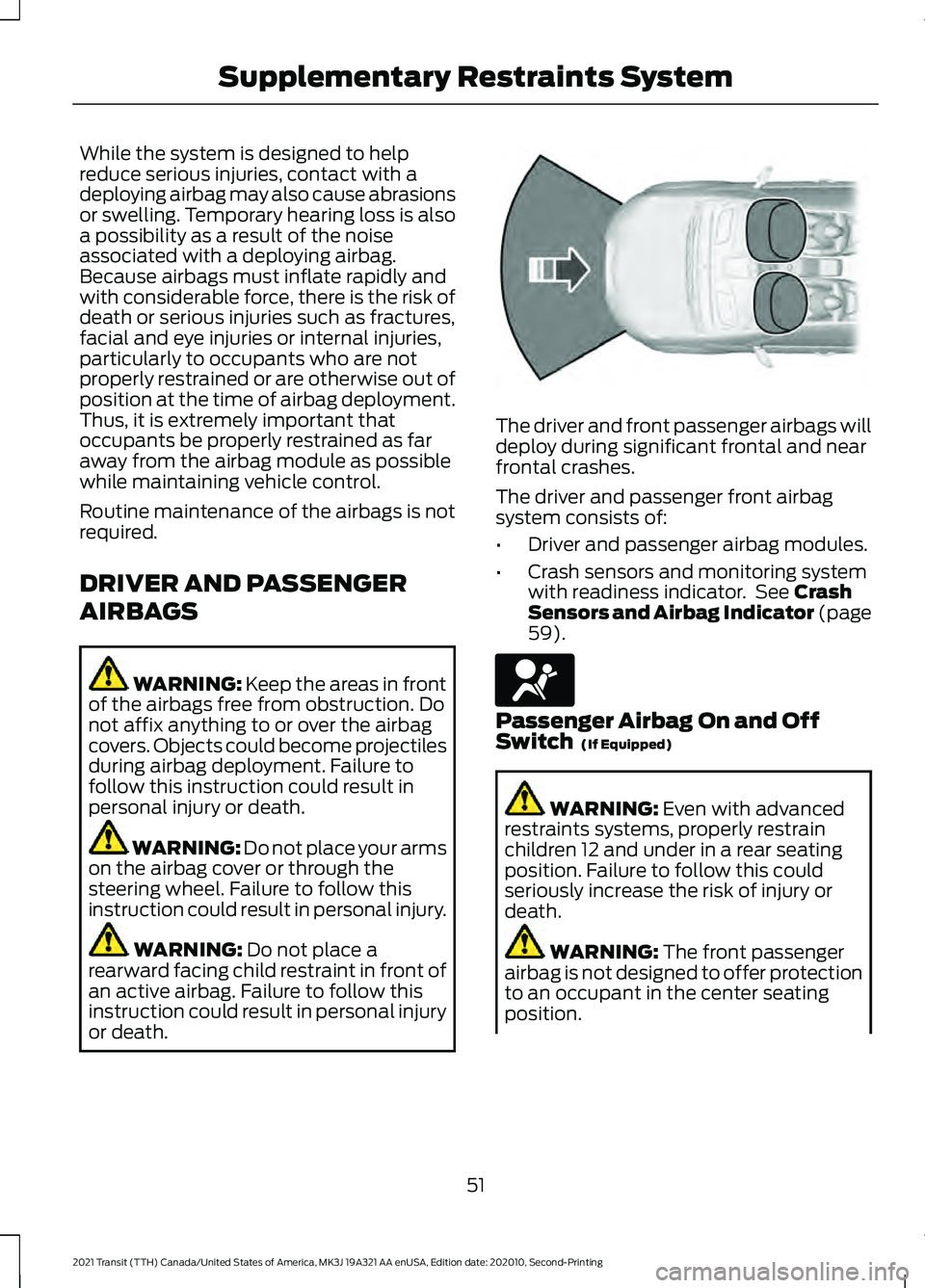
or death. The driver and front passenger airbags will
deploy during significant frontal and near
frontal crashes.
The driver and passenger front airbag
system consists of:
•
Driver and passenger airbag modules.
• Crash sensors and monitoring system
with readiness indicator. See
Crash
Sensors and Airbag Indicator (page
59
). Passenger Airbag On and Off
Switch
(If Equipped)
WARNING:
Even with advanced
restraints systems, properly restrain
children 12 and under in a rear seating
position. Failure to follow this could
seriously increase the risk of injury or
death. WARNING:
The front passenger
airbag is not designed to offer protection
to an occupant in the center seating
position.
51
2021 Transit (TTH) Canada/United States of America, MK3J 19A321 AA enUSA, Edition date: 202010, Second-Printing Supplementary Restraints SystemE151127 E67017
Page 64 of 509
WHAT IS 911 ASSIST
911 Assist is a SYNC system feature that
can call for help.
For more information, visit
www
. o wner .f or d . c om .
HOW DOES 911 ASSIST WORK
If a crash deploys an airbag, excluding knee
airbags and rear inflatable seatbelts, or
activates the fuel pump shut-off, your
vehicle may be able to contact emergency
services by dialing 911 through a paired and
connected Bluetooth®-enabled phone.
Not all crashes will deploy an airbag or
activate the fuel pump shut-off. If a
connected cell phone sustains damage or
loses its connection to SYNC during a
crash, SYNC will search for and try to
connect to a previously paired cell phone.
SYNC will then attempt to call the
emergency services.
Before making the call:
• SYNC provides about 10 seconds to
cancel the call. If you fail to cancel the
call, SYNC attempts to dial 911.
• SYNC says the following, or a similar
message: "SYNC will attempt to call
911, to cancel the call, press Cancel on
your screen or press and hold the
phone button on your steering wheel."
If you do not cancel the call and SYNC
makes a successful call a pre-recorded
message plays for the 911 operator. The
occupants in your vehicle are able to talk
with the operator. Be prepared to provide
your name, phone number and location
immediately because not all 911 systems
are capable of receiving this information
electronically.
During an emergency call the system
transmits vehicle data to the emergency
service. EMERGENCY CALL
REQUIREMENTS WARNING:
Do not wait for 911
Assist to make an emergency call if you
can do it yourself. Dial emergency
services immediately to avoid delayed
response time which could increase the
risk of serious injury or death after a
crash. If you do not hear 911 Assist within
five seconds of the crash, the system or
phone may be damaged or
non-functional. WARNING:
Always place your
phone in a secure location in your vehicle
so it does not become a projectile or get
damaged in a crash. Failure to do so may
cause serious injury to someone or
damage the phone which could prevent
911 Assist from working properly. WARNING:
Unless the 911 Assist
setting is set on before a crash, the
system will not dial for help which could
delay response time, potentially
increasing the risk of serious injury or
death after a crash.
• SYNC must be powered and working
properly at the time of the incident and
throughout feature activation and use.
• The 911 Assist feature must be set on
before the incident.
• You must pair and connect a
Bluetooth®
enabled and compatible
cell phone to SYNC.
• A connected
Bluetooth® enabled
phone must have the ability to make
and maintain an outgoing call at the
time of the incident.
61
2021 Transit (TTH) Canada/United States of America, MK3J 19A321 AA enUSA, Edition date: 202010, Second-Printing 911 Assist