radio FORD TRANSIT CONNECT 2012 1.G User Guide
[x] Cancel search | Manufacturer: FORD, Model Year: 2012, Model line: TRANSIT CONNECT, Model: FORD TRANSIT CONNECT 2012 1.GPages: 299, PDF Size: 3.31 MB
Page 31 of 299
•Track/Folder mode:Available only on MP3 discs in CD mode. In
Track mode, pressing
SEEK, SEEKwill scroll through all
tracks on the disc
In Folder mode, pressing
SEEK, SEEKwill scroll only
through tracks within the selected folder.
Press
FOLDER, FOLDERto access the previous/next folder
(if available).
•COMPRESS (Compression):Available only in CD/MP3 mode. Press
MENU until COMPRESS ON/OFF appears in the display.
Use
//SEEK, SEEKto toggle ON/OFF. When
COMPRESS is ON, the system will bring the soft and loud CD
passages together for a more consistent listening level.
•BT On/OffPress to turnBluetoothon/off (if equipped). Refer to
Bluetooth hands free systemlater in this chapter for more
information.
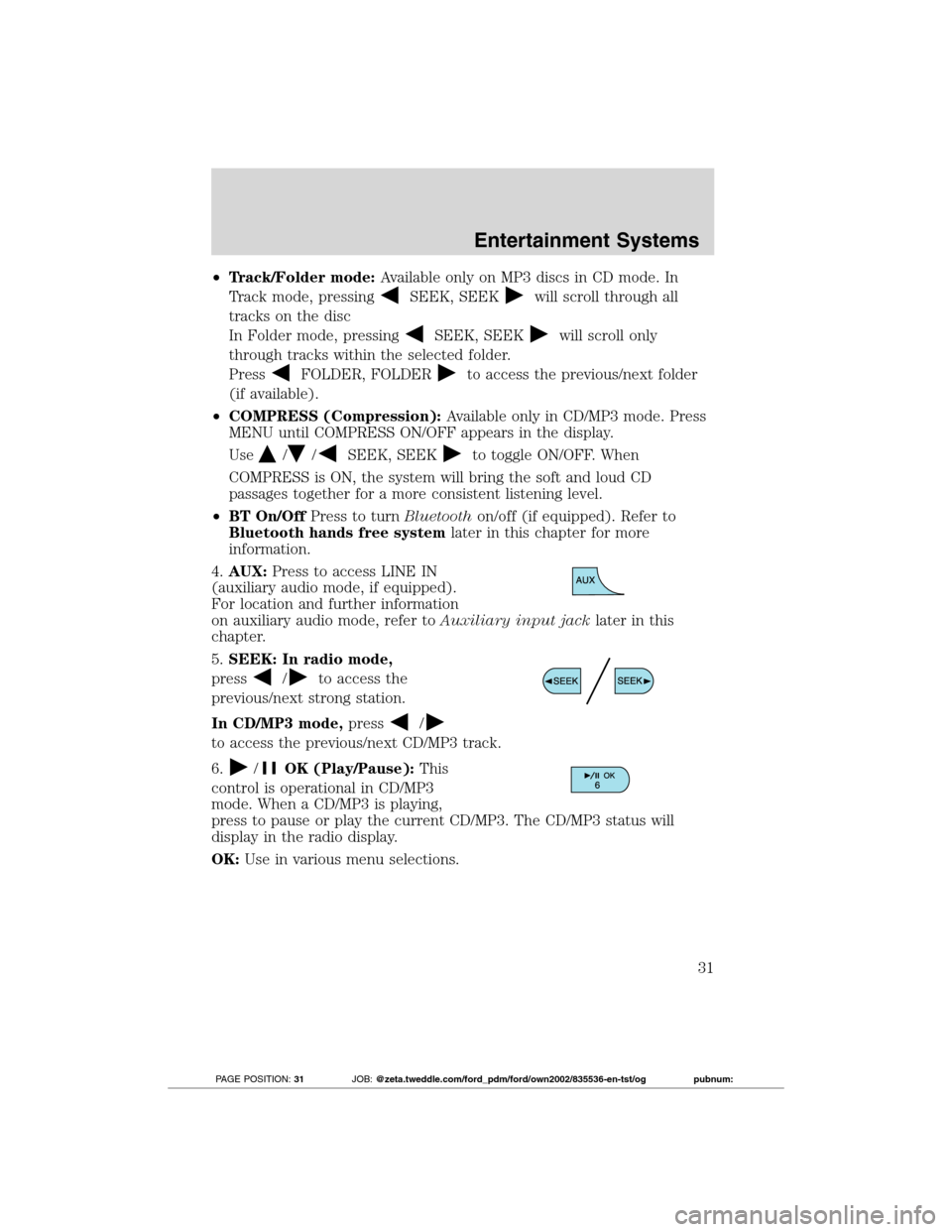
4.AUX:Press to access LINE IN
(auxiliary audio mode, if equipped).
For location and further information
on auxiliary audio mode, refer toAuxiliary input jacklater in this
chapter.
5.SEEK: In radio mode,
press
/to access the
previous/next strong station.
In CD/MP3 mode,press
/
to access the previous/next CD/MP3 track.
6.
/OK (Play/Pause):This
control is operational in CD/MP3
mode. When a CD/MP3 is playing,
press to pause or play the current CD/MP3. The CD/MP3 status will
display in the radio display.
OK:Use in various menu selections.
Entertainment Systems
31
2012 Transit Connect(tst)
Owners Guide, 1st Printing
USA(fus)
PAGE POSITION:31JOB:@zeta.tweddle.com/ford_pdm/ford/own2002/835536-en-tst/og pubnum:
Page 32 of 299
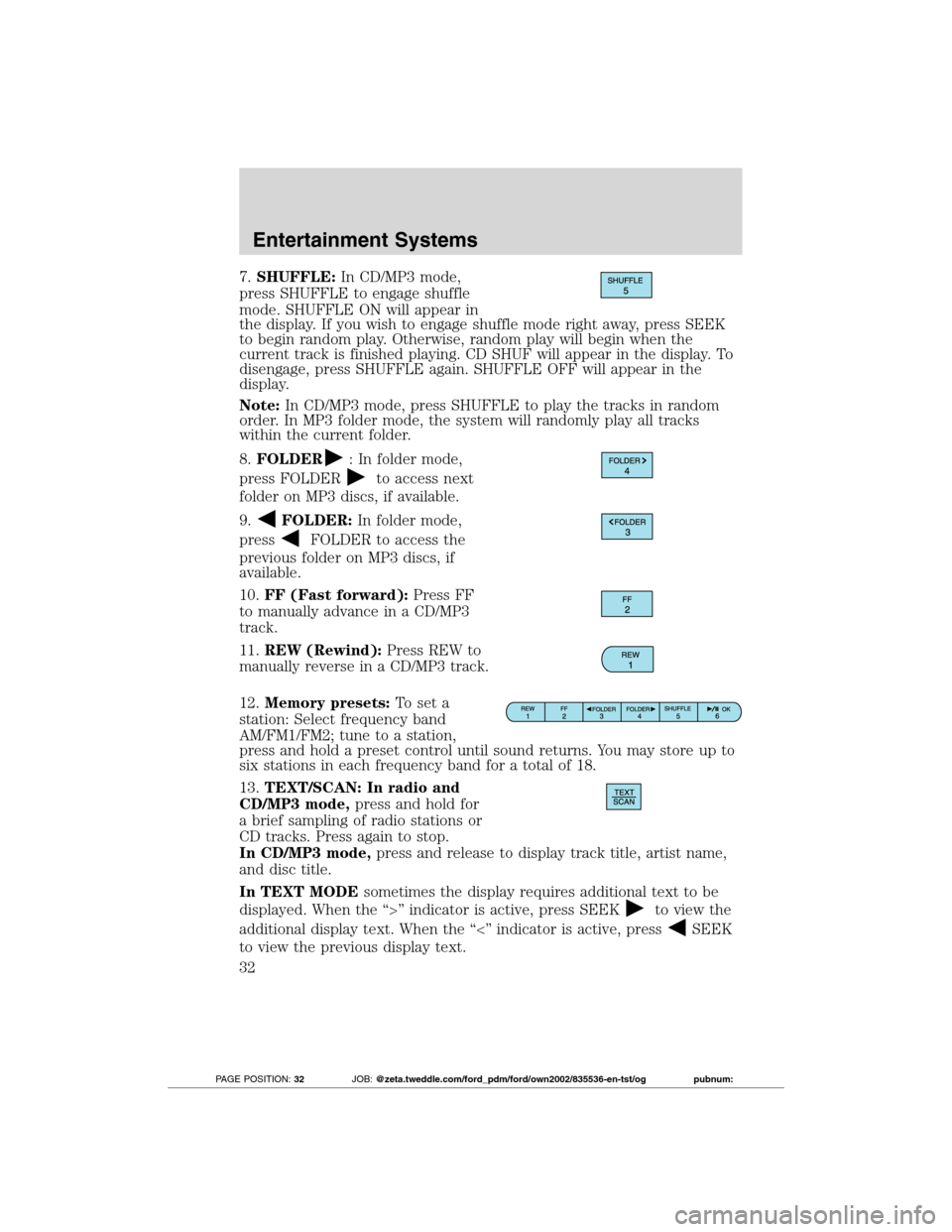
7.SHUFFLE:In CD/MP3 mode,
press SHUFFLE to engage shuffle
mode. SHUFFLE ON will appear in
the display. If you wish to engage shuffle mode right away, press SEEK
to begin random play. Otherwise, random play will begin when the
current track is finished playing. CD SHUF will appear in the display. To
disengage, press SHUFFLE again. SHUFFLE OFF will appear in the
display.
Note:In CD/MP3 mode, press SHUFFLE to play the tracks in random
order. In MP3 folder mode, the system will randomly play all tracks
within the current folder.
8.FOLDER
: In folder mode,
press FOLDER
to access next
folder on MP3 discs, if available.
9.
FOLDER:In folder mode,
press
FOLDER to access the
previous folder on MP3 discs, if
available.
10.FF (Fast forward):Press FF
to manually advance in a CD/MP3
track.
11.REW (Rewind):Press REW to
manually reverse in a CD/MP3 track.
12.Memory presets:To set a
station: Select frequency band
AM/FM1/FM2; tune to a station,
press and hold a preset control until sound returns. You may store up to
six stations in each frequency band for a total of 18.
13.TEXT/SCAN: In radio and
CD/MP3 mode,press and hold for
a brief sampling of radio stations or
CD tracks. Press again to stop.
In CD/MP3 mode,press and release to display track title, artist name,
and disc title.
In TEXT MODEsometimes the display requires additional text to be
displayed. When the “>” indicator is active, press SEEK
to view the
additional display text. When the “<” indicator is active, press
SEEK
to view the previous display text.
Entertainment Systems
32
2012 Transit Connect(tst)
Owners Guide, 1st Printing
USA(fus)
PAGE POSITION:32JOB:@zeta.tweddle.com/ford_pdm/ford/own2002/835536-en-tst/og pubnum:
Page 34 of 299
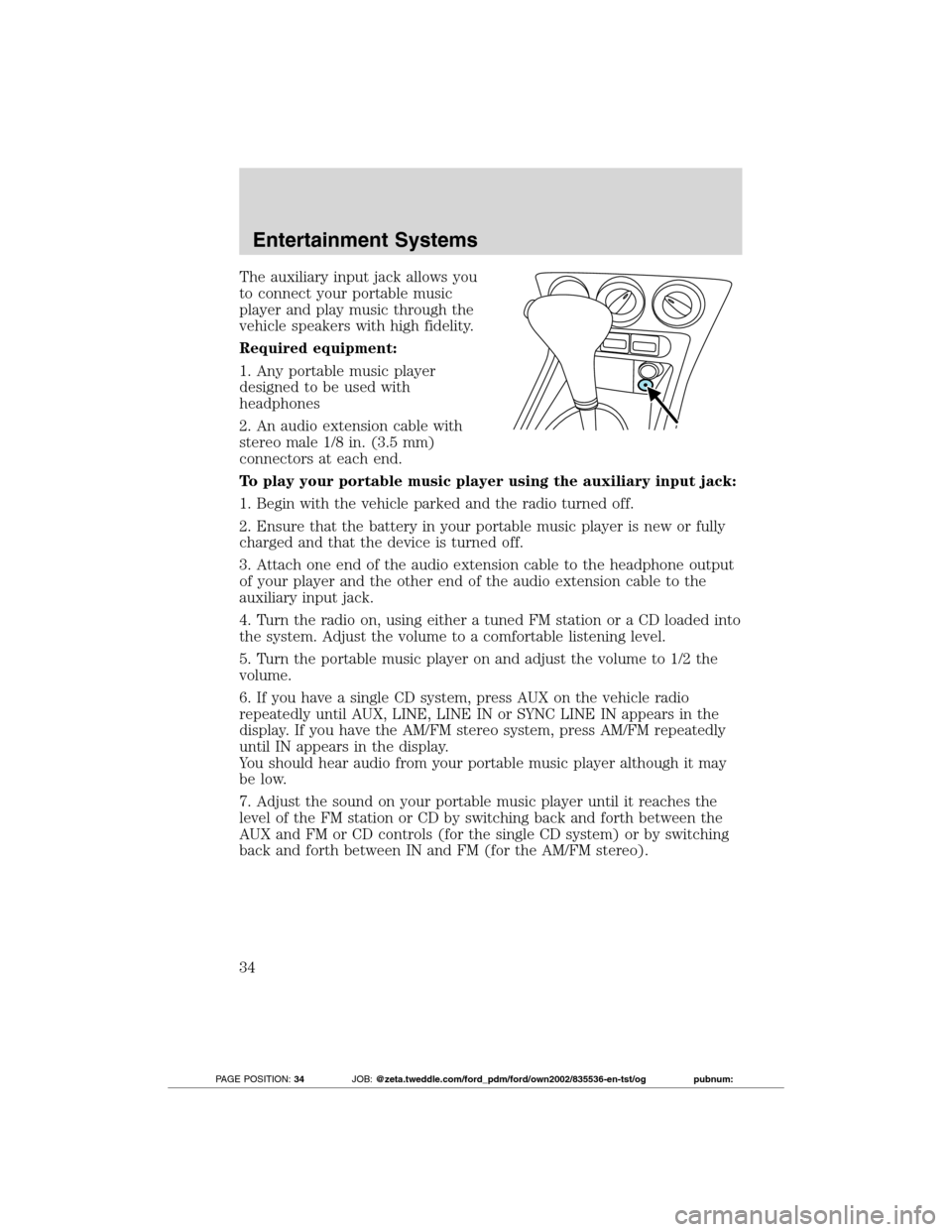
The auxiliary input jack allows you
to connect your portable music
player and play music through the
vehicle speakers with high fidelity.
Required equipment:
1. Any portable music player
designed to be used with
headphones
2. An audio extension cable with
stereo male 1/8 in. (3.5 mm)
connectors at each end.
To play your portable music player using the auxiliary input jack:
1. Begin with the vehicle parked and the radio turned off.
2. Ensure that the battery in your portable music player is new or fully
charged and that the device is turned off.
3. Attach one end of the audio extension cable to the headphone output
of your player and the other end of the audio extension cable to the
auxiliary input jack.
4. Turn the radio on, using either a tuned FM station or a CD loaded into
the system. Adjust the volume to a comfortable listening level.
5. Turn the portable music player on and adjust the volume to 1/2 the
volume.
6. If you have a single CD system, press AUX on the vehicle radio
repeatedly until AUX, LINE, LINE IN or SYNC LINE IN appears in the
display. If you have the AM/FM stereo system, press AM/FM repeatedly
until IN appears in the display.
You should hear audio from your portable music player although it may
be low.
7. Adjust the sound on your portable music player until it reaches the
level of the FM station or CD by switching back and forth between the
AUX and FM or CD controls (for the single CD system) or by switching
back and forth between IN and FM (for the AM/FM stereo).
Entertainment Systems
34
2012 Transit Connect(tst)
Owners Guide, 1st Printing
USA(fus)
PAGE POSITION:34JOB:@zeta.tweddle.com/ford_pdm/ford/own2002/835536-en-tst/og pubnum:
Page 35 of 299
Troubleshooting:
1. Do not connect the audio input jack to a line level output. Line level
outputs are intended for connection to a home stereo and are not
compatible with the AIJ. The AIJ will only work correctly with devices
that have a headphone output with a volume control.
2. Do not set the portable music player’s volume level higher than is
necessary to match the volume of the CD or FM radio in your audio
system as this will cause distortion and will reduce sound quality. Many
portable music players have different output levels, so not all players
should be set at the same levels. Some players will sound best at full
volume and others will need to be set at a lower volume.
3. If the music sounds distorted at lower listening levels, turn the
portable music player volume down. If the problems persists, replace or
recharge the batteries in the portable music player.
4. The portable music player must be controlled in the same manner
when it is used with headphones as the AIJ does not provide control
(play, pause, etc.) over the attached portable music player.
5. For safety reasons, connecting or adjusting the settings on your
portable music player should not be attempted while the vehicle is
moving. Also, the portable music player should be stored in a secure
location, such as the center console or the glove box, when the vehicle is
in motion. The audio extension cable must be long enough to allow the
portable music player to be safely stored while the vehicle is in motion.
USB port (if equipped, late availability)
WARNING:Driving while distracted can result in loss of vehicle
control, accident and injury. Ford strongly recommends that
drivers use extreme caution when using any device or feature that may
take their focus off the road. Your primary responsibility is the safe
operation of the vehicle. We recommend against the use of any
handheld device while driving, encourage the use of voice-operated
systems when possible and that you become aware of applicable state
and local laws that may affect use of electronic devices while driving.
Entertainment Systems
35
2012 Transit Connect(tst)
Owners Guide, 1st Printing
USA(fus)
PAGE POSITION:35JOB:@zeta.tweddle.com/ford_pdm/ford/own2002/835536-en-tst/og pubnum:
Page 38 of 299
To pair/bond subsequent phones to the system,simply follow the
previous procedure.
Phonebook entries:Once theBluetoothsystem connects to your
phone, it will attempt to automatically download your Phonebook entries
so that you can easily access them later. The maximum number of
entries vary depending on the information attached to the number.
Voice recognition
YourBluetoothsystem is equipped with a voice recognition system
which allows you to perform some operations by speaking certain
commands to the system. The system will respond with a series of beeps,
confirmations or questions when necessary. At any time, you can say,
“Cancel” if you do not wish to continue, or “Help” for a list of possible
voice commands in your current mode. Speak the command clearly to
ensure that the system is able to recognize and perform the desired
function.
For best system performance:
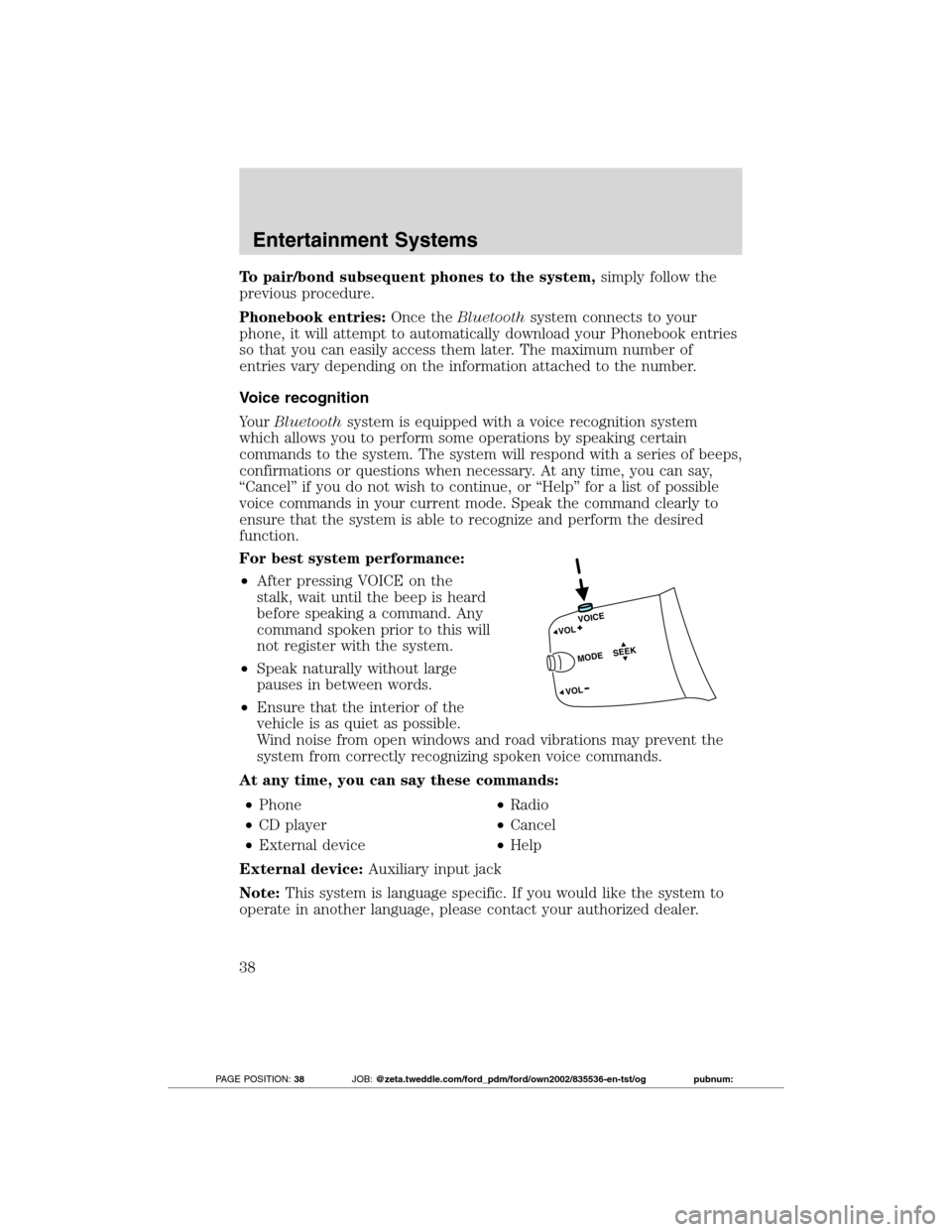
•After pressing VOICE on the
stalk, wait until the beep is heard
before speaking a command. Any
command spoken prior to this will
not register with the system.
•Speak naturally without large
pauses in between words.
•Ensure that the interior of the
vehicle is as quiet as possible.
Wind noise from open windows and road vibrations may prevent the
system from correctly recognizing spoken voice commands.
At any time, you can say these commands:
•Phone•Radio
•CD player•Cancel
•External device•Help
External device:Auxiliary input jack
Note:This system is language specific. If you would like the system to
operate in another language, please contact your authorized dealer.
VOICE
SEEK
VOL
VOL
MODE
Entertainment Systems
38
2012 Transit Connect(tst)
Owners Guide, 1st Printing
USA(fus)
PAGE POSITION:38JOB:@zeta.tweddle.com/ford_pdm/ford/own2002/835536-en-tst/og pubnum:
Page 39 of 299
Microphone
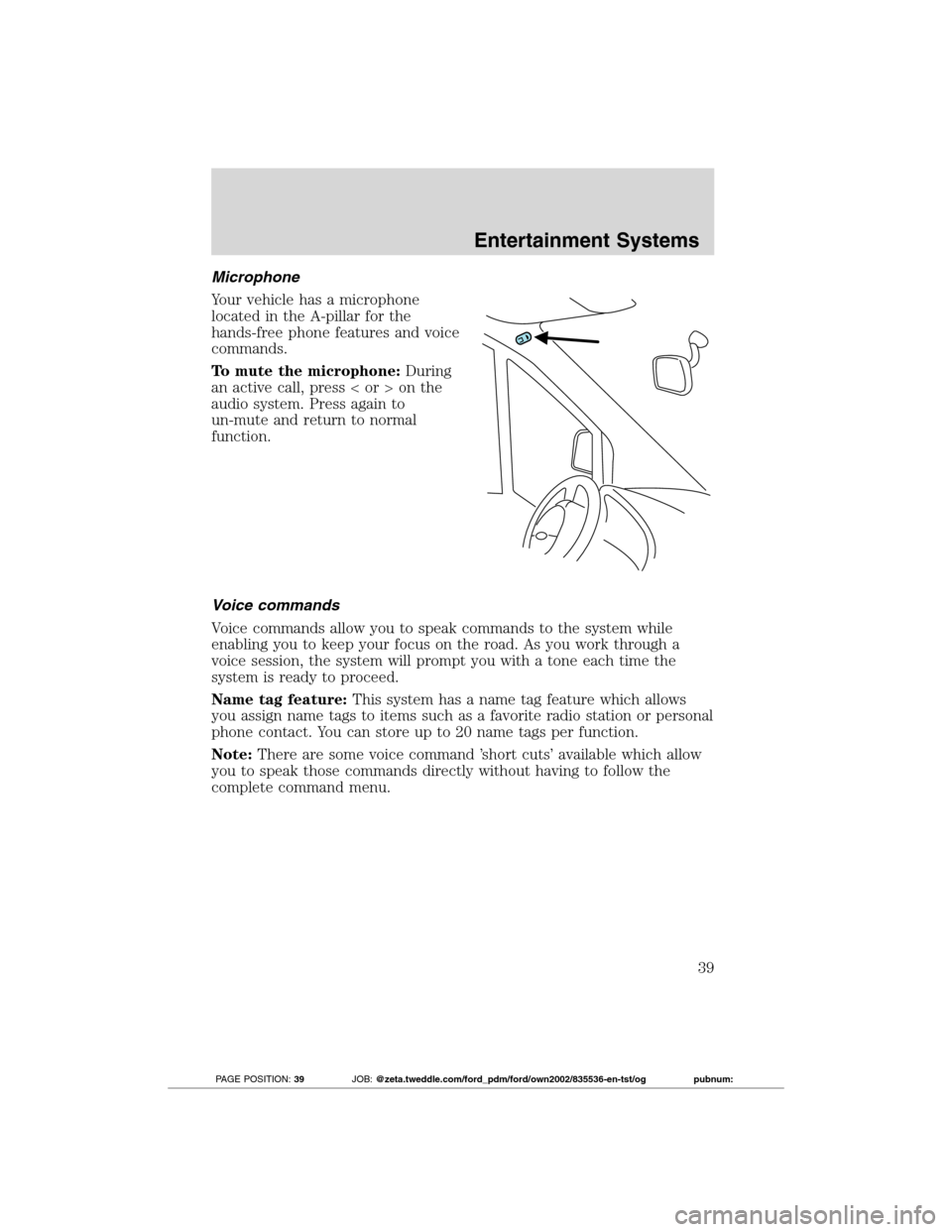
Your vehicle has a microphone
located in the A-pillar for the
hands-free phone features and voice
commands.
To mute the microphone:During
an active call, press < or > on the
audio system. Press again to
un-mute and return to normal
function.
Voice commands
Voice commands allow you to speak commands to the system while
enabling you to keep your focus on the road. As you work through a
voice session, the system will prompt you with a tone each time the
system is ready to proceed.
Name tag feature:This system has a name tag feature which allows
you assign name tags to items such as a favorite radio station or personal
phone contact. You can store up to 20 name tags per function.
Note:There are some voice command ’short cuts’ available which allow
you to speak those commands directly without having to follow the
complete command menu.
Entertainment Systems
39
2012 Transit Connect(tst)
Owners Guide, 1st Printing
USA(fus)
PAGE POSITION:39JOB:@zeta.tweddle.com/ford_pdm/ford/own2002/835536-en-tst/og pubnum:
Page 40 of 299
CD player voice commands
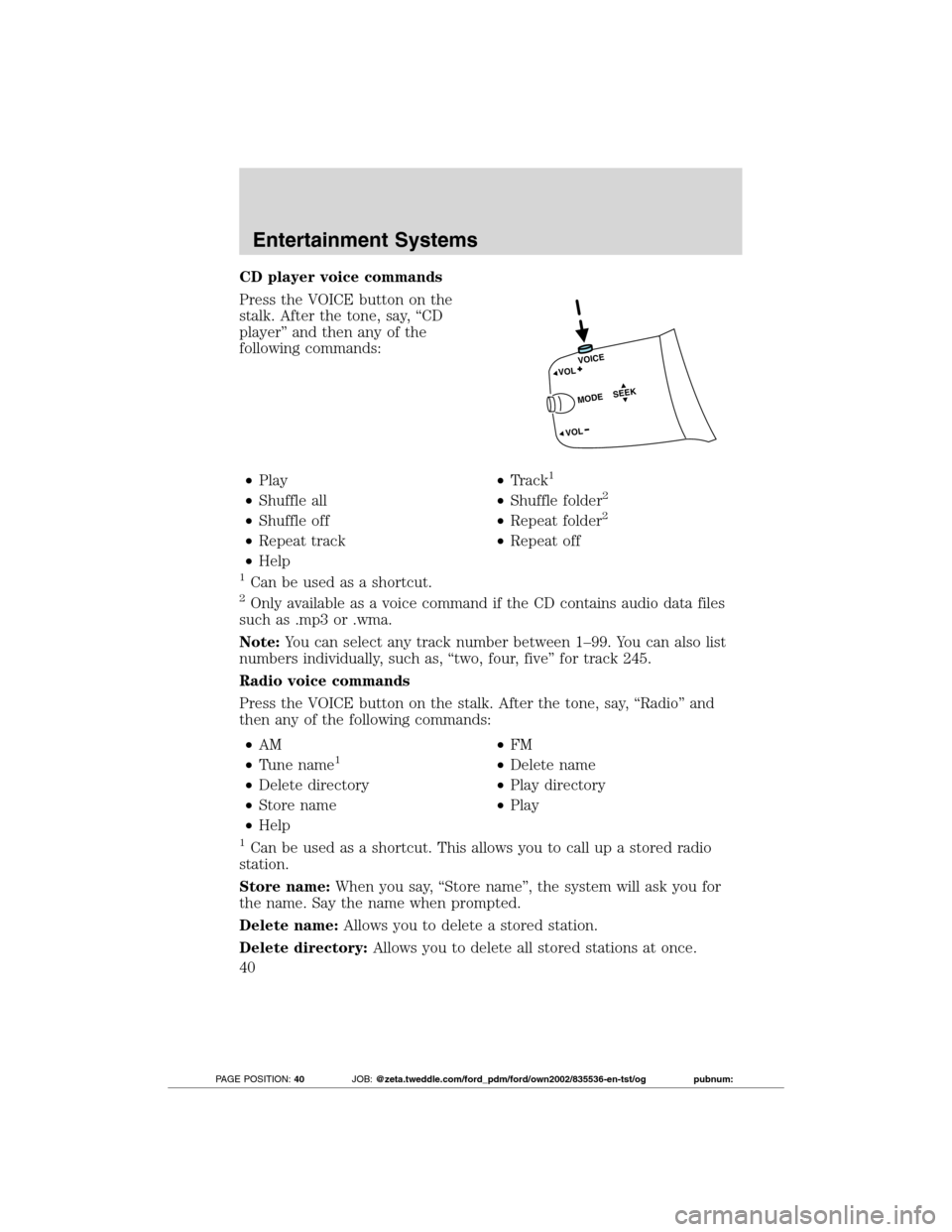
Press the VOICE button on the
stalk. After the tone, say, “CD
player” and then any of the
following commands:
•Play•Track
1
•Shuffle all•Shuffle folder2
•Shuffle off•Repeat folder2
•Repeat track•Repeat off
•Help
1Can be used as a shortcut.2Only available as a voice command if the CD contains audio data files
such as .mp3 or .wma.
Note:You can select any track number between 1–99. You can also list
numbers individually, such as, “two, four, five” for track 245.
Radio voice commands
Press the VOICE button on the stalk. After the tone, say, “Radio” and
then any of the following commands:
•AM•FM
•Tune name
1•Delete name
•Delete directory•Play directory
•Store name•Play
•Help
1Can be used as a shortcut. This allows you to call up a stored radio
station.
Store name:When you say, “Store name”, the system will ask you for
the name. Say the name when prompted.
Delete name:Allows you to delete a stored station.
Delete directory:Allows you to delete all stored stations at once.
VOICE
SEEK
VOL
VOL
MODE
Entertainment Systems
40
2012 Transit Connect(tst)
Owners Guide, 1st Printing
USA(fus)
PAGE POSITION:40JOB:@zeta.tweddle.com/ford_pdm/ford/own2002/835536-en-tst/og pubnum:
Page 41 of 299
Play directory:Allows you to let the system tell you of all the stored
radio stations.
Note:Using the system with the engine off will drain the battery.
Phone voice commands
Press the VOICE button on the stalk. After the tone, say, “Phone” and
then any of the following commands:
•Mobile name
1•Dial name1
•Dial number1•Delete name
•Delete directory•Play directory
•Store name•Redial
1
•Accept calls•Reject calls
•Help
1Can be used as a shortcut.
Store name:When you say, “Store name”, the system will ask you for
the name. Say the name. The system will then ask you for the number
associated with that name. Say the number.
Delete name:Allows you to delete a stored name.
Delete directory:Allows you to delete all stored names at once.
Play directory:Allows you to let the system tell you of all the stored
names.
Note:Using the system with the engine off will drain the battery.
External device commands (if equipped)
Press the VOICE button on the stalk. After the tone, say, “External
device” and then any of the following commands:
•Help•Line in
•Play
Phone features
Phonebook
If yourBluetoothenabled cellular phone supports the feature, you can
download your cell phone’s phone book to theBluetoothsystem.
Depending on your phone book entry, different categories may be
displayed in the audio display, such as:
•
or Phone
•
or Mobile or M
Entertainment Systems
41
2012 Transit Connect(tst)
Owners Guide, 1st Printing
USA(fus)
PAGE POSITION:41JOB:@zeta.tweddle.com/ford_pdm/ford/own2002/835536-en-tst/og pubnum:
Page 44 of 299
Deleting a phone
A paired (bonded) phone can be deleted from the system at any time as
long as the phone is not involved in an active call. To delete a phone
from the system:
1. Press
on the audio system to enter the phone menu.
2. Press MENU repeatedly until DEBOND appears in the display.
3. Press < or > on the audio system to scroll through the list of paired
(bonded) phones.
4. When the desired selection appears in the display that you would like
to delete, press MENU.
GENERAL AUDIO INFORMATION
Radio frequencies:
AM and FM frequencies are established by the Federal Communications
Commission (FCC) and the Canadian Radio and Telecommunications
Commission (CRTC). Those frequencies are:
AM: 530, 540–1700, 1710 kHz
FM: 87.7, 87.9–107.7, 107.9 MHz
Radio reception factors:
There are three factors that can affect radio reception:
•Distance/strength: The further you travel from an FM station, the
weaker the signal and the weaker the reception.
•Terrain: Hills, mountains, tall buildings, power lines, electric fences,
traffic lights and thunderstorms can interfere with your reception.
•Station overload: When you pass a broadcast tower, a stronger signal
may overtake a weaker one and play while the weak station frequency
is displayed.
Entertainment Systems
44
2012 Transit Connect(tst)
Owners Guide, 1st Printing
USA(fus)
PAGE POSITION:44JOB:@zeta.tweddle.com/ford_pdm/ford/own2002/835536-en-tst/og pubnum:
Page 50 of 299
REAR WINDOW DEFROSTER (IF EQUIPPED) / HEATED MIRRORS
(IF EQUIPPED)
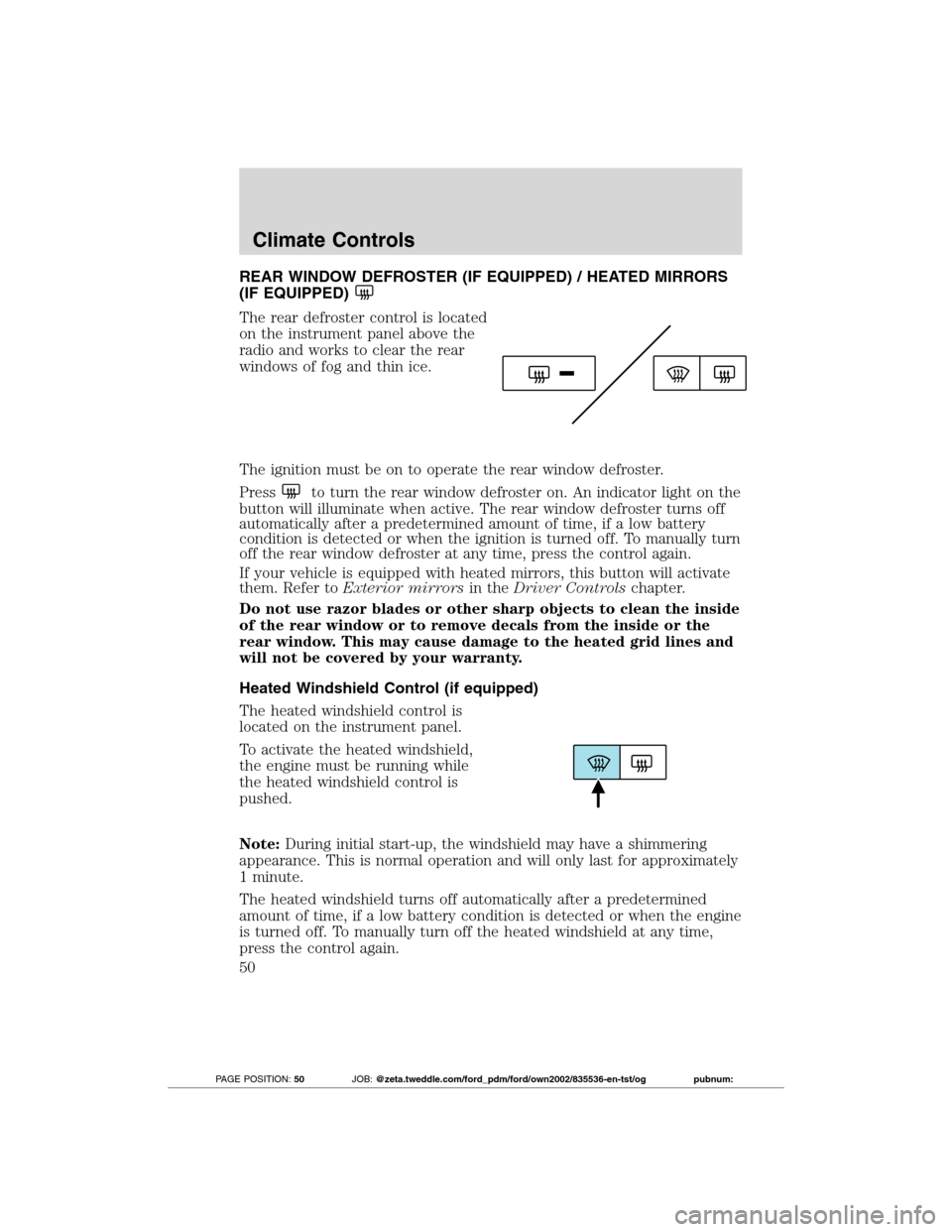
The rear defroster control is located
on the instrument panel above the
radio and works to clear the rear
windows of fog and thin ice.
The ignition must be on to operate the rear window defroster.
Press
to turn the rear window defroster on. An indicator light on the
button will illuminate when active. The rear window defroster turns off
automatically after a predetermined amount of time, if a low battery
condition is detected or when the ignition is turned off. To manually turn
off the rear window defroster at any time, press the control again.
If your vehicle is equipped with heated mirrors, this button will activate
them. Refer toExterior mirrorsin theDriver Controlschapter.
Do not use razor blades or other sharp objects to clean the inside
of the rear window or to remove decals from the inside or the
rear window. This may cause damage to the heated grid lines and
will not be covered by your warranty.
Heated Windshield Control (if equipped)
The heated windshield control is
located on the instrument panel.
To activate the heated windshield,
the engine must be running while
the heated windshield control is
pushed.
Note:During initial start-up, the windshield may have a shimmering
appearance. This is normal operation and will only last for approximately
1 minute.
The heated windshield turns off automatically after a predetermined
amount of time, if a low battery condition is detected or when the engine
is turned off. To manually turn off the heated windshield at any time,
press the control again.
Climate Controls
50
2012 Transit Connect(tst)
Owners Guide, 1st Printing
USA(fus)
PAGE POSITION:50JOB:@zeta.tweddle.com/ford_pdm/ford/own2002/835536-en-tst/og pubnum: