warning light FORD TRANSIT CONNECT 2012 1.G User Guide
[x] Cancel search | Manufacturer: FORD, Model Year: 2012, Model line: TRANSIT CONNECT, Model: FORD TRANSIT CONNECT 2012 1.GPages: 299, PDF Size: 3.31 MB
Page 58 of 299
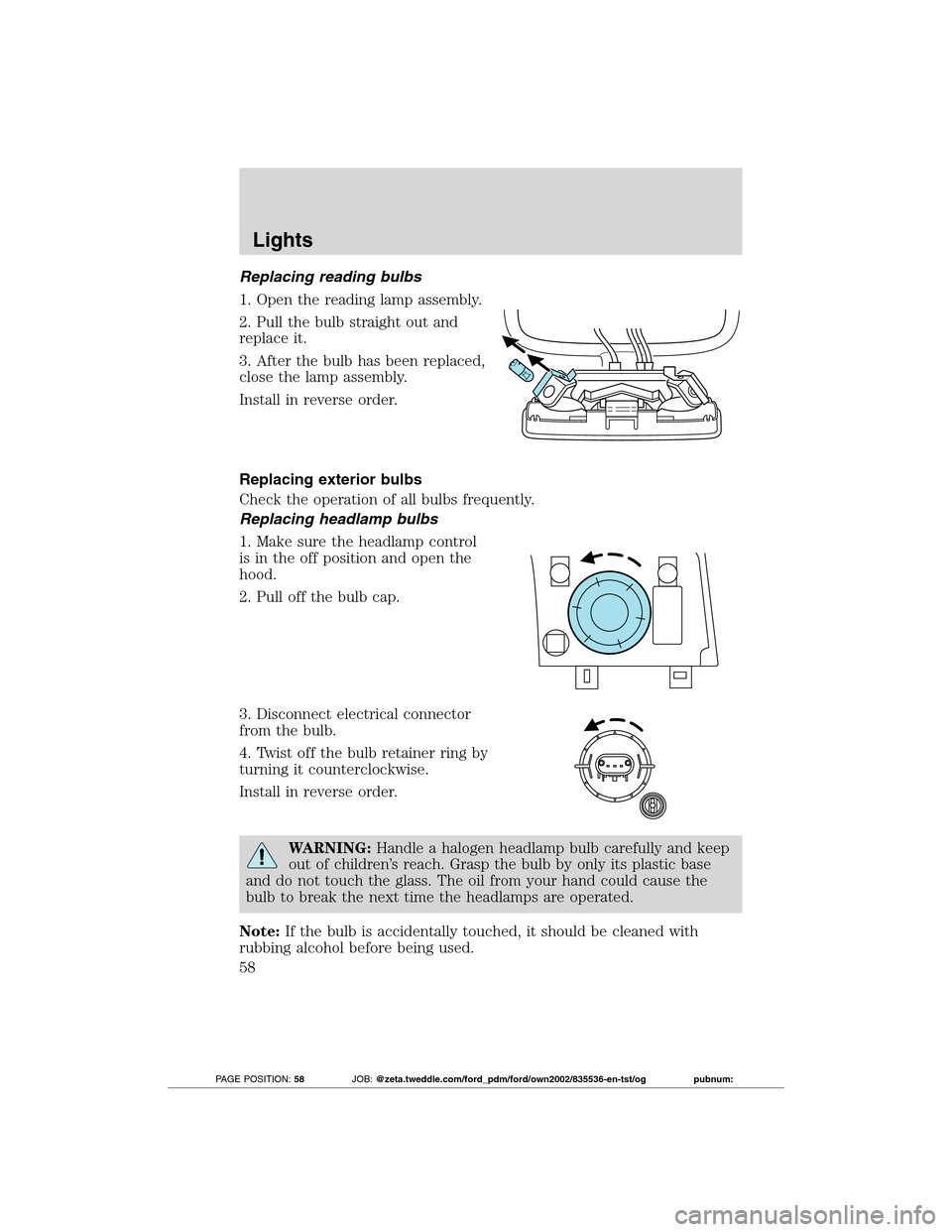
Replacing reading bulbs
1. Open the reading lamp assembly.
2. Pull the bulb straight out and
replace it.
3. After the bulb has been replaced,
close the lamp assembly.
Install in reverse order.
Replacing exterior bulbs
Check the operation of all bulbs frequently.
Replacing headlamp bulbs
1. Make sure the headlamp control
is in the off position and open the
hood.
2. Pull off the bulb cap.
3. Disconnect electrical connector
from the bulb.
4. Twist off the bulb retainer ring by
turning it counterclockwise.
Install in reverse order.
WARNING:Handle a halogen headlamp bulb carefully and keep
out of children’s reach. Grasp the bulb by only its plastic base
and do not touch the glass. The oil from your hand could cause the
bulb to break the next time the headlamps are operated.
Note:If the bulb is accidentally touched, it should be cleaned with
rubbing alcohol before being used.
Lights
58
2012 Transit Connect(tst)
Owners Guide, 1st Printing
USA(fus)
PAGE POSITION:58JOB:@zeta.tweddle.com/ford_pdm/ford/own2002/835536-en-tst/og pubnum:
Page 65 of 299
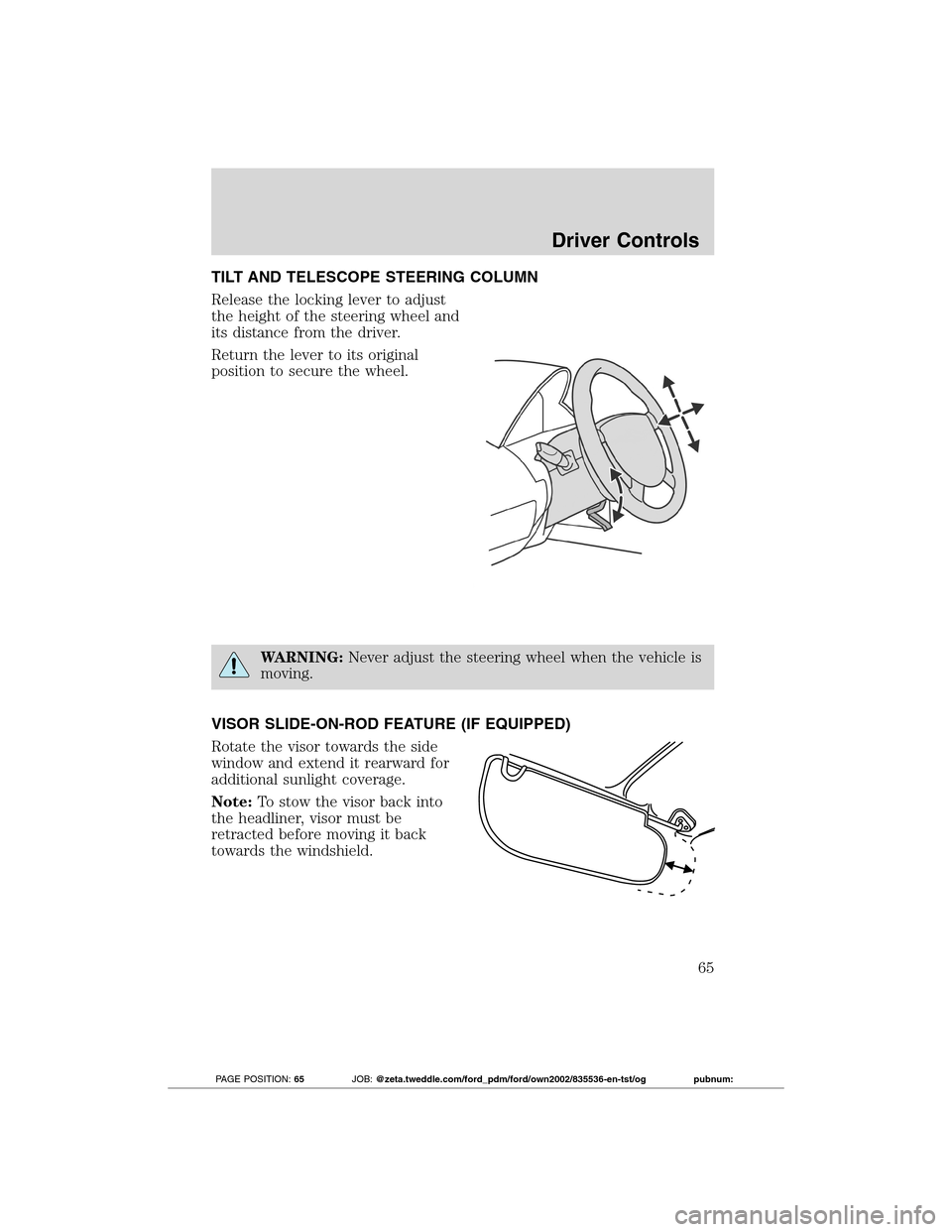
TILT AND TELESCOPE STEERING COLUMN
Release the locking lever to adjust
the height of the steering wheel and
its distance from the driver.
Return the lever to its original
position to secure the wheel.
WARNING:Never adjust the steering wheel when the vehicle is
moving.
VISOR SLIDE-ON-ROD FEATURE (IF EQUIPPED)
Rotate the visor towards the side
window and extend it rearward for
additional sunlight coverage.
Note:To stow the visor back into
the headliner, visor must be
retracted before moving it back
towards the windshield.
Driver Controls
65
2012 Transit Connect(tst)
Owners Guide, 1st Printing
USA(fus)
PAGE POSITION:65JOB:@zeta.tweddle.com/ford_pdm/ford/own2002/835536-en-tst/og pubnum:
Page 66 of 299
CENTER CONSOLE
Your vehicle has a variety of console features. These include:
•Cupholders
•Storage area
•Power window switches (if equipped)
WARNING:Use only soft cups in the cupholder. Hard objects
can injure you in a collision.
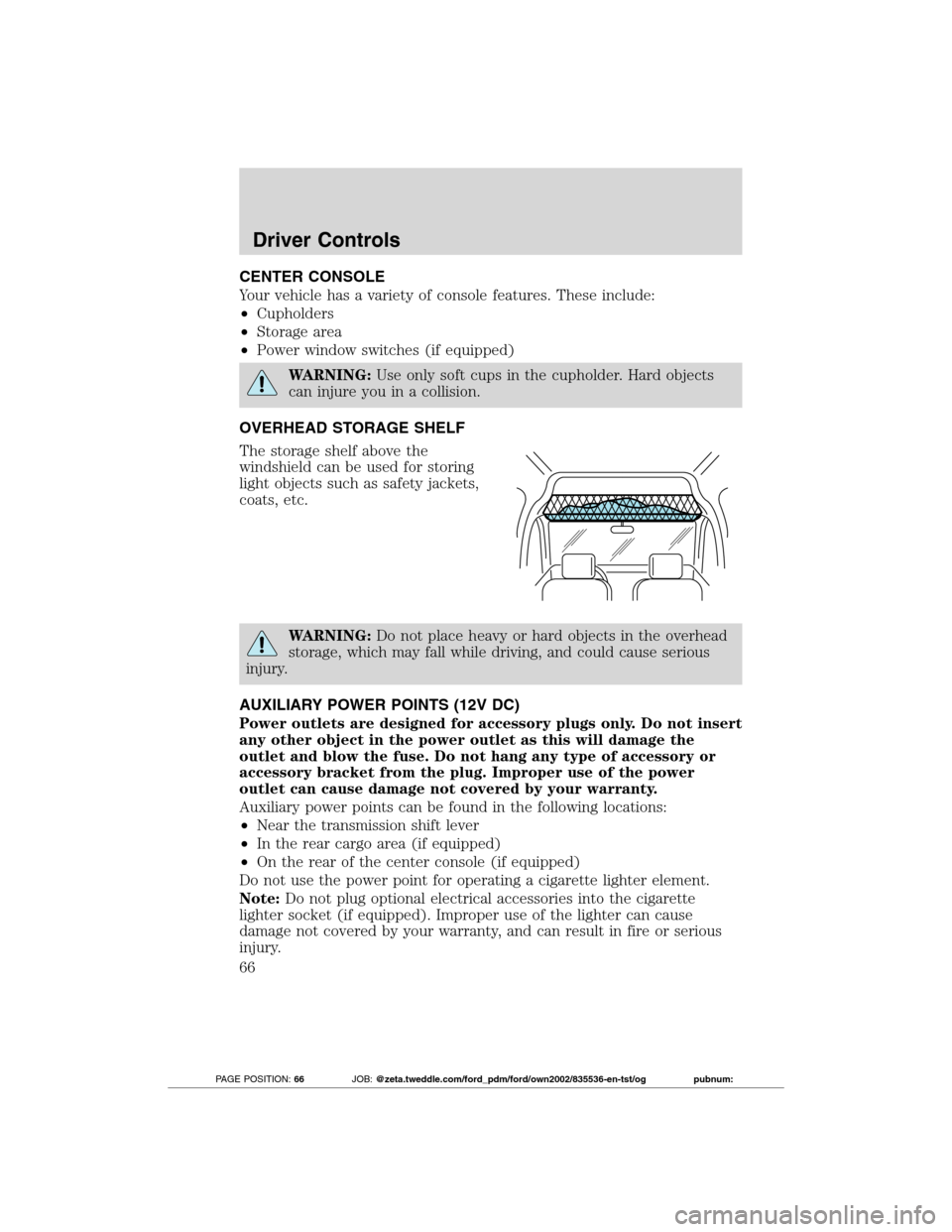
OVERHEAD STORAGE SHELF
The storage shelf above the
windshield can be used for storing
light objects such as safety jackets,
coats, etc.
WARNING:Do not place heavy or hard objects in the overhead
storage, which may fall while driving, and could cause serious
injury.
AUXILIARY POWER POINTS (12V DC)
Power outlets are designed for accessory plugs only. Do not insert
any other object in the power outlet as this will damage the
outlet and blow the fuse. Do not hang any type of accessory or
accessory bracket from the plug. Improper use of the power
outlet can cause damage not covered by your warranty.
Auxiliary power points can be found in the following locations:
•Near the transmission shift lever
•In the rear cargo area (if equipped)
•On the rear of the center console (if equipped)
Do not use the power point for operating a cigarette lighter element.
Note:Do not plug optional electrical accessories into the cigarette
lighter socket (if equipped). Improper use of the lighter can cause
damage not covered by your warranty, and can result in fire or serious
injury.
Driver Controls
66
2012 Transit Connect(tst)
Owners Guide, 1st Printing
USA(fus)
PAGE POSITION:66JOB:@zeta.tweddle.com/ford_pdm/ford/own2002/835536-en-tst/og pubnum:
Page 67 of 299
To prevent the fuse from being blown, do not use the power point(s)
over the vehicle capacity of 12V DC/135W. If the power point or cigar
lighter socket is not working, a fuse may have blown. Refer toFuses and
relaysin theRoadside Emergencieschapter for information on
checking and replacing fuses.
To have full capacity usage of your power point, the engine is required to
be running to avoid unintentional discharge of the battery. To prevent
the battery from being discharged:
•do not use the power point longer than necessary when the engine is
not running,
•do not leave battery chargers, video game adapters, computers and
other devices plugged in overnight or when the vehicle is parked for
extended periods.
Always keep the power point caps closed when not being used.
POWER WINDOWS (IF EQUIPPED)
WARNING:Do not leave children unattended in the vehicle and
do not let children play with the power windows. They may
seriously injure themselves.
WARNING:When closing the power windows, you should verify
they are free of obstructions and ensure that children and/or
pets are not in the proximity of the window openings.
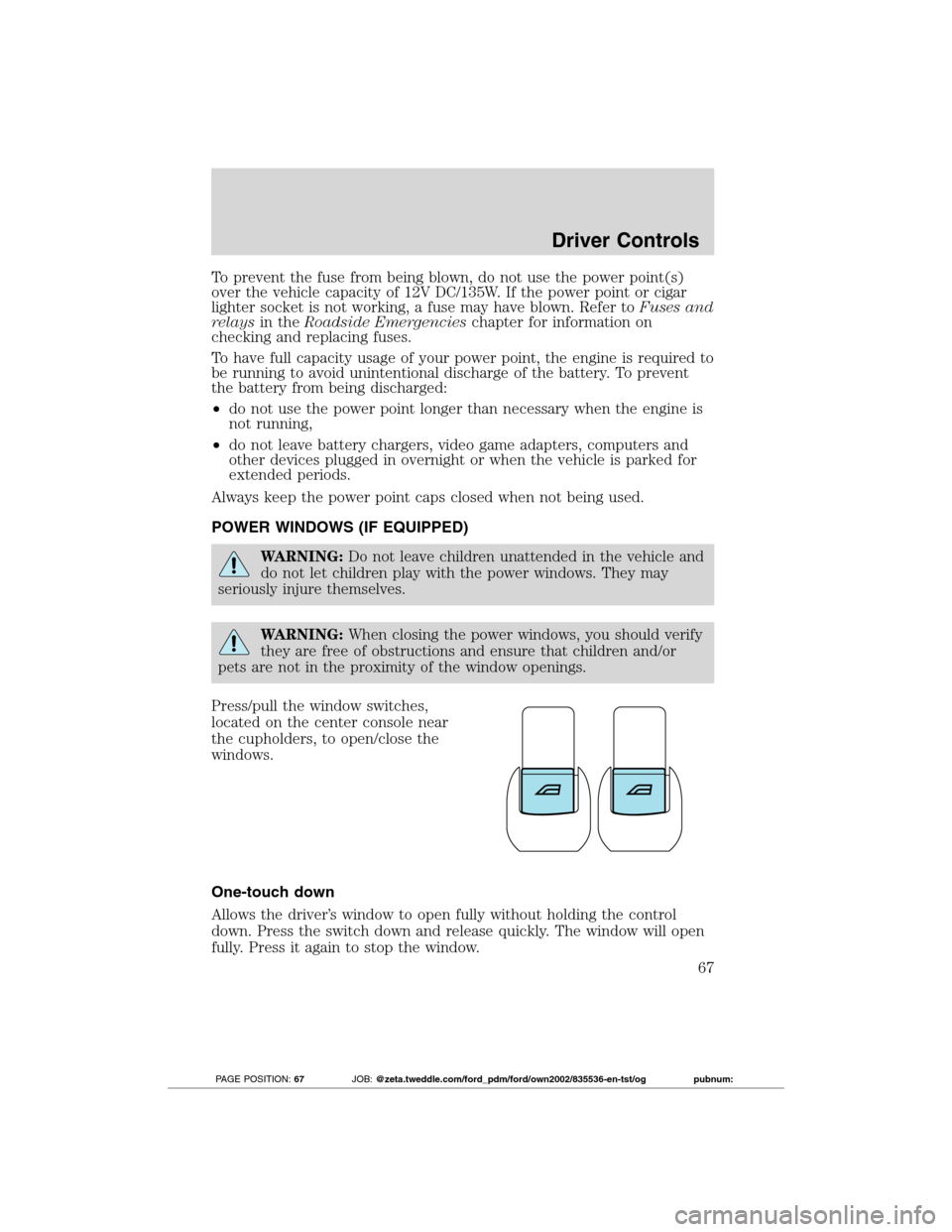
Press/pull the window switches,
located on the center console near
the cupholders, to open/close the
windows.
One-touch down
Allows the driver’s window to open fully without holding the control
down. Press the switch down and release quickly. The window will open
fully. Press it again to stop the window.
Driver Controls
67
2012 Transit Connect(tst)
Owners Guide, 1st Printing
USA(fus)
PAGE POSITION:67JOB:@zeta.tweddle.com/ford_pdm/ford/own2002/835536-en-tst/og pubnum:
Page 68 of 299
INTERIOR MIRROR
The interior rearview mirror has two pivot points on the support arm
which lets you adjust the mirror up or down and from side to side.
WARNING:Do not adjust the mirror while the vehicle is in
motion.
Automatic dimming interior rear view mirror (if equipped)
The interior rear view mirror has an auto-dimming function. The
electronic day/night mirror will change from the normal (high reflective)
state to the non-glare (darkened) state when bright lights (glare) reach
the mirror. When the mirror detects bright light from behind the vehicle,
it will automatically adjust (darken) to minimize glare.
The mirror will automatically return to the normal state whenever the
vehicle is placed in R (Reverse) to ensure a bright clear view when
backing up.
Do not block the sensors on the front and back of the interior
rear view mirror since this may impair proper mirror
performance.
Note:A rear center passenger and/or raised rear center headrest (if
equipped) may also block the light from reaching the sensor.
Do not clean the housing or glass of any mirror with harsh
abrasives, fuel or other petroleum-based cleaning products.
Note:If equipped with a rearview camera system, a video image will
display in the mirror when the vehicle is put in R (Reverse). As you shift
into any other gear from R (Reverse), the image will remain for a few
seconds and then turn off. Refer toRearview camera systemin the
Drivingchapter.
Driver Controls
68
2012 Transit Connect(tst)
Owners Guide, 1st Printing
USA(fus)
PAGE POSITION:68JOB:@zeta.tweddle.com/ford_pdm/ford/own2002/835536-en-tst/og pubnum:
Page 95 of 299
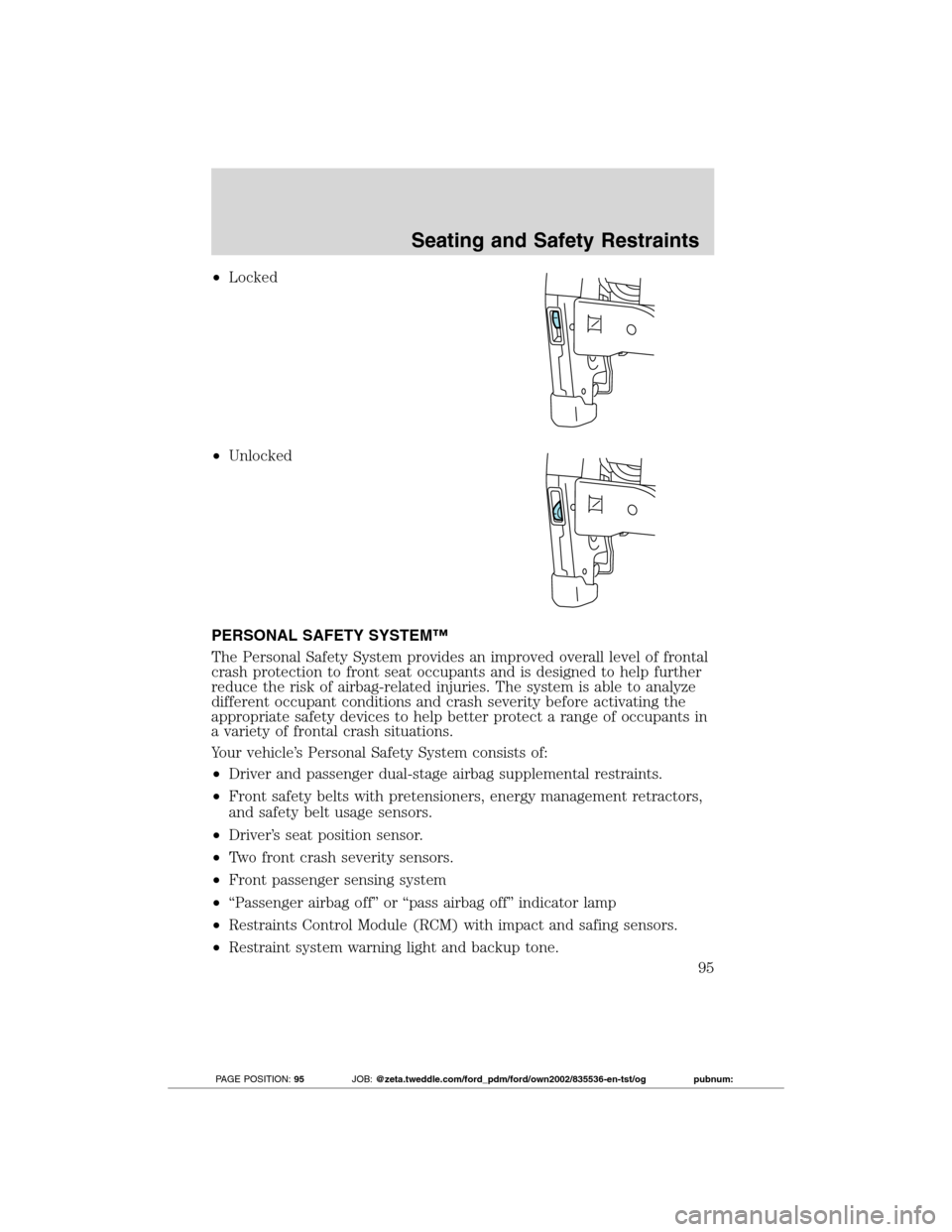
•Locked
•Unlocked
PERSONAL SAFETY SYSTEM™
The Personal Safety System provides an improved overall level of frontal
crash protection to front seat occupants and is designed to help further
reduce the risk of airbag-related injuries. The system is able to analyze
different occupant conditions and crash severity before activating the
appropriate safety devices to help better protect a range of occupants in
a variety of frontal crash situations.
Your vehicle’s Personal Safety System consists of:
•Driver and passenger dual-stage airbag supplemental restraints.
•Front safety belts with pretensioners, energy management retractors,
and safety belt usage sensors.
•Driver’s seat position sensor.
•Two front crash severity sensors.
•Front passenger sensing system
•“Passenger airbag off” or “pass airbag off” indicator lamp
•Restraints Control Module (RCM) with impact and safing sensors.
•Restraint system warning light and backup tone.
Seating and Safety Restraints
95
2012 Transit Connect(tst)
Owners Guide, 1st Printing
USA(fus)
PAGE POSITION:95JOB:@zeta.tweddle.com/ford_pdm/ford/own2002/835536-en-tst/og pubnum:
Page 97 of 299
Front passenger sensing system
For airbags to do their job they must inflate with great force, and this
force can pose a potentially deadly risk to occupants that are very close
to the airbag when it begins to inflate. For some occupants, like infants
in rear-facing child seats, this occurs because they are initially sitting
very close to the airbag. For other occupants, this occurs when the
occupant is not properly restrained by safety belts or child safety seats
and they move forward during pre-crash braking. The most effective way
to reduce the risk of unnecessary injuries is to make sure all occupants
are properly restrained. Accident statistics suggest that children are
much safer when properly restrained in the rear seating positions than in
the front.
WARNING:Air bags can kill or injure a child in a child seat.
NEVERplace a rear-facing child seat in front of an active air
bag. If you must use a forward-facing child seat in the front seat, move
the seat all the way back.
WARNING:Always transport children 12 years old and under in
the back seat and always properly use appropriate child
restraints.
The front passenger sensing system can automatically turn off the
passenger front airbag. The system is designed to help protect small
(child size) occupants from airbag deployments when they are
improperly seated or restrained in the front passenger seat contrary to
proper child-seating or restraint usage recommendations. Even with this
technology, parents areSTRONGLYencouraged to always properly
restrain children in the rear seat. The sensor also turns off the airbag
when the passenger seat is empty to prevent unnecessary replacement of
the airbag(s) after a collision.
When the front passenger seat is occupied and the sensing system has
turned off the passenger’s frontal airbag, the “pass airbag off” indicator
will light and stay lit to remind you that the front passenger frontal
airbag is off. SeeFront passenger sensing systemin theAirbag
supplemental restraint system (SRS)section of this chapter.
Front safety belt usage sensors
The front safety belt usage sensors detect whether or not the driver and
front outboard passenger safety belts are fastened. This information
allows your Personal Safety System to tailor the airbag deployment and
safety belt pretensioner activation depending upon safety belt usage.
Seating and Safety Restraints
97
2012 Transit Connect(tst)
Owners Guide, 1st Printing
USA(fus)
PAGE POSITION:97JOB:@zeta.tweddle.com/ford_pdm/ford/own2002/835536-en-tst/og pubnum:
Page 98 of 299
Front outboard safety belt pretensioners
The safety belt pretensioners at the front outboard seating positions
activate with the front airbags during frontal and side collisions of
sufficient severity and are designed to tighten the safety belts firmly
against the occupant’s body. This helps increase the effectiveness of the
safety belts.
Front outboard safety belt energy management retractors
The front safety belt energy management retractors allow webbing to be
pulled out of the retractor in a gradual and controlled manner in
response to the occupant’s forward momentum. This helps reduce the
risk of force-related injuries to the occupant’s chest by limiting the load
on the occupant. Refer to theEnergy management featuresection in
this chapter.
Determining if the Personal Safety System is operational
The Personal Safety System uses a warning light in the instrument
cluster or a backup tone to indicate the condition of the system. Refer to
theWarning lights and chimessection in theInstrument Cluster
chapter. Routine maintenance of the Personal Safety System is not
required.
The Restraints Control Module (RCM) monitors its own internal circuits
and the circuits for the airbag supplemental restraints, crash sensor(s),
safety belt pretensioners, front safety belt buckle sensors, front
passenger sensing system, and the driver seat position sensor. In
addition, the RCM also monitors the restraints warning light in the
instrument cluster. A difficulty with the system is indicated by one or
more of the following.
•The warning light will either flash or stay lit.
•The warning light will not illuminate immediately after ignition is
turned on.
•A series of five beeps will be heard. The tone pattern will repeat
periodically until the problem and warning light are repaired.
If any of these things happen, even intermittently, have the Personal
Safety System serviced at an authorized dealer immediately. Unless
serviced, the system may not function properly in the event of a
collision.
Seating and Safety Restraints
98
2012 Transit Connect(tst)
Owners Guide, 1st Printing
USA(fus)
PAGE POSITION:98JOB:@zeta.tweddle.com/ford_pdm/ford/own2002/835536-en-tst/og pubnum:
Page 101 of 299
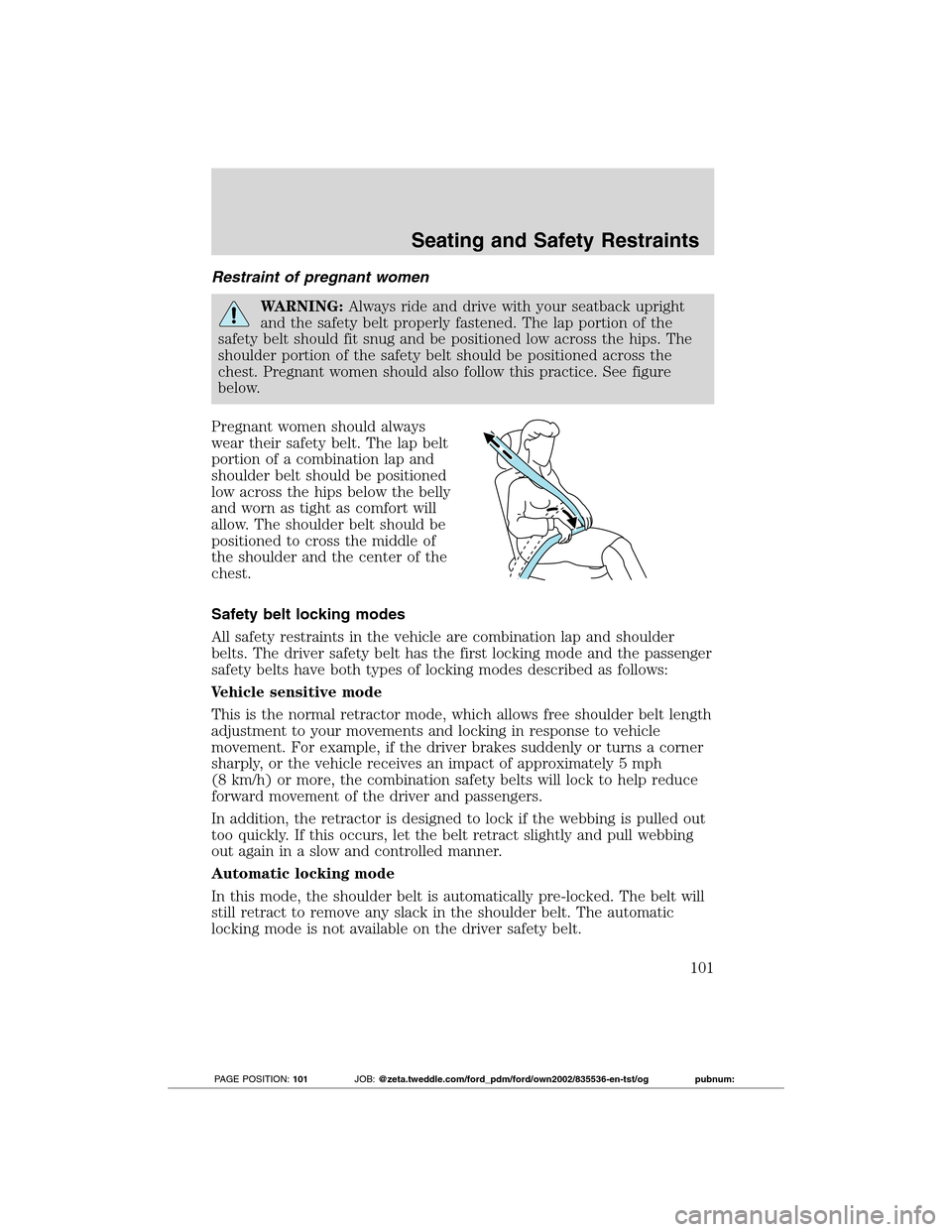
Restraint of pregnant women
WARNING:Always ride and drive with your seatback upright
and the safety belt properly fastened. The lap portion of the
safety belt should fit snug and be positioned low across the hips. The
shoulder portion of the safety belt should be positioned across the
chest. Pregnant women should also follow this practice. See figure
below.
Pregnant women should always
wear their safety belt. The lap belt
portion of a combination lap and
shoulder belt should be positioned
low across the hips below the belly
and worn as tight as comfort will
allow. The shoulder belt should be
positioned to cross the middle of
the shoulder and the center of the
chest.
Safety belt locking modes
All safety restraints in the vehicle are combination lap and shoulder
belts. The driver safety belt has the first locking mode and the passenger
safety belts have both types of locking modes described as follows:
Vehicle sensitive mode
This is the normal retractor mode, which allows free shoulder belt length
adjustment to your movements and locking in response to vehicle
movement. For example, if the driver brakes suddenly or turns a corner
sharply, or the vehicle receives an impact of approximately 5 mph
(8 km/h) or more, the combination safety belts will lock to help reduce
forward movement of the driver and passengers.
In addition, the retractor is designed to lock if the webbing is pulled out
too quickly. If this occurs, let the belt retract slightly and pull webbing
out again in a slow and controlled manner.
Automatic locking mode
In this mode, the shoulder belt is automatically pre-locked. The belt will
still retract to remove any slack in the shoulder belt. The automatic
locking mode is not available on the driver safety belt.
Seating and Safety Restraints
101
2012 Transit Connect(tst)
Owners Guide, 1st Printing
USA(fus)
PAGE POSITION:101JOB:@zeta.tweddle.com/ford_pdm/ford/own2002/835536-en-tst/og pubnum:
Page 103 of 299
Safety belt pretensioner
Your vehicle is equipped with safety belt pretensioners at the driver and
front outboard passenger seating positions.
The safety belt pretensioner tightens the safety belts firmly against the
occupant’s body at the start of the crash.
WARNING:The driver and front passenger safety belt system
(including retractors, buckles and height adjusters) must be
replaced if the vehicle is involved in a collision that results in
deployment of front airbags, side airbags, and safety belt pretensioners.
Safety belt extension assembly
If the safety belt is too short when fully extended, a safety belt extension
assembly can be obtained from an authorized dealer.
Use only extensions manufactured by the same supplier as the safety
belt. Manufacturer identification is located at the end of the webbing on
the label. Also, use the safety belt extension only if the safety belt is too
short for you when fully extended.
WARNING:Do not use extensions to change the fit of the
shoulder belt across the torso.
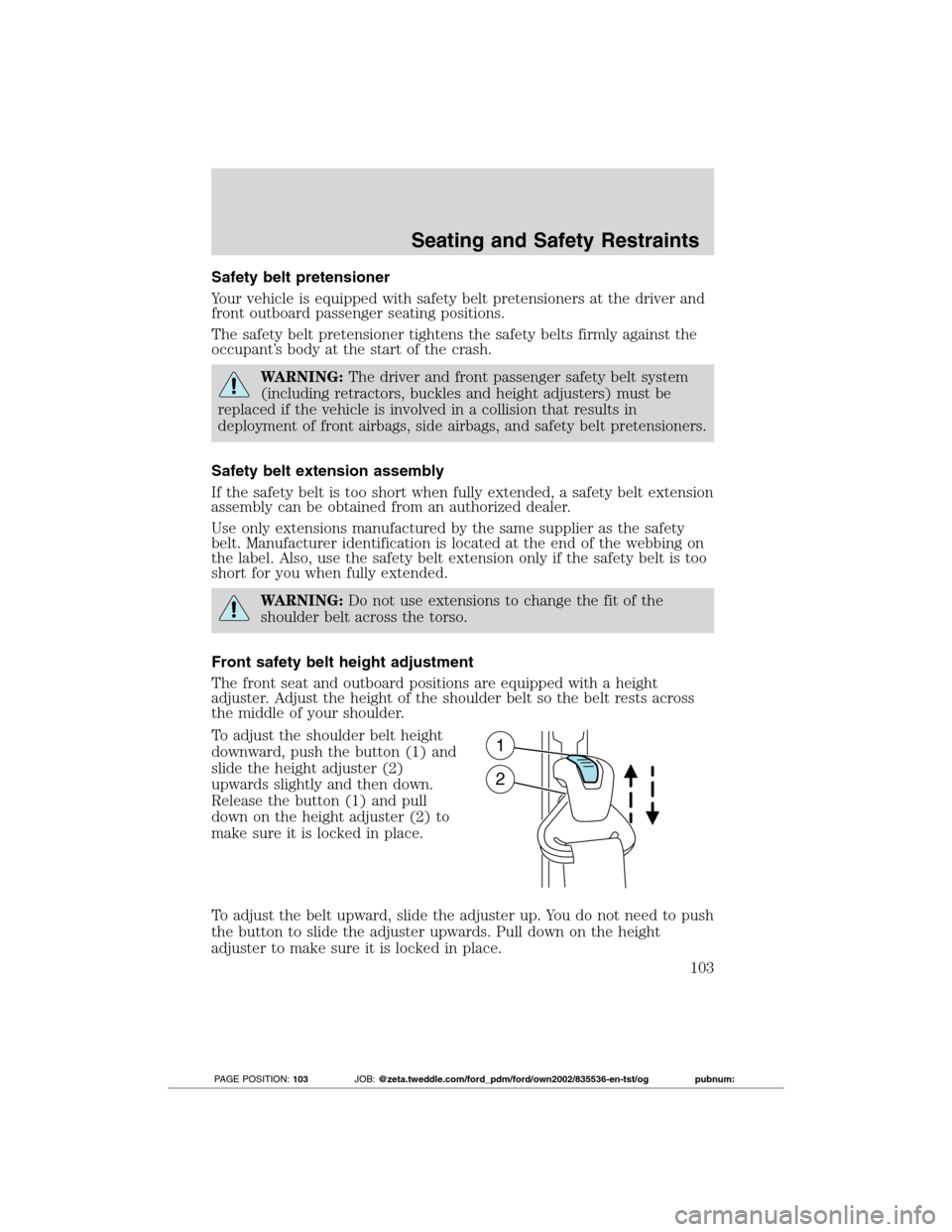
Front safety belt height adjustment
The front seat and outboard positions are equipped with a height
adjuster. Adjust the height of the shoulder belt so the belt rests across
the middle of your shoulder.
To adjust the shoulder belt height
downward, push the button (1) and
slide the height adjuster (2)
upwards slightly and then down.
Release the button (1) and pull
down on the height adjuster (2) to
make sure it is locked in place.
To adjust the belt upward, slide the adjuster up. You do not need to push
the button to slide the adjuster upwards. Pull down on the height
adjuster to make sure it is locked in place.
1
2
Seating and Safety Restraints
103
2012 Transit Connect(tst)
Owners Guide, 1st Printing
USA(fus)
PAGE POSITION:103JOB:@zeta.tweddle.com/ford_pdm/ford/own2002/835536-en-tst/og pubnum: