brake FORD TRANSIT CONNECT 2013 1.G Owner's Manual
[x] Cancel search | Manufacturer: FORD, Model Year: 2013, Model line: TRANSIT CONNECT, Model: FORD TRANSIT CONNECT 2013 1.GPages: 321, PDF Size: 4.5 MB
Page 153 of 321
Preparing Your Vehicle
Note:Use only a 12–volt supply to start your vehicle.
Note:Do not disconnect the battery of the disabled vehicle as this could
damage the vehicle’s electrical system.
1. Park the booster vehicle close to the hood of the disabled vehicle
making sure the two vehicles do not touch. Set the parking brake on
both vehicles and stay clear of the engine cooling fan and other moving
parts.
2. Check all battery terminals. Remove the positive terminal cover
(if equipped) and any excessive corrosion before you attach the battery
cables. Ensure that vent caps are tight and level.
3. Turn the heater fan on in both vehicles to protect from any electrical
surges. Turn all other accessories off.
Connecting the Jumper Cables
WARNING:Do not connect the end of the second cable to the
negative (-) terminal of the battery to be jumped. A spark may
cause an explosion of the gases that surround the battery.
Note:Do not attach the negative (-) cable to fuel lines, engine rocker
covers, the intake manifold or electrical components as grounding points.
Note:In the illustration, the vehicle on the bottom is used to designate
the assisting (boosting) battery.
152Roadside Emergencies
2013 Transit Connect(tst)
Owners Guide gf, 2nd Printing, November 2012
USA(fus)
Page 166 of 321
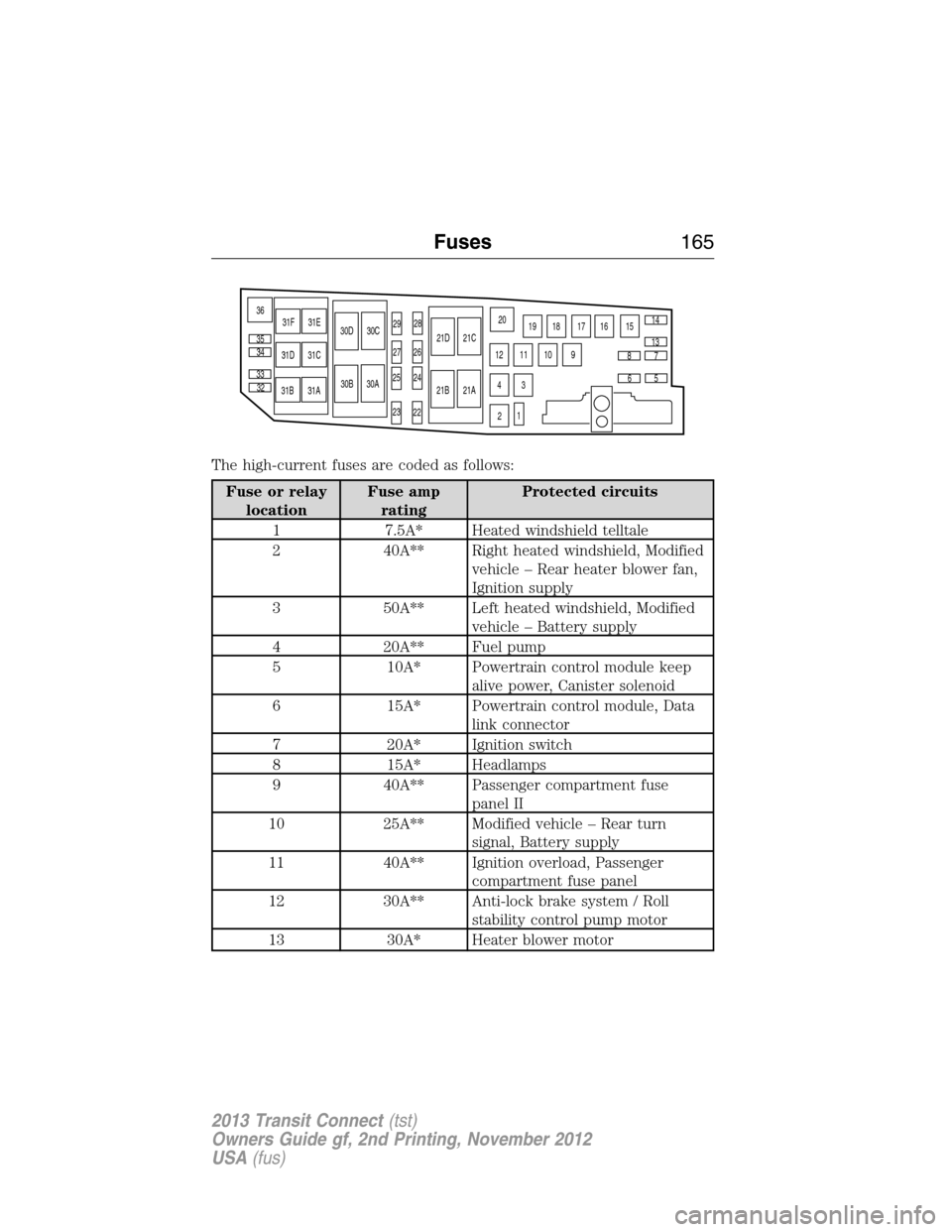
The high-current fuses are coded as follows:
Fuse or relay
locationFuse amp
ratingProtected circuits
1 7.5A* Heated windshield telltale
2 40A** Right heated windshield, Modified
vehicle – Rear heater blower fan,
Ignition supply
3 50A** Left heated windshield, Modified
vehicle – Battery supply
4 20A** Fuel pump
5 10A* Powertrain control module keep
alive power, Canister solenoid
6 15A* Powertrain control module, Data
link connector
7 20A* Ignition switch
8 15A* Headlamps
9 40A** Passenger compartment fuse
panel II
10 25A** Modified vehicle – Rear turn
signal, Battery supply
11 40A** Ignition overload, Passenger
compartment fuse panel
12 30A** Anti-lock brake system / Roll
stability control pump motor
13 30A* Heater blower motor
25
24
22 2326 2728
29
21A
21B21C
21D
30A
30B30C 30D
31A
31B31C 31D31E 31F
32 3334 35 36
15
16 17
18 19 20
10 11 12
9
3 4
1
25
67 81314
Fuses165
2013 Transit Connect(tst)
Owners Guide gf, 2nd Printing, November 2012
USA(fus)
Page 167 of 321
Fuse or relay
locationFuse amp
ratingProtected circuits
14 10A* Powertrain control module relay
15 20A** Anti-lock brake system / Roll
stability control valves
16 30A** Cooling fan – low
17 50A** Cooling fan – high
18 25A** Daytime running lamps, Low
beam interrupt relay
19 50A** Passenger compartment fuse
panel III
20 — A/C clutch relay
21A — Right heated windshield relay,
Modified vehicle – Rear fan relay
21B — Starter lock relay
21C — High beam headlamp relay
21D — Powertrain control module relay
22 10A* Powertrain control module,
Auxiliary connector, Fuel injectors
23 10A* Right low beam headlamp
24 10A* A/C clutch solenoid
25 10A* Left low beam headlamp
26 10A* Mass air flow sensor, Brake
switch, Backup lamps relay,
Exhaust gas recovery valve
stepper motor, Electronic vapor
canister purge valve, Heated
oxygen sensors, Floor shifter,
Transmission range sensor
27 — Not used
166Fuses
2013 Transit Connect(tst)
Owners Guide gf, 2nd Printing, November 2012
USA(fus)
Page 170 of 321
Fuse or relay
locationFuse amp
ratingProtected circuits
126 — Rear unlock relay
127 — Ignition overload relay
128 — Battery saver relay
(modified vehicle)
130 15A Hazard flashers
131 5A Power mirrors
132 10A Light switch, Exterior lighting
133 — Not used
134 — Not used
135 — Not used
136 15A Horn
137 7.5A Tire pressure monitoring system,
Radio, Instrument cluster
138 10A Reverse lamp
139 20A Ignition supply (modified vehicle)
140 — Not used
141 7.5A Front/rear fog lamps
142 15A Brake lamps
143 20A Cigar lighter, Front power point
144 10A Ignition supply (modified vehicle)
145 — Not used
146 20A Windshield wipers, Wiper switch
147 15A Front fog lamps
148 7.5A Recirculation, Instrument cluster
149 10A Ignition supply/Battery supply
(modified vehicle)
150 — Not used
151 15A Radio, Bluetooth®/Voice
command module
152 7.5A A/C switch, Park aid module
153 7.5A Interior lamps, Battery saver
154 15A Roof lamp (modified vehicle)
Fuses169
2013 Transit Connect(tst)
Owners Guide gf, 2nd Printing, November 2012
USA(fus)
Page 171 of 321
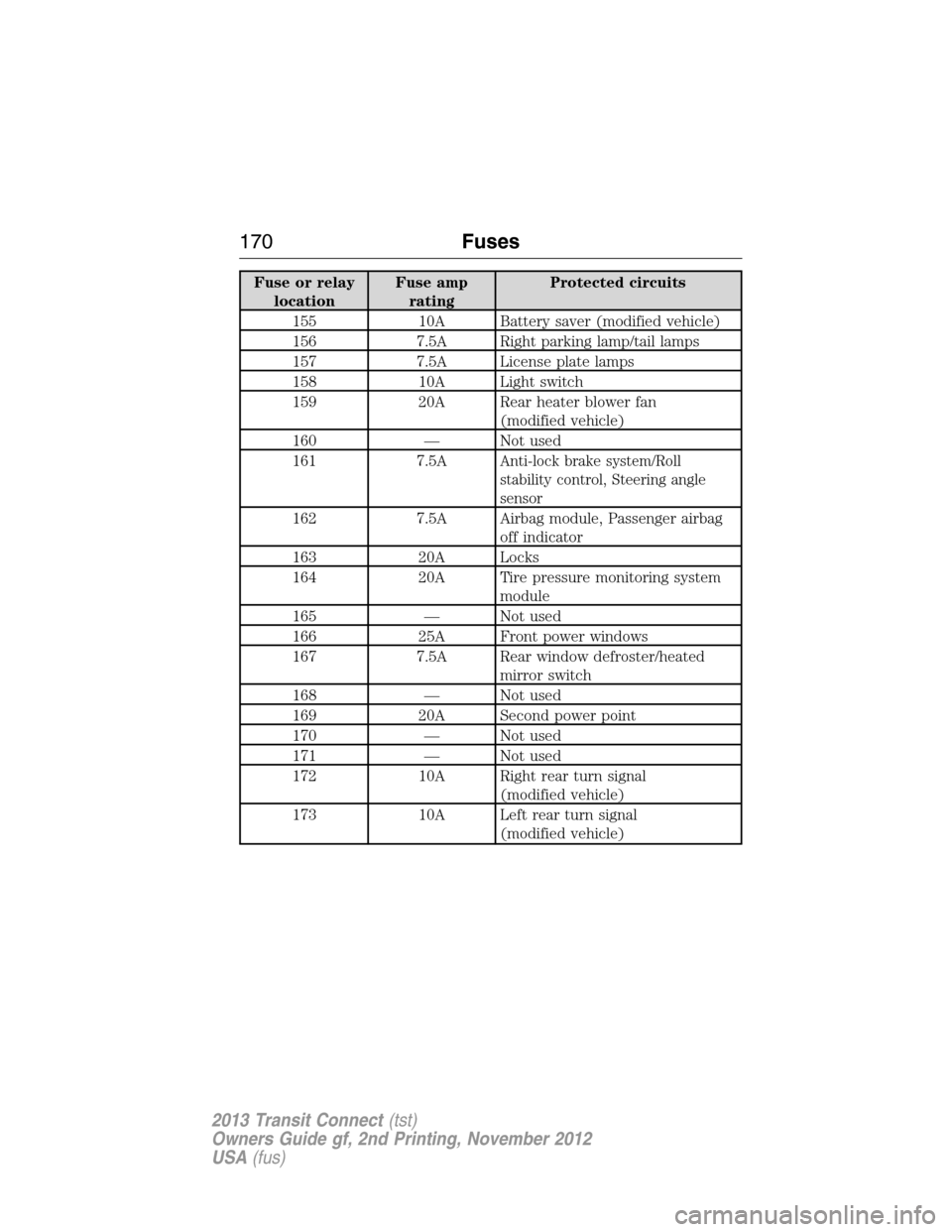
Fuse or relay
locationFuse amp
ratingProtected circuits
155 10A Battery saver (modified vehicle)
156 7.5A Right parking lamp/tail lamps
157 7.5A License plate lamps
158 10A Light switch
159 20A Rear heater blower fan
(modified vehicle)
160 — Not used
161 7.5A
Anti-lock brake system/Roll
stability control, Steering angle
sensor
162 7.5A Airbag module, Passenger airbag
off indicator
163 20A Locks
164 20A Tire pressure monitoring system
module
165 — Not used
166 25A Front power windows
167 7.5A Rear window defroster/heated
mirror switch
168 — Not used
169 20A Second power point
170 — Not used
171 — Not used
172 10A Right rear turn signal
(modified vehicle)
173 10A Left rear turn signal
(modified vehicle)
170Fuses
2013 Transit Connect(tst)
Owners Guide gf, 2nd Printing, November 2012
USA(fus)
Page 173 of 321
GENERAL INFORMATION
Have your vehicle serviced regularly to help maintain its roadworthiness
and resale value. There is a large network of Ford authorized dealers
who are there to help you with their professional servicing expertise.
We believe that their specially trained technicians are best qualified to
service your vehicle properly and expertly. They are supported by a wide
range of highly specialized tools developed specifically for servicing your
vehicle.
To help you service your vehicle, we provideScheduled Maintenance
Informationwhich makes tracking routine service easy.
If your vehicle requires professional service, your authorized dealer
can provide the necessary parts and service. Check your warranty
information to find out which parts and services are covered.
Use only recommended fuels, lubricants, fluids and service parts
conforming to specifications. Motorcraft® parts are designed and built
to provide the best performance in your vehicle.
Precautions
•Do not work on a hot engine.
•Make sure that nothing gets caught in moving parts.
•Do not work on a vehicle with the engine running in an enclosed
space, unless you are sure you have enough ventilation.
•Keep all open flames and other burning material (such as cigarettes)
away from the battery and all fuelrelated parts.
Working with the Engine Off
1. Set the parking brake and shift toP(Park).
2. Turn off the engine and remove the key (if equipped).
3. Block the wheels.
172Maintenance
2013 Transit Connect(tst)
Owners Guide gf, 2nd Printing, November 2012
USA(fus)
Page 174 of 321
Working with the Engine On
WARNING:To reduce the risk of vehicle damage or personal
burn injuries, do not start your engine with the air cleaner
removed and do not remove it while the engine is running.
1. Set the parking brake and shift to positionP.
2. Block the wheels.
Electric vehicles
For specific information on the Transit Connect Electric, refer to the
Azure Dynamics TC-E Owner’s GuideSupplement.
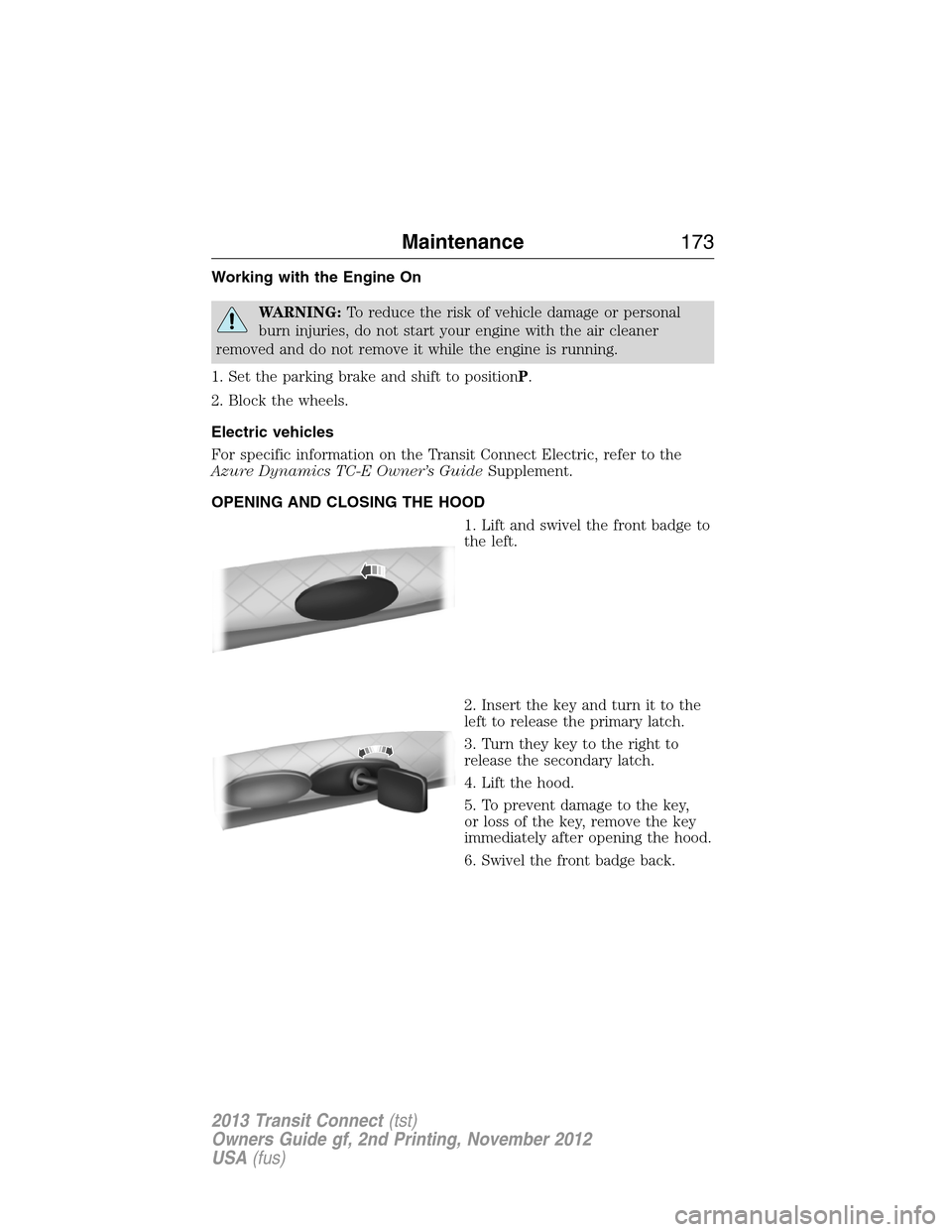
OPENING AND CLOSING THE HOOD
1. Lift and swivel the front badge to
the left.
2. Insert the key and turn it to the
left to release the primary latch.
3. Turn they key to the right to
release the secondary latch.
4. Lift the hood.
5. To prevent damage to the key,
or loss of the key, remove the key
immediately after opening the hood.
6. Swivel the front badge back.
Maintenance173
2013 Transit Connect(tst)
Owners Guide gf, 2nd Printing, November 2012
USA(fus)
Page 176 of 321
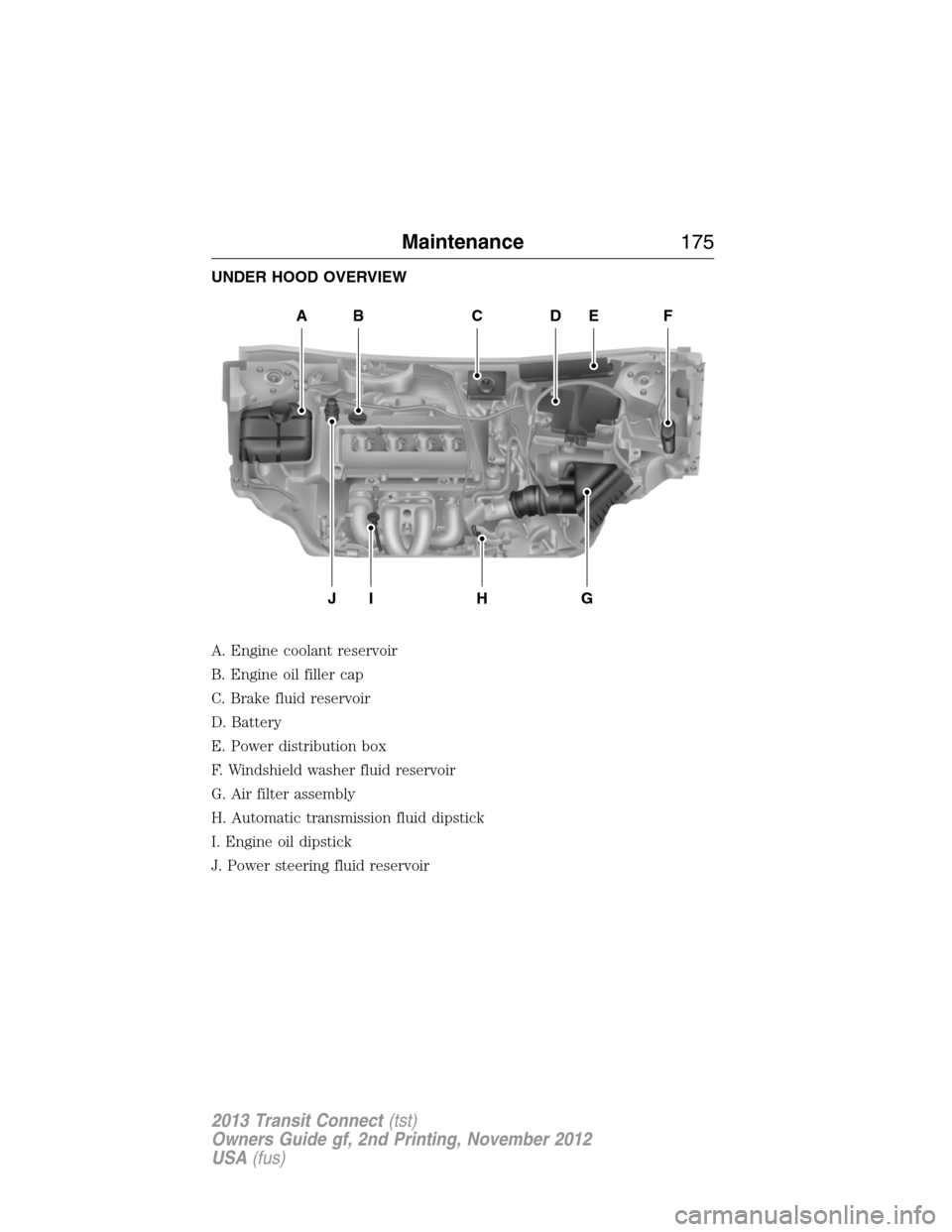
UNDER HOOD OVERVIEW
A. Engine coolant reservoir
B. Engine oil filler cap
C. Brake fluid reservoir
D. Battery
E. Power distribution box
F. Windshield washer fluid reservoir
G. Air filter assembly
H. Automatic transmission fluid dipstick
I. Engine oil dipstick
J. Power steering fluid reservoir
ABCDEF
GHIJ
Maintenance175
2013 Transit Connect(tst)
Owners Guide gf, 2nd Printing, November 2012
USA(fus)
Page 177 of 321
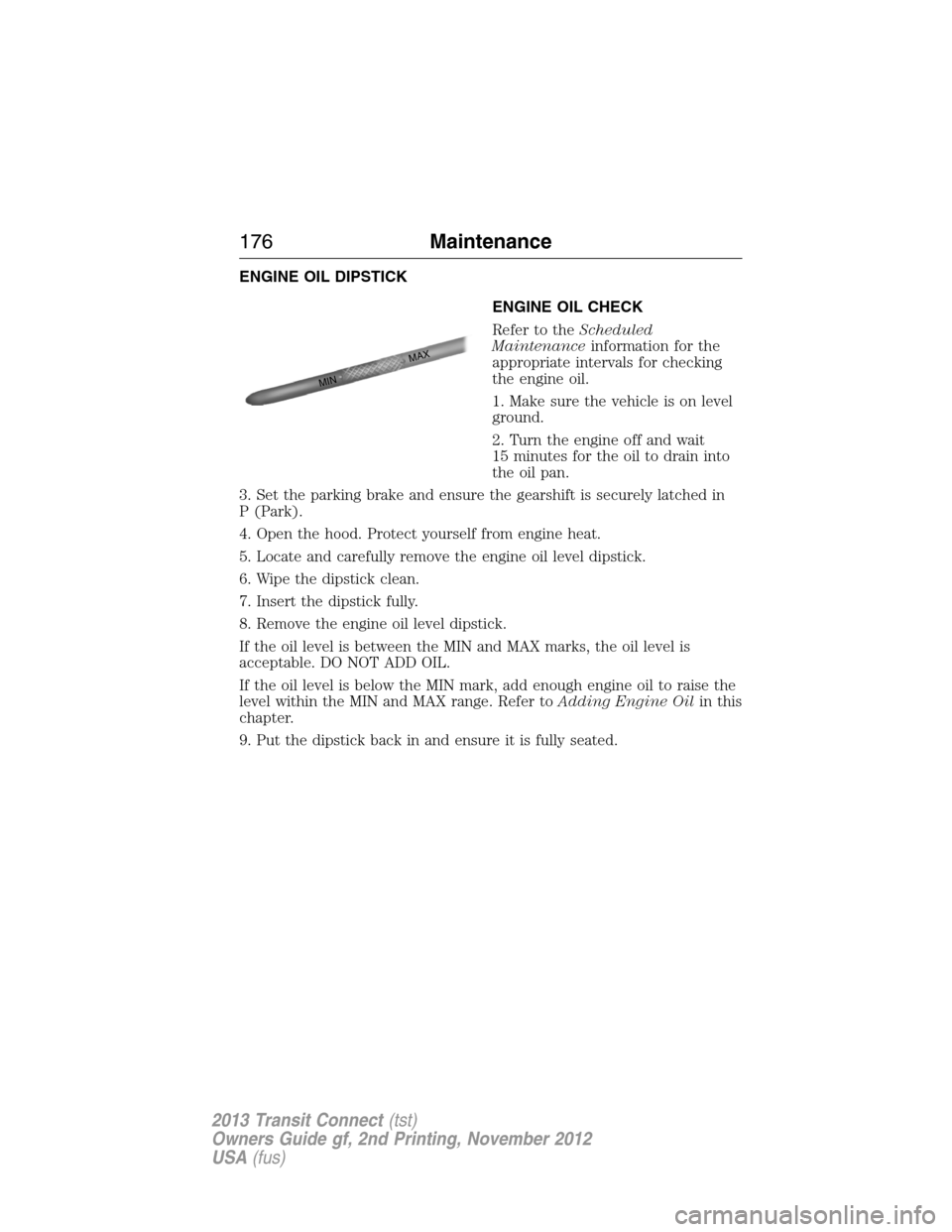
ENGINE OIL DIPSTICK
ENGINE OIL CHECK
Refer to theScheduled
Maintenanceinformation for the
appropriate intervals for checking
the engine oil.
1. Make sure the vehicle is on level
ground.
2. Turn the engine off and wait
15 minutes for the oil to drain into
the oil pan.
3. Set the parking brake and ensure the gearshift is securely latched in
P (Park).
4. Open the hood. Protect yourself from engine heat.
5. Locate and carefully remove the engine oil level dipstick.
6. Wipe the dipstick clean.
7. Insert the dipstick fully.
8. Remove the engine oil level dipstick.
If the oil level is between the MIN and MAX marks, the oil level is
acceptable. DO NOT ADD OIL.
If the oil level is below the MIN mark, add enough engine oil to raise the
level within the MIN and MAX range. Refer toAdding Engine Oilin this
chapter.
9. Put the dipstick back in and ensure it is fully seated.
MINMAX
176Maintenance
2013 Transit Connect(tst)
Owners Guide gf, 2nd Printing, November 2012
USA(fus)
Page 182 of 321
When fail-safe mode is activated
You have limited engine power when in the fail-safe mode, so drive the
vehicle with caution. The vehicle will not be able to maintain high speed
operation and the engine will run rough. Remember that the engine is
capable of completely shutting down automatically to prevent engine
damage, therefore:
1. Pull off the road as soon as safely possible and turn off the engine.
2. Arrange for the vehicle to be taken to an authorized dealer.
3. If this is not possible, wait a short period for the engine to cool.
4. Check the coolant level and replenish if low.
WARNING:Never remove the coolant reservoir cap while the
engine is running or hot.
5. Restart the engine and take your vehicle to an authorized dealer.
Driving the vehicle without repairing the engine problem
increases the chance of engine damage. Take your vehicle to an
authorized dealer as soon as possible.
TRANSMISSION FLUID CHECK
Checking Automatic Transmission Fluid
Refer to yourScheduled Maintenanceinformation for scheduled
intervals for fluid checks and changes. Your transmission does not
consume fluid. However, the fluid level should be checked if the
transmission is not working properly, i.e., if the transmission slips
or shifts slowly or if you notice some sign of fluid leakage.
Automatic transmission fluid expands when warmed. Check the
transmission fluid when the fluid is at normal operating temperature
(120°F-140°F [50°C-60°C]) on a level surface. The normal operating
temperature can be reached after approximately 20 miles (30 km) of
driving. If your vehicle has been operated for an extended period at
high speeds, in city traffic, or during hot weather, the vehicle should be
turned off for about 30 minutes to allow fluid to cool before checking.
Under these conditions, the vehicle must be restarted prior to checking
the fluid level.
1. Drive the vehicle 20 miles (30 km) or until it reaches normal operating
temperature.
2. Park the vehicle on a level surface and engage the parking brake.
Maintenance181
2013 Transit Connect(tst)
Owners Guide gf, 2nd Printing, November 2012
USA(fus)