heating FORD WINDSTAR 1999 2.G User Guide
[x] Cancel search | Manufacturer: FORD, Model Year: 1999, Model line: WINDSTAR, Model: FORD WINDSTAR 1999 2.GPages: 248, PDF Size: 2.28 MB
Page 154 of 248

The Traction Controlysystem will assist you in making better use of
available traction on slippery surfaces. The system is a driver aid which
makes your vehicle easier to handle primarily on snow and ice covered
roads.
During Traction Controlyoperation, TRACTION CONTROL OK is
displayed on the message center (if equipped). You may hear an electric
motor type of sound coming from the engine compartment and the
engine will not ªrev-upº when you push further on the accelerator. This
is normal system behavior.
If you should become stuck in snow or on a very slippery road surface,
try switching the Traction Controlysystem off with the traction control
switch located on the left hand side of the radio. This may allow excess
wheel spin to ªdigº the vehicle out or enable a successful ªrockingº
maneuver.
If the Traction Controlysystem is cycled excessively, the brake portion
of the system will shut down to prevent the front brakes from
overheating. A limited Traction Controlyfunction using only engine
torque reduction will still control wheels from over-spinning. When the
front brakes have cooled down, the system will again function normally.
Anti-lock braking is not affected by this condition and will function
normally during the cool down period.
If a system fault is detected, CHECK TRACTION CONTROL is displayed
on the message center, the ªTC OFFº warning indicator lamp is on and
your vehicle should be serviced.
STEERING
Your vehicle is equipped with power steering. Power steering uses energy
from the engine to help steer the vehicle.
To prevent damage to the power steering pump:
²Never hold the steering wheel to the extreme right or the extreme left
for more than a few seconds when the engine is running.
²Do not operate the vehicle with a low power steering pump fluid level.
If the power steering system breaks down (or if the engine is turned
off), you can steer the vehicle manually, but it takes more effort.
Driving
154
Page 202 of 248
1. Drive the vehicle 30 km (20 miles) or until it reaches normal operating
temperature.
2. Park the vehicle on a level surface and engage the parking brake.
3. With the parking brake engaged and your foot on the brake pedal,
start the engine and move the gearshift lever through all of the gear
ranges. Allow sufficient time for each gear to engage.
4. Latch the gearshift lever in P (Park) and leave the engine running.
5. Remove the dipstick, wiping it clean with a clean, dry lint free rag.
6. Install the dipstick making sure it is fully seated in the filler tube.
7. Remove the dipstick and inspect the fluid level. The fluid should be in
the designated areas for normal and room temperature.
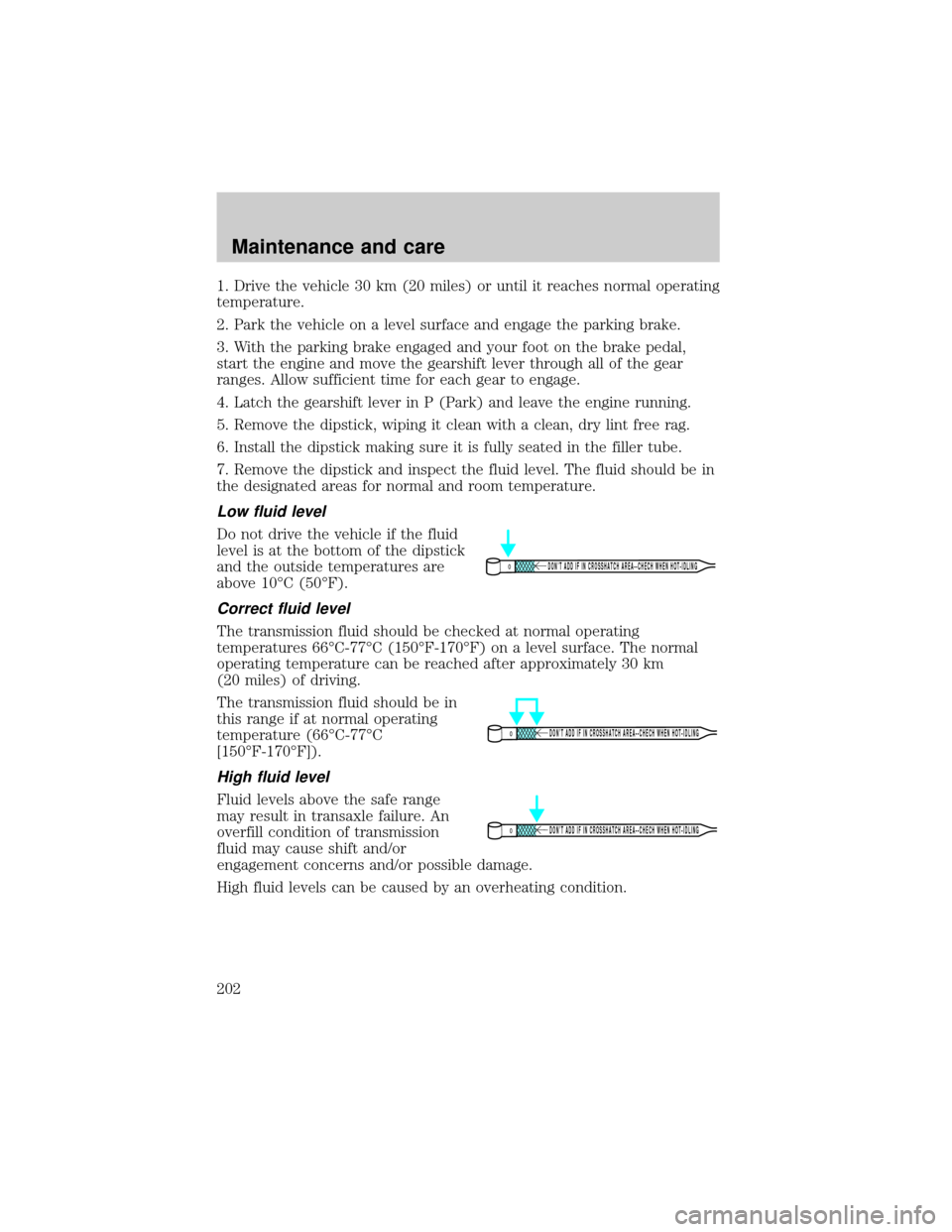
Low fluid level
Do not drive the vehicle if the fluid
level is at the bottom of the dipstick
and the outside temperatures are
above 10ÉC (50ÉF).
Correct fluid level
The transmission fluid should be checked at normal operating
temperatures 66ÉC-77ÉC (150ÉF-170ÉF) on a level surface. The normal
operating temperature can be reached after approximately 30 km
(20 miles) of driving.
The transmission fluid should be in
this range if at normal operating
temperature (66ÉC-77ÉC
[150ÉF-170ÉF]).
High fluid level
Fluid levels above the safe range
may result in transaxle failure. An
overfill condition of transmission
fluid may cause shift and/or
engagement concerns and/or possible damage.
High fluid levels can be caused by an overheating condition.
DON’T ADD IF IN CROSSHATCH AREA--CHECH WHEN HOT-IDLING
DON’T ADD IF IN CROSSHATCH AREA--CHECH WHEN HOT-IDLING
DON’T ADD IF IN CROSSHATCH AREA--CHECH WHEN HOT-IDLING
Maintenance and care
202
Page 244 of 248

Gas mileage (see Fuel
economy) ..............218,219,220,221
Gauges .........................................12
engine coolant temperature
gauge .........................................13
GVWR
(Gross Vehicle Weight Rating)
calculating ...............................161
Hazard flashers .........................167
Head restraints ...........105,109,110
Headlamps
aiming ........................228,229,230
bulb specifications ..................228
high beam ..............................8,26
warning chime ..........................11
Heating ........................................27
heater only system ...27,28,29,30,
31,32,33,34
rear seat controls .....................35
Hood ..........................................189
Ignition .......................................239
Inspection/maintenance (I/M)
testing ........................................223
Instrument panel
cleaning ...................................233
Keyless entry system
autolock .....................................99
Keys
key in ignition chime ...............11
positions of the ignition ...........70
Lamps
autolamp system .......................27
daytime running light ...............26
headlamps .................................25
headlamps, flash to pass ..........26
instrument panel, dimming .....25
interior lamps ......................85,87
replacing bulbs .........224,226,227
Lane change indicator
(see Turn signal) ........................74
Liftgate ......................................103Lights, warning and indicator
air bag ..........................................8
anti-lock brakes (ABS) ..............8
anti-theft .....................................7
brake ............................................9
charging system ..........................6
door ajar ....................................10
high beam .................................11
low fuel ........................................6
low washer fluid .......................11
oil pressure .................................8
overdrive off ................................9
safety belt ...................................7
traction control off .....................7
turn signal indicator ...................7
Locks
childproof ..................................80
Lumbar support, seats ......108,109
Message center ......................14,15
system check button ...........15,16
warning messages ................16,21
Mirrors .........................................81
automatic dimming rearview
mirror ........................................80
cleaning ...................................235
fold away ...................................79
heated ........................................79
side view mirrors (power) .......78
Motorcraft parts ........................218
Octane rating ............................217
Odometer .....................................13
Overdrive ..............................75,156
Panic alarm feature, remote
entry system ................................95
Parking brake ............................152
Power distribution box
(see Fuses) ...............................173
Power door locks ...................79,80
Power steering ..........................154
fluid, checking and
adding ...............................200,201
Index
244