wheel FORD WINDSTAR 1999 2.G Owner's Manual
[x] Cancel search | Manufacturer: FORD, Model Year: 1999, Model line: WINDSTAR, Model: FORD WINDSTAR 1999 2.GPages: 248, PDF Size: 2.28 MB
Page 210 of 248
Treadwear
The treadwear grade is a comparative rating based on the wear rate of
the tire when tested under controlled conditions on a specified
government test course. For example, a tire graded 150 would wear one
and one-half (1 1/2) times as well on the government course as a tire
graded 100. The relative performance of tires depends upon the actual
conditions of their use, however, and may depart significantly from the
norm due to variations in driving habits, service practices, and
differences in road characteristics and climate.
Traction AA A B C
The traction grades, from highest to lowest are AA, A, B, and C. Those
grades represent the tire's ability to stop on wet pavement as measured
under controlled conditions on specified government test surfaces of
asphalt and concrete. A tire marked C may have poor traction
performance.
The traction grade assigned to this tire is based on
straight-ahead braking traction tests, and does not include
acceleration, cornering, hydroplaning or peak traction characteristics.
Temperature A B C
The temperature grades are A (the highest), B, and C, representing the
tire's resistance to the generation of heat and its ability to dissipate heat
when tested under controlled conditions on a specified indoor laboratory
test wheel. Sustained high temperature can cause the material of the tire
to degenerate and reduce tire life, and excessive temperature can lead to
sudden tire failure. The grade C corresponds to a level of performance
which all passenger car tires must meet under the Federal Motor Vehicle
Safety Standard No. 109. Grades B and A represent higher levels of
performance on the laboratory test wheel than the minimum required by
law.
The temperature grade for this tire is established for a tire that
is properly inflated and not overloaded. Excessive speed,
underinflation, or excessive loading, either separately or in
combination, can cause heat buildup and possible tire failure.
Maintenance and care
210
Page 213 of 248
SNOW TIRES AND CHAINS
Driving too fast for conditions creates the possibility of loss of
vehicle control. Driving at very high speeds for extended periods
of time may result in damage to vehicle components.
Snow tires must be the same size and grade as the tires you
currently have on your vehicle.
The tires on your vehicle have all weather treads to provide traction in
rain and snow. However, in some climates, you may need to use snow
tires and chains. If you need to use chains, it is recommended that steel
wheels (of the same size and specifications) be used as chains may chip
aluminum wheels.
Follow these guidelines when using snow tires and chains:
²Do not use tire chains with size P225/60R16 or P215/70R15 tires.
²Use only SAE Class S chains.
²Install chains securely, verifying that the chains do not touch any
wiring, brake lines or fuel lines.
²Drive cautiously. If you hear the chains rub or bang against your
vehicle, stop and re-tighten the chains. If this does not work, remove
the chains to prevent damage to your vehicle.
²If possible, avoid fully loading your vehicle.
²Remove the tire chains when they are no longer needed. Do not use
tire chains on dry roads.
²The suspension insulation and bumpers will help prevent vehicle
damage. Do not remove these components from your vehicle when
using snow tires and chains.
Maintenance and care
213
Page 221 of 248

Maintenance
²Keep tires properly inflated and use only recommended size.
²Operating a vehicle with the wheels out of alignment will reduce fuel
economy.
²Use recommended engine oil. Refer toLubricant Specifications.
²Perform all regularly scheduled maintenance items. Follow the
recommended maintenance schedule and owner maintenance checks
found in your vehicle Scheduled Maintenance Guide.
Conditions
²Heavily loading a vehicle or towing a trailer may reduce fuel economy
at any speed.
²Carrying unnecessary weight may reduce fuel economy (approximately
2 km/h [1 mpg] is lost for every 180 kg [400 lb] of weight carried).
²Adding certain accessories to your vehicle (for example bug
deflectors, rollover/light bars, running boards, ski/luggage racks) may
reduce fuel economy.
²Use of fuel blended with alcohol may lower fuel economy.
²Fuel economy may decrease with lower temperatures during the first
12±16 km (8±10 miles) of driving.
²Flat terrain driving improves fuel economy over hilly roads.
²Transmissions give their best fuel economy when operated in the top
cruise gear and with steady pressure on the gas pedal.
²Close windows for high speed driving.
EPA window sticker
Every new vehicle should have the EPA window sticker. Contact your
dealer if the window sticker is not supplied with your vehicle. The EPA
window sticker should be your guide for the fuel economy comparisons
with other vehicles.
It is important to note the box in the lower left corner of the window
sticker. These numbers represent the Range of Km/L (MPG) expected on
the vehicle, depending upon the driver's method of operation and
conditions.
Maintenance and care
221
Page 232 of 248
Cleaning the wheels
Wash with the same detergent as the body of your vehicle. Do not use
acid-based or alcohol-based wheel cleaners, steel wool, fuel or strong
detergents. Never use abrasives that will damage the finish of special
wheel surfaces. Use a tar remover to remove grease and tar.
Cleaning the engine
Engines are more efficient when they are clean because grease and dirt
buildup keep the engine warmer than normal. When washing:
²Take care when using a power washer to clean the engine. The high
pressure fluid could penetrate the sealed parts and cause damage.
²Do not spray with cold water to avoid cracking the engine block or
other engine components.
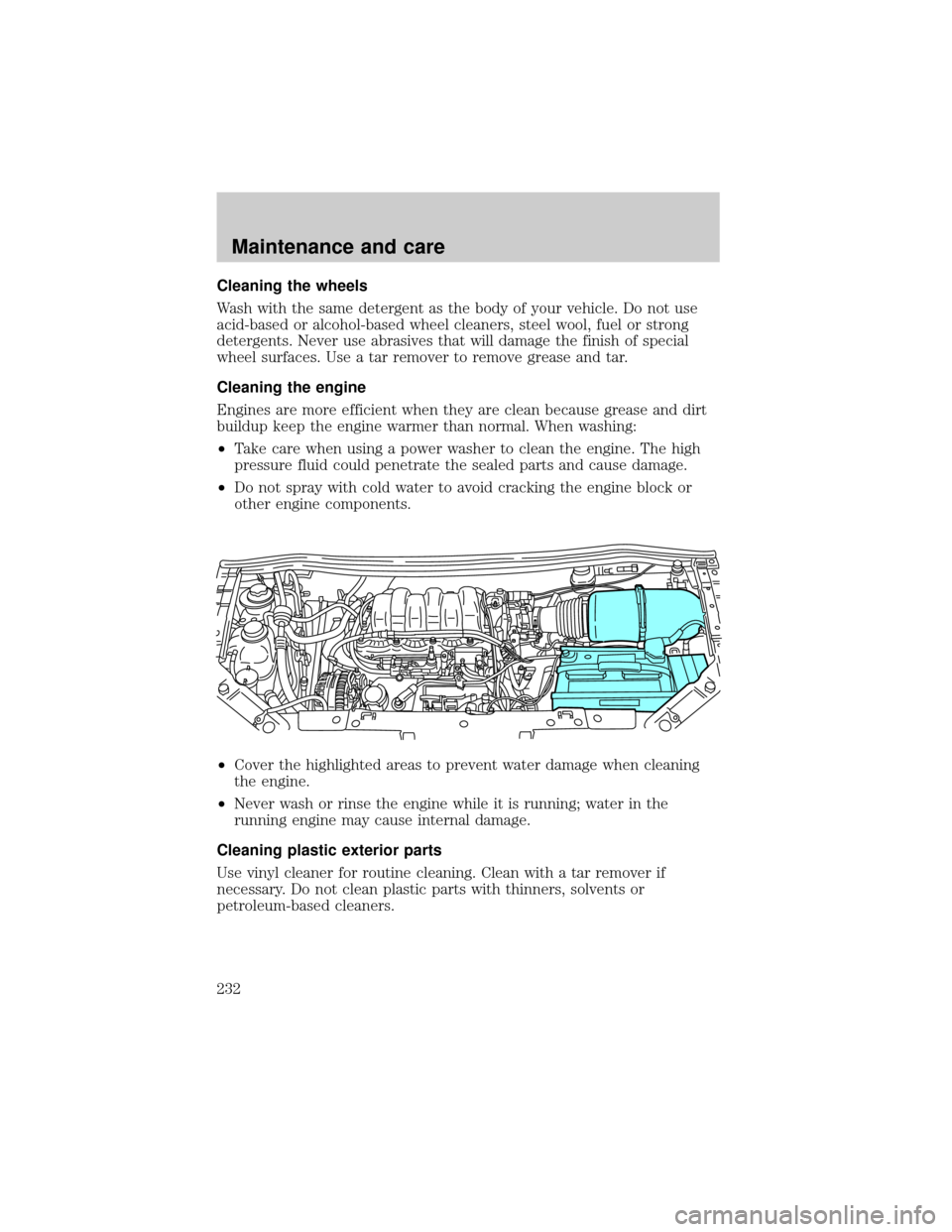
²Cover the highlighted areas to prevent water damage when cleaning
the engine.
²Never wash or rinse the engine while it is running; water in the
running engine may cause internal damage.
Cleaning plastic exterior parts
Use vinyl cleaner for routine cleaning. Clean with a tar remover if
necessary. Do not clean plastic parts with thinners, solvents or
petroleum-based cleaners.
Maintenance and care
232
Page 240 of 248
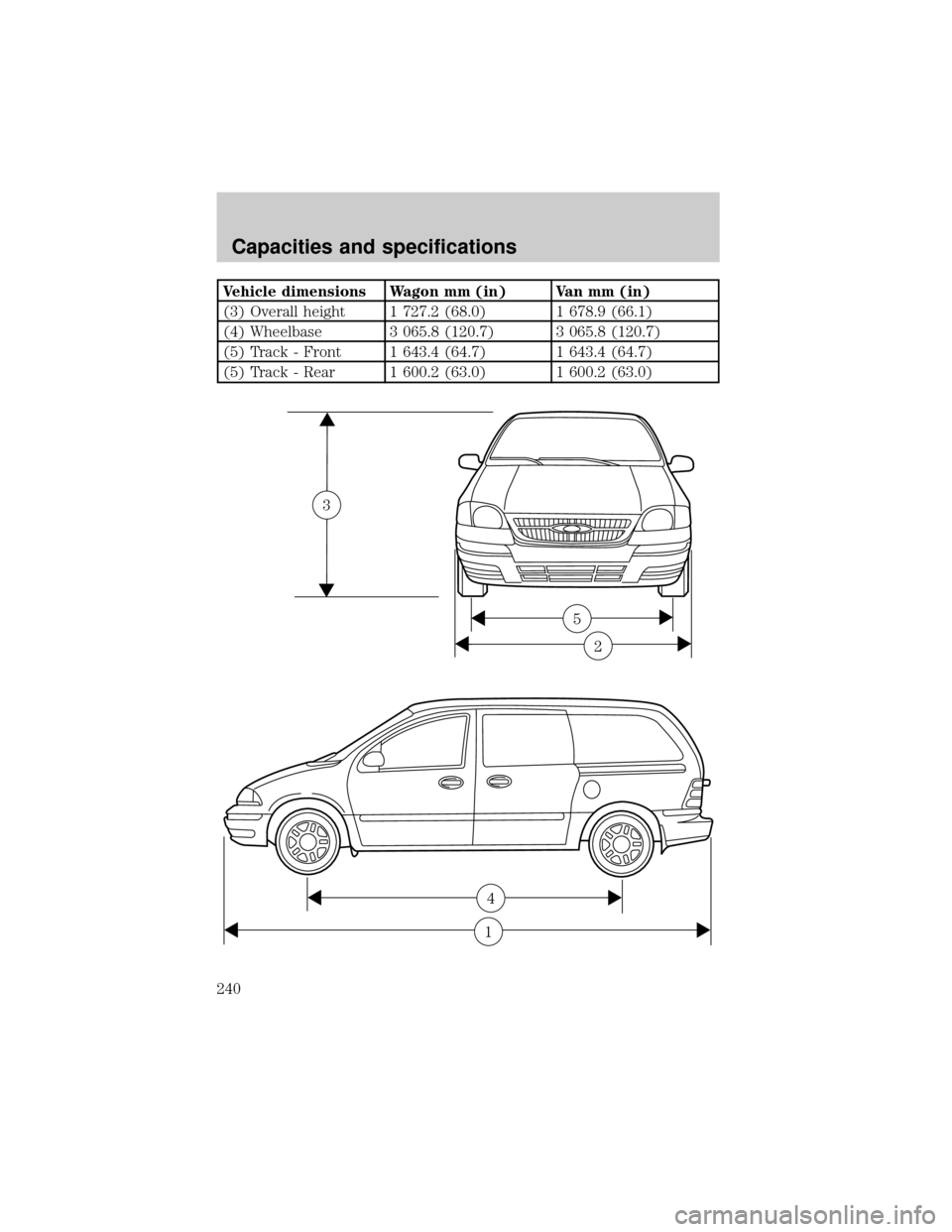
Vehicle dimensions Wagon mm (in) Van mm (in)
(3) Overall height 1 727.2 (68.0) 1 678.9 (66.1)
(4) Wheelbase 3 065.8 (120.7) 3 065.8 (120.7)
(5) Track - Front 1 643.4 (64.7) 1 643.4 (64.7)
(5) Track - Rear 1 600.2 (63.0) 1 600.2 (63.0)
2
5
3
1
4
Capacities and specifications
240
Page 243 of 248

Accessory delay ..........................78
Air bag supplemental restraint
system ........................................124
and child safety seats ............126
description .......................125,128
disposal ....................................131
indicator light ..................128,130
passenger air bag ............126,129
Air filter, cabin ..........................203
Anti-theft system ...99,100,101,102
,103
arming the system ..................100
disarming a triggered system 100
Automatic transaxle .................155
driving with ...............156,157,158
Brakes ........................................151
anti-lock ............................151,152
anti-lock brake system (ABS)
warning light ...........................152
fluid, checking and adding ....195
shift interlock ..........................155
Break-in period .............................3
Cargo net ...................................104
CD player .....................64,65,66,67
Child safety seats
attaching with tether straps ..136
in rear seat .......................133,136
tether anchorage
hardware ...................137,138,140
Cleaning your vehicle ...............230
built-in child seat ...........141,142,
145,146
engine compartment ..............232
exterior .............................231,234
exterior lamps .........................233
interior .....................................234
plastic parts ............................232
washing ....................................231
waxing .....................................231
wheels ......................................232
windows ..................................235
wiper blades ............................233Compass, electronic
set zone adjustment .......22,23,24
Console ........................................90
overhead ....................................86
Controls
power seat ...............................108
Coolant ......................................199
checking and adding ..............197
refill capacities ........................199
Cupholder(s) .110,112,113,115,117
Defrost
rear window ..............................37
Doors
power sliding .............87,88,89,90
Emission control system ..........222
Engine
check engine/service engine
soon light ...............................9,10
coolant .....................................197
idle speed control ...................206
service points ...................190,191
starting after a collision .........167
Engine block heater .................149
Engine oil
checking and adding ..............193
dipstick ....................................192
specifications ...................192,194
Exhaust fumes ..........................150
Floor mats ...................................91
Fuel
choosing the right fuel ...........216
comparisons with EPA fuel
economy estimates .................221
detergent in fuel .....................217
filling your vehicle
with fuel ...........................214,215
gauge .........................................12
quality ......................................217
running out of fuel .................218
safety information relating to
automotive fuels .....................214
Fuses ...................................168,169
Index
243
Page 245 of 248

Radio ...37,38,39,40,41,42,43,44,45,
46,47,48,49,50,51,52,53,54,
55,56,57,58,59,60,61,62,63
Relays ........................................168
Remote entry system .................91
illuminated entry ............26,96,99
locking/unlocking doors .92,93,94
replacement/additional
transmitters ...............................98
replacing the batteries .............97
Reverse sensing system .............67
Roof rack ...................................166
Safety belts (see Safety
restraints) ....................................11
Safety Compliance
Certification Label ....................241
Safety defects, reporting ..........242
Safety restraints
cleaning the safety belts .......123,
124,235
extension assembly ................122
for children .............................131
lap belt ....................................121
warning light and chime ..11,122,
123
Seat belts (see Safety
restraints) .............118,119,120,122
Seats ..........................................105
child safety seats ....................132
cleaning .....................233,234,235
Seats-easy access/easyout
feature .......................................106
Servicing your vehicle ..............188
Spark plugs, specifications .......236
Specification chart, lubricants .238
Speed control ..............................70
Speedometer ...............................13
Starting your vehicle .........147,149
jump starting ............182,183,185Steering wheel
tilting .........................................76
Tachometer .................................12
Tires .............................209,210,211
changing .............177,178,179,180
checking the pressure ............211
replacing ..................................212
rotating ....................................211
snow tires and chains ............213
tire grades ...............................210
treadwear ................................210
Towing ..................162,163,164,165
wrecker ....................................187
Traction control ...................69,153
active light ..................................6
Transaxle
fluid, refill capacities ..............237
Transmission
fluid, checking and adding
(automatic) ...............201,202,203
Trip odometer .............................14
Turn signal ..................................11
Universal transmitter (see
garage door opener) ....81,82,83,84
Vehicle dimensions ...................239
Vehicle Identification Number
(VIN) ..........................................241
Vehicle loading ..........................159
Ventilating your vehicle ...........150
Warning chimes .............................6
Washer fluid ..............................196
Water, Driving through .............159
Windows ......................................77
rear wiper/washer .....................75
Windshield washer fluid and
wipers
checking and cleaning ............208
operation ...................................74
replacing wiper blades ...........209
Index
245