Restraint FORD WINDSTAR 2000 2.G Service Manual
[x] Cancel search | Manufacturer: FORD, Model Year: 2000, Model line: WINDSTAR, Model: FORD WINDSTAR 2000 2.GPages: 280, PDF Size: 2.49 MB
Page 155 of 280
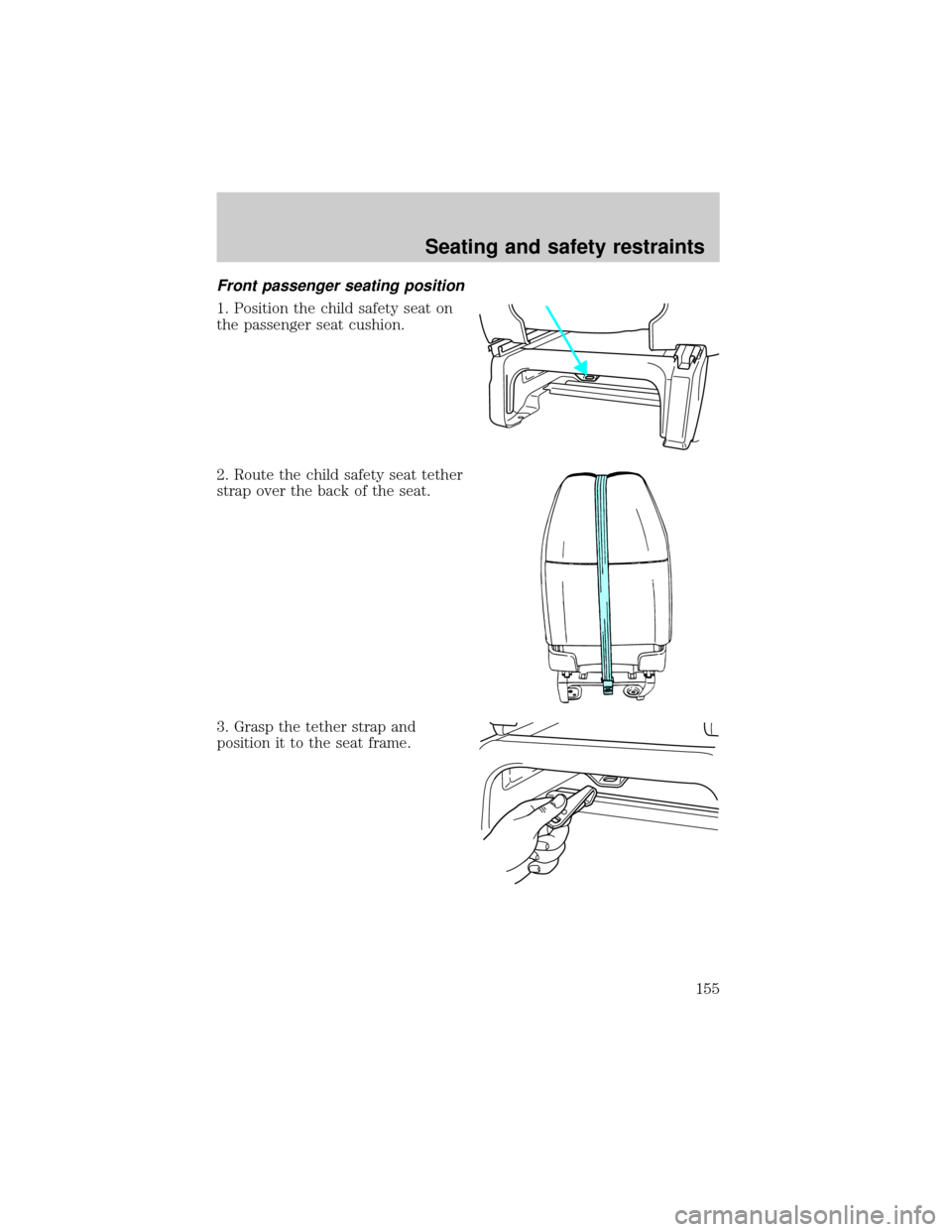
Front passenger seating position
1. Position the child safety seat on
the passenger seat cushion.
2. Route the child safety seat tether
strap over the back of the seat.
3. Grasp the tether strap and
position it to the seat frame.
Seating and safety restraints
155
Page 156 of 280
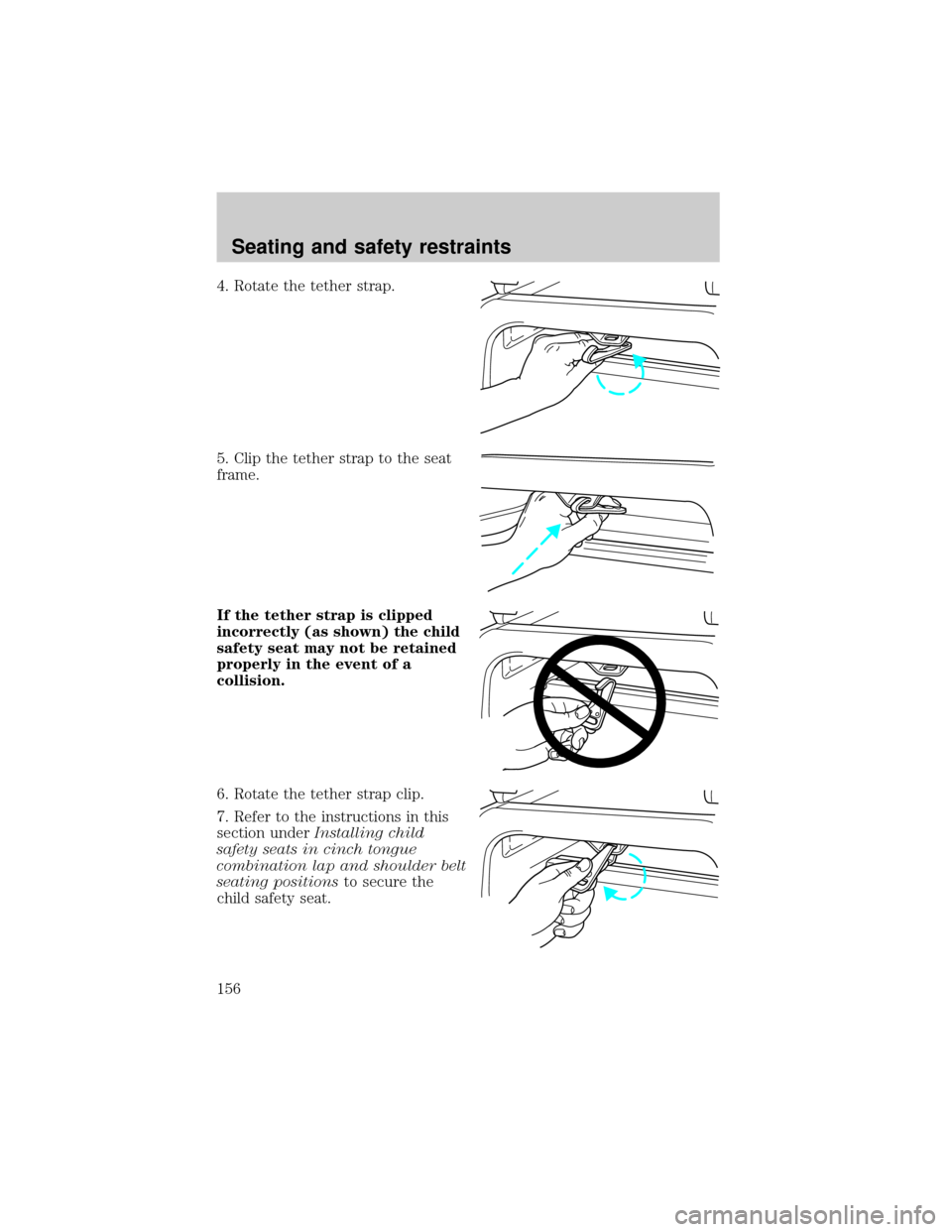
4. Rotate the tether strap.
5. Clip the tether strap to the seat
frame.
If the tether strap is clipped
incorrectly (as shown) the child
safety seat may not be retained
properly in the event of a
collision.
6. Rotate the tether strap clip.
7. Refer to the instructions in this
section underInstalling child
safety seats in cinch tongue
combination lap and shoulder belt
seating positionsto secure the
child safety seat.
Seating and safety restraints
156
Page 157 of 280
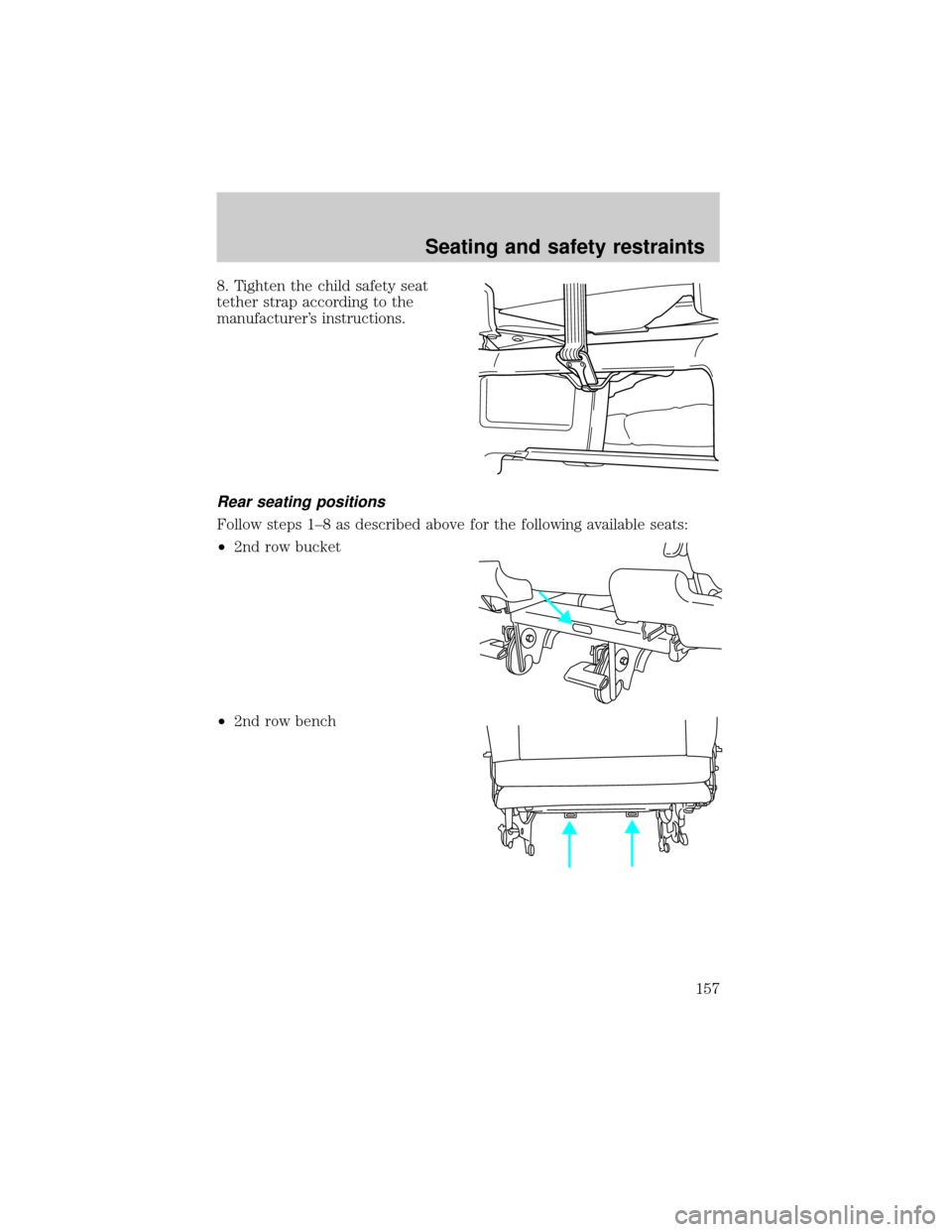
8. Tighten the child safety seat
tether strap according to the
manufacturer's instructions.
Rear seating positions
Follow steps 1±8 as described above for the following available seats:
²2nd row bucket
²2nd row bench
Seating and safety restraints
157
Page 158 of 280
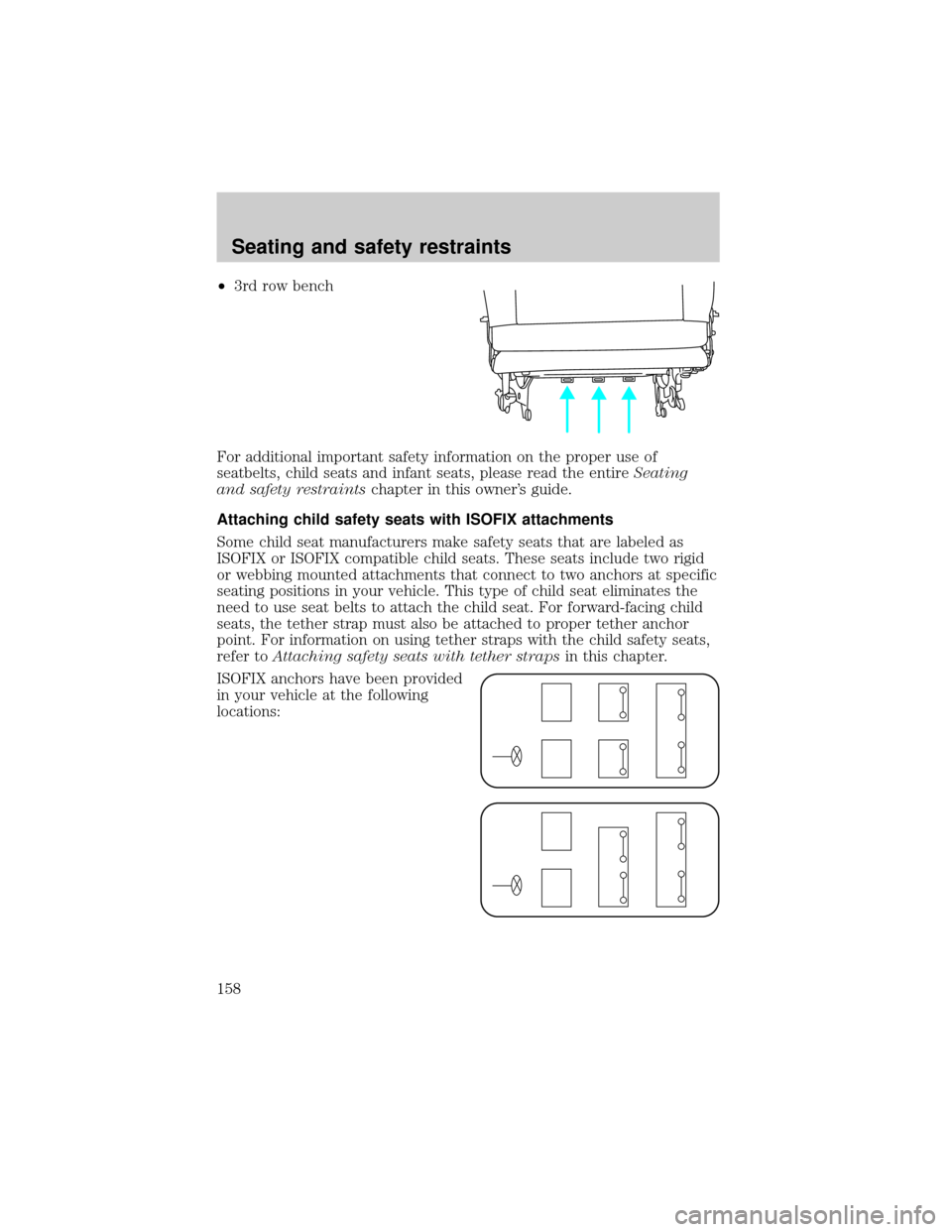
²3rd row bench
For additional important safety information on the proper use of
seatbelts, child seats and infant seats, please read the entireSeating
and safety restraintschapter in this owner's guide.
Attaching child safety seats with ISOFIX attachments
Some child seat manufacturers make safety seats that are labeled as
ISOFIX or ISOFIX compatible child seats. These seats include two rigid
or webbing mounted attachments that connect to two anchors at specific
seating positions in your vehicle. This type of child seat eliminates the
need to use seat belts to attach the child seat. For forward-facing child
seats, the tether strap must also be attached to proper tether anchor
point. For information on using tether straps with the child safety seats,
refer toAttaching safety seats with tether strapsin this chapter.
ISOFIX anchors have been provided
in your vehicle at the following
locations:
Seating and safety restraints
158
Page 159 of 280
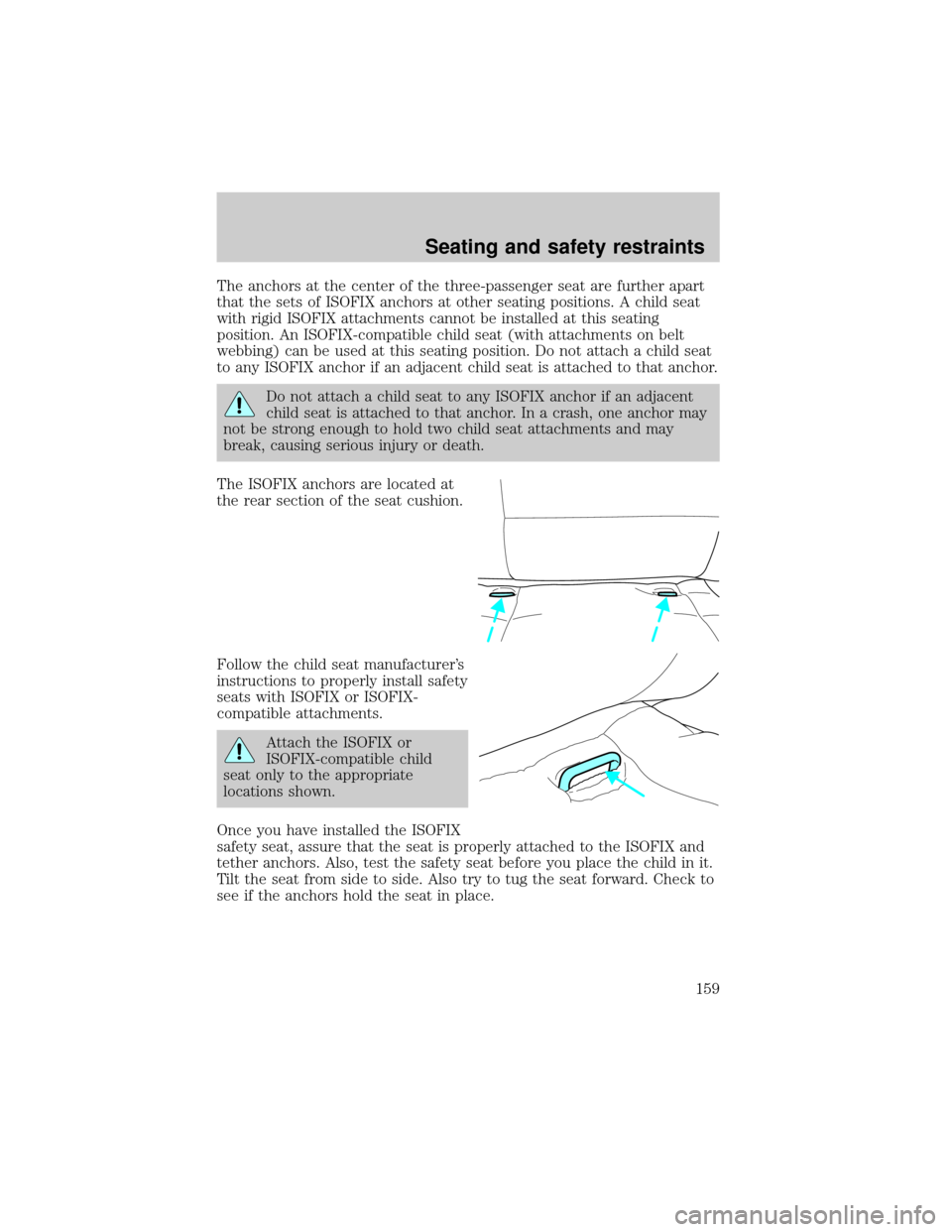
The anchors at the center of the three-passenger seat are further apart
that the sets of ISOFIX anchors at other seating positions. A child seat
with rigid ISOFIX attachments cannot be installed at this seating
position. An ISOFIX-compatible child seat (with attachments on belt
webbing) can be used at this seating position. Do not attach a child seat
to any ISOFIX anchor if an adjacent child seat is attached to that anchor.
Do not attach a child seat to any ISOFIX anchor if an adjacent
child seat is attached to that anchor. In a crash, one anchor may
not be strong enough to hold two child seat attachments and may
break, causing serious injury or death.
The ISOFIX anchors are located at
the rear section of the seat cushion.
Follow the child seat manufacturer's
instructions to properly install safety
seats with ISOFIX or ISOFIX-
compatible attachments.
Attach the ISOFIX or
ISOFIX-compatible child
seat only to the appropriate
locations shown.
Once you have installed the ISOFIX
safety seat, assure that the seat is properly attached to the ISOFIX and
tether anchors. Also, test the safety seat before you place the child in it.
Tilt the seat from side to side. Also try to tug the seat forward. Check to
see if the anchors hold the seat in place.
Seating and safety restraints
159
Page 160 of 280
If the safety seat in not anchored properly, the risk of a child
being injured in a collision greatly increases.
To properly install any child seat in the second or third row seats, first
set the seatback angle.
1. Pull up on the seatback recline control located on the side of the seat,
allowing the seatback to spring to its forward position.
2. Without touching the recline control, push the seatback rearward
until the recline control drops into position. (If the recline control is
pulled up during this step, the seatback will not be properly positioned.)
Seating and safety restraints
160
Page 161 of 280
PREPARING TO START YOUR VEHICLE
Engine starting is controlled by the powertrain control system. This system
meets all Canadian Interference-Causing Equipment standard requirements
regulating the impulse electrical field strength of radio noise.
When starting a fuel-injected engine, avoid pressing the accelerator
before or during starting. Only use the accelerator when you have
difficulty starting the engine. For more information on starting the
vehicle, refer toStarting the enginein this chapter.
Extended idling at high engine speeds can produce very high
temperatures in the engine and exhaust system, creating the risk
of fire or other damage.
Do not park, idle, or drive your vehicle in dry grass or other dry
ground cover. The emission system heats up the engine
compartment and exhaust system, which can start a fire.
Do not start your vehicle in a closed garage or in other enclosed
areas. Exhaust fumes can be toxic. Always open the garage door
before you start the engine. SeeGuarding against exhaust fumesin
this chapter for more instructions.
If you smell exhaust fumes inside your vehicle, have your dealer
inspect your vehicle immediately. Do not drive if you smell
exhaust fumes.
Important safety precautions
A computer system controls the engine's idle revolutions per minute
(RPM). When the engine starts, the idle RPM runs faster to warm the
engine. If the engine idle speed does not slow down automatically, have
the vehicle checked. Do not allow the vehicle to idle for more than 10
minutes at the higher engine RPM.
Before starting the vehicle:
1. Make sure all vehicle occupants have buckled their safety belts. For
more information on safety belts and their proper usage, refer to the
Seating and safety restraintschapter.
2. Make sure the headlamps and vehicle accessories are off.
Starting
161
Page 252 of 280
Cleaning seats equipped with side air bags
Remove dust and loose dirt with a whisk broom or a vacuum cleaner.
Remove fresh spots immediately. Follow the directions that come with
the cleaner. Do not saturate the seat cover with upholstery cleaner.
Do not use chemical solvents or strong detergents when cleaning
the seat mounted side air bag. Such products could contaminate
the side air bag system and affect performance of the side air bag in a
collision.
Woodtone trim
Wipe stains with a soft cloth and a multi-purpose cleaning solution.
Inside windows
Use Ultra-Clear Spray Glass Cleaner (E4AZ-19C507±AA) for the inside
windows if they become fogged.
Cleaning and maintaining the safety belts
Clean the safety belts with a mild soap solution recommended for
cleaning upholstery or carpets. Do not bleach or dye the belts, because
these actions may weaken the belt webbing.
Check the safety belt system periodically to make sure there are no
nicks, wear or cuts. If your vehicle has been involved in an accident,
refer to theSafety belt maintenancesection in theSeating and safety
restraintschapter.
Maintenance and care
252
Page 273 of 280

Accessory delay ..........................90
Air bag supplemental
restraint system ..........140,141,145
and child safety seats ............142
description .......................141,145
disposal ....................................148
driver air bag ...................143,146
indicator light .............10,144,147
operation ..........................143,146
passenger air bag ............143,146
side air bag ..............................145
Air cleaner filter .......................254
Air conditioning ..........................28
Air filter, cabin ..........................220
Antifreeze
(see Engine coolant) ................211
Anti-lock brake system
(see Brakes) .......................165,166
Anti-theft system ......................113
arming the system ..................113
disarming a
triggered system .....................114
warning light ...............................9
Audio system (see Radio) .........38
Automatic transaxle .................169
driving with .............................170
fluid, adding ............................218
fluid, checking ........................218
fluid, refill capacities ..............255
fluid, specification ..................257
Auxiliary power point ...............116
Axle
lubricant specifications ..........256
Battery .......................................223
acid, treating emergencies .....223
charging system warning light ..8
jumping a disabled battery ....197
maintenance-free ....................223
replacement, specifications ...254
servicing ..................................223
Belt minder ...............................136
Brakes ........................................165anti-lock ............................165,166
anti-lock brake system
(ABS) warning light ..........10,166
brake warning light ..................10
fluid, checking and adding ....210
fluid, refill capacities ..............255
fluid, specifications ..........256,257
lubricant specifications ...256,257
parking ....................................166
pedals (see Power
adjustable foot pedals) ............81
shift interlock ..........................169
Break-in period .............................3
Capacities for refilling fluids ....255
Cargo net ...................................118
Cassette tape player ...................63
CD changer .................................74
Certification Label ....................259
Child safety restraints ..............148
child safety belts ....................148
Child safety seats ......................149
in front seat ............................150
in rear seat .......................150,153
tether anchorage hardware ...154
Cleaning your vehicle ...............248
engine compartment ..............250
exterior ....................................249
exterior lamps .........................250
instrument panel ....................251
instrument panel lens ............251
interior .......................251,252,253
mirrors .....................................249
plastic parts ............................249
safety belts ..............................252
washing ....................................248
waxing .....................................248
wheels ......................................249
windows ..................................252
wiper blades ............................250
woodtone trim ........................252
Climate control (see Air
conditioning or Heating) ............28
Index
273
Page 275 of 280

gauge .........................................14
improving fuel economy ........235
low fuel warning light ................8
octane rating ....................234,257
quality ......................................234
running out of fuel .................235
safety information relating
to automotive fuels ................230
Fuses ...................................182,183
Garage door opener ...............93,99
Gas cap (see Fuel cap) ............233
Gas mileage
(see Fuel economy) .................235
Gauges .........................................14
engine coolant
temperature gauge ...................15
fuel gauge ..................................14
odometer ...................................15
speedometer .............................15
tachometer ................................14
trip odometer ............................16
GAWR
(Gross Axle Weight Rating) .....173
calculating ...............................175
definition .................................173
driving with a heavy load ......173
location ....................................173
GVWR (Gross
Vehicle Weight Rating) .............173
calculating ........................173,175
definition .................................173
driving with a heavy load ......173
location ....................................173
Hazard flashers .........................181
Head restraints ..................119,122
Headlamps ...................................26
aiming ...............................246,247
autolamp system .......................28
bulb specifications ..................245
daytime running lights .............26
flash to pass ..............................27
high beam ............................10,26replacing bulbs .......................241
turning on and off ....................26
warning chime ..........................13
Heating ........................................28
heater only system ...................28
rear seat controls .....................36
HomeLink universal
transceiver (see Garage
door opener) .....................93,95,96
Hood ..........................................204
Ignition .......................................257
positions of the ignition ...........81
Infant seats
(see Safety seats) .....................149
Inspection/maintenance
(I/M) testing ..............................240
Instrument panel
cleaning ...................................251
cluster ...................................8,251
lighting up
panel and interior .....................27
location of components ..............8
Jump-starting your vehicle ......197
Keyless entry system
autolock ...................................113
Keys
key in ignition chime ...............13
positions of the ignition ...........81
Lamps
autolamp system .......................28
bulb replacement
specifications chart ................245
cargo lamps ...............................27
daytime running light ...............26
headlamps .................................26
headlamps, flash to pass ..........27
instrument panel, dimming .....27
interior lamps ...............98,99,100
replacing bulbs ..240,241,243,244
Lane change indicator
(see Turn signal) ........................85
Liftgate ...............................117,118
Index
275