lights FORD WINDSTAR 2003 2.G Owner's Manual
[x] Cancel search | Manufacturer: FORD, Model Year: 2003, Model line: WINDSTAR, Model: FORD WINDSTAR 2003 2.GPages: 240, PDF Size: 3.09 MB
Page 113 of 240
Do not attempt to service, repair, or modify the air bag
supplemental restraint systems or its fuses. See your Ford or
Lincoln Mercury dealer.
Modifying or adding equipment to the front end of the vehicle
(including frame, bumper, front end body structure and tow
hooks) may affect the performance of the air bag system, increasing
the risk of injury. Do not modify the front end of the vehicle.
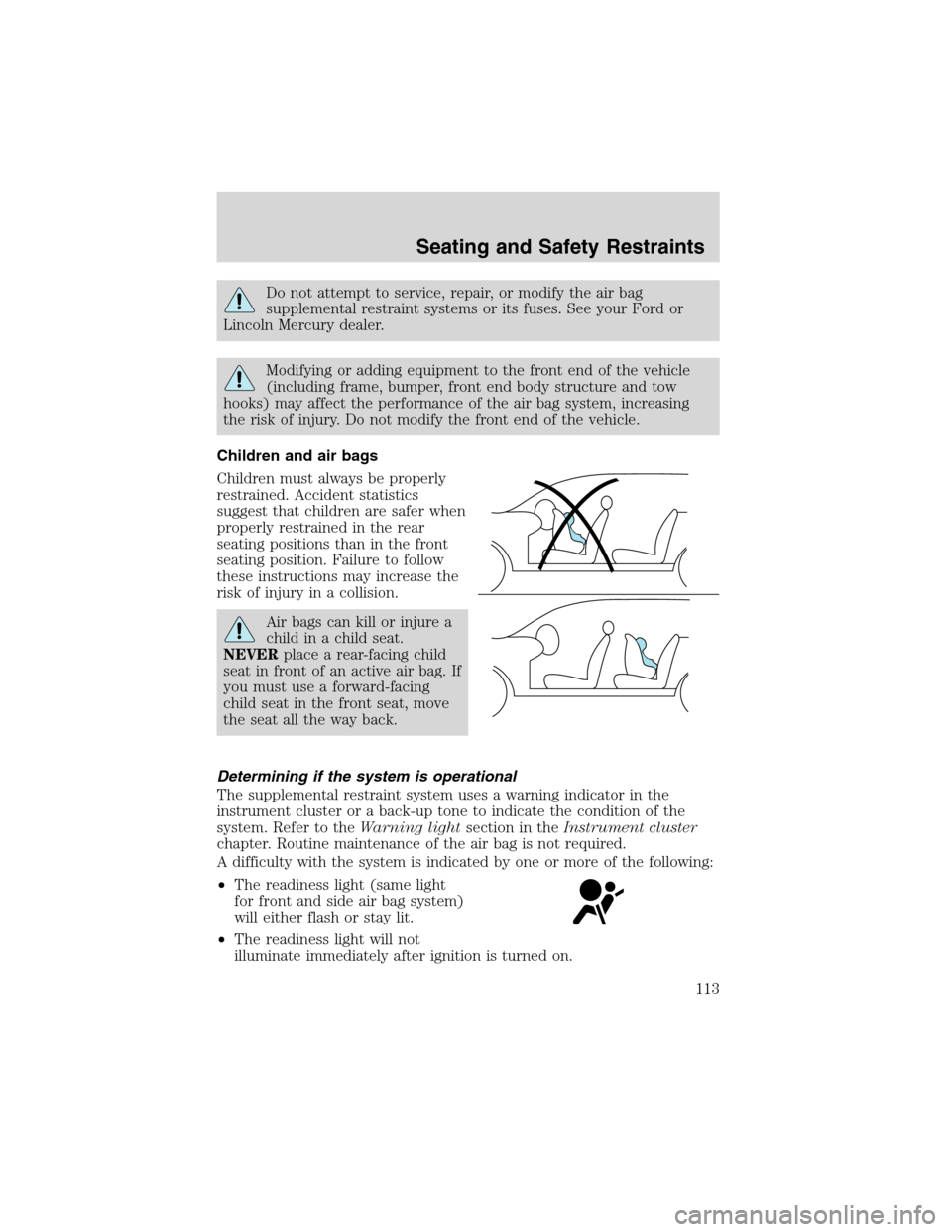
Children and air bags
Children must always be properly
restrained. Accident statistics
suggest that children are safer when
properly restrained in the rear
seating positions than in the front
seating position. Failure to follow
these instructions may increase the
risk of injury in a collision.
Air bags can kill or injure a
child in a child seat.
NEVERplace a rear-facing child
seat in front of an active air bag. If
you must use a forward-facing
child seat in the front seat, move
the seat all the way back.
Determining if the system is operational
The supplemental restraint system uses a warning indicator in the
instrument cluster or a back-up tone to indicate the condition of the
system. Refer to theWarning lightsection in theInstrument cluster
chapter. Routine maintenance of the air bag is not required.
A difficulty with the system is indicated by one or more of the following:
•The readiness light (same light
for front and side air bag system)
will either flash or stay lit.
•The readiness light will not
illuminate immediately after ignition is turned on.
Seating and Safety Restraints
113
Page 131 of 240
STARTING
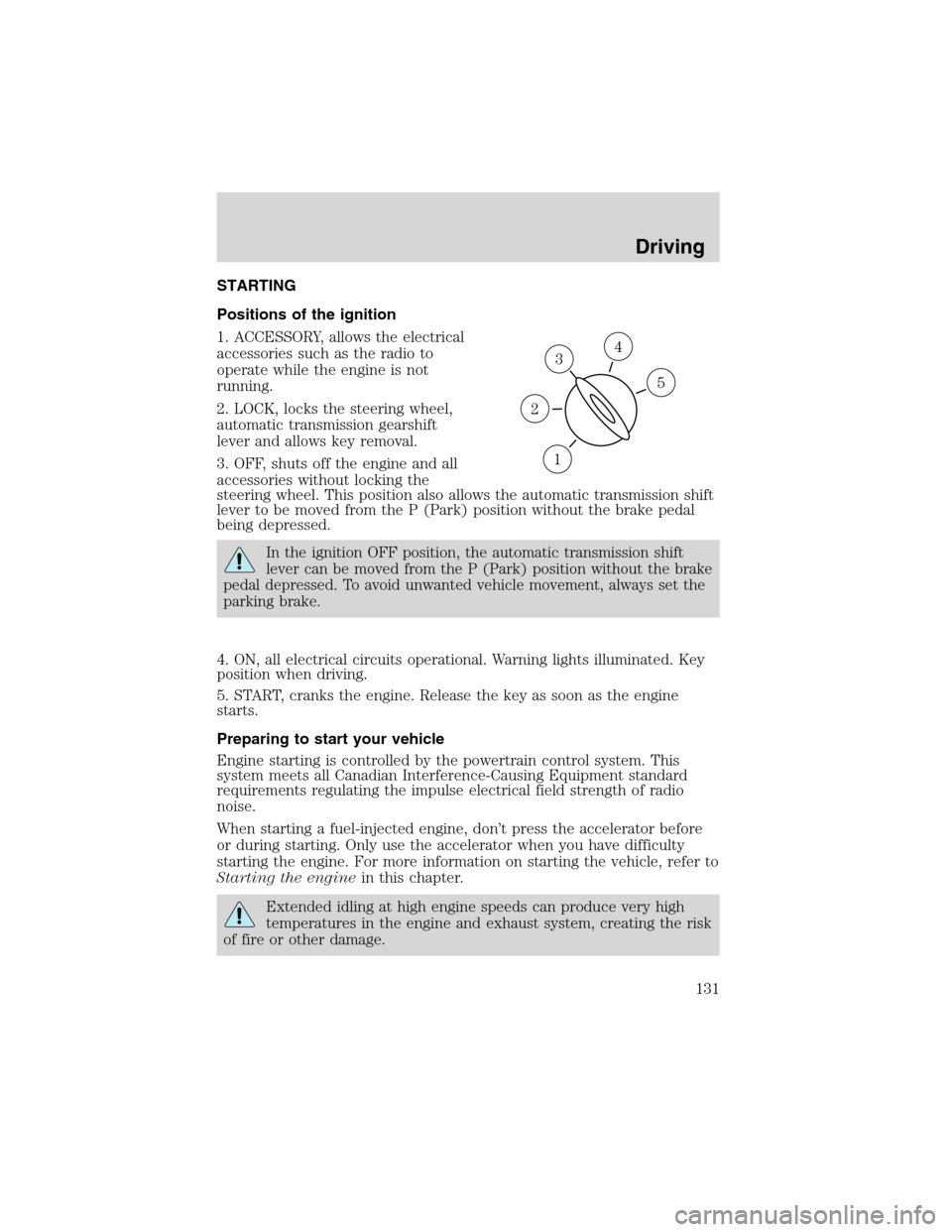
Positions of the ignition
1. ACCESSORY, allows the electrical
accessories such as the radio to
operate while the engine is not
running.
2. LOCK, locks the steering wheel,
automatic transmission gearshift
lever and allows key removal.
3. OFF, shuts off the engine and all
accessories without locking the
steering wheel. This position also allows the automatic transmission shift
lever to be moved from the P (Park) position without the brake pedal
being depressed.
In the ignition OFF position, the automatic transmission shift
lever can be moved from the P (Park) position without the brake
pedal depressed. To avoid unwanted vehicle movement, always set the
parking brake.
4. ON, all electrical circuits operational. Warning lights illuminated. Key
position when driving.
5. START, cranks the engine. Release the key as soon as the engine
starts.
Preparing to start your vehicle
Engine starting is controlled by the powertrain control system. This
system meets all Canadian Interference-Causing Equipment standard
requirements regulating the impulse electrical field strength of radio
noise.
When starting a fuel-injected engine, don’t press the accelerator before
or during starting. Only use the accelerator when you have difficulty
starting the engine. For more information on starting the vehicle, refer to
Starting the enginein this chapter.
Extended idling at high engine speeds can produce very high
temperatures in the engine and exhaust system, creating the risk
of fire or other damage.
3
1
2
5
4
Driving
131
Page 133 of 240
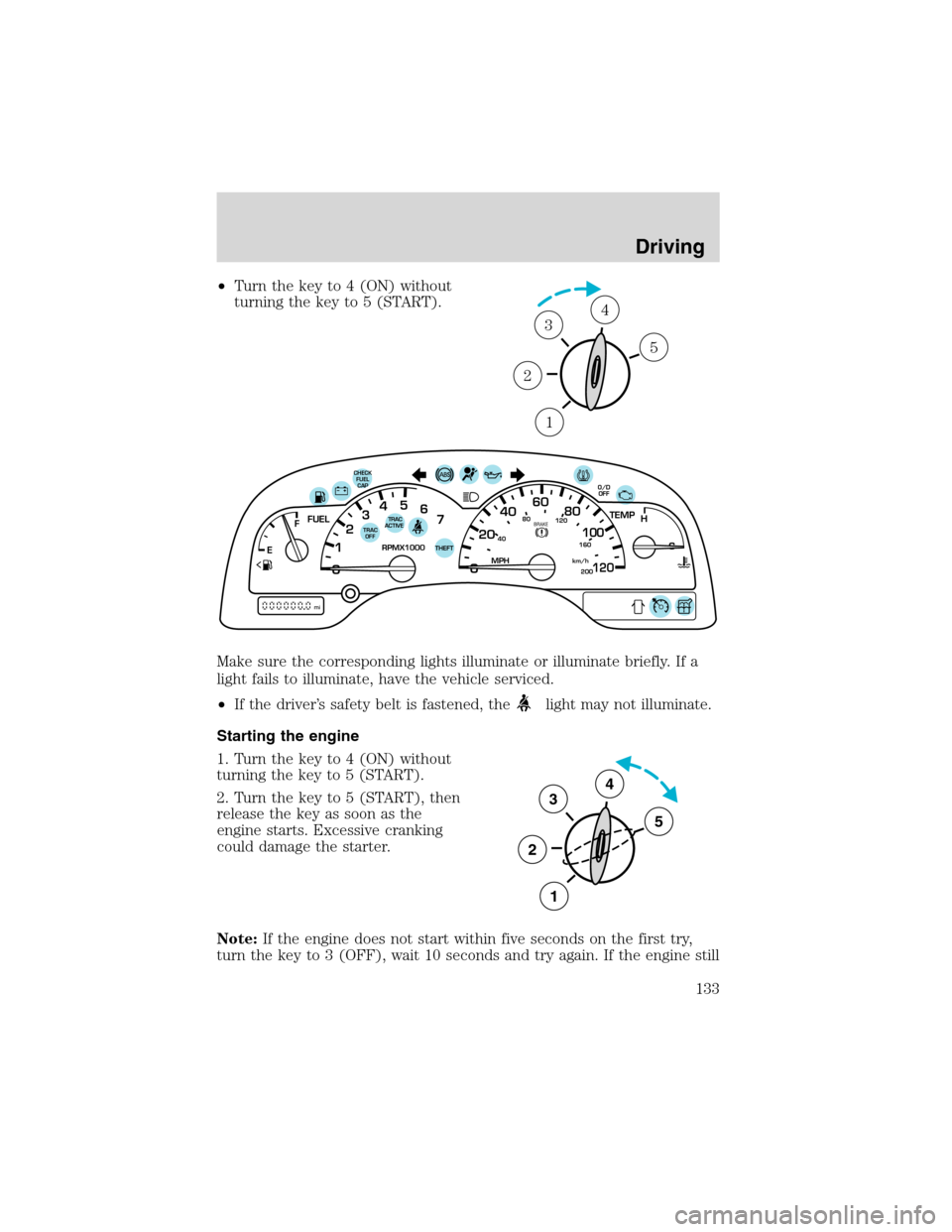
•Turn the key to 4 (ON) without
turning the key to 5 (START).
Make sure the corresponding lights illuminate or illuminate briefly. If a
light fails to illuminate, have the vehicle serviced.
•If the driver’s safety belt is fastened, the
light may not illuminate.
Starting the engine
1. Turn the key to 4 (ON) without
turning the key to 5 (START).
2. Turn the key to 5 (START), then
release the key as soon as the
engine starts. Excessive cranking
could damage the starter.
Note:If the engine does not start within five seconds on the first try,
turn the key to 3 (OFF), wait 10 seconds and try again. If the engine still
1
2
34
5
40
4080
120
160
20020
12345
6
760
80100
120MPH RPMX1000 THEFT
TRAC
ACTIVE TRAC
OFFTEMP
H
FFUEL
E
km/h
BRAKE
mi
O/D
OFFCHECK
FUEL
CAP
3
2
1
5
4
Driving
133
Page 210 of 240
Exhaust leaks may result in entry of harmful and potentially
lethal fumes into the passenger compartment.
Do not make any unauthorized changes to your vehicle or engine. By
law, vehicle owners and anyone who manufactures, repairs, services,
sells, leases, trades vehicles, or supervises a fleet of vehicles are not
permitted to intentionally remove an emission control device or prevent
it from working. Information about your vehicle’s emission system is on
the Vehicle Emission Control Information Decal located on or near the
engine. This decal identifies engine displacement and gives some tune up
specifications.
Please consult yourWarranty Guidefor complete emission warranty
information.
Readiness for Inspection/Maintenance (I/M) testing
In some localities, it may be a legal requirement to pass an I/M test of
the on-board diagnostics system. If your“Check Engine/Service Engine
Soon”light is on, refer to the description in theWarning lights and
chimessection of theInstrument clusterchapter. Your vehicle may not
pass the I/M test with the“Check Engine/Service Engine Soon”light on.
If the vehicle’s powertrain system or its battery has just been serviced,
the on-board diagnostics system is reset to a“not ready for I/M test”
condition. To ready the on-board diagnostics system for I/M testing, a
minimum of 30 minutes of city and highway driving is necessary as
described below:
•First, at least 10 minutes of driving on an expressway or highway.
•Next, at least 20 minutes driving in stop-and-go, city-type traffic with
at least four idle periods.
Allow the vehicle to sit for at least eight hours without starting the
engine. Then, start the engine and complete the above driving cycle. The
engine must warm up to its normal operating temperature. Once started,
do not turn off the engine until the above driving cycle is complete.
Maintenance and Specifications
210
Page 232 of 240
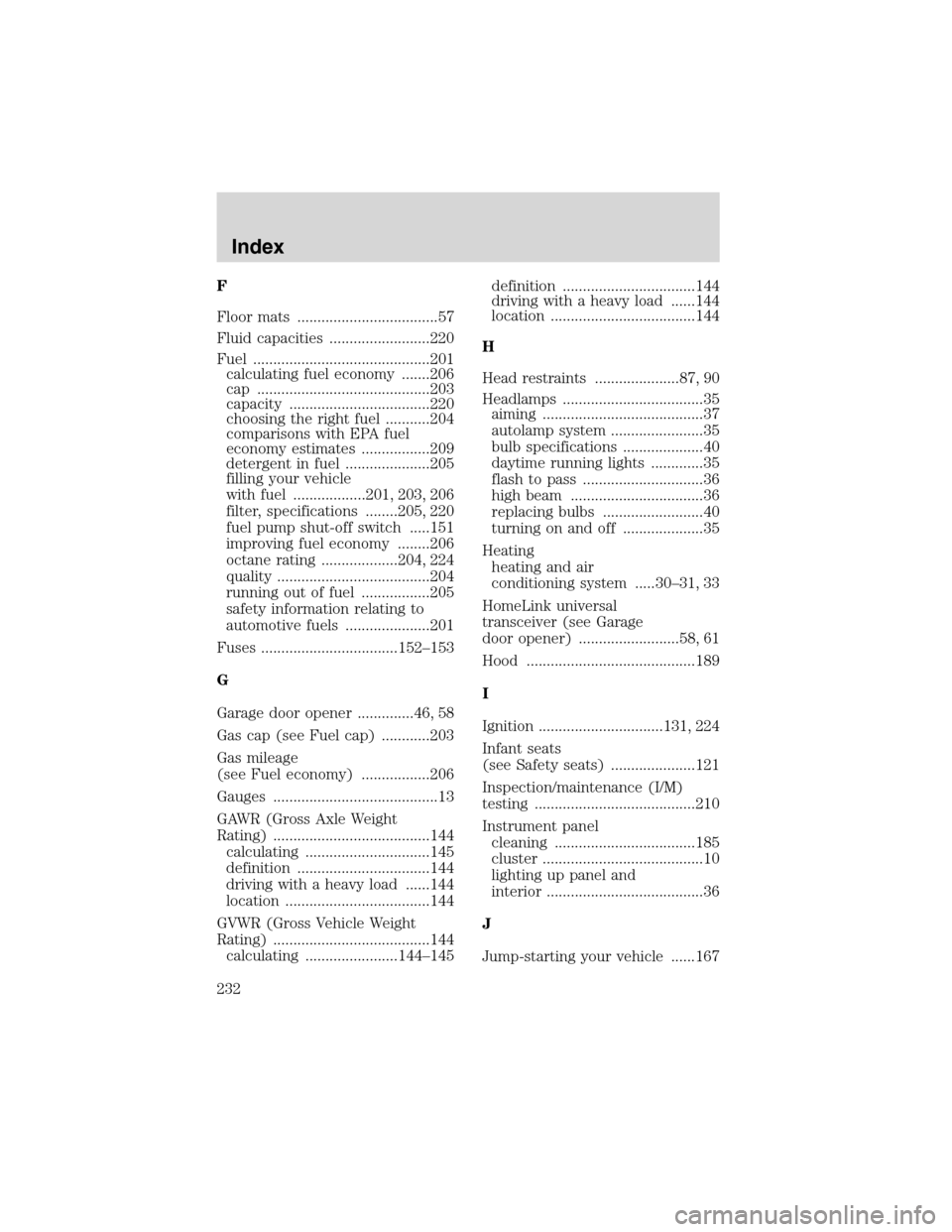
F
Floor mats ...................................57
Fluid capacities .........................220
Fuel ............................................201
calculating fuel economy .......206
cap ...........................................203
capacity ...................................220
choosing the right fuel ...........204
comparisons with EPA fuel
economy estimates .................209
detergent in fuel .....................205
filling your vehicle
with fuel ..................201, 203, 206
filter, specifications ........205, 220
fuel pump shut-off switch .....151
improving fuel economy ........206
octane rating ...................204, 224
quality ......................................204
running out of fuel .................205
safety information relating to
automotive fuels .....................201
Fuses ..................................152–153
G
Garage door opener ..............46, 58
Gas cap (see Fuel cap) ............203
Gas mileage
(see Fuel economy) .................206
Gauges .........................................13
GAWR (Gross Axle Weight
Rating) .......................................144
calculating ...............................145
definition .................................144
driving with a heavy load ......144
location ....................................144
GVWR (Gross Vehicle Weight
Rating) .......................................144
calculating .......................144–145definition .................................144
driving with a heavy load ......144
location ....................................144
H
Head restraints .....................87, 90
Headlamps ...................................35
aiming ........................................37
autolamp system .......................35
bulb specifications ....................40
daytime running lights .............35
flash to pass ..............................36
high beam .................................36
replacing bulbs .........................40
turning on and off ....................35
Heating
heating and air
conditioning system .....30–31, 33
HomeLink universal
transceiver (see Garage
door opener) .........................58, 61
Hood ..........................................189
I
Ignition ...............................131, 224
Infant seats
(see Safety seats) .....................121
Inspection/maintenance (I/M)
testing ........................................210
Instrument panel
cleaning ...................................185
cluster ........................................10
lighting up panel and
interior .......................................36
J
Jump-starting your vehicle ......167
Index
232
Page 233 of 240
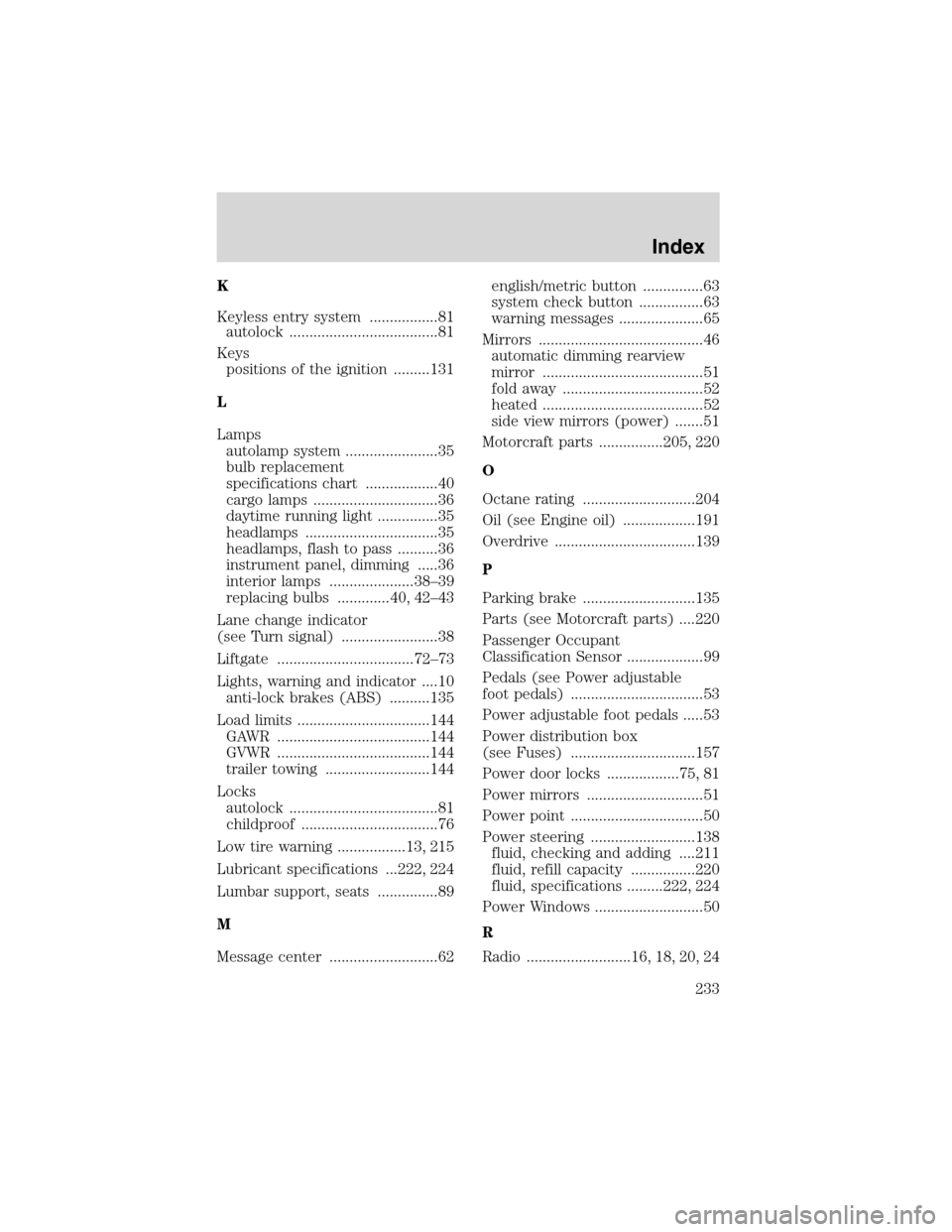
K
Keyless entry system .................81
autolock .....................................81
Keys
positions of the ignition .........131
L
Lamps
autolamp system .......................35
bulb replacement
specifications chart ..................40
cargo lamps ...............................36
daytime running light ...............35
headlamps .................................35
headlamps, flash to pass ..........36
instrument panel, dimming .....36
interior lamps .....................38–39
replacing bulbs .............40, 42–43
Lane change indicator
(see Turn signal) ........................38
Liftgate ..................................72–73
Lights, warning and indicator ....10
anti-lock brakes (ABS) ..........135
Load limits .................................144
GAWR ......................................144
GVWR ......................................144
trailer towing ..........................144
Locks
autolock .....................................81
childproof ..................................76
Low tire warning .................13, 215
Lubricant specifications ...222, 224
Lumbar support, seats ...............89
M
Message center ...........................62english/metric button ...............63
system check button ................63
warning messages .....................65
Mirrors .........................................46
automatic dimming rearview
mirror ........................................51
fold away ...................................52
heated ........................................52
side view mirrors (power) .......51
Motorcraft parts ................205, 220
O
Octane rating ............................204
Oil (see Engine oil) ..................191
Overdrive ...................................139
P
Parking brake ............................135
Parts (see Motorcraft parts) ....220
Passenger Occupant
Classification Sensor ...................99
Pedals (see Power adjustable
foot pedals) .................................53
Power adjustable foot pedals .....53
Power distribution box
(see Fuses) ...............................157
Power door locks ..................75, 81
Power mirrors .............................51
Power point .................................50
Power steering ..........................138
fluid, checking and adding ....211
fluid, refill capacity ................220
fluid, specifications .........222, 224
Power Windows ...........................50
R
Radio ..........................16, 18, 20, 24
Index
233
Page 234 of 240
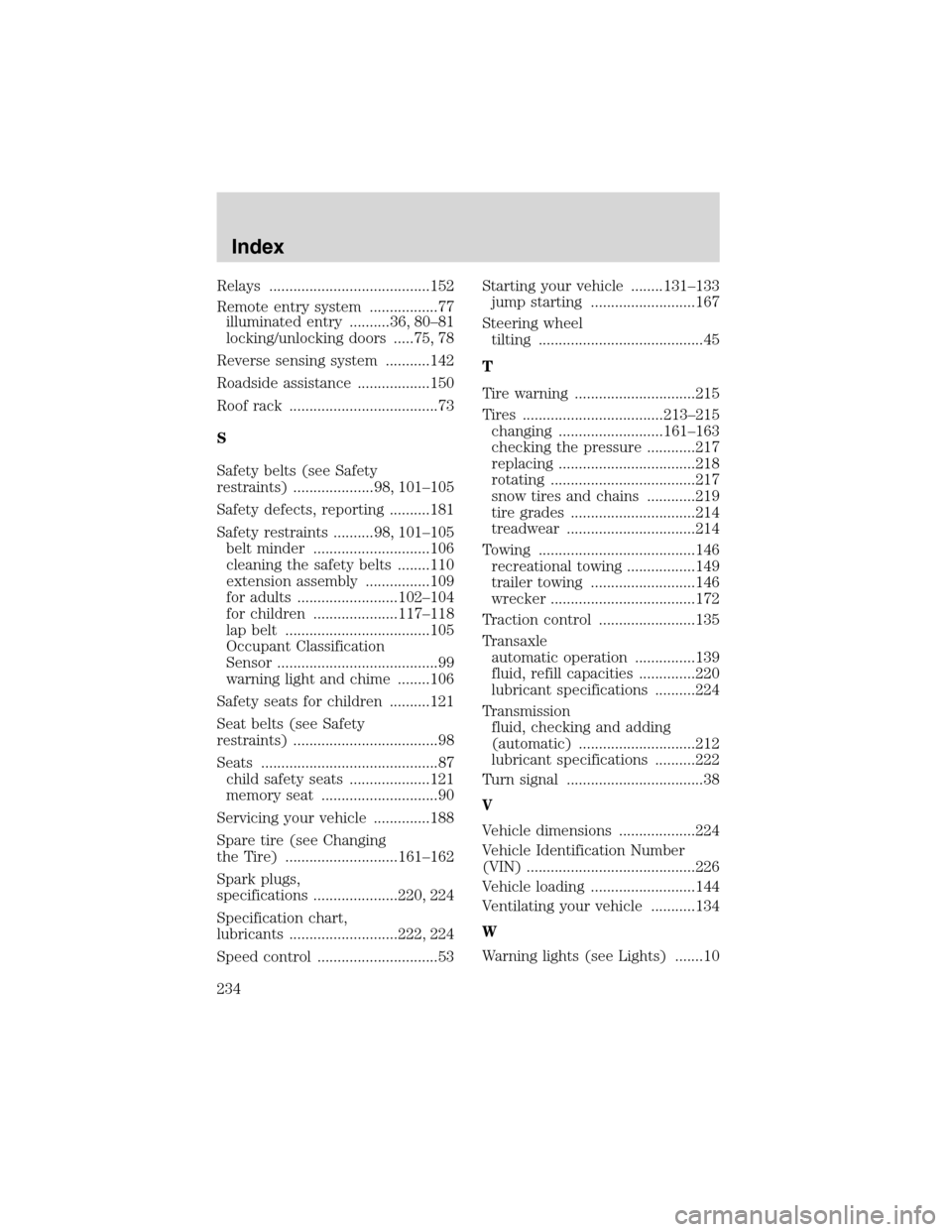
Relays ........................................152
Remote entry system .................77
illuminated entry ..........36, 80–81
locking/unlocking doors .....75, 78
Reverse sensing system ...........142
Roadside assistance ..................150
Roof rack .....................................73
S
Safety belts (see Safety
restraints) ....................98, 101–105
Safety defects, reporting ..........181
Safety restraints ..........98, 101–105
belt minder .............................106
cleaning the safety belts ........110
extension assembly ................109
for adults .........................102–104
for children .....................117–118
lap belt ....................................105
Occupant Classification
Sensor ........................................99
warning light and chime ........106
Safety seats for children ..........121
Seat belts (see Safety
restraints) ....................................98
Seats ............................................87
child safety seats ....................121
memory seat .............................90
Servicing your vehicle ..............188
Spare tire (see Changing
the Tire) ............................161–162
Spark plugs,
specifications .....................220, 224
Specification chart,
lubricants ...........................222, 224
Speed control ..............................53Starting your vehicle ........131–133
jump starting ..........................167
Steering wheel
tilting .........................................45
T
Tire warning ..............................215
Tires ...................................213–215
changing ..........................161–163
checking the pressure ............217
replacing ..................................218
rotating ....................................217
snow tires and chains ............219
tire grades ...............................214
treadwear ................................214
Towing .......................................146
recreational towing .................149
trailer towing ..........................146
wrecker ....................................172
Traction control ........................135
Transaxle
automatic operation ...............139
fluid, refill capacities ..............220
lubricant specifications ..........224
Transmission
fluid, checking and adding
(automatic) .............................212
lubricant specifications ..........222
Turn signal ..................................38
V
Vehicle dimensions ...................224
Vehicle Identification Number
(VIN) ..........................................226
Vehicle loading ..........................144
Ventilating your vehicle ...........134
W
Warning lights (see Lights) .......10
Index
234