lock FORD WINDSTAR 2003 2.G Workshop Manual
[x] Cancel search | Manufacturer: FORD, Model Year: 2003, Model line: WINDSTAR, Model: FORD WINDSTAR 2003 2.GPages: 240, PDF Size: 3.09 MB
Page 156 of 240
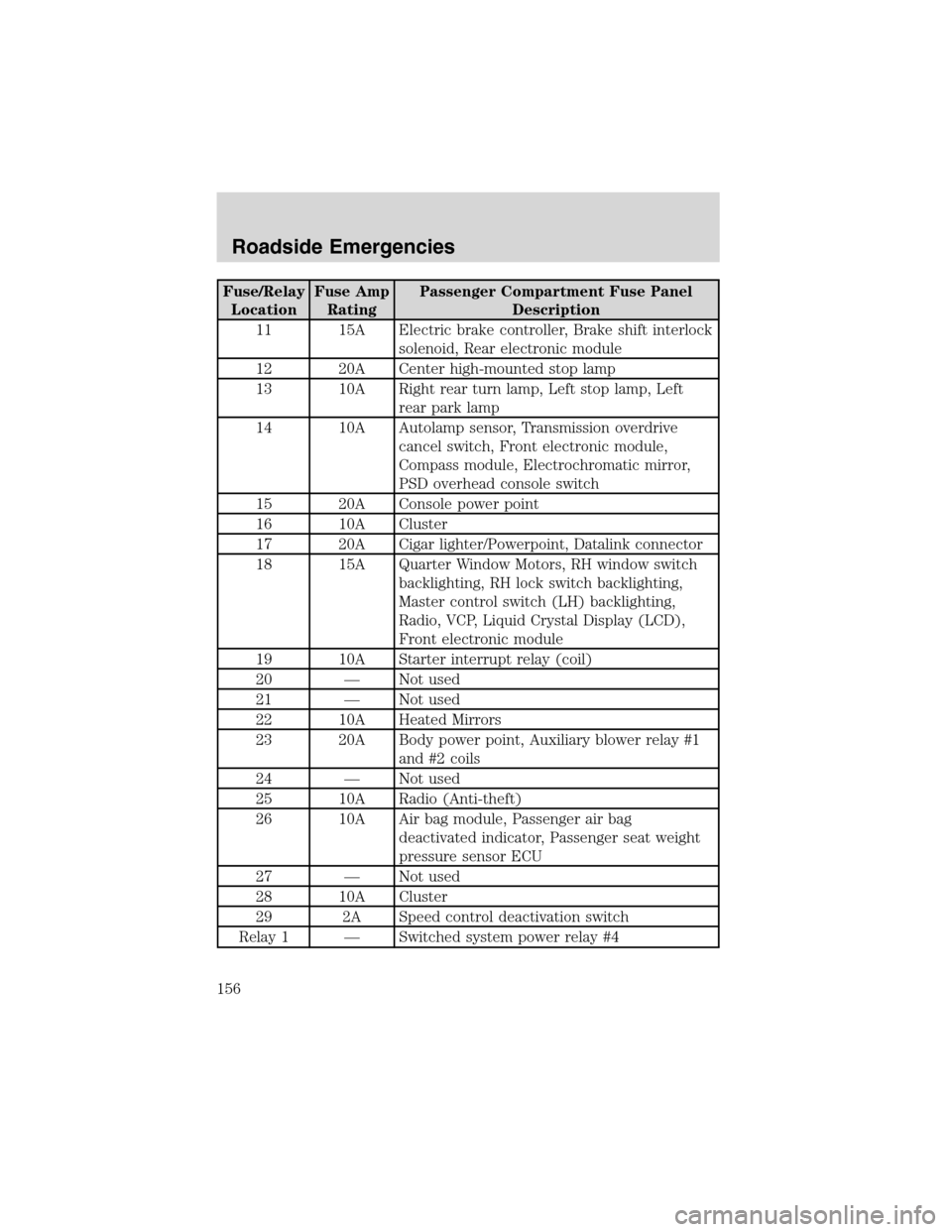
Fuse/Relay
LocationFuse Amp
RatingPassenger Compartment Fuse Panel
Description
11 15A Electric brake controller, Brake shift interlock
solenoid, Rear electronic module
12 20A Center high-mounted stop lamp
13 10A Right rear turn lamp, Left stop lamp, Left
rear park lamp
14 10A Autolamp sensor, Transmission overdrive
cancel switch, Front electronic module,
Compass module, Electrochromatic mirror,
PSD overhead console switch
15 20A Console power point
16 10A Cluster
17 20A Cigar lighter/Powerpoint, Datalink connector
18 15A Quarter Window Motors, RH window switch
backlighting, RH lock switch backlighting,
Master control switch (LH) backlighting,
Radio, VCP, Liquid Crystal Display (LCD),
Front electronic module
19 10A Starter interrupt relay (coil)
20—Not used
21—Not used
22 10A Heated Mirrors
23 20A Body power point, Auxiliary blower relay #1
and #2 coils
24—Not used
25 10A Radio (Anti-theft)
26 10A Air bag module, Passenger air bag
deactivated indicator, Passenger seat weight
pressure sensor ECU
27—Not used
28 10A Cluster
29 2A Speed control deactivation switch
Relay 1—Switched system power relay #4
Roadside Emergencies
156
Page 158 of 240
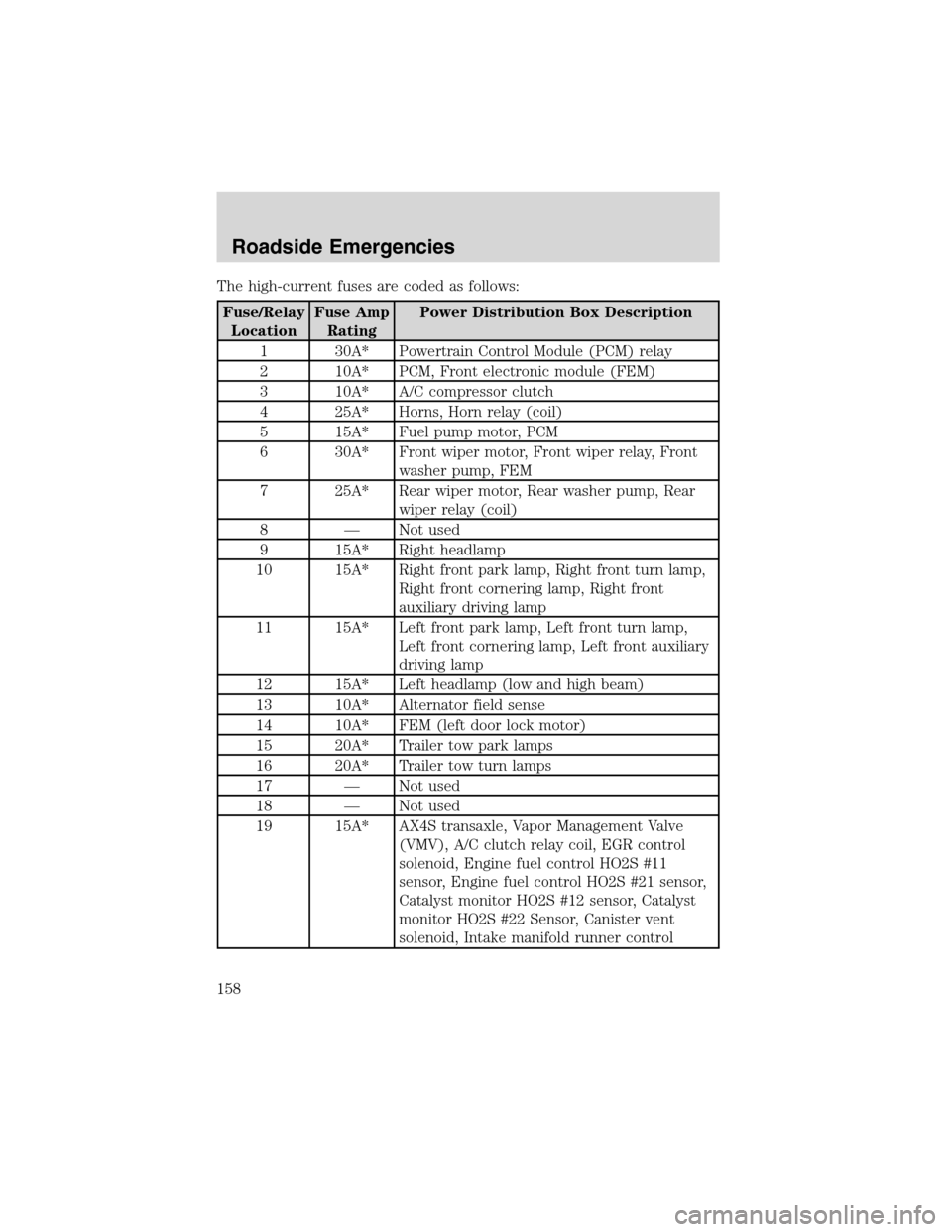
The high-current fuses are coded as follows:
Fuse/Relay
LocationFuse Amp
RatingPower Distribution Box Description
1 30A* Powertrain Control Module (PCM) relay
2 10A* PCM, Front electronic module (FEM)
3 10A* A/C compressor clutch
4 25A* Horns, Horn relay (coil)
5 15A* Fuel pump motor, PCM
6 30A* Front wiper motor, Front wiper relay, Front
washer pump, FEM
7 25A* Rear wiper motor, Rear washer pump, Rear
wiper relay (coil)
8—Not used
9 15A* Right headlamp
10 15A* Right front park lamp, Right front turn lamp,
Right front cornering lamp, Right front
auxiliary driving lamp
11 15A* Left front park lamp, Left front turn lamp,
Left front cornering lamp, Left front auxiliary
driving lamp
12 15A* Left headlamp (low and high beam)
13 10A* Alternator field sense
14 10A* FEM (left door lock motor)
15 20A* Trailer tow park lamps
16 20A* Trailer tow turn lamps
17—Not used
18—Not used
19 15A* AX4S transaxle, Vapor Management Valve
(VMV), A/C clutch relay coil, EGR control
solenoid, Engine fuel control HO2S #11
sensor, Engine fuel control HO2S #21 sensor,
Catalyst monitor HO2S #12 sensor, Catalyst
monitor HO2S #22 Sensor, Canister vent
solenoid, Intake manifold runner control
Roadside Emergencies
158
Page 159 of 240
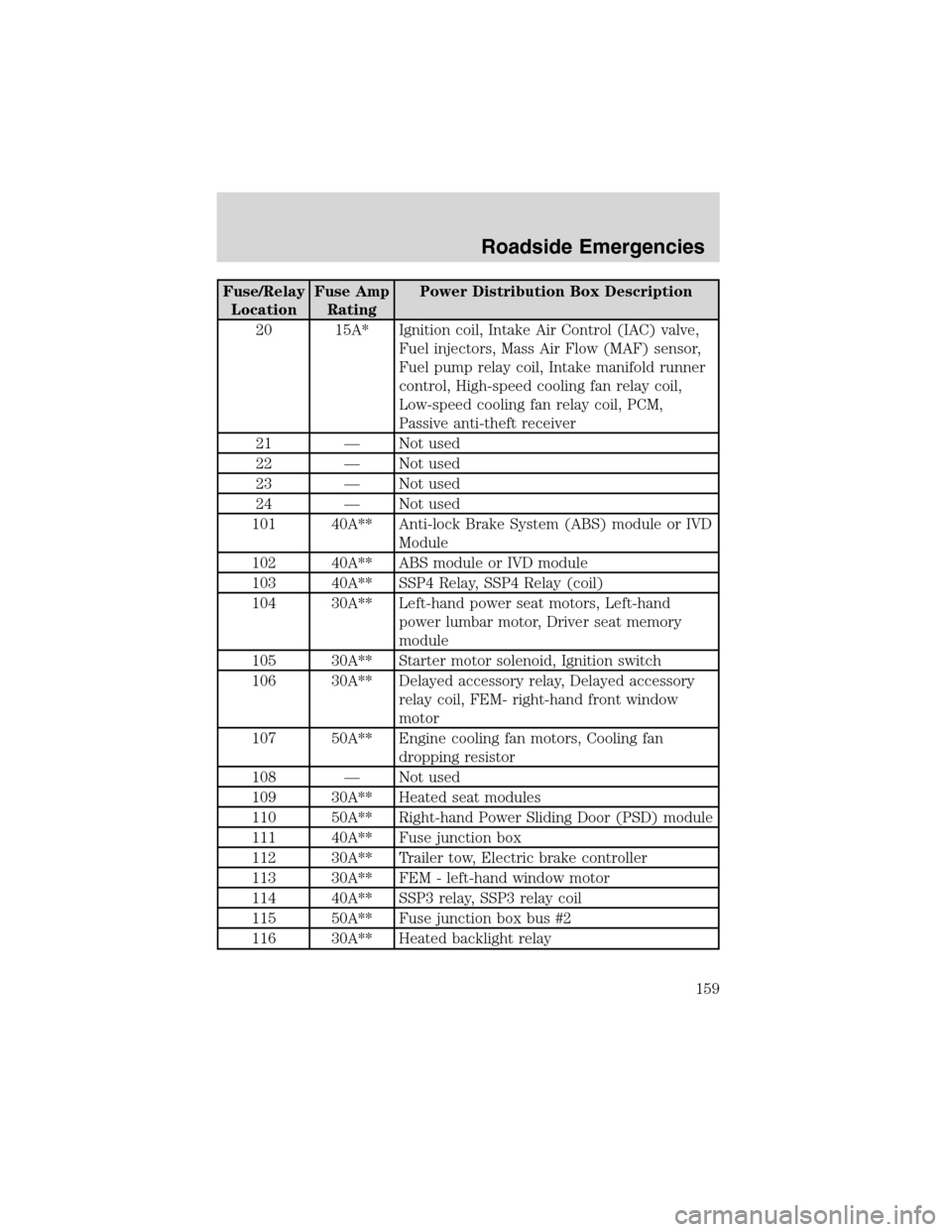
Fuse/Relay
LocationFuse Amp
RatingPower Distribution Box Description
20 15A* Ignition coil, Intake Air Control (IAC) valve,
Fuel injectors, Mass Air Flow (MAF) sensor,
Fuel pump relay coil, Intake manifold runner
control, High-speed cooling fan relay coil,
Low-speed cooling fan relay coil, PCM,
Passive anti-theft receiver
21—Not used
22—Not used
23—Not used
24—Not used
101 40A** Anti-lock Brake System (ABS) module or IVD
Module
102 40A** ABS module or IVD module
103 40A** SSP4 Relay, SSP4 Relay (coil)
104 30A** Left-hand power seat motors, Left-hand
power lumbar motor, Driver seat memory
module
105 30A** Starter motor solenoid, Ignition switch
106 30A** Delayed accessory relay, Delayed accessory
relay coil, FEM- right-hand front window
motor
107 50A** Engine cooling fan motors, Cooling fan
dropping resistor
108—Not used
109 30A** Heated seat modules
110 50A** Right-hand Power Sliding Door (PSD) module
111 40A** Fuse junction box
112 30A** Trailer tow, Electric brake controller
113 30A** FEM - left-hand window motor
114 40A** SSP3 relay, SSP3 relay coil
115 50A** Fuse junction box bus #2
116 30A** Heated backlight relay
Roadside Emergencies
159
Page 162 of 240
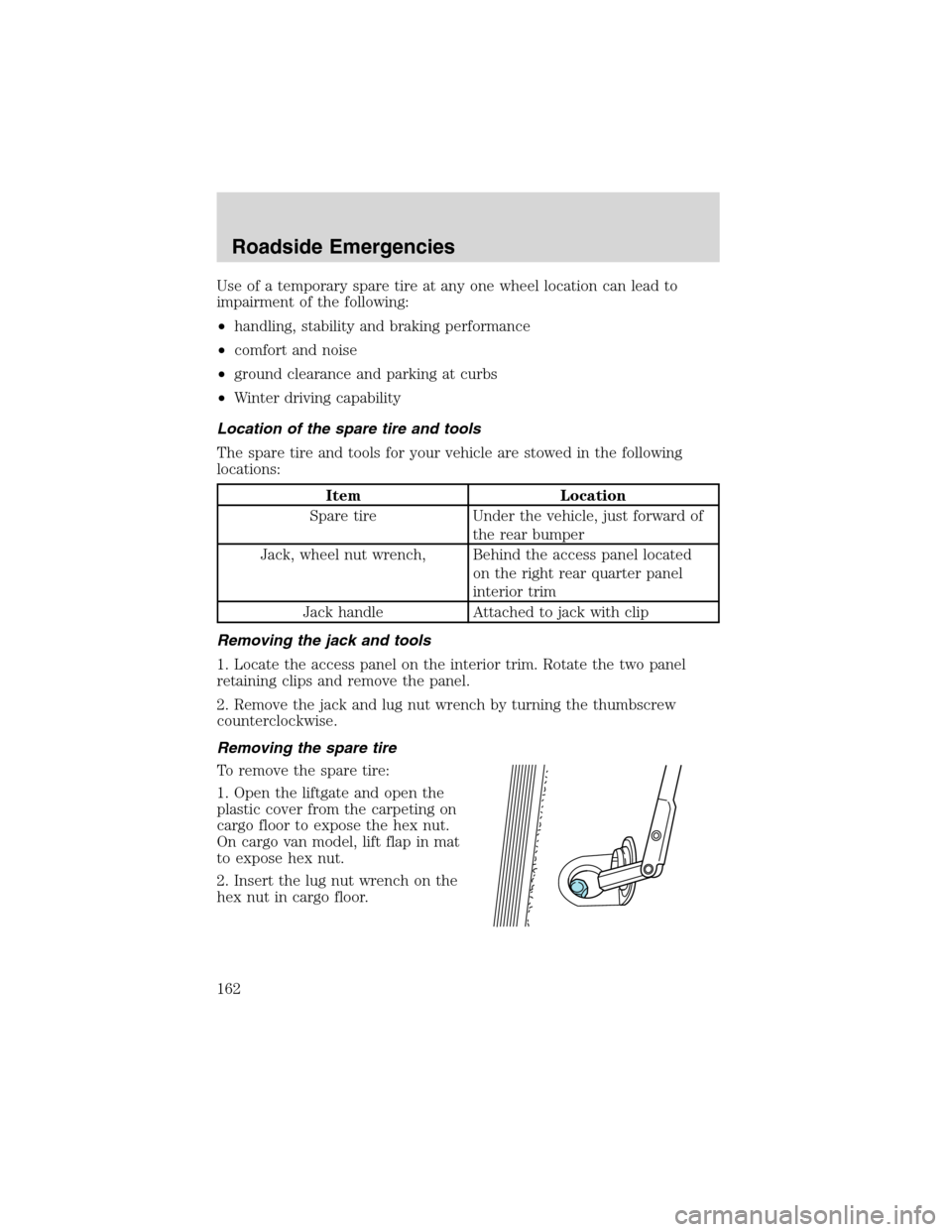
Use of a temporary spare tire at any one wheel location can lead to
impairment of the following:
•handling, stability and braking performance
•comfort and noise
•ground clearance and parking at curbs
•Winter driving capability
Location of the spare tire and tools
The spare tire and tools for your vehicle are stowed in the following
locations:
Item Location
Spare tire Under the vehicle, just forward of
the rear bumper
Jack, wheel nut wrench, Behind the access panel located
on the right rear quarter panel
interior trim
Jack handle Attached to jack with clip
Removing the jack and tools
1. Locate the access panel on the interior trim. Rotate the two panel
retaining clips and remove the panel.
2. Remove the jack and lug nut wrench by turning the thumbscrew
counterclockwise.
Removing the spare tire
To remove the spare tire:
1. Open the liftgate and open the
plastic cover from the carpeting on
cargo floor to expose the hex nut.
On cargo van model, lift flap in mat
to expose hex nut.
2. Insert the lug nut wrench on the
hex nut in cargo floor.
Roadside Emergencies
162
Page 163 of 240
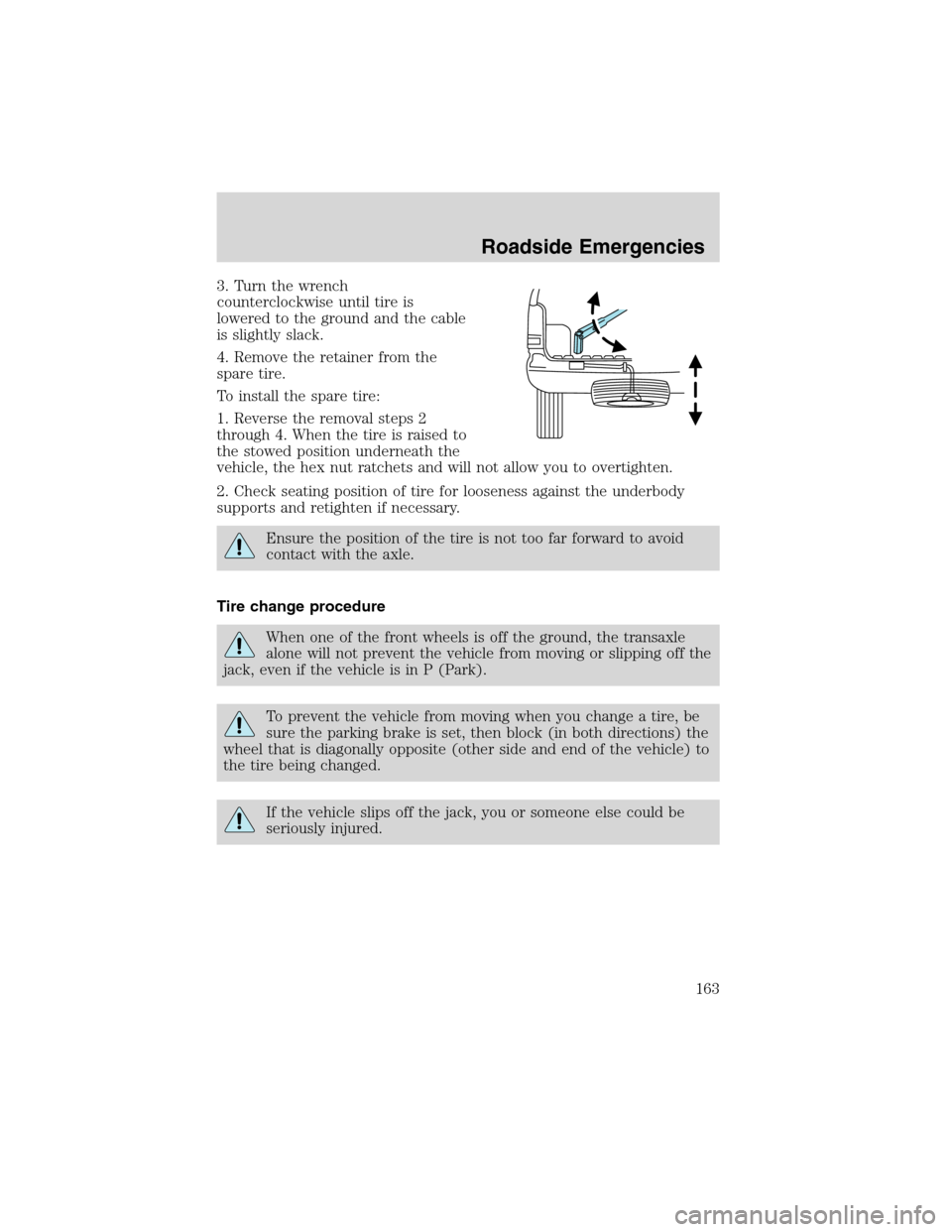
3. Turn the wrench
counterclockwise until tire is
lowered to the ground and the cable
is slightly slack.
4. Remove the retainer from the
spare tire.
To install the spare tire:
1. Reverse the removal steps 2
through 4. When the tire is raised to
the stowed position underneath the
vehicle, the hex nut ratchets and will not allow you to overtighten.
2. Check seating position of tire for looseness against the underbody
supports and retighten if necessary.
Ensure the position of the tire is not too far forward to avoid
contact with the axle.
Tire change procedure
When one of the front wheels is off the ground, the transaxle
alone will not prevent the vehicle from moving or slipping off the
jack, even if the vehicle is in P (Park).
To prevent the vehicle from moving when you change a tire, be
sure the parking brake is set, then block (in both directions) the
wheel that is diagonally opposite (other side and end of the vehicle) to
the tire being changed.
If the vehicle slips off the jack, you or someone else could be
seriously injured.
Roadside Emergencies
163
Page 164 of 240
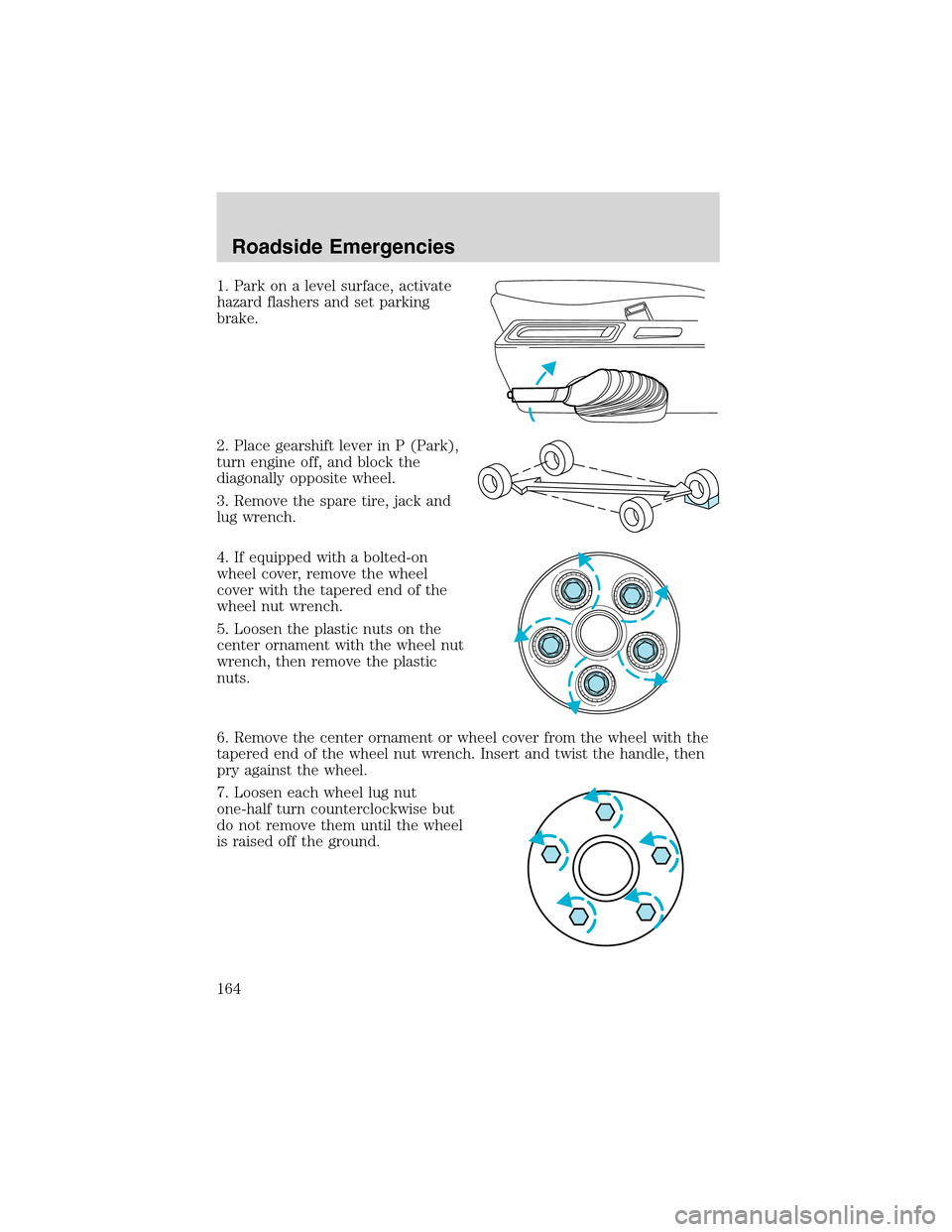
1. Park on a level surface, activate
hazard flashers and set parking
brake.
2. Place gearshift lever in P (Park),
turn engine off, and block the
diagonally opposite wheel.
3. Remove the spare tire, jack and
lug wrench.
4. If equipped with a bolted-on
wheel cover, remove the wheel
cover with the tapered end of the
wheel nut wrench.
5. Loosen the plastic nuts on the
center ornament with the wheel nut
wrench, then remove the plastic
nuts.
6. Remove the center ornament or wheel cover from the wheel with the
tapered end of the wheel nut wrench. Insert and twist the handle, then
pry against the wheel.
7. Loosen each wheel lug nut
one-half turn counterclockwise but
do not remove them until the wheel
is raised off the ground.
Roadside Emergencies
164
Page 165 of 240
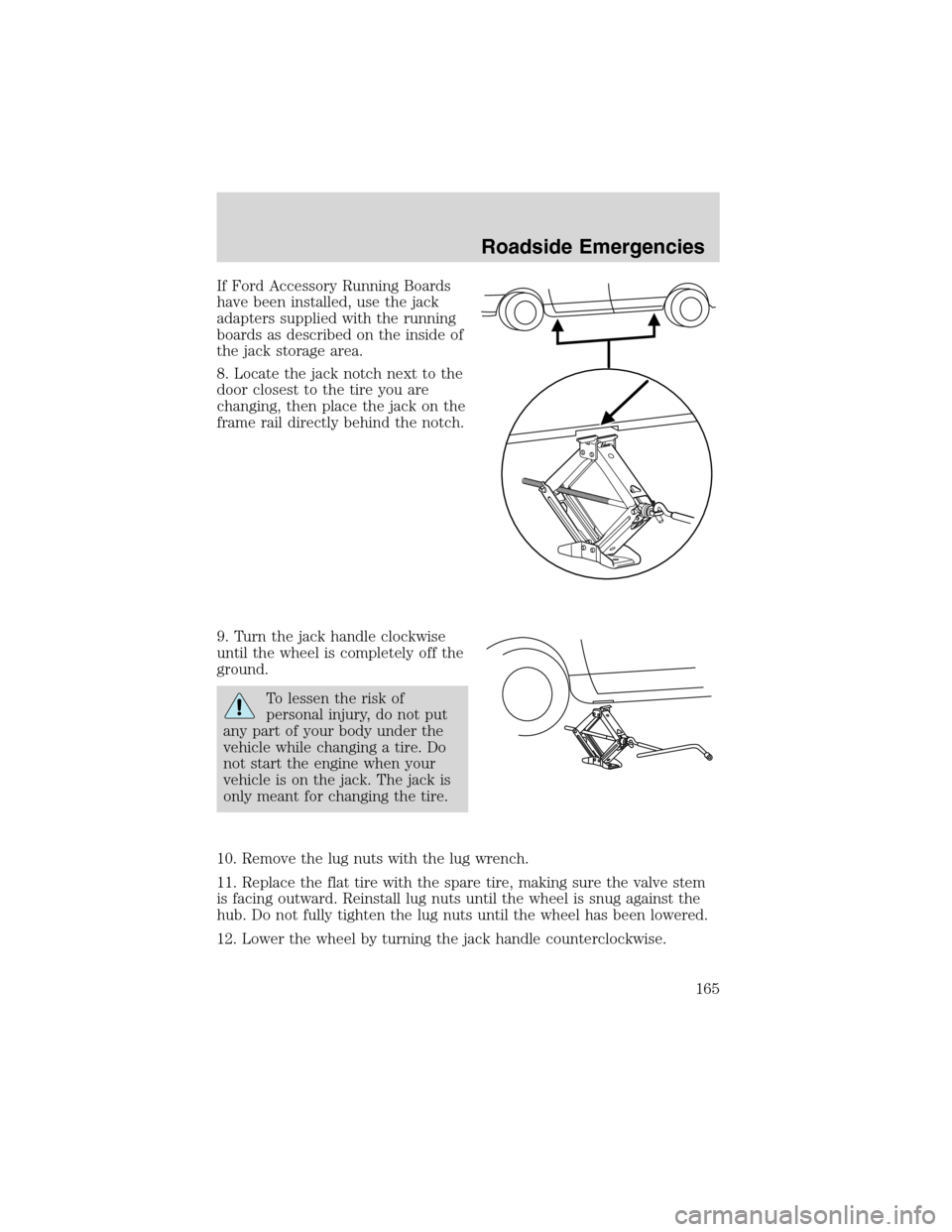
If Ford Accessory Running Boards
have been installed, use the jack
adapters supplied with the running
boards as described on the inside of
the jack storage area.
8. Locate the jack notch next to the
door closest to the tire you are
changing, then place the jack on the
frame rail directly behind the notch.
9. Turn the jack handle clockwise
until the wheel is completely off the
ground.
To lessen the risk of
personal injury, do not put
any part of your body under the
vehicle while changing a tire. Do
not start the engine when your
vehicle is on the jack. The jack is
only meant for changing the tire.
10. Remove the lug nuts with the lug wrench.
11. Replace the flat tire with the spare tire, making sure the valve stem
is facing outward. Reinstall lug nuts until the wheel is snug against the
hub. Do not fully tighten the lug nuts until the wheel has been lowered.
12. Lower the wheel by turning the jack handle counterclockwise.
Roadside Emergencies
165
Page 166 of 240
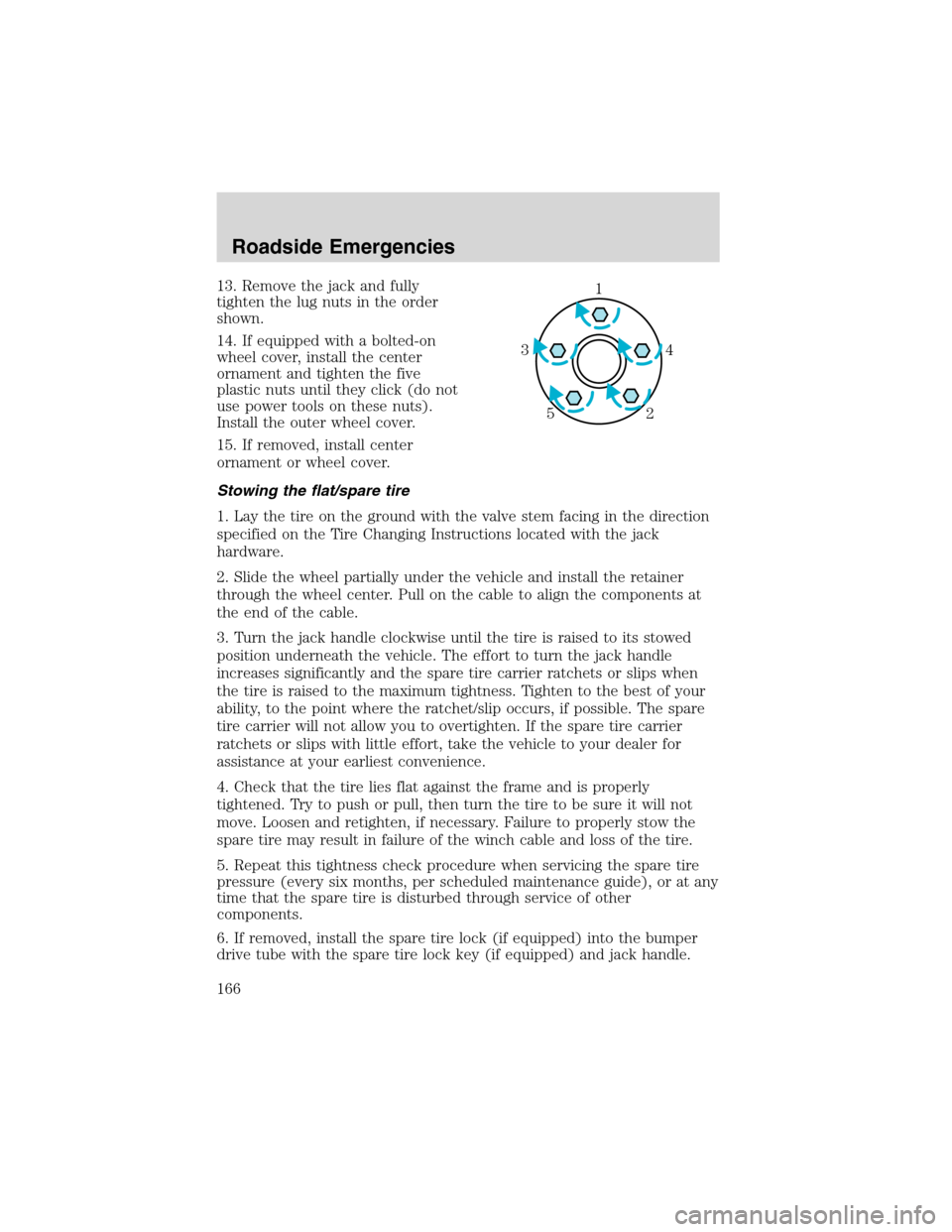
13. Remove the jack and fully
tighten the lug nuts in the order
shown.
14. If equipped with a bolted-on
wheel cover, install the center
ornament and tighten the five
plastic nuts until they click (do not
use power tools on these nuts).
Install the outer wheel cover.
15. If removed, install center
ornament or wheel cover.
Stowing the flat/spare tire
1. Lay the tire on the ground with the valve stem facing in the direction
specified on the Tire Changing Instructions located with the jack
hardware.
2. Slide the wheel partially under the vehicle and install the retainer
through the wheel center. Pull on the cable to align the components at
the end of the cable.
3. Turn the jack handle clockwise until the tire is raised to its stowed
position underneath the vehicle. The effort to turn the jack handle
increases significantly and the spare tire carrier ratchets or slips when
the tire is raised to the maximum tightness. Tighten to the best of your
ability, to the point where the ratchet/slip occurs, if possible. The spare
tire carrier will not allow you to overtighten. If the spare tire carrier
ratchets or slips with little effort, take the vehicle to your dealer for
assistance at your earliest convenience.
4. Check that the tire lies flat against the frame and is properly
tightened. Try to push or pull, then turn the tire to be sure it will not
move. Loosen and retighten, if necessary. Failure to properly stow the
spare tire may result in failure of the winch cable and loss of the tire.
5. Repeat this tightness check procedure when servicing the spare tire
pressure (every six months, per scheduled maintenance guide), or at any
time that the spare tire is disturbed through service of other
components.
6. If removed, install the spare tire lock (if equipped) into the bumper
drive tube with the spare tire lock key (if equipped) and jack handle.1
4 3
2 5
Roadside Emergencies
166
Page 183 of 240
•Remove particles such as bird droppings, tree sap, insect deposits, tar
spots, road salt and industrial fallout before repairing paint chips.
•Always read the instructions before using the products.
ALUMINUM WHEELS AND COVERS
Aluminum wheel rims or covers are coated with a clearcoat paint finish.
In order to maintain their shine:
•Clean weekly with Motorcraft Wheel and Tire Cleaner (ZC-37–A),
which is available from your dealer. Agitate the area with a sponge and
rinse thoroughly with a strong stream of water.
•Never apply any cleaning chemical to hot or warm wheel rims or
covers.
•Some automatic car washes may cause damage to the finish on your
wheel rims or covers. Chemical-strength cleaners, or cleaning
chemicals, in combination with brush agitation to remove brake dust
and dirt, could wear away the clearcoat finish over time.
•Do not use hydrofluoric acid-based or high caustic-based wheel
cleaners, steel wool, fuels or strong household detergent.
•To remove tar and grease, use Ford Extra Strength Tar and Road Oil
Removal (B7A-19520–AA), available from your dealer.
ENGINE
Engines are more efficient when they are clean because grease and dirt
buildup keep the engine warmer than normal. When washing:
•Take care when using a power washer to clean the engine. The
high-pressure fluid could penetrate the sealed parts and cause
damage.
•Do not spray a hot engine with cold water to avoid cracking the
engine block or other engine components.
•Spray Motorcraft Engine Shampoo and Degreaser (ZC-20) on all parts
that require cleaning and pressure rinse clean.
Cleaning
183
Page 188 of 240
SERVICE RECOMMENDATIONS
To help you service your vehicle:
•We highlight do-it-yourself items in the engine compartment for easy
location.
•We provide a scheduled maintenance guide which makes tracking
routine service easy.
If your vehicle requires professional service, your dealership can provide
the necessary parts and service. Check yourWarranty Guide/Owner
Information Guideto find out which parts and services are covered.
Use only recommended fuels, lubricants, fluids and service parts
conforming to specifications. Motorcraft parts are designed and built to
provide the best performance in your vehicle.
PRECAUTIONS WHEN SERVICING YOUR VEHICLE
•Do not work on a hot engine.
•Make sure that nothing gets caught in moving parts.
•Do not work on a vehicle with the engine running in an enclosed
space, unless you are sure you have enough ventilation.
•Keep all open flames and other lit material away from the battery and
all fuel related parts.
Working with the engine off
1. Set the parking brake and shift to P (Park).
2. Turn off the engine and remove the key.
3. Block the wheels.
Working with the engine on
1. Set the parking brake and shift to P (Park).
2. Block the wheels.
Note:Do not start your engine with the air cleaner removed and do not
remove it while the engine is running.
Maintenance and Specifications
188