air filter GENESIS G80 2018 User Guide
[x] Cancel search | Manufacturer: GENESIS, Model Year: 2018, Model line: G80, Model: GENESIS G80 2018Pages: 516, PDF Size: 81.01 MB
Page 419 of 516

7-18
Maintenance
I : Inspect and if necessary, adjust, correct, clean or replace.
R : Replace or change.
*
5: Front/rear differential oil should be changed anytime they have been submerged in water.
Number of months or driving distance, whichever comes first
Months1224364860728496108120132144156168180
Miles×1,00061218243036424854606672788490
Km×1,000102030405060708090100110120130140150
Disc brakes and padsIIIIIIIIIIIIIII
Steering gear rack, linkage and bootsIIIIIIIIIIIIIII
Driveshaft and bootsIIIIIIIIIIIIIII
Rotate tiresRotate every 6,000 miles (10,000 km)
Suspension mounting boltsIIIIIIIIIIIIIII
Air conditioner refrigerantIIIIIIIIIIIIIII
Air conditioner compressorIIIIIIIIIIIIIII
Climate control air filter (if equipped)RRRRRRRRRRRRRRR
Automatic transaxle fluidNo check, No service required
Front (AWD) / rear differential oil *5III
Propeller shaftIIIIIIIIIIIIIII
Exhaust pipe and mufflerIIIIIIIIIIIIIII
MAINTENANCE
INTERVALS
MAINTENANCE
ITEM
Normal Maintenance Schedule (Lambda 3.3 T-GDI) (CONT.)
Page 420 of 516
7-19
7
Maintenance
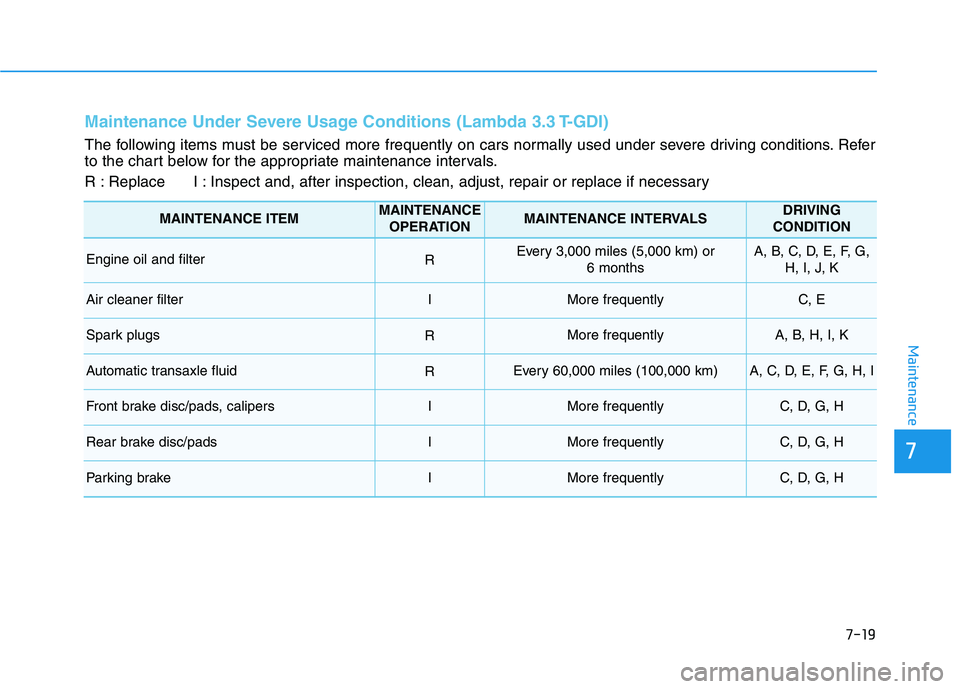
Maintenance Under Severe Usage Conditions (Lambda 3.3 T-GDI)
The following items must be serviced more frequently on cars normally used under severe driving conditions. Refer
to the chart below for the appropriate maintenance intervals.
R : Replace I : Inspect and, after inspection, clean, adjust, repair or replace if necessary
MAINTENANCE ITEMMAINTENANCE
OPERATIONMAINTENANCE INTERVALSDRIVING
CONDITION
Engine oil and filterREvery 3,000 miles (5,000 km) or
6 monthsA, B, C, D, E, F, G,
H, I, J, K
Air cleaner filterIMore frequentlyC, E
Spark plugs RMore frequentlyA, B, H, I, K
Automatic transaxle fluidREvery 60,000 miles (100,000 km) A, C, D, E, F, G, H, I
Front brake disc/pads, calipersIMore frequentlyC, D, G, H
Rear brake disc/padsIMore frequentlyC, D, G, H
Parking brakeIMore frequentlyC, D, G, H
Page 421 of 516

7-20
Maintenance
Severe driving conditions
A - Repeatedly driving short distance of less than 5 miles (8 km)
in normal temperature or less than 10 miles (16 km) in freez-
ing temperature
B - Extensive engine idling or low speed driving for long dis-
tances
C - Driving on rough, dusty, muddy, unpaved, graveled or salt-
spread roads
D - Driving in areas using salt or other corrosive materials or in
very cold weather
E - Driving in heavy dust conditionF - Driving in heavy traffic area
G- Driving on uphill, downhill, or mountain road repeatedly
H - Towing a Trailer, or using a camper, or roof rack
I - Driving as a patrol car, taxi, other commercial use or vehicle
towing
J - Driving over 106 mph (170 km/h)
K - Frequently driving in stop-and-go conditions
MAINTENANCE ITEMMAINTENANCE
OPERATIONMAINTENANCE INTERVALSDRIVING
CONDITION
Steering gear box, linkage & boots/
Lower arm ball joint, upper arm ball jointIMore frequentlyC, D, E, F, G, H, I
Drive shafts and bootsIEvery 3,000 miles (5,000 km) or
6 monthsC, D, E, F, G, H, I, J
Front(AWD)/rear differential oilREvery 72,000 miles (120,000 km)C, G, H, I, J
Climate control air filter
(for evaporator and blower unit)RMore frequentlyC, E
Propeller shaftIEvery 3,000 miles (5,000 km) or
6 monthsC, E
Page 422 of 516

7-21
7
Maintenance
E EX
XP
PL
LA
AN
NA
AT
TI
IO
ON
N
O
OF
F
S
SC
CH
HE
ED
DU
UL
LE
ED
D
M
MA
AI
IN
NT
TE
EN
NA
AN
NC
CE
E
I
IT
TE
EM
MS
S
Engine oil and filter
The engine oil and filter should be
changed at the intervals specified in
the maintenance schedule. If the car
is being driven in severe conditions,
more frequent oil and filter changes
are required.
Drive belts
Inspect all drive belts for evidence of
cuts, cracks, excessive wear or oil
saturation and replace if necessary.
Drive belts should be checked peri-
odically for proper tension and
adjusted as necessary.
Fuel filter
A clogged filter can limit the speed at
which the vehicle may be driven,
damage the emission system and
cause multiple issues such as hard
starting. If an excessive amount of
foreign matter accumulates in the
fuel tank, the filter may require
replacement more frequently. After
installing a new filter, run the engine
for several minutes, and check for
leaks at the connections. Fuel filters
should be installed by an authorized
retailer of Genesis Branded prod-
ucts.
Fuel lines, fuel hoses and con-
nections
Check the fuel lines, fuel hoses and
connections for leakage and dam-
age. Have an authorized retailer of
Genesis Branded products replace
any damaged or leaking parts imme-
diately.
Vapor hose and fuel filler cap
The vapor hose and fuel filler cap
should be inspected at those inter-
vals specified in the maintenance
schedule. Make sure a new vapor
hose or fuel filler cap is correctly
replaced.
Air cleaner filter
A Genesis/Hyundai Part air cleaner
filter is recommended when the filter
is replaced.
Spark plugs
Make sure to install new spark plugs
of the correct part number and heat
range.
Page 434 of 516

7-33
7
Maintenance
A AI
IR
R
C
CL
LE
EA
AN
NE
ER
R
Filter replacement
The air cleaner filter can be cleaned
for inspection using compressed air.
Do not attempt to wash or to rinse it,
as water will damage the filter. If
soiled, the air cleaner filter must be
replaced.We recommend that you visit an
authorized retailer of Genesis
Branded products to replace air
cleaner filter.
Replace the filter according to the
Maintenance Schedule
✽ ✽
NOTICE
If the vehicle is operated in extreme-
ly dusty or sandy areas, replace the
element more often than the usual
recommended intervals (refer to
"Maintenance Under Severe Usage
Conditions" in this chapter).
ODH073008
ODH073063L
■Lambda engine, Tau engine
■Tau engine
Do not drive with the air clean-
er filter removed. This will
result in excessive engine
wear.
When removing the air clean-
er filter, be careful that dust or
dirt does not enter the air
intake, or damage may result.
Use a Genesis/Hyundai Part,
use of non-Genesis/Hyundai
Part could damage the air flow
sensor.
CAUTION
Page 435 of 516

7-34
Maintenance
C CL
LI
IM
MA
AT
TE
E
C
CO
ON
NT
TR
RO
OL
L
A
AI
IR
R
F
FI
IL
LT
TE
ER
R
Filter inspection
The climate control air filter should
be replaced according to the
Maintenance Schedule. If the vehicle
is operated in severely air-polluted
cities or on dusty rough roads for a
long period, it should be inspected
more frequently and replaced earlier.
When you replace the climate control
air filter, replace it performing the fol-
lowing procedure, and be careful to
avoid damaging other components.
1. With the glove box open, remove
the stoppers on both sides to allow
the glove box to hang freely on the
hinges.2. Remove the support rod (1).
ODH073010ODH073009
Page 492 of 516

7-91
7
Maintenance
E EM
MI
IS
SS
SI
IO
ON
N
C
CO
ON
NT
TR
RO
OL
L
S
SY
YS
ST
TE
EM
M
The emission control system of your
vehicle is covered by a written limited
warranty. Please see the warranty
information contained in the Owner’s
Handbook & Warranty Information
booklet in your vehicle.
Your vehicle is equipped with an
emission control system to meet all
applicable emission regulations.
There are three emission control
systems, as follows.
(1) Crankcase emission control sys-
tem
(2) Evaporative emission control sys-
tem
(3) Exhaust emission control system
In order to assure the proper function
of the emission control systems, it is
recommended that you have your
vehicle inspected and maintained by
an authorized retailer of Genesis
Branded products in accordance
with the maintenance schedule in
this manual.1. Crankcase emission control
system
The positive crankcase ventilation
system is employed to prevent air
pollution caused by blow-by gases
being emitted from the crankcase.
This system supplies fresh filtered air
to the crankcase through the air
intake hose. Inside the crankcase,
the fresh air mixes with blow-by
gases, which then pass through the
PCV valve into the induction system.
2. Evaporative emission con-
trol system including
Onboard Refueling Vapor
Recovery (ORVR)
The Evaporative Emission Control
System is designed to prevent fuel
vapors from escaping into the atmos-
phere. The ORVR system is
designed to allow the vapors from
the fuel tank to be loaded into a can-
ister while refueling at the gas sta-
tion, preventing the escape of fuel
vapors into the atmosphere.
For the Inspection and
Maintenance Test (With Electronic
Stability Control (ESC) system)
To prevent the vehicle from
misfiring during dynamome-
ter testing, turn the Electronic
Stability Control (ESC) sys-
tem off by pressing the ESC
switch (ESC OFF light illumi-
nated).
After dynamometer testing is
completed, turn the ESC sys-
tem back on by pressing the
ESC switch again.
CAUTION
Page 510 of 516

I-3
Blind Spot Detection System (BSD) ..............................5-57
BSD (Blind Spot Detection) /
LCA (Lane Change Assist).........................................5-58
Limitation of the System ............................................5-63
RCTA (Rear Cross Traffic Alert) ...............................5-60
Brake fluid ......................................................................7-30
Checking the brake fluid level ...................................7-30
Braking system ...............................................................5-33
Anti-lock Brake System (ABS)..................................5-45
AUTO HOLD .............................................................5-41
Disc brakes wear indicator .........................................5-34
Electronic parking brake (EPB) .................................5-36
Electronic Stability Control (ESC).............................5-48
Foot parking brake .....................................................5-34
Good braking practices ..............................................5-52
Hill-Start Assist Control (HAC) .................................5-52
Power brakes ..............................................................5-33
Vehicle Stability Management (VSM) .......................5-51
Bulb wattage .....................................................................8-3
California perchlorate notice ..........................................7-95
Child restraint system (CRS) ..........................................2-35
Installing a child restraint system (CRS) ...................2-38
Selecting a child restraint system (CRS) ...................2-36Climate control additional features...............................3-149
Cluster ionizer ..........................................................3-149
CO2 control auto air conditioner .............................3-150
Rear climate system ON/OFF ..................................3-150
Smart ventilation ......................................................3-149
Climate control air filter .................................................7-34
Filter inspection ..........................................................7-34
Consumer information ....................................................8-10
Defroster .......................................................................3-129
Rear window defroster .............................................3-129
Dimensions .......................................................................8-2
Door locks .......................................................................3-11
Auto door lock/unlock features ..................................3-14
Child-protector rear door locks ..................................3-14
Operating door locks from inside the vehicle ............3-12
Operating door locks from outside the vehicle ..........3-11
Power Door Latch ......................................................3-12
Drive mode integrated control system ............................5-54
Driver assist system ......................................................3-123
Multi-View Camera System .....................................3-124
Parking Assist System ..............................................3-125
Rear view camera .....................................................3-123
I
Index
C
D