seats GENESIS G90 2017 Owner's Manual
[x] Cancel search | Manufacturer: GENESIS, Model Year: 2017, Model line: G90, Model: GENESIS G90 2017Pages: 524, PDF Size: 19.3 MB
Page 21 of 524

Important Safety Precautions ....................................................2-3
Always Wear Your Seat Belt .....................................................................2-3\
Restrain All Children........................................................................\
............2-3
Air Bag Hazards ........................................................................\
...................2-3
Driver Distraction ........................................................................\
.................2-3
Control Your Speed ........................................................................\
.............2-4
Keep Your Vehicle in Safe Condition ......................................................2-4
Seats ........................................................................\
......................2-5
Safety Precautions ........................................................................\
..............2-7
Front Seats ........................................................................\
............................2-8
Rear Seats ........................................................................\
...........................2-14
Additional Switches for Adjusting the Front Passenger Seat........2-17
VIP Seat Mode Switches ........................................................................\
..2-18
Head Restraints ........................................................................\
..................2-23
Seat Warmers and Coolers ......................................................................2-\
28
Seat Belts ........................................................................\
............2-32
Seat Belt Safety Precautions .................................................................2-32
Seat Belt Warning Light ........................................................................\
...2-33
Seat Belt Restraint System .....................................................................2-3\
4
Pre-Active Seat belt (PSB)......................................................................2-\
41
Additional Seat Belt Safety Precautions .............................................2-42
Care of Seat Belts ........................................................................\
.............2-44
Child Restraint System ..............................................................2-45
Children Always in the Rear ...................................................................2-45
Selecting a Child Restraint System (CRS) ............................................2-46
Installing a Child Restraint System (CRS) ............................................2-48
2
S Sa
af
fe
e t
ty
y
s
s y
y s
st
te
e m
m
o
o f
f
y
y o
o u
ur
r
v
v e
e h
h i
ic
c l
le
e
Page 27 of 524
2-7
02
Safety Precautions
Adjusting the seats so that you are sit-
ting in a safe, comfortable position
plays an important role in driver and
passenger safety together with the
seat belts and air bags in an accident.
Air bags
You can take steps to reduce the risk
of being injured by an inflating air
bag. Sitting too close to an air bag
greatly increases the risk of injury in
the event the air bag inflates.
The National Highway Traffic Safety
Administration (NHTSA) recommends
that drivers allow at least 10 inches
(25 cm) between the center of the
steering wheel and their chest.
Do not use a cushion that
reduces friction between the
seat and the passenger. The
passenger's hips may slide
under the lap portion of the seat
belt during an accident or a
sudden stop. Serious or fatal
internal injuries could result
because the seat belt cannot
operate properly.
WARNING
To reduce the risk of serious
injury or death from an inflating
air bag, take the following pre-
cautions:
• Adjust the driver's seat as far
to the rear as possible while
maintaining the ability to
maintain full control of the
vehicle.
Adjust the front passenger seat as far to the rear as pos-
sible.
Hold the steering wheel by the rim with hands at the 9 o'clock
and 3 o'clock positions to
minimize the risk of injuries to
your hands and arms.
NEVER place anything or any- one between the steering
wheel and the air bag.
Do not allow the front passen- ger to place feet or legs on the
dashboard to minimize the
risk of leg injuries.
WARNING
Page 28 of 524
2-8
Safety system of your vehicle
Seat belts
Always fasten your seat belt before
starting any trip.
At all times, passengers should sit
upright and be properly restrained.
Infants and small children must be
restrained in appropriate child restraint
systems. Adults and children who
have outgrown a booster seat must be
restrained using the seat belts.
Front Seats
The front seat can be adjusted by
using the switches located on the
outside of the seat cushion. Before
driving, adjust the seat to the proper
position so that you can easily con-
trol the steering wheel, foot pedals
and controls on the instrument panel.
Take the following precautions
when adjusting your seat belt:
NEVER use one seat belt for more than one occupant.
Always position the seatback upright with the lap portion of
the seat belt snug and low
across the hips.
NEVER allow children or small infants to ride in a pas-
senger's lap.
Do not route the seat belt across your neck, across
sharp edges, or reroute the
shoulder strap away from
your body.
Do not allow the seat belt to become caught or jammed.
WARNINGTake the following precautions
when adjusting your seat:
NEVER attempt to adjust theseat while the vehicle is mov-
ing. The seat could respond
with unexpected movement
and may cause loss of vehicle
control resulting in an acci-
dent.
Do not place anything under the front seats. Loose objects
in the driver's foot area could
interfere with the operation of
the foot pedals, causing an
accident.
Do not allow anything to inter- fere with the normal position
and proper locking of the
seatback.
Do not place a cigarette lighter on the floor or seat.
When you operate the seat,
gas may exit out of the lighter
causing a fire.
Use extreme caution when picking small objects trapped
under the seats or between
the seat and the center con-
sole. Your hands might be cut
or injured by the sharp edges
of the seat mechanism.
WARNING
Page 29 of 524
2-9
02
To prevent damage to the seats:
Always stop adjusting the seatswhen the seat has been adjusted
as far forward or rearward as
possible.
Do not adjust the seats longer than necessary when the engine
is turned off. This may result in
unnecessary battery drain.
Do not operate two or more seats at the same time. This may
result in an electrical malfunc-
tion.
NOTICE
To prevent injury:
Do not adjust your seat whilewearing your seat belt.
Moving the seat cushion for-
ward may cause strong pres-
sure on your abdomen.
Do not allow your hands or fingers to get caught in the
seat mechanisms while the
seat is moving.
WARNING
NEVER allow children in the
vehicle unattended. The power
seats are operable when the
engine is turned off.
WARNING
Page 31 of 524
2-11
02
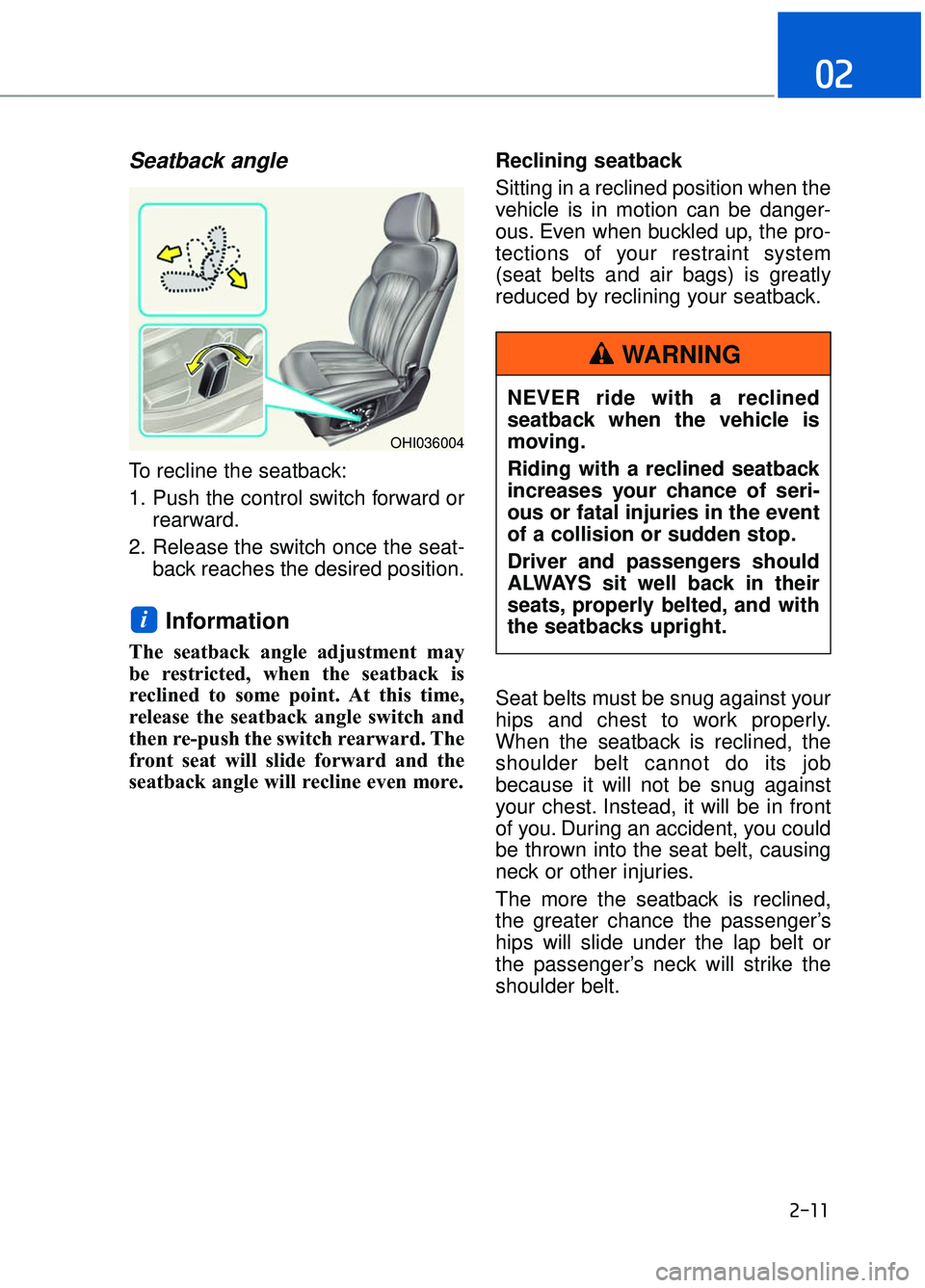
Seatback angle
To recline the seatback:
1. Push the control switch forward orrearward.
2. Release the switch once the seat- back reaches the desired position.
Information
The seatback angle adjustment may
be restricted, when the seatback is
reclined to some point. At this time,
release the seatback angle switch and
then re-push the switch rearward. The
front seat will slide forward and the
seatback angle will recline even more. Reclining seatback
Sitting in a reclined position when the
vehicle is in motion can be danger-
ous. Even when buckled up, the pro-
tections of your restraint system
(seat belts and air bags) is greatly
reduced by reclining your seatback.
Seat belts must be snug against your
hips and chest to work properly.
When the seatback is reclined, the
shoulder belt cannot do its job
because it will not be snug against
your chest. Instead, it will be in front
of you. During an accident, you could
be thrown into the seat belt, causing
neck or other injuries.
The more the seatback is reclined,
the greater chance the passenger’s
hips will slide under the lap belt or
the passenger’s neck will strike the
shoulder belt.
i
OHI036004
NEVER ride with a reclined
seatback when the vehicle is
moving.
Riding with a reclined seatback
increases your chance of seri-
ous or fatal injuries in the event
of a collision or sudden stop.
Driver and passengers should
ALWAYS sit well back in their
seats, properly belted, and with
the seatbacks upright.
WARNING
Page 34 of 524
2-14
Safety system of your vehicle
Seatback pocket
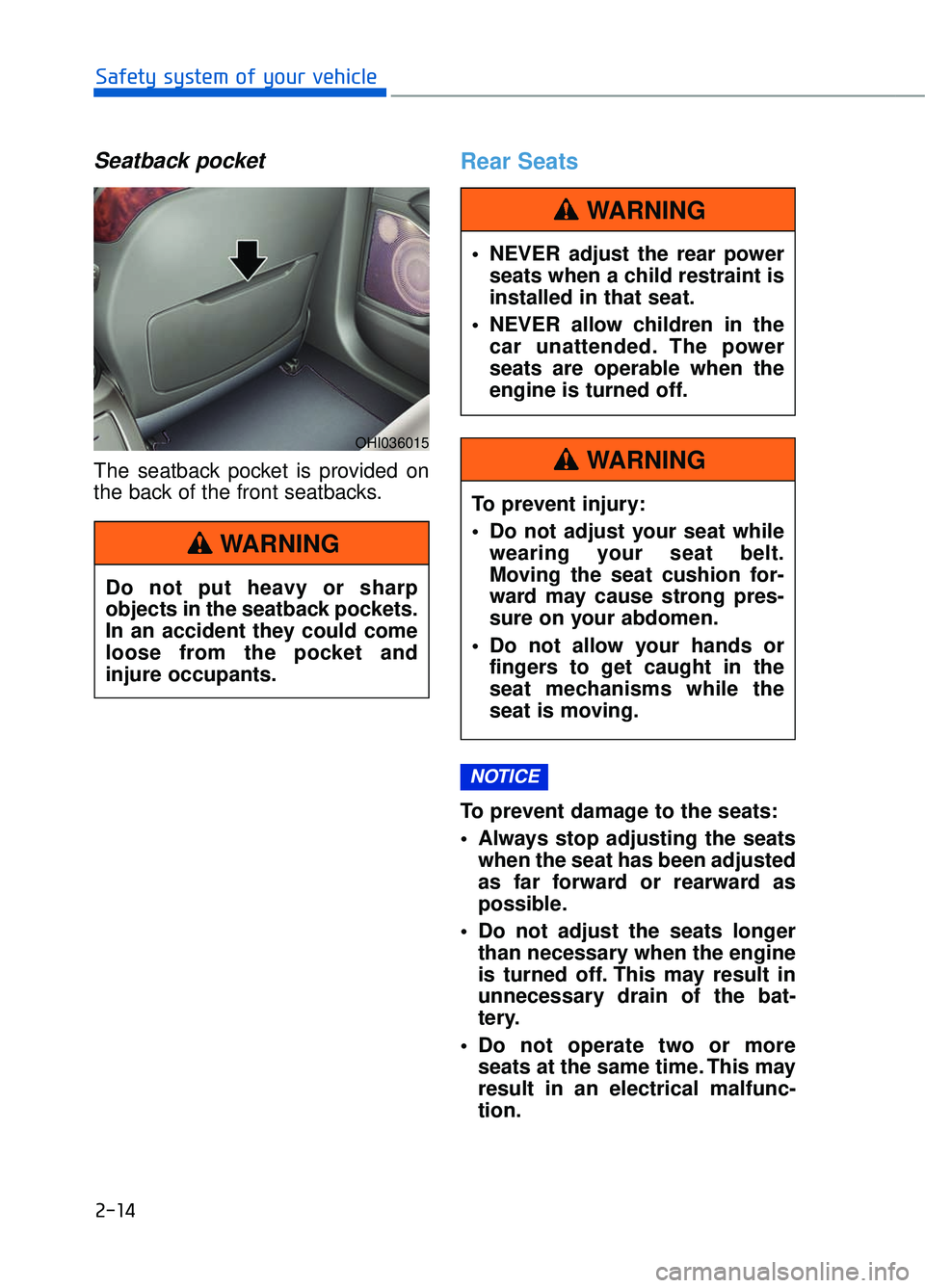
The seatback pocket is provided on
the back of the front seatbacks.
Rear Seats
To prevent damage to the seats:
Always stop adjusting the seatswhen the seat has been adjusted
as far forward or rearward as
possible.
Do not adjust the seats longer than necessary when the engine
is turned off. This may result in
unnecessary drain of the bat-
tery.
Do not operate two or more seats at the same time. This may
result in an electrical malfunc-
tion.
NOTICE
NEVER adjust the rear powerseats when a child restraint is
installed in that seat.
NEVER allow children in the car unattended. The power
seats are operable when the
engine is turned off.
WARNING
To prevent injury:
Do not adjust your seat whilewearing your seat belt.
Moving the seat cushion for-
ward may cause strong pres-
sure on your abdomen.
Do not allow your hands or fingers to get caught in the
seat mechanisms while the
seat is moving.
WARNING
OHI036015
Do not put heavy or sharp
objects in the seatback pockets.
In an accident they could come
loose from the pocket and
injure occupants.
WARNING
Page 37 of 524
2-17
02
Additional Switches for
Adjusting the Front Passenger
Seat
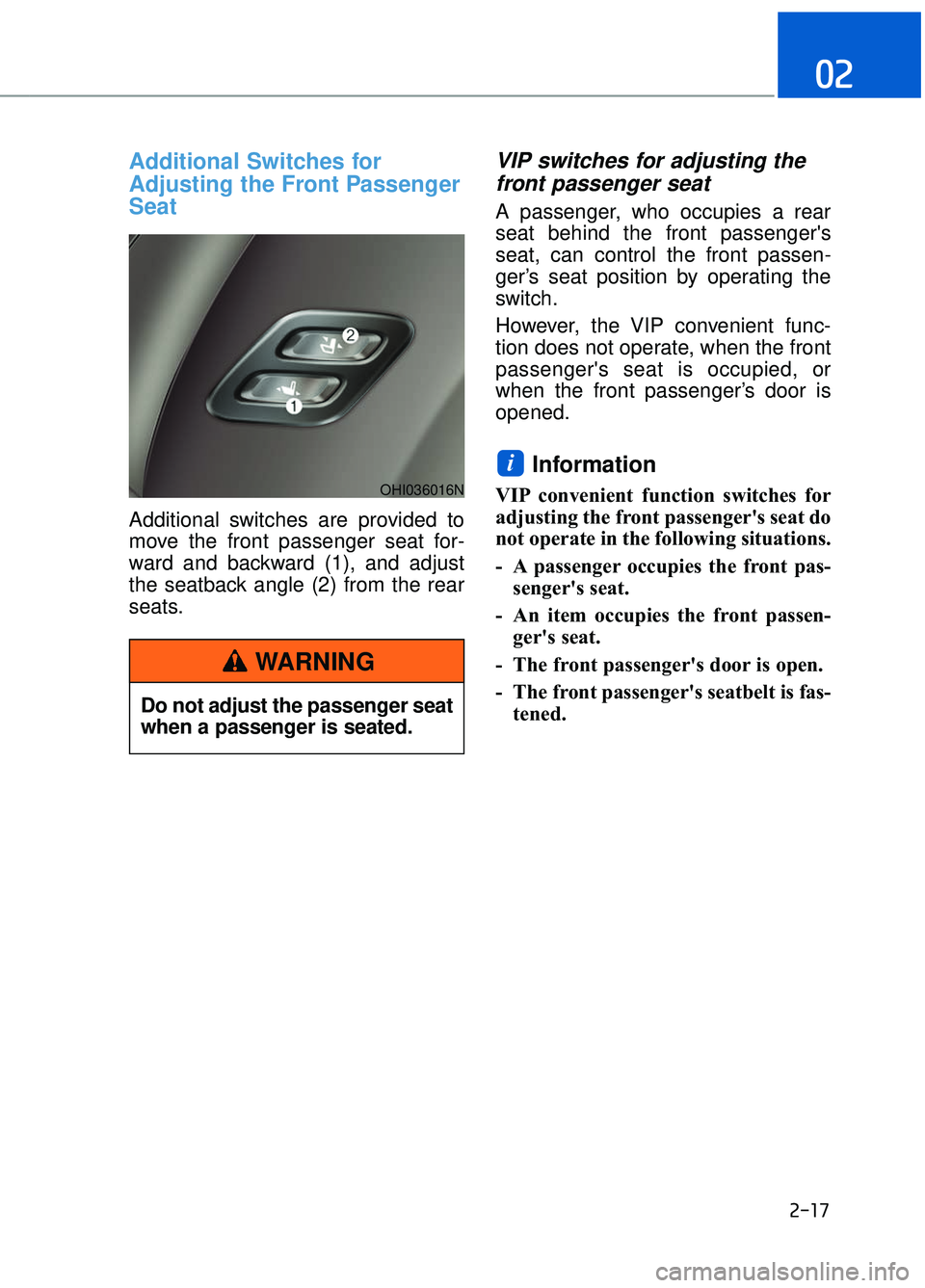
Additional switches are provided to
move the front passenger seat for-
ward and backward (1), and adjust
the seatback angle (2) from the rear
seats.
VIP switches for adjusting thefront passenger seat
A passenger, who occupies a rear
seat behind the front passenger's
seat, can control the front passen-
ger’s seat position by operating the
switch.
However, the VIP convenient func-
tion does not operate, when the front
passenger's seat is occupied, or
when the front passenger’s door is
opened.
Information
VIP convenient function switches for
adjusting the front passenger's seat do
not operate in the following situations.
- A passenger occupies the front pas-
senger's seat.
- An item occupies the front passen- ger's seat.
- The front passenger's door is open.
- The front passenger's seatbelt is fas- tened.
i
OHI036016N
Do not adjust the passenger seat
when a passenger is seated.
WARNING
Page 42 of 524
2-22
Safety system of your vehicle
Carrying long/narrow cargo
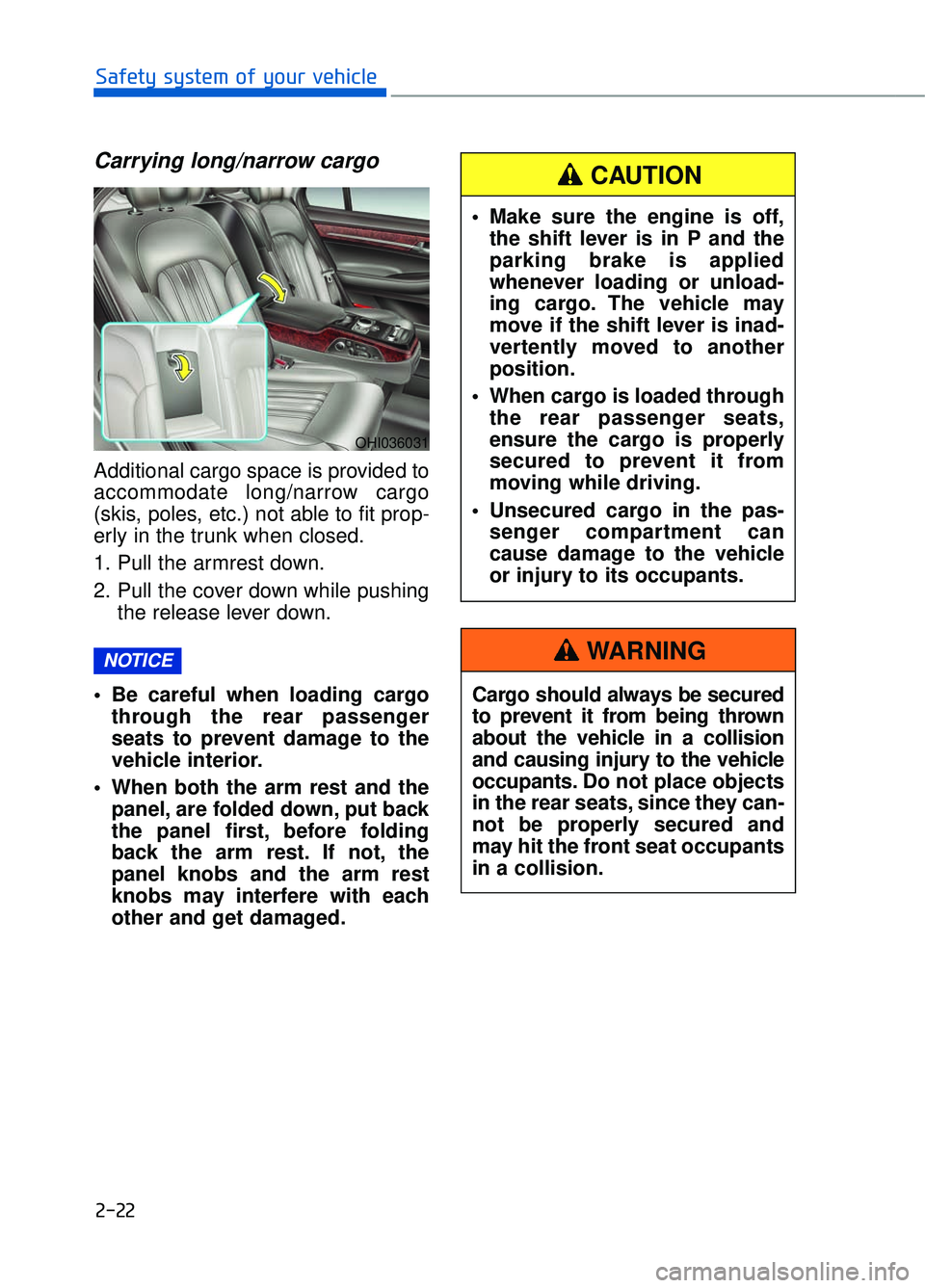
Additional cargo space is provided to
accommodate long/narrow cargo
(skis, poles, etc.) not able to fit prop-
erly in the trunk when closed.
1. Pull the armrest down.
2. Pull the cover down while pushingthe release lever down.
Be careful when loading cargo through the rear passenger
seats to prevent damage to the
vehicle interior.
When both the arm rest and the panel, are folded down, put back
the panel first, before folding
back the arm rest. If not, the
panel knobs and the arm rest
knobs may interfere with each
other and get damaged.
NOTICE
OHI036031
Cargo should always be secured
to prevent it from being thrown
about the vehicle in a collision
and causing injury to the vehicle
occupants. Do not place objects
in the rear seats, since they can-
not be properly secured and
may hit the front seat occupants
in a collision.
WARNING
Make sure the engine is off,the shift lever is in P and the
parking brake is applied
whenever loading or unload-
ing cargo. The vehicle may
move if the shift lever is inad-
vertently moved to another
position.
When cargo is loaded through the rear passenger seats,
ensure the cargo is properly
secured to prevent it from
moving while driving.
Unsecured cargo in the pas- senger compartment can
cause damage to the vehicle
or injury to its occupants.
CAUTION
Page 43 of 524

2-23
02
Head Restraints
The vehicle's front and rear seats
have adjustable head restraints. The
head restraints provide comfort for
passengers, but more importantly
they are designed to help protect
passengers from whiplash and other
neck and spinal injuries during an
accident, especially in a rear impact
collision.To prevent damage, NEVER hit or
pull on the head restraints.
NOTICE
To reduce the risk of serious
injury or death in an accident,
take the following precautions
when adjusting your head
restraints:
Always properly adjust thehead restraints for all passen-
gers BEFORE starting the
vehicle.
NEVER let anyone ride in a seat with the head restraints
removed.
(Continued)
(Continued)
Adjust the head restraints sothe middle of the head
restraint is at the same height
as the height of the top of the
eyes.
NEVER adjust the head restraint position of the dri-
ver's seat when the vehicle is
in motion.
Adjust the head restraint as close to the passenger's head
as possible. Do not use a seat
cushion that holds the body
away from the seatback.
Make sure the head restraint locks into position after
adjusting it.
WARNINGOLF034072N
When there is no occupant in
the rear seats, adjust the height
of the head restraints to the
lowest position. The rear seat
head restraints can reduce the
visibility of the rear area.
CAUTION
Page 44 of 524

2-24
Safety system of your vehicle
Front seat head restraints
The driver's and front passenger's
seats are equipped with adjustable
head restraints for the passengers
safety and comfort.
Forward and rearward adjustment
Push the control switch forward or
backward to move the head restraint.
Release the switch once the head
restraint reaches the desired posi-
tion.
Adjusting the height up and down
Push the control switch up to raise or
down to lower the head restraint.
Release the switch once the head
restraint reaches the desired posi-
tion.
If you recline the seatback
towards the front with the head
restraint and seat cushion raised,
the head restraint may come in
contact with the sunvisor or other
parts of the vehicle.
NOTICE
OHI036008
OHI036009
OHI036133N
OHI036010