engine compartment GENESIS G90 2018 Owner's Manual
[x] Cancel search | Manufacturer: GENESIS, Model Year: 2018, Model line: G90, Model: GENESIS G90 2018Pages: 519, PDF Size: 19.52 MB
Page 11 of 519
F11
Introduction
By following a few simple precautions for the first 600 miles (1,000 km) you
may add to the performance, economy and life of your vehicle.
Do not race the engine.
While driving, keep your engine speed (rpm, or revolutions per minute)between 2,000 rpm and 4,000 rpm.
Do not maintain a single speed for long periods of time, either fast or slow. Varying engine speed is needed to properly break-in the engine.
Avoid hard stops, except in emergencies, to allow the brakes to seat prop- erly.
V VE
EH
H I
IC
C L
LE
E
B
B R
RE
EA
A K
K-
-I
IN
N
P
P R
R O
O C
CE
E S
SS
S
CALIFORNIA PROPOSITION 65 WARNING
Items contained in motor vehicles or emitted from them are known to
the State of California to cause cancer and birth defects or reproduc-
tive harm. These include:
Gasoline and its vapors
Engine exhaust
Used engine oil
Interior passenger compartment components and materials
Component parts which are subject to heat and wear
In addition, battery posts, terminals and related accessories contain
lead, lead compounds and other chemicals known to the State of
California to cause cancer and reproductive harm.
WARNING
Page 14 of 519
Y
Yo
ou
ur
r
v
v e
e h
h i
ic
c l
le
e
a
a t
t
a
a
g
g l
la
a n
n c
ce
e
Exterior Overview (Front) ..........................................................1-2
Exterior Overview (Rear)............................................................1-3
Interior Overview ........................................................................\
.1-4
Instrument Panel Overview (l) ...................................................1-5
Instrument Panel Overview (ll) ..................................................1-6
Engine Compartment ...................................................................1-7
1
Page 42 of 519
2-22
Safety system of your vehicle
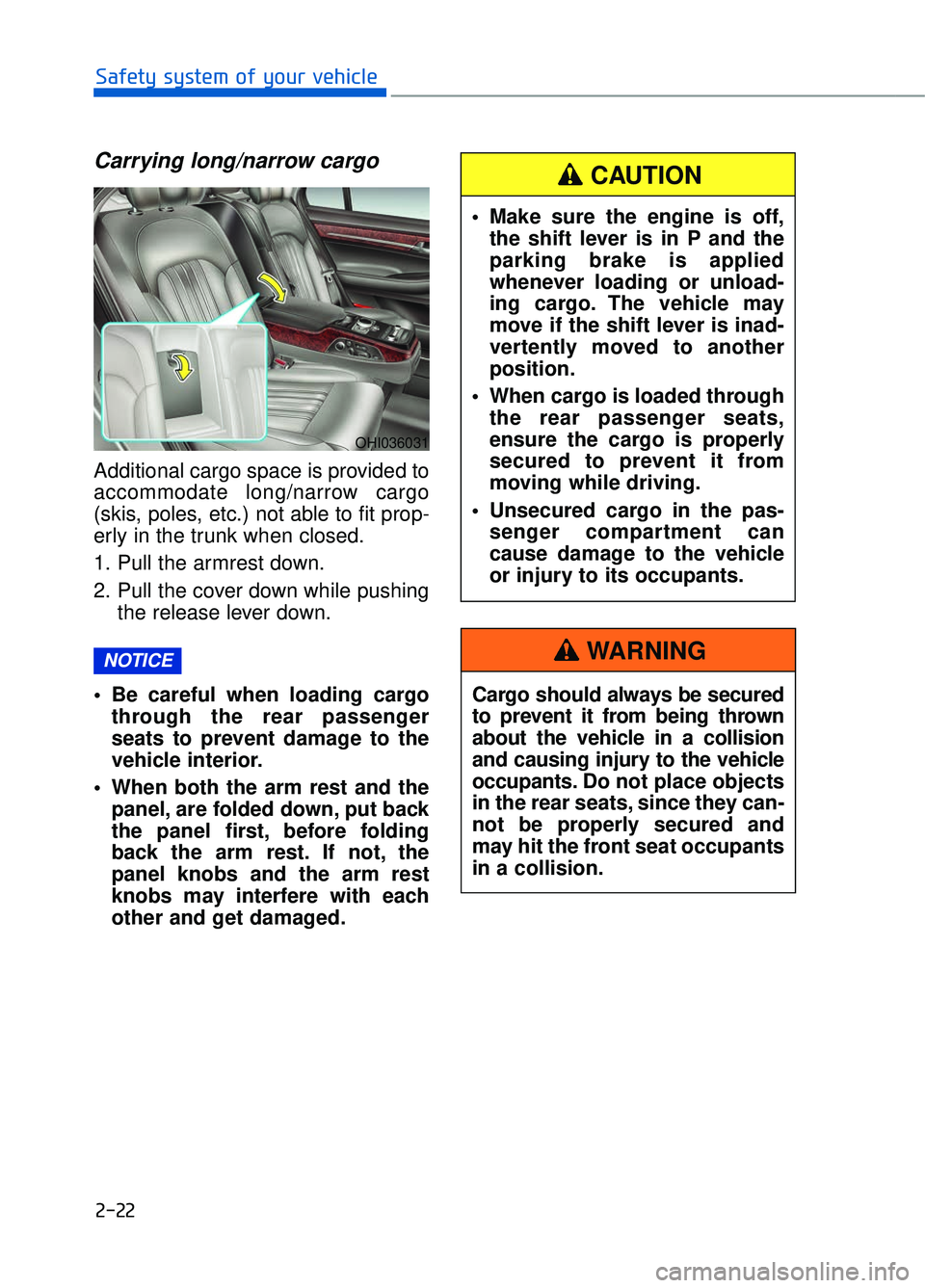
Carrying long/narrow cargo
Additional cargo space is provided to
accommodate long/narrow cargo
(skis, poles, etc.) not able to fit prop-
erly in the trunk when closed.
1. Pull the armrest down.
2. Pull the cover down while pushingthe release lever down.
Be careful when loading cargo through the rear passenger
seats to prevent damage to the
vehicle interior.
When both the arm rest and the panel, are folded down, put back
the panel first, before folding
back the arm rest. If not, the
panel knobs and the arm rest
knobs may interfere with each
other and get damaged.
NOTICE
OHI036031
Cargo should always be secured
to prevent it from being thrown
about the vehicle in a collision
and causing injury to the vehicle
occupants. Do not place objects
in the rear seats, since they can-
not be properly secured and
may hit the front seat occupants
in a collision.
WARNING
Make sure the engine is off,the shift lever is in P and the
parking brake is applied
whenever loading or unload-
ing cargo. The vehicle may
move if the shift lever is inad-
vertently moved to another
position.
When cargo is loaded through the rear passenger seats,
ensure the cargo is properly
secured to prevent it from
moving while driving.
Unsecured cargo in the pas- senger compartment can
cause damage to the vehicle
or injury to its occupants.
CAUTION
Page 60 of 519

2-40
Safety system of your vehicle
Information
• Both the driver's and front passen-ger's pre-tensioner seat belts may be
activated in certain frontal or side
collisions or rollovers.
• When the pre-tensioner seat belts are activated, a loud noise may be
heard and fine dust, which may
appear to be smoke, may be visible
in the passenger compartment.
These are normal operating condi-
tions and are not hazardous.
• Although it is non-toxic, the fine dust may cause skin irritation and
should not be breathed for pro-
longed periods. Wash all exposed
skin areas thoroughly after an acci-
dent in which the pre-tensioner seat
belts were activated.
• The pre-tensioner seat belt system may get adversely affected by
installing an audio system to the
center console or welding/painting
the frontal vehicle body.
In this case, consult an authorized
retailer of Genesis Branded prod-
ucts. The air bag warning light illu-
minates, if there is a malfunction
with the pre-tensioner seat belt sys-
tem.
• In following situations, immediately have the air bag system and the pre-
tensioner seat belt system checked
by an authorized retailer of Genesis
Branded products.
- The air bag warning light does notilluminate at all after turning ON
the engine.
- The air bag warning light remains ON over 6 seconds after turning
ON the engine.
i
Fasten your seat belt while sitting properly in an upright
position to maximize the
effectiveness of the pre-ten-
sioner seat belt system.
A pre-tensioner seat belt sys- tem is designed to activate
only once. Replace the pre-
tensioner seat belt system, if
it was activated in an acci-
dent.
Properly fasten a seat belt in an upright position to maxi-
mize protection from a pre-
tensioner seat belt system.
The pre-tensioner seat belt
instantly tightens the seat belt
to hold an occupant body in
position in forward collision.
A pre-tensioner seat belt sys- tem is designed to activate
only once. Replace the pre-
tensioner seat belt system, if
it was activated in an acci-
dent.
WARNING
Page 110 of 519
Restrictions in handling keys
When leaving keys with parking lot and
valet attendants, the following proce-
dures will ensure your vehicle's trunk
and glove box compartment can only
be opened with the mechanical key.
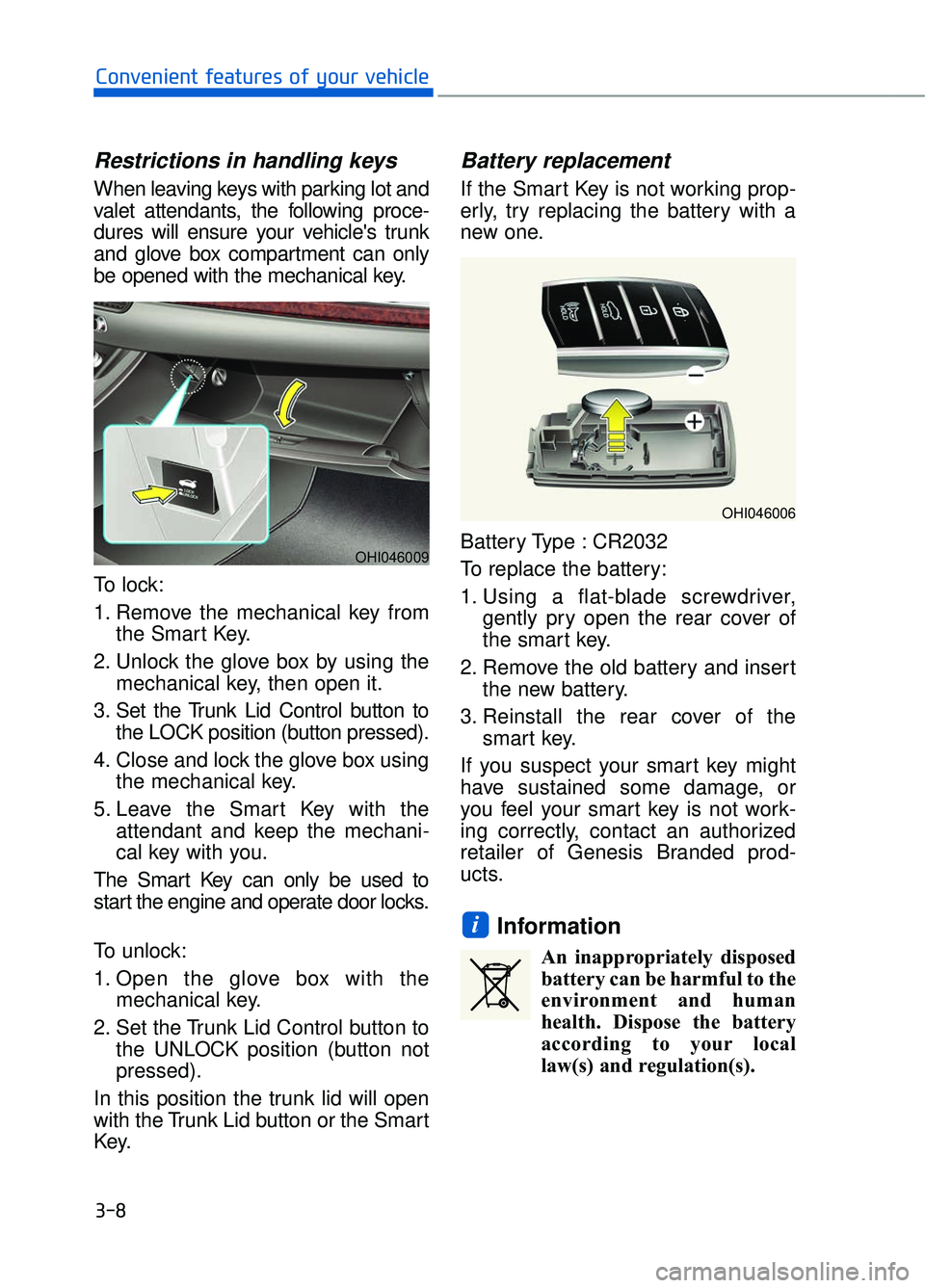
To lock:
1. Remove the mechanical key fromthe Smart Key.
2. Unlock the glove box by using the mechanical key, then open it.
3. Set the Trunk Lid Control button to the LOCK position (button pressed).
4. Close and lock the glove box using the mechanical key.
5. Leave the Smart Key with the attendant and keep the mechani-
cal key with you.
The Smart Key can only be used to
start the engine and operate door locks.
To unlock:
1. Open the glove box with the mechanical key.
2. Set the Trunk Lid Control button to the UNLOCK position (button not
pressed).
In this position the trunk lid will open
with the Trunk Lid button or the Smart
Key.
Battery replacement
If the Smart Key is not working prop-
erly, try replacing the battery with a
new one.
Battery Type : CR2032
To replace the battery:
1. Using a flat-blade screwdriver, gently pry open the rear cover of
the smart key.
2. Remove the old battery and insert the new battery.
3. Reinstall the rear cover of the smart key.
If you suspect your smart key might
have sustained some damage, or
you feel your smart key is not work-
ing correctly, contact an authorized
retailer of Genesis Branded prod-
ucts.
Information
An inappropriately disposed battery can be harmful to the
environment and human
health. Dispose the battery
according to your local
law(s) and regulation(s).
i
3-8
Convenient features of your vehicle
OHI046006
OHI046009
Page 234 of 519
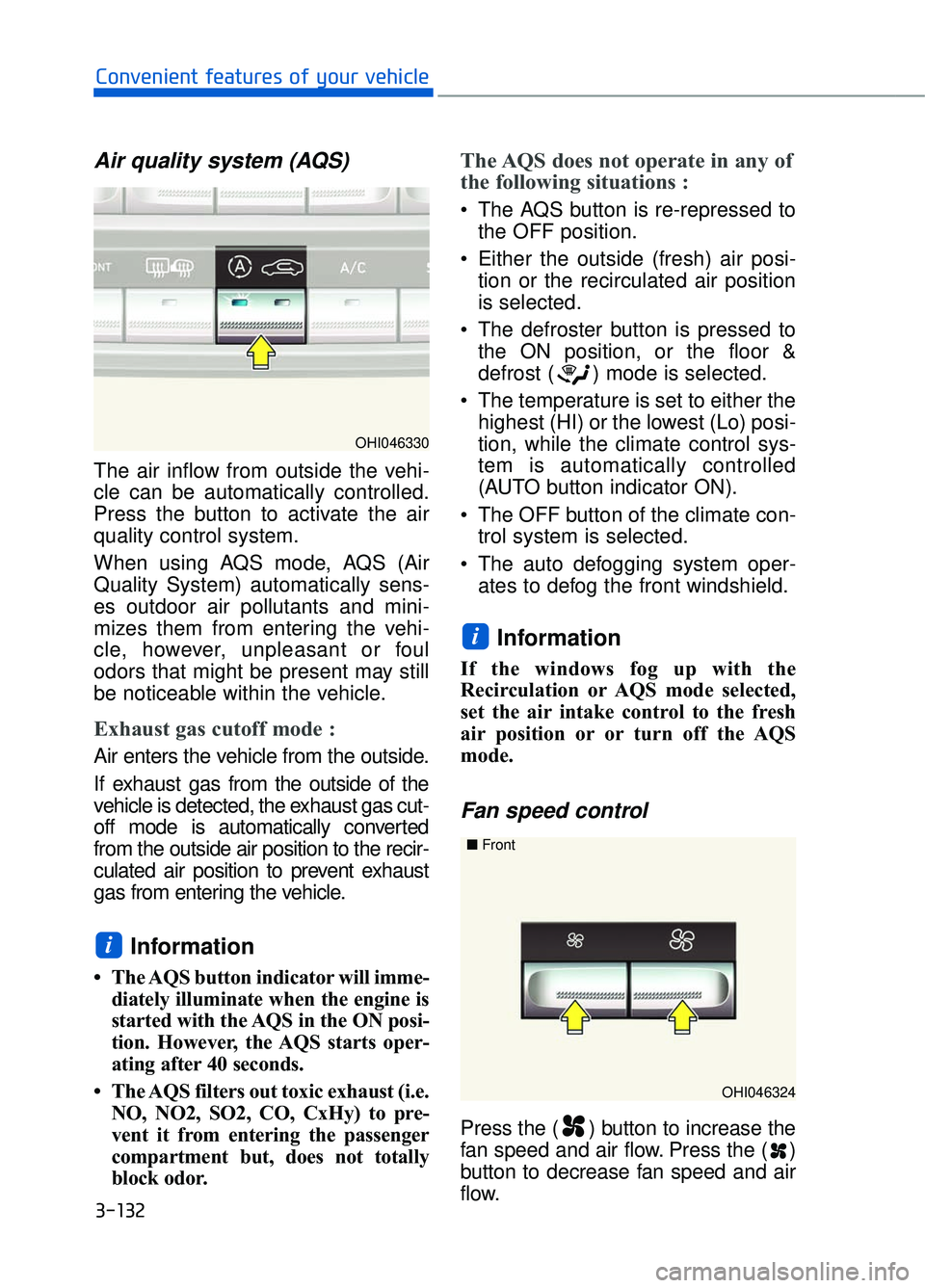
Air quality system (AQS)
The air inflow from outside the vehi-
cle can be automatically controlled.
Press the button to activate the air
quality control system.
When using AQS mode, AQS (Air
Quality System) automatically sens-
es outdoor air pollutants and mini-
mizes them from entering the vehi-
cle, however, unpleasant or foul
odors that might be present may still
be noticeable within the vehicle.
Exhaust gas cutoff mode :
Air enters the vehicle from the outside.
If exhaust gas from the outside of the
vehicle is detected, the exhaust gas cut-
off mode is automatically converted
from the outside air position to the recir-
culated air position to prevent exhaust
gas from entering the vehicle.
Information
• The AQS button indicator will imme-diately illuminate when the engine is
started with the AQS in the ON posi-
tion. However, the AQS starts oper-
ating after 40 seconds.
• The AQS filters out toxic exhaust (i.e. NO, NO2, SO2, CO, CxHy) to pre-
vent it from entering the passenger
compartment but, does not totally
block odor.
The AQS does not operate in any of
the following situations :
The AQS button is re-repressed tothe OFF position.
Either the outside (fresh) air posi- tion or the recirculated air position
is selected.
The defroster button is pressed to the ON position, or the floor &
defrost ( ) mode is selected.
The temperature is set to either the highest (HI) or the lowest (Lo) posi-
tion, while the climate control sys-
tem is automatically controlled
(AUTO button indicator ON).
The OFF button of the climate con- trol system is selected.
The auto defogging system oper- ates to defog the front windshield.
Information
If the windows fog up with the
Recirculation or AQS mode selected,
set the air intake control to the fresh
air position or or turn off the AQS
mode.
Fan speed control
Press the ( ) button to increase the
fan speed and air flow. Press the ( )
button to decrease fan speed and air
flow.
i
i
3-132
Convenient features of your vehicle
OHI046330
OHI046324
■
Front
Page 363 of 519

5-102
Driving your vehicle
Hazardous Driving Conditions
When hazardous driving elements
are encountered such as water,
snow, ice, mud and sand, take the
below suggestions:
Drive cautiously and keep a longerbraking distance.
Avoid abrupt braking or steering.
When your vehicle is stuck in snow, mud, or sand, use second gear.
Accelerate slowly to avoid unnec-
essary wheel spin.
Put sand, rock salt, tire chains or other non-slip materials under the
wheels to provide additional trac-
tion while the vehicle becomes
stuck in ice, snow, or mud.
Rocking the Vehicle
If it is necessary to rock the vehicle
to free it from snow, sand, or mud,
first turn the steering wheel right and
left to clear the area around your
front wheels. Then, shift back and
forth between R (Reverse) and a for-
ward gear.
Try to avoid spinning the wheels, and
do not race the engine.
To prevent transmission wear, wait
until the wheels stop spinning before
shifting gears. Release the accelera-
tor pedal while shifting, and press
lightly on the accelerator pedal while
the transmission is in gear. Slowly
spinning the wheels in forward and
reverse directions causes a rocking
motion that may free the vehicle.
S SP
P E
EC
CI
IA
A L
L
D
D R
RI
IV
V I
IN
N G
G
C
C O
O N
ND
DI
IT
T I
IO
O N
NS
S
Downshifting with an automatic
transmission while driving on
slippery surfaces can cause an
accident. The sudden change in
tire speed could cause the tires
to skid. Be careful when down-
shifting on slippery surfaces.
WARNING
If the vehicle is stuck and
excessive wheel spin occurs,
the temperature in the tires can
increase very quickly. If the tires
become damaged, a tire blow
out or tire explosion can occur.
This condition is dangerous -
you and others may be injured.
Do not attempt this procedure if
people or objects are anywhere
near the vehicle.
If you attempt to free the vehi-
cle, the vehicle can overheat
quickly, possibly causing an
engine compartment fire or
other damage. Try to avoid spin-
ning the wheels as much as
possible to prevent overheating
of either the tires or the engine.
DO NOT allow the vehicle to
spin the wheels above 35 mph
(56 km/h).
WARNING
Page 369 of 519
5-108
Driving your vehicle
Check spark plugs and ignitionsystem
Inspect your spark plugs as
described in chapter 7 and replace
them if necessary. Also check all
ignition wiring and components to be
sure they are not cracked, worn or
damaged in any way.
Use approved window washeranti-freeze in system
To keep the water in the window
washer system from freezing, add an
approved window washer anti-freeze
solution in accordance with instruc-
tions on the container. Window wash-
er anti-freeze is available from an
authorized retailer of Genesis
Branded products and most auto
parts outlets. Do not use engine
coolant or other types of anti-freeze
as these may damage the paint fin-
ish.
Do not let your parking brakefreeze
Under some conditions your parking
brake can freeze in the engaged
position. This is most likely to happen
when there is an accumulation of
snow or ice around or near the rear
brakes or if the brakes are wet. If
there is a risk the parking brake may
freeze, apply it only temporarily while
you put the gear selector lever in P
and block the rear wheels so the car
cannot roll. Then release the parking
brake.
Do not let ice and snow accu-mulate underneath
Under some conditions, snow and
ice can build up under the fenders
and interfere with the steering. When
driving in severe winter conditions
where this may happen, you should
periodically check underneath the
car to be sure the movement of the
front wheels and the steering compo-
nents is not obstructed.
Don't place foreign objects ormaterials in the engine com-partment
Placement of foreign object or mate-
rials which prevent cooling of the
engine, in the engine compartment,
may cause a failure or combustion.
The manufacturer is not responsible
for the damage caused by such
placement.
To keep locks from freezing
To keep the locks from freezing,
squirt an approved de-icer fluid or
glycerine into the key opening. If a
lock is covered with ice, squirt it with
an approved de-icing fluid to remove
the ice. If the lock is frozen internally,
you may be able to thaw it out by
using a heated key. Handle the heat-
ed key with care to avoid injury.
Page 381 of 519

Information
An inappropriately disposedbattery can be harmful to the
environment and human
health. Dispose the battery
according to your local law(s)
or regulations.
To prevent damage to your vehi-
cle:
Only use a 12-volt power supply (battery or jumper system) to
jump start your vehicle.
Do not attempt to jump start your vehicle by push-starting.
Jump starting procedure
Information
Your vehicle has a battery in the trunk
compartment, but when you jump
start your vehicle, use the jumper ter-
minal in the engine compartment.
1. Position the vehicles close enough that the jumper cables will reach,
but do not allow the vehicles to
touch.
2. Avoid fans or any moving parts in the engine compartment at all
times, even when the vehicles are
turned off.
3. Turn off all electrical devices such as radios, lights, air conditioning,
etc. Put the vehicles in P (Park)
and set the parking brakes. Turn
both vehicles OFF.
4. Open the engine hood. 5. Open the small service cover with
a screwdriver.
6. Remove the engine room fuse box cover.
7. Connect the jumper cables in the exact sequence shown in the illus-
tration. First connect one jumper
cable to the red, positive (+)
jumper terminal of your vehicle (1).
8. Connect the other end of the jumper cable to the red, positive
(+) battery/jumper terminal of the
assisting vehicle (2).
i
NOTICE
i
6-6
What to do in an emergency
OHI066005
OHI066006N
Page 403 of 519
Engine Compartment ...................................................................7-3
Maintenance Services .................................................................7-5
Owner's Responsibility ........................................................................\
.......7-5
Owner Maintenance Precautions ............................................................7-5
Owner Maintenance ....................................................................7-6
Owner Maintenance Schedule..................................................................7-7
Scheduled Maintenance Service................................................7-8
Normal Maintenance Schedule (Tau 5.0 GDI) .......................................7-9
Maintenance Under Severe Usage Conditions (Tau 5.0 GDI) .........7-12
Normal Maintenance Schedule (Lambda 3.3 Turbo-GDI) ................7-14
Maintenance Under Severe Usage Conditions (Lambda 3.3 Turbo-GDI) ........................................................................\
.7-17
Explanation of Scheduled Maintenance Items ......................7-19
Engine oil........................................................................\
.............7-22
Checking the Engine Oil Level................................................................7-22
Checking the Engine Oil and Filter .......................................................7-23
Engine Coolant ........................................................................\
...7-24
Checking the Engine Coolant Level ......................................................7-24
Changing Engine Coolant........................................................................\
.7-26
Brake Fluid ........................................................................\
..........7-27
Checking the Brake Fluid Level .............................................................7-27
Washer Fluid ........................................................................\
.......7-28
Checking the Washer Fluid Level ..........................................................7-28
Air Cleaner ........................................................................\
..........7-29
Filter Replacement........................................................................\
.............7-29
Climate Control Air Filter ..........................................................7-30
Filter Inspection ........................................................................\
.................7-30
Wiper Blades ........................................................................\
.......7-31
Blade Inspection ........................................................................\
.................7-31
Blade Replacement ........................................................................\
............7-31
Battery ........................................................................\
.................7-33
For Best Battery Service ........................................................................\
.7-34
Battery Recharging ........................................................................\
...........7-35
Reset features ........................................................................\
....................7-36
7
M M a
ai
in
n t
te
e n
n a
an
n c
ce
e