oil GENESIS G90 2021 User Guide
[x] Cancel search | Manufacturer: GENESIS, Model Year: 2021, Model line: G90, Model: GENESIS G90 2021Pages: 538, PDF Size: 13.02 MB
Page 389 of 538
5-137
05
• The lane markers are complicated
or a structure substitutes for the
lines such as a construction area.
• There are crosswalk signs or other
symbols on the road.
• The lane marker in a tunnel is
stained with oil, etc.
• The lane suddenly disappears
such as at the intersection.
When external condition is inter-
vened
• The brightness outside changes
suddenly such as when entering or
exiting a tunnel, or when passing
under a bridge.
• The brightness outside is too low
such as when the headlamps are
not on at night or the vehicle is
going through a tunnel.
• There is a boundary structure in
the roadway such as a concrete
barrier, guardrail and reflector post
that is inadvertently being detected
by the camera.
• When light coming from a street
light or an oncoming vehicle is
reflected on a wet road surface
such as a puddle in the road.
• The field of view in front is
obstructed by sun glare.
• There is not enough distance
between you and the vehicle in
front to be able to detect the lane
marker or the vehicle ahead is driv-
ing on the lane marker.
• Driving on a steep grade, over a hill,
or when driving on a curved road.
• The adverse road conditions cause
excessive vehicle vibrations while
driving.
• The surrounding of the inside rear
view mirror temperature is high
due to direct sunlight, etc.When front visibility is poor
• The windshield or the camera lens
is covered with dirt or debris.
• The windshield glass is fogged up;
a clear view of the road is obstruct-
ed.
• Placing objects on the dashboard,
etc.
• The sensor cannot detect the lane
because of fog, heavy rain or snow.
LKA System Setting
• Setting LKA function
The driver can change between
‘Lane Keeping Assist’ and ‘Lane
Departure Warning’ from the
Settings menu in the AVN system
screen. Select:
- Setup →Vehicle →Driver
Assistance →Lane Safety
For detailed information, scan
the QR code in a separately sup-
plied simple manual.
- Lane Keeping Assist
Lane Keeping Assist guides the
driver to help keep the vehicle with-
in the lanes. It rarely controls the
steering wheel, when the vehicle
drives well inside the lanes.
However, it starts to control the
steering wheel, when the vehicle is
about to deviate out of the lane.
- Lane Departure Warning
Lane Departure Warning alerts the
driver with a visual warning and a
warning alarm when the system
detects the vehicle departing the
lane. The steering wheel will not be
controlled.
-Off
If you select 'Off', the LKA system
is deactivated.
Page 404 of 538

5-152
Driving your vehicle
Driving in Flooded Areas
Avoid driving through flooded areas
unless you are sure the water is no
higher than the bottom of the wheel
hub. Drive through any water slowly.
Allow adequate stopping distance
because brake performance may be
reduced.
After driving through water, dry the
brakes by gently applying them sev-
eral times while the vehicle is moving
slowly.
Highway Driving
Tires
Adjust the tire inflation, as specified.
Under-inflation may overheat or
damage the tires.
Do not install worn-out or damaged
tires, which may reduce traction or
fail the braking operation.
Information
Never over-inflate your tires above the
maximum inflation pressure, as speci-
fied on your tires.
Fuel, engine coolant and engine
oil
Driving at higher speeds on the high-
way consumes more fuel and is less
efficient than driving at a slower,
more moderate speed. Maintain a
moderate speed in order to conserve
fuel when driving on the highway.
Be sure to check both the engine
coolant level and the engine oil
before driving.
Drive belt
A loose or damaged drive belt may
overheat the engine.
i
Utility vehicles have a signifi-
cantly higher rollover rate than
other types of vehicles. To pre-
vent rollovers or loss of control:
• Take corners at slower speeds
than you would with a passen-
ger vehicle.
• Avoid sharp turns and abrupt
maneuvers.
• Do not modify your vehicle in
any way that you would raise
the center of gravity.
• Keep tires properly inflated.
• Do not carry heavy cargo on
the roof.
WARNING
In a rollover crash, an unbelted
person is significantly more
likely to die than a person wear-
ing a seat belt. Make sure all
passengers are wearing their
seat belts.
WARNING
Page 407 of 538
5-155
05
Chain Installation
When installing AutoSock®(fabric
snow chain), follow the manufactur-
er's instructions and mount them as
tightly as possible. Drive slowly (less
than 20 mph (30 km/h)) with
AutoSock
®installed. If you hear the
fabric snow chains contacting the
body or chassis, stop and tighten
them. If they still make contact, slow
down until the noise stops. Remove
the AutoSock
®(fabric snow chain) as
soon as you begin driving on cleared
roads.
When mounting AutoSock
®(fabric
snow chain), park the vehicle on
level ground away from traffic.
Turn on the vehicle Hazard Warning
Flasher and place a triangular emer-
gency warning device behind the
vehicle (if available).
Always place the vehicle in P (Park),
apply the parking brake and turn off
the engine before installing
AutoSock
®.
When using AutoSock
®(fabric
snow chain):
• Wrong size fabric snow chains
or improperly installed fabric
snow chains can damage your
vehicle's brake lines, suspen-
sion, body and wheels.
• If you hear noise caused by fabric
snow chains contacting the body,
retighten the chain to prevent
contact with the vehicle body.
• To prevent body damage,
retighten the fabric snow chains
after driving 0.3~0.6 miles
(0.5~1.0 km).
AutoSock
®is a Registered trade-
mark of AutoSock.
Winter Precautions
Use high quality ethylene glycol
coolant
Your vehicle is delivered with high
quality ethylene glycol coolant in the
cooling system. It is the only type of
coolant that should be used because
it helps prevent corrosion in the cool-
ing system, lubricates the water
pump and prevents freezing. Be sure
to replace or replenish your coolant
in accordance with the maintenance
schedule in chapter 7. Before winter,
have your coolant tested to assure
that its freezing point is sufficient for
the temperatures anticipated during
the winter.
Change to "winter weight" oil if
necessary
In some climates it is recommended
that a lower viscosity "winter weight"
oil be used during cold weather. See
chapter 8 for recommendations. If
you aren't sure what weight oil you
should use, consult an authorized
retailer of Genesis Branded prod-
ucts.
Check battery and cables
Winter puts additional burdens on
the battery system. Visually inspect
the battery and cables as described
in chapter 7. The level of charge in
your battery can be checked by an
authorized retailer of Genesis
Branded products or a service sta-
tion.
NOTICE
Page 441 of 538
7
7. Maintenance
Engine Compartment ....................7-3
Maintenance Services ..................7-5
Owner's Responsibility ....................7-5
Owner Maintenance Precautions ....7-5
Owner Maintenance......................7-6
Owner Maintenance Schedule ........7-7
Scheduled Maintenance Service ..7-8
Normal Maintenance Schedule
(5.0 GDI) ..........................................7-9
Maintenance Under Severe Usage
Conditions (5.0 GDI) ......................7-12
Normal Maintenance Schedule
(3.3 Turbo-GDI) ..............................7-14
Maintenance Under Severe Usage
Conditions (3.3 Turbo-GDI) ..........7-17
Explanation of Scheduled
Maintenance Items ......................7-19
Engine Oil ....................................7-22
Checking the Engine Oil Level ......7-22
Checking the Engine Oil and Filter ..7-23
Engine Coolant ............................7-24
Checking the Engine Coolant
Level................................................7-24
Changing Engine Coolant ..............7-26
Brake Fluid....................................7-27
Checking the Brake Fluid Level......7-27
Washer Fluid ................................7-28
Checking the Washer Fluid Level ..7-28
Air Cleaner ..................................7-29
Filter Replacement ........................7-29
Cabin Air Filter ............................7-30
Filter Inspection..............................7-30
Wiper Blades ................................7-31
Blade Inspection ..............................7-31
Blade Replacement ........................7-31
Battery ..........................................7-33
Battery Usage Recommendations..7-34
Battery Replacement ....................7-34
Battery Recharging ........................7-35
Reset features ................................7-36
Tires and Wheels ........................7-37
Tire Care ..........................................7-37
Recommended Cold Tire Inflation
Pressures ........................................7-38
Check Tire Inflation Pressure ........7-39
Tire Rotation ..................................7-39
Wheel Alignment and Tire
Balance ..........................................7-40
Tire Replacement ............................7-41
Wheel Replacement ......................7-42
Tire Traction ....................................7-42
Tire Maintenance............................7-42
Tire Sidewall Labeling ....................7-42
Tire Terminology and Definitions ..7-46
All Season Tires ..............................7-50
Summer Tires ................................7-50
Snow Tires ......................................7-50
Radial-Ply Tires ..............................7-50
Low Aspect Ratio Tires ..................7-51
Page 443 of 538
7-3
07
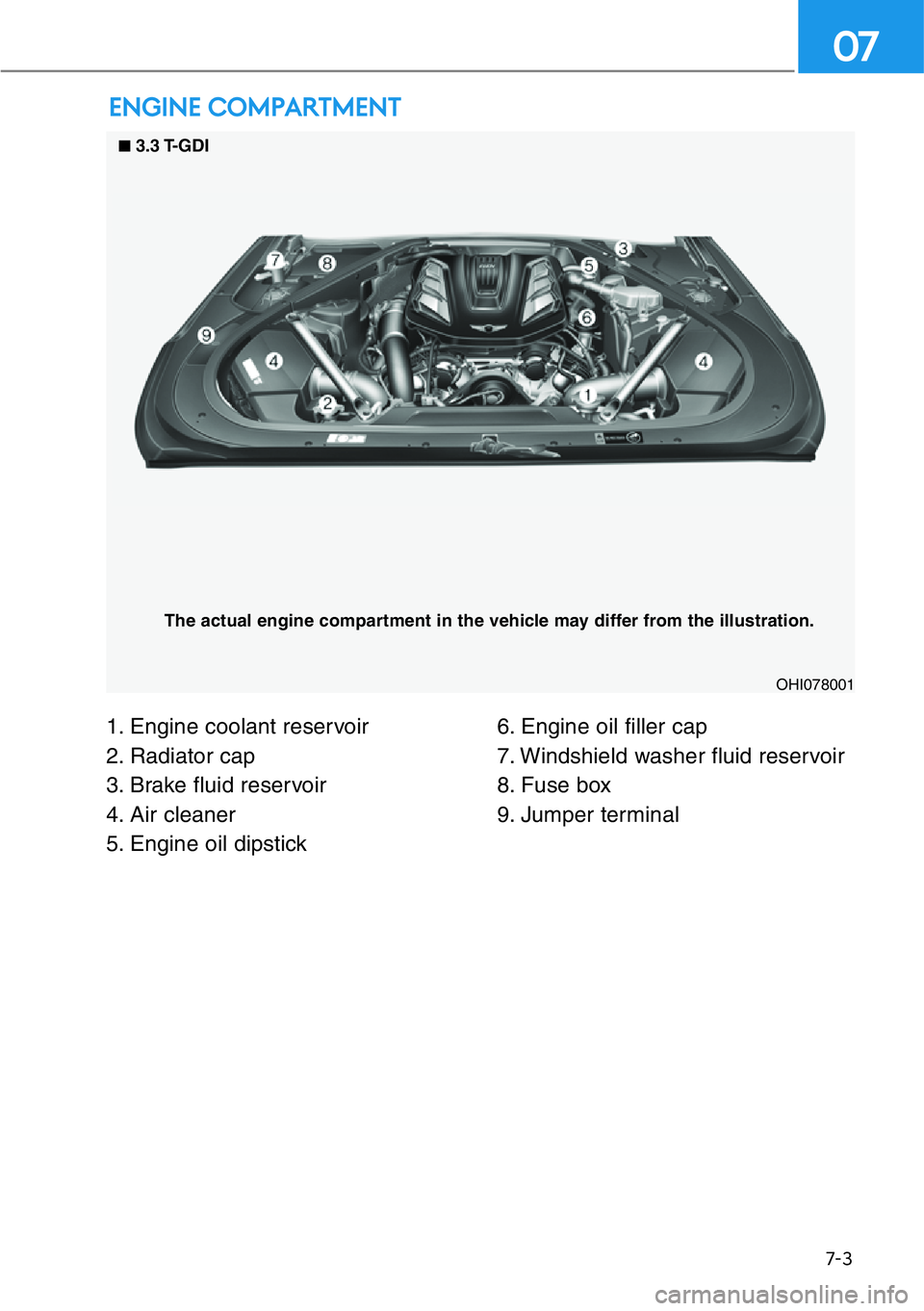
1. Engine coolant reservoir
2. Radiator cap
3. Brake fluid reservoir
4. Air cleaner
5. Engine oil dipstick6. Engine oil filler cap
7. Windshield washer fluid reservoir
8. Fuse box
9. Jumper terminal
ENGINE COMPARTMENT
OHI078001
The actual engine compartment in the vehicle may differ from the illustration.
■3.3 T-GDI
Page 444 of 538
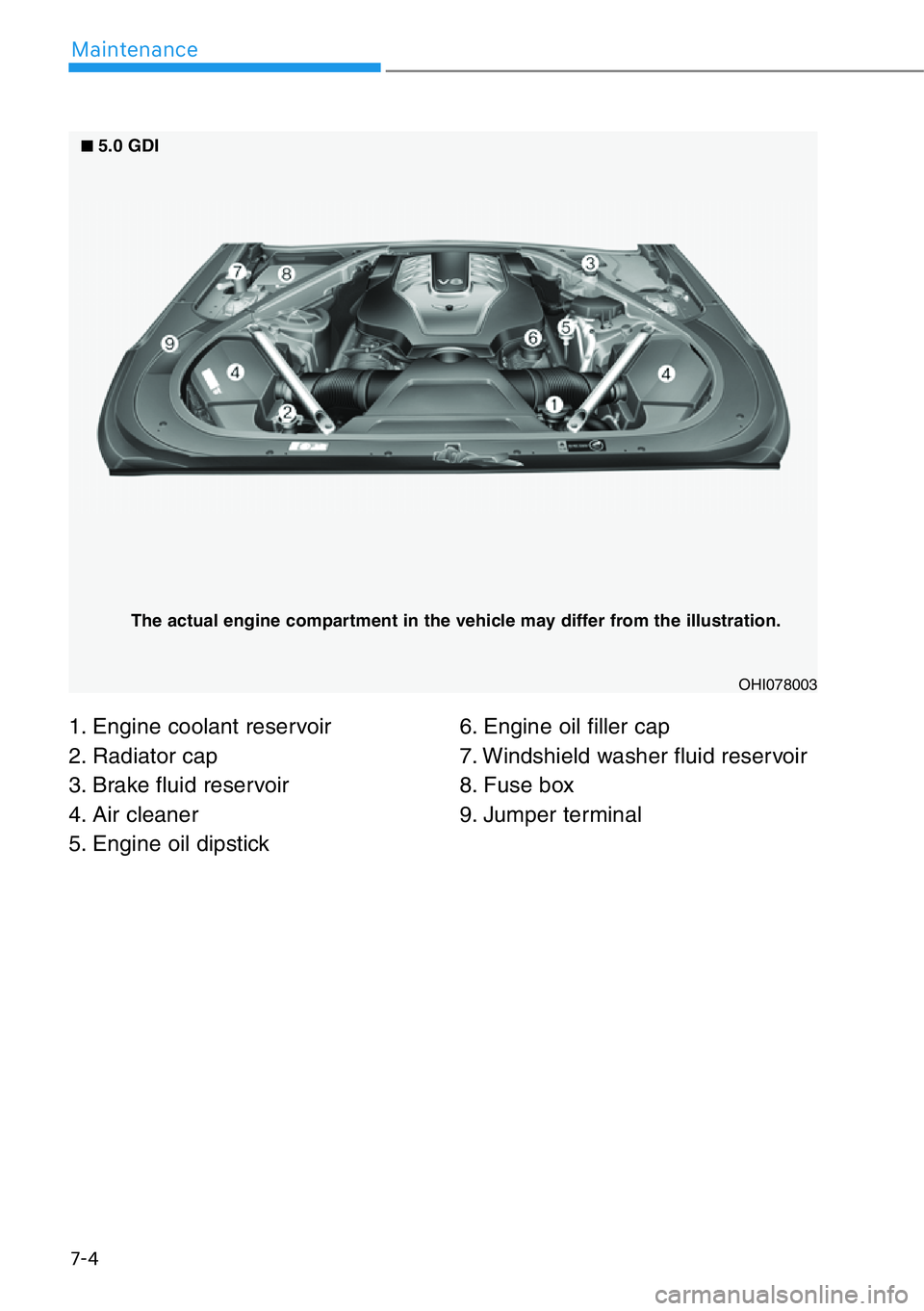
7-4
Maintenance
1. Engine coolant reservoir
2. Radiator cap
3. Brake fluid reservoir
4. Air cleaner
5. Engine oil dipstick6. Engine oil filler cap
7. Windshield washer fluid reservoir
8. Fuse box
9. Jumper terminal
OHI078003
The actual engine compartment in the vehicle may differ from the illustration.
■5.0 GDI
Page 447 of 538
7-7
07
Owner Maintenance Schedule
When you stop for fuel:
• Check the engine oil level.
• Check the coolant level in the
engine coolant reservoir.
• Check the windshield washer fluid
level.
• Check the tire for low or under-
inflated tires.
While operating your vehicle:
• Note any changes in the sound of
the exhaust or any smell of exhaust
fumes in the vehicle.
• Check for vibrations in the steering
wheel. Notice if there is any
increased steering effort or loose-
ness in the steering wheel, or
change in its straight-ahead posi-
tion.
• Notice if your vehicle constantly
turns slightly or "pulls" to one side
when traveling on smooth, level
road.
• When stopping, listen and check
for unusual sounds, pulling to one
side, increased brake pedal travel
or "hard-to-push" brake pedal.
• If any slipping or changes in the
operation of your transmission
occurs, check the transmission
fluid level.
• Check the automatic transmission
P (Park) function.
• Check the parking brake.
• Check for fluid leaks under your
vehicle (water dripping from the air
conditioning system during or after
use is normal).
At least monthly:
• Check coolant level in the engine
coolant reservoir.
• Check the operation of all exterior
lights, including the brake lights,
turn signals and hazard warning
flashers.
• Check the inflation pressures of all
tires including the spare for tires
that are worn, show uneven wear,
or are damaged.
• Check for loose wheel lug nuts. Be careful when checking your
engine coolant level when the
engine is hot. This may result in
coolant being blown out of the
opening and cause serious
burns and other injuries.
WARNING
Page 449 of 538

7-9
07
Normal Maintenance Schedule (5.0 GDI)The following maintenance services must be performed to ensure good emission control and performance.
Keep receipts for all vehicle emission services to protect your warranty. Where both mileage and time are shown,
the frequency of service is determined by whichever occurs first.I : Inspect and if necessary, adjust, correct, clean or replace.
R : Replace or change.
*1: The drive belt should be replaced when cracks occur or tension is reduced.
*2: If TOP TIER Detergent Gasoline is not available, one bottle of additive is recommended. Additives are available from your
authorized retailer of Genesis Branded products along with information on how to use them. Do not mix other additives.
Number of months or driving distance, whichever comes first
180112.5180
At first, inspect at 60,000 miles (96,000 km) or 72 months,
after that, inspect every 15,000 miles (24,000 km) or 24 months
R
Add every 7,500 miles (12,000 km) or 12 months
I
Replace every 97,500 miles (156,000 km) Rotate every 7,500 miles (12,000 km)
R
168105168RIR
15697.5156RIR
14490144RRR
13282.5132RIR
12075120RIR
10867.5108RIR
966096RRR
8452.584RIR
724572RIR
6037.560RIR
483048RRR
3622.536RIR
241524RIR
127.512RIR
MonthsMiles×1,000Km×1,000
Drive belts *
1
Engine oil and engine oil filterFuel additives *
2
Air cleaner filterSpark plugsRotate tiresClimate control air filter
(for evaporator and blower unit)
MAINTENANCE
INTERVALS
MAINTENANCE
ITEM
Page 451 of 538

7-11
07
Normal Maintenance Schedule (5.0 GDI) (CONT.)I : Inspect and if necessary, adjust, correct, clean or replace.
R : Replace or change.
*3: Use only the specified automatic transmission fluid. (Refer to "Recommended lubricants and capacities" in chapter 8 or the
label in the engine compartment.)
*4: Front/rear differential oil should be changed anytime, front/rear differential have been submerged in water.
*5: Fuel filter & Fuel tank air filter are considered to be maintenance free but periodic inspection is recommended for this main-
tenance schedule depends on fuel quality. If there are some important safety matters like fuel flow restriction, surging, loss
of power, hard starting problem, etc. replace the fuel filter immediately regardless of maintenance schedule and consult an
authorized retailer of Genesis Branded products for details.
Number of months or driving distance, whichever comes first
180112.5180
No check, No service required
lnspect every 15,000 miles (24,000km) or 12 months,
Replace every 60,000 miles (96,000km) or 48 months
I
168105168IIII
15697.5156I
14490144IIIIIR
13282.5132I
12075120IIII
10867.5108I
966096IIIIIR
8452.584I
724572IIII
6037.560I
483048IIIIIR
3622.536I
241524IIII
127.512I
MonthsMiles×1,000Km×1,000
Automatic transmission fluid *
3
Front (AWD) / rear differential oil *
4
Vapor hose, fuel filler cap and fuel tankFuel tank air filter *
5
Fuel filter *
5
Fuel lines, hoses and connectionsParking brakeBrake fluid
MAINTENANCE
INTERVALS
MAINTENANCE
ITEM
Page 452 of 538

7-12
Maintenance
The following items must be serviced more frequently on cars normally used
under severe driving conditions. Refer to the chart below for the appropriate
maintenance intervals.
R : Replace
I : Inspect and, after inspection, clean, adjust, repair or replace if necessary
Maintenance Under Severe Usage Conditions (5.0 GDI)
Maintenance itemMaintenance
operationMaintenance IntervalsDriving
condition
Engine oil and filterREvery 3,750 miles
(6,000 km) or 6 monthsA, B, C, D, E,
F, G, H, I, J, K
Air cleaner filterIMore frequentlyC, E
Spark plugs RMore frequentlyA, B, F, H, I, K
Automatic transmission
fluidREvery 60,000 miles
(96,000 km) A, C, D, E, F,
G, H, I
Front brake disc/
pads, calipersIMore frequentlyC, D, G, H
Rear brake disc/padsIMore frequentlyC, D, G, H
Parking brakeIMore frequentlyC, D, G, H
Steering gear box,
linkage & boots/
Lower arm ball joint,
upper arm ball joint
IMore frequentlyC, D, E, F, G,
H, I
Drive shafts and bootsIMore frequentlyC, D, E, F, G,
H, I, J
Front(AWD)/
Rear differential oilREvery 75,000 miles
(120,000 km)C, E, G, H, I, J
Climate control air filter
(for evaporator and
blower unit)
RMore frequentlyC, E, G
Propeller shaftIMore frequentlyC, D, E, F,
G, H, I, J