roof GENESIS G90 2021 User Guide
[x] Cancel search | Manufacturer: GENESIS, Model Year: 2021, Model line: G90, Model: GENESIS G90 2021Pages: 538, PDF Size: 13.02 MB
Page 175 of 538

3-74
Convenient features of your vehicle
Sunroof open (if equipped)
This warning is displayed if you turn
off the engine when the sunroof is
open.
Close the sunroof securely when
leaving your vehicle.
Window open (if equipped)
This warning is displayed if you turn
off the engine when any window is
open.
Lights
This indicator displays which exterior
light is selected using the lighting
control.
You activate or deactivate Wiper/
Lights display function from the
Settings menu in the AVN system
screen. Select:
- Setup
→Vehicle Settings →Cluster
→Content Selection →Wiper/Lights
Display
For detailed information, scan
the QR code in a separately sup-
plied simple manual.
OHI048126
OHI048127
OHI048148L
Page 225 of 538
3-124
Convenient features of your vehicle
When using the air conditioning
system, monitor the engine tem-
perature gauge closely while driv-
ing up hills or in heavy traffic when
outside temperatures are high. Air
conditioning system operation
when climbing a steep grade or in
high outside ambient temperatures
can cause engine overheating.
Continue to use the fan, but turn
the air conditioning system off if
the engine temperature gauge
indicates engine overheating.
Air conditioning system operation
tips
• If the vehicle has been parked in
direct sunlight during hot weather,
open the windows for a short time
to let the hot air inside the vehicle
escape.
• After sufficient cooling has been
achieved, switch back from recir-
culation mode to fresh mode.
• To help reduce moisture inside of
the windows on rainy or humid
days, decrease the humidity inside
the vehicle by operating the air
conditioning system with the win-
dows and sunroof closed.
• Use the air conditioning system
every month only for a few minutes
to ensure maximum system per-
formance.
• If you operate air conditioner
excessively, the difference between
the temperature of the outside air
and that of the windshield could
cause the outer surface of the
windshield to fog up, causing loss
of visibility. In this case, set the
mode selection knob or button to
the position and fan speed
control to the lowest speed.
System Maintenance
Cabin air filter
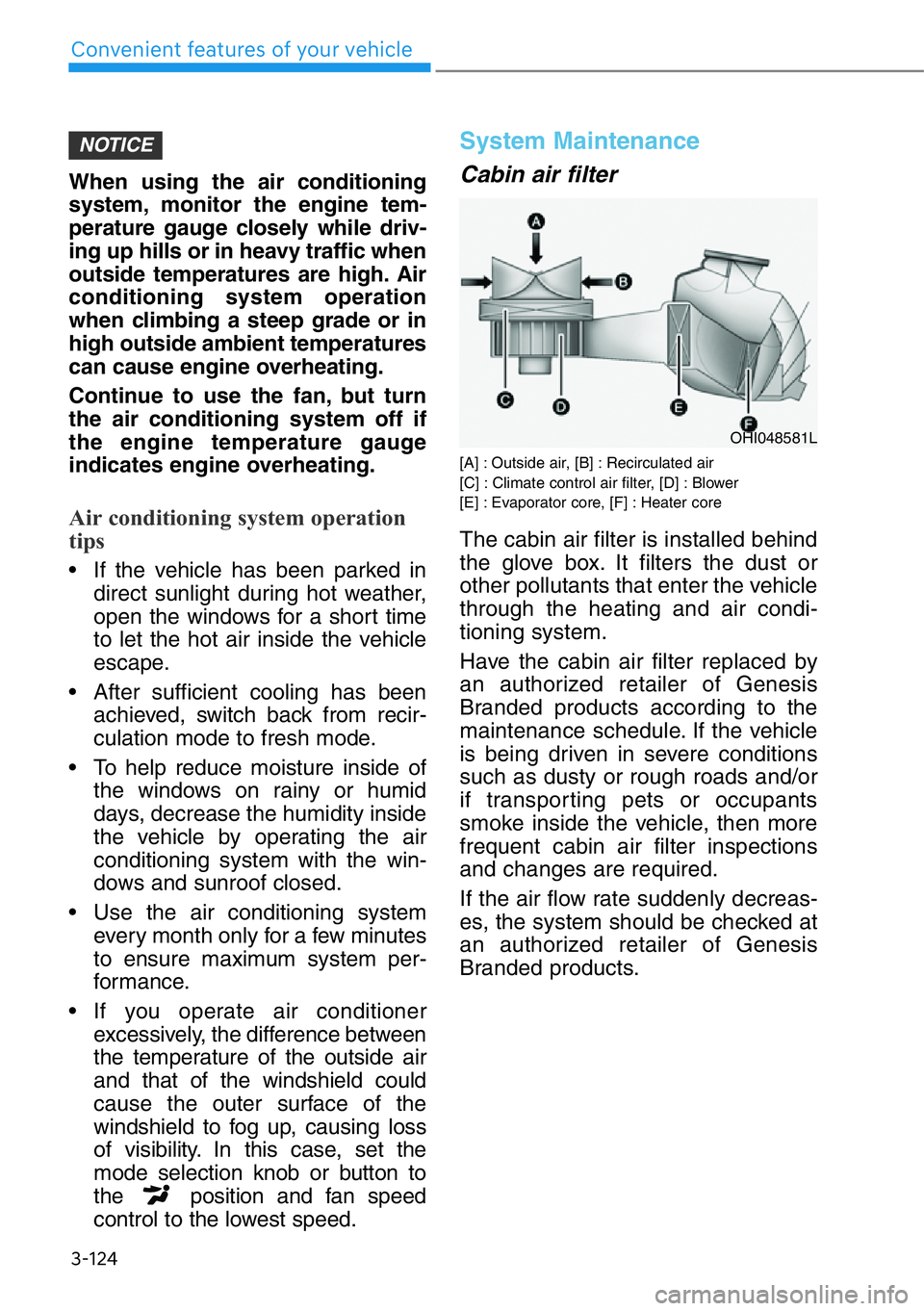
[A] : Outside air, [B] : Recirculated air
[C] : Climate control air filter, [D] : Blower
[E] : Evaporator core, [F] : Heater core
The cabin air filter is installed behind
the glove box. It filters the dust or
other pollutants that enter the vehicle
through the heating and air condi-
tioning system.
Have the cabin air filter replaced by
an authorized retailer of Genesis
Branded products according to the
maintenance schedule. If the vehicle
is being driven in severe conditions
such as dusty or rough roads and/or
if transporting pets or occupants
smoke inside the vehicle, then more
frequent cabin air filter inspections
and changes are required.
If the air flow rate suddenly decreas-
es, the system should be checked at
an authorized retailer of Genesis
Branded products.
NOTICE
OHI048581L
Page 232 of 538

3-131
03
Sunroof Inside Air
Recirculation (if equipped)
When the sunroof is opened, outside
(fresh) air will be automatically
selected. At this time, if you press the
air intake control button, recirculated
air position will be selected but will
change back to outside (fresh) air
after 3 minutes. When the sunroof is
closed, the air intake position will
return to the original position that
was selected.
Setting the Climate Control
System in the AVN System
Screen
Using the AVN System screen,
select 'Home →Climate'.
The Climate settings screen will be
displayed.
Climate information
Climate information (e.g. temperature,
air-flow direction, fan speed, etc.) of
the driver's/front passenger’s/rear
seats is displayed.
Adjusting the rear climate con-
trol system
Select 'Rear Climate Controls' and
then adjust the temperature, fan
speed and mode selection.
Also, the rear climate controls can be
turned off by selecting OFF.
OHI048181L
OHI048183L
Page 404 of 538

5-152
Driving your vehicle
Driving in Flooded Areas
Avoid driving through flooded areas
unless you are sure the water is no
higher than the bottom of the wheel
hub. Drive through any water slowly.
Allow adequate stopping distance
because brake performance may be
reduced.
After driving through water, dry the
brakes by gently applying them sev-
eral times while the vehicle is moving
slowly.
Highway Driving
Tires
Adjust the tire inflation, as specified.
Under-inflation may overheat or
damage the tires.
Do not install worn-out or damaged
tires, which may reduce traction or
fail the braking operation.
Information
Never over-inflate your tires above the
maximum inflation pressure, as speci-
fied on your tires.
Fuel, engine coolant and engine
oil
Driving at higher speeds on the high-
way consumes more fuel and is less
efficient than driving at a slower,
more moderate speed. Maintain a
moderate speed in order to conserve
fuel when driving on the highway.
Be sure to check both the engine
coolant level and the engine oil
before driving.
Drive belt
A loose or damaged drive belt may
overheat the engine.
i
Utility vehicles have a signifi-
cantly higher rollover rate than
other types of vehicles. To pre-
vent rollovers or loss of control:
• Take corners at slower speeds
than you would with a passen-
ger vehicle.
• Avoid sharp turns and abrupt
maneuvers.
• Do not modify your vehicle in
any way that you would raise
the center of gravity.
• Keep tires properly inflated.
• Do not carry heavy cargo on
the roof.
WARNING
In a rollover crash, an unbelted
person is significantly more
likely to die than a person wear-
ing a seat belt. Make sure all
passengers are wearing their
seat belts.
WARNING
Page 448 of 538

7-8
Maintenance
At least twice a year:
(i.e., every Spring and Autumn)
• Check radiator, heater and air con-
ditioning hoses for leaks or dam-
age.
• Check windshield washer spray
and wiper operation. Clean wiper
blades with a clean cloth damp-
ened with washer fluid.
• Check headlamp alignment.
• Check muffler, exhaust pipes,
shields and clamps.
• Check the seat belts for wear and
function.
At least once a year:
• Clean body and door drain holes.
• Lubricate door hinges and hood
hinges.
• Lubricate door and hood locks and
latches.
• Lubricate door rubber weather
strips.
• Lubricate door checker.
• Check the air conditioning system.
• Inspect and lubricate automatic
transmission linkage and controls.
• Clean the battery and terminals.
• Check the brake fluid level.Follow Normal Maintenance Schedule
if the vehicle is usually operated where
none of the following conditions apply.
If any of the following conditions apply,
you must follow the Maintenance
Under Severe Usage Conditions.
• Repeated driving short distance of
less than 5 miles (8 km) in normal
temperature or less than 10miles
(16 km) in freezing temperature
• Extensive engine idling or low
speed driving for long distances
• Driving on rough, dusty, muddy,
unpaved, graveled or salt-spread
roads
• Driving in areas using salt or other
corrosive materials or in very cold
weather
• Driving in heavy dust conditions
• Driving in heavy traffic area
• Driving on uphill, downhill, or
mountain road repeatedly
• Towing a trailer or using a camper,
or roof rack
• Driving as a patrol car, taxi, other
commercial use of vehicle towing
• Frequently driving in stop-and-go
condition
For additional information or assis-
tance see an authorized retailer of
Genesis Branded products.
SCHEDULED MAINTENANCE
SERVICE
Page 453 of 538
7-13
07
SEVERE DRIVING CONDITIONS
A -Repeatedly driving short distance of less than 5 miles (8 km) in normal
temperature or less than 10 miles (16 km) in freezing temperature
B -Extensive engine idling or low speed driving for long distances
C -Driving on rough, dusty, muddy, unpaved, graveled or salt- spread roads
D -Driving in areas using salt or other corrosive materials or in very cold
weather
E -Driving in heavy dust conditions
F -Driving in heavy traffic area
G -Driving on uphill, downhill, or mountain road repeatedly
H -Towing a trailer, or using a camper, or roof rack
I -Driving as a patrol car, taxi, other commercial use or vehicle towing
J -Driving over 106 mph (170 km/h)
K -Frequently driving in stop-and-go conditions
Page 458 of 538
7-18
Maintenance
SEVERE DRIVING CONDITIONS
A -Repeatedly driving short distance of less than 5 miles (8 km) in normal
temperature or less than 10 miles (16 km) in freezing temperature
B -Extensive engine idling or low speed driving for long distances
C -Driving on rough, dusty, muddy, unpaved, graveled or salt- spread roads
D -Driving in areas using salt or other corrosive materials or in very cold
weather
E -Driving in heavy dust conditions
F -Driving in heavy traffic area
G -Driving on uphill, downhill, or mountain road repeatedly
H -Towing a trailer, or using a camper, or roof rack
I -Driving as a patrol car, taxi, other commercial use or vehicle towing
J -Driving over 106 mph (170 km/h)
K -Frequently driving in stop-and-go conditions
Page 476 of 538
7-36
Maintenance
By jump starting
After a jump start from a good bat-
tery, drive the vehicle for 20-30 min-
utes before it is shutoff. The vehicle
may not restart if you shut it off
before the battery had a chance to
adequately recharge. See "Jump
Starting" in chapter 6 for more infor-
mation on jump starting procedures.
Information
An inappropriately disposed
battery can be harmful to
the environment and human
health.
Dispose of the battery according to
your local law(s) or regulation.
Reset features
The following items may need to be
reset after the battery has been dis-
charged or the battery has been dis-
connected.
• Seat position memory system (See
chapter 3)
• Auto up/down window (See chap-
ter 3)
• Sunroof (See chapter 3)
• Power trunk (See chapter 3)
• Trip computer (See chapter 3)
• Climate control system (See chap-
ter 3)
• Clock (See AVN manual)
• Rear door window curtain (See
chapter 3)
• AVN system (See AVN manual)
i
• The negative battery cable
must be removed first and
installed last when the battery
is disconnected. Disconnect
the battery charger in the fol-
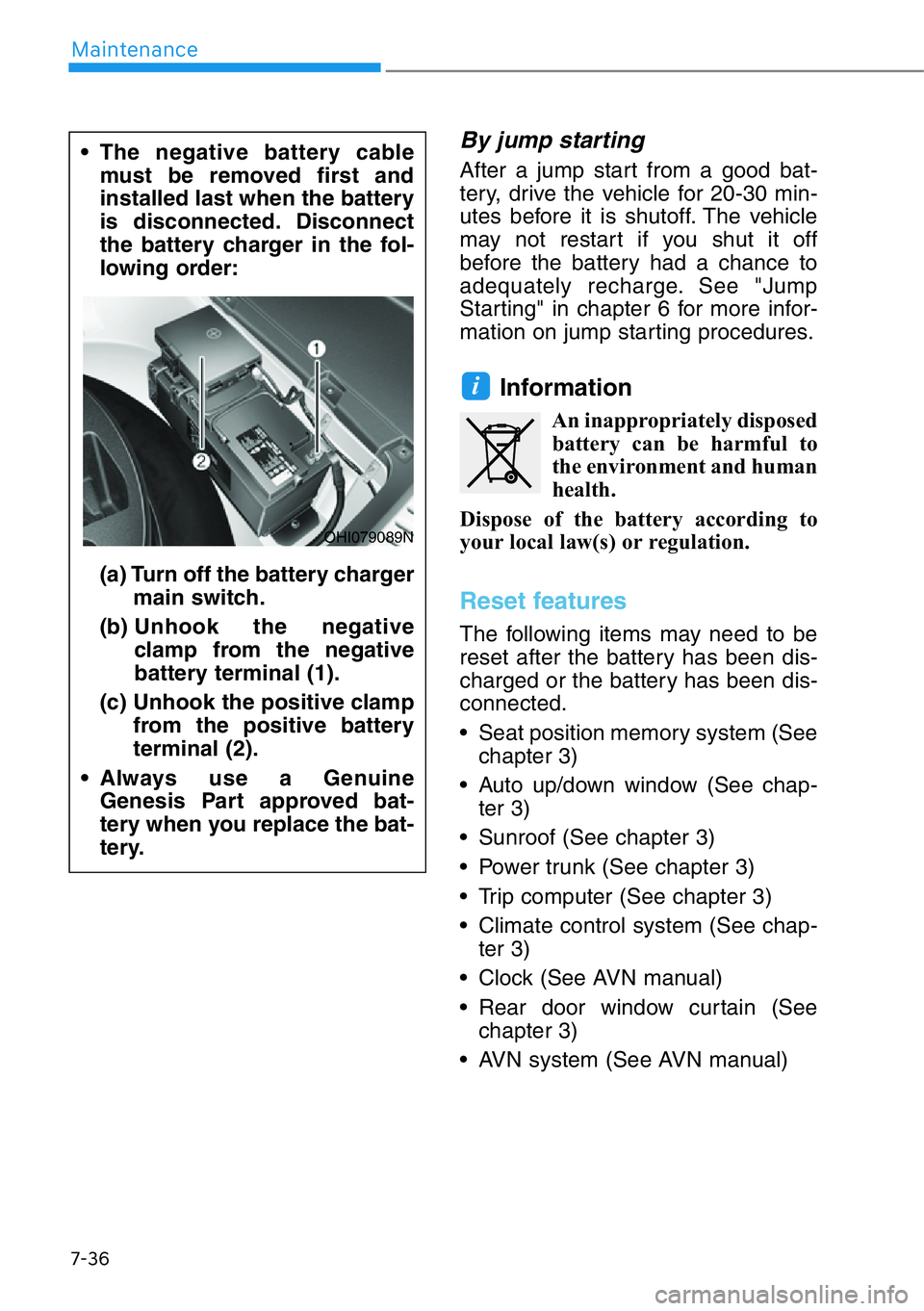
lowing order:
(a) Turn off the battery charger
main switch.
(b) Unhook the negative
clamp from the negative
battery terminal (1).
(c) Unhook the positive clamp
from the positive battery
terminal (2).
• Always use a Genuine
Genesis Part approved bat-
tery when you replace the bat-
tery.
OHI079089N
Page 488 of 538

7-48
Maintenance
Maximum Loaded Vehicle
Weight
The sum of curb weight; accessory
weight; vehicle capacity weight; and
production options weight.
Normal Occupant Weight
The number of occupants a vehicle
is designed to seat multiplied by 150
pounds (68 kg).
Occupant Distribution
Designated seating positions.
Outward Facing Sidewall
An asymmetrical tire has a particular
side that faces outward when mount-
ed on a vehicle. The outward facing
sidewall bears white lettering or
bears manufacturer, brand, and/or
model name molding that is higher or
deeper than the same moldings on
the inner facing sidewall.
Passenger (P-Metric) tire
A tire used on passenger cars and
some light duty trucks and multipur-
pose vehicles.
Ply
A layer of rubber-coated parallel
cords.
Pneumatic tire
A mechanical device made of rubber,
chemicals, fabric and steel or other
materials, that, when mounted on an
automotive wheel provides the trac-
tion and contains the gas or fluid that
sustains the load.
Pneumatic options weight
The combined weight of installed
regular production options weighing
over 5 lb. (2.3 kg) in excess of the
standard items which they replace,
not previously considered in curb
weight or accessory weight, includ-
ing heavy duty breaks, ride levelers,
roof rack, heavy duty battery, and
special trim.
Recommended Inflation
Pressure
Vehicle manufacturer's recommend-
ed tire inflation pressure as shown
on the tire placard.
Radial Ply Tire
A pneumatic tire in which the ply
cords that extend to the beads are
laid at 90 degrees to the centerline of
the tread.
Rim
A metal support for a tire and upon
which the tire beads are seated.
Page 497 of 538

7-57
07
Instrument panel fuse panel
Fuse name Fuse rating Circuit protected
MODULE5 10AStop Lamp Switch, Driver/Passenger Door Module
MODULE7 10A
Electro Chromic Mirror, A/V & Navigation Head Unit, AMP,
A/C Control Module, Front A/C Controller, Air Quality
Sensor, Rear Seat Warmer Control Module LH/RH,
Driver/Passenger CCS Module, Rear CCS Module LH/RH,
Parking Collision Avoidance Assist Unit, Driver/Passenger
IMS Control Module, Rear IMS Control Module LH/RH, Rear
Seat Console Switch, Driver/Passenger Seat Warmer
Control Module
IBU3 10AIBU Control Module
E-SHIFTER2 10AElectronic ATM Shift Lever
MEMORY1 10A
Security Indicator, A/C Control Module, Front A/C Controller,
Instrument Cluster, Driver/Passenger IMS Control Module,
Rear IMS Control Module LH/RH, Head-Up Display, Analog
Clock, Driver/Passenger Seat Control Switch, Power Trunk
Module, Rear Seat Control Switch LH/RH, Driver/Passenger
Smart Key Outside Handle, Rear Smart Key Outside Handle
LH/RH, Blind Spot Collision Warning Unit LH/RH
P/SEAT
(RR LH) 225ARear IMS Control Module LH
P/SEAT
(DRV) 225ADriver IMS Control Module
P/WINDOW (RH)30APassenger Power Window Module, Rear Power Window
Module RH
MODULE 610ACrash Pad Switch, Blind Spot Collision Warning Unit LH/RH,
ECS Unit, Front Console Switch, Front Camera, Steering Tilt
& Telescopic Module
MODULE 10 10ACooling Fan Controller (BLDC), Rear Seat Console Switch,
Surround View Monitor, Parking Collision Avoidance Assist
Unit
MODULE3 10AGATEWAY (B+ (MCU)), Data Link Connector, Hazard
Switch
SUNROOF 25ASunroof Motor
P/SEAT (PASS) 225APassenger IMS Control Module