Oil GENESIS GV80 2021 Owner's Guide
[x] Cancel search | Manufacturer: GENESIS, Model Year: 2021, Model line: GV80, Model: GENESIS GV80 2021Pages: 632, PDF Size: 9.37 MB
Page 580 of 632

09
9-39
Bias ply tire
A pneumatic tire in which the plies are
laid at alternate angles less than 90
degrees to the centerline of the tread.
Cold tire pressure
The amount of air pressure in a tire,
measured in pounds per square inch
(psi) or kilopascals (kPa) before a tire
has built up heat from driving.
Curb weight
This means the weight of a motor
vehicle with standard and optional
equipment including the maximum
capacity of fuel, oil and coolant, but
without passengers and cargo.
DOT markings
A code molded into the sidewall
of a tire signifying that the tire
is in compliance with the U.S.
Department of Transportation motor
vehicle safety standards. The DOT
code includes the Tire Identification
Number (TIN), an alphanumeric
designator which can also identify
the tire manufacturer, production
plant, brand and date of production.
GVWR
Gross Vehicle Weight Rating
GAWR FRT
Gross Axle Weight Rating for the
Front Axle.
GAWR RR
Gross Axle Weight Rating for the
Rear axle.Intended outboard sidewall
The side of an asymmetrical tire,
that must always face outward when
mounted on a vehicle.
Kilopascal (kPa)
The metric unit for air pressure.
Light Truck (LT) tire
A tire designated by its manufacturer
as primarily intended for use on
lightweight trucks or multipurpose
passenger vehicles.
Load ratings
The maximum load that a tire is rated
to carry for a given inflation pressure.
Load index
An assigned number ranging from 1
to 279 that corresponds to the load
carrying capacity of a tire.
Maximum inflation pressure
The maximum air pressure to which
a cold tire may be inflated. The
maximum air pressure is molded
onto the sidewall.
Maximum load rating
The load rating for a tire at the
maximum permissible inflation
pressure for that tire.
Page 585 of 632
Maintenance
9-44
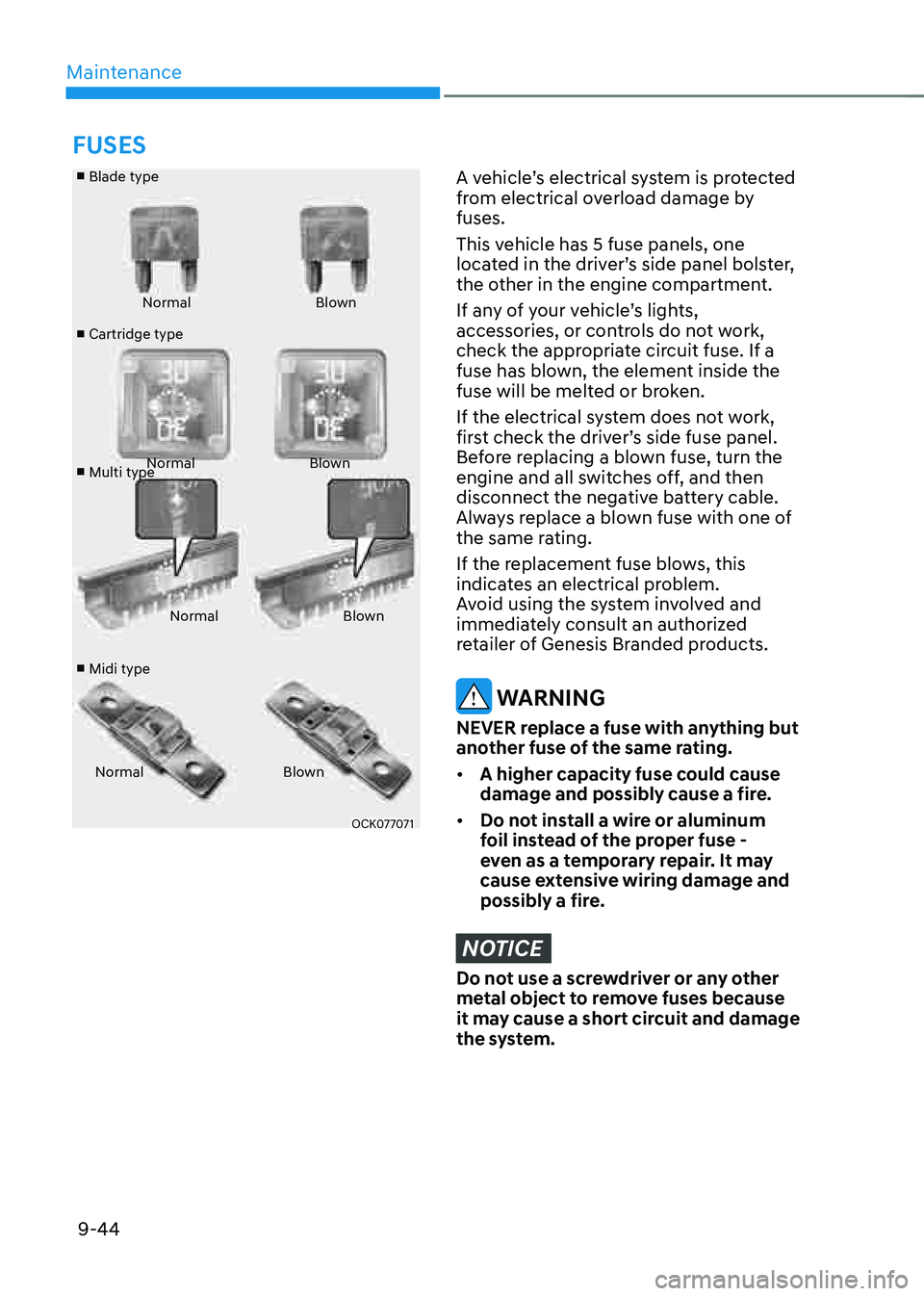
■ Blade type
■ Cartridge type
■ Multi type
■ Midi type Normal
Blown
Normal Blown
Normal Blown
Normal Blown
OCK077071OCK077071
A vehicle’s electrical system is protected
from electrical overload damage by
fuses.
This vehicle has 5 fuse panels, one
located in the driver’s side panel bolster,
the other in the engine compartment.
If any of your vehicle’s lights,
accessories, or controls do not work,
check the appropriate circuit fuse. If a
fuse has blown, the element inside the
fuse will be melted or broken.
If the electrical system does not work,
first check the driver’s side fuse panel.
Before replacing a blown fuse, turn the
engine and all switches off, and then
disconnect the negative battery cable.
Always replace a blown fuse with one of
the same rating.
If the replacement fuse blows, this
indicates an electrical problem.
Avoid using the system involved and
immediately consult an authorized
retailer of Genesis Branded products.
WARNING
NEVER replace a fuse with anything but
another fuse of the same rating.
• A higher capacity fuse could cause
damage and possibly cause a fire.
• Do not install a wire or aluminum
foil instead of the proper fuse -
even as a temporary repair. It may
cause extensive wiring damage and
possibly a fire.
NOTICE
Do not use a screwdriver or any other
metal object to remove fuses because
it may cause a short circuit and damage
the system.
FUSES
Page 593 of 632
Maintenance
9-52
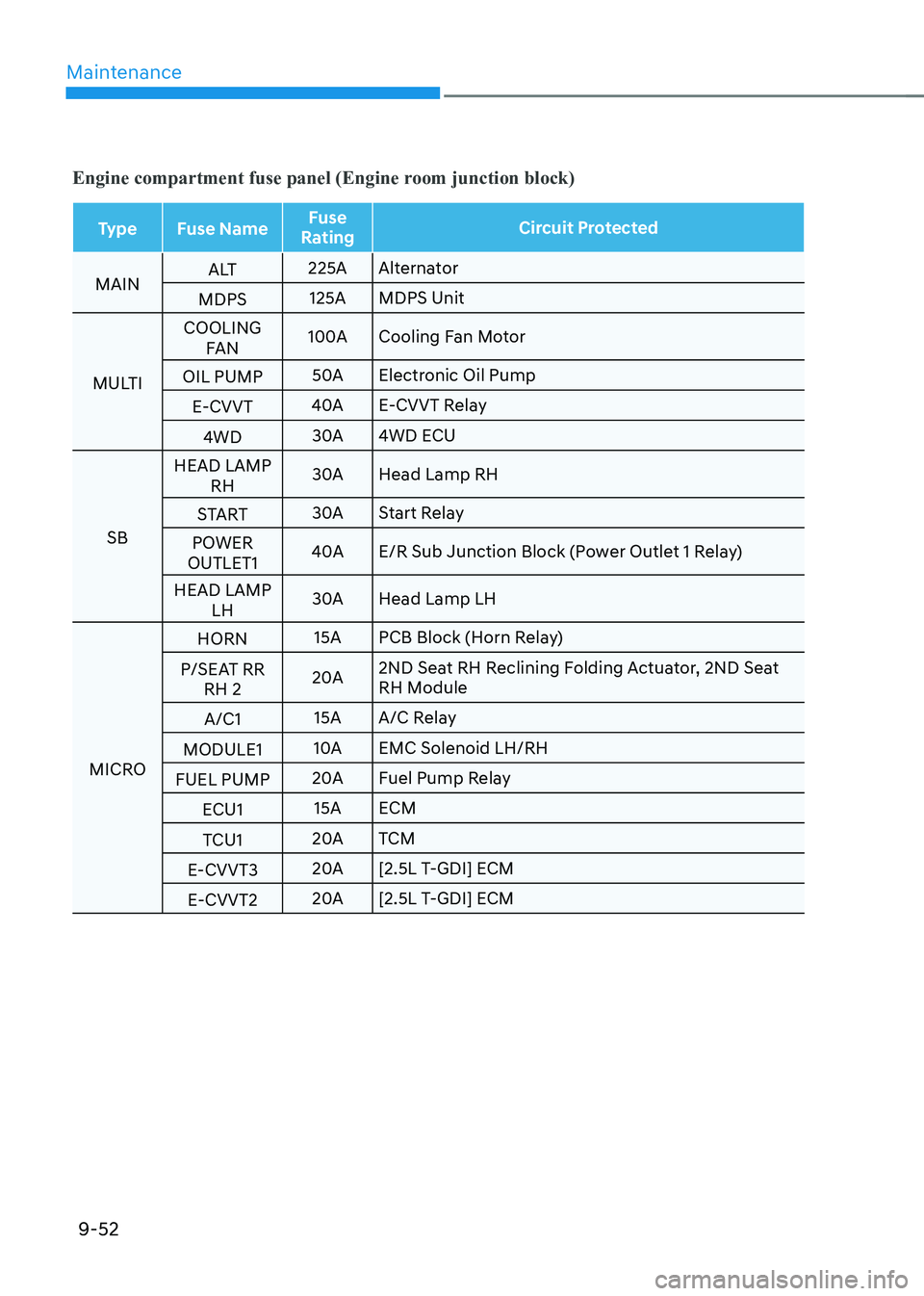
Engine compartment fuse panel (Engine room junction block)
TypeFuse Name Fuse
Rating Circuit Protected
MAIN A LT
225A
Alternator
MDPS 125A
MDPS Unit
MULTI COOLING
FAN 100A
Cooling Fan Motor
OIL PUMP 50A
Electronic Oil Pump
E-CVVT 40A
E-CVVT Relay
4WD 30A
4WD ECU
SB HEAD LAMP
RH 30A
Head Lamp RH
START 30A
Start Relay
POWER
OUTLET1 40A
E/R Sub Junction Block (Power Outlet 1 Relay)
HEAD LAMP LH 30A
Head Lamp LH
MICRO HORN
15A
PCB Block (Horn Relay)
P/SEAT RR RH 2 20A
2ND Seat RH Reclining Folding Actuator, 2ND Seat
RH Module
A/C1 15A
A/C Relay
MODULE1 10A
Solenoid LH/RH
FUEL PUMP 20A
Fuel Pump Relay
ECU1 15A
ECM
TCU1 20A
TCM
E-CVVT3 20A
[2.5L T-GDI] ECM
E-CVVT2 20A
[2.5L T-GDI] ECM
Page 594 of 632
09
9-53
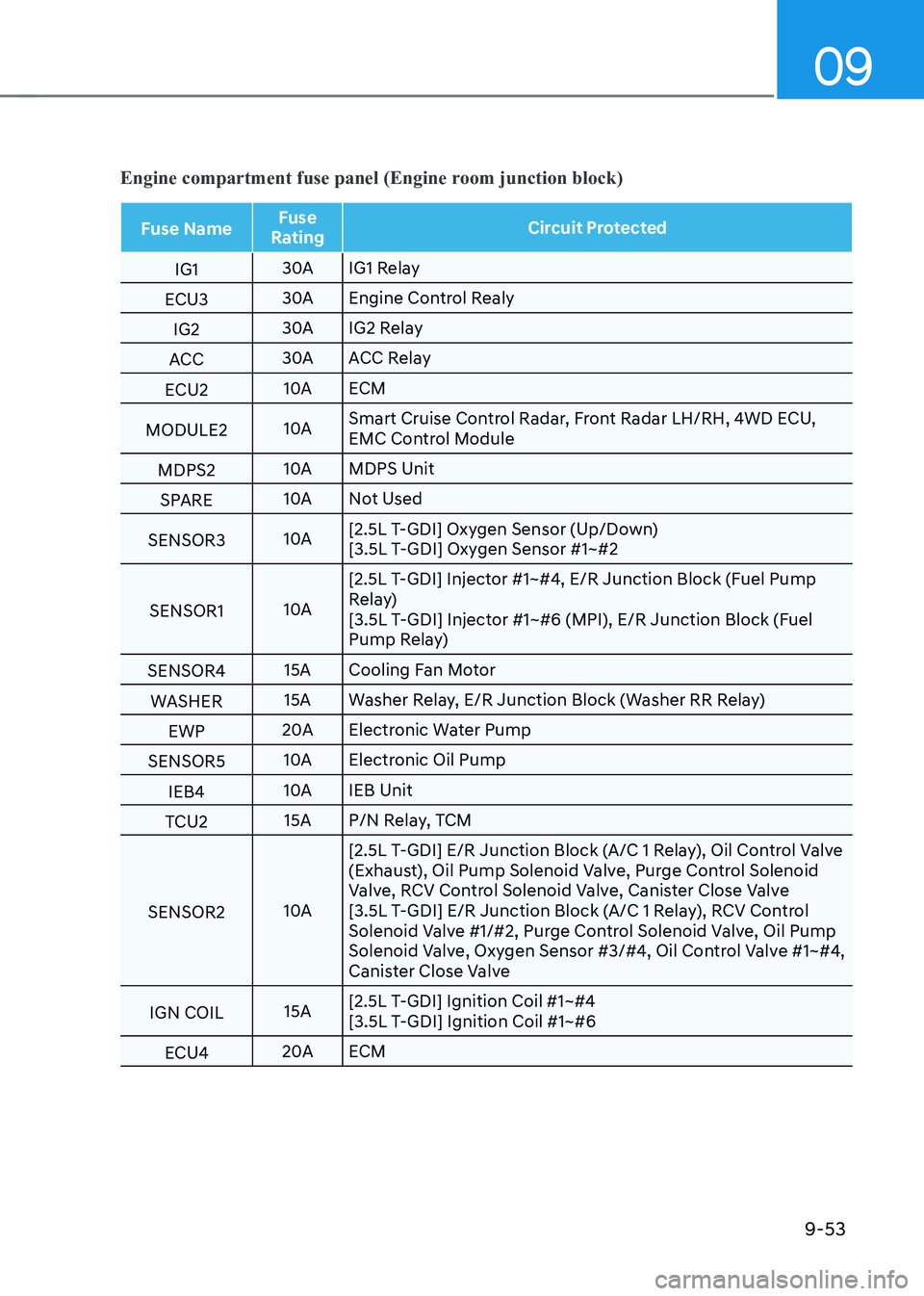
Engine compartment fuse panel (Engine room junction block)
Fuse NameFuse
Rating Circuit Protected
IG1 30A
IG1 Relay
ECU3 30A
Engine Control Realy
IG2 30A
IG2 Relay
ACC 30A
ACC Relay
ECU2 10A
ECM
MODULE2 10ASmart Cruise Control Radar, Front Radar LH/RH, 4WD ECU,
Control Module
MDPS2 10A
MDPS Unit
SPARE 10A
Not Used
SENSOR3 10A[2.5L T-GDI] Oxygen Sensor (Up/Down)
[3.5L T-GDI] Oxygen Sensor #1~#2
SENSOR1 10A[2.5L T-GDI] Injector #1~#4, E/R Junction Block (Fuel Pump
Relay)
[3.5L T-GDI] Injector #1~#6 (MPI), E/R Junction Block (Fuel
Pump Relay)
SENSOR4 15A
Cooling Fan Motor
WASHER 15A
Washer Relay, E/R Junction Block (Washer RR Relay)
EWP 20A
Electronic Water Pump
SENSOR5 10A
Electronic Oil Pump
IEB4 10A
IEB Unit
TCU2 15A
P/N Relay, TCM
SENSOR2 10A[2.5L T-GDI] E/R Junction Block (A/C 1 Relay), Oil Control Valve
(Exhaust), Oil Pump Solenoid Valve, Purge Control Solenoid
Valve, RCV Control Solenoid Valve, Canister Close Valve
[3.5L T-GDI] E/R Junction Block (A/C 1 Relay), RCV Control
Solenoid Valve #1/#2, Purge Control Solenoid Valve, Oil Pump
Solenoid Valve, Oxygen Sensor #3/#4, Oil Control Valve #1~#4,
Canister Close Valve
IGN COIL 15A[2.5L T-GDI] Ignition Coil #1~#4
[3.5L T-GDI] Ignition Coil #1~#6
ECU4 20A
ECM
Page 608 of 632
09
9-67
NOTICE
• Do not use strong soap, chemical
detergents or hot water, and do not
wash the vehicle in direct sunlight
or when the body of the vehicle is
warm.
• Be careful when washing the side
windows of your vehicle.
• Especially, with high-pressure water,
water may leak through the windows
and wet the interior.
• To prevent damage to the plastic
parts, do not clean with chemical
solvents or strong detergents.
NOTICE
OJX1099040OJX1099040
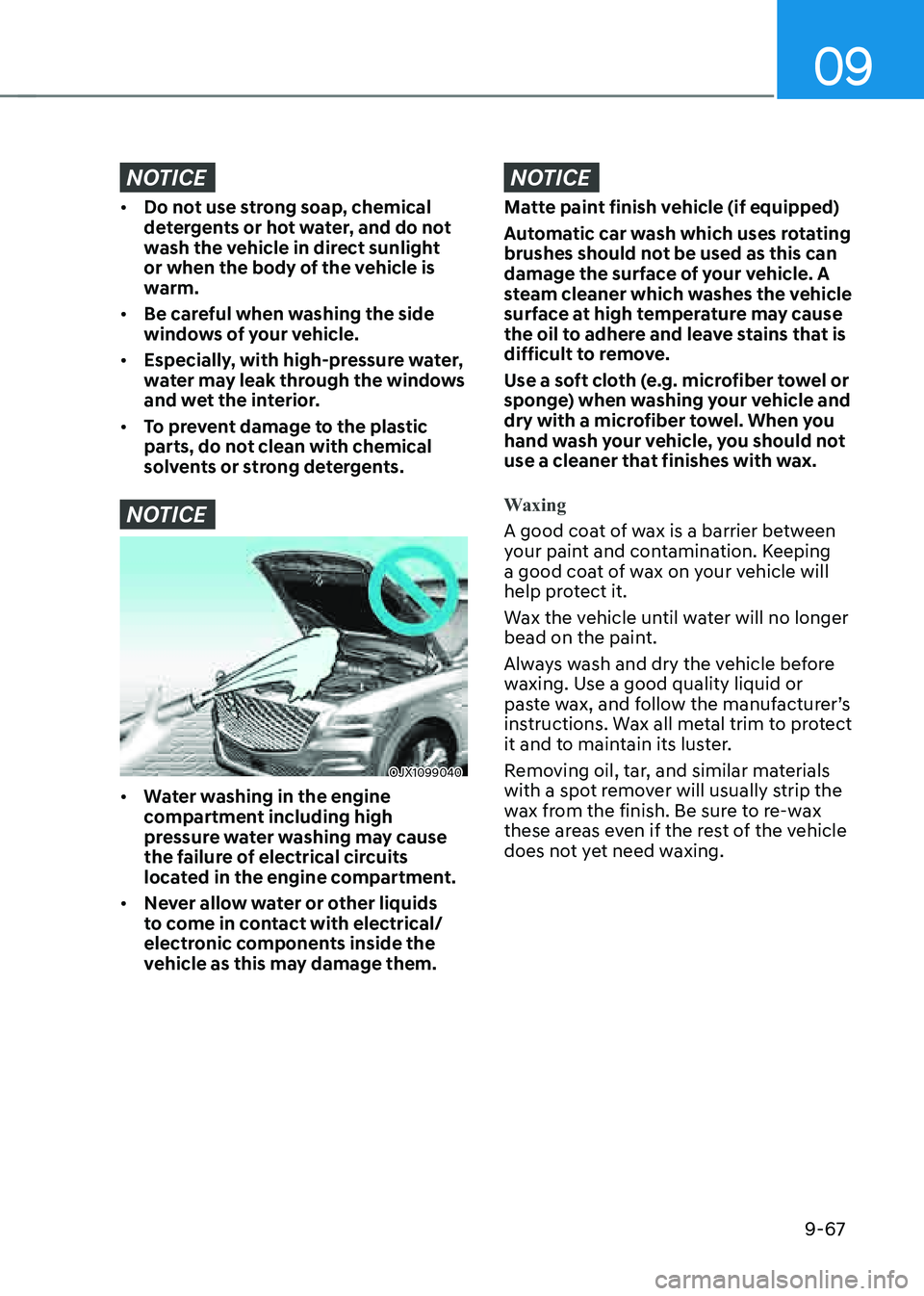
• Water washing in the engine
compartment including high
pressure water washing may cause
the failure of electrical circuits
located in the engine compartment.
• Never allow water or other liquids
to come in contact with electrical/
electronic components inside the
vehicle as this may damage them.
NOTICE
Matte paint finish vehicle (if equipped)
Automatic car wash which uses rotating
brushes should not be used as this can
damage the surface of your vehicle. A
steam cleaner which washes the vehicle
surface at high temperature may cause
the oil to adhere and leave stains that is
difficult to remove.
Use a soft cloth (e.g. microfiber towel or
sponge) when washing your vehicle and
dry with a microfiber towel. When you
hand wash your vehicle, you should not
use a cleaner that finishes with wax.
Waxing
A good coat of wax is a barrier between
your paint and contamination. Keeping
a good coat of wax on your vehicle will
help protect it.
Wax the vehicle until water will no longer
bead on the paint.
Always wash and dry the vehicle before
waxing. Use a good quality liquid or
paste wax, and follow the manufacturer’s
instructions. Wax all metal trim to protect
it and to maintain its luster.
Removing oil, tar, and similar materials
with a spot remover will usually strip the
wax from the finish. Be sure to re-wax
these areas even if the rest of the vehicle
does not yet need waxing.
Page 613 of 632

Maintenance
9-72
Interior Care
Interior general precautions
Prevent caustic solutions such as
perfume and cosmetic oil, from
contacting the interior parts because
they may cause damage or discoloration.
If they do contact the interior parts,
wipe them off immediately. See the
instructions for the proper way to clean
vinyl.
NOTICE
• Never allow water or other liquids
to come in contact with electrical/
electronic components inside the
vehicle as this may damage them.
• When cleaning leather products
(steering wheel, seats etc.), use
neutral detergents or low alcohol
content solutions. If you use high
alcohol content solutions or acid/
alkaline detergents, the color of the
leather may fade or the surface may
get stripped off.
Cleaning the upholstery and interior
trim
Vinyl (if equipped)
Remove dust and loose dirt from vinyl
with a whisk broom or vacuum cleaner.
Clean vinyl surfaces with a vinyl cleaner.
Fabric (if equipped)
Remove dust and loose dirt from
fabric with a whisk broom or vacuum
cleaner. Clean with a mild soap solution
recommended for upholstery or carpets.
Remove fresh spots immediately with
a fabric spot cleaner. If fresh spots do
not receive immediate attention, the
fabric can be stained and its color can be
affected. Also, its fire-resistant properties
can be reduced if the material is not
properly maintained.
NOTICE
Using anything but recommended
cleaners and procedures may affect the
fabric’s appearance and fire-resistant
properties.
Page 615 of 632
Maintenance
9 -74
-Oil
Remove oil instantly with
absorbable cloth and wipe with
stain remover used only for natural
leather.
-Chewing gum
Harden the gum with ice and
remove gradually.
• Handling prime napa leather (if
equipped)
Try to avoid excessive sunlight and
heat exposure. Excessive sunlight
and heat exposure naturally fades
and dries out napa leather, causing
wrinkles and discoloration. If the napa
leather is wet with liquid, immediately
clean it with lint-free cloth to minimize
damage. Do not scratch the napa
leather surface with a sharp object.
If your napa leather seat is bright
colored, it may be contaminated or
stained from dyed materials such as
jeans.
Interior wooden trim
• Use a wooden furniture protector (e.g.
wax, coating compound) to clean the
interior wooden trim.
• Wipe the interior wooden trim with a
lint-free, clean cloth to maintain the
unique wooden textures for a longer
period of time.
• If you spill beverage (e.g. water,
coffee) over the interior wooden trim,
immediately wipe it with clean, dry
cloth.
• Sharp objects (e.g. driver, knife),
adhesive materials, or tapes may
damage the interior wooden trim.
• Any strong impacts may damage the
interior wooden trim.
• If the coating finish over the interior
wooden trim is removed, moisture
may damage or change wood traits.
• If the interior wooden trim is
damaged, you may get a splinter
from the wood surface. Therefore,
you should immediately have the
damaged interior wooden trim
replaced by an authorized retailer of
Genesis Branded products.
Cleaning the seat belt webbing
Clean the belt webbing with any
mild soap solution recommended for
cleaning upholstery or carpet. Follow
the instructions provided with the soap.
Do not bleach or re-dye the webbing
because this may weaken the seat belt.
Cleaning the interior window glass
If the interior glass surfaces of the
vehicle become fogged (that is, covered
with an oily, greasy or waxy film), they
should be cleaned with glass cleaner.
Follow the directions on the glass cleaner
container.
NOTICE
Do not scrape or scratch the inside of
the rear window. This may result in
damage to the rear window defroster
grid.
Page 623 of 632
I
I-5
E
Electronically Controlled Suspension with Road Preview
..................................6-46
Limitations of the System
........................................................................\
.......6-47
System Malfunction
........................................................................\
................6-47
Electronic Control Suspension
........................................................................\
....6-46
System Malfunction
........................................................................\
................6-46
Electronic Limited Slip Differential
....................................................................6-45
Drive Mode Selection
........................................................................\
.............6-45
Warning Messages ........................................................................\
................... 6-45
Emission Control System
........................................................................\
............9-75
Crankcase Emission Control System
..............................................................9-75
Evaporative Emission Control System including Onboard Refueling Vapor
Recovery (ORVR)
........................................................................\
...................9-75
Exhaust Emission Control System
..................................................................9-76
Engine
........................................................................\
............................................2-8
Engine Compartment
........................................................................\
.....................9-3
Engine Compartment
........................................................................\
.....................2-7
Engine Coolant/Liquid-Cooled Intercooler Coolant
...........................................9-17
Changing Coolant ........................................................................\
.................... 9-19
Checking the Coolant Level
........................................................................\
....9-17
Engine Number
........................................................................\
............................2-15
Engine oil
........................................................................\
.....................................9-15
Checking the Engine Oil and Filter
.................................................................9-16
Checking the Engine Oil Level
.......................................................................9-15
Engine Start/Stop Button
........................................................................\
...............6-6
Engine Stop/Start Button Positions
...................................................................6-7
Remote Start
........................................................................\
............................6-10
Starting the Engine
........................................................................\
....................6-8
Turning Off the Engine
........................................................................\
.............6-9
Explanation of Scheduled Maintenance Items
....................................................9-13
Exterior Features
........................................................................\
........................5-127
Roof Side Rails
........................................................................\
.....................5-127
Exterior Features
........................................................................\
..........................5-62
Fuel Filler Door
........................................................................\
.......................5-71
Hood
........................................................................\
........................................5-62
Power Liftgate
........................................................................\
.........................5-63
Smart Liftgate ........................................................................\
.......................... 5-69