change wheel GMC ACADIA 2007 User Guide
[x] Cancel search | Manufacturer: GMC, Model Year: 2007, Model line: ACADIA, Model: GMC ACADIA 2007Pages: 554, PDF Size: 2.76 MB
Page 371 of 554
Towing a Trailer
{CAUTION:
If you do not use the correct equipment
and drive properly, you can lose control
when you pull a trailer. For example, if the
trailer is too heavy, the brakes may not
work well — or even at all. You and your
passengers could be seriously injured.
You may also damage your vehicle; the
resulting repairs would not be covered by
your warranty. Pull a trailer only if you
have followed all the steps in this section.
Ask your dealer/retailer for advice and
information about towing a trailer with
your vehicle.
To identify the trailering capacity of your vehicle,
you should read the information in “Weight of
the Trailer” that appears later in this section.But trailering is different than just driving your
vehicle by itself. Trailering means changes
in handling, acceleration, braking, durability and
fuel economy. Successful, safe trailering takes
correct equipment, and it has to be used properly.
That’s the reason for this part. In it are many
time-tested, important trailering tips and safety
rules. Many of these are important for your safety
and that of your passengers. So please read
this section carefully before you pull a trailer.
Load-pulling components such as the engine,
transmission, rear axle, wheel assemblies and tires
are forced to work harder against the drag of
the added weight. The engine is required
to operate at relatively higher speeds and under
greater loads, generating extra heat. What’s more,
the trailer adds considerably to wind resistance,
increasing the pulling requirements.
371
Page 379 of 554
Passing
You’ll need more passing distance up ahead when
you’re towing a trailer. And, because you’re a
good deal longer, you’ll need to go much farther
beyond the passed vehicle before you can
return to your lane.
Backing Up
Hold the bottom of the steering wheel with
one hand. Then, to move the trailer to the left,
just move that hand to the left. To move the trailer
to the right, move your hand to the right. Always
back up slowly and, if possible, have someone
guide you.
Making Turns
Notice:Making very sharp turns while
trailering could cause the trailer to come in
contact with the vehicle. Your vehicle could
be damaged. Avoid making very sharp turns
while trailering.When you’re turning with a trailer, make wider
turns than normal. Do this so your trailer
won’t strike soft shoulders, curbs, road signs,
trees or other objects. Avoid jerky or sudden
maneuvers. Signal well in advance.
Turn Signals When Towing a Trailer
When you tow a trailer, your vehicle may need a
different turn signal asher and/or extra wiring.
Check with your dealer/retailer. The arrows
on your instrument panel will ash whenever you
signal a turn or lane change. Properly hooked
up, the trailer lamps will also ash, telling other
drivers you’re about to turn, change lanes or stop.
When towing a trailer, the arrows on your
instrument panel will ash for turns even if the
bulbs on the trailer are burned out. Thus, you may
think drivers behind you are seeing your signal
when they are not. It’s important to check
occasionally to be sure the trailer bulbs are
still working.
379
Page 448 of 554
The spare tire does not have a TPMS sensor.
If you replace one of the road tires with the spare,
the SERVICE TIRE MONITOR SYSTEM
message displays on the DIC screen. This
message should go off once you re-install the
road tire containing the TPMS sensor.
Federal Communications Commission
(FCC) and Industry and Science
Canada
The Tire Pressure Monitor System (TPMS)
operates on a radio frequency and complies with
Part 15 of the FCC Rules. Operation is subject
to the following two conditions:
1. This device may not cause harmful
interference.
2. This device must accept any interference
received, including interference that may
cause undesired operation.The Tire Pressure Monitor System (TPMS)
operates on a radio frequency and complies with
RSS-210 of Industry and Science Canada.
Operation is subject to the following two
conditions:
1. This device may not cause interference.
2. This device must accept any interference
received, including interference that may
cause undesired operation of the device.
Changes or modications to this system by other
than an authorized service facility could void
authorization to use this equipment.
Tire Inspection and Rotation
Tires should be rotated every 5,000 to 8,000 miles
(8 000 to 13 000 km).
Any time you notice unusual wear, rotate your
tires as soon as possible and check wheel
alignment. Also check for damaged tires or wheels.
SeeWhen It Is Time for New Tires on page 450
andWheel Replacement on page 454for
more information.
448
Page 449 of 554
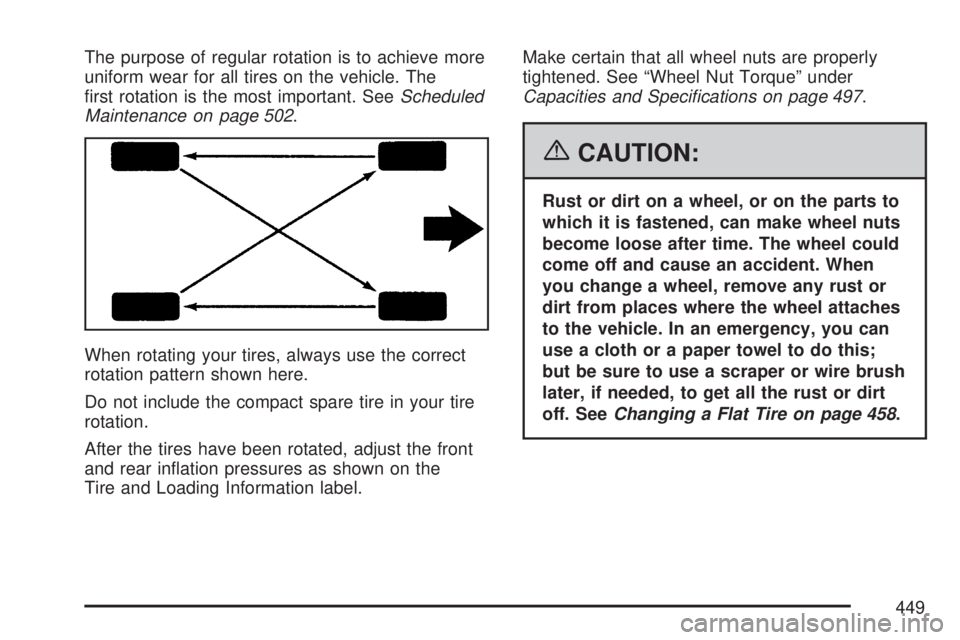
The purpose of regular rotation is to achieve more
uniform wear for all tires on the vehicle. The
rst rotation is the most important. SeeScheduled
Maintenance on page 502.
When rotating your tires, always use the correct
rotation pattern shown here.
Do not include the compact spare tire in your tire
rotation.
After the tires have been rotated, adjust the front
and rear ination pressures as shown on the
Tire and Loading Information label.Make certain that all wheel nuts are properly
tightened. See “Wheel Nut Torque” under
Capacities and Specifications on page 497.
{CAUTION:
Rust or dirt on a wheel, or on the parts to
which it is fastened, can make wheel nuts
become loose after time. The wheel could
come off and cause an accident. When
you change a wheel, remove any rust or
dirt from places where the wheel attaches
to the vehicle. In an emergency, you can
use a cloth or a paper towel to do this;
but be sure to use a scraper or wire brush
later, if needed, to get all the rust or dirt
off. SeeChanging a Flat Tire on page 458.
449
Page 457 of 554
If a Tire Goes Flat
It is unusual for a tire to blowout while you are
driving, especially if you maintain your vehicle’s
tires properly. If air goes out of a tire, it is
much more likely to leak out slowly. But if you
should ever have a blowout, here are a few tips
about what to expect and what to do:
If a front tire fails, the at tire will create a drag
that pulls the vehicle toward that side. Take your
foot off the accelerator pedal and grip the
steering wheel rmly. Steer to maintain lane
position, and then gently brake to a stop well out
of the traffic lane.
A rear blowout, particularly on a curve, acts much
like a skid and may require the same correction
you would use in a skid. In any rear blowout
remove your foot from the accelerator pedal. Get
the vehicle under control by steering the way
you want the vehicle to go. It may be very bumpy
and noisy, but you can still steer. Gently brake
to a stop, well off the road if possible.{CAUTION:
Lifting a vehicle and getting under it to do
maintenance or repairs is dangerous
without the appropriate safety equipment
and training. The jack provided with your
vehicle is designed only for changing a
at tire. If it is used for anything else, you
or others could be badly injured or killed
if the vehicle slips off the jack. Use the
jack provided with your vehicle only for
changing a at tire.
If a tire goes at, the next part shows how to use the
jacking equipment to change a at tire safely.
457
Page 458 of 554
Changing a Flat Tire
If a tire goes at, avoid further tire and wheel
damage by driving slowly to a level place. Turn on
your vehicle’s hazard warning ashers. See
Hazard Warning Flashers on page 172for more
information.
{CAUTION:
Changing a tire can be dangerous. The
vehicle can slip off the jack and roll over
or fall on you or other people. You and
they could be badly injured or even killed.
Find a level place to change your tire.
To help prevent the vehicle from moving:
1. Set the parking brake rmly.
2. Put the shift lever in PARK (P).
CAUTION: (Continued)
CAUTION: (Continued)
3. Turn off the engine and do not restart
while the vehicle is raised.
4. Do not allow passengers to remain in
the vehicle.
To be even more certain the vehicle will
not move, you should put blocks at the
front and rear of the tire farthest away
from the one being changed. That would
be the tire, on the other side, at the
opposite end of the vehicle.
When your vehicle has a at tire, use the following
example as a guide to assist you in the placement
of wheel blocks.
458
Page 552 of 554
Service........................................................ 385
Accessories and Modications.................. 385
Adding Equipment to the Outside of
Your Vehicle......................................... 387
California Proposition 65 Warning............. 386
Doing Your Own Work............................. 386
Engine Soon Light................................... 226
Publications Ordering Information............. 535
Servicing Your Airbag-Equipped Vehicle......... 90
Sheet Metal Damage................................... 486
Shifting Into Park (P)................................... 135
Shifting Out of Park (P)............................... 137
Shoulder Belt Height Adjuster........................ 38
Signals, Turn and Lane-Change.................. 175
Spare Tire
Compact.................................................. 477
Installing.................................................. 463
Removing................................................ 459
Storing..................................................... 472
Specications, Capacities............................ 497
Speedometer............................................... 216
StabiliTrak
®System..................................... 337
StabiliTrak®Indicator Light........................... 224
Starting Your Engine................................... 126
Steering...................................................... 340
Steering Wheel Controls, Audio................... 325
Steering Wheel, Power Tilt Wheel and
Telescopic Steering Column..................... 174Storage Areas
Cargo Management System..................... 164
Center Console Storage Area................... 161
Convenience Net..................................... 163
Cupholder(s)............................................ 161
Glove Box................................................ 161
Instrument Panel Storage Area................. 161
Luggage Carrier....................................... 162
Rear Seat Armrest................................... 163
Stuck in Sand, Mud, Ice, or Snow............... 360
Sun Visors.................................................. 117
Sunroof....................................................... 164
System Identication, Universal Home
Remote System....................................... 149
T
Tachometer................................................. 216
Telescopic Steering Column,
Power Tilt Wheel...................................... 174
Theft-Deterrent, Radio................................. 325
Theft-Deterrent Systems.............................. 118
Content Theft-Deterrent............................ 118
PASS-Key
®III+........................................ 120
PASS-Key®III+ Operation........................ 121
Time, Setting............................................... 266
552
Page 553 of 554
Tire
Pressure Light.......................................... 225
Tires........................................................... 435
Aluminum or Chrome-Plated Wheels,
Cleaning............................................... 484
Buying New Tires..................................... 450
Chains..................................................... 456
Changing a Flat Tire................................ 458
Cleaning.................................................. 485
Compact Spare Tire................................. 477
Different Size........................................... 452
If a Tire Goes Flat................................... 457
Ination - Tire Pressure............................ 442
Inspection and Rotation............................ 448
Installing the Spare Tire........................... 463
Pressure Monitor System......................... 444
Removing the Flat Tire............................. 463
Removing the Spare Tire and Tools......... 459
Secondary Latch System......................... 468
Storing a Flat or Spare Tire and Tools..... 472
Tire Sidewall Labeling.............................. 436
Tire Terminology and Denitions............... 439
Uniform Tire Quality Grading.................... 453
Wheel Alignment and Tire Balance........... 454Tires (cont.)
Wheel Replacement................................. 454
When It Is Time for New Tires................. 450
Tow/Haul Mode........................................... 133
Tow/Haul Mode Light................................... 230
Towing
Recreational Vehicle................................. 367
Towing a Trailer....................................... 371
Your Vehicle............................................. 367
Traction
StabiliTrak
®System................................. 337
Transmission
Fluid, Automatic....................................... 404
Transmission Operation, Automatic.............. 129
Turn and Lane-Change Signals................... 175
Turn Signal/Multifunction Lever.................... 174
U
Ultrasonic Rear Parking Assist (URPA)........ 194
Understanding Radio Reception................... 326
Uniform Tire Quality Grading....................... 453
Universal Home Remote System................. 150
Operation........................................150, 154
System Identication................................ 149
553