fuel GMC ACADIA 2007 Owner's Guide
[x] Cancel search | Manufacturer: GMC, Model Year: 2007, Model line: ACADIA, Model: GMC ACADIA 2007Pages: 554, PDF Size: 2.76 MB
Page 360 of 554
You will need a well-charged battery to restart the
vehicle, and possibly for signaling later on with
the headlamps. Let the heater run for a while.
Then, shut the engine off and close the window
almost all the way to preserve the heat. Start
the engine again and repeat this only when you
feel really uncomfortable from the cold. But do it as
little as possible. Preserve the fuel as long as
you can. To help keep warm, you can get out of
the vehicle and do some fairly vigorous exercises
every half hour or so until help comes.
If Your Vehicle is Stuck in Sand,
Mud, Ice, or Snow
In order to free your vehicle when it is stuck, you
need to spin the wheels, but you do not want
to spin the wheels too fast. The method known
as rocking can help you get out when you
are stuck, but you must use caution.
{CAUTION:
If you let your vehicle’s tires spin at high
speed, they can explode, and you or others
could be injured. And, the transmission or
other parts of the vehicle can overheat.
That could cause an engine compartment
re or other damage. When you are stuck,
spin the wheels as little as possible. Do not
spin the wheels above 35 mph (55 km/h) as
shown on the speedometer.
Notice:Spinning the wheels can destroy parts
of your vehicle as well as the tires. If you
spin the wheels too fast while shifting
the transmission back and forth, you can
destroy the transmission.
For information about using tire chains on your
vehicle, seeTire Chains on page 456.
360
Page 365 of 554
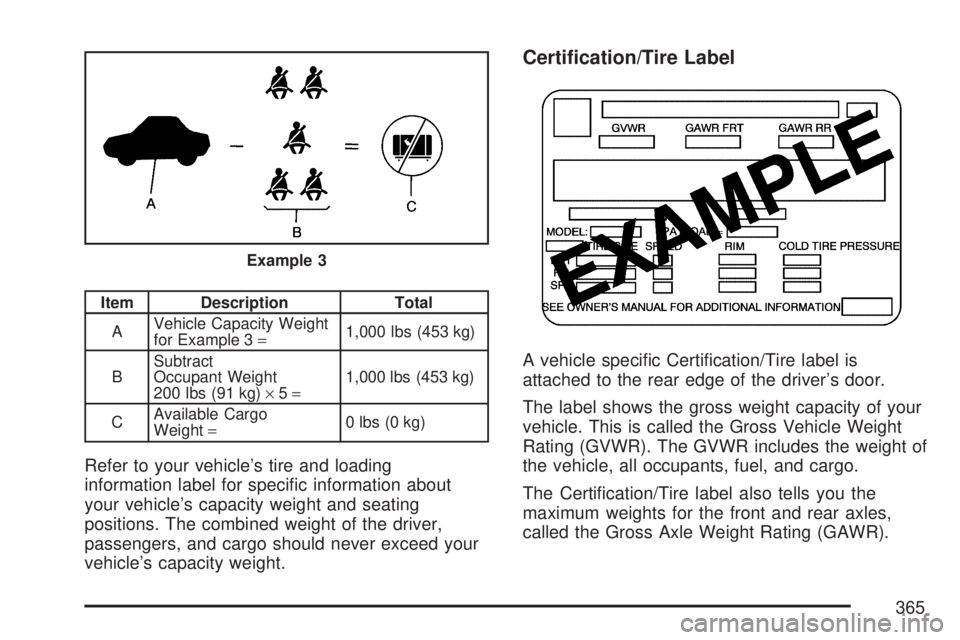
Item Description Total
AVehicle Capacity Weight
for Example 3=1,000 lbs (453 kg)
BSubtract
Occupant Weight
200 lbs (91 kg)×5=1,000 lbs (453 kg)
CAvailable Cargo
Weight=0 lbs (0 kg)
Refer to your vehicle’s tire and loading
information label for specic information about
your vehicle’s capacity weight and seating
positions. The combined weight of the driver,
passengers, and cargo should never exceed your
vehicle’s capacity weight.
Certication/Tire Label
A vehicle specic Certication/Tire label is
attached to the rear edge of the driver’s door.
The label shows the gross weight capacity of your
vehicle. This is called the Gross Vehicle Weight
Rating (GVWR). The GVWR includes the weight of
the vehicle, all occupants, fuel, and cargo.
The Certication/Tire label also tells you the
maximum weights for the front and rear axles,
called the Gross Axle Weight Rating (GAWR).
Example 3
365
Page 368 of 554
Dinghy Towing
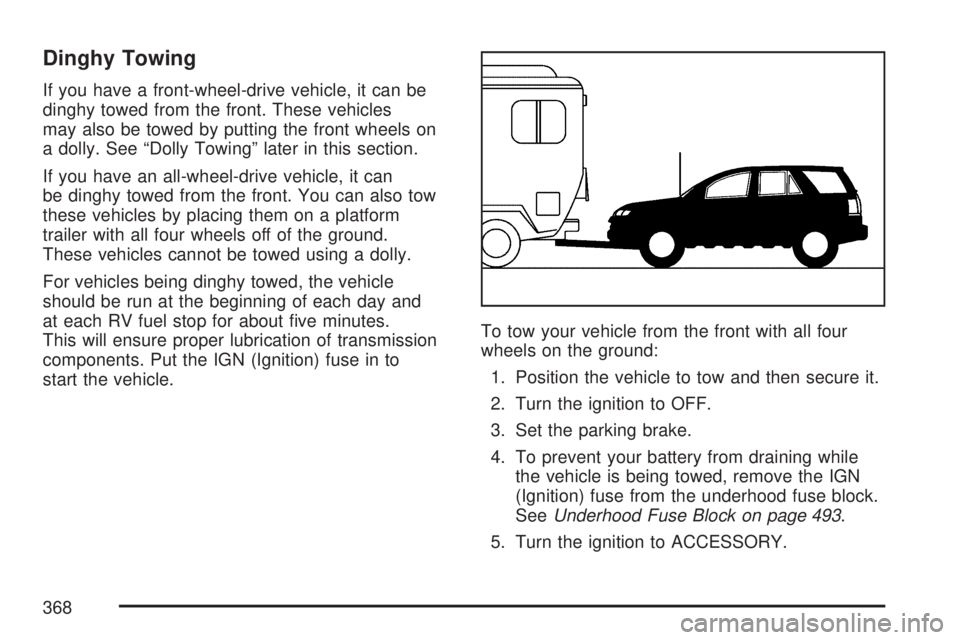
If you have a front-wheel-drive vehicle, it can be
dinghy towed from the front. These vehicles
may also be towed by putting the front wheels on
a dolly. See “Dolly Towing” later in this section.
If you have an all-wheel-drive vehicle, it can
be dinghy towed from the front. You can also tow
these vehicles by placing them on a platform
trailer with all four wheels off of the ground.
These vehicles cannot be towed using a dolly.
For vehicles being dinghy towed, the vehicle
should be run at the beginning of each day and
at each RV fuel stop for about ve minutes.
This will ensure proper lubrication of transmission
components. Put the IGN (Ignition) fuse in to
start the vehicle.To tow your vehicle from the front with all four
wheels on the ground:
1. Position the vehicle to tow and then secure it.
2. Turn the ignition to OFF.
3. Set the parking brake.
4. To prevent your battery from draining while
the vehicle is being towed, remove the IGN
(Ignition) fuse from the underhood fuse block.
SeeUnderhood Fuse Block on page 493.
5. Turn the ignition to ACCESSORY.
368
Page 371 of 554
Towing a Trailer
{CAUTION:
If you do not use the correct equipment
and drive properly, you can lose control
when you pull a trailer. For example, if the
trailer is too heavy, the brakes may not
work well — or even at all. You and your
passengers could be seriously injured.
You may also damage your vehicle; the
resulting repairs would not be covered by
your warranty. Pull a trailer only if you
have followed all the steps in this section.
Ask your dealer/retailer for advice and
information about towing a trailer with
your vehicle.
To identify the trailering capacity of your vehicle,
you should read the information in “Weight of
the Trailer” that appears later in this section.But trailering is different than just driving your
vehicle by itself. Trailering means changes
in handling, acceleration, braking, durability and
fuel economy. Successful, safe trailering takes
correct equipment, and it has to be used properly.
That’s the reason for this part. In it are many
time-tested, important trailering tips and safety
rules. Many of these are important for your safety
and that of your passengers. So please read
this section carefully before you pull a trailer.
Load-pulling components such as the engine,
transmission, rear axle, wheel assemblies and tires
are forced to work harder against the drag of
the added weight. The engine is required
to operate at relatively higher speeds and under
greater loads, generating extra heat. What’s more,
the trailer adds considerably to wind resistance,
increasing the pulling requirements.
371
Page 374 of 554
Operating the vehicle in tow/haul when lightly
loaded or with no trailer at all will not cause
damage. However, there is no benet to the
selection of Tow/Haul when the vehicle is
unloaded. Such a selection when unloaded may
result in unpleasant engine and transmission
driving characteristics and reduced fuel economy.
Tow/Haul is recommended only when pulling a
heavy trailer or a large or heavy load.
Weight of the Trailer
How heavy can a trailer safely be?
It depends on how you plan to use your rig.
For example, speed, altitude, road grades, outside
temperature and how much your vehicle is used
to pull a trailer are all important. It can also depend
on any special equipment that you have on your
vehicle, and the amount of tongue weight the
vehicle can carry. See “Weight of the Trailer
Tongue” later in this section for more information.
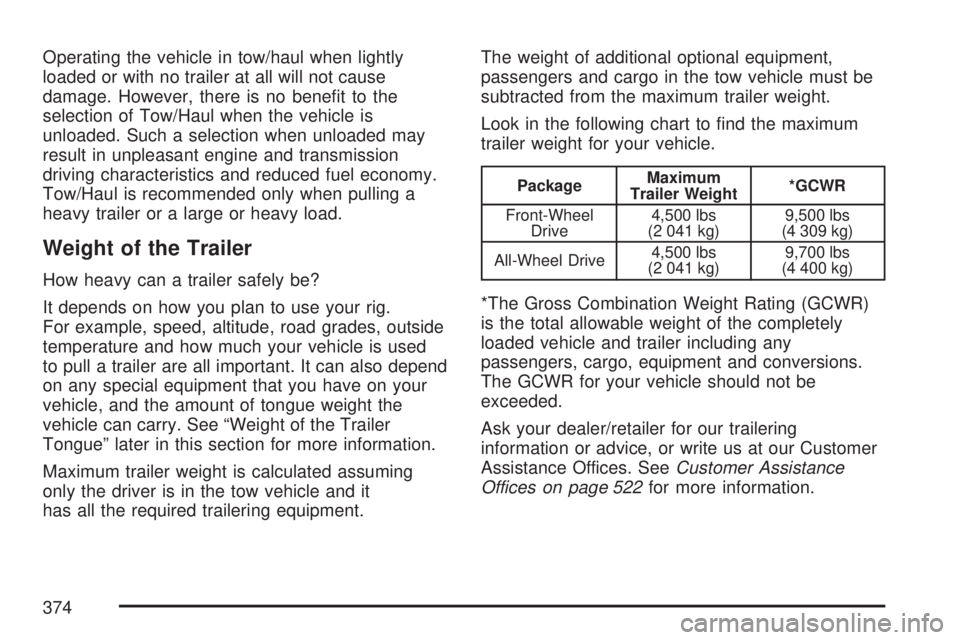
Maximum trailer weight is calculated assuming
only the driver is in the tow vehicle and it
has all the required trailering equipment.The weight of additional optional equipment,
passengers and cargo in the tow vehicle must be
subtracted from the maximum trailer weight.
Look in the following chart to nd the maximum
trailer weight for your vehicle.
PackageMaximum
Trailer Weight*GCWR
Front-Wheel
Drive4,500 lbs
(2 041 kg)9,500 lbs
(4 309 kg)
All-Wheel Drive4,500 lbs
(2 041 kg)9,700 lbs
(4 400 kg)
*The Gross Combination Weight Rating (GCWR)
is the total allowable weight of the completely
loaded vehicle and trailer including any
passengers, cargo, equipment and conversions.
The GCWR for your vehicle should not be
exceeded.
Ask your dealer/retailer for our trailering
information or advice, or write us at our Customer
Assistance Offices. SeeCustomer Assistance
Offices on page 522for more information.
374
Page 383 of 554
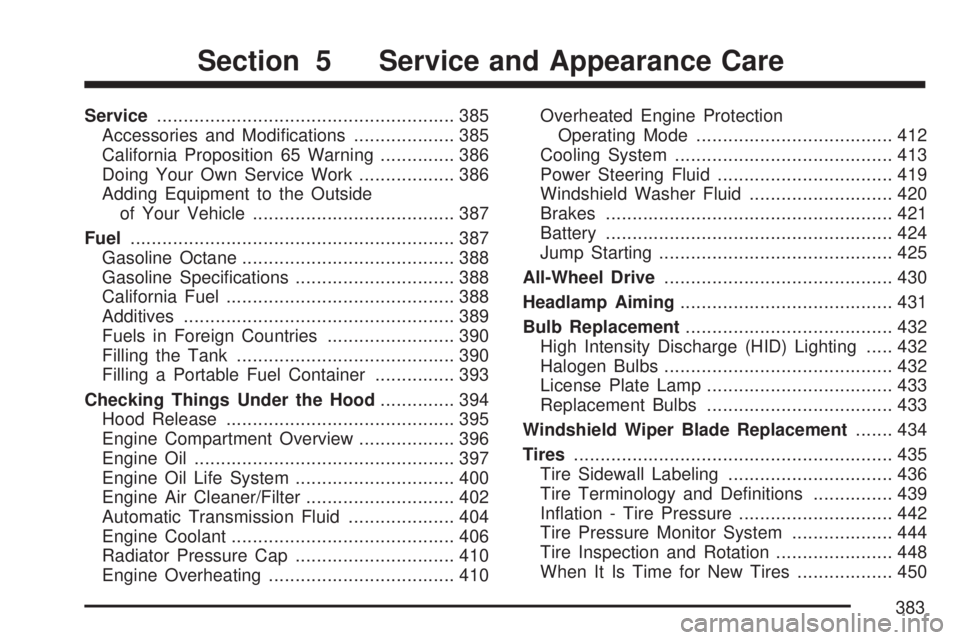
Service........................................................ 385
Accessories and Modications................... 385
California Proposition 65 Warning.............. 386
Doing Your Own Service Work.................. 386
Adding Equipment to the Outside
of Your Vehicle...................................... 387
Fuel............................................................. 387
Gasoline Octane........................................ 388
Gasoline Specications.............................. 388
California Fuel........................................... 388
Additives................................................... 389
Fuels in Foreign Countries........................ 390
Filling the Tank......................................... 390
Filling a Portable Fuel Container............... 393
Checking Things Under the Hood.............. 394
Hood Release........................................... 395
Engine Compartment Overview.................. 396
Engine Oil................................................. 397
Engine Oil Life System.............................. 400
Engine Air Cleaner/Filter............................ 402
Automatic Transmission Fluid.................... 404
Engine Coolant.......................................... 406
Radiator Pressure Cap.............................. 410
Engine Overheating................................... 410Overheated Engine Protection
Operating Mode..................................... 412
Cooling System......................................... 413
Power Steering Fluid................................. 419
Windshield Washer Fluid........................... 420
Brakes...................................................... 421
Battery...................................................... 424
Jump Starting............................................ 425
All-Wheel Drive........................................... 430
Headlamp Aiming........................................ 431
Bulb Replacement....................................... 432
High Intensity Discharge (HID) Lighting..... 432
Halogen Bulbs........................................... 432
License Plate Lamp................................... 433
Replacement Bulbs................................... 433
Windshield Wiper Blade Replacement....... 434
Tires............................................................ 435
Tire Sidewall Labeling............................... 436
Tire Terminology and Denitions............... 439
Ination - Tire Pressure............................. 442
Tire Pressure Monitor System................... 444
Tire Inspection and Rotation...................... 448
When It Is Time for New Tires.................. 450
Section 5 Service and Appearance Care
383
Page 387 of 554
If you want to do some of your own service work,
you should use the proper service manual.
It tells you much more about how to service your
vehicle than this manual can. To order the
proper service manual, seeService Publications
Ordering Information on page 535.
Your vehicle has an airbag system. Before
attempting to do your own service work, see
Servicing Your Airbag-Equipped Vehicle on
page 90.
You should keep a record with all parts receipts
and list the mileage and the date of any service
work you perform. SeeMaintenance Record
on page 514.Adding Equipment to the Outside
of Your Vehicle
Things you might add to the outside of your
vehicle can affect the airow around it. This may
cause wind noise and affect windshield washer
performance. Check with your dealer/retailer
before adding equipment to the outside of your
vehicle.
Fuel
Use of the recommended fuel is an important
part of the proper maintenance of your vehicle.
To help keep the engine clean and maintain
optimum vehicle performance, we recommend
the use of gasoline advertised as TOP TIER
Detergent Gasoline.
387
Page 388 of 554
Gasoline Octane
Use regular unleaded gasoline with a posted
octane rating of 87 or higher. For best performance
or trailer towing, you could choose to use middle
grade 89 octane unleaded gasoline. If the
octane rating is less than 87, you might notice
an audible knocking noise when you drive,
commonly referred to as spark knock. If this
occurs, use a gasoline rated at 87 octane or higher
as soon as possible. If you are using gasoline
rated at 87 octane or higher and you hear heavy
knocking, the engine needs service.
Gasoline Specications
At a minimum, gasoline should meet ASTM
specication D 4814 in the United States or
CAN/CGSB-3.5 or 3.511 in Canada. Some
gasolines contain an octane-enhancing additive
called methylcyclopentadienyl manganese
tricarbonyl (MMT). We recommend against the
use of gasolines containing MMT. SeeAdditives
on page 389for additional information.
California Fuel
If your vehicle is certied to meet California
Emissions Standards, it is designed to operate
on fuels that meet California specications.
See the underhood emission control label.
If this fuel is not available in states adopting
California emissions standards, your vehicle will
operate satisfactorily on fuels meeting federal
specications, but emission control system
performance might be affected. The malfunction
indicator lamp could turn on and your vehicle might
fail a smog-check test. SeeMalfunction Indicator
Lamp on page 226. If this occurs, return to
your authorized dealer/retailer for diagnosis.
If it is determined that the condition is caused
by the type of fuel used, repairs might not
be covered by your warranty.
388
Page 389 of 554
Additives
To provide cleaner air, all gasolines in the
United States are now required to contain additives
that help prevent engine and fuel system
deposits from forming, allowing the emission
control system to work properly. In most cases,
you should not have to add anything to the
fuel. However, some gasolines contain only the
minimum amount of additive required to meet
U.S. Environmental Protection Agency regulations.
To help keep fuel injectors and intake valves
clean, or if your vehicle experiences problems due
to dirty injectors or valves, look for gasoline that
is advertised as TOP TIER Detergent Gasoline.
Also, your dealer/retailer has additives that
will help correct and prevent most deposit-related
problems.
Gasolines containing oxygenates, such as ethers
and ethanol, and reformulated gasolines might
be available in your area. We recommend
that you use these gasolines, if they comply
with the specications described earlier.However, E85 (85% ethanol) and other fuels
containing more than 10% ethanol must not be
used in vehicles that were not designed for
those fuels.
Notice:Your vehicle was not designed for
fuel that contains methanol. Do not use
fuel containing methanol. It can corrode metal
parts in the fuel system and also damage
plastic and rubber parts. That damage would
not be covered under your warranty.
Some gasolines that are not reformulated for low
emissions can contain an octane-enhancing
additive called methylcyclopentadienyl manganese
tricarbonyl (MMT); ask the attendant where you
buy gasoline whether the fuel contains MMT.
We recommend against the use of such gasolines.
Fuels containing MMT can reduce the life of
spark plugs and the performance of the emission
control system could be affected. The malfunction
indicator lamp might turn on. If this occurs,
return to your dealer/retailer for service.
389
Page 390 of 554
Fuels in Foreign Countries
If you plan on driving in another country outside
the United States or Canada, the proper fuel might
be hard to nd. Never use leaded gasoline or
any other fuel not recommended in the previous
text on fuel. Costly repairs caused by use of
improper fuel would not be covered by your
warranty.
To check the fuel availability, ask an auto club, or
contact a major oil company that does business
in the country where you will be driving.
Filling the Tank
{CAUTION:
Fuel vapor burns violently and a fuel re
can cause bad injuries. To help avoid
injuries to you and others, read and follow
all the instructions on the pump island.
Turn off your engine when you are
refueling. Do not smoke if you are near fuel
or refueling your vehicle. Do not use
cellular phones. Keep sparks, ames, and
smoking materials away from fuel. Do not
leave the fuel pump unattended when
refueling your vehicle. This is against the
law in some places. Do not re-enter the
vehicle while pumping fuel. Keep children
away from the fuel pump; never let children
pump fuel.
390