mirror GMC ACADIA 2007 Owner's Guide
[x] Cancel search | Manufacturer: GMC, Model Year: 2007, Model line: ACADIA, Model: GMC ACADIA 2007Pages: 554, PDF Size: 2.76 MB
Page 345 of 554
The three types of skids correspond to your
vehicle’s three control systems. In the braking skid,
the wheels are not rolling. In the steering or
cornering skid, too much speed or steering in a
curve causes tires to slip and lose cornering force.
And in the acceleration skid, too much throttle
causes the driving wheels to spin.
A cornering skid is best handled by easing your
foot off the accelerator pedal.
If your vehicle starts to slide, ease your foot off the
accelerator pedal and quickly steer the way you
want the vehicle to go. If you start steering quickly
enough, your vehicle may straighten out. Always be
ready for a second skid if it occurs.
Of course, traction is reduced when water, snow,
ice, gravel, or other material is on the road.
For safety, you want to slow down and adjust your
driving to these conditions. It is important to slow
down on slippery surfaces because stopping
distance is longer and vehicle control more limited.While driving on a surface with reduced traction,
try your best to avoid sudden steering,
acceleration, or braking, including reducing
vehicle speed by shifting to a lower gear.
Any sudden changes could cause the tires to
slide. You might not realize the surface is slippery
until your vehicle is skidding. Learn to recognize
warning clues — such as enough water, ice,
or packed snow on the road to make a mirrored
surface — and slow down when you have any
doubt.
Remember: Any Anti-Lock Brake System (ABS)
helps avoid only the braking skid.
345
Page 346 of 554
Driving at Night
Night driving is more dangerous than day driving.
One reason is that some drivers are likely to
be impaired — by alcohol or drugs, with night
vision problems, or by fatigue.
Here are some tips on night driving.
Drive defensively.
Do not drink and drive.
Adjust the inside rearview mirror to reduce the
glare from headlamps behind you.
Since you cannot see as well, slow down and
keep more space between you and other
vehicles.
Slow down, especially on higher speed roads.
Your vehicle’s headlamps can light up only so
much road ahead.
In remote areas, watch for animals.
If you are tired, pull off the road in a safe
place and rest.No one can see as well at night as in the daytime.
But as we get older these differences increase.
A 50-year-old driver might require at least twice as
much light to see the same thing at night as a
20-year-old.
What you do in the daytime can also affect your
night vision. For example, if you spend the
day in bright sunshine you are wise to wear
sunglasses. Your eyes will have less trouble
adjusting to night. But if you are driving, do not
wear sunglasses at night. They might cut down on
glare from headlamps, but they also make a lot
of things invisible.
You can be temporarily blinded by approaching
headlamps. It can take a second or two, or
even several seconds, for your eyes to re-adjust
to the dark. When you are faced with severe glare,
as from a driver who does not lower the high
beams, or a vehicle with misaimed headlamps,
slow down a little. Avoid staring directly into
the approaching headlamps.
346
Page 351 of 554
Freeway Driving
Mile for mile, freeways — also called thruways,
parkways, expressways, turnpikes, or
superhighways — are the safest of all roads.
But they have their own special rules.
The most important advice on freeway driving
is: Keep up with traffic and keep to the right. Drive
at the same speed most of the other drivers are
driving. Too-fast or too-slow driving breaks a
smooth traffic ow. Treat the left lane on a freeway
as a passing lane.
At the entrance, there is usually a ramp that leads
to the freeway. If you have a clear view of the
freeway as you drive along the entrance ramp,
you should begin to check traffic. Try to determine
where you expect to blend with the ow. Try to
merge into the gap at close to the prevailing
speed. Switch on the turn signal, check the
mirrors, and glance over your shoulder as often
as necessary. Try to blend smoothly with the
traffic ow.Once you are on the freeway, adjust your speed
to the posted limit or to the prevailing rate if it
is slower. Stay in the right lane unless you want
to pass.
Before changing lanes, check the mirrors. Then,
use the turn signal.
Just before you leave the lane, glance quickly
over your shoulder to make sure there is not
another vehicle in your blind spot.
Once you are moving on the freeway, make sure
you allow a reasonable following distance.
Expect to move slightly slower at night.
When you want to leave the freeway, move to the
proper lane well in advance. If you miss your
exit, do not, under any circumstances, stop and
back up. Drive on to the next exit.
The exit ramp can be curved, sometimes quite
sharply. The exit speed is usually posted. Reduce
your speed according to the speedometer, not
to your sense of motion. After driving for any
distance at higher speeds, you might tend to think
you are going slower than you actually are.
351
Page 353 of 554
Highway Hypnosis
Is there actually such a condition as highway
hypnosis? Or is it just plain falling asleep at
the wheel? Call it highway hypnosis, lack of
awareness, or whatever.
There is something about an easy stretch of road
with the same scenery, along with the hum of
the tires on the road, the drone of the engine,
and the rush of the wind against the vehicle that
can make you sleepy. Do not let it happen to you!
If it does, your vehicle can leave the road in
less than a second, and you could crash and
be injured.
What can you do about highway hypnosis?
First, be aware that it can happen.Then here are some tips:Make sure your vehicle is well ventilated,
with a comfortably cool interior.
Keep your eyes moving. Scan the road ahead
and to the sides. Check your vehicle’s mirrors
and instruments frequently.
If you get sleepy, pull off the road into a rest,
service, or parking area and take a nap, get
some exercise, or both. For safety, treat
drowsiness on the highway as an emergency.
353
Page 378 of 554
Safety Chains
You should always attach chains between your
vehicle and your trailer. Cross the safety
chains under the tongue of the trailer so that the
tongue will not drop to the road if it becomes
separated from the hitch. Instructions about safety
chains may be provided by the hitch manufacturer
or by the trailer manufacturer. Follow the
manufacturer’s recommendation for attaching
safety chains and do not attach them to the
bumper. Always leave just enough slack so you
can turn with your rig. And, never allow safety
chains to drag on the ground.
Trailer Brakes
If you tow more than 1,000 lbs (450 kg), use trailer
brakes. Because your vehicle has anti-lock brakes,
don’t try to tap into your vehicle’s hydraulic brake
system. If you do, both brake systems won’t
work well, or at all.
Be sure to read and follow the instructions for the
trailer brakes so you’ll be able to install, adjust
and maintain them properly.
Driving with a Trailer
Towing a trailer requires a certain amount of
experience. Before setting out for the open road,
you’ll want to get to know your rig. Acquaint
yourself with the feel of handling and braking with
the added weight of the trailer. And always
keep in mind that the vehicle you are driving is
now a good deal longer and not nearly as
responsive as your vehicle is by itself.
Before you start, check all trailer hitch parts and
attachments, safety chains, electrical connector,
lamps, tires and mirror adjustment. If the trailer has
electric brakes, start your vehicle and trailer moving
and then apply the trailer brake controller by hand
to be sure the brakes are working. This lets you
check your electrical connection at the same time.
During your trip, check occasionally to be sure
that the load is secure, and that the lamps and any
trailer brakes are still working.
Following Distance
Stay at least twice as far behind the vehicle ahead
as you would when driving your vehicle without
a trailer. This can help you avoid situations
that require heavy braking and sudden turns.
378
Page 491 of 554
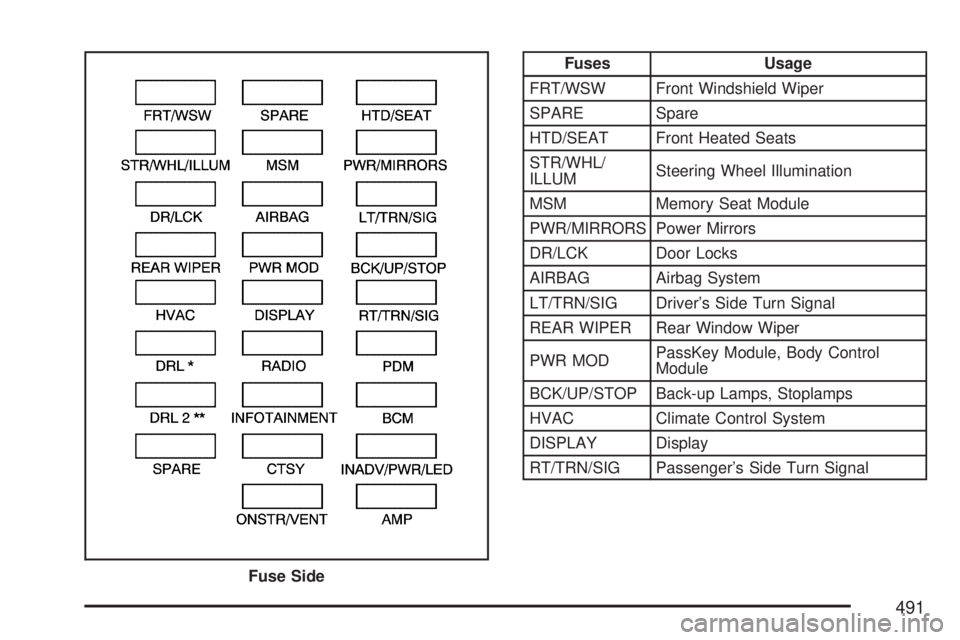
Fuses Usage
FRT/WSW Front Windshield Wiper
SPARE Spare
HTD/SEAT Front Heated Seats
STR/WHL/
ILLUMSteering Wheel Illumination
MSM Memory Seat Module
PWR/MIRRORS Power Mirrors
DR/LCK Door Locks
AIRBAG Airbag System
LT/TRN/SIG Driver’s Side Turn Signal
REAR WIPER Rear Window Wiper
PWR MODPassKey Module, Body Control
Module
BCK/UP/STOP Back-up Lamps, Stoplamps
HVAC Climate Control System
DISPLAY Display
RT/TRN/SIG Passenger’s Side Turn Signal
Fuse Side
491
Page 492 of 554
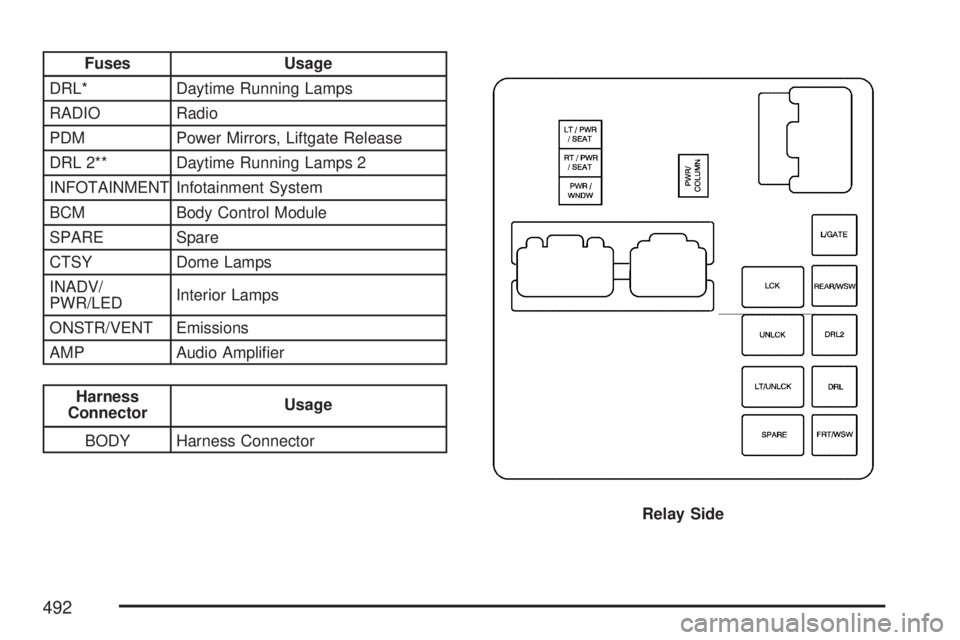
Fuses Usage
DRL* Daytime Running Lamps
RADIO Radio
PDM Power Mirrors, Liftgate Release
DRL 2** Daytime Running Lamps 2
INFOTAINMENT Infotainment System
BCM Body Control Module
SPARE Spare
CTSY Dome Lamps
INADV/
PWR/LEDInterior Lamps
ONSTR/VENT Emissions
AMP Audio Amplier
Harness
ConnectorUsage
BODY Harness Connector
Relay Side
492
Page 495 of 554
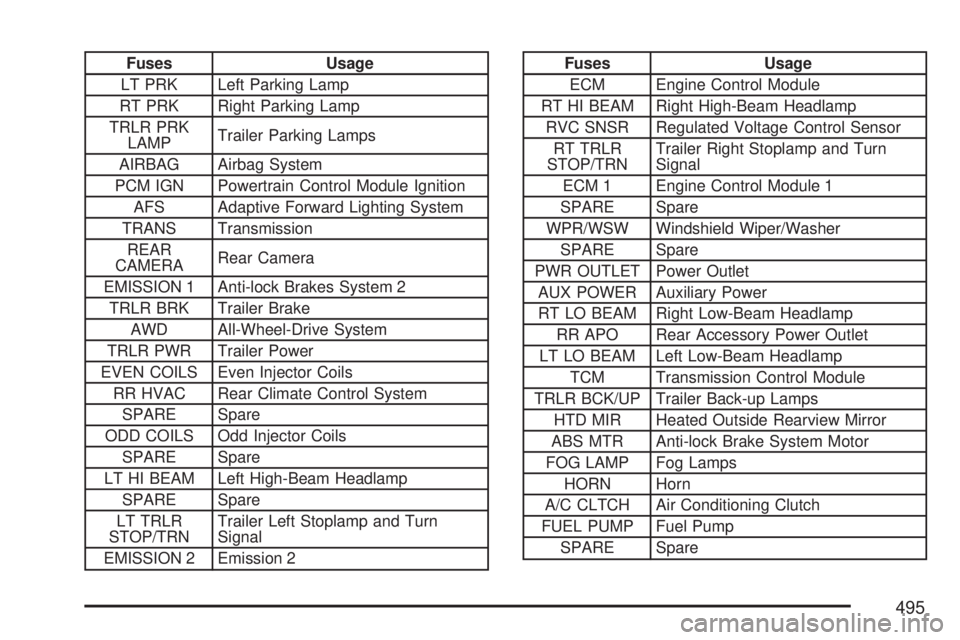
Fuses Usage
LT PRK Left Parking Lamp
RT PRK Right Parking Lamp
TRLR PRK
LAMPTrailer Parking Lamps
AIRBAG Airbag System
PCM IGN Powertrain Control Module Ignition
AFS Adaptive Forward Lighting System
TRANS Transmission
REAR
CAMERARear Camera
EMISSION 1 Anti-lock Brakes System 2
TRLR BRK Trailer Brake
AWD All-Wheel-Drive System
TRLR PWR Trailer Power
EVEN COILS Even Injector Coils
RR HVAC Rear Climate Control System
SPARE Spare
ODD COILS Odd Injector Coils
SPARE Spare
LT HI BEAM Left High-Beam Headlamp
SPARE Spare
LT TRLR
STOP/TRNTrailer Left Stoplamp and Turn
Signal
EMISSION 2 Emission 2Fuses Usage
ECM Engine Control Module
RT HI BEAM Right High-Beam Headlamp
RVC SNSR Regulated Voltage Control Sensor
RT TRLR
STOP/TRNTrailer Right Stoplamp and Turn
Signal
ECM 1 Engine Control Module 1
SPARE Spare
WPR/WSW Windshield Wiper/Washer
SPARE Spare
PWR OUTLET Power Outlet
AUX POWER Auxiliary Power
RT LO BEAM Right Low-Beam Headlamp
RR APO Rear Accessory Power Outlet
LT LO BEAM Left Low-Beam Headlamp
TCM Transmission Control Module
TRLR BCK/UP Trailer Back-up Lamps
HTD MIR Heated Outside Rearview Mirror
ABS MTR Anti-lock Brake System Motor
FOG LAMP Fog Lamps
HORN Horn
A/C CLTCH Air Conditioning Clutch
FUEL PUMP Fuel Pump
SPARE Spare
495
Page 548 of 554
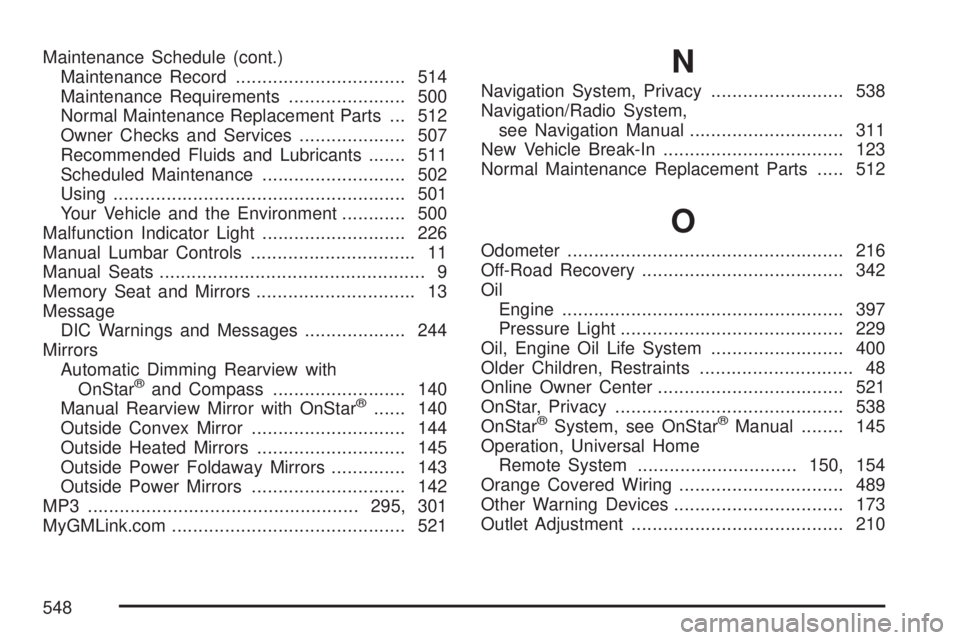
Maintenance Schedule (cont.)
Maintenance Record................................ 514
Maintenance Requirements...................... 500
Normal Maintenance Replacement Parts ... 512
Owner Checks and Services.................... 507
Recommended Fluids and Lubricants....... 511
Scheduled Maintenance........................... 502
Using....................................................... 501
Your Vehicle and the Environment............ 500
Malfunction Indicator Light........................... 226
Manual Lumbar Controls............................... 11
Manual Seats.................................................. 9
Memory Seat and Mirrors.............................. 13
Message
DIC Warnings and Messages................... 244
Mirrors
Automatic Dimming Rearview with
OnStar
®and Compass......................... 140
Manual Rearview Mirror with OnStar®...... 140
Outside Convex Mirror............................. 144
Outside Heated Mirrors............................ 145
Outside Power Foldaway Mirrors.............. 143
Outside Power Mirrors............................. 142
MP3 ...................................................295, 301
MyGMLink.com............................................ 521
N
Navigation System, Privacy ......................... 538
Navigation/Radio System,
see Navigation Manual............................. 311
New Vehicle Break-In.................................. 123
Normal Maintenance Replacement Parts..... 512
O
Odometer.................................................... 216
Off-Road Recovery...................................... 342
Oil
Engine..................................................... 397
Pressure Light.......................................... 229
Oil, Engine Oil Life System ......................... 400
Older Children, Restraints............................. 48
Online Owner Center................................... 521
OnStar, Privacy........................................... 538
OnStar
®System, see OnStar®Manual........ 145
Operation, Universal Home
Remote System..............................150, 154
Orange Covered Wiring............................... 489
Other Warning Devices................................ 173
Outlet Adjustment........................................ 210
548
Page 549 of 554
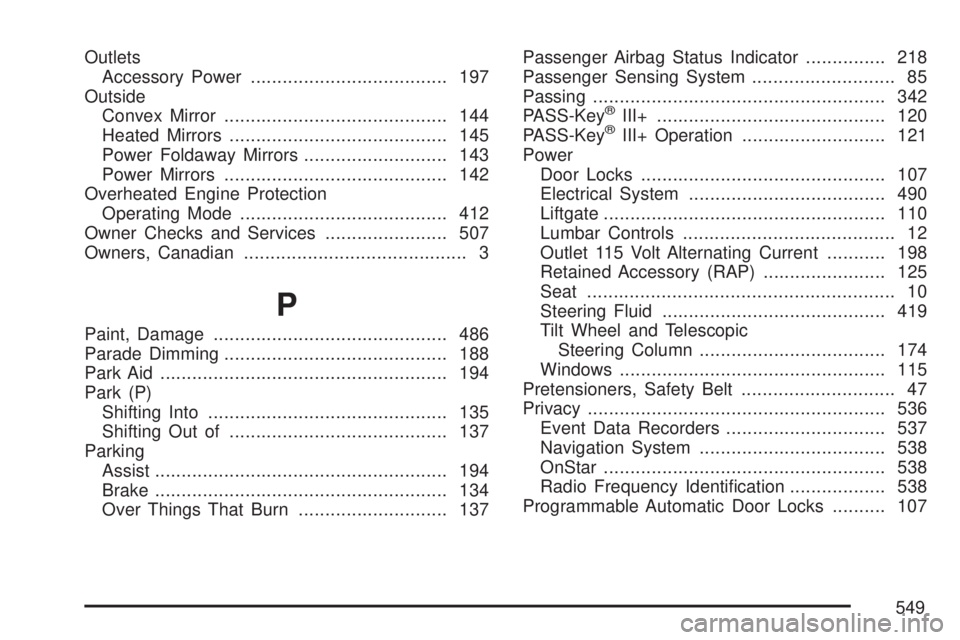
Outlets
Accessory Power..................................... 197
Outside
Convex Mirror.......................................... 144
Heated Mirrors......................................... 145
Power Foldaway Mirrors........................... 143
Power Mirrors.......................................... 142
Overheated Engine Protection
Operating Mode....................................... 412
Owner Checks and Services....................... 507
Owners, Canadian.......................................... 3
P
Paint, Damage............................................ 486
Parade Dimming.......................................... 188
Park Aid...................................................... 194
Park (P)
Shifting Into............................................. 135
Shifting Out of......................................... 137
Parking
Assist....................................................... 194
Brake....................................................... 134
Over Things That Burn............................ 137Passenger Airbag Status Indicator............... 218
Passenger Sensing System........................... 85
Passing....................................................... 342
PASS-Key
®III+........................................... 120
PASS-Key®III+ Operation........................... 121
Power
Door Locks.............................................. 107
Electrical System..................................... 490
Liftgate..................................................... 110
Lumbar Controls........................................ 12
Outlet 115 Volt Alternating Current ........... 198
Retained Accessory (RAP)....................... 125
Seat.......................................................... 10
Steering Fluid.......................................... 419
Tilt Wheel and Telescopic
Steering Column................................... 174
Windows.................................................. 115
Pretensioners, Safety Belt............................. 47
Privacy........................................................ 536
Event Data Recorders.............................. 537
Navigation System................................... 538
OnStar..................................................... 538
Radio Frequency Identication.................. 538
Programmable Automatic Door Locks.......... 107
549