tire size GMC ACADIA 2010 Owner's Guide
[x] Cancel search | Manufacturer: GMC, Model Year: 2010, Model line: ACADIA, Model: GMC ACADIA 2010Pages: 444, PDF Size: 2.58 MB
Page 383 of 444
Vehicle Care 10-77
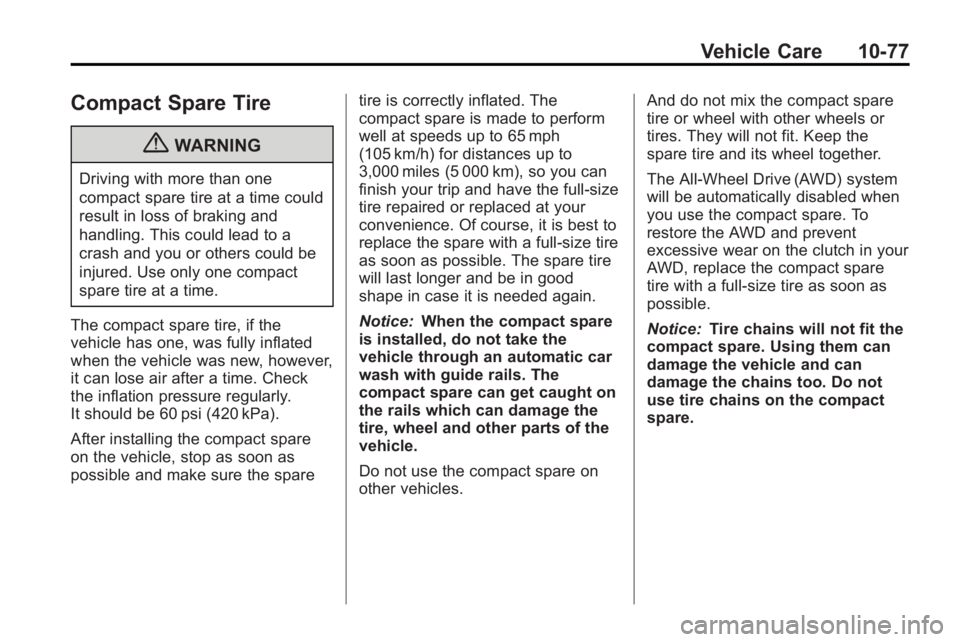
Compact Spare Tire
{WARNING
Driving with more than one
compact spare tire at a time could
result in loss of braking and
handling. This could lead to a
crash and you or others could be
injured. Use only one compact
spare tire at a time.
The compact spare tire, if the
vehicle has one, was fully inflated
when the vehicle was new, however,
it can lose air after a time. Check
the inflation pressure regularly.
It should be 60 psi (420 kPa).
After installing the compact spare
on the vehicle, stop as soon as
possible and make sure the spare tire is correctly inflated. The
compact spare is made to perform
well at speeds up to 65 mph
(105 km/h) for distances up to
3,000 miles (5 000 km), so you can
finish your trip and have the full-size
tire repaired or replaced at your
convenience. Of course, it is best to
replace the spare with a full-size tire
as soon as possible. The spare tire
will last longer and be in good
shape in case it is needed again.
Notice:
When the compact spare
is installed, do not take the
vehicle through an automatic car
wash with guide rails. The
compact spare can get caught on
the rails which can damage the
tire, wheel and other parts of the
vehicle.
Do not use the compact spare on
other vehicles. And do not mix the compact spare
tire or wheel with other wheels or
tires. They will not fit. Keep the
spare tire and its wheel together.
The All-Wheel Drive (AWD) system
will be automatically disabled when
you use the compact spare. To
restore the AWD and prevent
excessive wear on the clutch in your
AWD, replace the compact spare
tire with a full-size tire as soon as
possible.
Notice:
Tire chains will not fit the
compact spare. Using them can
damage the vehicle and can
damage the chains too. Do not
use tire chains on the compact
spare.
Page 389 of 444
Vehicle Care 10-83
If the vehicle is all-wheel-drive, it
can be dinghy towed from the front.
These vehicles can also be towed
by placing them on a platform trailer
with all four wheels off of the
ground. These vehicles cannot be
towed using a dolly.
For vehicles being dinghy towed,
the vehicle should be run at the
beginning of each day and at each
RV fuel stop for about five minutes.
This will ensure proper lubrication of
transmission components. Re-install
the fuse to start the vehicle.
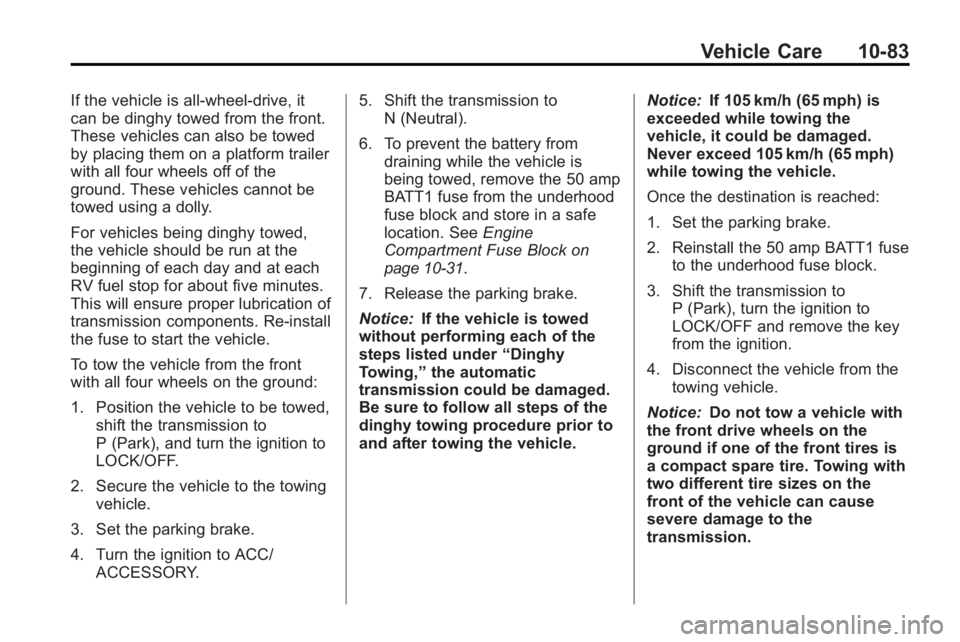
To tow the vehicle from the front
with all four wheels on the ground:
1. Position the vehicle to be towed,shift the transmission to
P (Park), and turn the ignition to
LOCK/OFF.
2. Secure the vehicle to the towing vehicle.
3. Set the parking brake.
4. Turn the ignition to ACC/ ACCESSORY. 5. Shift the transmission to
N (Neutral).
6. To prevent the battery from draining while the vehicle is
being towed, remove the 50 amp
BATT1 fuse from the underhood
fuse block and store in a safe
location. See Engine
Compartment Fuse Block
on
page 10‑31.
7. Release the parking brake.
Notice: If the vehicle is towed
without performing each of the
steps listed under “Dinghy
Towing,” the automatic
transmission could be damaged.
Be sure to follow all steps of the
dinghy towing procedure prior to
and after towing the vehicle. Notice:
If 105 km/h (65 mph) is
exceeded while towing the
vehicle, it could be damaged.
Never exceed 105 km/h (65 mph)
while towing the vehicle.
Once the destination is reached:
1. Set the parking brake.
2. Reinstall the 50 amp BATT1 fuse to the underhood fuse block.
3. Shift the transmission to P (Park), turn the ignition to
LOCK/OFF and remove the key
from the ignition.
4. Disconnect the vehicle from the towing vehicle.
Notice: Do not tow a vehicle with
the front drive wheels on the
ground if one of the front tires is
a compact spare tire. Towing with
two different tire sizes on the
front of the vehicle can cause
severe damage to the
transmission.
Page 443 of 444
INDEX i-11
T
Tachometer . . . . . . . . . . . . . . . . . . . . 5-12
Text Telephone (TTY) Users . . . 13-4
Theft-Deterrent Systems . . . . . . . 2-14Immobilizer . . . . . . . . . . . . . . . . . . . 2-14
Third-Row Seats . . . . . . . . . . . . . . . 3-11
Time . . . . . . . . . . . . . . . . . . . . . . . . . . . . 5-8
Tires Buying New Tires . . . . . . . . . . . 10-51
Chains . . . . . . . . . . . . . . . . . . . . . . 10-56
Changing . . . . . . . . . . . . . . . . . . . 10-66
Compact Spare . . . . . . . . . . . . . 10-77
Designations . . . . . . . . . . . . . . . 10-39
Different Size . . . . . . . . . . . . . . . 10-53
If a Tire Goes Flat . . . . . . . . . . 10-56
Inflation Monitor System . . . . 10-45
Inspection . . . . . . . . . . . . . . . . . . 10-49
Messages . . . . . . . . . . . . . . . . . . . . 5-41
Pressure Light . . . . . . . . . . . . . . . . 5-21
Pressure Monitor System . . . 10-44
Rotation . . . . . . . . . . . . . . . . . . . . 10-49
Sealant andCompressor Kit . . . . . . . . . . . 10-58 Tires (cont.)
Sealant and Compressor
Kit, Storing . . . . . . . . . . . . . . . . 10-65
Secondary Latch System . . . 10-74
Sidewall Labeling . . . . . . . . . . . 10-37
Terminology and
Definitions . . . . . . . . . . . . . . . . . 10-40
Uniform Tire Quality Grading . . . . . . . . . . . . . . . . . . . 10-53
Wheel Alignment and Tire Balance . . . . . . . . . . . . . . . . . . . 10-55
Wheel Replacement . . . . . . . . 10-55
When It Is Time for New Tires . . . . . . . . . . . . . . . . . . . . . . 10-50
Tow/Haul Mode . . . . . . . . . . . . . . . . 9-25
Tow/Haul Mode Light . . . . . . . . . . 5-20
Towing Driving Characteristics . . . . . . . . 9-44
Equipment . . . . . . . . . . . . . . . . . . . . 9-53
General Information . . . . . . . . . . 9-44
Recreational Vehicle . . . . . . . . 10-82
Trailer . . . . . . . . . . . . . . . . . . . . . . . . 9-49
Vehicle . . . . . . . . . . . . . . . . . . . . . 10-82
Trailer Towing . . . . . . . . . . . . . . . . . 9-49 Transmission
Automatic . . . . . . . . . . . . . . . . . . . . . 9-22
Fluid, Automatic . . . . . . . . . . . . .10-11
Messages . . . . . . . . . . . . . . . . . . . . 5-42
Transportation Program, Courtesy . . . . . . . . . . . . . . . . . . . . . 13-8
Turn and Lane-Change
Signals . . . . . . . . . . . . . . . . . . . . . . . . 6-4
U
Ultrasonic Parking Assist . . . . . . 9-32
Uniform Tire QualityGrading . . . . . . . . . . . . . . . . . . . . . 10-53
Universal Remote System . . . . . 5-51 Operation . . . . . . . . . . . . . . . . . . . . . 5-55
Programming . . . . . . . . . . . . . . . . . 5-51
Using this Manual . . . . . . . . . . . . . . . . iv
Page 444 of 444
i-12 INDEX
V
VehicleCanadian Owners . . . . . . . . . . . . . . . iii
Control . . . . . . . . . . . . . . . . . . . . . . . . 9-3
Load Limits . . . . . . . . . . . . . . . . . . . 9-10
Messages . . . . . . . . . . . . . . . . . . . . 5-34
Personalization . . . . . . . . . . . . . . . 5-44
Remote Start . . . . . . . . . . . . . . . . . . 2-5
Security . . . . . . . . . . . . . . . . . . . . . . 2-13
Speed Messages . . . . . . . . . . . . . 5-43
Towing . . . . . . . . . . . . . . . . . . . . . . 10-82
Vehicle Care Storing the Tire Sealantand Compressor Kit . . . . . . . 10-65
Tire Pressure . . . . . . . . . . . . . . . 10-43
Vehicle Identification
Number (VIN) . . . . . . . . . . . . . . . . . 12-1
Service Parts IdentificationLabel . . . . . . . . . . . . . . . . . . . . . . . . 12-1
Vehicle Reminder
Messages . . . . . . . . . . . . . . . . . . . . 5-43 Ventilation, Air . . . . . . . . . . . . . . . . . 8-11
Visors . . . . . . . . . . . . . . . . . . . . . . . . . 2-21
Voltage Devices, and
Wiring . . . . . . . . . . . . . . . . . . . . . . . 10-30
Voltmeter Gage . . . . . . . . . . . . . . . . 5-13
W
Warning Lights, Gages, and Indicators . . . . . . . . . . . . . . . . . . . . 5-10
Warnings . . . . . . . . . . . . . . . . . . . . . . . . . iv Cautions and Danger . . . . . . . . . . . .iv
Hazard Flashers . . . . . . . . . . . . . . . 6-3
Washer Fluid . . . . . . . . . . . . . . . . . 10-22
Washer Fluid Messages . . . . . . . 5-43
Wheels
Alignment and TireBalance . . . . . . . . . . . . . . . . . . . 10-55
Different Size . . . . . . . . . . . . . . . 10-53
Replacement . . . . . . . . . . . . . . . 10-55
When It Is Time for New Tires . . . . . . . . . . . . . . . . . . . . . . . . 10-50 Where to Put the Child
Restraint . . . . . . . . . . . . . . . . . . . . . 3-51
Windows . . . . . . . . . . . . . . . . . . . . . . 2-19 Power . . . . . . . . . . . . . . . . . . . . . . . . 2-20
Windshield Wiper/Washer . . . . . . . . . . . . . . . . . 5-5
Winter Driving . . . . . . . . . . . . . . . . . . 9-8
Wiper Blade Replacement . . . . 10-27
Wipers
Rear Washer . . . . . . . . . . . . . . . . . . 5-6
Wiring, High Voltage
Devices . . . . . . . . . . . . . . . . . . . . . 10-30