traction control GMC CANYON 2004 User Guide
[x] Cancel search | Manufacturer: GMC, Model Year: 2004, Model line: CANYON, Model: GMC CANYON 2004Pages: 420, PDF Size: 2.84 MB
Page 219 of 420
Driving in Mud, Sand, Snow or Ice
When you drive in mud, snow or sand, your wheels
will not get good traction. You can not accelerate
as quickly, turning is more difficult, and you will need
longer braking distances.
It is best to use a low gear when you are in mud — the
deeper the mud, the lower the gear. In really deep
mud, the idea is to keep your vehicle moving so you do
not get stuck.
When you drive on sand, you will sense a change in
wheel traction. But it will depend upon how loosely
packed the sand is. On loosely packed sand (as
on beaches or sand dunes) your tires will tend to sink
into the sand. This has an effect on steering,
accelerating and braking. Drive at a reduced speed and
avoid sharp turns or abrupt maneuvers.Hard packed snow and ice offer the worst tire traction.
On these surfaces, it is very easy to lose control.
On wet ice, for example, the traction is so poor that you
will have difficulty accelerating. And if you do get
moving, poor steering and difficult braking can cause
you to slide out of control.
{CAUTION:
Driving on frozen lakes, ponds or rivers can be
dangerous. Underwater springs, currents
under the ice, or sudden thaws can weaken
the ice. Your vehicle could fall through the ice
and you and your passengers could drown.
Drive your vehicle on safe surfaces only.
4-27
Page 237 of 420
Rocking Your Vehicle To Get It Out
First, turn your steering wheel left and right. That will
clear the area around your front wheels. If you have a
four-wheel-drive vehicle, shift into 4HI. If you have
traction control, turn the traction control system off.
SeeTraction Control System (TCS) on page 4-9.
Then shift back and forth between REVERSE (R) and a
forward gear (or with a manual transmission, between
FIRST (1) or SECOND (2) and REVERSE (R)), spinning
the wheels as little as possible. Release the accelerator
pedal while you shift, and press lightly on the
accelerator pedal when the transmission is in gear.
By slowly spinning your wheels in the forward and
reverse directions, you will cause a rocking motion that
may free your vehicle. If that does not get you out
after a few tries, you may need to be towed out.
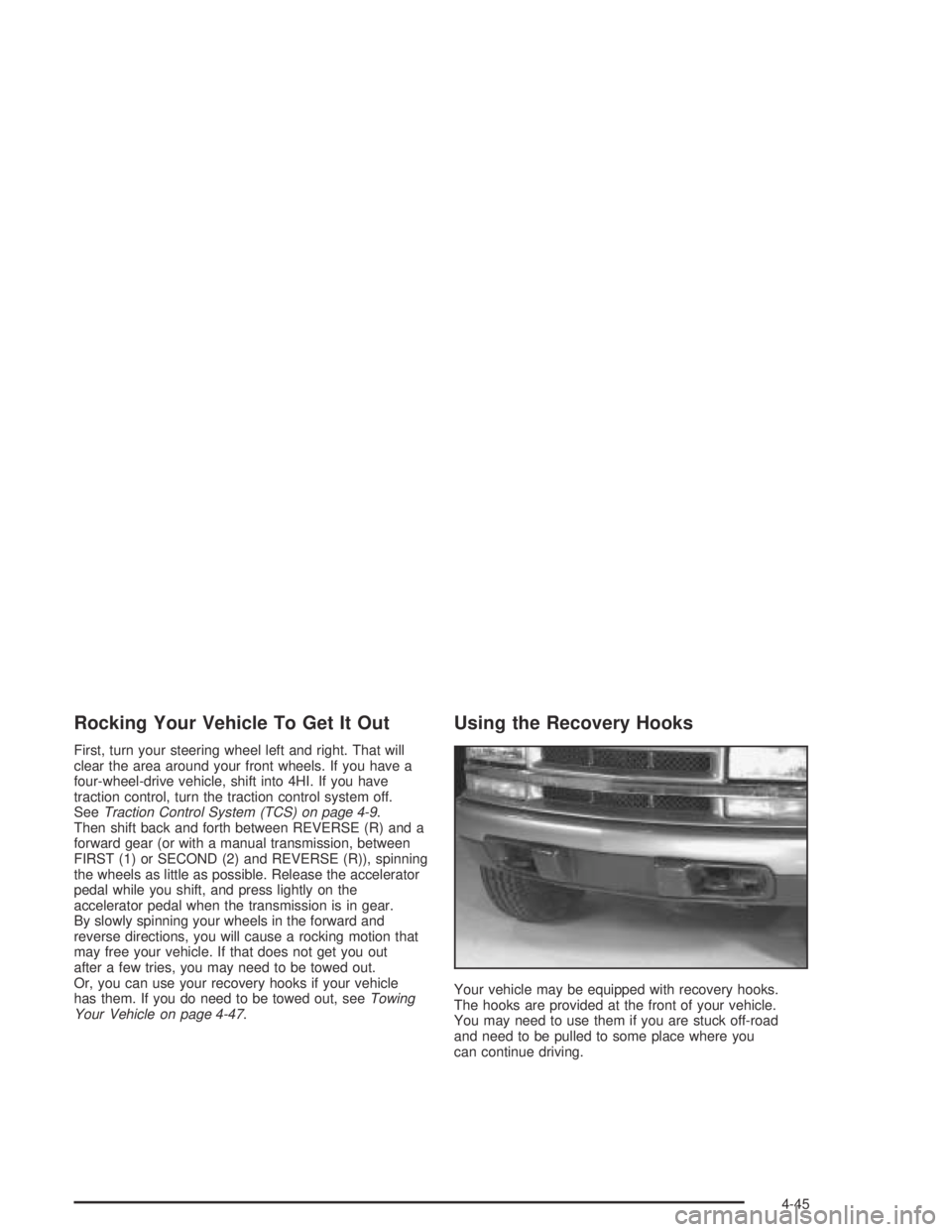
Or, you can use your recovery hooks if your vehicle
has them. If you do need to be towed out, seeTowing
Your Vehicle on page 4-47.
Using the Recovery Hooks
Your vehicle may be equipped with recovery hooks.
The hooks are provided at the front of your vehicle.
You may need to use them if you are stuck off-road
and need to be pulled to some place where you
can continue driving.
4-45
Page 332 of 420
Buying New Tires
To nd out what kind and size of tires you need, look at
the Certication/Tire label or the Tire and Loading
Information label. SeeLoading Your Vehicle on
page 4-52, for examples of these labels and where they
can be found on your vehicle.
The tires installed on your vehicle when it was new had
a Tire Performance Criteria Specication (TPC Spec)
number on each tire’s sidewall. When you get new tires,
GM recommends that you get tires with that same
TPC Spec number. That way your vehicle will continue
to have tires that are designed to give proper
endurance, handling, speed rating, traction, ride and
other things during normal service on your vehicle.
If your tires have an all-season tread design, the TPC
number will be followed by an “MS” (for mud and snow).
If you ever replace your tires with those not having a
TPC Spec number, make sure they are the same size,
load range, speed rating and construction type
(bias, bias-belted or radial) as your original tires.{CAUTION:
Mixing tires could cause you to lose control
while driving. If you mix tires of different sizes
or types (radial and bias-belted tires), the
vehicle may not handle properly, and you
could have a crash. Using tires of different
sizes may also cause damage to your vehicle.
Be sure to use the same size and type tires on
all wheels. It’s all right to drive with your
compact spare (if you have one). It was
developed for use on your vehicle.
{CAUTION:
If you use bias-ply tires on your vehicle, the
wheel rim anges could develop cracks after
many miles of driving. A tire and/or wheel
could fail suddenly, causing a crash. Use only
radial-ply tires with the wheels on your vehicle.
5-68
Page 333 of 420
Uniform Tire Quality Grading
Quality grades can be found where applicable on the
tire sidewall between tread shoulder and maximum
section width. For example:
Treadwear 200 Traction AA Temperature A
The following information relates to the system
developed by the United States National Highway
Traffic Safety Administration, which grades tires by
treadwear, traction and temperature performance.
(This applies only to vehicles sold in the United States.)
The grades are molded on the sidewalls of most
passenger car tires. The Uniform Tire Quality Grading
system does not apply to deep tread, winter-type
snow tires, space-saver or temporary use spare tires,
tires with nominal rim diameters of 10 to 12 inches
(25 to 30 cm), or to some limited-production tires.
While the tires available on General Motors passenger
cars and light trucks may vary with respect to these
grades, they must also conform to federal safety
requirements and additional General Motors Tire
Performance Criteria (TPC) standards.
Treadwear
The treadwear grade is a comparative rating based on
the wear rate of the tire when tested under controlled
conditions on a specied government test course.
For example, a tire graded 150 would wear one and
a half (1.5) times as well on the government course as
a tire graded 100. The relative performance of tires
depends upon the actual conditions of their use,
however, and may depart signicantly from the norm
due to variations in driving habits, service practices and
differences in road characteristics and climate.
Traction – AA, A, B, C
The traction grades, from highest to lowest, are AA, A,
B, and C. Those grades represent the tire’s ability
to stop on wet pavement as measured under controlled
conditions on specied government test surfaces of
asphalt and concrete. A tire marked C may have poor
traction performance. Warning: The traction grade
assigned to this tire is based on straight-ahead braking
traction tests, and does not include acceleration,
cornering, hydroplaning, or peak traction characteristics.
5-69
Page 336 of 420
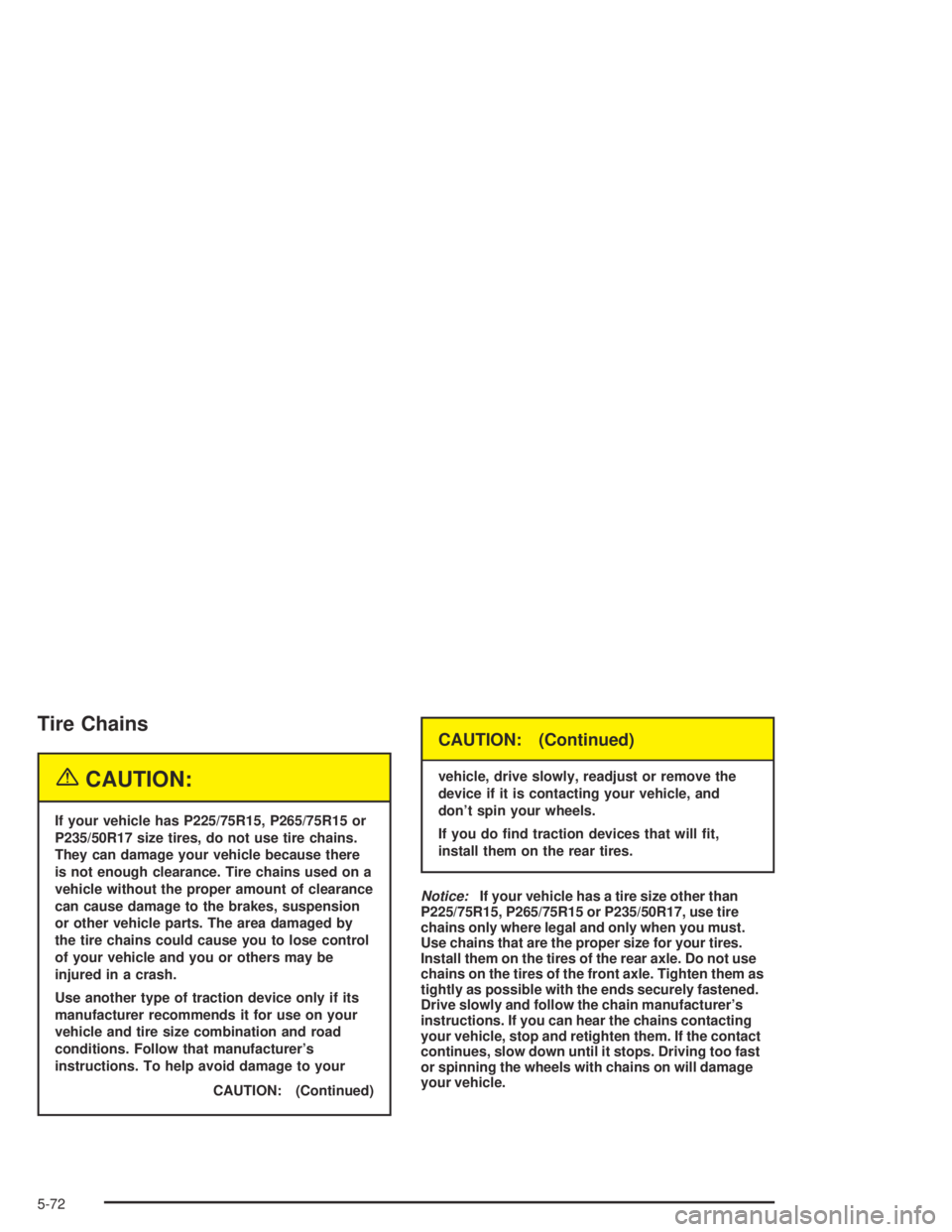
Tire Chains
{CAUTION:
If your vehicle has P225/75R15, P265/75R15 or
P235/50R17 size tires, do not use tire chains.
They can damage your vehicle because there
is not enough clearance. Tire chains used on a
vehicle without the proper amount of clearance
can cause damage to the brakes, suspension
or other vehicle parts. The area damaged by
the tire chains could cause you to lose control
of your vehicle and you or others may be
injured in a crash.
Use another type of traction device only if its
manufacturer recommends it for use on your
vehicle and tire size combination and road
conditions. Follow that manufacturer’s
instructions. To help avoid damage to your
CAUTION: (Continued)
CAUTION: (Continued)
vehicle, drive slowly, readjust or remove the
device if it is contacting your vehicle, and
don’t spin your wheels.
If you do nd traction devices that will t,
install them on the rear tires.
Notice:If your vehicle has a tire size other than
P225/75R15, P265/75R15 or P235/50R17, use tire
chains only where legal and only when you must.
Use chains that are the proper size for your tires.
Install them on the tires of the rear axle. Do not use
chains on the tires of the front axle. Tighten them as
tightly as possible with the ends securely fastened.
Drive slowly and follow the chain manufacturer’s
instructions. If you can hear the chains contacting
your vehicle, stop and retighten them. If the contact
continues, slow down until it stops. Driving too fast
or spinning the wheels with chains on will damage
your vehicle.
5-72
Page 412 of 420
J
Jump Starting.................................................5-42
K
Keyless Entry System....................................... 2-4
Keys............................................................... 2-2
LLamps
Exterior......................................................3-12
Interior.......................................................3-15
Lamps On Reminder.......................................3-13
Language......................................................3-39
Lap Belt........................................................1-24
Lap-Shoulder Belt...........................................1-16
LATCH System
Child Restraints...........................................1-46
Securing a Child Restraint Designed for
the LATCH System...........................1-48, 1-51
Latches, Seatback............................................ 1-8
Leaving Your Vehicle.......................................2-10
Leaving Your Vehicle With the
Engine Running..........................................2-31
Light
Air Bag Off .................................................3-26
Air Bag Readiness.......................................3-25Light (cont.)
Anti-Lock Brake System Warning...................3-29
Battery Warning..........................................3-27
Brake System Warning.................................3-28
Cruise Control.............................................3-35
Daytime Running Lamps Indicator..................3-36
Highbeam On.............................................3-35
Malfunction Indicator....................................3-30
Oil Pressure...............................................3-34
Safety Belt Reminder...................................3-24
Security.....................................................3-35
Up-Shift.....................................................3-28
Loading Your Vehicle.......................................4-52
Loading Your Vehicle for Off-Road Driving..........4-16
Lockout Protection............................................ 2-9
Locks
Door........................................................... 2-7
Leaving Your Vehicle....................................2-10
Lockout Protection......................................... 2-9
Power Door.................................................. 2-8
Programmable Automatic Door Locks............... 2-8
Rear Door Security Locks............................... 2-9
Loss of Control...............................................4-14
LOW FUEL....................................................3-41
LOW TRAC (Traction).....................................3-41
Lumbar
Manual Controls............................................ 1-5
8
Page 418 of 420
T
Tachometer....................................................3-24
Tailgate.........................................................2-10
Taillamps
Turn Signal, Stoplamps and
Back-up Lamps........................................5-53
Temperature Display Operation.........................2-39
Temperature Knob...........................................3-18
Testing the Alarm............................................2-15
Theft-Deterrent, Radio.....................................3-67
Theft-Deterrent Systems...................................2-14
Content Theft-Deterrent................................2-14
Passlock
®...................................................2-16
Tilt Wheel........................................................ 3-5
Tire Sidewall Labeling......................................5-58
Tire Size.......................................................5-61
Tire Terminology and Denitions........................5-62
Tires.............................................................5-57
Buying New Tires........................................5-68
Chains.......................................................5-72
Changing a Flat Tire....................................5-74
If a Tire Goes Flat.......................................5-73
Ination - Tire Pressure................................5-64
Inspection and Rotation................................5-65
Spare Tire..................................................5-93
Uniform Tire Quality Grading.........................5-69
Wheel Alignment and Tire Balance.................5-70Tires (cont.)
Wheel Replacement.....................................5-70
When It Is Time for New Tires......................5-67
To Use the Engine Coolant Heater....................2-20
Top Strap......................................................1-42
Top Strap Anchor Location...............................1-44
Torque Lock...................................................2-32
Total Weight on Your Vehicle’s Tires..................4-68
Towing
Recreational Vehicle.....................................4-47
Towing a Trailer..........................................4-60
Your Vehicle...............................................4-47
Traction
Control System (TCS).................................... 4-9
TRACTION FAULT..........................................3-42
Trailer
Recommendations.......................................4-59
Trailer Brakes.................................................4-69
Transfer Case................................................5-48
Transmission
Fluid, Automatic...........................................5-19
Fluid, Manual..............................................5-22
Up-Shift Light..............................................3-28
Transmission Operation, Automatic....................2-21
Transmission Operation, Manual........................2-24
Transmission, Transaxle, Transfer Case Unit
Repair Manual............................................7-11
Transportation Options...................................... 7-8
14