tow GMC CANYON 2004 Owner's Guide
[x] Cancel search | Manufacturer: GMC, Model Year: 2004, Model line: CANYON, Model: GMC CANYON 2004Pages: 420, PDF Size: 2.84 MB
Page 237 of 420
Rocking Your Vehicle To Get It Out
First, turn your steering wheel left and right. That will
clear the area around your front wheels. If you have a
four-wheel-drive vehicle, shift into 4HI. If you have
traction control, turn the traction control system off.
SeeTraction Control System (TCS) on page 4-9.
Then shift back and forth between REVERSE (R) and a
forward gear (or with a manual transmission, between
FIRST (1) or SECOND (2) and REVERSE (R)), spinning
the wheels as little as possible. Release the accelerator
pedal while you shift, and press lightly on the
accelerator pedal when the transmission is in gear.
By slowly spinning your wheels in the forward and
reverse directions, you will cause a rocking motion that
may free your vehicle. If that does not get you out
after a few tries, you may need to be towed out.
Or, you can use your recovery hooks if your vehicle
has them. If you do need to be towed out, seeTowing
Your Vehicle on page 4-47.
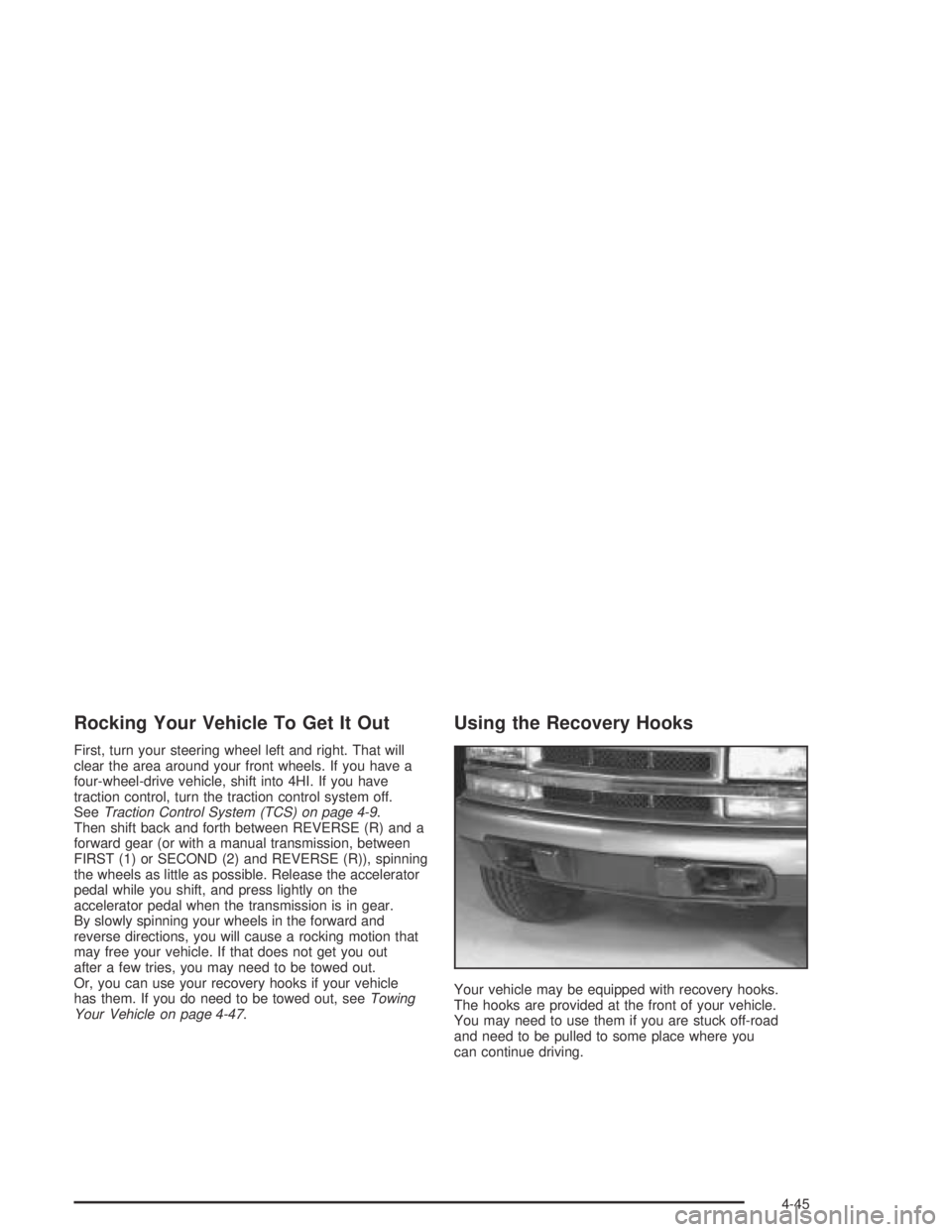
Using the Recovery Hooks
Your vehicle may be equipped with recovery hooks.
The hooks are provided at the front of your vehicle.
You may need to use them if you are stuck off-road
and need to be pulled to some place where you
can continue driving.
4-45
Page 238 of 420
{CAUTION:
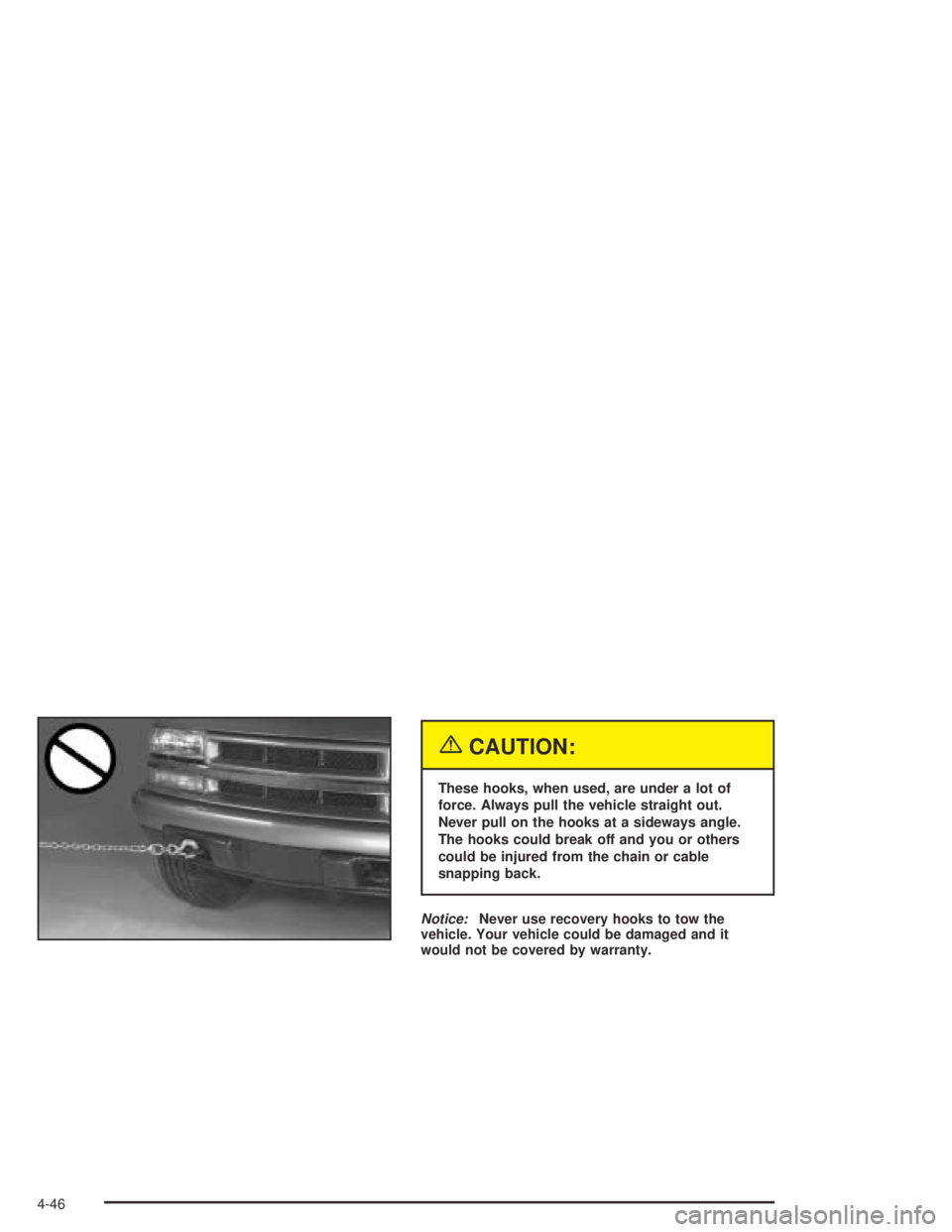
These hooks, when used, are under a lot of
force. Always pull the vehicle straight out.
Never pull on the hooks at a sideways angle.
The hooks could break off and you or others
could be injured from the chain or cable
snapping back.
Notice:Never use recovery hooks to tow the
vehicle. Your vehicle could be damaged and it
would not be covered by warranty.
4-46
Page 239 of 420
Towing
Towing Your Vehicle
Consult your dealer or a professional towing service if
you need to have your disabled vehicle towed.
SeeRoadside Assistance Program on page 7-6.
If you want to tow your vehicle behind another vehicle
for recreational purposes (such as behind a motorhome),
see “Recreational Vehicle Towing” following.
Recreational Vehicle Towing
Recreational vehicle towing means towing your vehicle
behind another vehicle — such as behind a motorhome.
The two most common types of recreational vehicle
towing are known as “dinghy (towing your vehicle with
all four wheels on the ground) and “dolly (towing
your vehicle with two wheels on the ground and
two wheels up on a device known as a “dolly”).With the proper preparation and equipment, many
vehicles can be towed in these ways. See “Dinghy
Towing” and “Dolly Towing” following.
Here are some important things to consider before you
do recreational vehicle towing:
What’s the towing capacity of the towing vehicle?
Be sure you read the tow vehicle manufacturer’s
recommendations.
How far will you tow? Some vehicles have
restrictions on how far and how long they can tow.
Do you have the proper towing equipment?
See your dealer or trailering professional for
additional advice and equipment recommendations.
Is your vehicle ready to be towed? Just as you
would prepare your vehicle for a long trip, you’ll
want to make sure your vehicle is prepared to
be towed.
4-47
Page 240 of 420
Dinghy Towing
Two-Wheel Drive Vehicles
Notice:If you tow your vehicle with all four wheels
on the ground, the drivetrain components could
be damaged. The repairs would not be covered by
your warranty. Do not tow your vehicle with all
four wheels on the ground.
Two-wheel-drive vehicles should not be towed with
all four wheels on the ground. Two-wheel-drive
transmissions have no provisions for internal lubrication
while being towed.
Four-Wheel Drive Vehicles
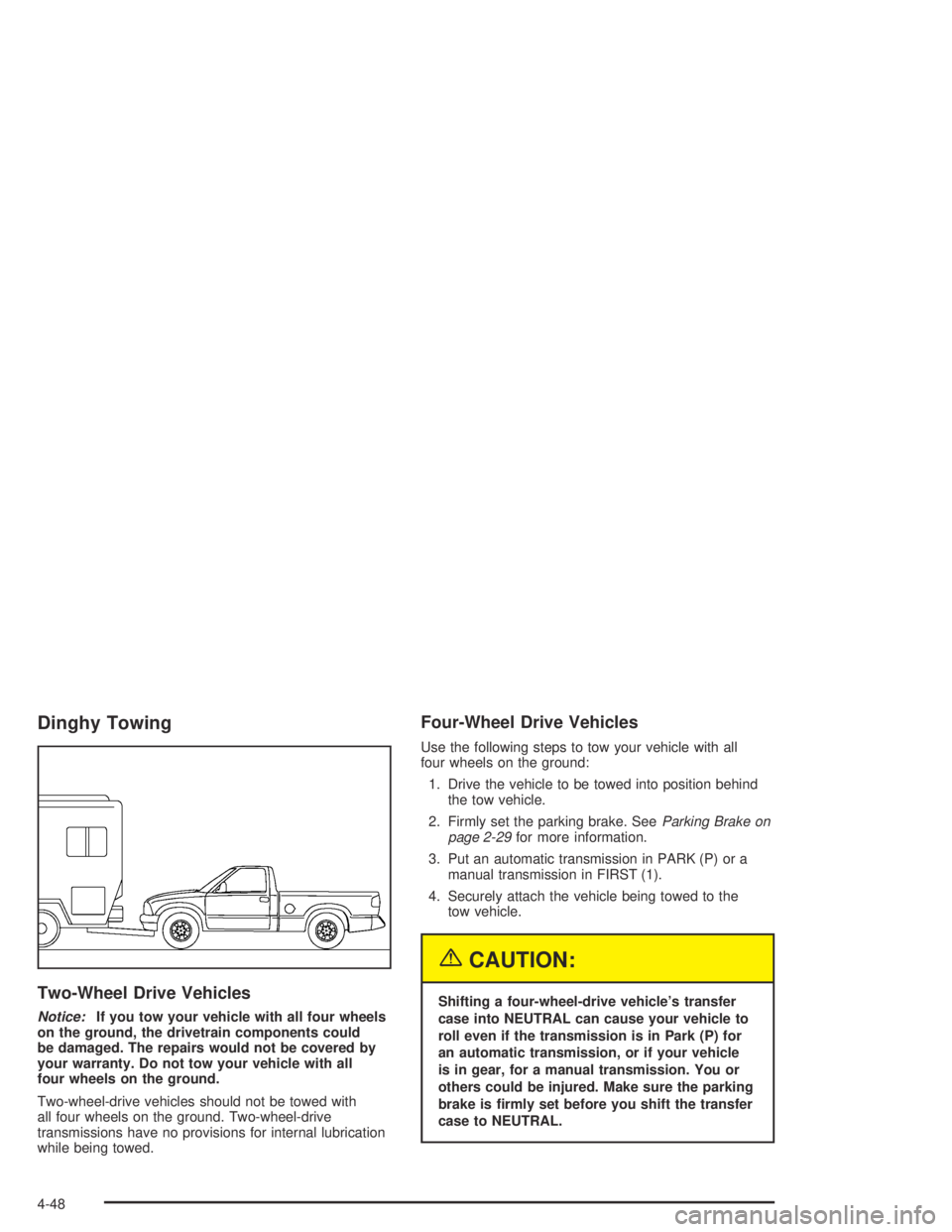
Use the following steps to tow your vehicle with all
four wheels on the ground:
1. Drive the vehicle to be towed into position behind
the tow vehicle.
2. Firmly set the parking brake. SeeParking Brake on
page 2-29for more information.
3. Put an automatic transmission in PARK (P) or a
manual transmission in FIRST (1).
4. Securely attach the vehicle being towed to the
tow vehicle.
{CAUTION:
Shifting a four-wheel-drive vehicle’s transfer
case into NEUTRAL can cause your vehicle to
roll even if the transmission is in Park (P) for
an automatic transmission, or if your vehicle
is in gear, for a manual transmission. You or
others could be injured. Make sure the parking
brake is rmly set before you shift the transfer
case to NEUTRAL.
4-48
Page 241 of 420
5. Shift the transfer case to NEUTRAL.
SeeFour-Wheel Drive on page 2-26for
more information.
6. Release the parking brake only after the vehicle
being towed is rmly attached to the towing
vehicle.
Notice:If you exceed 55 mph (90 km/h) while towing
your vehicle, it could be damaged. Never exceed
55 mph (90 km/h) while towing your vehicle.
7. Turn the ignition to LOCK. To prevent your
battery from draining while towing, remove the
RDO BATT and CLSTR fuses from the instrument
panel fuse block. Be sure to replace the fuse
when you reach your destination. SeeFuses and
Circuit Breakers on page 5-104for more information.
After towing see “Shifting out of NEUTRAL” under
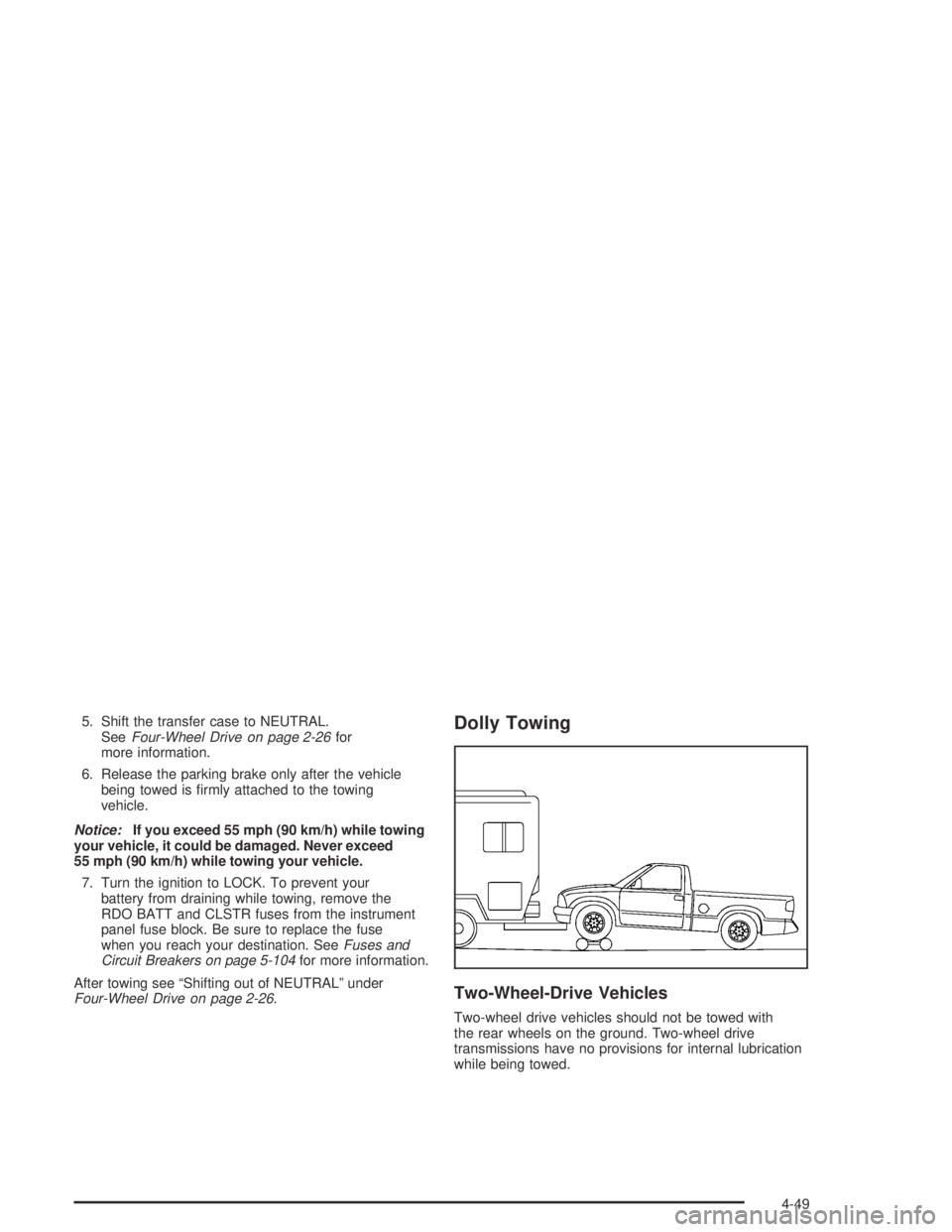
Four-Wheel Drive on page 2-26.Dolly Towing
Two-Wheel-Drive Vehicles
Two-wheel drive vehicles should not be towed with
the rear wheels on the ground. Two-wheel drive
transmissions have no provisions for internal lubrication
while being towed.
4-49
Page 242 of 420
Four-Wheel-Drive Vehicles
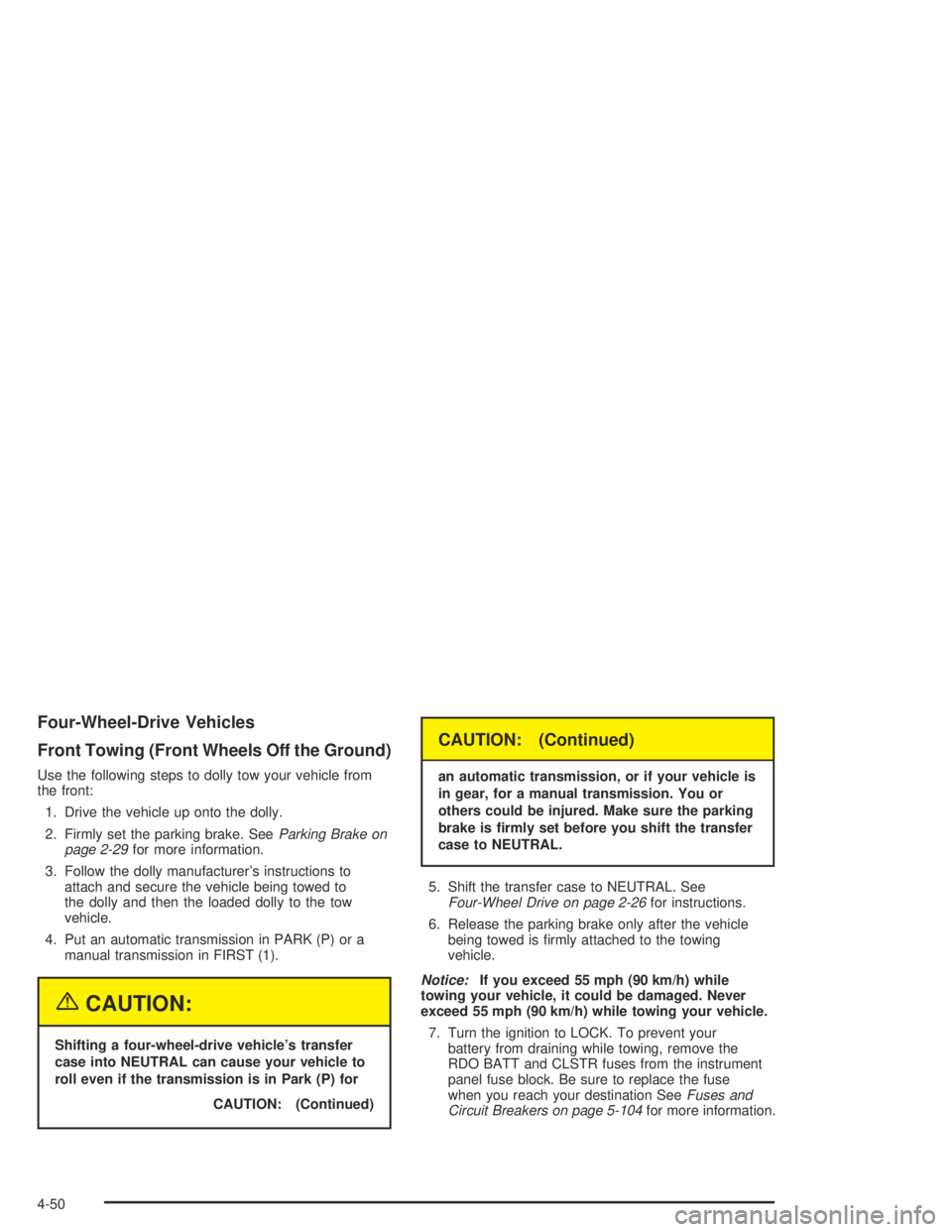
Front Towing (Front Wheels Off the Ground)
Use the following steps to dolly tow your vehicle from
the front:
1. Drive the vehicle up onto the dolly.
2. Firmly set the parking brake. SeeParking Brake on
page 2-29for more information.
3. Follow the dolly manufacturer’s instructions to
attach and secure the vehicle being towed to
the dolly and then the loaded dolly to the tow
vehicle.
4. Put an automatic transmission in PARK (P) or a
manual transmission in FIRST (1).
{CAUTION:
Shifting a four-wheel-drive vehicle’s transfer
case into NEUTRAL can cause your vehicle to
roll even if the transmission is in Park (P) for
CAUTION: (Continued)
CAUTION: (Continued)
an automatic transmission, or if your vehicle is
in gear, for a manual transmission. You or
others could be injured. Make sure the parking
brake is rmly set before you shift the transfer
case to NEUTRAL.
5. Shift the transfer case to NEUTRAL. See
Four-Wheel Drive on page 2-26for instructions.
6. Release the parking brake only after the vehicle
being towed is rmly attached to the towing
vehicle.
Notice:If you exceed 55 mph (90 km/h) while
towing your vehicle, it could be damaged. Never
exceed 55 mph (90 km/h) while towing your vehicle.
7. Turn the ignition to LOCK. To prevent your
battery from draining while towing, remove the
RDO BATT and CLSTR fuses from the instrument
panel fuse block. Be sure to replace the fuse
when you reach your destination SeeFuses and
Circuit Breakers on page 5-104for more information.
4-50
Page 243 of 420
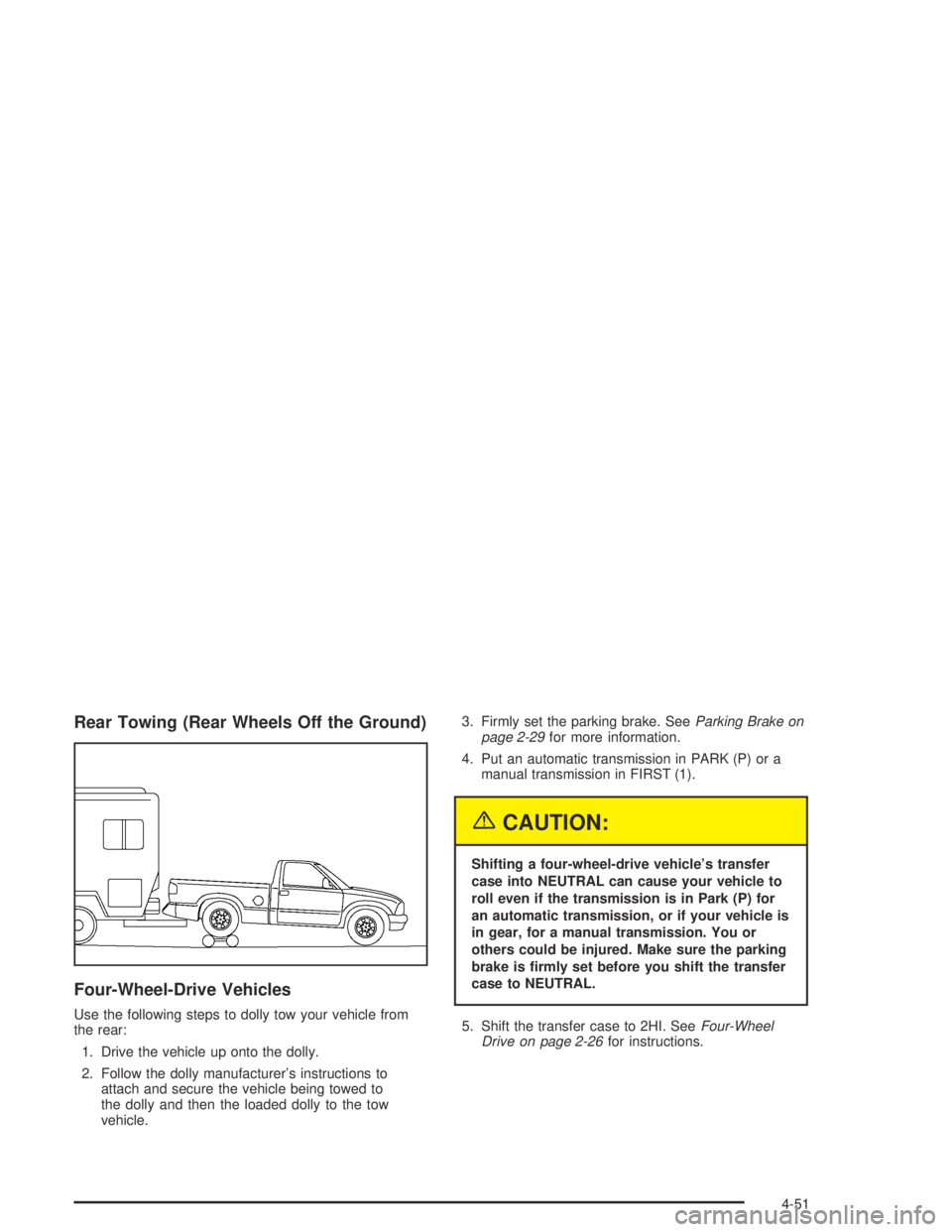
Rear Towing (Rear Wheels Off the Ground)
Four-Wheel-Drive Vehicles
Use the following steps to dolly tow your vehicle from
the rear:
1. Drive the vehicle up onto the dolly.
2. Follow the dolly manufacturer’s instructions to
attach and secure the vehicle being towed to
the dolly and then the loaded dolly to the tow
vehicle.3. Firmly set the parking brake. SeeParking Brake on
page 2-29for more information.
4. Put an automatic transmission in PARK (P) or a
manual transmission in FIRST (1).
{CAUTION:
Shifting a four-wheel-drive vehicle’s transfer
case into NEUTRAL can cause your vehicle to
roll even if the transmission is in Park (P) for
an automatic transmission, or if your vehicle is
in gear, for a manual transmission. You or
others could be injured. Make sure the parking
brake is rmly set before you shift the transfer
case to NEUTRAL.
5. Shift the transfer case to 2HI. SeeFour-Wheel
Drive on page 2-26for instructions.
4-51
Page 244 of 420
6. Release the parking brake only after the vehicle
being towed is rmly attached to the towing
vehicle.
Notice:If you exceed 55 mph (90 km/h) while
towing your vehicle, it could be damaged. Never
exceed 55 mph (90 km/h) while towing your vehicle.
7. Turn the ignition to LOCK. To prevent your
battery from draining while towing, remove the
RDO BATT and CLSTR fuses from the instrument
panel fuse block. Be sure to replace the fuse
when you reach your destination SeeFuses and
Circuit Breakers on page 5-104for more information.
After towing see “Shifting out of NEUTRAL” under
Four-Wheel Drive on page 2-26.Loading Your Vehicle
It is very important to know how much weight your
vehicle can carry. This weight is called the vehicle
capacity weight and includes the weight of all occupants,
cargo and all nonfactory-installed options. Two labels
on your vehicle show how much weight it may properly
carry, the Tire and Loading Information label and the
Certication/Tire label.
{CAUTION:
Do not load your vehicle any heavier than the
GVWR, or either the maximum front or rear
GAWR. If you do, parts on your vehicle can
break, and it can change the way your vehicle
handles. These could cause you to lose
control and crash. Also, overloading can
shorten the life of your vehicle.
4-52
Page 246 of 420
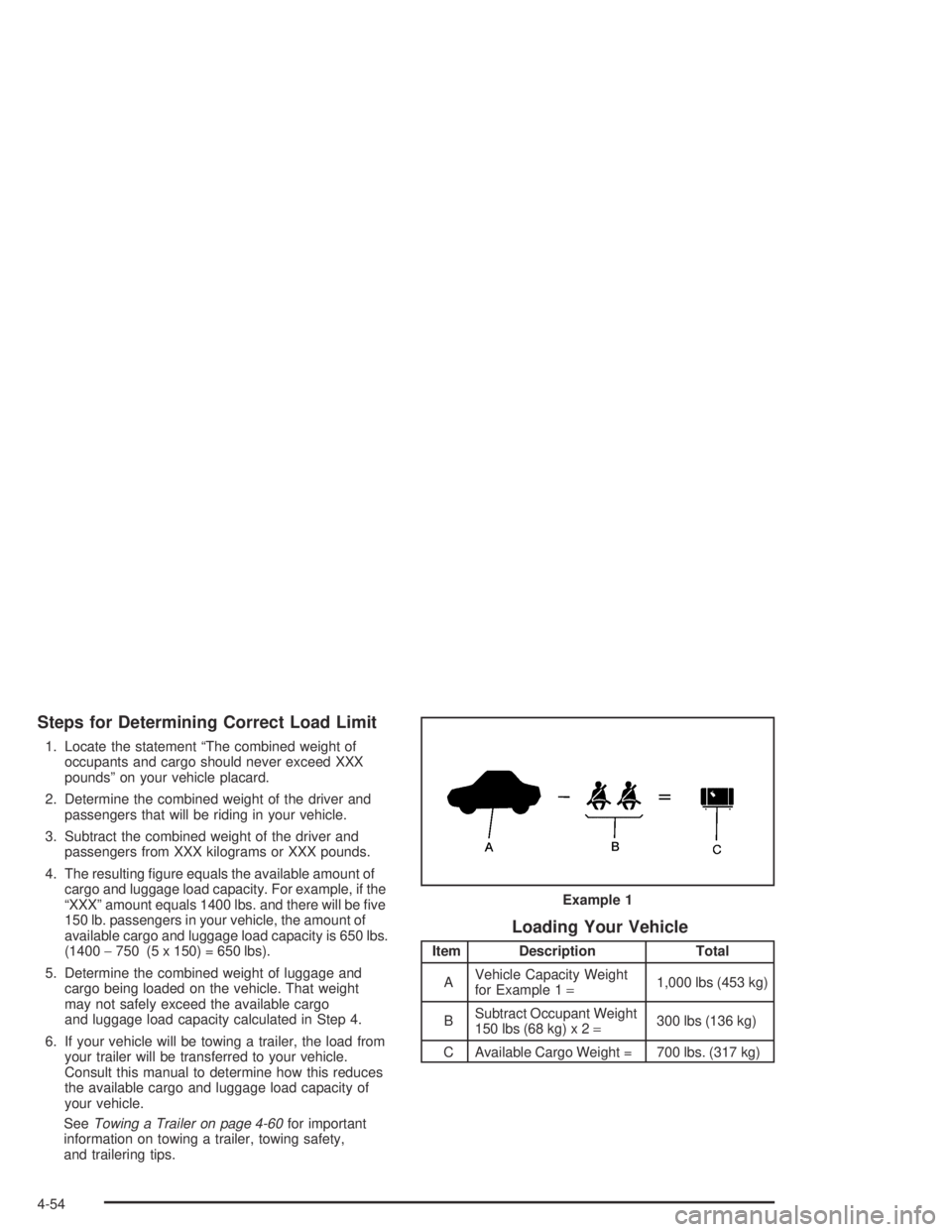
Steps for Determining Correct Load Limit
1. Locate the statement “The combined weight of
occupants and cargo should never exceed XXX
pounds” on your vehicle placard.
2. Determine the combined weight of the driver and
passengers that will be riding in your vehicle.
3. Subtract the combined weight of the driver and
passengers from XXX kilograms or XXX pounds.
4. The resulting gure equals the available amount of
cargo and luggage load capacity. For example, if the
“XXX” amount equals 1400 lbs. and there will be ve
150 lb. passengers in your vehicle, the amount of
available cargo and luggage load capacity is 650 lbs.
(1400−750 (5 x 150) = 650 lbs).
5. Determine the combined weight of luggage and
cargo being loaded on the vehicle. That weight
may not safely exceed the available cargo
and luggage load capacity calculated in Step 4.
6. If your vehicle will be towing a trailer, the load from
your trailer will be transferred to your vehicle.
Consult this manual to determine how this reduces
the available cargo and luggage load capacity of
your vehicle.
SeeTowing a Trailer on page 4-60for important
information on towing a trailer, towing safety,
and trailering tips.
Loading Your Vehicle
Item Description Total
AVehicle Capacity Weight
for Example 1=1,000 lbs (453 kg)
BSubtract Occupant Weight
150 lbs (68 kg) x 2=300 lbs (136 kg)
C Available Cargo Weight = 700 lbs. (317 kg)Example 1
4-54
Page 251 of 420
Truck-Camper Loading Information
Your vehicle was not designed to carry a slide-in
camper.
Trailer Recommendations
You must subtract your hitch load from the CWR for
your vehicle. Weigh your vehicle with your trailer
attached, so that you won’t go over the GVWR or the
GAWR.
You’ll get the best performance if you spread out the
weight of your load the right way, and if you choose the
correct hitch and trailer brakes.
For more information, seeTowing a Trailer on page 4-60
later in this section.
Pickup Conversion to Chassis Cab
General Motors is aware that some vehicle owners may
consider having the pickup box removed and a
commercial or recreational body installed. However, we
recommend that conversions of this type not be done
to pickups. Owners should be aware that, as
manufactured, there are differences between a chassis
cab and a pickup with the box removed which may
affect vehicle safety. For specic information on
this pickup, contact GM Customer Assistance.
SeeCustomer Assistance Offices on page 7-4.
4-59