change wheel GMC CANYON 2005 User Guide
[x] Cancel search | Manufacturer: GMC, Model Year: 2005, Model line: CANYON, Model: GMC CANYON 2005Pages: 420, PDF Size: 2.73 MB
Page 228 of 420
Driving in Mud, Sand, Snow or Ice
When you drive in mud, snow or sand, your wheels
will not get good traction. You cannot accelerate
as quickly, turning is more difficult, and you will need
longer braking distances.
It is best to use a low gear when you are in mud — the
deeper the mud, the lower the gear. In really deep mud,
the idea is to keep your vehicle moving so you do
not get stuck.
When you drive on sand, you will sense a change in
wheel traction. But it will depend upon how loosely
packed the sand is. On loosely packed sand (as on
beaches or sand dunes) your tires will tend to sink into
the sand. This has an effect on steering, accelerating
and braking. Drive at a reduced speed
and avoid sharp turns or abrupt maneuvers.
Hard packed snow and ice offer the worst tire traction.
On these surfaces, it is very easy to lose control.
On wet ice, for example, the traction is so poor that you
will have difficulty accelerating. And if you do get
moving, poor steering and difficult braking can cause
you to slide out of control.{CAUTION:
Driving on frozen lakes, ponds or rivers can be
dangerous. Underwater springs, currents under
the ice, or sudden thaws can weaken the ice.
Your vehicle could fall through the ice and you
and your passengers could drown. Drive your
vehicle on safe surfaces only.
Driving in Water
Heavy rain can mean ash ooding, and ood waters
demand extreme caution.
Find out how deep the water is before you drive through
it. If it is deep enough to cover your wheel hubs,
axles or exhaust pipe, do not try it — you probably will
not get through. Also, water that deep can damage
your axle and other vehicle parts.
4-26
Page 269 of 420
Following Distance
Stay at least twice as far behind the vehicle ahead as
you would when driving your vehicle without a trailer.
This can help you avoid situations that require
heavy braking and sudden turns.
Passing
You’ll need more passing distance up ahead when
you’re towing a trailer. And, because you’re a good deal
longer, you’ll need to go much farther beyond the
passed vehicle before you can return to your lane.
Backing Up
Hold the bottom of the steering wheel with one hand.
Then, to move the trailer to the left, just move that hand
to the left. To move the trailer to the right, move your
hand to the right. Always back up slowly and, if possible,
have someone guide you.
Making Turns
Notice:Making very sharp turns while trailering
could cause the trailer to come in contact with the
vehicle. Your vehicle could be damaged. Avoid
making very sharp turns while trailering.
When you’re turning with a trailer, make wider turns than
normal. Do this so your trailer won’t strike soft shoulders,
curbs, road signs, trees or other objects. Avoid jerky or
sudden maneuvers. Signal well in advance.
Turn Signals When Towing a Trailer
When you tow a trailer, your vehicle has to have extra
wiring and a heavy-duty turn signal asher.
The arrows on your instrument panel will ash whenever
you signal a turn or lane change. Properly hooked up,
the trailer lamps will also ash, telling other drivers
you’re about to turn, change lanes or stop.
When towing a trailer, the arrows on your instrument
panel will ash for turns even if the bulbs on the trailer
are burned out. Thus, you may think drivers behind
you are seeing your signal when they are not. It’s
important to check occasionally to be sure the trailer
bulbs are still working.
4-67
Page 335 of 420
After the tires have been rotated, adjust the front and
rear ination pressures as shown on the Tire and
Loading Information label. For the location of the tire
and loading information label seeLoading Your Vehicle
on page 4-44. Make certain that all wheel nuts are
properly tightened, see “Wheel Nut Torque” under
Capacities and Specications on page 5-103for the
proper wheel nut torque specication.
{CAUTION:
Rust or dirt on a wheel, or on the parts to
which it is fastened, can make wheel nuts
become loose after a time. The wheel could
come off and cause an accident. When you
change a wheel, remove any rust or dirt from
places where the wheel attaches to the vehicle.
In an emergency, you can use a cloth or a
paper towel to do this; but be sure to use a
scraper or wire brush later, if you need to,
to get all the rust or dirt off. SeeChanging a
Flat Tire on page 5-70.
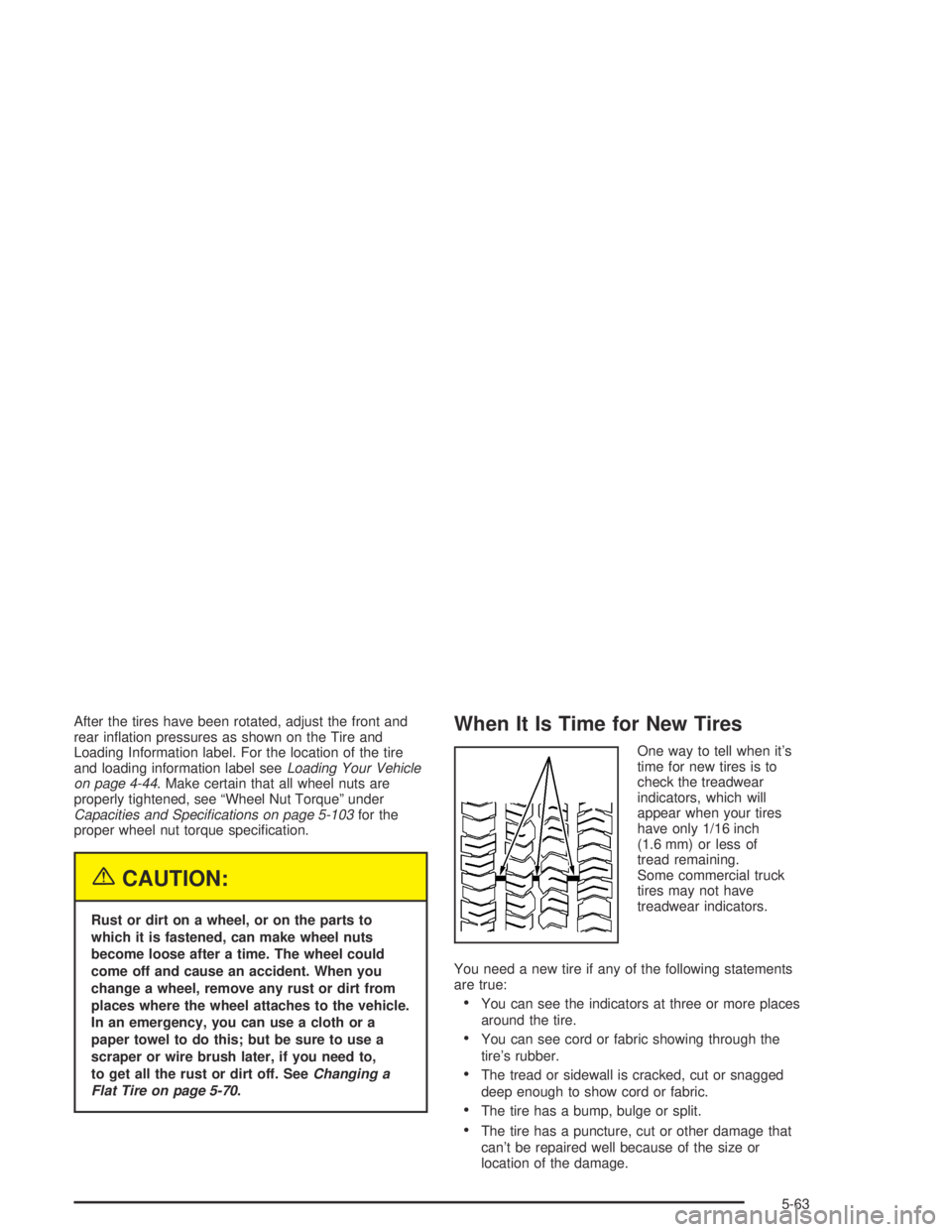
When It Is Time for New Tires
One way to tell when it’s
time for new tires is to
check the treadwear
indicators, which will
appear when your tires
have only 1/16 inch
(1.6 mm) or less of
tread remaining.
Some commercial truck
tires may not have
treadwear indicators.
You need a new tire if any of the following statements
are true:
You can see the indicators at three or more places
around the tire.
You can see cord or fabric showing through the
tire’s rubber.
The tread or sidewall is cracked, cut or snagged
deep enough to show cord or fabric.
The tire has a bump, bulge or split.
The tire has a puncture, cut or other damage that
can’t be repaired well because of the size or
location of the damage.
5-63
Page 341 of 420
If a Tire Goes Flat
It’s unusual for a tire to “blowout” while you’re driving,
especially if you maintain your tires properly. If air goes
out of a tire, it’s much more likely to leak out slowly.
But if you should ever have a “blowout,” here are a few
tips about what to expect and what to do:
If a front tire fails, the at tire will create a drag that
pulls the vehicle toward that side. Take your foot off the
accelerator pedal and grip the steering wheel rmly.
Steer to maintain lane position, and then gently brake to
a stop well out of the traffic lane.
A rear blowout, particularly on a curve, acts much like a
skid and may require the same correction you’d use
in a skid. In any rear blowout, remove your foot from the
accelerator pedal. Get the vehicle under control by
steering the way you want the vehicle to go. It may be
very bumpy and noisy, but you can still steer. Gently
brake to a stop, well off the road if possible.{CAUTION:
Lifting a vehicle and getting under it to do
maintenance or repairs is dangerous without
the appropriate safety equipment and training.
The jack provided with your vehicle is
designed only for changing a at tire. If it is
used for anything else, you or others could be
badly injured or killed if the vehicle slips off
the jack. Use the jack provided with your
vehicle only for changing a at tire.
If a tire goes at, the next part shows how to use your
jacking equipment to change a at tire safely.
5-69
Page 342 of 420
Changing a Flat Tire
If a tire goes at, avoid further tire and wheel damage
by driving slowly to a level place. Turn on your
hazard warning ashers.
{CAUTION:
Changing a tire can be dangerous. The vehicle
can slip off the jack and roll over or fall on you
or other people. You and they could be badly
injured or even killed. Find a level place to
change your tire. To help prevent the vehicle
from moving:
1. Set the parking brake rmly.
2. Put an automatic transmission shift lever in
PARK (P), or shift a manual transmission to
FIRST (1) or REVERSE (R).
3. If you have a four-wheel-drive vehicle,
be sure the transfer case is in a drive
gear — not in NEUTRAL.
4. Turn off the engine and do not restart while
the vehicle is raised.
5. Do not allow passengers to remain in
the vehicle.
CAUTION: (Continued)
CAUTION: (Continued)
To be even more certain the vehicle won’t
move, you can put blocks at the front and rear
of the tire farthest away from the one being
changed. That would be the tire on the other
side, at the opposite end of the vehicle.
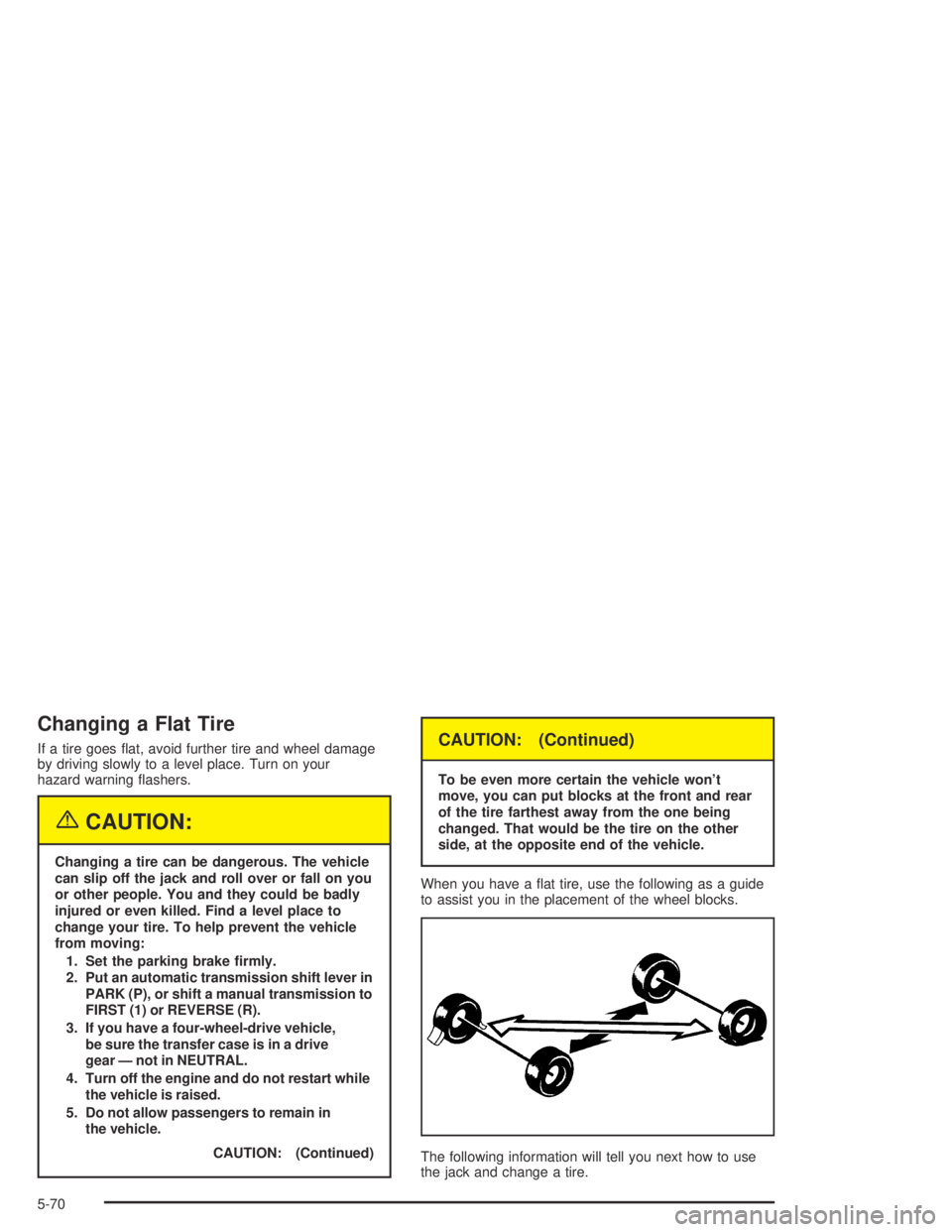
When you have a at tire, use the following as a guide
to assist you in the placement of the wheel blocks.
The following information will tell you next how to use
the jack and change a tire.
5-70
Page 344 of 420
2. Turn the wing nut on the cover counterclockwise to
remove it.
For crew cab models, reach under the rear seat to
access the jack and wheel blocks. To reinstall the
jack and wheel block assembly in the mounting
bracket, insert the tabs into the jack base by pushing
the blocks up into the assembly. The outer hole in the
jack base aligns with the tab on the bracket.
When reinstalling, make sure the jack is secure,
but do not overtighten the jack in the bracket.
3. Remove the wheel blocks and the wheel block
retainer by turning the wing nut counterclockwise.
4. Put the wheel blocks at the front and rear of the tire
farthest away from the one being changed.
That would be the tire on the other side, at the
opposite end of the vehicle.
5. Locate the wing nut used to retain the storage bag
and tools which is under the front passenger’s seat.
Remove it by turning the wing nut counterclockwise.You will use the jack handle extensions and the wheel
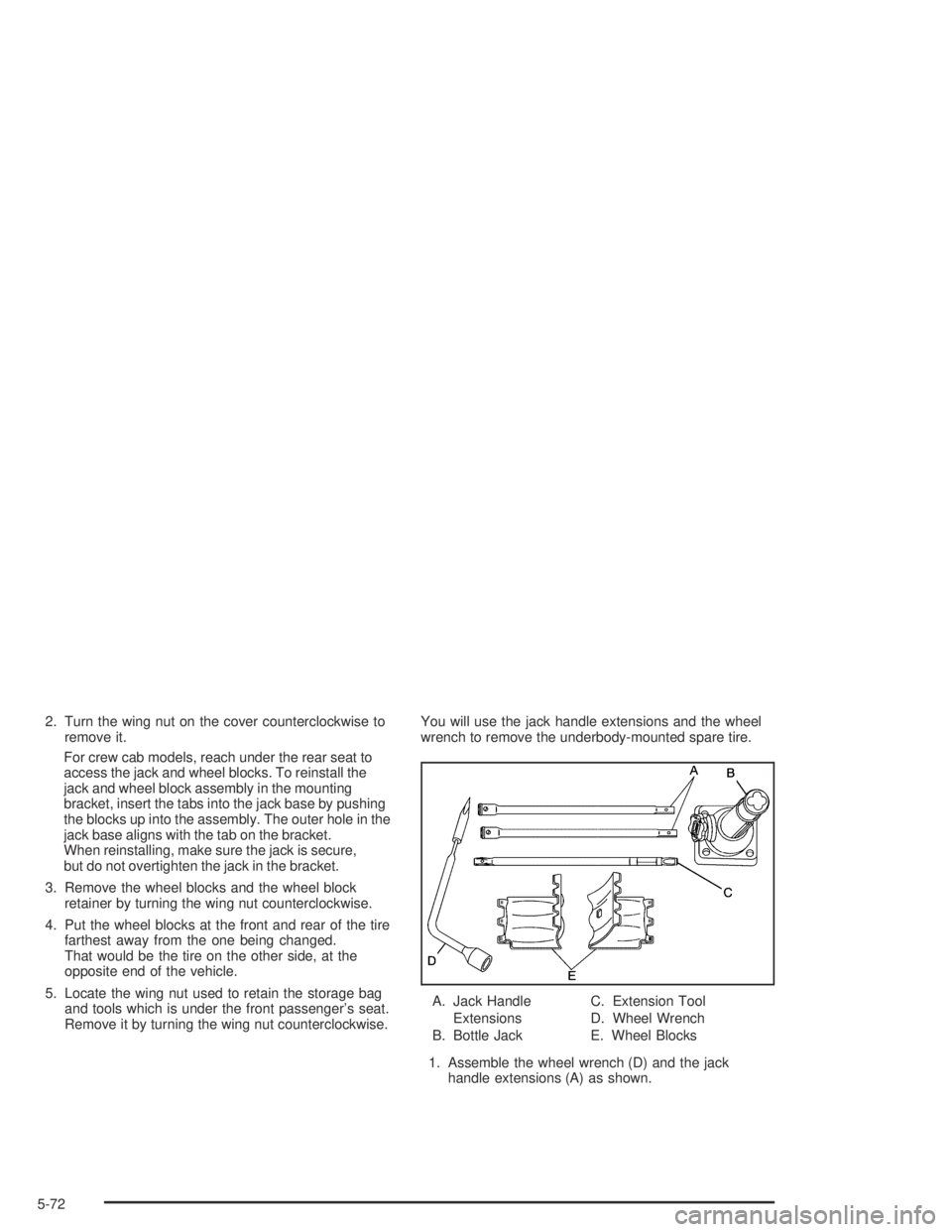
wrench to remove the underbody-mounted spare tire.
A. Jack Handle
Extensions
B. Bottle JackC. Extension Tool
D. Wheel Wrench
E. Wheel Blocks
1. Assemble the wheel wrench (D) and the jack
handle extensions (A) as shown.
5-72
Page 350 of 420
{CAUTION:
Rust or dirt on the wheel, or on the parts to
which it is fastened, can make the wheel nuts
become loose after a time. The wheel could
come off and cause an accident. When you
change a wheel, remove any rust or dirt from
the places where the wheel attaches to the
vehicle. In an emergency, you can use a cloth
or a paper towel to do this; but be sure to use
a scraper or wire brush later, if you need to,
to get all the rust or dirt off.
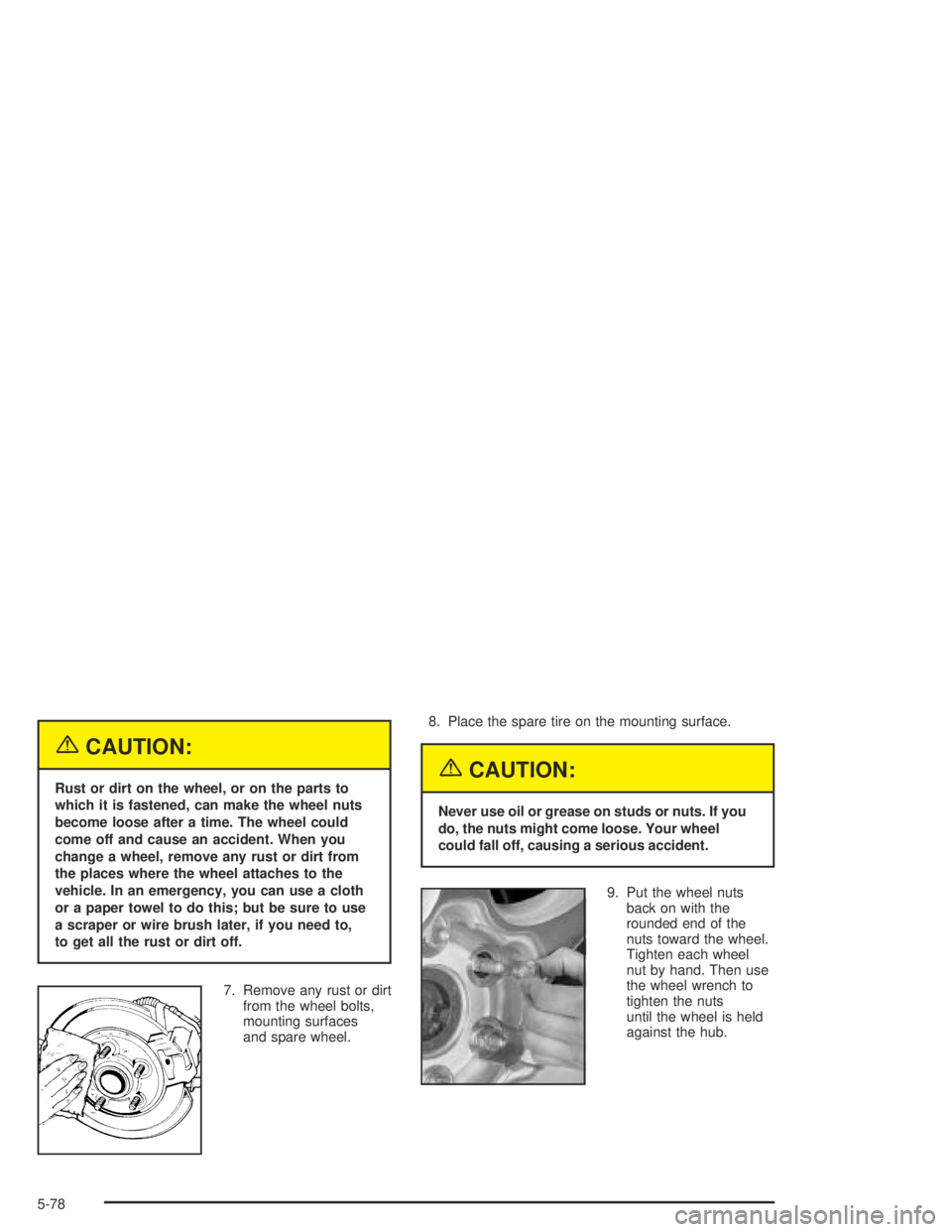
7. Remove any rust or dirt
from the wheel bolts,
mounting surfaces
and spare wheel.8. Place the spare tire on the mounting surface.{CAUTION:
Never use oil or grease on studs or nuts. If you
do, the nuts might come loose. Your wheel
could fall off, causing a serious accident.
9. Put the wheel nuts
back on with the
rounded end of the
nuts toward the wheel.
Tighten each wheel
nut by hand. Then use
the wheel wrench to
tighten the nuts
until the wheel is held
against the hub.
5-78
Page 418 of 420
Service........................................................... 5-3
Adding Equipment to the Outside of
Your Vehicle.............................................. 5-5
Doing Your Own Work................................... 5-4
Engine Soon Light.......................................3-30
Publications Ordering Information...................7-11
Servicing Your Airbag-Equipped Vehicle..............1-74
Setting the Time
Radios with Radio Data Systems (RDS)............3-45
Radios without Radio Data Systems (RDS)........3-44
Sheet Metal Damage.......................................5-96
Shifting Into Park (P).......................................2-30
Shifting Out of Park (P)...................................2-32
Shoulder Belt Height Adjuster...........................1-23
Signals, Turn and Lane-Change.......................... 3-8
Sliding Rear Windows.....................................2-14
Spare Tire.....................................................5-88
Installing....................................................5-74
Removing...................................................5-71
Storing.......................................................5-84
Specications, Capacities...............................5-103
Speedometer..................................................3-24
Starting Your Engine.......................................2-18
Steering........................................................4-10
Steering Wheel, Tilt Wheel................................. 3-7Storage Areas
Cupholder(s)...............................................2-42
Front Armrest Storage Area...........................2-42
Glove Box..................................................2-42
Rear Storage Area.......................................2-43
Stuck in Sand, Mud, Ice or Snow......................4-42
Sun Visors.....................................................2-14
T
Tachometer....................................................3-24
Tailgate.........................................................2-10
Taillamps
Turn Signal, Stoplamps and Back-up Lamps......5-50
Theft-Deterrent, Radio.....................................3-74
Theft-Deterrent Systems...................................2-14
Content Theft-Deterrent................................2-14
Passlock
®...................................................2-16
Tilt Wheel........................................................ 3-7
Tires.............................................................5-54
Aluminum Wheels, Cleaning..........................5-95
Buying New Tires........................................5-64
Chains.......................................................5-68
Changing a Flat Tire....................................5-70
Cleaning....................................................5-95
If a Tire Goes Flat.......................................5-69
12
Page 419 of 420
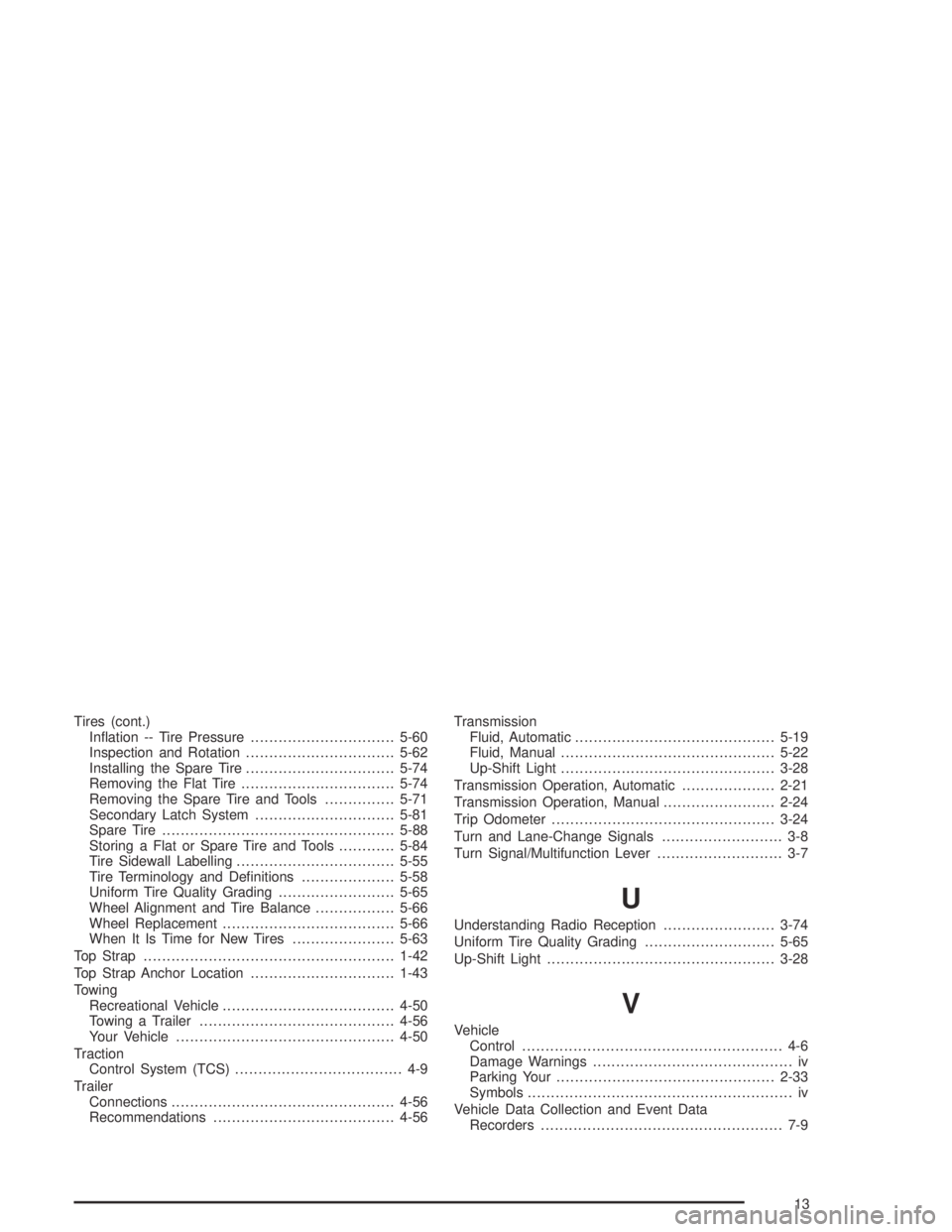
Tires (cont.)
Ination -- Tire Pressure...............................5-60
Inspection and Rotation................................5-62
Installing the Spare Tire................................5-74
Removing the Flat Tire.................................5-74
Removing the Spare Tire and Tools...............5-71
Secondary Latch System..............................5-81
Spare Tire..................................................5-88
Storing a Flat or Spare Tire and Tools............5-84
Tire Sidewall Labelling..................................5-55
Tire Terminology and Denitions....................5-58
Uniform Tire Quality Grading.........................5-65
Wheel Alignment and Tire Balance.................5-66
Wheel Replacement.....................................5-66
When It Is Time for New Tires......................5-63
Top Strap......................................................1-42
Top Strap Anchor Location...............................1-43
Towing
Recreational Vehicle.....................................4-50
Towing a Trailer..........................................4-56
Your Vehicle...............................................4-50
Traction
Control System (TCS).................................... 4-9
Trailer
Connections................................................4-56
Recommendations.......................................4-56Transmission
Fluid, Automatic...........................................5-19
Fluid, Manual..............................................5-22
Up-Shift Light..............................................3-28
Transmission Operation, Automatic....................2-21
Transmission Operation, Manual........................2-24
Trip Odometer................................................3-24
Turn and Lane-Change Signals.......................... 3-8
Turn Signal/Multifunction Lever........................... 3-7
U
Understanding Radio Reception........................3-74
Uniform Tire Quality Grading............................5-65
Up-Shift Light.................................................3-28
V
Vehicle
Control........................................................ 4-6
Damage Warnings........................................... iv
Parking Your...............................................2-33
Symbols......................................................... iv
Vehicle Data Collection and Event Data
Recorders.................................................... 7-9
13