automatic transmission GMC CANYON 2005 Owner's Guide
[x] Cancel search | Manufacturer: GMC, Model Year: 2005, Model line: CANYON, Model: GMC CANYON 2005Pages: 420, PDF Size: 2.73 MB
Page 255 of 420
{CAUTION:
Shifting a four-wheel-drive vehicle’s transfer
case into NEUTRAL can cause your vehicle to
roll even if the transmission is in Park (P) for
an automatic transmission, or if your vehicle
is in gear, for a manual transmission. You or
others could be injured. Make sure the parking
brake is rmly set before you shift the transfer
case to NEUTRAL.
5. Shift the transfer case to NEUTRAL. See
Four-Wheel Drive on page 2-26for more information.
6. Release the parking brake only after the vehicle
being towed is rmly attached to the tow vehicle.
7. Turn the ignition to LOCK.
If the tow vehicle will not be started or driven for
six weeks or more, remove the battery cable
from the negative terminal (post) of the battery to
prevent your battery from draining while towing.
After towing see “Shifting Out of NEUTRAL” under
Four-Wheel Drive on page 2-26.
Rear Towing (Rear Wheels Off the Ground)
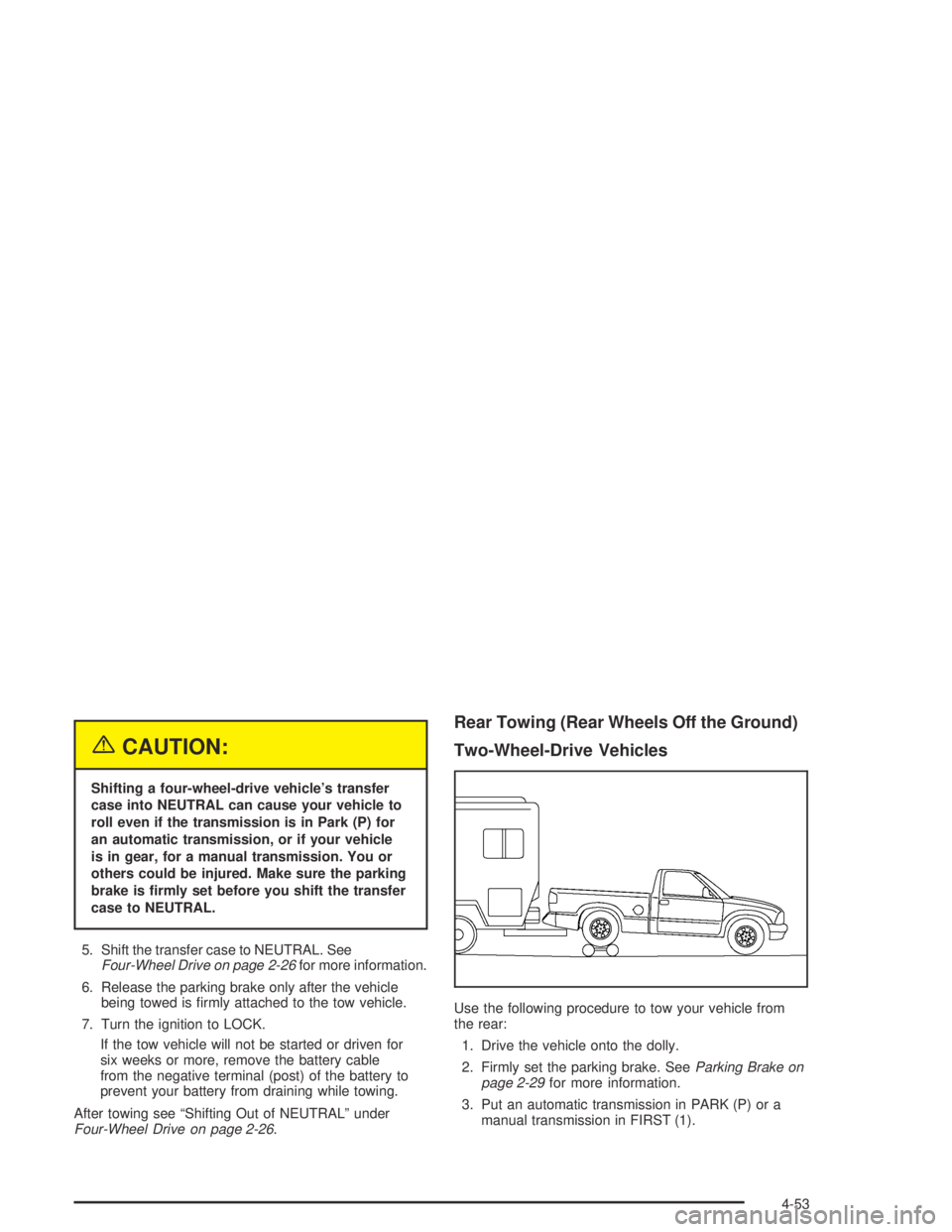
Two-Wheel-Drive Vehicles
Use the following procedure to tow your vehicle from
the rear:
1. Drive the vehicle onto the dolly.
2. Firmly set the parking brake. SeeParking Brake on
page 2-29for more information.
3. Put an automatic transmission in PARK (P) or a
manual transmission in FIRST (1).
4-53
Page 256 of 420
4. Follow the dolly manufacturer’s instructions to
attach and secure the vehicle being towed to
the dolly and then the loaded dolly to the tow
vehicle. Make sure the wheels are straight
before towing.
For manual transmission vehicles, make sure the
wheels are straight before proceeding to the
next steps. On automatic transmission vehicles,
use an adequate clamping device to ensure that the
front wheels are locked into the straight position.
5. Release the parking brake only after the vehicle
being towed is rmly attached to the tow vehicle.
6. Turn the ignition to LOCK.
If the tow vehicle will not be started or driven for
six weeks or more, remove the battery cable
from the negative terminal (post) of the battery to
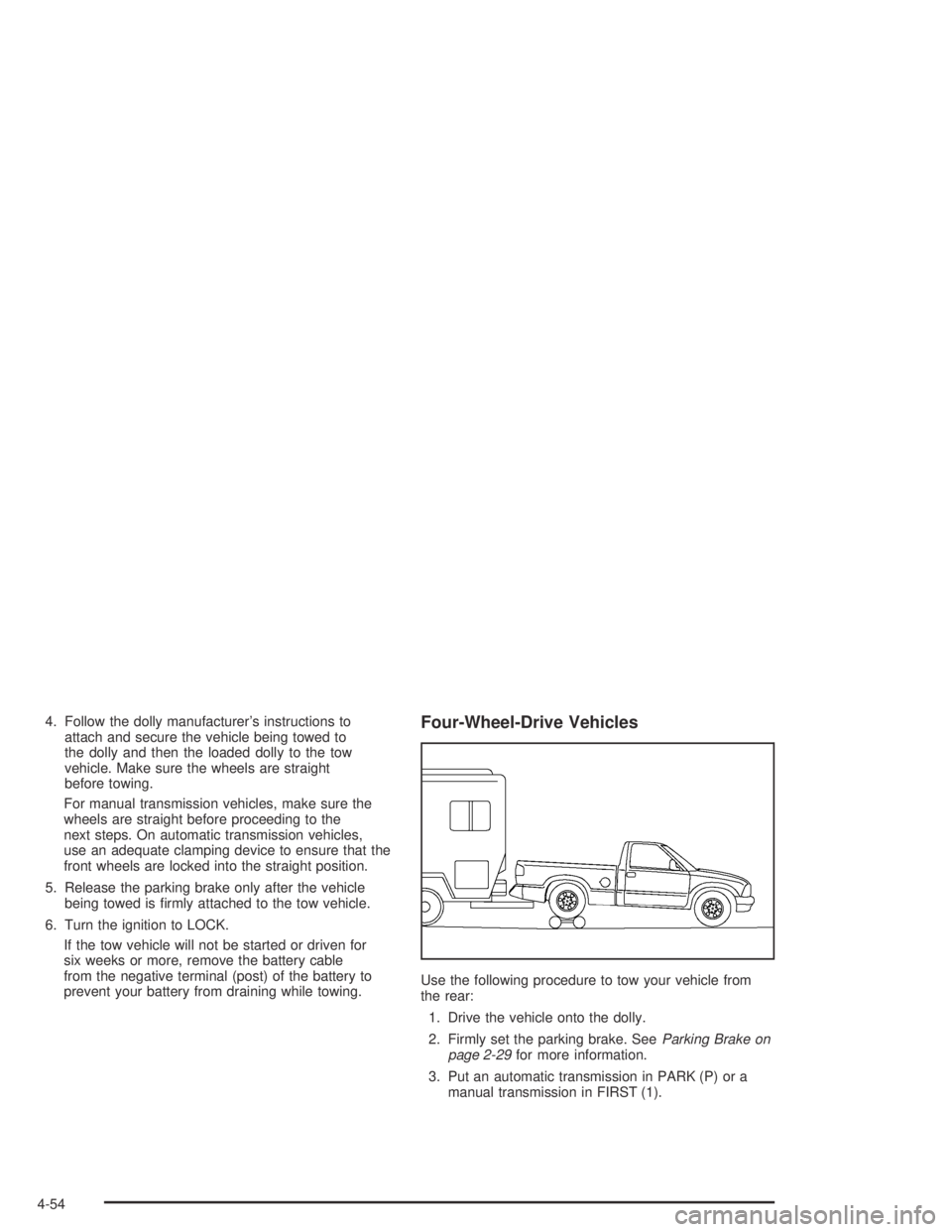
prevent your battery from draining while towing.Four-Wheel-Drive Vehicles
Use the following procedure to tow your vehicle from
the rear:
1. Drive the vehicle onto the dolly.
2. Firmly set the parking brake. SeeParking Brake on
page 2-29for more information.
3. Put an automatic transmission in PARK (P) or a
manual transmission in FIRST (1).
4-54
Page 257 of 420
4. Follow the dolly manufacturer’s instructions to attach
and secure the vehicle being towed to the dolly and
then the loaded dolly to the tow vehicle.
For manual transmission vehicles, make sure the
wheels are straight before proceeding to the next
steps. On automatic transmission vehicles, use
an adequate clamping device to ensure that the
front wheels are locked into the straight position.
{CAUTION:
Shifting a four-wheel-drive vehicle’s transfer
case into NEUTRAL can cause your vehicle to
roll even if the transmission is in Park (P) for
an automatic transmission, or if your vehicle is
in gear, for a manual transmission. You or
others could be injured. Make sure the parking
brake is rmly set before you shift the transfer
case to NEUTRAL.5. Shift the transfer case to NEUTRAL. See
Four-Wheel Drive on page 2-26for more information.
6. Release the parking brake only after the vehicle
being towed is rmly attached to the tow vehicle.
7. Turn the ignition to LOCK.
If the tow vehicle will not be started or driven for
six weeks or more, remove the battery cable
from the negative terminal (post) of the battery to
prevent your battery from draining while towing.
After towing, see “Shifting Out of NEUTRAL” under
Four-Wheel Drive on page 2-26.
4-55
Page 260 of 420
Weight of the Trailer
How heavy can a trailer safely be?
It depends on how you plan to use your rig.
For example, speed, altitude, road grades, outside
temperature and how much your vehicle is used to
pull a trailer are all important. And, it can also
depend on any special equipment that you have on
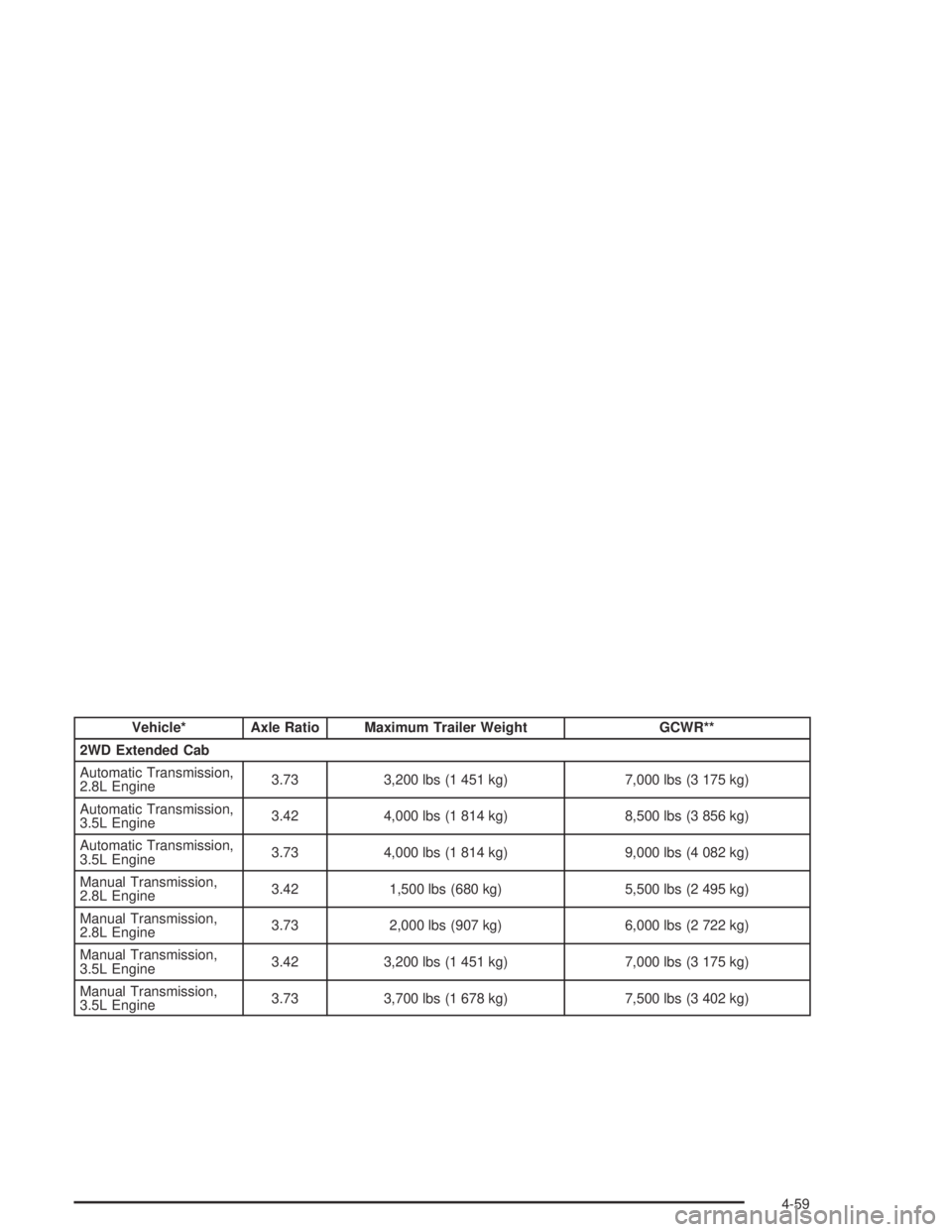
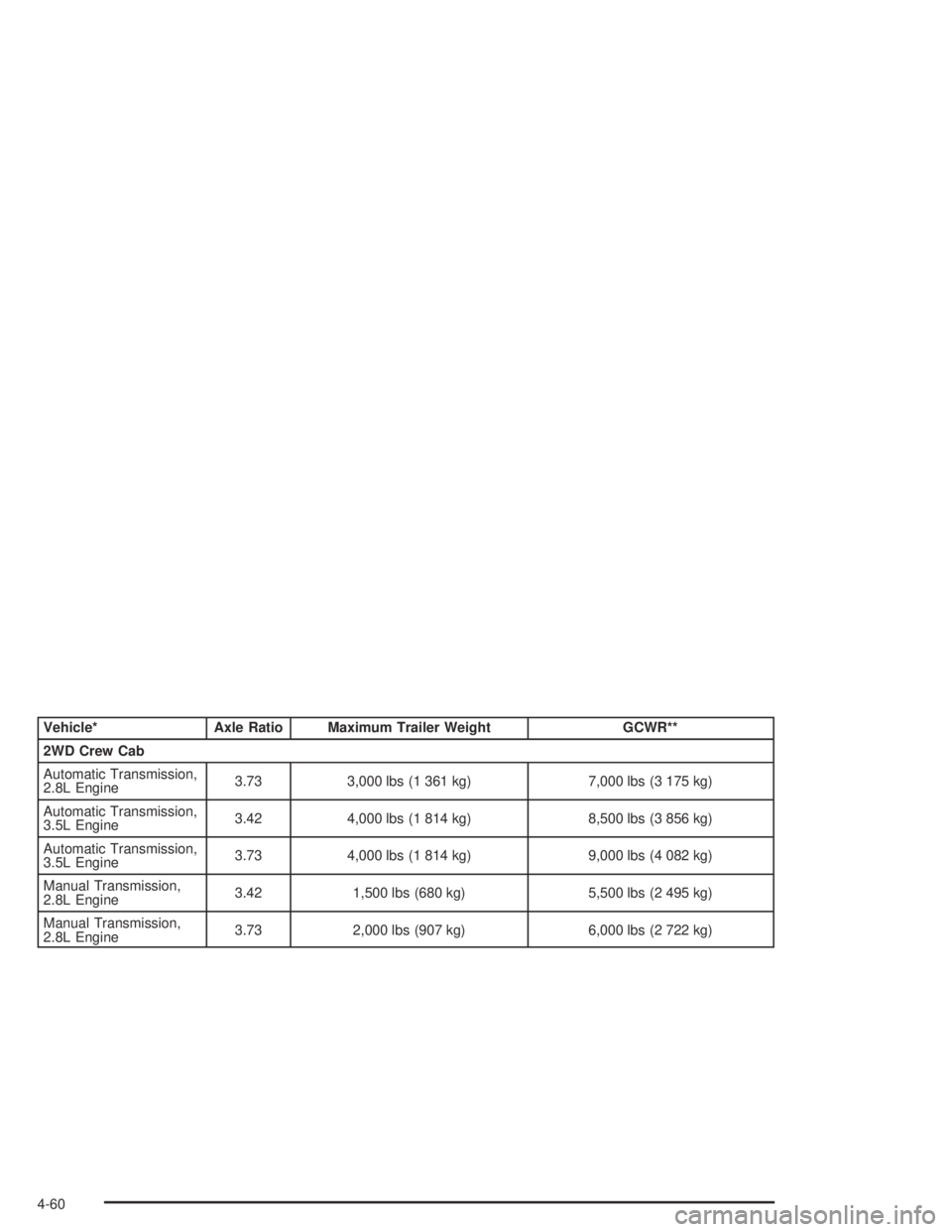
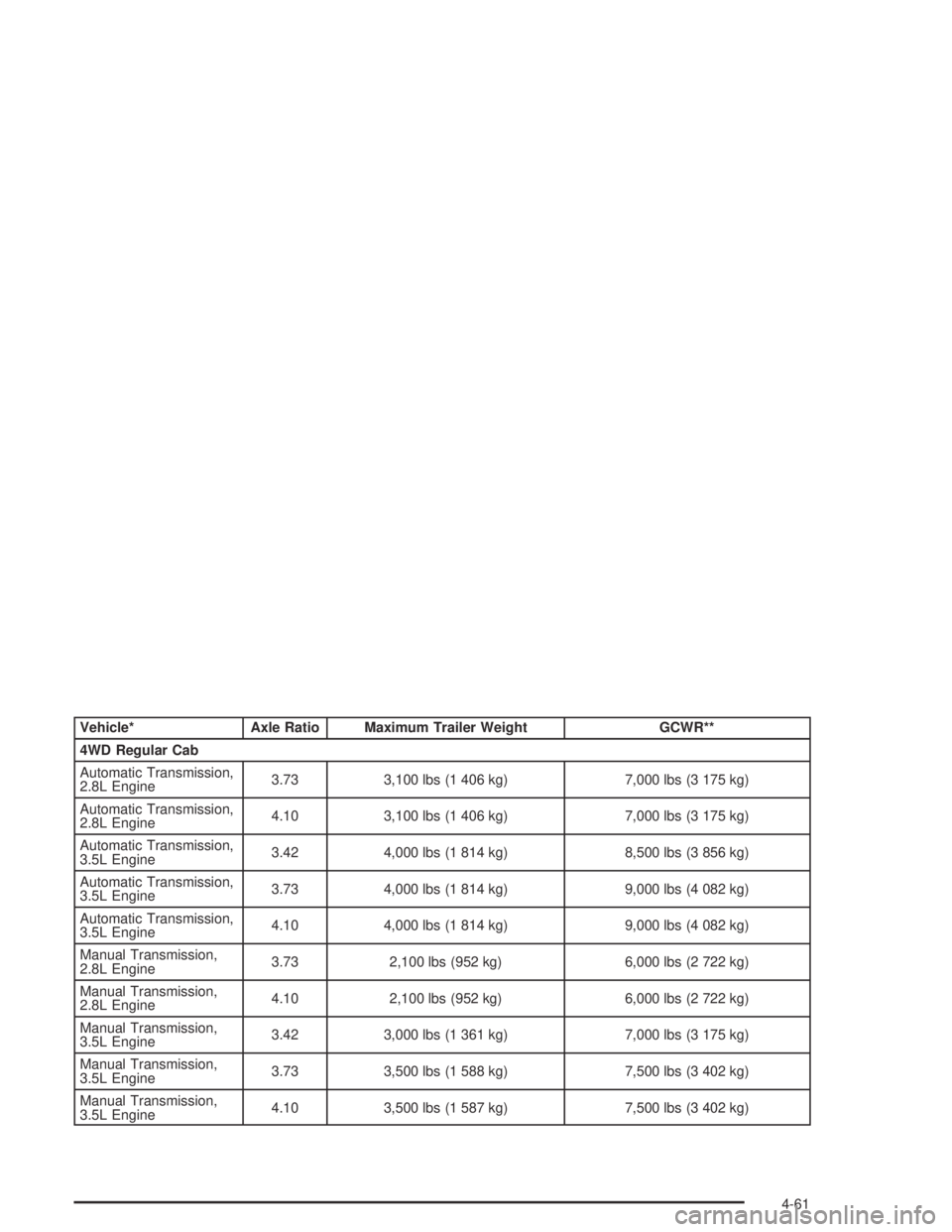
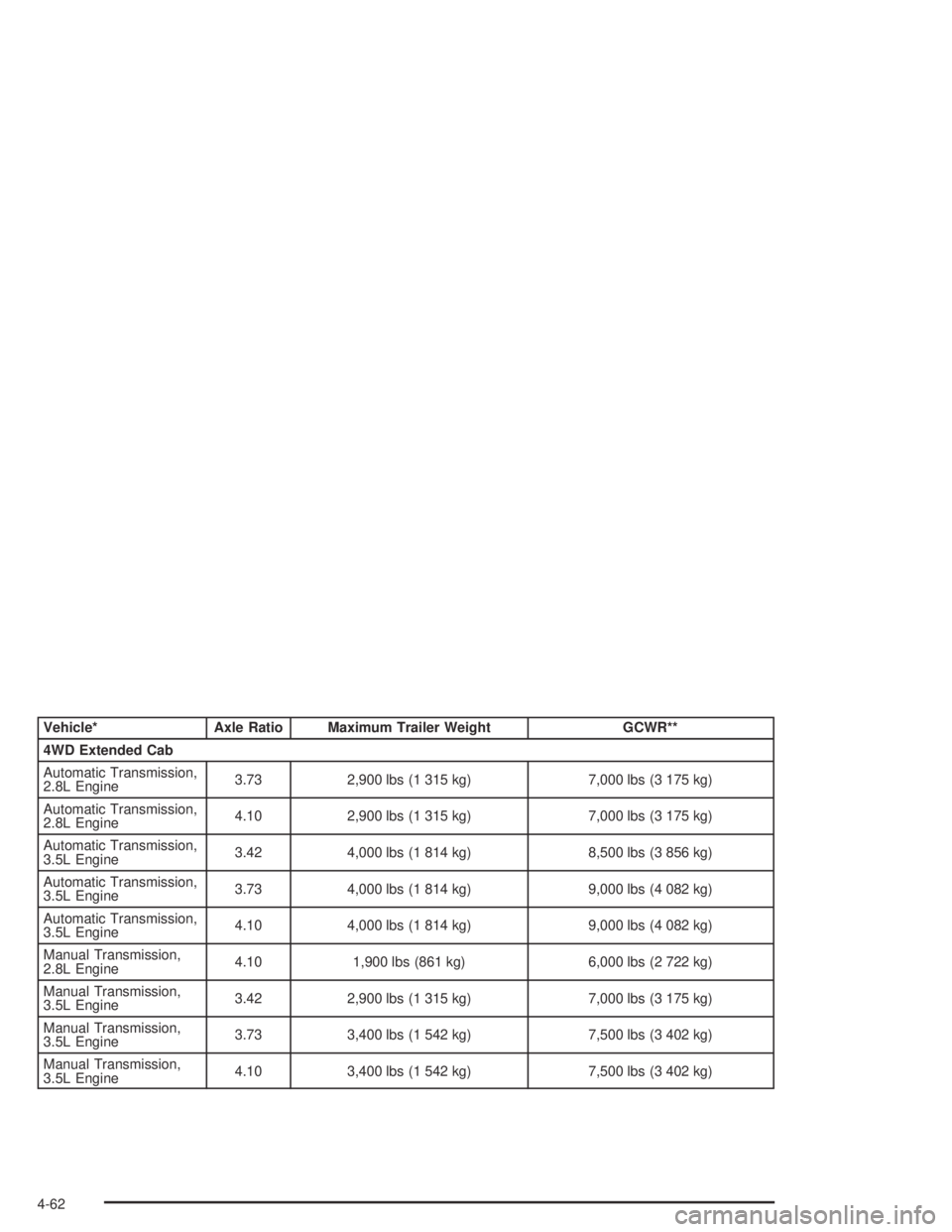
your vehicle.The following chart shows how much your trailer can
weigh, based upon your vehicle model and options.
Maximum trailer weight is calculated assuming only the
driver is in the tow vehicle and it has all the required
trailering equipment. The weight of additional optional
equipment, passengers and cargo in the tow vehicle
must be subtracted from the maximum trailer weight.
The weight of the trailer tongue also affects trailering
capacity. See “Weight of the Trailer Tongue” next.
Vehicle* Axle Ratio Maximum Trailer Weight GCWR**
2WD Regular Cab
Automatic Transmission,
2.8L Engine3.73 3,400 lbs (1 542 kg) 7,000 lbs (3 175 kg)
Automatic Transmission,
3.5L Engine3.42 4,000 lbs (1 814 kg) 8,500 lbs (3 856 kg)
Automatic Transmission,
3.5L Engine3.73 4,000 lbs (1 814 kg) 8,500 lbs (3 855 kg)
Manual Transmission,
2.8L Engine3.42 1,900 lbs (862 kg) 5,500 lbs (2 495 kg)
Manual Transmission,
2.8L Engine3.73 2,400 lbs (1 089 kg) 6,000 lbs (2 722 kg)
Manual Transmission,
3.5L Engine3.42 3,300 lbs (1 497 kg) 7,000 lbs (3 175 kg)
Manual Transmission,
3.5L Engine3.73 3,800 lbs (1 724 kg) 7,500 lbs (3 402 kg)
4-58
Page 261 of 420
Vehicle* Axle Ratio Maximum Trailer Weight GCWR**
2WD Extended Cab
Automatic Transmission,
2.8L Engine3.73 3,200 lbs (1 451 kg) 7,000 lbs (3 175 kg)
Automatic Transmission,
3.5L Engine3.42 4,000 lbs (1 814 kg) 8,500 lbs (3 856 kg)
Automatic Transmission,
3.5L Engine3.73 4,000 lbs (1 814 kg) 9,000 lbs (4 082 kg)
Manual Transmission,
2.8L Engine3.42 1,500 lbs (680 kg) 5,500 lbs (2 495 kg)
Manual Transmission,
2.8L Engine3.73 2,000 lbs (907 kg) 6,000 lbs (2 722 kg)
Manual Transmission,
3.5L Engine3.42 3,200 lbs (1 451 kg) 7,000 lbs (3 175 kg)
Manual Transmission,
3.5L Engine3.73 3,700 lbs (1 678 kg) 7,500 lbs (3 402 kg)
4-59
Page 262 of 420
Vehicle* Axle Ratio Maximum Trailer Weight GCWR**
2WD Crew Cab
Automatic Transmission,
2.8L Engine3.73 3,000 lbs (1 361 kg) 7,000 lbs (3 175 kg)
Automatic Transmission,
3.5L Engine3.42 4,000 lbs (1 814 kg) 8,500 lbs (3 856 kg)
Automatic Transmission,
3.5L Engine3.73 4,000 lbs (1 814 kg) 9,000 lbs (4 082 kg)
Manual Transmission,
2.8L Engine3.42 1,500 lbs (680 kg) 5,500 lbs (2 495 kg)
Manual Transmission,
2.8L Engine3.73 2,000 lbs (907 kg) 6,000 lbs (2 722 kg)
4-60
Page 263 of 420
Vehicle* Axle Ratio Maximum Trailer Weight GCWR**
4WD Regular Cab
Automatic Transmission,
2.8L Engine3.73 3,100 lbs (1 406 kg) 7,000 lbs (3 175 kg)
Automatic Transmission,
2.8L Engine4.10 3,100 lbs (1 406 kg) 7,000 lbs (3 175 kg)
Automatic Transmission,
3.5L Engine3.42 4,000 lbs (1 814 kg) 8,500 lbs (3 856 kg)
Automatic Transmission,
3.5L Engine3.73 4,000 lbs (1 814 kg) 9,000 lbs (4 082 kg)
Automatic Transmission,
3.5L Engine4.10 4,000 lbs (1 814 kg) 9,000 lbs (4 082 kg)
Manual Transmission,
2.8L Engine3.73 2,100 lbs (952 kg) 6,000 lbs (2 722 kg)
Manual Transmission,
2.8L Engine4.10 2,100 lbs (952 kg) 6,000 lbs (2 722 kg)
Manual Transmission,
3.5L Engine3.42 3,000 lbs (1 361 kg) 7,000 lbs (3 175 kg)
Manual Transmission,
3.5L Engine3.73 3,500 lbs (1 588 kg) 7,500 lbs (3 402 kg)
Manual Transmission,
3.5L Engine4.10 3,500 lbs (1 587 kg) 7,500 lbs (3 402 kg)
4-61
Page 264 of 420
Vehicle* Axle Ratio Maximum Trailer Weight GCWR**
4WD Extended Cab
Automatic Transmission,
2.8L Engine3.73 2,900 lbs (1 315 kg) 7,000 lbs (3 175 kg)
Automatic Transmission,
2.8L Engine4.10 2,900 lbs (1 315 kg) 7,000 lbs (3 175 kg)
Automatic Transmission,
3.5L Engine3.42 4,000 lbs (1 814 kg) 8,500 lbs (3 856 kg)
Automatic Transmission,
3.5L Engine3.73 4,000 lbs (1 814 kg) 9,000 lbs (4 082 kg)
Automatic Transmission,
3.5L Engine4.10 4,000 lbs (1 814 kg) 9,000 lbs (4 082 kg)
Manual Transmission,
2.8L Engine4.10 1,900 lbs (861 kg) 6,000 lbs (2 722 kg)
Manual Transmission,
3.5L Engine3.42 2,900 lbs (1 315 kg) 7,000 lbs (3 175 kg)
Manual Transmission,
3.5L Engine3.73 3,400 lbs (1 542 kg) 7,500 lbs (3 402 kg)
Manual Transmission,
3.5L Engine4.10 3,400 lbs (1 542 kg) 7,500 lbs (3 402 kg)
4-62
Page 265 of 420
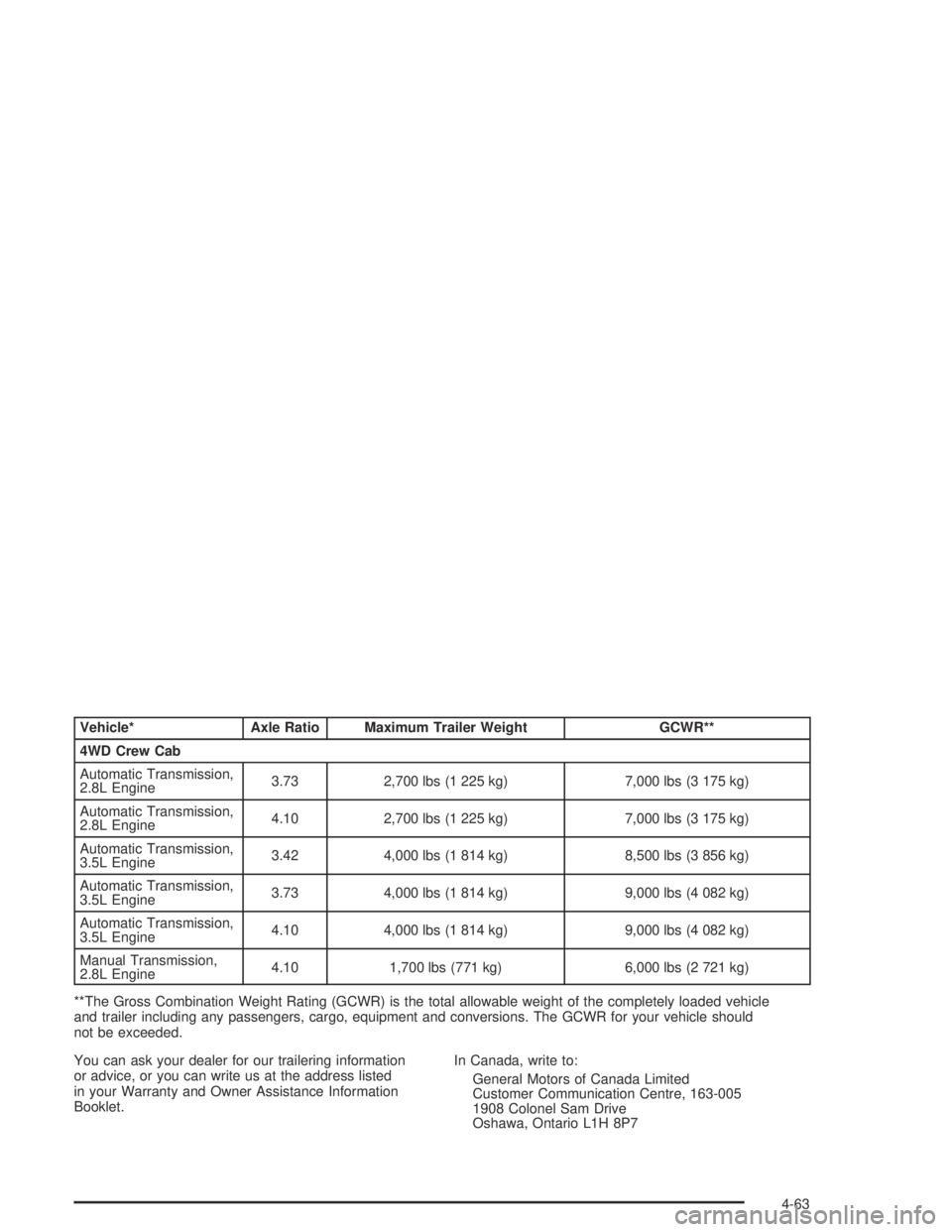
Vehicle* Axle Ratio Maximum Trailer Weight GCWR**
4WD Crew Cab
Automatic Transmission,
2.8L Engine3.73 2,700 lbs (1 225 kg) 7,000 lbs (3 175 kg)
Automatic Transmission,
2.8L Engine4.10 2,700 lbs (1 225 kg) 7,000 lbs (3 175 kg)
Automatic Transmission,
3.5L Engine3.42 4,000 lbs (1 814 kg) 8,500 lbs (3 856 kg)
Automatic Transmission,
3.5L Engine3.73 4,000 lbs (1 814 kg) 9,000 lbs (4 082 kg)
Automatic Transmission,
3.5L Engine4.10 4,000 lbs (1 814 kg) 9,000 lbs (4 082 kg)
Manual Transmission,
2.8L Engine4.10 1,700 lbs (771 kg) 6,000 lbs (2 721 kg)
**The Gross Combination Weight Rating (GCWR) is the total allowable weight of the completely loaded vehicle
and trailer including any passengers, cargo, equipment and conversions. The GCWR for your vehicle should
not be exceeded.
You can ask your dealer for our trailering information
or advice, or you can write us at the address listed
in your Warranty and Owner Assistance Information
Booklet.In Canada, write to:
General Motors of Canada Limited
Customer Communication Centre, 163-005
1908 Colonel Sam Drive
Oshawa, Ontario L1H 8P7
4-63
Page 270 of 420
Driving On Grades
Reduce speed and shift to a lower gear before you start
down a long or steep downgrade. If you don’t shift
down, you might have to use your brakes so much that
they would get hot and no longer work well.
When towing at high altitude on steep uphill grades,
consider the following: Engine coolant will boil at a lower
temperature than at normal altitudes. If you turn your
engine off immediately after towing at high altitude
on steep uphill grades, your vehicle may show signs
similar to engine overheating. To avoid this, let the
engine run while parked (preferably on level ground)
with the automatic transmission in PARK (P) (or the
manual transmission out of gear and the parking brake
applied) for a few minutes before turning the engine
off. If you do get the overheat warning, seeEngine
Overheating on page 5-28.
Parking on Hills
{CAUTION:
You really should not park your vehicle, with a
trailer attached, on a hill. If something goes
wrong, your rig could start to move. People
can be injured, and both your vehicle and the
trailer can be damaged.
But if you ever have to park your rig on a hill,
here’s how to do it:
1. Apply your regular brakes, but don’t shift into
PARK (P) yet, or into gear for a manual
transmission. When parking uphill, turn your wheels
away from the curb. When parking downhill, turn
your wheels into the curb.
2. Have someone place chocks under the trailer
wheels.
3. When the wheel chocks are in place, release the
regular brakes until the chocks absorb the load.
4-68