seats GMC CANYON 2005 Owner's Guide
[x] Cancel search | Manufacturer: GMC, Model Year: 2005, Model line: CANYON, Model: GMC CANYON 2005Pages: 420, PDF Size: 2.73 MB
Page 57 of 420
1. Your vehicle has a right front passenger’s frontal
airbag. SeeAirbag Off Switch on page 1-71.
If your child restraint is forward-facing, always move
the seat as far back as it will go before securing
it in this seat. SeeManual Seats on page 1-3
orPower Seats on page 1-4. Never use a
rear-facing child restraint in this seat unless the
airbag is off.
2. Find the LATCH anchorages in the passenger seat.
SeeLower Anchorages and Top Tethers for
Children (LATCH System) on page 1-46.
3. Put the child restraint on the seat.
4. Attach the LATCH attachments on the child
restraint to the LATCH anchorages in the vehicle.
The child restraint instructions will show you how.
5. If the child restraint is forward-facing, attach the
top tether to the top tether anchorage if your child
restraint has one. The child restraint instructions
will show you how. You must pull the seatback
forward to access the top tether anchorage.
SeeSeatback Latches on page 1-8andTop Strap
Anchor Location on page 1-43.
6. Tighten the LATCH attachments and top tether.
The child restraint instructions will show you how.
7. Push and pull the child restraint in different
directions to be sure it is secure.To remove the child restraint, loosen and disconnect the
LATCH attachments and loosen the top tether. Pull
the seatback forward, and unhook the top tether from
the top tether anchorage. Be sure to return the seatback
to its fully upright position. SeeSeatback Latches on
page 1-8.
Turn on the right front passenger’s frontal airbag when
you remove the child restraint from the vehicle unless
the person who will be sitting there is a member of
a passenger airbag risk group. SeeAirbag Off Switch
on page 1-71.
{CAUTION:
If the right front passenger’s frontal airbag is
turned off for a person who is not in a risk
group identied by the national government,
that person will not have the extra protection
of an airbag. In a crash, the airbag would not
be able to inate and help protect the person
sitting there. Do not turn off the right front
passenger’s frontal airbag unless the person
sitting there is in a risk group. SeeAirbag Off
Switch on page 1-71for more on this,
including important safety information.
1-51
Page 60 of 420
Securing a Child Restraint in the
Center Front Seat Position
Do not use child restraints in this position. The restraints
will not work properly.
Securing a Child Restraint in the
Right Front Seat Position (Models
without an Airbag Off Switch)
Crew Cab Models and Extended Cab
Models with Rear Seats
If your child restraint is equipped with the LATCH
system, seeLower Anchorages and Top Tethers for
Children (LATCH System) on page 1-46. SeeTop Strap
on page 1-42if the child restraint has one.
There is no top strap anchor in the right front
passenger’s position. Do not secure a child seat in this
position if a national or local law requires that the
top strap be anchored, or if the instructions that come
with the child restraint say that the top strap must
be anchored. SeeTop Strap on page 1-42if the child
restraint has one.Your vehicle has a right front passenger airbag.
Neverput a rear-facing child restraint in the right front
passenger’s seat. Here is why:
{CAUTION:
A child in a rear-facing child restraint can be
seriously injured or killed if the right front
passenger’s airbag inates. This is because
the back of the rear-facing child restraint
would be very close to the inating airbag.
Always secure a rear-facing child restraint in a
rear seat.
A rear seat is a safer place to secure a forward-facing
child restraint. If you need to secure a forward-facing
child restraint in the right front seat position, seeWhere
to Put the Restraint on page 1-40.
1-54
Page 61 of 420
If your child restraint does not have the LATCH system,
you will be using the lap-shoulder belt to secure the
child restraint in this position. Be sure to follow the
instructions that came with the child restraint.
Secure the child in the child restraint when and as the
instructions say.
1. Because your vehicle has a right front passenger’s
frontal airbag, always move the seat as far back as
it will go before securing a forward-facing child
restraint. SeeManual Seats on page 1-3orPower
Seats on page 1-4.
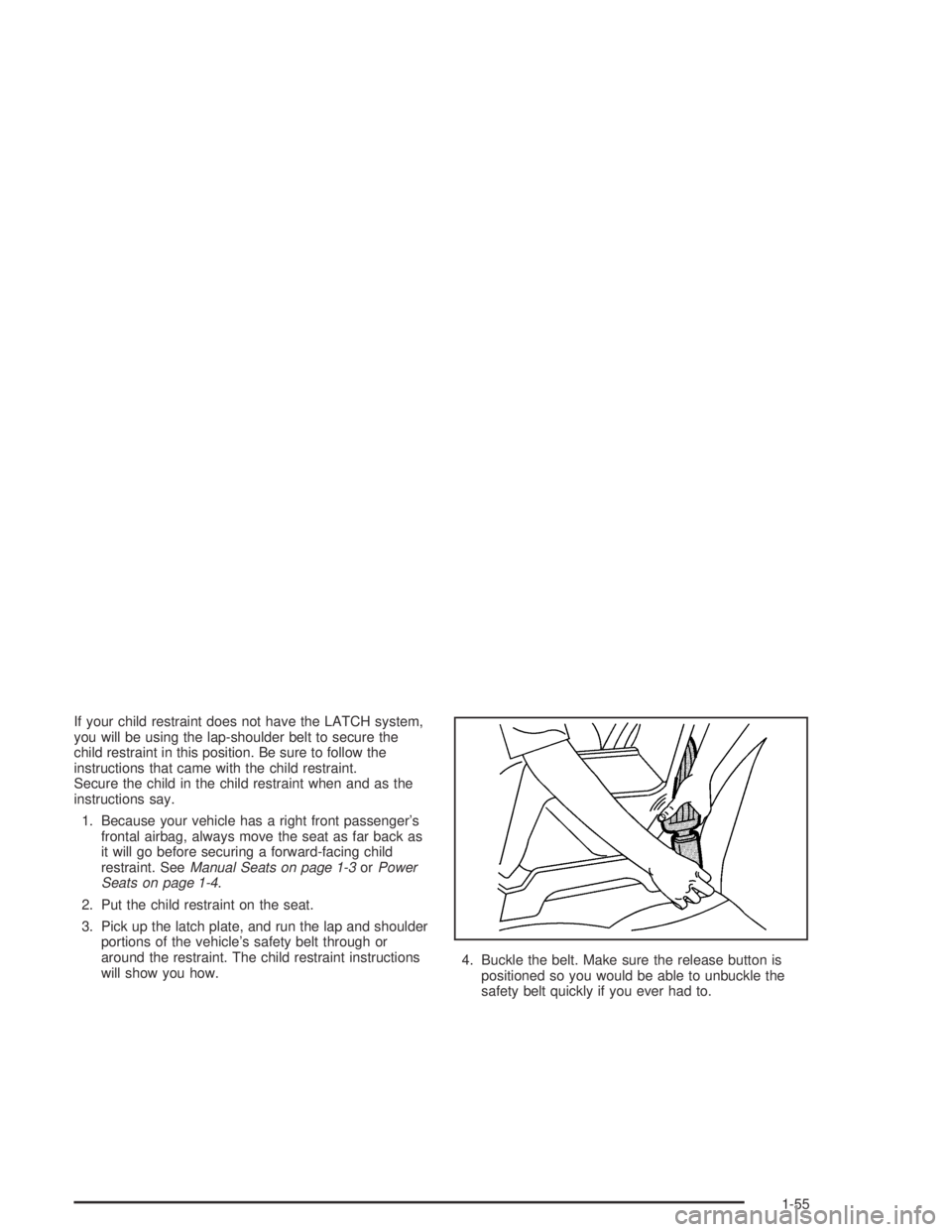
2. Put the child restraint on the seat.
3. Pick up the latch plate, and run the lap and shoulder
portions of the vehicle’s safety belt through or
around the restraint. The child restraint instructions
will show you how.4. Buckle the belt. Make sure the release button is
positioned so you would be able to unbuckle the
safety belt quickly if you ever had to.
1-55
Page 63 of 420
Securing a Child Restraint in the
Right Front Seat Position
(Models with an Airbag Off Switch)
Regular Cab Models and Extended
Cab Models without Rear Seats
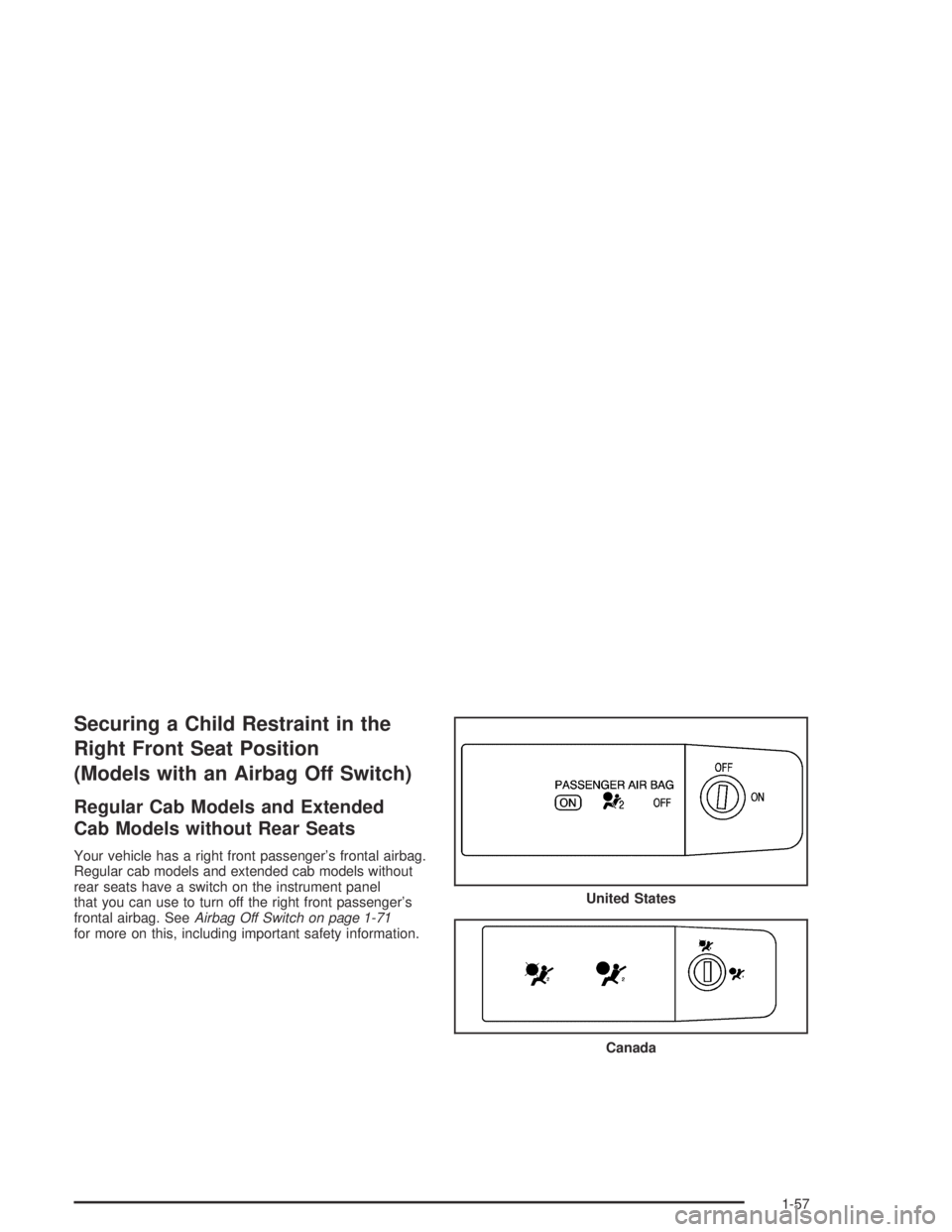
Your vehicle has a right front passenger’s frontal airbag.
Regular cab models and extended cab models without
rear seats have a switch on the instrument panel
that you can use to turn off the right front passenger’s
frontal airbag. SeeAirbag Off Switch on page 1-71
for more on this, including important safety information.United States
Canada
1-57
Page 65 of 420
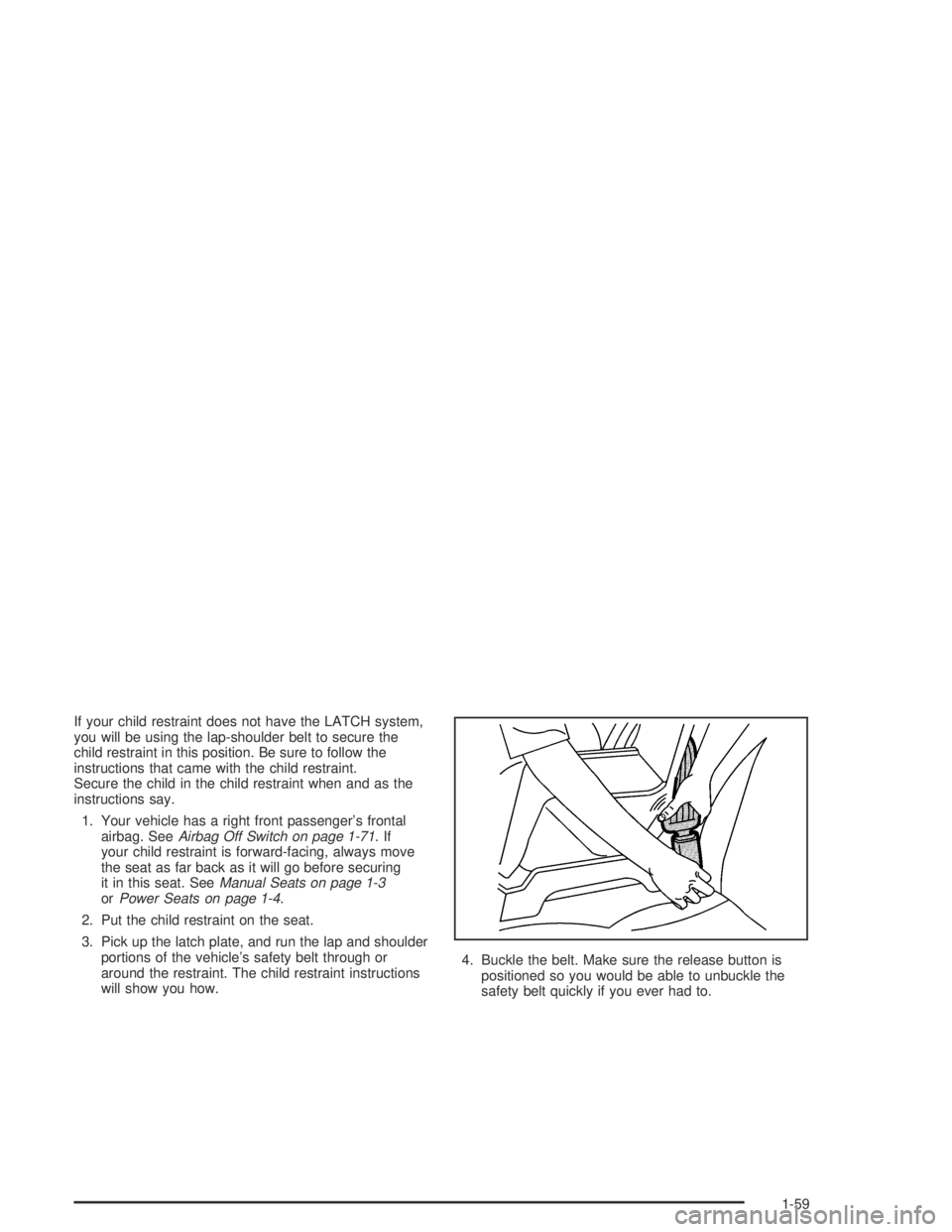
If your child restraint does not have the LATCH system,
you will be using the lap-shoulder belt to secure the
child restraint in this position. Be sure to follow the
instructions that came with the child restraint.
Secure the child in the child restraint when and as the
instructions say.
1. Your vehicle has a right front passenger’s frontal
airbag. SeeAirbag Off Switch on page 1-71.If
your child restraint is forward-facing, always move
the seat as far back as it will go before securing
it in this seat. SeeManual Seats on page 1-3
orPower Seats on page 1-4.
2. Put the child restraint on the seat.
3. Pick up the latch plate, and run the lap and shoulder
portions of the vehicle’s safety belt through or
around the restraint. The child restraint instructions
will show you how.4. Buckle the belt. Make sure the release button is
positioned so you would be able to unbuckle the
safety belt quickly if you ever had to.
1-59
Page 77 of 420
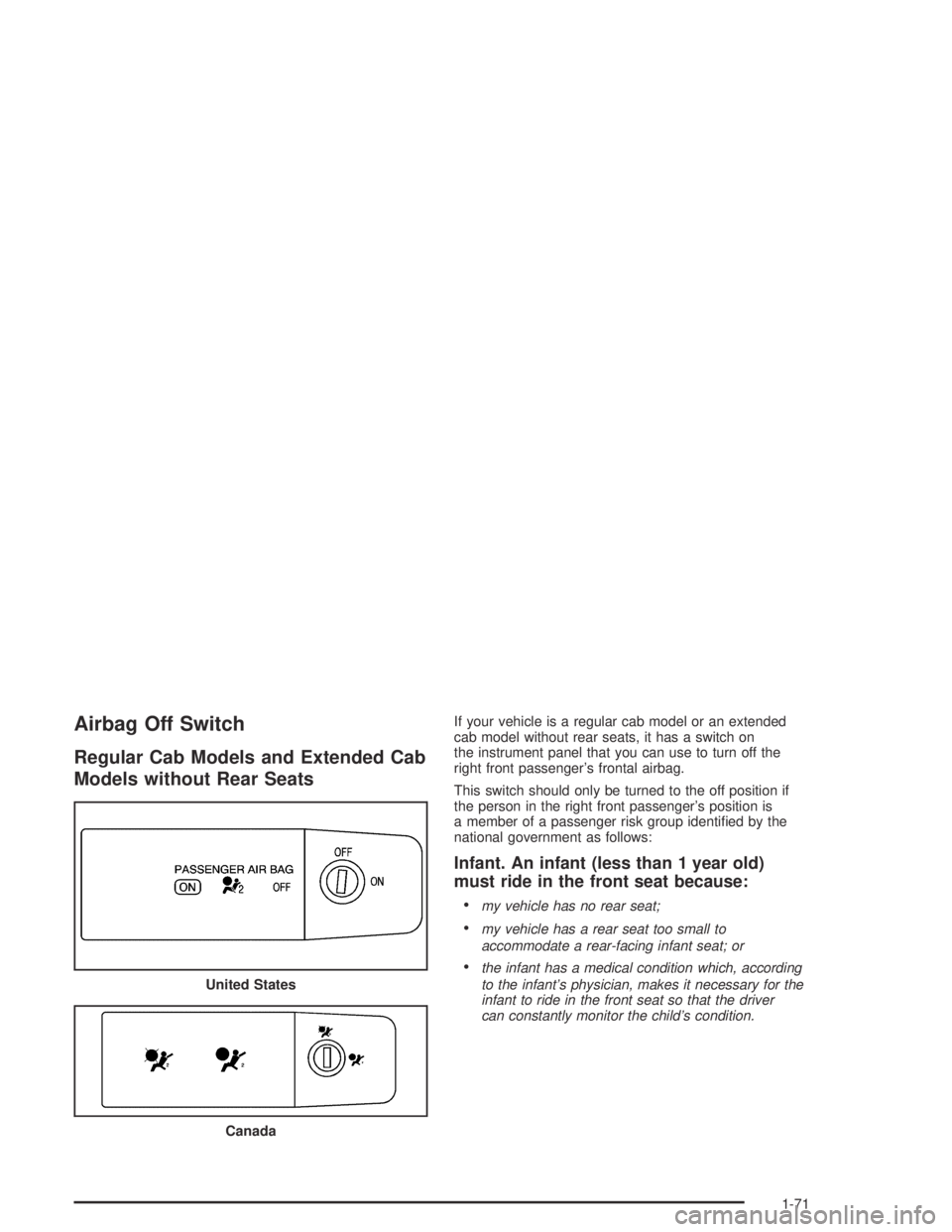
Airbag Off Switch
Regular Cab Models and Extended Cab
Models without Rear Seats
If your vehicle is a regular cab model or an extended
cab model without rear seats, it has a switch on
the instrument panel that you can use to turn off the
right front passenger’s frontal airbag.
This switch should only be turned to the off position if
the person in the right front passenger’s position is
a member of a passenger risk group identied by the
national government as follows:
Infant. An infant (less than 1 year old)
must ride in the front seat because:
my vehicle has no rear seat;
my vehicle has a rear seat too small to
accommodate a rear-facing infant seat; or
the infant has a medical condition which, according
to the infant’s physician, makes it necessary for the
infant to ride in the front seat so that the driver
can constantly monitor the child’s condition. United States
Canada
1-71
Page 124 of 420
Storage Areas
Glove Box
To open the glove box, pull on the lever.
Cupholder(s)
Your vehicle may have two cupholders located on the
lower part of the front doors as well as two cupholders
located at the front end of the console. Vehicles
with bench seats may have cupholders attached to the
front of the center seat.
If your vehicle is an extended cab or crew cab model,
your vehicle also has two rear cupholders. On crew cab
models, the cupholders are located at the front end
of the rear center seat cushion. On extended cab
models, the rear seat cupholders are located on top of
the rear center console.
Front Armrest Storage Area
For vehicles with bench seats, you may have a center
armrest storage area. Lift up on the upper tab located at
the front of the armrest to release the latch. Lift the lid
to open the storage area.
For vehicles with bucket seats or uplevel packages,
your vehicle may have a two-tiered center armrest
storage area. Lift up on the upper tab located at the
front of the armrest to release the latch. Lift the lid to
the top storage area. A second tab is located below the
top one and allows you to access the bottom storage
area. Lift up on the lower tab to release the latch.
Then, raise the lid of the lower storage area.
The upper storage area will lift up with the lid of the
lower storage area.
To close the storage area(s), lower the lid(s) until you
feel the latch close.
2-42
Page 125 of 420
Assist Handles
Your vehicle may have assist handles to be used when
getting out of your vehicle. If your vehicle has assist
handles, they may be located above the front passenger
door if you have a regular cab, or above the front and
rear passenger doors if you have an extended cab
or crew cab.
If your vehicle is equipped with roof-mounted side
impact air bags, there will be assist handles located
above both the driver’s and front passenger’s doors.
Rear Storage Area
If your vehicle is an extended cab model, it may be
equipped with storage compartments under the
rear seats.
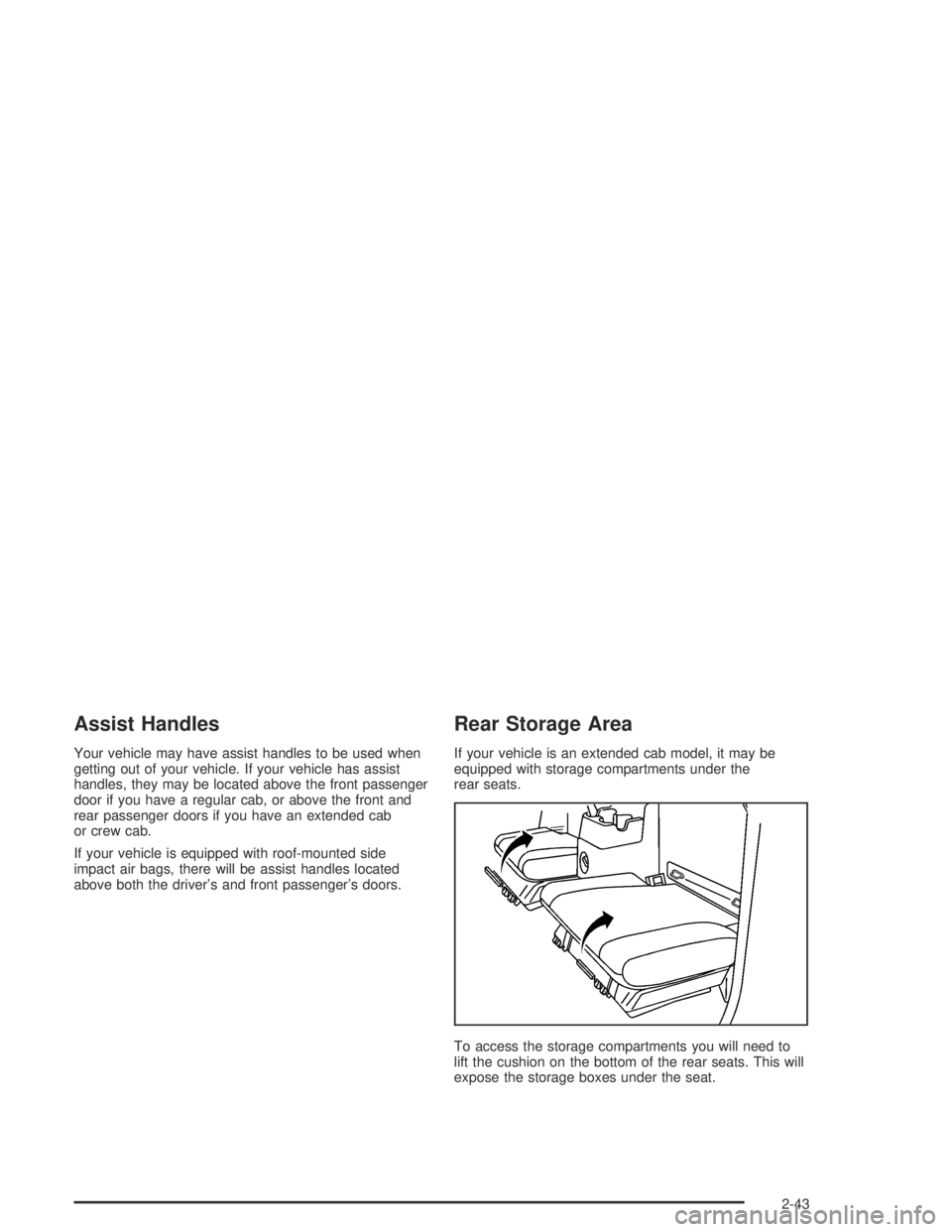
To access the storage compartments you will need to
lift the cushion on the bottom of the rear seats. This will
expose the storage boxes under the seat.
2-43
Page 147 of 420
to make adjustments to help with fuel economy while
still maintaining the selected temperature.
The air conditioning system removes moisture from the
air, so you may sometimes notice a small amount of
water dripping underneath your vehicle while idling
or after turning off the engine. This is normal.
Defogging and Defrosting
Fog on the inside of windows is a result of high humidity
(moisture) condensing on the cool window glass.
This can be minimized if the climate control system is
used properly. There are two modes to clear fog or frost
from your windshield and side windows. Use the
defog mode to clear the windows of fog or moisture and
warm the passengers. Use the defrost mode to
remove fog or frost from the windshield more quickly.
For best results, clear all snow and ice from the
windshield before defrosting.
Turn the mode knob on the climate control panel
clockwise to select the defog or defrost modes.
/(Floor/Defog):This mode directs the air to the
windshield, the side window outlets, and to the
oor outlets. When you select this mode, the system
runs the air conditioning compressor unless the outside
temperature is near freezing or below. Recirculation
is not available in this mode.
0(Defrost):This mode directs most of the air to the
windshield, and the side window outlets. When you
select this mode, the system runs the air conditioning
compressor unless the outside temperature is near,
or below freezing. Recirculation is not available in
this mode.
Do not drive the vehicle until all the windows are clear.
Outlet Adjustment
Use the thumbwheel on the outlets to change the
direction of the air ow.
Lift up or push down on the thumbwheel located in the
center of the outlet to direct the air up or down, or
slide the thumbwheel to the left or right to direct the
airow from side-to-side.
Operation Tips
Clear away any ice, snow or leaves from the air
inlets at the base of the windshield that may
block the ow of air into your vehicle.
Use of non-GM approved hood deectors may
adversely affect the performance of the system.
Keep the path under the front seats clear of objects
to help circulate the air inside of your vehicle more
effectively.
3-21
Page 152 of 420

Airbag Off Light
Regular Cab Models and Extended Cab
Models without Rear Seats
When you turn the airbag off switch to the off position,
the off indictor will come on and stay on to remind
you that the airbag has been turned off. When you
turn the airbag off switch to the on position, the
on indicator will come on. SeeAirbag Off Switch on
page 1-71for more on this, including important safety
information.
{CAUTION:
If the right front passenger’s frontal airbag is
turned off for a person who is not in a risk
group identied by the national government,
that person will not have the extra protection
of an airbag. In a crash, the frontal airbag
would not be able to inate and help protect
the person sitting there.
Do not turn off the right front passenger’s
frontal airbag unless the person sitting there
is in a risk group identied by the national
government. SeeAirbag Off Switch on
page 1-71for more on this, including important
safety information. United States
Canada
3-26