belt GMC CANYON 2005 Service Manual
[x] Cancel search | Manufacturer: GMC, Model Year: 2005, Model line: CANYON, Model: GMC CANYON 2005Pages: 420, PDF Size: 2.73 MB
Page 66 of 420

5. Pull the rest of the shoulder belt all the way out of
the retractor to set the lock.6. To tighten the belt, push down on the child restraint,
pull the shoulder portion of the belt to tighten the
lap portion of the belt and feed the shoulder
belt back into the retractor. If you are using a
forward-facing child restraint, you may nd it helpful
to use your knee to push down on the child
restraint as you tighten the belt.
7. Push and pull the child restraint in different
directions to be sure it is secure.
To remove the child restraint, just unbuckle the vehicle’s
safety belt and let it go back all the way. The safety
belt will move freely again and be ready to work for an
adult or larger child passenger.
1-60
Page 68 of 420
Here are the most important things to know about the
airbag system:
{CAUTION:
You can be severely injured or killed in a crash
if you are not wearing your safety belt — even
if you have airbags. Wearing your safety belt
during a crash helps reduce your chance of
hitting things inside the vehicle or being
ejected from it. Airbags are “supplemental
restraints” to the safety belts. All airbags are
designed to work with safety belts but do not
replace them.
CAUTION: (Continued)
CAUTION: (Continued)
Frontal airbags for the driver and right front
passenger are designed to deploy only in
moderate to severe frontal and near frontal
crashes. They are not designed to inate in
rollover, rear or low-speed frontal crashes,
or in many side crashes. And, for some
unrestrained occupants, frontal airbags may
provide less protection in frontal crashes than
more forceful airbags have provided in the
past. The roof-mounted side impact airbags
are designed to inate only in moderate to
severe crashes where something hits the side
of your vehicle. They are not designed to
inate in frontal, in rollover or in rear crashes.
Everyone in your vehicle should wear a safety
belt properly — whether or not there is an
airbag for that person.
1-62
Page 69 of 420
{CAUTION:
Both frontal and side impact airbags inate
with great force, faster than the blink of an
eye. If you are too close to an inating airbag,
as you would be if you were leaning forward,
it could seriously injure you. Safety belts help
keep you in position for airbag ination before
and during a crash. Always wear your safety
belt even with frontal airbags. The driver
should sit as far back as possible while still
maintaining control of the vehicle. Occupants
should not lean on or sleep against the door.
{CAUTION:
Anyone who is up against, or very close to,
any airbag when it inates can be seriously
injured or killed. Airbags plus lap-shoulder
belts offer the best protection for adults, but
not for young children and infants. Neither the
vehicle’s safety belt system nor its airbag
system is designed for them. Young children
and infants need the protection that a child
restraint system can provide. Always secure
children properly in your vehicle. To read how,
seeOlder Children on page 1-32orInfants and
Young Children on page 1-34.
1-63
Page 74 of 420
If your vehicle has side impact airbags, it has electronic
side sensors. The side impact airbags are designed
to inate in moderate to severe side crashes. A side
impact airbag will inate if the crash severity is above
the system’s designed “threshold level”. The threshold
level can vary with specic vehicle design. Side impact
airbags are not designed to inate in frontal or
near-frontal impacts, rollovers or rear impacts, because
ination would not likely help the occupant. A side
impact airbag will only deploy on the side of the vehicle
that is struck.
Your vehicle has seat position sensors which enable the
sensing system to monitor the position of the driver’s
seat and the right front passenger’s seat. Seat position
sensors provide information that is used to determine
if the airbags should deploy at a reduced level or
at full deployment.
In any particular crash, no one can say whether an
airbag should have inated simply because of the
damage to a vehicle or because of what the repair costs
were. For frontal airbags, ination is determined by
the angle of the impact and how quickly the vehicle
slows down in frontal or near-frontal impacts. For side
impact airbags, ination is determined by the location
and severity of the impact.What Makes an Airbag Inate?
In an impact of sufficient severity, the airbag sensing
system detects that the vehicle is in a crash. For both
frontal and side impact airbags, the sensing system
triggers a release of gas from the inator, which inates
the airbag. The inator, airbag, and related hardware
are all part of the airbag modules inside the steering
wheel and in the instrument panel in front of the
right front passenger. For vehicles with side impact
airbags, the airbag modules are located in the ceiling of
the vehicle, near the side windows.
How Does an Airbag Restrain?
In moderate to severe frontal or near frontal collisions,
even belted occupants can contact the steering wheel or
the instrument panel. In moderate to severe side
collisions, even belted occupants can contact the inside
of the vehicle. The airbag supplements the protection
provided by safety belts. Airbags distribute the force of
the impact more evenly over the occupant’s upper
body, stopping the occupant more gradually. But the
frontal airbags would not help you in many types
of collisions, including rollovers, rear impacts, and many
side impacts, primarily because an occupant’s motion
is not toward the airbag. Side impact airbags would not
help you in many types of collisions, including frontal
1-68
Page 75 of 420
or near frontal collisions, rollovers, and rear impacts,
primarily because an occupant’s motion is not toward
those airbags. Airbags should never be regarded
as anything more than a supplement to safety belts, and
then only in moderate to severe frontal or near-frontal
collisions for the driver’s and right front passenger’s
frontal airbags, and only in moderate to severe
side collisions for side impact airbags.
What Will You See After an
Airbag Inates?
After an airbag inates, it quickly deates, so quickly that
some people may not even realize the airbag inated.
Some components of the airbag module — the steering
wheel hub for the driver’s airbag, the instrument panel for
the right front passenger’s bag or the ceiling of your
vehicle near the side windows — will be hot for a short
time. The parts of the bag that come into contact
with you may be warm, but not too hot to touch.There will be some smoke and dust coming from the
vents in the deated airbags. Airbag ination does not
prevent the driver from seeing or being able to steer the
vehicle, nor does it stop people from leaving the vehicle.
{CAUTION:
When an airbag inates, there is dust in the
air. This dust could cause breathing problems
for people with a history of asthma or other
breathing trouble. To avoid this, everyone in
the vehicle should get out as soon as it is safe
to do so. If you have breathing problems but
can not get out of the vehicle after an airbag
inates, then get fresh air by opening a
window or a door. If you experience breathing
problems following an airbag deployment,
you should seek medical attention.
1-69
Page 78 of 420
Child age 1 to 12. A child age 1 to 12 must
ride in the front seat because:
my vehicle has no rear seat;
although children ages 1 to 12 ride in the rear
seat(s) whenever possible, children ages 1 to
12 sometimes must ride in the front because no
space is available in the rear seat(s) of my vehicle;
or
the child has a medical condition which, according
to the child’s physician, makes it necessary for the
child to ride in the front seat so that the driver
can constantly monitor the child’s condition.
Medical Condition. A passenger has a
medical condition which, according to his
or her physician:
causes the passenger airbag to pose a special risk
for the passenger; and
makes the potential harm from the passenger
airbag in a crash greater than the potential
harm from turning off the airbag and allowing the
passenger, even if belted, to hit the dashboard
or windshield in a crash.
{CAUTION:
If the right front passenger’s frontal airbag is
turned off for a person who is not in a risk
group identied by the national government,
that person will not have the extra protection
of an airbag. In a crash, the airbag would not
be able to inate and help protect the person
sitting there. Do not turn off the passenger’s
frontal airbag unless the person sitting there is
in a risk group.
1-72
Page 81 of 420
Adding Equipment to Your
Airbag-Equipped Vehicle
Q:Is there anything I might add to the front of
the vehicle that could keep the airbags from
working properly?
A:Yes. If you add things that change your vehicle’s
frame, bumper system, front end sheet metal or
height, they may keep the airbag system from
working properly. Also, the airbag system may not
work properly if you relocate any of the airbag
sensors. If you have any questions about this, you
should contact Customer Assistance before you
modify your vehicle. The phone numbers and
addresses for Customer Assistance are in
Step Two of theCustomer Satisfaction Procedure
on page 7-2.
Restraint System Check
Checking Your Restraint Systems
Now and then, make sure the safety belt reminder light
and all your belts, buckles, latch plates, retractors
and anchorages are working properly. Look for any other
loose or damaged safety belt system parts. If you see
anything that might keep a safety belt system from doing
its job, have it repaired.
Torn or frayed safety belts may not protect you in a
crash. They can rip apart under impact forces. If a belt
is torn or frayed, get a new one right away.
Also look for any opened or broken airbag covers, and
have them repaired or replaced. (The airbag system
does not need regular maintenance.)
1-75
Page 82 of 420
Replacing Restraint System Parts
After a Crash
{CAUTION:
A crash can damage the restraint systems in
your vehicle. A damaged restraint system
may not properly protect the person using it,
resulting in serious injury or even death in a
crash. To help make sure your restraint
systems are working properly after a crash,
have them inspected and any necessary
replacements made as soon as possible.
If you have had a crash, do you need new belts or
LATCH system parts?
After a very minor collision, nothing may be necessary.
But if the belts were stretched, as they would be if
worn during a more severe crash, then you need
new parts.If the LATCH system was being used during a more
severe crash, you may need new LATCH system parts.
If belts are cut or damaged, replace them. Collision
damage also may mean you will need to have LATCH
system, safety belt or seat parts repaired or replaced.
New parts and repairs may be necessary even if the belt
or LATCH system was not being used at the time of
the collision.
If an airbag inates, you will need to replace airbag
system parts. See the part on the airbag system earlier
in this section.
If the frontal airbags inate, you will also need to
replace the driver’s and right front passenger’s safety
belt retractor assembly. Be sure to do so. Then the new
retractor assembly will be there to help protect you in
a collision.
After a crash you may need to replace the driver and
front passenger’s safety belt retractor assemblies, even
if the frontal airbags have not deployed. The driver
and front passenger’s safety belt retractor assemblies
contain the safety belt pretensioners. Have your
safety belt pretensioners checked if your vehicle has
been in a collision, or if your airbag readiness light stays
on after you start your vehicle or while you are driving.
SeeAirbag Readiness Light on page 3-25.
1-76
Page 89 of 420
Doors and Locks
Door Locks
{CAUTION:
Unlocked doors can be dangerous.
Passengers — especially children — can
easily open the doors and fall out of a
moving vehicle. When a door is locked,
the handle will not open it. You increase
the chance of being thrown out of the
vehicle in a crash if the doors are not
locked. So, wear safety belts properly and
lock the doors whenever you drive.
Young children who get into unlocked
vehicles may be unable to get out. A child
can be overcome by extreme heat and can
suffer permanent injuries or even death
from heat stroke. Always lock your vehicle
whenever you leave it.
Outsiders can easily enter through an
unlocked door when you slow down or
stop your vehicle. Locking your doors can
help prevent this from happening.There are several ways to lock and unlock your vehicle.
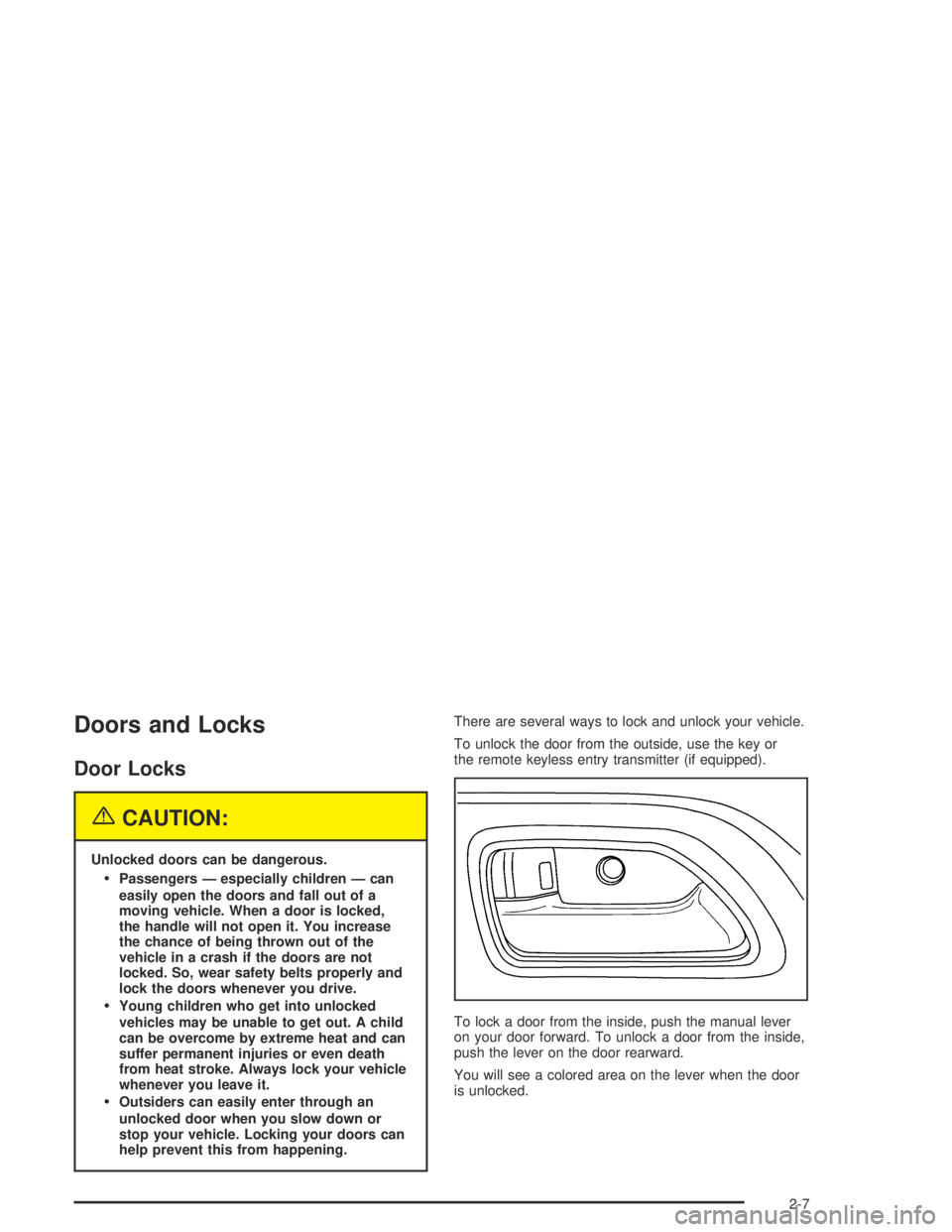
To unlock the door from the outside, use the key or
the remote keyless entry transmitter (if equipped).
To lock a door from the inside, push the manual lever
on your door forward. To unlock a door from the inside,
push the lever on the door rearward.
You will see a colored area on the lever when the door
is unlocked.
2-7
Page 127 of 420
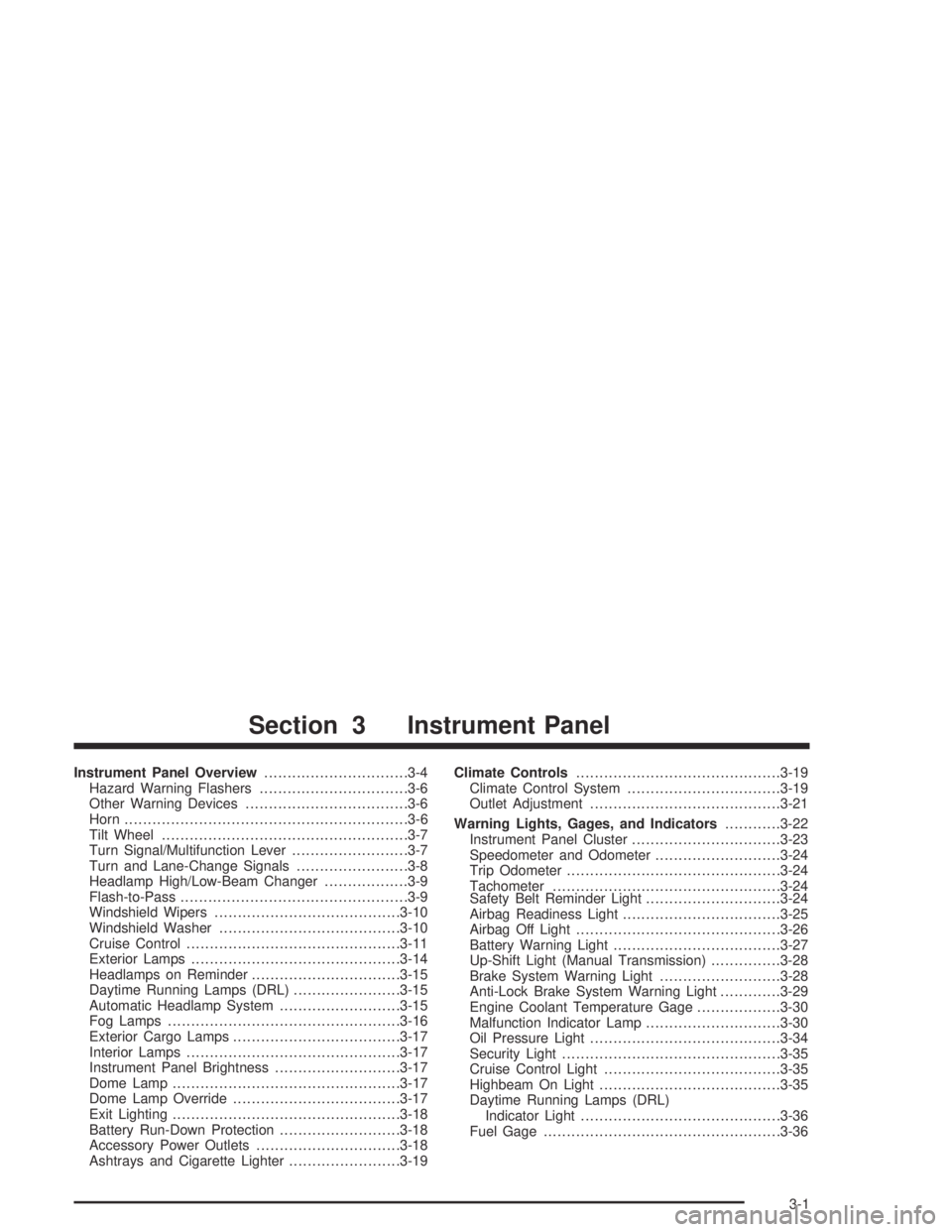
Instrument Panel Overview...............................3-4
Hazard Warning Flashers................................3-6
Other Warning Devices...................................3-6
Horn.............................................................3-6
Tilt Wheel.....................................................3-7
Turn Signal/Multifunction Lever.........................3-7
Turn and Lane-Change Signals........................3-8
Headlamp High/Low-Beam Changer..................3-9
Flash-to-Pass.................................................3-9
Windshield Wipers........................................3-10
Windshield Washer.......................................3-10
Cruise Control..............................................3-11
Exterior Lamps.............................................3-14
Headlamps on Reminder................................3-15
Daytime Running Lamps (DRL).......................3-15
Automatic Headlamp System..........................3-15
Fog Lamps..................................................3-16
Exterior Cargo Lamps....................................3-17
Interior Lamps..............................................3-17
Instrument Panel Brightness...........................3-17
Dome Lamp.................................................3-17
Dome Lamp Override....................................3-17
Exit Lighting.................................................3-18
Battery Run-Down Protection..........................3-18
Accessory Power Outlets...............................3-18
Ashtrays and Cigarette Lighter........................3-19Climate Controls............................................3-19
Climate Control System.................................3-19
Outlet Adjustment.........................................3-21
Warning Lights, Gages, and Indicators............3-22
Instrument Panel Cluster................................3-23
Speedometer and Odometer...........................3-24
Trip Odometer..............................................3-24
Tachometer.................................................3-24
Safety Belt Reminder Light.............................3-24
Airbag Readiness Light..................................3-25
Airbag Off Light............................................3-26
Battery Warning Light....................................3-27
Up-Shift Light (Manual Transmission)...............3-28
Brake System Warning Light..........................3-28
Anti-Lock Brake System Warning Light.............3-29
Engine Coolant Temperature Gage..................3-30
Malfunction Indicator Lamp.............................3-30
Oil Pressure Light.........................................3-34
Security Light...............................................3-35
Cruise Control Light......................................3-35
Highbeam On Light.......................................3-35
Daytime Running Lamps (DRL)
Indicator Light...........................................3-36
Fuel Gage...................................................3-36
Section 3 Instrument Panel
3-1