seats GMC CANYON 2006 Owner's Guide
[x] Cancel search | Manufacturer: GMC, Model Year: 2006, Model line: CANYON, Model: GMC CANYON 2006Pages: 434, PDF Size: 2.64 MB
Page 61 of 434
3. Tighten the lower anchor attachments and the top
tether. The child restraint instructions will show
you how.
4. Push and pull the child restraint in different
directions to be sure it is secure.
Front Seat — Regular/Extended Cab
without Rear Seats
Your vehicle has a right front passenger’s airbag and a
passenger sensing system. The passenger sensing
system is designed to turn off the right front passenger’s
frontal airbag when an infant in a rear-facing infant
seat or a small child in a forward-facing child restraint or
booster seat is detected. SeeSecuring a Child
Restraint in the Right Front Seat Position on page 1-59
andPassenger Sensing System on page 1-72for
important safety information and additional information
on installing a child restraint in the right front seat
position.
1. SeeSecuring a Child Restraint in the Right Front
Seat Position on page 1-59for instructions on
installing the child restraint using the safety belts.2. If the child restraint manufacturer’s instructions
recommends that the top tether be attached,
attach and tighten the top tether to the top tether
anchor. Refer to the child restraint instructions and
the following steps:
2.1. Pull the seatback forward to access the top
tether anchor. SeeSeatback Latches on
page 1-9.
2.2. Pull on the nger access tab to remove the
cover to access the top tether anchor.
2.3. Route the top tether according to your child
restraint instructions and the following
instructions:
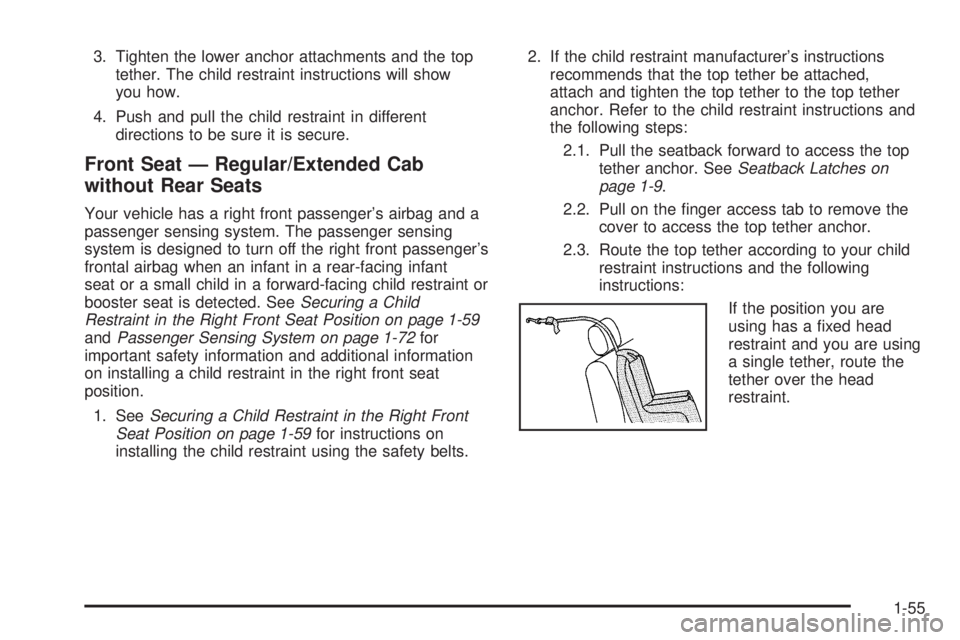
If the position you are
using has a xed head
restraint and you are using
a single tether, route the
tether over the head
restraint.
1-55
Page 66 of 434
If your vehicle does not have a rear seat that will
accommodate a rear-facing child restraint, never put a
child in a rear-facing child restraint in the right front
passenger seat the unless passenger airbag status
indicator shows off. Never put a rear facing child
restraint in the right front passenger seat unless the
airbag is off. Here is why:
{CAUTION:
A child in a rear-facing child restraint can be
seriously injured or killed if the right front
passenger’s airbag inates. This is because
the back of the rear facing child restraint
would be very close to the inating airbag. Be
sure the airbag is off before using a rear-facing
child restraint in the right front seat position.
Even though the passenger sensing system is
designed to turn off the passenger’s frontal
airbag if the system detects a rear-facing child
restraint, no system is fail-safe, and no one
can guarantee that an airbag will not deploy
CAUTION: (Continued)
CAUTION: (Continued)
under some unusual circumstance, even
though it is turned off. We recommend that
rear-facing child restraints be transported
in vehicles with a rear seat that will
accommodate a rear-facing child restraint,
whenever possible.
If you need to secure a forward-facing child restraint in
the right front seat position, move the seat as far
back as it will go before securing the forward-facing
child restraint. SeePower Seats on page 1-3orManual
Seats on page 1-2.
If your child restraint is equipped with the LATCH
system, seeLower Anchors and Tethers for Children
(LATCH) on page 1-46.
If your vehicle has rear seats, there is no top tether
anchor at the right front seating position. Do not secure
a child seat in this position if a national or local law
requires that the top tether be anchored or if the
instructions that come with the child restraint say that
the top tether must be anchored. SeeLower Anchors
and Tethers for Children (LATCH) on page 1-46if
the child restraint has a top tether.
1-60
Page 67 of 434
You will be using the lap-shoulder belt to secure the
child restraint in this position. Be sure to follow the
instructions that came with the child restraint. Secure
the child in the child restraint when and as the
instructions say.
1. Your vehicle has a right front passenger’s frontal
airbag. SeePassenger Sensing System on
page 1-72. We recommend that rear-facing child
restraints be secured in a rear seat, even if
the airbag is off. If your child restraint is
forward-facing, move the seat as far back as it will
go before securing the child restraint in this
seat. SeePower Seats on page 1-3orManual
Seats on page 1-2.
When the passenger sensing system has turned off
the right front passenger’s frontal airbag, the off
indicator in the passenger airbag status indicator
should light and stay lit when you turn the ignition to
ON or START. SeePassenger Airbag Status
Indicator on page 3-27.
2. Put the child restraint on the seat.
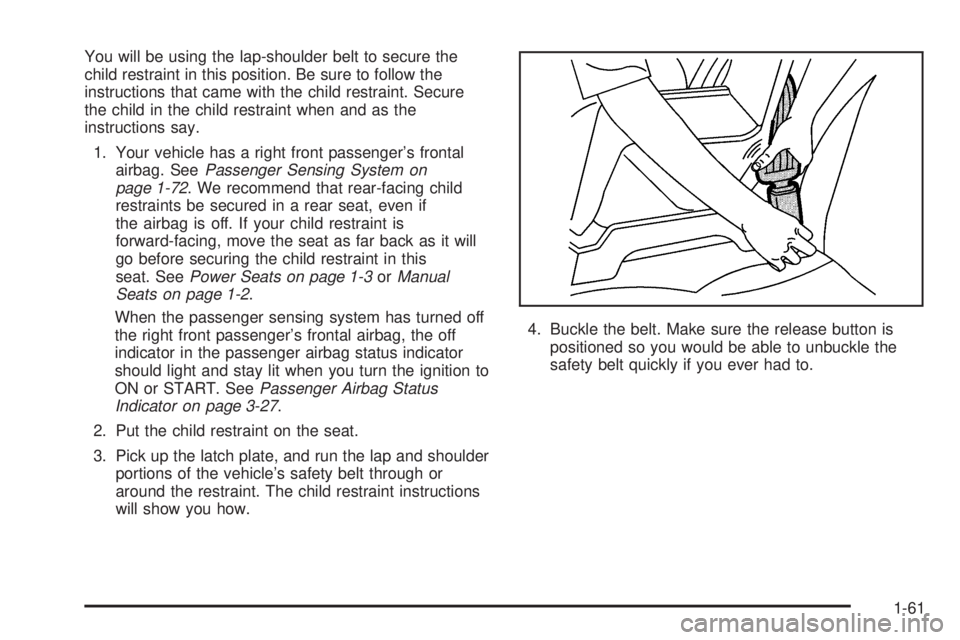
3. Pick up the latch plate, and run the lap and shoulder
portions of the vehicle’s safety belt through or
around the restraint. The child restraint instructions
will show you how.4. Buckle the belt. Make sure the release button is
positioned so you would be able to unbuckle the
safety belt quickly if you ever had to.
1-61
Page 68 of 434
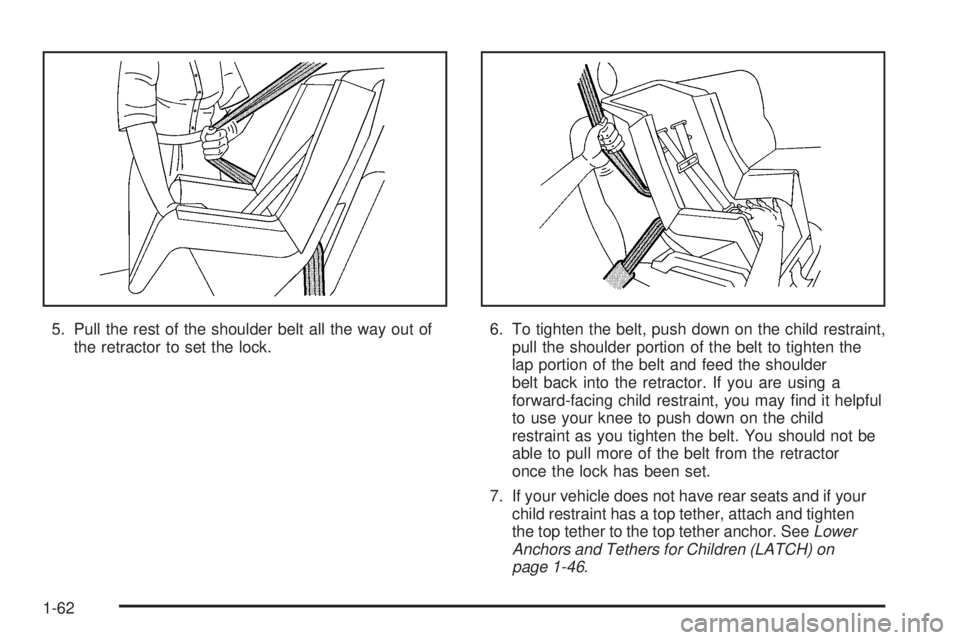
5. Pull the rest of the shoulder belt all the way out of
the retractor to set the lock.6. To tighten the belt, push down on the child restraint,
pull the shoulder portion of the belt to tighten the
lap portion of the belt and feed the shoulder
belt back into the retractor. If you are using a
forward-facing child restraint, you may nd it helpful
to use your knee to push down on the child
restraint as you tighten the belt. You should not be
able to pull more of the belt from the retractor
once the lock has been set.
7. If your vehicle does not have rear seats and if your
child restraint has a top tether, attach and tighten
the top tether to the top tether anchor. SeeLower
Anchors and Tethers for Children (LATCH) on
page 1-46.
1-62
Page 84 of 434
Adding Equipment to Your
Airbag-Equipped Vehicle
Q:Is there anything I might add to the front or
sides of the vehicle that could keep the
airbags from working properly?
A:Yes. If you add things that change your vehicle’s
frame, bumper system, front end or side sheet
metal or height, they may keep the airbag system
from working properly. Also, the airbag system may
not work properly if you relocate any of the airbag
sensors. If you have any questions about this,
you should contact Customer Assistance before you
modify your vehicle. The phone numbers and
addresses for Customer Assistance are in Step Two
of the Customer Satisfaction Procedure in this
manual. SeeCustomer Satisfaction Procedure on
page 7-2.
Q:Because I have a disability, I have to get my
vehicle modied. How can I nd out whether
this will affect my airbag system?
A:Changing or moving any parts of the front seats,
safety belts, the airbag sensing and diagnostic
module, or the instrument panel can affect
the operation of the airbag system. If you have
questions, call Customer Assistance. The phone
numbers and addresses for Customer Assistance
are in Step Two of the Customer Satisfaction
Procedure in this manual. SeeCustomer
Satisfaction Procedure on page 7-2.
1-78
Page 126 of 434

Storage Areas
Glove Box
To open the glove box, pull on the lever.
Cupholder(s)
Your vehicle may have two cupholders located on the
lower part of the front doors as well as two cupholders
located at the front end of the console. Vehicles with
bench seats may have cupholders attached to the front
of the center seat.
If your vehicle is an extended cab or crew cab model,
your vehicle also has two rear cupholders. On crew cab
models, the cupholders are located at the front end
of the rear center seat cushion. On extended cab
models, the rear seat cupholders are located on top of
the rear center console.
If you have an ashtray, it will use one of the cupholders.
Front Armrest Storage Area
For vehicles with bench seats, you may have a center
armrest storage area. Lift up on the upper tab located at
the front of the armrest to release the latch. Lift the lid
to open the storage area.
For vehicles with bucket seats or uplevel packages, your
vehicle may have a two-tiered center armrest storage
area. Lift up on the upper tab located at the front of the
armrest to release the latch. Lift the lid to the top storage
area. A second tab is located below the top one and
allows you to access the bottom storage area. Lift up on
the lower tab to release the latch. Then, raise the lid of
the lower storage area. The upper storage area will lift up
with the lid of the lower storage area.
To close the storage area(s), lower the lid(s) until you
feel the latch close.
2-40
Page 127 of 434
Assist Handles
Your vehicle may have assist handles to be used when
getting out of your vehicle. If your vehicle has assist
handles, they are located above the front passenger
door if you have a regular cab, or above the front and
rear passenger doors if you have an extended cab
or crew cab.
If your vehicle is equipped with roof-mounted side
impact air bags, there will be assist handles located
above both the driver’s and front passenger’s doors.
Rear Storage Area
If your vehicle is an extended cab model, it may be
equipped with storage compartments under the
rear seats.
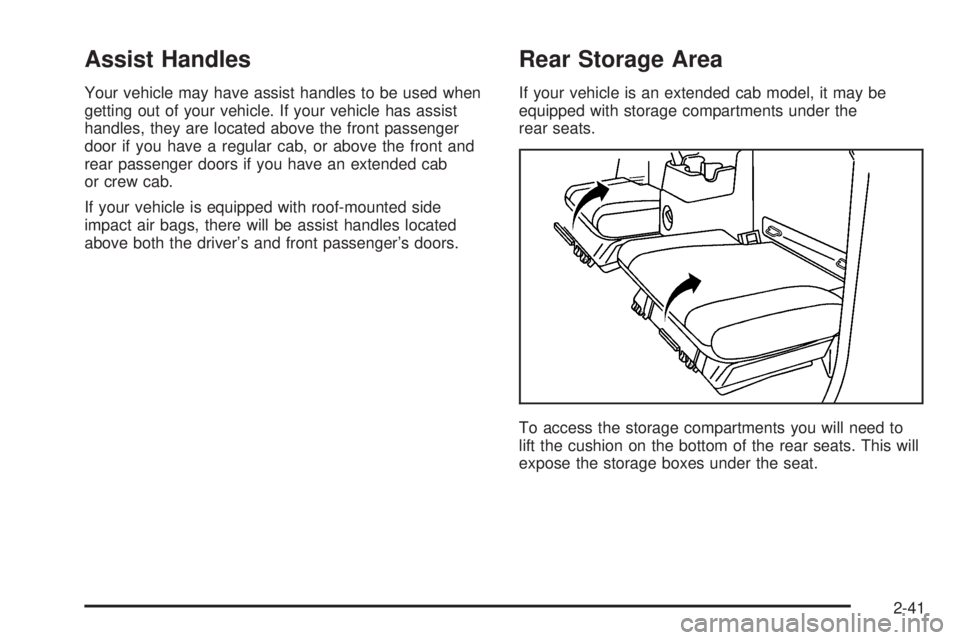
To access the storage compartments you will need to
lift the cushion on the bottom of the rear seats. This will
expose the storage boxes under the seat.
2-41
Page 149 of 434
You may notice a slight change in engine performance
when the air conditioning compressor shuts off and
turns on again. This is normal. The system is designed
to make adjustments to help with fuel economy while
still maintaining the selected temperature.
The air conditioning system removes moisture from the
air, so you may sometimes notice a small amount of
water dripping underneath your vehicle while idling
or after turning off the engine. This is normal.
Defogging and Defrosting
Fog on the inside of windows is a result of high humidity
(moisture) condensing on the cool window glass. This
can be minimized if the climate control system is used
properly. There are two modes to clear fog or frost from
your windshield and side windows. Use the defog mode
to clear the windows of fog or moisture and warm the
passengers. Use the defrost mode to remove fog or frost
from the windshield more quickly. For best results, clear
all snow and ice from the windshield before defrosting.
Turn the mode knob on the climate control panel
clockwise to select the defog or defrost modes.
/(Floor/Defog):This mode directs the air to the
windshield, the side window outlets, and to the oor
outlets. When you select this mode, the system runs the
air conditioning compressor unless the outside
temperature is near freezing or below. Recirculation is not
available in this mode.
0(Defrost):This mode directs most of the air to the
windshield, and the side window outlets. When you
select this mode, the system runs the air conditioning
compressor unless the outside temperature is near, or
below freezing. Recirculation is not available in
this mode.
Do not drive the vehicle until all the windows are clear.
Outlet Adjustment
Use the thumbwheel on the outlets to change the
direction of the air ow.
Lift up or push down on the thumbwheel located in the
center of the outlet to direct the air up or down, or
slide the thumbwheel to the left or right to direct the
airow from side-to-side.
Operation Tips
Clear away any ice, snow or leaves from the air
inlets at the base of the windshield that may
block the ow of air into your vehicle.
Use of non-GM approved hood deectors may
adversely affect the performance of the system.
Keep the path under the front seats clear of objects
to help circulate the air inside of your vehicle more
effectively.
3-21
Page 256 of 434
Never exceed the GVWR for your vehicle, or the GAWR
for either the front or rear axle.
If you do have a heavy load, you should spread it out.
Similar appearing vehicles may have different GVWRs
and capacity weights. Please note your vehicle’s
Certication/Tire label or consult your dealer for
additional details.
{CAUTION:
Do not load your vehicle any heavier than the
Gross Vehicle Weight Rating (GVWR), or either
the maximum front or rear Gross Axle Weight
Rating (GAWR). If you do, parts on your
vehicle can break, and it can change the way
your vehicle handles. These could cause you
to lose control and crash. Also, overloading
can shorten the life of your vehicle.
Using heavier suspension components to get added
durability might not change your weight ratings. Ask your
dealer to help you load your vehicle the right way.
Notice:Overloading your vehicle may cause
damage. Repairs would not be covered by your
warranty. Do not overload your vehicle.If you put things inside your vehicle — like suitcases,
tools, packages, or anything else — they will go as fast
as the vehicle goes. If you have to stop or turn
quickly, or if there is a crash, they will keep going.
{CAUTION:
Things you put inside your vehicle can strike
and injure people in a sudden stop or turn, or
in a crash.
Put things in the cargo area of your
vehicle. Try to spread the weight evenly.
Never stack heavier things, like suitcases,
inside the vehicle so that some of them
are above the tops of the seats.
Do not leave an unsecured child restraint
in your vehicle.
When you carry something inside the
vehicle, secure it whenever you can.
Do not leave a seat folded down unless
you need to.
4-48
Page 334 of 434
Tire Size
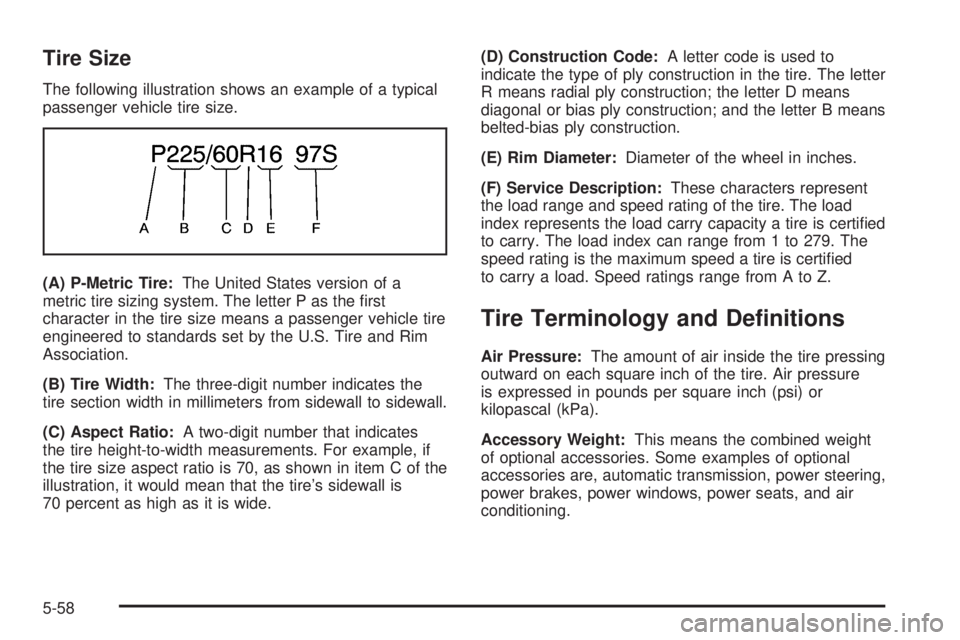
The following illustration shows an example of a typical
passenger vehicle tire size.
(A) P-Metric Tire:The United States version of a
metric tire sizing system. The letter P as the rst
character in the tire size means a passenger vehicle tire
engineered to standards set by the U.S. Tire and Rim
Association.
(B) Tire Width:The three-digit number indicates the
tire section width in millimeters from sidewall to sidewall.
(C) Aspect Ratio:A two-digit number that indicates
the tire height-to-width measurements. For example, if
the tire size aspect ratio is 70, as shown in item C of the
illustration, it would mean that the tire’s sidewall is
70 percent as high as it is wide.(D) Construction Code:A letter code is used to
indicate the type of ply construction in the tire. The letter
R means radial ply construction; the letter D means
diagonal or bias ply construction; and the letter B means
belted-bias ply construction.
(E) Rim Diameter:Diameter of the wheel in inches.
(F) Service Description:These characters represent
the load range and speed rating of the tire. The load
index represents the load carry capacity a tire is certied
to carry. The load index can range from 1 to 279. The
speed rating is the maximum speed a tire is certied
to carry a load. Speed ratings range from A to Z.
Tire Terminology and Denitions
Air Pressure:The amount of air inside the tire pressing
outward on each square inch of the tire. Air pressure
is expressed in pounds per square inch (psi) or
kilopascal (kPa).
Accessory Weight:This means the combined weight
of optional accessories. Some examples of optional
accessories are, automatic transmission, power steering,
power brakes, power windows, power seats, and air
conditioning.
5-58