oil GMC CANYON 2007 User Guide
[x] Cancel search | Manufacturer: GMC, Model Year: 2007, Model line: CANYON, Model: GMC CANYON 2007Pages: 492, PDF Size: 2.79 MB
Page 233 of 492
If the ignition or radio is turned off with a CD in the
player it stays in the player. When the ignition or
radio is turned on, the CD starts to play where it
stopped, if it was the last selected audio source.
As each new track starts to play, the track number
appears on the display.
The CD player can play the smaller 3 inch (8 cm)
single CDs with an adapter ring. Full-size CDs and
the smaller CDs are loaded in the same manner.
If playing a CD-R, the sound quality may be
reduced due to CD-R quality, the method of
recording, the quality of the music that has been
recorded, and the way the CD-R has been
handled. There may be an increase in skipping,
difficulty in nding tracks, and/or difficulty in loading
and ejecting. If these problems occur, check the
bottom surface of the CD. If the surface of the CD
is damaged, such as cracked, broken, or
scratched, the CD will not play properly. If the
surface of the CD is soiled, seeCare of Your CDs
on page 239Care of Your CDs for more
information.
If there is no apparent damage, try a known
good CD.Do not add any label to a CD, it could get caught
in the CD player. If a CD is recorded on a
personal computer and a description label is
needed, try labeling the top of the recorded CD
with a marking pen.
Notice:If you add any label to a CD, insert
more than one CD into the slot at a time,
or attempt to play scratched or damaged CDs,
you could damage the CD player. When
using the CD player, use only CDs in good
condition without any label, load one CD at a
time, and keep the CD player and the loading
slot free of foreign materials, liquids, and
debris.
If an error appears on the display, see “CD
Messages” later in this section.
1 FLD
x(Previous Folder):Press this
pushbutton to go to the rst track in the previous
folder. Pressing this button while in folder
random mode takes you to the previous folder and
plays the tracks in random order in that folder.
233
Page 239 of 492
XM™ Satellite Radio Service
XM™ Satellite Radio Service gives digital radio
reception from coast-to-coast in the 48 contiguous
United States, and in Canada. Just as with FM,
tall buildings or hills can interfere with satellite
radio signals, causing the sound to fade in and out.
In addition, traveling or standing under heavy
foliage, bridges, garages, or tunnels may cause
loss of the XM™ signal for a period of time.
The radio may display No Signl to indicate
interference.
Care of Your CDs
Handle CDs carefully. Store them in their original
cases or other protective cases and away from
direct sunlight and dust. The CD player scans the
bottom surface of the disc. If the surface of a
CD is damaged, such as cracked, broken,
or scratched, the CD will not play properly or not
at all. If the surface of a CD is soiled, take a
soft, lint free cloth or dampen a clean, soft cloth in
a mild, neutral detergent solution mixed with
water, and clean it. Make sure the wiping process
starts from the center to the edge.Do not touch the bottom side of a CD while
handling it; this could damage the surface.
Pick up CDs by grasping the outer edges or
the edge of the hole and the outer edge.
Care of the CD Player
Do not use CD lens cleaners for CD players
because the lens of the CD optics can become
contaminated by lubricants.
Fixed Mast Antenna
The xed mast antenna can withstand most car
washes without being damaged. If the mast should
ever become slightly bent, straighten it out by
hand. If the mast is badly bent, replace it.
Check occasionally to make sure the mast is
still tightened to the fender. If tightening is
required, tighten by hand, then with a wrench
one quarter turn.
239
Page 277 of 492
Here are some things you can check before a trip:
Windshield Washer Fluid:Is the reservoir
full? Are all windows clean inside and outside?
Wiper Blades:Are they in good shape?
Fuel, Engine Oil, Other Fluids:Have you
checked all levels?
Lamps:Are they all working? Are the
lenses clean?
Tires:They are vitally important to a safe,
trouble-free trip. Is the tread good enough
for long-distance driving? Are the tires
all inated to the recommended pressure?
Weather Forecasts:What is the weather
outlook along your route? Should you
delay your trip a short time to avoid a major
storm system?
Maps:Do you have up-to-date maps?
Highway Hypnosis
Is there actually such a condition as highway
hypnosis? Or is it just plain falling asleep at the
wheel? Call it highway hypnosis, lack of
awareness, or whatever.
There is something about an easy stretch of road
with the same scenery, along with the hum of the
tires on the road, the drone of the engine, and the
rush of the wind against the vehicle that can make
you sleepy. Do not let it happen to you! If it does,
your vehicle can leave the road in less than a
second, and you could crash and be injured.
What can you do about highway hypnosis?
First, be aware that it can happen.
Then here are some tips:
Make sure your vehicle is well ventilated,
with a comfortably cool interior.
Keep your eyes moving. Scan the road ahead
and to the sides. Check your mirrors and
your instruments frequently.
If you get sleepy, pull off the road into a rest,
service, or parking area and take a nap, get
some exercise, or both. For safety, treat
drowsiness on the highway as an emergency.
277
Page 309 of 492
Backing Up
Hold the bottom of the steering wheel with
one hand. Then, to move the trailer to the left, just
move that hand to the left. To move the trailer to the
right, move your hand to the right. Always back up
slowly and, if possible, have someone guide you.
Making Turns
Notice:Making very sharp turns while
trailering could cause the trailer to come in
contact with the vehicle. Your vehicle could
be damaged. Avoid making very sharp
turns while trailering.
When you’re turning with a trailer, make wider
turns than normal. Do this so your trailer
won’t strike soft shoulders, curbs, road signs,
trees or other objects. Avoid jerky or sudden
maneuvers. Signal well in advance.
Turn Signals When Towing a Trailer
When you tow a trailer, your vehicle has to have
extra wiring and a heavy-duty turn signal asher.
The arrows on your instrument panel will ash
whenever you signal a turn or lane change.
Properly hooked up, the trailer lamps will also
ash, telling other drivers you’re about to
turn, change lanes or stop.When towing a trailer, the arrows on your
instrument panel will ash for turns even if the bulbs
on the trailer are burned out. Thus, you may think
drivers behind you are seeing your signal when
they are not. It’s important to check occasionally to
be sure the trailer bulbs are still working.
Driving On Grades
Reduce speed and shift to a lower gear before
you start down a long or steep downgrade. If you
don’t shift down, you might have to use your
brakes so much that they would get hot and no
longer work well.
When towing at high altitude on steep uphill
grades, consider the following: Engine coolant
will boil at a lower temperature than at normal
altitudes. If you turn your engine off immediately
after towing at high altitude on steep uphill grades,
your vehicle may show signs similar to engine
overheating. To avoid this, let the engine run while
parked (preferably on level ground) with the
automatic transmission in PARK (P) (or the manual
transmission out of gear and the parking brake
applied) for a few minutes before turning the
engine off. If you do get the overheat warning,
seeEngine Overheating on page 340.
309
Page 311 of 492
Maintenance When Trailer Towing
Your vehicle will need service more often
when you’re pulling a trailer. SeeScheduled
Maintenance on page 437for more on this. Things
that are especially important in trailer operation
are automatic transmission uid (don’t overll),
engine oil, axle lubricant, belt, cooling system and
brake system. Each of these is covered in this
manual, and the Index will help you nd them
quickly. If you’re trailering, it’s a good idea
to review these sections before you start your trip.
Check periodically to see that all hitch nuts and
bolts are tight.
Trailer Wiring Harness
Your vehicle may be equipped with a four-pin
trailer towing harness. This harness has a four-pin
trailer connector that is attached to a bracket on
the hitch platform. The four-wire harness contains
the following trailer circuits:
Yellow: Left Stop/Turn Signal
Green: Right Stop/Turn Signal
Brown: Taillamps/Park lamps
White: Ground
Trailer Recommendations
You must subtract your hitch load from the
CWR for your vehicle. Weigh your vehicle with
your trailer attached, so that you won’t go over
the GVWR or the GAWR.
You’ll get the best performance if you spread out
the weight of your load the right way, and if
you choose the correct hitch and trailer brakes.
For more information, seeTowing a Trailer
on page 300later in this section.
311
Page 313 of 492
Service........................................................ 316
Accessories and Modications................... 316
California Proposition 65 Warning.............. 317
Doing Your Own Service Work.................. 317
Adding Equipment to the Outside of
Your Vehicle.......................................... 318
Fuel............................................................. 318
Gasoline Octane........................................ 318
Gasoline Specications.............................. 318
California Fuel........................................... 318
Additives................................................... 319
Fuels in Foreign Countries........................ 320
Filling the Tank......................................... 320
Filling a Portable Fuel Container............... 322
Checking Things Under the Hood.............. 323
Hood Release........................................... 323
Engine Compartment Overview.................. 324
Engine Oil................................................. 325Engine Oil Life System.............................. 328
Engine Air Cleaner/Filter............................ 330
Automatic Transmission Fluid.................... 331
Manual Transmission Fluid........................ 334
Hydraulic Clutch........................................ 336
Engine Coolant.......................................... 337
Radiator Pressure Cap.............................. 340
Engine Overheating................................... 340
Cooling System......................................... 342
Engine Fan Noise..................................... 347
Power Steering Fluid ................................. 348
Windshield Washer Fluid........................... 349
Brakes...................................................... 350
Battery...................................................... 353
Jump Starting............................................ 354
Rear Axle.................................................... 359
Four-Wheel Drive........................................ 359
Front Axle................................................... 360
Section 5 Service and Appearance Care
313
Page 320 of 492
Fuels in Foreign Countries
If you plan on driving in another country outside
the United States or Canada, the proper fuel may
be hard to nd. Never use leaded gasoline or
any other fuel not recommended in the previous
text on fuel. Costly repairs caused by use of
improper fuel would not be covered by your
warranty.
To check the fuel availability, ask an auto club, or
contact a major oil company that does business
in the country where you will be driving.
Filling the Tank
{CAUTION:
Fuel vapor burns violently and a fuel re
can cause bad injuries. To help avoid
injuries to you and others, read and follow
all the instructions on the pump island.
Turn off your engine when you are
refueling. Do not smoke if you are near
fuel or refueling your vehicle. Keep
sparks, ames, and smoking materials
away from fuel. Do not leave the fuel
pump unattended when refueling your
vehicle. This is against the law in some
places. Keep children away from the fuel
pump; never let children pump fuel.
320
Page 323 of 492
Checking Things Under
the Hood
{CAUTION:
Things that burn can get on hot engine
parts and start a re. These include
liquids like fuel, oil, coolant, brake uid,
windshield washer and other uids, and
plastic or rubber. You or others could be
burned. Be careful not to drop or spill
things that will burn onto a hot engine.
Hood Release
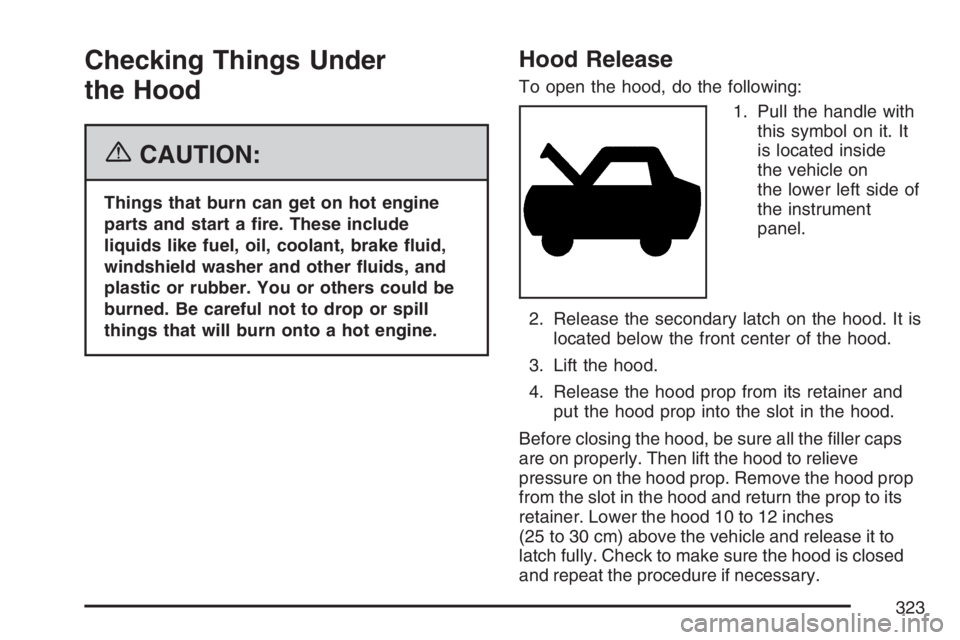
To open the hood, do the following:
1. Pull the handle with
this symbol on it. It
is located inside
the vehicle on
the lower left side of
the instrument
panel.
2. Release the secondary latch on the hood. It is
located below the front center of the hood.
3. Lift the hood.
4. Release the hood prop from its retainer and
put the hood prop into the slot in the hood.
Before closing the hood, be sure all the ller caps
are on properly. Then lift the hood to relieve
pressure on the hood prop. Remove the hood prop
from the slot in the hood and return the prop to its
retainer. Lower the hood 10 to 12 inches
(25 to 30 cm) above the vehicle and release it to
latch fully. Check to make sure the hood is closed
and repeat the procedure if necessary.
323
Page 325 of 492
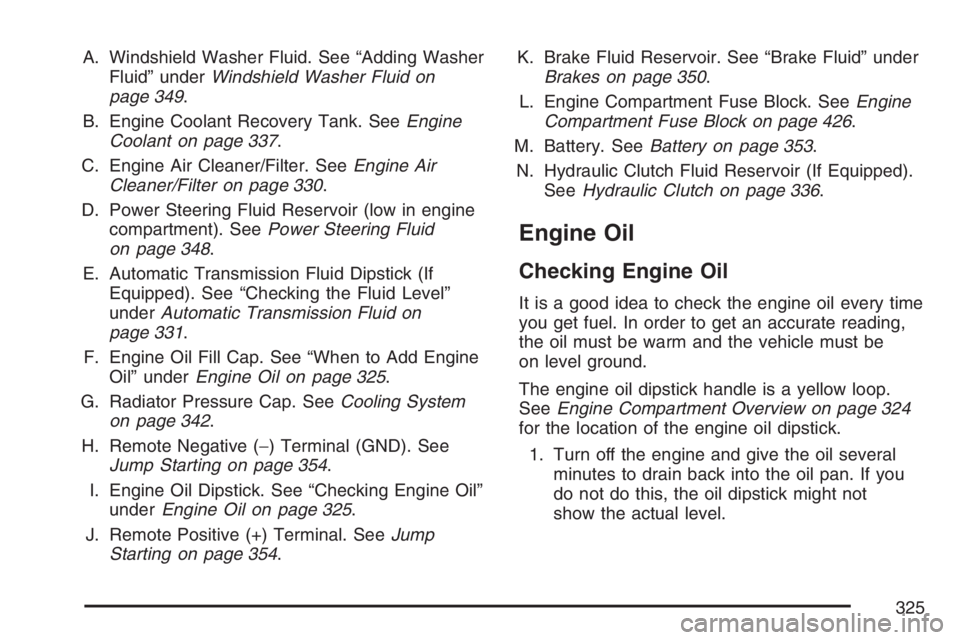
A. Windshield Washer Fluid. See “Adding Washer
Fluid” underWindshield Washer Fluid on
page 349.
B. Engine Coolant Recovery Tank. SeeEngine
Coolant on page 337.
C. Engine Air Cleaner/Filter. SeeEngine Air
Cleaner/Filter on page 330.
D. Power Steering Fluid Reservoir (low in engine
compartment). SeePower Steering Fluid
on page 348.
E. Automatic Transmission Fluid Dipstick (If
Equipped). See “Checking the Fluid Level”
underAutomatic Transmission Fluid on
page 331.
F. Engine Oil Fill Cap. See “When to Add Engine
Oil” underEngine Oil on page 325.
G. Radiator Pressure Cap. SeeCooling System
on page 342.
H. Remote Negative (−) Terminal (GND). See
Jump Starting on page 354.
I. Engine Oil Dipstick. See “Checking Engine Oil”
underEngine Oil on page 325.
J. Remote Positive (+) Terminal. SeeJump
Starting on page 354.K. Brake Fluid Reservoir. See “Brake Fluid” under
Brakes on page 350.
L. Engine Compartment Fuse Block. SeeEngine
Compartment Fuse Block on page 426.
M. Battery. SeeBattery on page 353.
N. Hydraulic Clutch Fluid Reservoir (If Equipped).
SeeHydraulic Clutch on page 336.
Engine Oil
Checking Engine Oil
It is a good idea to check the engine oil every time
you get fuel. In order to get an accurate reading,
the oil must be warm and the vehicle must be
on level ground.
The engine oil dipstick handle is a yellow loop.
SeeEngine Compartment Overview on page 324
for the location of the engine oil dipstick.
1. Turn off the engine and give the oil several
minutes to drain back into the oil pan. If you
do not do this, the oil dipstick might not
show the actual level.
325
Page 326 of 492
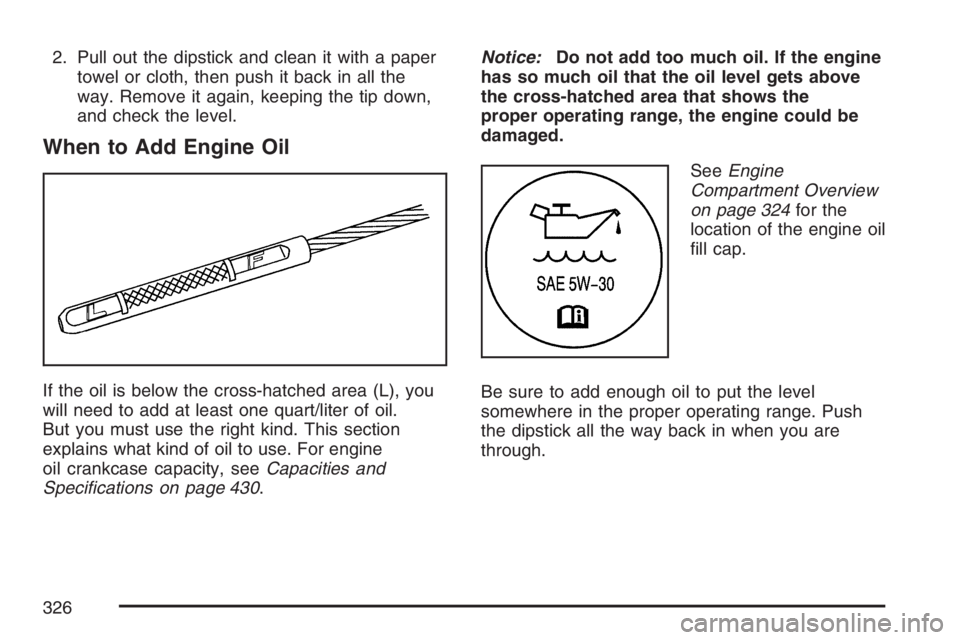
2. Pull out the dipstick and clean it with a paper
towel or cloth, then push it back in all the
way. Remove it again, keeping the tip down,
and check the level.
When to Add Engine Oil
If the oil is below the cross-hatched area (L), you
will need to add at least one quart/liter of oil.
But you must use the right kind. This section
explains what kind of oil to use. For engine
oil crankcase capacity, seeCapacities and
Specications on page 430.Notice:Do not add too much oil. If the engine
has so much oil that the oil level gets above
the cross-hatched area that shows the
proper operating range, the engine could be
damaged.
SeeEngine
Compartment Overview
on page 324for the
location of the engine oil
ll cap.
Be sure to add enough oil to put the level
somewhere in the proper operating range. Push
the dipstick all the way back in when you are
through.
326