seats GMC CANYON 2007 Owner's Guide
[x] Cancel search | Manufacturer: GMC, Model Year: 2007, Model line: CANYON, Model: GMC CANYON 2007Pages: 492, PDF Size: 2.79 MB
Page 59 of 492
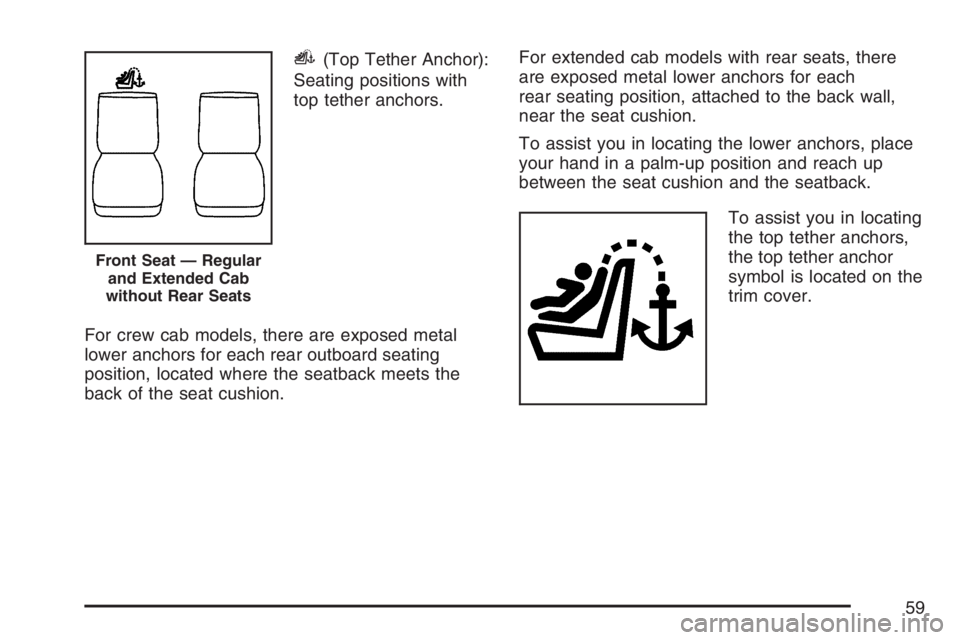
i(Top Tether Anchor):
Seating positions with
top tether anchors.
For crew cab models, there are exposed metal
lower anchors for each rear outboard seating
position, located where the seatback meets the
back of the seat cushion.For extended cab models with rear seats, there
are exposed metal lower anchors for each
rear seating position, attached to the back wall,
near the seat cushion.
To assist you in locating the lower anchors, place
your hand in a palm-up position and reach up
between the seat cushion and the seatback.
To assist you in locating
the top tether anchors,
the top tether anchor
symbol is located on the
trim cover.
Front Seat — Regular
and Extended Cab
without Rear Seats
59
Page 61 of 492
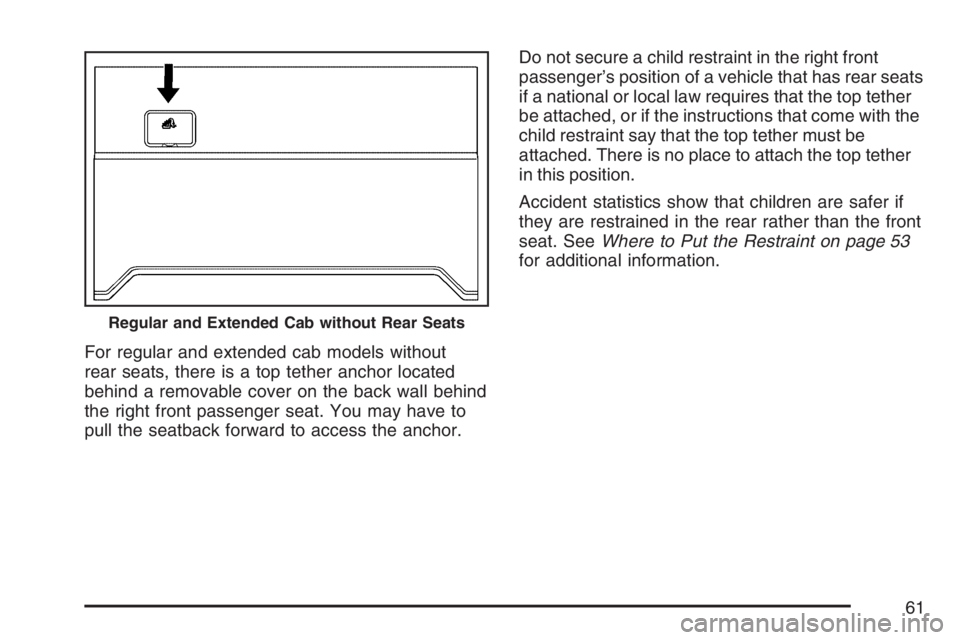
For regular and extended cab models without
rear seats, there is a top tether anchor located
behind a removable cover on the back wall behind
the right front passenger seat. You may have to
pull the seatback forward to access the anchor.Do not secure a child restraint in the right front
passenger’s position of a vehicle that has rear seats
if a national or local law requires that the top tether
be attached, or if the instructions that come with the
child restraint say that the top tether must be
attached. There is no place to attach the top tether
in this position.
Accident statistics show that children are safer if
they are restrained in the rear rather than the front
seat. SeeWhere to Put the Restraint on page 53
for additional information.
Regular and Extended Cab without Rear Seats
61
Page 67 of 492
3. Tighten the lower anchor attachments and the
top tether. The child restraint instructions will
show you how.
4. Push and pull the child restraint in different
directions to be sure it is secure.
Front Seat — Regular/Extended Cab
without Rear Seats
Your vehicle has a right front passenger’s airbag
and a passenger sensing system. The passenger
sensing system is designed to turn off the right
front passenger’s frontal airbag when an infant in
a rear-facing infant seat or a small child in a
forward-facing child restraint or booster seat is
detected. SeeSecuring a Child Restraint in
the Right Front Seat Position on page 71and
Passenger Sensing System on page 86for
important safety information and additional
information on installing a child restraint in the
right front seat position.
1. SeeSecuring a Child Restraint in the Right
Front Seat Position on page 71for instructions
on installing the child restraint using the
safety belts.2. If the child restraint manufacturer’s instructions
recommends that the top tether be attached,
attach and tighten the top tether to the top
tether anchor. Refer to the child restraint
instructions and the following steps:
2.1. Pull the seatback forward to access the
top tether anchor. SeeSeatback
Latches on page 16.
2.2. Pull on the nger access tab to remove
the cover to access the top tether
anchor.
2.3. Route the top tether according to your
child restraint instructions and the
following instructions:
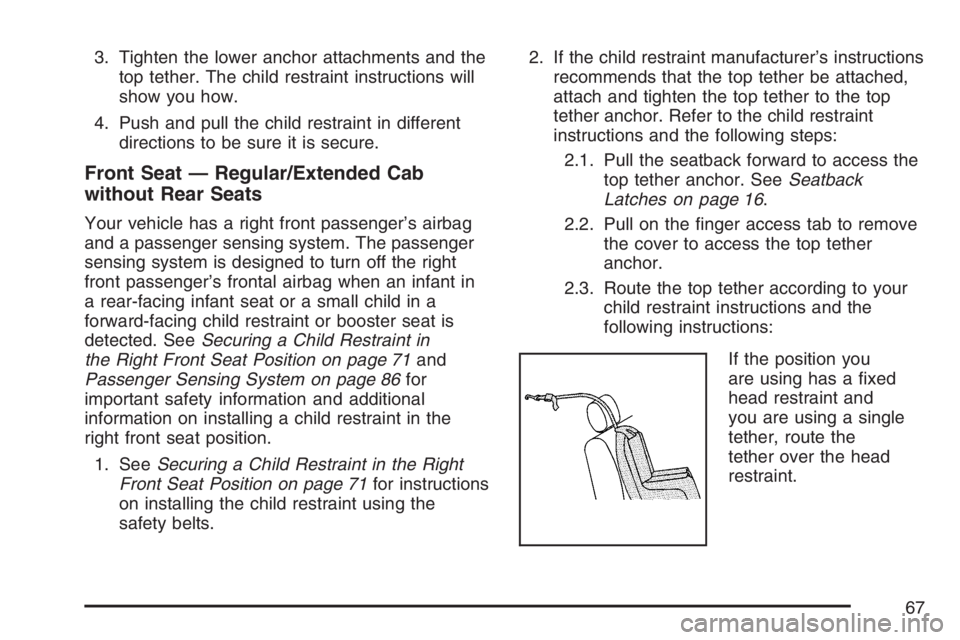
If the position you
are using has a xed
head restraint and
you are using a single
tether, route the
tether over the head
restraint.
67
Page 73 of 492
If your vehicle does not have a rear seat that
will accommodate a rear-facing child restraint,
never put a child in a rear-facing child restraint
in the right front passenger seat unless the
passenger airbag status indicator shows off and
the airbag is off. Here is why:
{CAUTION:
A child in a rear-facing child restraint
can be seriously injured or killed if the
right front passenger’s airbag inates.
This is because the back of the
rear-facing child restraint would be very
close to the inating airbag. Be sure the
airbag is off before using a rear-facing
child restraint in the right front seat
position.
Even though the passenger sensing
system is designed to turn off the
passenger’s frontal airbag if the system
detects a rear-facing child restraint,
CAUTION: (Continued)
CAUTION: (Continued)
no system is fail-safe, and no one can
guarantee that an airbag will not deploy
under some unusual circumstance, even
though it is turned off. We recommend
that rear-facing child restraints be
transported in vehicles with a rear seat
that will accommodate a rear-facing child
restraint, whenever possible.
If you need to secure a forward-facing
child restraint in the right front seat,
always move the front passenger seat as
far back as it will go. It is better to secure
the child restraint in a rear seat.
If your child restraint has the LATCH system, see
Lower Anchors and Tethers for Children (LATCH)
on page 56.
If your vehicle has rear seats, there is no top
tether anchor at the right front seating position.
73
Page 74 of 492
Do not secure a child seat in this position if a
national or local law requires that the top tether be
anchored or if the instructions that come with the
child restraint say that the top tether must be
anchored. SeeLower Anchors and Tethers for
Children (LATCH) on page 56if the child restraint
has a top tether.
You will be using the lap-shoulder belt to secure
the child restraint in this position. Be sure to follow
the instructions that came with the child restraint.
Secure the child in the child restraint when and as
the instructions say.
1. Your vehicle has a right front passenger’s
frontal airbag. SeePassenger Sensing System
on page 86. We recommend that rear-facing
child restraints be secured in a rear seat, even
if the airbag is off. If your child restraint is
forward-facing, move the seat as far back as it
will go before securing the child restraint in this
seat. SeeManual Seats on page 9orPower
Seats on page 10.
When the passenger sensing system has
turned off the right front passenger’s frontal
airbag, the off indicator in the passenger airbag
status indicator should light and stay lit whenyou turn the ignition to ON or START. See
Passenger Airbag Status Indicator on
page 182.
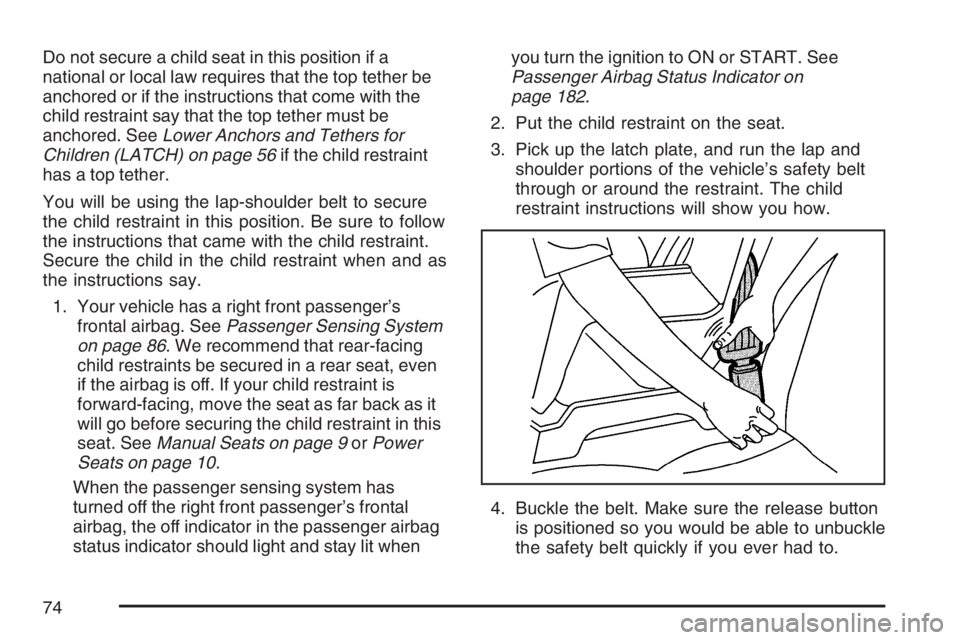
2. Put the child restraint on the seat.
3. Pick up the latch plate, and run the lap and
shoulder portions of the vehicle’s safety belt
through or around the restraint. The child
restraint instructions will show you how.
4. Buckle the belt. Make sure the release button
is positioned so you would be able to unbuckle
the safety belt quickly if you ever had to.
74
Page 75 of 492
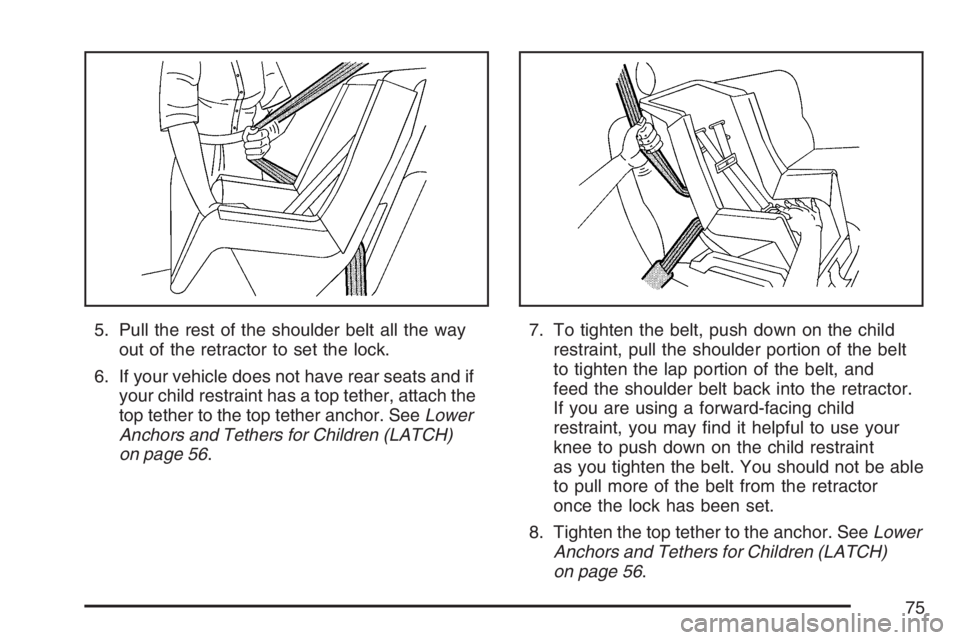
5. Pull the rest of the shoulder belt all the way
out of the retractor to set the lock.
6. If your vehicle does not have rear seats and if
your child restraint has a top tether, attach the
top tether to the top tether anchor. SeeLower
Anchors and Tethers for Children (LATCH)
on page 56.7. To tighten the belt, push down on the child
restraint, pull the shoulder portion of the belt
to tighten the lap portion of the belt, and
feed the shoulder belt back into the retractor.
If you are using a forward-facing child
restraint, you may nd it helpful to use your
knee to push down on the child restraint
as you tighten the belt. You should not be able
to pull more of the belt from the retractor
once the lock has been set.
8. Tighten the top tether to the anchor. SeeLower
Anchors and Tethers for Children (LATCH)
on page 56.
75
Page 93 of 492
Adding Equipment to Your
Airbag-Equipped Vehicle
Q:Is there anything I might add to the front
or sides of the vehicle that could keep
the airbags from working properly?
A:Yes. If you add things that change your
vehicle’s frame, bumper system, height,
front end or side sheet metal, they may keep
the airbag system from working properly.
Also, the airbag system may not work properly
if you relocate any of the airbag sensors.
If you have any questions about this,
you should contact Customer Assistance
before you modify your vehicle. The phone
numbers and addresses for Customer
Assistance are in Step Two of the Customer
Satisfaction Procedure in this manual.
SeeCustomer Satisfaction Procedure
on page 456.
Q:Because I have a disability, I have to get
my vehicle modied. How can I nd out
whether this will affect my airbag system?
A:Changing or moving any parts of the
front seats, safety belts, the airbag sensing
and diagnostic module, steering wheel,
instrument panel, ceiling headliner, ceiling
and pillar garnish trim, roof-mounted airbag
modules, or airbag wiring can affect the
operation of the airbag system. If you
have questions, call Customer Assistance.
The phone numbers and addresses for
Customer Assistance are in Step Two of
the Customer Satisfaction Procedure in
this manual. SeeCustomer Satisfaction
Procedure on page 456.
93
Page 150 of 492
Storage Areas
Glove Box
To open the glove box, pull on the lever.
Cupholder(s)
Your vehicle may have two cupholders located
on the lower part of the front doors as well as
two cupholders located at the front end of the
console. Vehicles with bench seats may have
cupholders attached to the front of the center seat.
If your vehicle is an extended cab or crew cab
model, your vehicle also has two rear cupholders.
On crew cab models, the cupholders are located
at the front end of the rear center seat cushion.
On extended cab models, the rear seat cupholders
are located on top of the rear center console.
If you have an ashtray, it will use one of the
cupholders.
Front Armrest Storage Area
For vehicles with bench seats, you may have a
center armrest storage area. Lift up on the upper
tab located at the front of the armrest to release
the latch. Lift the lid to open the storage area.For vehicles with bucket seats or uplevel
packages, your vehicle may have a two-tiered
center armrest storage area. Lift up on the upper
tab located at the front of the armrest to release
the latch. Lift the lid to the top storage area.
A second tab is located below the top one and
allows you to access the bottom storage area.
Lift up on the lower tab to release the latch.
Then, raise the lid of the lower storage area.
The upper storage area will lift up with the lid of
the lower storage area.
To close the storage area(s), lower the lid(s) until
you feel the latch close.
Assist Handles
Your vehicle may have assist handles to be used
when getting out of your vehicle. If your vehicle has
assist handles, they are located above the doors.
If your vehicle has roof-mounted side impact air
bags, there are assist handles located above both
the driver’s and front passenger’s doors.
150
Page 151 of 492
Rear Storage Area
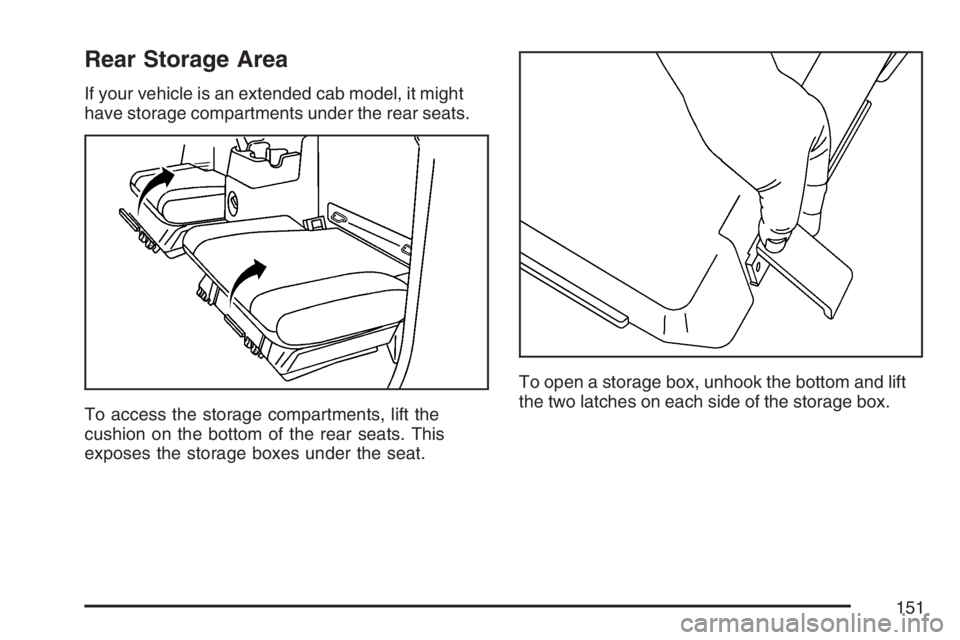
If your vehicle is an extended cab model, it might
have storage compartments under the rear seats.
To access the storage compartments, lift the
cushion on the bottom of the rear seats. This
exposes the storage boxes under the seat.To open a storage box, unhook the bottom and lift
the two latches on each side of the storage box.
151
Page 171 of 492
Exit Lighting
With exit lighting, the interior lamps will come on
when you remove the key from the ignition.
The lamps will not come on if the dome override
button is pressed in.
Electric Power Management
The vehicle has Electric Power Management
(EPM) that estimates the battery’s temperature and
state of charge. It then adjusts the voltage for
best performance and extended life of the battery.
When the battery’s state of charge is low, the
voltage is raised slightly to quickly put the charge
back in. When the state of charge is high, the
voltage is lowered slightly to prevent overcharging.
If the vehicle has a voltmeter gage, you may
see the voltage move up or down. This is normal.
If there is a problem, an alert will be displayed.The battery can be discharged at idle if the
electrical loads are very high. This is true for all
vehicles. This is because the generator (alternator)
may not be spinning fast enough at idle to
produce all the power that is needed for very high
electrical loads.
A high electrical load occurs when several of the
following loads are on: headlamps, high beams,
fog lamps, rear window defogger, climate
control fan at high speed, heated seats, engine
cooling fans, trailer loads, and loads plugged into
accessory power outlets.
Battery Run-Down Protection
This feature shuts off the dome lamp if it is left on
for more than 20 minutes when the ignition is
in LOCK. This will help prevent your battery from
running down.
171