oil level GMC CANYON 2007 Owner's Manual
[x] Cancel search | Manufacturer: GMC, Model Year: 2007, Model line: CANYON, Model: GMC CANYON 2007Pages: 492, PDF Size: 2.79 MB
Page 200 of 492
FUEL CAP
This message displays if the vehicle’s fuel cap is
either off or loose. Pull over as soon as possible
and check to see if the fuel cap is secure. You may
also see the check engine light on the instrument
panel cluster. If the check engine light does
come on when the fuel cap was loose, it may take
a few driving trips before the light turns off. See
Malfunction Indicator Lamp on page 188for more
information if the light still remains on. Press
and release the reset stem to acknowledge the
message and clear it from the display.
LOW FUEL
This message displays if the level of fuel in
the vehicle is low. Also check the fuel gage. See
Fuel Gage on page 193for more information.
Rell the fuel tank as soon as possible.
LOW TIRE
This message displays if a low tire pressure
is detected in any of the vehicle’s tires. Press
and release the reset stem to acknowledge
the message and clear it from the display.The message appears at each ignition cycle
until the tires are inated to the correct
ination pressure. SeeTires on page 369and
Ination - Tire Pressure on page 377for
more information on tires and the correct
ination pressures.
LOW TRAC (Traction)
If your vehicle has the Traction Control
System (TCS), this message displays when a
low traction condition is detected. SeeTraction
Control System (TCS) on page 249for more
information. Press and release the reset stem to
acknowledge the message and clear it from
the display.
OIL
This message displays when the oil pressure is
low. SeeOil Pressure Light on page 191and
Engine Oil on page 325for more information.
200
Page 277 of 492
Here are some things you can check before a trip:
Windshield Washer Fluid:Is the reservoir
full? Are all windows clean inside and outside?
Wiper Blades:Are they in good shape?
Fuel, Engine Oil, Other Fluids:Have you
checked all levels?
Lamps:Are they all working? Are the
lenses clean?
Tires:They are vitally important to a safe,
trouble-free trip. Is the tread good enough
for long-distance driving? Are the tires
all inated to the recommended pressure?
Weather Forecasts:What is the weather
outlook along your route? Should you
delay your trip a short time to avoid a major
storm system?
Maps:Do you have up-to-date maps?
Highway Hypnosis
Is there actually such a condition as highway
hypnosis? Or is it just plain falling asleep at the
wheel? Call it highway hypnosis, lack of
awareness, or whatever.
There is something about an easy stretch of road
with the same scenery, along with the hum of the
tires on the road, the drone of the engine, and the
rush of the wind against the vehicle that can make
you sleepy. Do not let it happen to you! If it does,
your vehicle can leave the road in less than a
second, and you could crash and be injured.
What can you do about highway hypnosis?
First, be aware that it can happen.
Then here are some tips:
Make sure your vehicle is well ventilated,
with a comfortably cool interior.
Keep your eyes moving. Scan the road ahead
and to the sides. Check your mirrors and
your instruments frequently.
If you get sleepy, pull off the road into a rest,
service, or parking area and take a nap, get
some exercise, or both. For safety, treat
drowsiness on the highway as an emergency.
277
Page 309 of 492
Backing Up
Hold the bottom of the steering wheel with
one hand. Then, to move the trailer to the left, just
move that hand to the left. To move the trailer to the
right, move your hand to the right. Always back up
slowly and, if possible, have someone guide you.
Making Turns
Notice:Making very sharp turns while
trailering could cause the trailer to come in
contact with the vehicle. Your vehicle could
be damaged. Avoid making very sharp
turns while trailering.
When you’re turning with a trailer, make wider
turns than normal. Do this so your trailer
won’t strike soft shoulders, curbs, road signs,
trees or other objects. Avoid jerky or sudden
maneuvers. Signal well in advance.
Turn Signals When Towing a Trailer
When you tow a trailer, your vehicle has to have
extra wiring and a heavy-duty turn signal asher.
The arrows on your instrument panel will ash
whenever you signal a turn or lane change.
Properly hooked up, the trailer lamps will also
ash, telling other drivers you’re about to
turn, change lanes or stop.When towing a trailer, the arrows on your
instrument panel will ash for turns even if the bulbs
on the trailer are burned out. Thus, you may think
drivers behind you are seeing your signal when
they are not. It’s important to check occasionally to
be sure the trailer bulbs are still working.
Driving On Grades
Reduce speed and shift to a lower gear before
you start down a long or steep downgrade. If you
don’t shift down, you might have to use your
brakes so much that they would get hot and no
longer work well.
When towing at high altitude on steep uphill
grades, consider the following: Engine coolant
will boil at a lower temperature than at normal
altitudes. If you turn your engine off immediately
after towing at high altitude on steep uphill grades,
your vehicle may show signs similar to engine
overheating. To avoid this, let the engine run while
parked (preferably on level ground) with the
automatic transmission in PARK (P) (or the manual
transmission out of gear and the parking brake
applied) for a few minutes before turning the
engine off. If you do get the overheat warning,
seeEngine Overheating on page 340.
309
Page 325 of 492
A. Windshield Washer Fluid. See “Adding Washer
Fluid” underWindshield Washer Fluid on
page 349.
B. Engine Coolant Recovery Tank. SeeEngine
Coolant on page 337.
C. Engine Air Cleaner/Filter. SeeEngine Air
Cleaner/Filter on page 330.
D. Power Steering Fluid Reservoir (low in engine
compartment). SeePower Steering Fluid
on page 348.
E. Automatic Transmission Fluid Dipstick (If
Equipped). See “Checking the Fluid Level”
underAutomatic Transmission Fluid on
page 331.
F. Engine Oil Fill Cap. See “When to Add Engine
Oil” underEngine Oil on page 325.
G. Radiator Pressure Cap. SeeCooling System
on page 342.
H. Remote Negative (−) Terminal (GND). See
Jump Starting on page 354.
I. Engine Oil Dipstick. See “Checking Engine Oil”
underEngine Oil on page 325.
J. Remote Positive (+) Terminal. SeeJump
Starting on page 354.K. Brake Fluid Reservoir. See “Brake Fluid” under
Brakes on page 350.
L. Engine Compartment Fuse Block. SeeEngine
Compartment Fuse Block on page 426.
M. Battery. SeeBattery on page 353.
N. Hydraulic Clutch Fluid Reservoir (If Equipped).
SeeHydraulic Clutch on page 336.
Engine Oil
Checking Engine Oil
It is a good idea to check the engine oil every time
you get fuel. In order to get an accurate reading,
the oil must be warm and the vehicle must be
on level ground.
The engine oil dipstick handle is a yellow loop.
SeeEngine Compartment Overview on page 324
for the location of the engine oil dipstick.
1. Turn off the engine and give the oil several
minutes to drain back into the oil pan. If you
do not do this, the oil dipstick might not
show the actual level.
325
Page 326 of 492
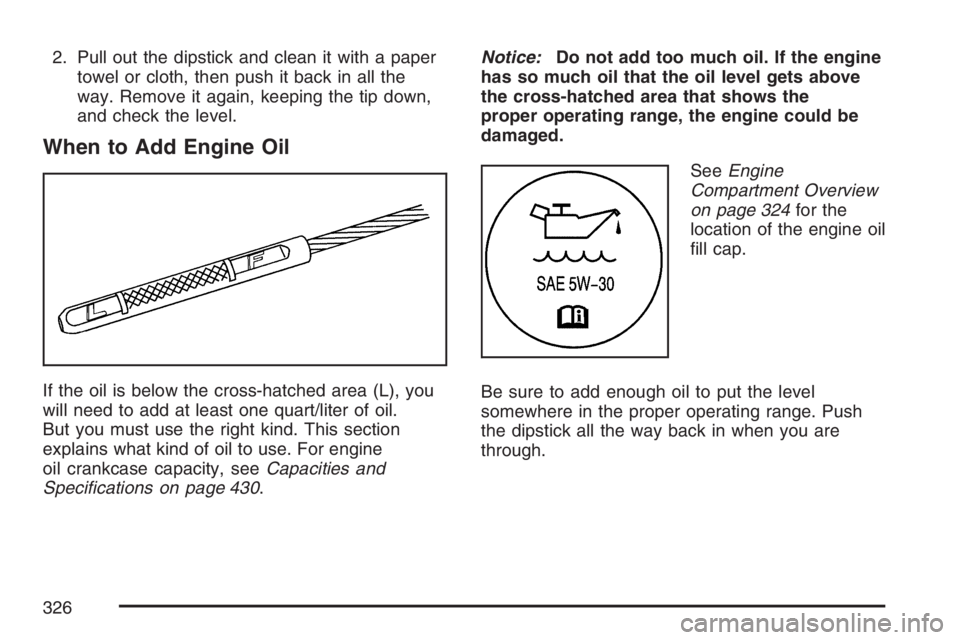
2. Pull out the dipstick and clean it with a paper
towel or cloth, then push it back in all the
way. Remove it again, keeping the tip down,
and check the level.
When to Add Engine Oil
If the oil is below the cross-hatched area (L), you
will need to add at least one quart/liter of oil.
But you must use the right kind. This section
explains what kind of oil to use. For engine
oil crankcase capacity, seeCapacities and
Specications on page 430.Notice:Do not add too much oil. If the engine
has so much oil that the oil level gets above
the cross-hatched area that shows the
proper operating range, the engine could be
damaged.
SeeEngine
Compartment Overview
on page 324for the
location of the engine oil
ll cap.
Be sure to add enough oil to put the level
somewhere in the proper operating range. Push
the dipstick all the way back in when you are
through.
326
Page 328 of 492
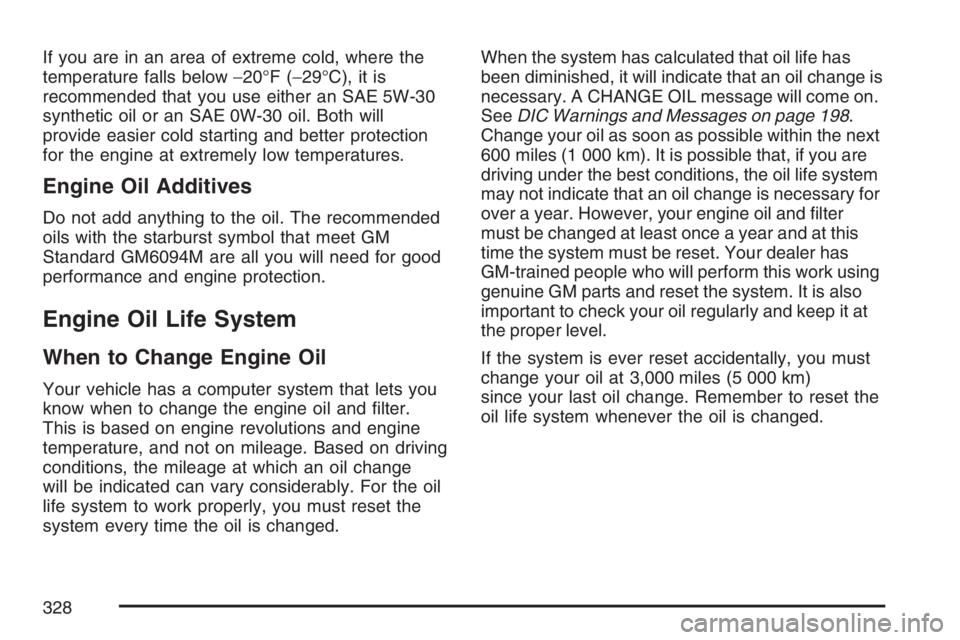
If you are in an area of extreme cold, where the
temperature falls below−20°F (−29°C), it is
recommended that you use either an SAE 5W-30
synthetic oil or an SAE 0W-30 oil. Both will
provide easier cold starting and better protection
for the engine at extremely low temperatures.
Engine Oil Additives
Do not add anything to the oil. The recommended
oils with the starburst symbol that meet GM
Standard GM6094M are all you will need for good
performance and engine protection.
Engine Oil Life System
When to Change Engine Oil
Your vehicle has a computer system that lets you
know when to change the engine oil and lter.
This is based on engine revolutions and engine
temperature, and not on mileage. Based on driving
conditions, the mileage at which an oil change
will be indicated can vary considerably. For the oil
life system to work properly, you must reset the
system every time the oil is changed.When the system has calculated that oil life has
been diminished, it will indicate that an oil change is
necessary. A CHANGE OIL message will come on.
SeeDIC Warnings and Messages on page 198.
Change your oil as soon as possible within the next
600 miles (1 000 km). It is possible that, if you are
driving under the best conditions, the oil life system
may not indicate that an oil change is necessary for
over a year. However, your engine oil and lter
must be changed at least once a year and at this
time the system must be reset. Your dealer has
GM-trained people who will perform this work using
genuine GM parts and reset the system. It is also
important to check your oil regularly and keep it at
the proper level.
If the system is ever reset accidentally, you must
change your oil at 3,000 miles (5 000 km)
since your last oil change. Remember to reset the
oil life system whenever the oil is changed.
328
Page 331 of 492
{CAUTION:
Operating the engine with the air
cleaner/lter off can cause you or others
to be burned. The air cleaner not only
cleans the air; it helps to stop ames if
the engine backres. If it is not there and
the engine backres, you could be
burned. Do not drive with it off, and be
careful working on the engine with the air
cleaner/lter off.
Notice:If the air cleaner/lter is off, a backre
can cause a damaging engine re. And, dirt
can easily get into your engine, which will
damage it. Always have the air cleaner/lter in
place when you are driving.
Automatic Transmission Fluid
When to Check and Change Automatic
Transmission Fluid
A good time to check your automatic transmission
uid level is when the engine oil is changed.
Change the uid and lter at the intervals listed in
Additional Required Services on page 440, and
be sure to use the transmission uid listed in
Recommended Fluids and Lubricants on page 447.
331
Page 334 of 492
How to Add Automatic Transmission
Fluid
Refer to the Maintenance Schedule to determine
what kind of transmission uid to use. See
Recommended Fluids and Lubricants on page 447.
Add uid only after checking the transmission
uid while it is hot. A cold check is used only as a
reference. If the uid level is low, add only
enough of the proper uid to bring the level up to
the HOT area for a hot check. It does not take
much uid, generally less than one pint (0.5 L). Do
not overll.
Notice:Use of the incorrect automatic
transmission uid may damage your vehicle,
and the damages may not be covered by
your warranty. Always use the automatic
transmission uid listed inRecommended
Fluids and Lubricants on page 447.
After adding uid, recheck the uid level as
described under “How to Check Automatic
Transmission Fluid,” earlier in this section.
When the correct uid level is obtained, push
the dipstick back in all the way; then ip the
handle down to lock the dipstick in place.
Manual Transmission Fluid
When to Check
A good time to have it checked is when the
engine oil is changed. However, the uid in your
manual transmission does not require changing.
How to Check
Because this operation can be a little difficult, you
may choose to have this done at your GM
dealership service department.
If you do it yourself, be sure to follow all the
instructions here, or you could get a false reading.
Notice:Too much or too little uid can
damage your transmission. Too little uid
could cause the transmission to overheat. Be
sure to get an accurate reading if you check
your transmission uid.
Check the uid level only when your engine is off,
the vehicle is parked on a level place and the
transmission is cool enough for you to rest your
ngers on the transmission case.
334
Page 337 of 492
How to Check and Add Fluid
The proper uid should be added if the level does
not reach the bottom of the diaphragm when it
is in place in the reservoir. See the instructions on
the reservoir cap.
Engine Coolant
The cooling system in your vehicle is lled with
DEX-COOL®engine coolant. This coolant is
designed to remain in your vehicle for ve years or
150,000 miles (240 000 km), whichever occurs
rst, if you add only DEX-COOL
®extended
life coolant.
The following explains your cooling system and
how to add coolant when it is low. If you have
a problem with engine overheating, seeEngine
Overheating on page 340.A 50/50 mixture of clean, drinkable water and
DEX-COOL
®coolant will:
Give freezing protection down to
−34°F (−37°C).
Give boiling protection up to 265°F (129°C).
Protect against rust and corrosion.
Help keep the proper engine temperature.
Let the warning lights and gages work as they
should.
Notice:Using coolant other than DEX-COOL
®
may cause premature engine, heater core,
or radiator corrosion. In addition, the engine
coolant may require changing sooner, at
the rst maintenance service after each
30,000 miles (50 000 km) or 24 months,
whichever occurs rst. Any repairs would not
be covered by your warranty. Always use
DEX-COOL
®(silicate-free) coolant in your
vehicle.
337
Page 342 of 492
Cooling System
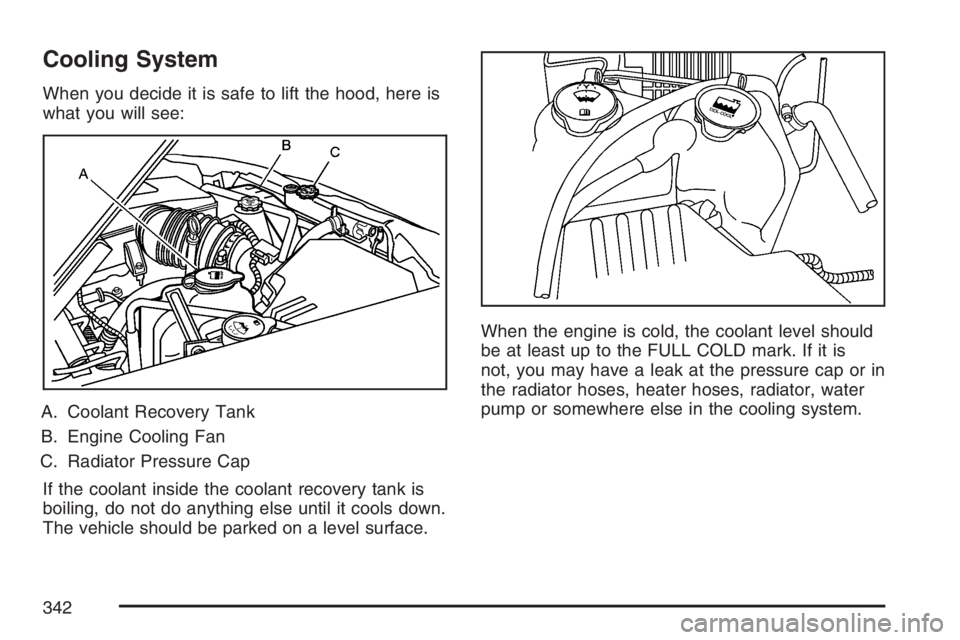
When you decide it is safe to lift the hood, here is
what you will see:
A. Coolant Recovery Tank
B. Engine Cooling Fan
C. Radiator Pressure Cap
If the coolant inside the coolant recovery tank is
boiling, do not do anything else until it cools down.
The vehicle should be parked on a level surface.When the engine is cold, the coolant level should
be at least up to the FULL COLD mark. If it is
not, you may have a leak at the pressure cap or in
the radiator hoses, heater hoses, radiator, water
pump or somewhere else in the cooling system.
342