traction control GMC CANYON 2009 Owner's Guide
[x] Cancel search | Manufacturer: GMC, Model Year: 2009, Model line: CANYON, Model: GMC CANYON 2009Pages: 414, PDF Size: 2.48 MB
Page 318 of 414
You need new tires if any of the following statements
are true:
You can see the indicators at three or more places
around the tire.
You can see cord or fabric showing through the
tire’s rubber.
The tread or sidewall is cracked, cut, or snagged
deep enough to show cord or fabric.
The tire has a bump, bulge, or split.
The tire has a puncture, cut, or other damage that
cannot be repaired well because of the size or
location of the damage.
The rubber in tires degrades over time, even if they are
not being used. This is also true for the spare tire, if
your vehicle has one. Multiple conditions affect how fast
this aging takes place, including temperatures, loading
conditions, and ination pressure maintenance. With
proper care and maintenance tires will typically wear out
before they degrade due to age. If you are unsure
about the need to replace your tires as they get older,
consult the tire manufacturer for more information.
Buying New Tires
GM has developed and matched specic tires for your
vehicle. The original equipment tires installed on
your vehicle, when it was new, were designed to meet
General Motors Tire Performance Criteria Specication
(TPC spec) system rating. If you need replacement
tires, GM strongly recommends that you get tires with
the same TPC Spec rating. This way, your vehicle
will continue to have tires that are designed to give the
same performance and vehicle safety, during normal
use, as the original tires.
GM’s exclusive TPC Spec system considers over a
dozen critical specications that impact the overall
performance of your vehicle, including brake system
performance, ride and handling, traction control, and tire
pressure monitoring performance. GM’s TPC Spec
number is molded onto the tire’s sidewall near the tire
size. If the tires have an all-season tread design,
the TPC spec number will be followed by an MS for
mud and snow. SeeTire Sidewall Labeling on page 5-55
for additional information.
5-70
Page 320 of 414
Different Size Tires and Wheels
If you add wheels or tires that are a different size than
your original equipment wheels and tires, this may affect
the way your vehicle performs, including its braking, ride
and handling characteristics, stability, and resistance to
rollover. Additionally, if your vehicle has electronic
systems such as, antilock brakes, traction control, and
electronic stability control, the performance of these
systems can be affected.
{CAUTION:
If you add different sized wheels, your vehicle may
not provide an acceptable level of performance and
safety if tires not recommended for those wheels
are selected. You may increase the chance that you
will crash and suffer serious injury. Only use GM
specic wheel and tire systems developed for your
vehicle, and have them properly installed by a GM
certied technician.
SeeBuying New Tires on page 5-70andAccessories
and Modifications on page 5-3for additional information.
Uniform Tire Quality Grading
Quality grades can be found where applicable on
the tire sidewall between tread shoulder and
maximum section width. For example:
Treadwear 200 Traction AA
Temperature A
The following information relates to the system
developed by the United States National Highway
Traffic Safety Administration (NHTSA), which
grades tires by treadwear, traction, and
temperature performance. This applies only to
vehicles sold in the United States. The grades are
molded on the sidewalls of most passenger car
tires. The Uniform Tire Quality Grading (UTQG)
system does not apply to deep tread, winter-type
snow tires, space-saver, or temporary use spare
tires, tires with nominal rim diameters of
10 to 12 inches (25 to 30 cm), or to some
limited-production tires.
5-72
Page 321 of 414
While the tires available on General Motors
passenger cars and light trucks may vary with
respect to these grades, they must also conform to
federal safety requirements and additional General
Motors Tire Performance Criteria (TPC) standards.
Treadwear
The treadwear grade is a comparative rating based
on the wear rate of the tire when tested under
controlled conditions on a specied government
test course. For example, a tire graded 150 would
wear one and a half (1.5) times as well on the
government course as a tire graded 100. The
relative performance of tires depends upon the
actual conditions of their use, however, and may
depart signicantly from the norm due to variations
in driving habits, service practices, and differences
in road characteristics and climate.
Traction – AA, A, B, C
The traction grades, from highest to lowest, are AA,
A, B, and C. Those grades represent the tire’s
ability to stop on wet pavement as measured under
controlled conditions on specied government test
surfaces of asphalt and concrete. A tire marked C
may have poor traction performance.
{WARNING:
The traction grade assigned to this tire is
based on straight-ahead braking traction
tests, and does not include acceleration,
cornering, hydroplaning, or peak traction
characteristics.
5-73
Page 324 of 414
Tire Chains
{CAUTION:
If your vehicle has P215/70R16, P235/75R16,
P265/70R17, or P235/50R18 size tires, do not
use tire chains. They can damage your vehicle
because there is not enough clearance. Tire
chains used on a vehicle without the proper
amount of clearance can cause damage to the
brakes, suspension, or other vehicle parts. The
area damaged by the tire chains could cause you
to lose control of your vehicle and you or others
may be injured in a crash.
Use another type of traction device only if its
manufacturer recommends it for use on your
vehicle and tire size combination and road
conditions. Follow that manufacturer’s instructions.
CAUTION: (Continued)
CAUTION: (Continued)
To help avoid damage to your vehicle, drive
slowly, readjust, or remove the device if it is
contacting your vehicle. Do not spin the vehicle’s
wheels.
If you do nd traction devices that will t, install
them on the rear tires.
Notice:If your vehicle has a tire size other than
P215/70R16, P235/75R16, P265/70R17, or P235/50R18
use tire chains only where legal and only when
you must. Use chains that are the proper size for
your tires. Install them on the tires of the rear axle.
Do not use chains on the tires of the front axle.
Tighten them as tightly as possible with the ends
securely fastened. Drive slowly and follow the chain
manufacturer’s instructions. If you can hear the
chains contacting your vehicle, stop and retighten
them. If the contact continues, slow down until
it stops. Driving too fast or spinning the wheels with
chains on will damage your vehicle.
5-76
Page 408 of 414
Light (cont.)
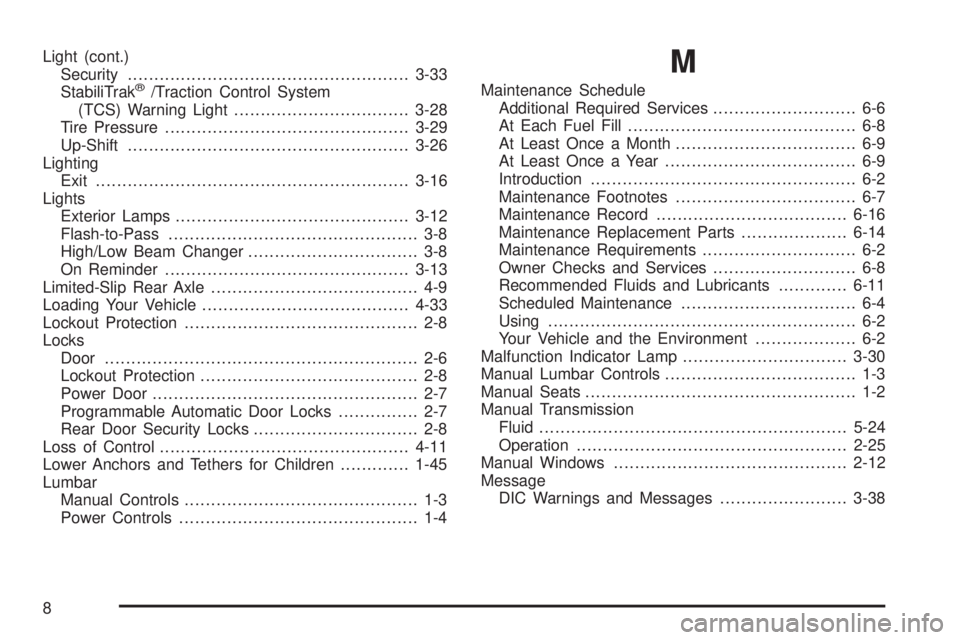
Security.....................................................3-33
StabiliTrak
®/Traction Control System
(TCS) Warning Light.................................3-28
Tire Pressure..............................................3-29
Up-Shift.....................................................3-26
Lighting
Exit ...........................................................3-16
Lights
Exterior Lamps............................................3-12
Flash-to-Pass............................................... 3-8
High/Low Beam Changer................................ 3-8
On Reminder..............................................3-13
Limited-Slip Rear Axle....................................... 4-9
Loading Your Vehicle.......................................4-33
Lockout Protection............................................ 2-8
Locks
Door ........................................................... 2-6
Lockout Protection......................................... 2-8
Power Door .................................................. 2-7
Programmable Automatic Door Locks............... 2-7
Rear Door Security Locks............................... 2-8
Loss of Control...............................................4-11
Lower Anchors and Tethers for Children.............1-45
Lumbar
Manual Controls............................................ 1-3
Power Controls............................................. 1-4
M
Maintenance Schedule
Additional Required Services........................... 6-6
At Each Fuel Fill........................................... 6-8
At Least Once a Month.................................. 6-9
At Least Once a Year.................................... 6-9
Introduction.................................................. 6-2
Maintenance Footnotes.................................. 6-7
Maintenance Record....................................6-16
Maintenance Replacement Parts....................6-14
Maintenance Requirements............................. 6-2
Owner Checks and Services........................... 6-8
Recommended Fluids and Lubricants.............6-11
Scheduled Maintenance................................. 6-4
Using.......................................................... 6-2
Your Vehicle and the Environment................... 6-2
Malfunction Indicator Lamp...............................3-30
Manual Lumbar Controls.................................... 1-3
Manual Seats................................................... 1-2
Manual Transmission
Fluid..........................................................5-24
Operation...................................................2-25
Manual Windows............................................2-12
Message
DIC Warnings and Messages........................3-38
8
Page 413 of 414
Tires.............................................................5-54
Aluminum or Chrome-Plated Wheels,
Cleaning...............................................5-105
Buying New Tires........................................5-70
Chains.......................................................5-76
Changing a Flat Tire....................................5-78
Cleaning...................................................5-106
Different Size..............................................5-72
High-Speed Operation..................................5-62
If a Tire Goes Flat.......................................5-77
Ination - Tire Pressure................................5-61
Inspection and Rotation................................5-68
Installing the Spare Tire................................5-83
Pressure Monitor Operation...........................5-65
Pressure Monitor System..............................5-63
Removing the Flat Tire.................................5-83
Removing the Spare Tire and Tools...............5-79
Secondary Latch System..............................5-90
Spare Tire..................................................5-98
Storing a Flat or Spare Tire and Tools............5-94
Tire Sidewall Labeling..................................5-55
Tire Terminology and Denitions....................5-58
Uniform Tire Quality Grading.........................5-72
Wheel Alignment and Tire Balance.................5-74
Wheel Replacement.....................................5-74
When It Is Time for New Tires......................5-69Towing
Recreational Vehicle.....................................4-41
Towing a Trailer..........................................4-47
Your Vehicle...............................................4-40
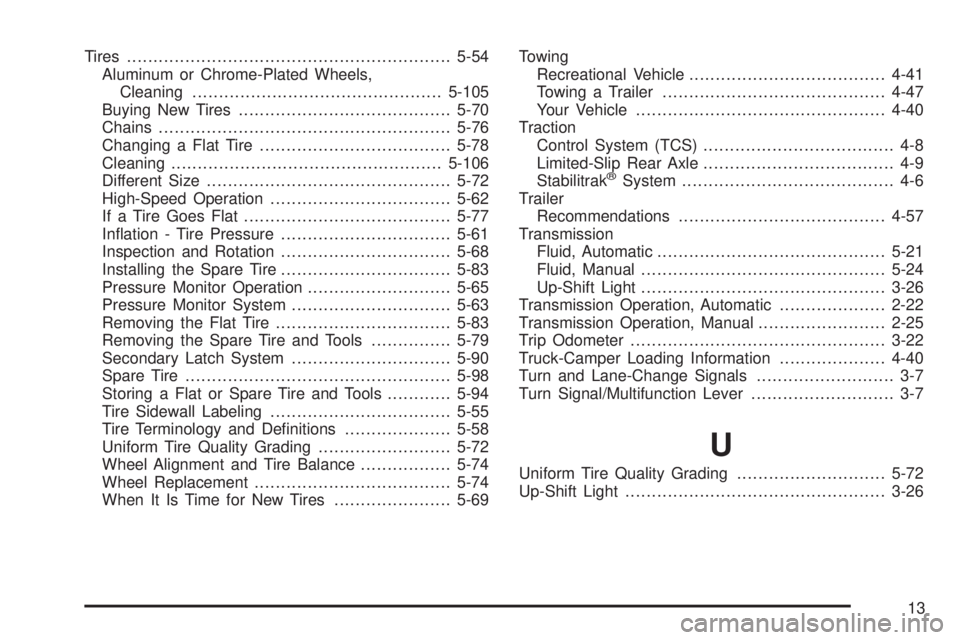
Traction
Control System (TCS).................................... 4-8
Limited-Slip Rear Axle.................................... 4-9
Stabilitrak
®System........................................ 4-6
Trailer
Recommendations.......................................4-57
Transmission
Fluid, Automatic...........................................5-21
Fluid, Manual..............................................5-24
Up-Shift Light..............................................3-26
Transmission Operation, Automatic....................2-22
Transmission Operation, Manual........................2-25
Trip Odometer................................................3-22
Truck-Camper Loading Information....................4-40
Turn and Lane-Change Signals.......................... 3-7
Turn Signal/Multifunction Lever........................... 3-7
U
Uniform Tire Quality Grading............................5-72
Up-Shift Light.................................................3-26
13