change wheel GMC CANYON 2010 User Guide
[x] Cancel search | Manufacturer: GMC, Model Year: 2010, Model line: CANYON, Model: GMC CANYON 2010Pages: 448, PDF Size: 2.62 MB
Page 234 of 448
Approaching a Hill
When you approach a hill, decide if it is too steep to
climb, descend, or cross. Steepness can be hard
to judge. On a very small hill, for example, there may be
a smooth, constant incline with only a small change in
elevation where you can easily see all the way to
the top. On a large hill, the incline may get steeper as
you near the top, but you might not see this because the
crest of the hill is hidden by bushes, grass, or shrubs.
Consider this as you approach a hill:
•Is there a constant incline, or does the hill get
sharply steeper in places?
•Is there good traction on the hillside, or will the
surface cause tire slipping?
•Is there a straight path up or down the hill so you
will not have to make turning maneuvers?
•Are there obstructions on the hill that can block your
path, such as boulders, trees, logs, or ruts?
•What is beyond the hill? Is there a cliff, an
embankment, a drop-off, a fence? Get out and walk
the hill if you do not know. It is the smart way to
find out.
•Is the hill simply too rough? Steep hills often have
ruts, gullies, troughs, and exposed rocks because
they are more susceptible to the effects of erosion.
Driving Uphill
Once you decide it is safe to drive up the hill:
•Use a low gear and get a firm grip on the steering
wheel.
•Get a smooth start up the hill and try to maintain
speed. Not using more power than needed can
avoid spinning the wheels or sliding.
{WARNING:
Turning or driving across steep hills can be
dangerous. You could lose traction, slide
sideways, and possibly roll over. You could be
seriously injured or killed. When driving up hills,
always try to go straight up.
•Try to drive straight up the hill if at all possible.
If the path twists and turns, you might want to
find another route.
•Ease up on the speed as you approach the top of
the hill.
5-18
Page 239 of 448
Stalling on an Incline
{WARNING:
Getting out on the downhill (low) side of a vehicle
stopped across an incline is dangerous. If the
vehicle rolls over, you could be crushed or killed.
Always get out on the uphill (high) side of the
vehicle and stay well clear of the rollover path.
If the vehicle stalls when crossing an incline, be sure you,
and any passengers, get out on the uphill side, even if the
door there is harder to open. If you get out on the downhill
side and the vehicle starts to roll over, you will be right in
its path.
If you have to walk down the slope, stay out of the path
the vehicle will take if it does roll over.
Driving in Mud, Sand, Snow, or Ice
When you drive in mud, snow, or sand, the wheels do not
get good traction. Acceleration is not as quick, turning is
more difficult, and braking distances are longer.
It is best to use a low gear when in mud — the deeper
the mud, the lower the gear. In really deep mud,
keep the vehicle moving so it does not get stuck.When driving on sand, wheel traction changes. On
loosely packed sand, such as on beaches or sand
dunes, the tires will tend to sink into the sand. This
affects steering, accelerating, and braking. Drive
at a reduced speed and avoid sharp turns or abrupt
maneuvers.
Hard packed snow and ice offer the worst tire traction.
On these surfaces, it is very easy to lose control.
On wet ice, for example, the traction is so poor that you
will have difficulty accelerating. And, if the vehicle
does get moving, poor steering and difficult braking can
cause it to slide out of control.
{WARNING:
Driving on frozen lakes, ponds, or rivers can be
dangerous. Underwater springs, currents under
the ice, or sudden thaws can weaken the ice. Your
vehicle could fall through the ice and you and your
passengers could drown. Drive your vehicle on
safe surfaces only.
5-23
Page 273 of 448
Following Distance
Stay at least twice as far behind the vehicle ahead as
you would when driving the vehicle without a trailer. This
can help to avoid situations that require heavy braking
and sudden turns.
Passing
More passing distance is needed when towing a trailer.
Because the rig is longer, it is necessary to go much
farther beyond the passed vehicle before returning to
the lane.
Backing Up
Hold the bottom of the steering wheel with one hand.
Then, to move the trailer to the left, move that hand
to the left. To move the trailer to the right, move your
hand to the right. Always back up slowly and, if possible,
have someone guide you.
Making Turns
Notice:Making very sharp turns while trailering
could cause the trailer to come in contact with the
vehicle. The vehicle could be damaged. Avoid
making very sharp turns while trailering.
When turning with a trailer, make wider turns than
normal. Do this so the trailer will not strike soft shoulders,
curbs, road signs, trees or other objects. Avoid jerky or
sudden maneuvers. Signal well in advance.
Turn Signals When Towing a Trailer
The arrows on the instrument panel flash whenever
signaling a turn or lane change. Properly hooked up, the
trailer lamps also flash, telling other drivers the vehicle
is turning, changing lanes or stopping.
When towing a trailer, the arrows on the instrument panel
flash for turns even if the bulbs on the trailer are burned
out. For this reason you may think other drivers are
seeing the signal when they are not. It is important to
check occasionally to be sure the trailer bulbs are still
working.
5-57
Page 348 of 448
Make certain that all wheel nuts are properly
tightened. See “Wheel Nut Torque” under
Capacities and Specications on page 6-118.
{WARNING:
Rust or dirt on a wheel, or on the parts to
which it is fastened, can make wheel nuts
become loose after time. The wheel could
come off and cause an accident. When you
change a wheel, remove any rust or dirt from
places where the wheel attaches to the
vehicle. In an emergency, you can use a cloth
or a paper towel to do this; but be sure to use a
scraper or wire brush later, if needed, to get all
the rust or dirt off. SeeChanging a Flat Tire on
page 6-80.
Make sure the spare tire is stored securely.
Push, pull, and then try to rotate or turn the tire.
If it moves, tighten the cable. SeeStoring a Flat
or Spare Tire and Tools on page 6-96.
When It Is Time for New Tires
Various factors, such as maintenance, temperatures,
driving speeds, vehicle loading, and road conditions,
influence when you need new tires.
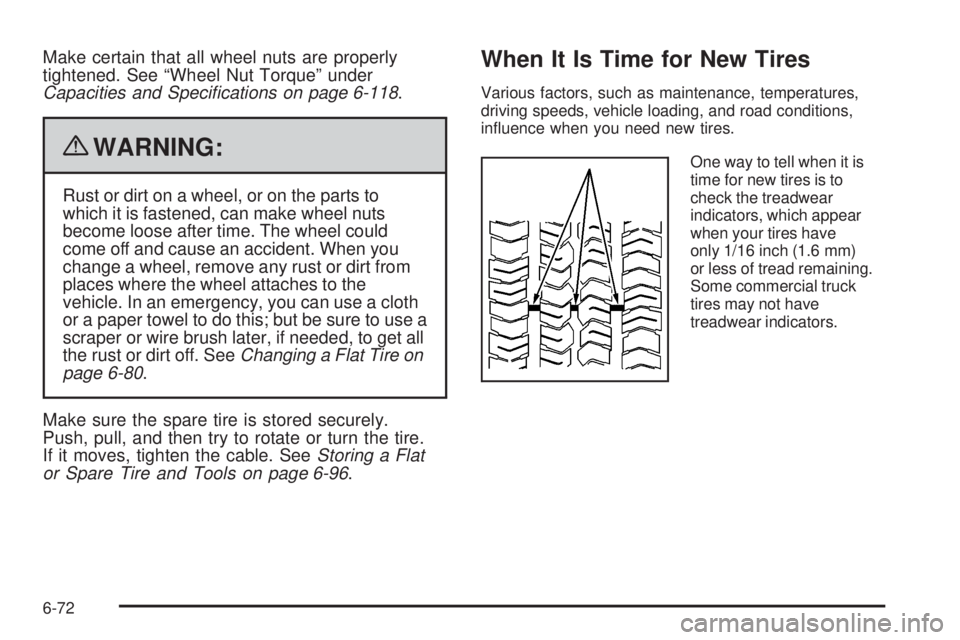
One way to tell when it is
time for new tires is to
check the treadwear
indicators, which appear
when your tires have
only 1/16 inch (1.6 mm)
or less of tread remaining.
Some commercial truck
tires may not have
treadwear indicators.
6-72
Page 355 of 448
Notice:If your vehicle has a tire size other than
P215/70R16, P235/75R16, P265/70R17, or P235/50R18
use tire chains only where legal and only when
you must. Use chains that are the proper size for
your tires. Install them on the tires of the rear axle.
Do not use chains on the tires of the front axle.
Tighten them as tightly as possible with the ends
securely fastened. Drive slowly and follow the chain
manufacturer’s instructions. If you can hear the
chains contacting your vehicle, stop and retighten
them. If the contact continues, slow down until it
stops. Driving too fast or spinning the wheels with
chains on will damage your vehicle.
If a Tire Goes Flat
It is unusual for a tire to blowout while you are driving,
especially if you maintain your vehicle’s tires properly.
If air goes out of a tire, it is much more likely to leak out
slowly. But if you should ever have a blowout, here
are a few tips about what to expect and what to do:
If a front tire fails, the flat tire creates a drag that pulls
the vehicle toward that side. Take your foot off the
accelerator pedal and grip the steering wheel firmly.
Steer to maintain lane position, and then gently brake
to a stop well out of the traffic lane.A rear blowout, particularly on a curve, acts much like a
skid and may require the same correction you would use
in a skid. In any rear blowout remove your foot from the
accelerator pedal. Get the vehicle under control by
steering the way you want the vehicle to go. It may be
very bumpy and noisy, but you can still steer. Gently
brake to a stop, well off the road if possible.
{WARNING:
Lifting a vehicle and getting under it to do
maintenance or repairs is dangerous without the
appropriate safety equipment and training. If a jack
is provided with the vehicle, it is designed only for
changing a flat tire. If it is used for anything else,
you or others could be badly injured or killed if the
vehicle slips off the jack. If a jack is provided with
the vehicle, only use it for changing a flat tire.
If a tire goes flat, the next part shows how to use the
jacking equipment to change a flat tire safely.
6-79
Page 356 of 448
Changing a Flat Tire
If a tire goes flat, avoid further tire and wheel damage
by driving slowly to a level place. Turn on the hazard
warning flashers. SeeHazard Warning Flashers
on page 4-3.
{WARNING:
Changing a tire can be dangerous. The vehicle
can slip off the jack and roll over or fall on you or
other people. You and they could be badly injured
or even killed. Find a level place to change your
tire. To help prevent the vehicle from moving:
1. Set the parking brake firmly.
2. Put an automatic transmission shift lever in
P (Park), or shift a manual transmission to
1 (First) or R (Reverse).
WARNING: (Continued)
WARNING: (Continued)
3. If you have a four-wheel-drive vehicle,
be sure the transfer case is in a drive
gear – not in Neutral.
4. Turn off the engine and do not restart while
the vehicle is raised.
5. Do not allow passengers to remain in the
vehicle.
To be even more certain the vehicle will not move,
put blocks at the front and rear of the tire farthest
away from the one being changed. That would be
the tire on the other side, at the opposite end of
the vehicle.
6-80
Page 357 of 448
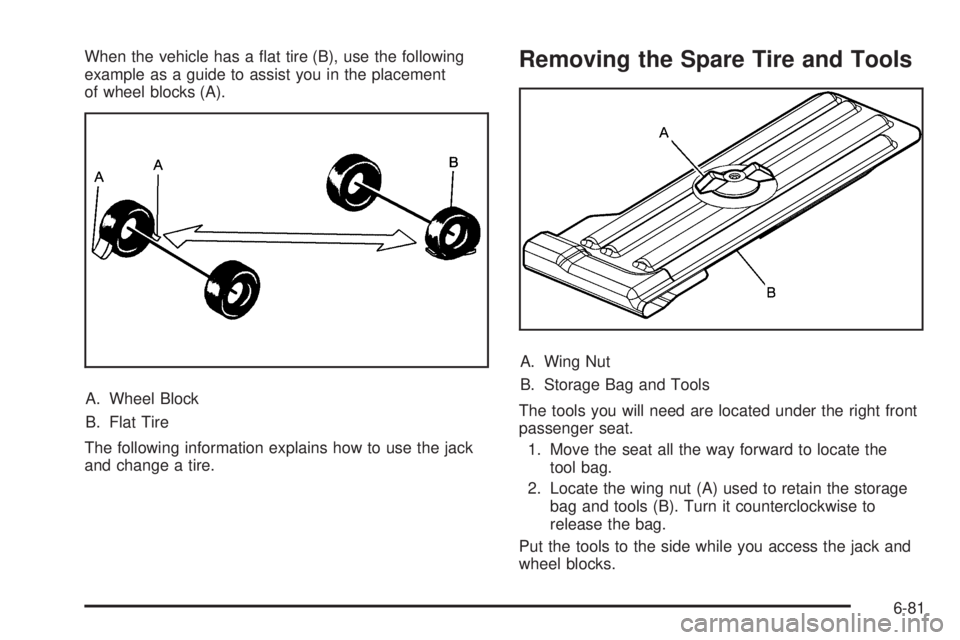
When the vehicle has a flat tire (B), use the following
example as a guide to assist you in the placement
of wheel blocks (A).
A. Wheel Block
B. Flat Tire
The following information explains how to use the jack
and change a tire.Removing the Spare Tire and Tools
A. Wing Nut
B. Storage Bag and Tools
The tools you will need are located under the right front
passenger seat.
1. Move the seat all the way forward to locate the
tool bag.
2. Locate the wing nut (A) used to retain the storage
bag and tools (B). Turn it counterclockwise to
release the bag.
Put the tools to the side while you access the jack and
wheel blocks.
6-81
Page 403 of 448
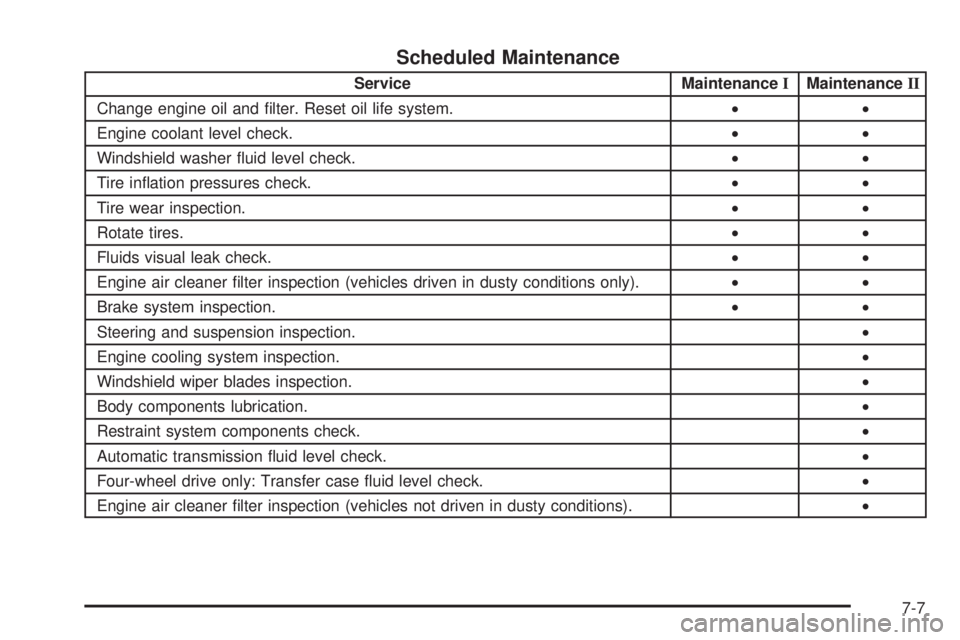
Scheduled Maintenance
Service MaintenanceIMaintenanceII
Change engine oil and filter. Reset oil life system.••
Engine coolant level check.••
Windshield washer fluid level check.••
Tire inflation pressures check.••
Tire wear inspection.••
Rotate tires.••
Fluids visual leak check.••
Engine air cleaner filter inspection (vehicles driven in dusty conditions only).••
Brake system inspection.••
Steering and suspension inspection.•
Engine cooling system inspection.•
Windshield wiper blades inspection.•
Body components lubrication.•
Restraint system components check.•
Automatic transmission fluid level check.•
Four-wheel drive only: Transfer case fluid level check.•
Engine air cleaner filter inspection (vehicles not driven in dusty conditions).•
7-7
Page 444 of 448
Scheduled Maintenance..................................... 7-3
Scheduling Appointments.................................8-10
Seatback Latches............................................. 2-9
Seats
Heated Seats............................................... 2-4
Manual Lumbar............................................. 2-3
Power Lumbar .............................................. 2-4
Power Seats................................................. 2-3
Rear Seat Operation............................2-10, 2-11
Reclining Seatbacks...................................... 2-5
Secondary Latch System.................................6-93
Securing a Child Restraint
Center Front Seat Position............................2-60
Rear Seat Position......................................2-58
Right Front Seat Position..............................2-60
Securing an Add-On Child Restraint in the
Vehicle.......................................................2-43
Securing the Child Within the Child Restraint......2-43
Security
Light..........................................................4-32
SERV (Service) 4WD (Four-Wheel Drive)...........4-40
SERV (Service) TPM (Tire Pressure Monitor)......4-40
SERV (Service) VEH (Vehicle)..........................4-40
Service........................................................... 6-3
Accessories and Modifications......................... 6-3
Adding Equipment to the Outside of the
Vehicle..................................................... 6-5
Doing Your Own Work................................... 6-4Service (cont.)
Engine Soon Lamp......................................4-28
Parts Identification Label.............................6-110
Publications Ordering Information...................8-15
Scheduling Appointments..............................8-10
Service Bulletins.............................................8-15
SERVICE CHARG (Charge) SYS (System).........4-41
Service Manuals.............................................8-15
SERVICE STAB (Stability) SYS (System)...........4-41
Services Not Included in Roadside Assistance...... 8-9
Services Provided............................................. 8-8
Services Specific to Canadian Purchased
Vehicles....................................................... 8-9
Servicing Your Airbag-Equipped Vehicle..............2-79
Setting Preset PTYs (RDS) Only.......................4-50
Setting Preset Stations............................
1-15, 4-47
Setting the Clock....................................1-15, 4-43
Setting the Tone (Bass/Treble)..........................4-47
Sheet Metal Damage.....................................6-109
Shift Speeds..................................................3-25
Shifting
Out of Park................................................3-32
Shifting Into Park............................................3-31
Shoulder Belt Height Adjuster...........................2-29
Signals, Turn and Lane-Change.......................... 4-4
Skidding........................................................5-12
Sliding Rear Windows.....................................3-12
14
Page 447 of 448
Traveling to Remote Areas...............................5-15
Treadwear.....................................................6-76
Treadwear 200 Traction AA Temperature A.........6-75
Trip Information..............................................4-34
Trip Odometer................................................4-20
Truck-Camper Loading Information....................5-40
Turn and Lane-Change Signals.......................... 4-4
TURN SIGNAL ...............................................4-41
Turn Signal/Multifunction Lever........................... 4-4
Turn Signals When Towing a Trailer..................5-57
Two-Tiered Loading.........................................5-40
U
Uniform Tire Quality Grading............................6-75
United States................................................... 8-6
Up-Shift Light.........................................3-24, 4-24
Used Replacement Wheels..............................6-78
Using ABS....................................................... 5-5
V
Vehicle
Control........................................................ 5-3
Loading......................................................5-33
Parking Your...............................................3-33
Running While Parked..................................3-34
Symbols......................................................... ivVehicle Data Recording and Privacy..................8-16
Vehicle Identification
Number (VIN)............................................6-110
Service Parts Identification Label..................6-110
Vehicle Personalization....................................1-16
Vehicle Storage..............................................6-42
Ventilation Adjustment......................................4-18
Visors...........................................................3-12
W
Warning Lights, Gages, and Indicators...............4-18
Warnings
DIC Warnings and Messages........................4-37
Hazard Flashers............................................ 4-3
Safety and Symbols......................................... iv
Weight of the Trailer........................................5-49
Weight of the Trailer Tongue.............................5-52
Weight-Distributing Hitches and Weight Carrying
Hitches......................................................5-55
What Kind of Engine Oil to Use........................6-17
What to Do with Used Oil ................................6-19
What to Use ..................6-30, 6-37, 6-38, 6-47, 6-49
Wheels
Alignment and Tire Balance..........................6-77
Different Size..............................................6-75
Replacement...............................................6-77
When It Is Time for New Tires..........................6-72
17