tire size GMC CANYON 2010 User Guide
[x] Cancel search | Manufacturer: GMC, Model Year: 2010, Model line: CANYON, Model: GMC CANYON 2010Pages: 448, PDF Size: 2.62 MB
Page 344 of 448
The low tire pressure warning light may come on in
cool weather when the vehicle is first started, and then
turn off as you start to drive. This could be an early
indicator that the air pressure in the tire(s) are getting
low and need to be inflated to the proper pressure.
A Tire and Loading Information label, attached to
your vehicle, shows the size of your vehicle’s original
equipment tires and the correct inflation pressure for
your vehicle’s tires when they are cold. SeeLoading the
Vehicle on page 5-33, for an example of the Tire and
Loading Information label and its location on your vehicle.
Also seeInation - Tire Pressure on page 6-64.
Your vehicle’s TPMS can warn you about a low tire
pressure condition but it does not replace normal
tire maintenance. SeeTire Inspection and Rotation
on page 6-71andTires on page 6-57.
Notice:Liquid tire sealants could damage the Tire
Pressure Monitor System (TPMS) sensors. Sensor
damage caused by using a tire sealant is not covered
by your warranty. Do not use liquid tire sealants.TPMS Malfunction Light and Message
The TPMS will not function properly if one or more of the
TPMS sensors are missing or inoperable. When the
system detects a malfunction, the low tire warning light
flashes for about one minute and then stays on for the
remainder of the ignition cycle. A DIC warning message
is also displayed. The low tire warning light and DIC
warning message come on at each ignition cycle until
the problem is corrected. Some of the conditions that
can cause the malfunction light and DIC message to
come on are:
•One of the road tires has been replaced with the
spare tire. The spare tire does not have a TPMS
sensor. The TPMS malfunction light and DIC
message should go off once you re-install the
road tire containing the TPMS sensor.
•The TPMS sensor matching process was started but
not completed or not completed successfully after
rotating the vehicle’s tires. The DIC message and
TPMS malfunction light should go off once the TPMS
sensor matching process is performed successfully.
See “TPMS Sensor Matching Process” later in this
section.
6-68
Page 349 of 448
You need new tires if any of the following statements
are true:
•You can see the indicators at three or more places
around the tire.
•You can see cord or fabric showing through the
tire’s rubber.
•The tread or sidewall is cracked, cut, or snagged
deep enough to show cord or fabric.
•The tire has a bump, bulge, or split.
•The tire has a puncture, cut, or other damage that
cannot be repaired well because of the size or
location of the damage.
The rubber in tires degrades over time, even if they are
not being used. This is also true for the spare tire, if your
vehicle has one. Multiple conditions affect how fast this
aging takes place, including temperatures, loading
conditions, and inflation pressure maintenance. With
proper care and maintenance tires will typically wear out
before they degrade due to age. If you are unsure about
the need to replace your tires as they get older, consult
the tire manufacturer for more information.
Buying New Tires
GM has developed and matched specific tires for
your vehicle. The original equipment tires installed
on your vehicle, when it was new, were designed
to meet General Motors Tire Performance Criteria
Specification (TPC spec) system rating. If you need
replacement tires, GM strongly recommends that you
get tires with the same TPC Spec rating. This way,
your vehicle will continue to have tires that are designed
to give the same performance and vehicle safety,
during normal use, as the original tires.
GM’s exclusive TPC Spec system considers over a
dozen critical specifications that impact the overall
performance of your vehicle, including brake system
performance, ride and handling, traction control, and
tire pressure monitoring performance. GM’s TPC Spec
number is molded onto the tire’s sidewall near the tire
size. If the tires have an all-season tread design, the TPC
spec number will be followed by an MS for mud and
snow. SeeTire Sidewall Labeling on page 6-58for
additional information.
6-73
Page 350 of 448
GM recommends replacing tires in sets of four. This is
because uniform tread depth on all tires will help keep
your vehicle performing most like it did when the tires
were new. Replacing less than a full set of tires can affect
the braking and handling performance of your vehicle.
SeeTire Inspection and Rotation on page 6-71for
information on proper tire rotation.
{WARNING:
Mixing tires could cause you to lose control of
your vehicle while driving. If you mix tires of
different sizes, brands, or types (radial and
bias-belted tires) the vehicle may not handle
properly, and you could have a crash. Using tires
of different sizes, brands, or types may also cause
damage to your vehicle. Be sure to use the correct
size, brand, and type of tires on all wheels.
Your vehicle may have a compact spare tire and
wheel assembly. It is all right to drive with your
vehicle’s compact spare tire temporarily. It was
developed for use on your vehicle. SeeSpare Tire
on page 6-101.
{WARNING:
If you use bias-ply tires on the vehicle,
the wheel rim flanges could develop cracks
after many miles of driving. A tire and/or
wheel could fail suddenly, causing a crash.
Use only radial-ply tires with the wheels on
the vehicle.
If you must replace your vehicle’s tires with those that do
not have a TPC Spec number, make sure they are the
same size, load range, speed rating, and construction
type (radial and bias-belted tires) as your vehicle’s
original tires.
Vehicles that have a tire pressure monitoring system
could give an inaccurate low-pressure warning if
non-TPC Spec rated tires are installed on your vehicle.
Non-TPC Spec rated tires may give a low-pressure
warning that is higher or lower than the proper warning
level you would get with TPC Spec rated tires. SeeTire
Pressure Monitor System on page 6-66.
Your vehicle’s original equipment tires are listed on
the Tire and Loading Information Label. SeeLoading the
Vehicle on page 5-33, for more information about the
Tire and Loading Information Label and its location
on your vehicle.
6-74
Page 351 of 448
Different Size Tires and Wheels
If you add wheels or tires that are a different size than
your original equipment wheels and tires, this may affect
the way your vehicle performs, including its braking, ride
and handling characteristics, stability, and resistance
to rollover. Additionally, if your vehicle has electronic
systems such as, antilock brakes, traction control, and
electronic stability control, the performance of these
systems can be affected.
{WARNING:
If you add different sized wheels, your vehicle may
not provide an acceptable level of performance and
safety if tires not recommended for those wheels
are selected. You may increase the chance that you
will crash and suffer serious injury. Only use GM
specific wheel and tire systems developed for your
vehicle, and have them properly installed by a GM
certified technician.
SeeBuying New Tires on page 6-73andAccessories
and Modications on page 6-3for additional information.
Uniform Tire Quality Grading
Quality grades can be found where applicable
on the tire sidewall between tread shoulder
and maximum section width. For example:
Treadwear 200 Traction AA
Temperature A
The following information relates to the system
developed by the United States National
Highway Traffic Safety Administration (NHTSA),
which grades tires by treadwear, traction, and
temperature performance. This applies only to
vehicles sold in the United States. The grades are
molded on the sidewalls of most passenger car
tires. The Uniform Tire Quality Grading (UTQG)
system does not apply to deep tread, winter-type
snow tires, space-saver, or temporary use
spare tires, tires with nominal rim diameters
of 10 to 12 inches (25 to 30 cm), or to some
limited-production tires.
While the tires available on General Motors
passenger cars and light trucks may vary with
respect to these grades, they must also conform
to federal safety requirements and additional
General Motors Tire Performance Criteria (TPC)
standards.
6-75
Page 354 of 448
Used Replacement Wheels
{WARNING:
Putting a used wheel on the vehicle is dangerous.
You cannot know how it has been used or how
far it has been driven. It could fail suddenly and
cause a crash. If you have to replace a wheel,
use a new GM original equipment wheel.
Tire Chains
{WARNING:
If your vehicle has P215/70R16, P235/75R16,
P265/70R17, or P235/50R18 size tires, do not use
tire chains. They can damage your vehicle because
there is not enough clearance. Tire chains used on
WARNING: (Continued)
WARNING: (Continued)
a vehicle without the proper amount of clearance
can cause damage to the brakes, suspension, or
other vehicle parts. The area damaged by the
tire chains could cause you to lose control of
your vehicle and you or others may be injured
in a crash.
Use another type of traction device only if its
manufacturer recommends it for use on your
vehicle and tire size combination and road
conditions. Follow that manufacturer’s instructions.
To help avoid damage to your vehicle, drive
slowly, readjust, or remove the device if it is
contacting your vehicle. Do not spin the vehicle’s
wheels.
If you do find traction devices that will fit, install
them on the rear tires.
6-78
Page 355 of 448
Notice:If your vehicle has a tire size other than
P215/70R16, P235/75R16, P265/70R17, or P235/50R18
use tire chains only where legal and only when
you must. Use chains that are the proper size for
your tires. Install them on the tires of the rear axle.
Do not use chains on the tires of the front axle.
Tighten them as tightly as possible with the ends
securely fastened. Drive slowly and follow the chain
manufacturer’s instructions. If you can hear the
chains contacting your vehicle, stop and retighten
them. If the contact continues, slow down until it
stops. Driving too fast or spinning the wheels with
chains on will damage your vehicle.
If a Tire Goes Flat
It is unusual for a tire to blowout while you are driving,
especially if you maintain your vehicle’s tires properly.
If air goes out of a tire, it is much more likely to leak out
slowly. But if you should ever have a blowout, here
are a few tips about what to expect and what to do:
If a front tire fails, the flat tire creates a drag that pulls
the vehicle toward that side. Take your foot off the
accelerator pedal and grip the steering wheel firmly.
Steer to maintain lane position, and then gently brake
to a stop well out of the traffic lane.A rear blowout, particularly on a curve, acts much like a
skid and may require the same correction you would use
in a skid. In any rear blowout remove your foot from the
accelerator pedal. Get the vehicle under control by
steering the way you want the vehicle to go. It may be
very bumpy and noisy, but you can still steer. Gently
brake to a stop, well off the road if possible.
{WARNING:
Lifting a vehicle and getting under it to do
maintenance or repairs is dangerous without the
appropriate safety equipment and training. If a jack
is provided with the vehicle, it is designed only for
changing a flat tire. If it is used for anything else,
you or others could be badly injured or killed if the
vehicle slips off the jack. If a jack is provided with
the vehicle, only use it for changing a flat tire.
If a tire goes flat, the next part shows how to use the
jacking equipment to change a flat tire safely.
6-79
Page 377 of 448
Spare Tire
Compact Spare Tire
Your vehicle may have a compact spare tire. Although
the compact spare tire was fully inflated when your
vehicle was new, it can lose air over time. Check the
inflation pressure regularly. It should be 60 psi (420 kPa).
Notice:If the vehicle has four-wheel drive and the
compact spare tire is installed on the vehicle, do not
drive in four-wheel drive until you can have the at
tire repaired and/or replaced. You could damage the
vehicle, and the repair costs would not be covered by
your warranty. Never use four-wheel drive when the
compact spare tire is installed on the vehicle.
After installing the compact spare on your vehicle, you
should stop as soon as possible and make sure your
vehicle’s spare tire is correctly inflated. The compact
spare is made to perform well at speeds up to 62 mph
(100 km/h) for distances up to 500 miles (804 km).
For heavy payloads or towing, and for low traction or
four-wheel-drive conditions, repair or replace the full-size
tire. Of course, it is best to replace your vehicle’s spare
with a full-size tire as soon as you can. The spare tire
will last longer and be in good shape in case you need
it again.Notice:When the compact spare is installed,
do not take the vehicle through an automatic car
wash with guide rails. The compact spare can
get caught on the rails which can damage the
tire, wheel and other parts of the vehicle.
Do not use your compact spare on other vehicles.
And do not mix your compact spare tire or wheel with
other wheels or tires. They will not fit. Keep your
spare tire and its wheel together.
Notice:Tire chains will not t the compact spare.
Using them can damage the vehicle and can damage
the chains too. Do not use tire chains on the
compact spare.
Full-Size Spare Tire
Your vehicle may have a full-size spare tire, which,
when new, was fully inflated. A spare tire may lose
air over time, so check its inflation pressure regularly.
SeeInation - Tire Pressure on page 6-64andLoading
the Vehicle on page 5-33for information regarding proper
tire inflation and loading your vehicle. For instruction
on how to remove, install, or store a spare tire, see
Removing the Flat Tire and Installing the Spare Tire
on page 6-85andStoring a Flat or Spare Tire and
Tools on page 6-96.
6-101
Page 378 of 448
Your vehicle may have a different size spare tire
than the road tires originally installed on your vehicle.
This spare was developed for use on your vehicle, so it
is alright to drive on it. If your vehicle has four-wheel
drive and the different size spare tire is installed, keep
the vehicle in two-wheel drive.
Notice:If the vehicle has four-wheel drive and the
different size spare tire is installed on the vehicle, do
not drive in four-wheel drive until you can have your
at tire repaired and/or replaced. You could damage
the vehicle, and the repair costs would not be
covered by your warranty. Never use four-wheel drive
when the different size spare tire is installed on the
vehicle.
After installing the spare tire on your vehicle, you should
stop as soon as possible and make sure the spare is
correctly inflated. The spare tire is made to perform well
at speeds up to 62 mph (100 km/h) for distances up to
500 miles (804 km). For heavy payloads or towing, and
for low traction or four-wheel-drive conditions, repair or
replace the full-size tire. Have the damaged or flat road
tire repaired or replaced as soon as you can and installed
back onto your vehicle. This way, the spare tire will be
available in case you need it again.
Do not mix tires and wheels of different sizes, because
they will not fit. Keep your spare tire and its wheel
together.Appearance Care
Interior Cleaning
The vehicle’s interior will continue to look its best if it is
cleaned often. Although not always visible, dust and
dirt can accumulate on the upholstery. Dirt can damage
carpet, fabric, leather, and plastic surfaces. Regular
vacuuming is recommended to remove particles from the
upholstery. It is important to keep the upholstery from
becoming and remaining heavily soiled. Soils should be
removed as quickly as possible. The vehicle’s interior
may experience extremes of heat that could cause
stains to set rapidly.
Lighter colored interiors may require more frequent
cleaning. Use care because newspapers and garments
that transfer color to home furnishings may also transfer
color to the vehicle’s interior.
When cleaning the vehicle’s interior, only use cleaners
specifically designed for the surfaces being cleaned.
Permanent damage may result from using cleaners on
surfaces for which they were not intended. Use glass
cleaner only on glass. Remove any accidental over-spray
from other surfaces immediately. To prevent over-spray,
apply cleaner directly to the cleaning cloth.
6-102
Page 438 of 448
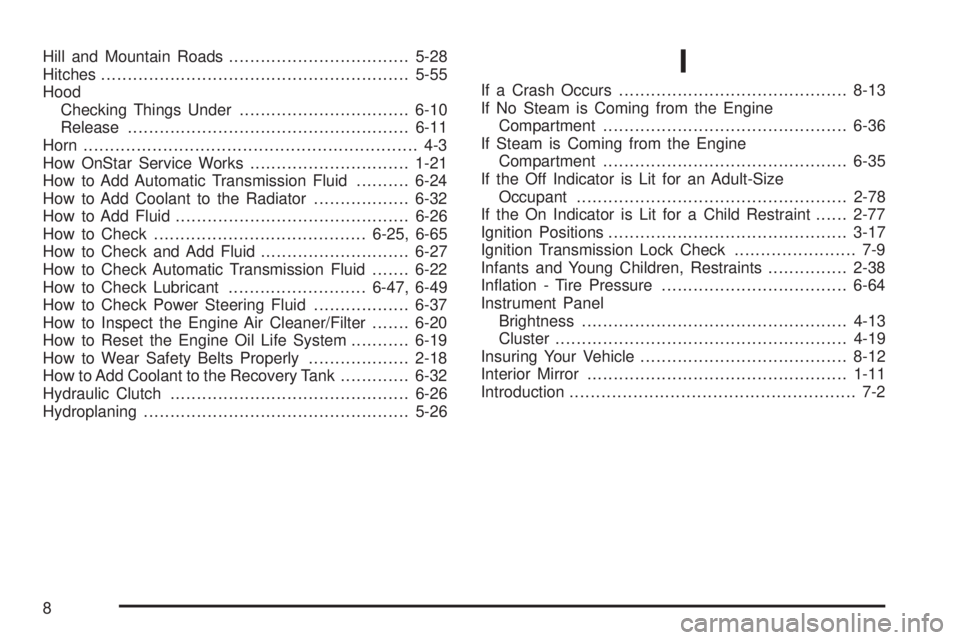
Hill and Mountain Roads..................................5-28
Hitches..........................................................5-55
Hood
Checking Things Under................................6-10
Release.....................................................6-11
Horn ............................................................... 4-3
How OnStar Service Works..............................1-21
How to Add Automatic Transmission Fluid..........6-24
How to Add Coolant to the Radiator..................6-32
How to Add Fluid............................................6-26
How to Check........................................6-25, 6-65
How to Check and Add Fluid............................6-27
How to Check Automatic Transmission Fluid.......6-22
How to Check Lubricant..........................6-47, 6-49
How to Check Power Steering Fluid..................6-37
How to Inspect the Engine Air Cleaner/Filter.......6-20
How to Reset the Engine Oil Life System...........6-19
How to Wear Safety Belts Properly...................2-18
How to Add Coolant to the Recovery Tank.............6-32
Hydraulic Clutch.............................................6-26
Hydroplaning..................................................5-26I
If a Crash Occurs...........................................8-13
If No Steam is Coming from the Engine
Compartment..............................................6-36
If Steam is Coming from the Engine
Compartment..............................................6-35
If the Off Indicator is Lit for an Adult-Size
Occupant...................................................2-78
If the On Indicator is Lit for a Child Restraint......2-77
Ignition Positions.............................................3-17
Ignition Transmission Lock Check....................... 7-9
Infants and Young Children, Restraints...............2-38
Inflation - Tire Pressure...................................6-64
Instrument Panel
Brightness..................................................4-13
Cluster.......................................................4-19
Insuring Your Vehicle.......................................8-12
Interior Mirror.................................................1-11
Introduction...................................................... 7-2
8
Page 445 of 448
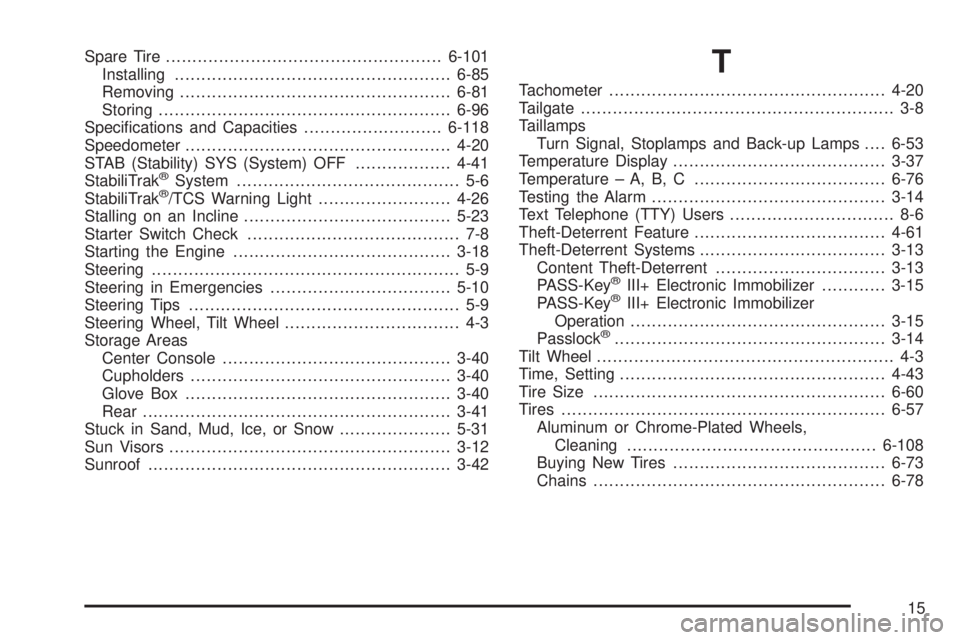
Spare Tire....................................................6-101
Installing....................................................6-85
Removing...................................................6-81
Storing.......................................................6-96
Specifications and Capacities..........................6-118
Speedometer..................................................4-20
STAB (Stability) SYS (System) OFF..................4-41
StabiliTrak
®System.......................................... 5-6
StabiliTrak®/TCS Warning Light.........................4-26
Stalling on an Incline.......................................5-23
Starter Switch Check........................................ 7-8
Starting the Engine.........................................3-18
Steering.......................................................... 5-9
Steering in Emergencies..................................5-10
Steering Tips................................................... 5-9
Steering Wheel, Tilt Wheel................................. 4-3
Storage Areas
Center Console...........................................3-40
Cupholders.................................................3-40
Glove Box..................................................3-40
Rear ..........................................................3-41
Stuck in Sand, Mud, Ice, or Snow.....................5-31
Sun Visors.....................................................3-12
Sunroof.........................................................3-42
T
Tachometer....................................................4-20
Tailgate........................................................... 3-8
Taillamps
Turn Signal, Stoplamps and Back-up Lamps....6-53
Temperature Display........................................3-37
Temperature – A, B, C....................................6-76
Testing the Alarm............................................3-14
Text Telephone (TTY) Users............................... 8-6
Theft-Deterrent Feature....................................4-61
Theft-Deterrent Systems...................................3-13
Content Theft-Deterrent................................3-13
PASS-Key
®III+ Electronic Immobilizer............3-15
PASS-Key®III+ Electronic Immobilizer
Operation................................................3-15
Passlock
®...................................................3-14
Tilt Wheel........................................................ 4-3
Time, Setting..................................................4-43
Tire Size.......................................................6-60
Tires.............................................................6-57
Aluminum or Chrome-Plated Wheels,
Cleaning...............................................6-108
Buying New Tires........................................6-73
Chains.......................................................6-78
15