automatic transmission GMC CANYON 2010 Owner's Guide
[x] Cancel search | Manufacturer: GMC, Model Year: 2010, Model line: CANYON, Model: GMC CANYON 2010Pages: 448, PDF Size: 2.62 MB
Page 261 of 448
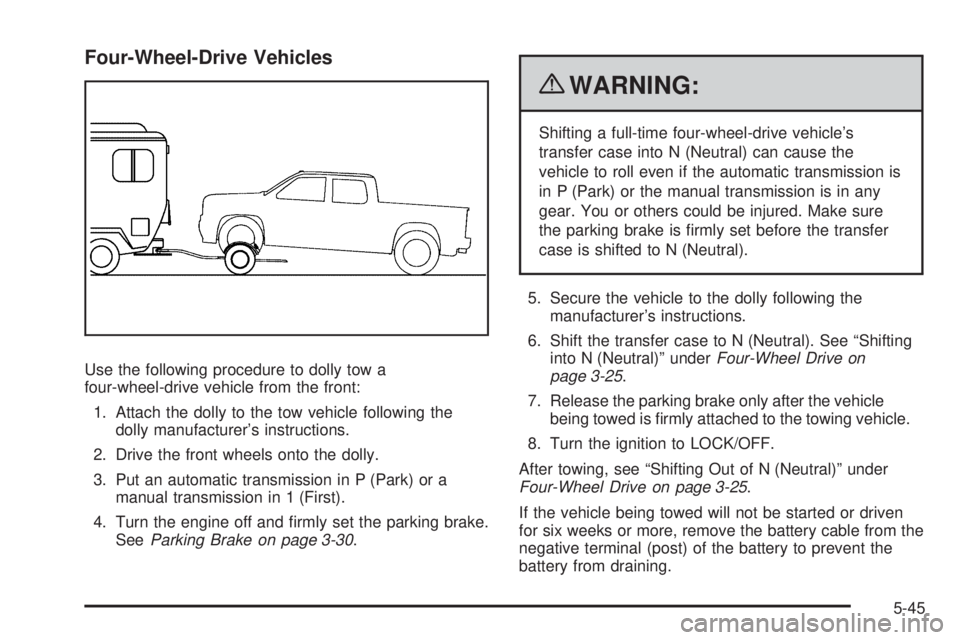
Four-Wheel-Drive Vehicles
Use the following procedure to dolly tow a
four-wheel-drive vehicle from the front:
1. Attach the dolly to the tow vehicle following the
dolly manufacturer’s instructions.
2. Drive the front wheels onto the dolly.
3. Put an automatic transmission in P (Park) or a
manual transmission in 1 (First).
4. Turn the engine off and firmly set the parking brake.
SeeParking Brake on page 3-30.
{WARNING:
Shifting a full-time four-wheel-drive vehicle’s
transfer case into N (Neutral) can cause the
vehicle to roll even if the automatic transmission is
in P (Park) or the manual transmission is in any
gear. You or others could be injured. Make sure
the parking brake is firmly set before the transfer
case is shifted to N (Neutral).
5. Secure the vehicle to the dolly following the
manufacturer’s instructions.
6. Shift the transfer case to N (Neutral). See “Shifting
into N (Neutral)” underFour-Wheel Drive on
page 3-25.
7. Release the parking brake only after the vehicle
being towed is firmly attached to the towing vehicle.
8. Turn the ignition to LOCK/OFF.
After towing, see “Shifting Out of N (Neutral)” under
Four-Wheel Drive on page 3-25.
If the vehicle being towed will not be started or driven
for six weeks or more, remove the battery cable from the
negative terminal (post) of the battery to prevent the
battery from draining.
5-45
Page 262 of 448
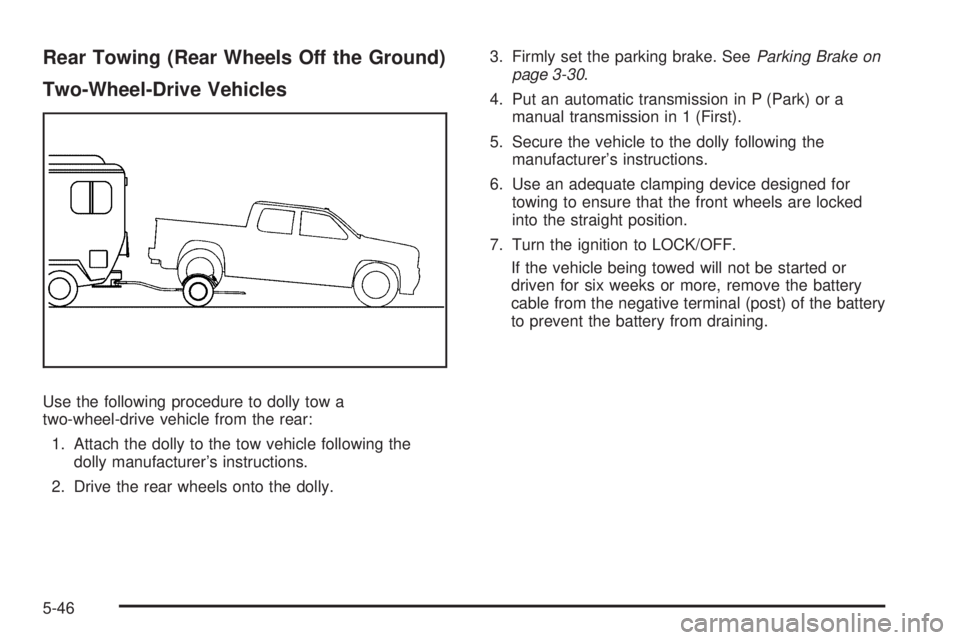
Rear Towing (Rear Wheels Off the Ground)
Two-Wheel-Drive Vehicles
Use the following procedure to dolly tow a
two-wheel-drive vehicle from the rear:
1. Attach the dolly to the tow vehicle following the
dolly manufacturer’s instructions.
2. Drive the rear wheels onto the dolly.3. Firmly set the parking brake. SeeParking Brake on
page 3-30.
4. Put an automatic transmission in P (Park) or a
manual transmission in 1 (First).
5. Secure the vehicle to the dolly following the
manufacturer’s instructions.
6. Use an adequate clamping device designed for
towing to ensure that the front wheels are locked
into the straight position.
7. Turn the ignition to LOCK/OFF.
If the vehicle being towed will not be started or
driven for six weeks or more, remove the battery
cable from the negative terminal (post) of the battery
to prevent the battery from draining.
5-46
Page 263 of 448
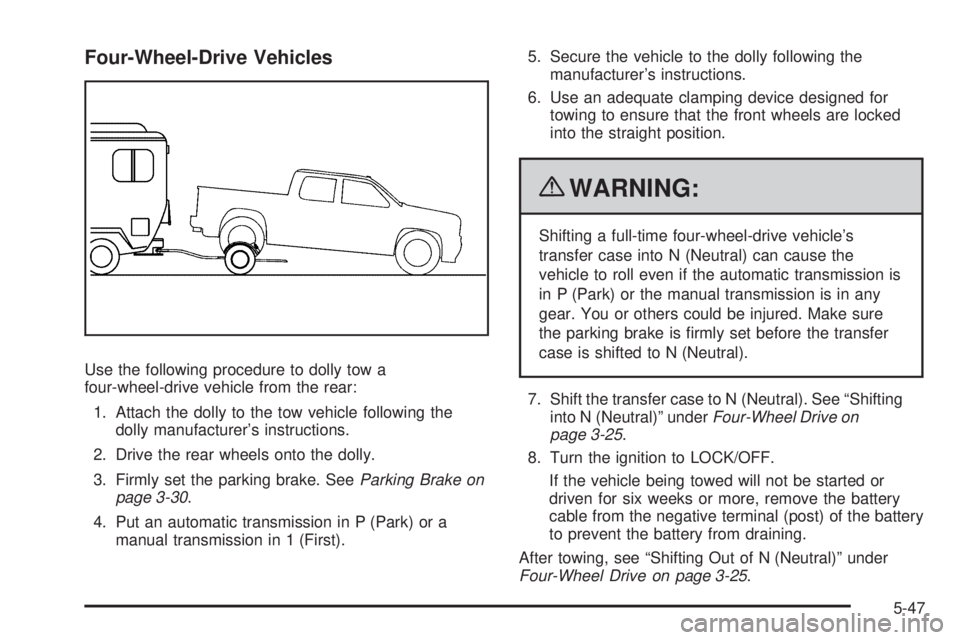
Four-Wheel-Drive Vehicles
Use the following procedure to dolly tow a
four-wheel-drive vehicle from the rear:
1. Attach the dolly to the tow vehicle following the
dolly manufacturer’s instructions.
2. Drive the rear wheels onto the dolly.
3. Firmly set the parking brake. SeeParking Brake on
page 3-30.
4. Put an automatic transmission in P (Park) or a
manual transmission in 1 (First).5. Secure the vehicle to the dolly following the
manufacturer’s instructions.
6. Use an adequate clamping device designed for
towing to ensure that the front wheels are locked
into the straight position.
{WARNING:
Shifting a full-time four-wheel-drive vehicle’s
transfer case into N (Neutral) can cause the
vehicle to roll even if the automatic transmission is
in P (Park) or the manual transmission is in any
gear. You or others could be injured. Make sure
the parking brake is firmly set before the transfer
case is shifted to N (Neutral).
7. Shift the transfer case to N (Neutral). See “Shifting
into N (Neutral)” underFour-Wheel Drive on
page 3-25.
8. Turn the ignition to LOCK/OFF.
If the vehicle being towed will not be started or
driven for six weeks or more, remove the battery
cable from the negative terminal (post) of the battery
to prevent the battery from draining.
After towing, see “Shifting Out of N (Neutral)” under
Four-Wheel Drive on page 3-25.
5-47
Page 265 of 448
Pulling A Trailer
Here are some important points:
•There are many different laws, including speed limit
restrictions, having to do with trailering. Make sure
the rig will be legal, not only where you live but
also where you will be driving. A good source for
this information can be state or provincial police.
•Consider using a sway control. See “Hitches” later
in this section.
•Do not tow a trailer at all during the first 500 miles
(800 km) the new vehicle is driven. The engine,
axle or other parts could be damaged.
•Then, during the first 500 miles (800 km) that a
trailer is towed, do not drive over 50 mph (80 km/h)
and do not make starts at full throttle. This helps
the engine and other parts of the vehicle wear in at
the heavier loads.
•Vehicles with automatic transmissions can tow in
D (Drive), but you may want to shift to a lower
gear selection if the transmission shifts too often
(e.g., under heavy loads and/or hilly conditions).
If the vehicle has a manual transmission it is better
not to use the highest gear.Three important considerations have to do with weight:
•The weight of the trailer
•The weight of the trailer tongue
•The weight on the vehicle’s tires
Weight of the Trailer
How heavy can a trailer safely be?
It depends on how the rig is used. For example, speed,
altitude, road grades, outside temperature and how
much the vehicle is used to pull a trailer are all
important. It can depend on any special equipment on
the vehicle, and the amount of tongue weight the vehicle
can carry. See “Weight of the Trailer Tongue” later in
this section for more information.
Maximum trailer weight is calculated assuming only the
driver is in the tow vehicle and it has all the required
trailering equipment. The weight of additional optional
equipment, passengers and cargo in the tow vehicle
must be subtracted from the maximum trailer weight.
5-49
Page 266 of 448
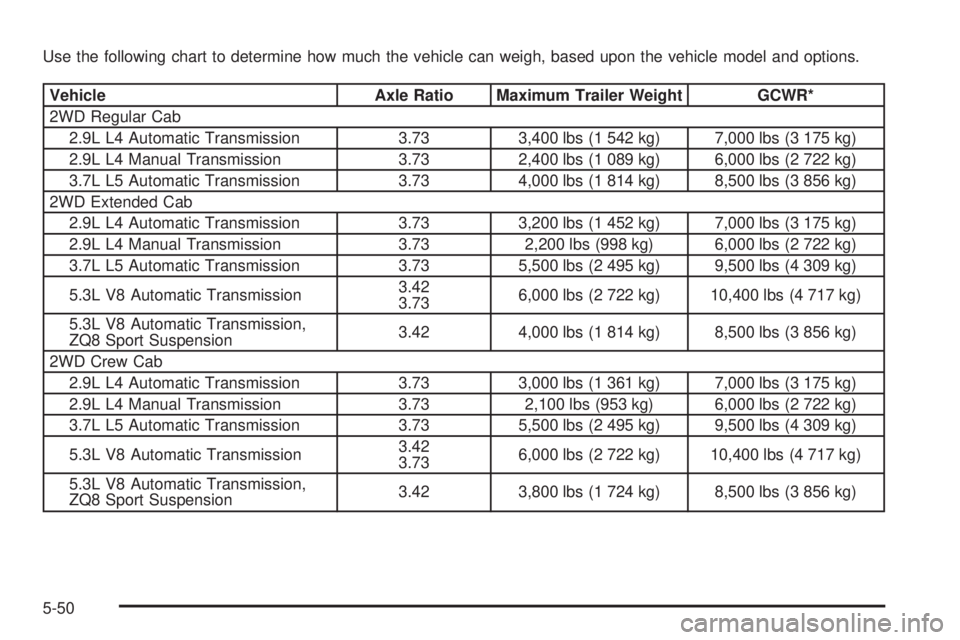
Use the following chart to determine how much the vehicle can weigh, based upon the vehicle model and options.
Vehicle Axle Ratio Maximum Trailer Weight GCWR*
2WD Regular Cab
2.9L L4 Automatic Transmission 3.73 3,400 lbs (1 542 kg) 7,000 lbs (3 175 kg)
2.9L L4 Manual Transmission 3.73 2,400 lbs (1 089 kg) 6,000 lbs (2 722 kg)
3.7L L5 Automatic Transmission 3.73 4,000 lbs (1 814 kg) 8,500 lbs (3 856 kg)
2WD Extended Cab
2.9L L4 Automatic Transmission 3.73 3,200 lbs (1 452 kg) 7,000 lbs (3 175 kg)
2.9L L4 Manual Transmission 3.73 2,200 lbs (998 kg) 6,000 lbs (2 722 kg)
3.7L L5 Automatic Transmission 3.73 5,500 lbs (2 495 kg) 9,500 lbs (4 309 kg)
5.3L V8 Automatic Transmission3.42
3.736,000 lbs (2 722 kg) 10,400 lbs (4 717 kg)
5.3L V8 Automatic Transmission,
ZQ8 Sport Suspension3.42 4,000 lbs (1 814 kg) 8,500 lbs (3 856 kg)
2WD Crew Cab
2.9L L4 Automatic Transmission 3.73 3,000 lbs (1 361 kg) 7,000 lbs (3 175 kg)
2.9L L4 Manual Transmission 3.73 2,100 lbs (953 kg) 6,000 lbs (2 722 kg)
3.7L L5 Automatic Transmission 3.73 5,500 lbs (2 495 kg) 9,500 lbs (4 309 kg)
5.3L V8 Automatic Transmission3.42
3.736,000 lbs (2 722 kg) 10,400 lbs (4 717 kg)
5.3L V8 Automatic Transmission,
ZQ8 Sport Suspension3.42 3,800 lbs (1 724 kg) 8,500 lbs (3 856 kg)
5-50
Page 267 of 448
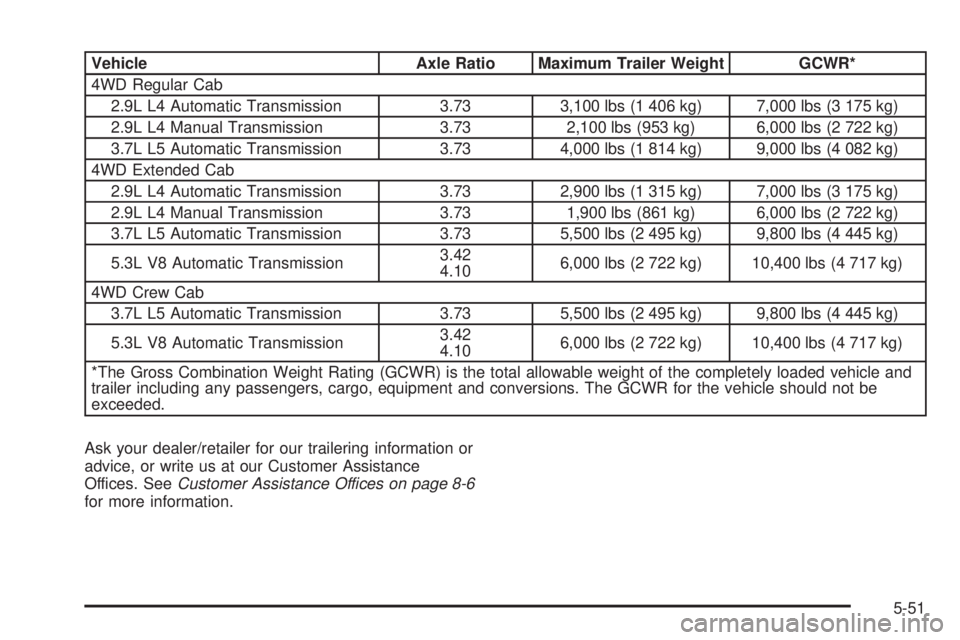
Vehicle Axle Ratio Maximum Trailer Weight GCWR*
4WD Regular Cab
2.9L L4 Automatic Transmission 3.73 3,100 lbs (1 406 kg) 7,000 lbs (3 175 kg)
2.9L L4 Manual Transmission 3.73 2,100 lbs (953 kg) 6,000 lbs (2 722 kg)
3.7L L5 Automatic Transmission 3.73 4,000 lbs (1 814 kg) 9,000 lbs (4 082 kg)
4WD Extended Cab
2.9L L4 Automatic Transmission 3.73 2,900 lbs (1 315 kg) 7,000 lbs (3 175 kg)
2.9L L4 Manual Transmission 3.73 1,900 lbs (861 kg) 6,000 lbs (2 722 kg)
3.7L L5 Automatic Transmission 3.73 5,500 lbs (2 495 kg) 9,800 lbs (4 445 kg)
5.3L V8 Automatic Transmission3.42
4.106,000 lbs (2 722 kg) 10,400 lbs (4 717 kg)
4WD Crew Cab
3.7L L5 Automatic Transmission 3.73 5,500 lbs (2 495 kg) 9,800 lbs (4 445 kg)
5.3L V8 Automatic Transmission3.42
4.106,000 lbs (2 722 kg) 10,400 lbs (4 717 kg)
*The Gross Combination Weight Rating (GCWR) is the total allowable weight of the completely loaded vehicle and
trailer including any passengers, cargo, equipment and conversions. The GCWR for the vehicle should not be
exceeded.
Ask your dealer/retailer for our trailering information or
advice, or write us at our Customer Assistance
Offices. SeeCustomer Assistance Offices on page 8-6
for more information.
5-51
Page 274 of 448
Driving On Grades
Reduce speed and shift to a lower gearbeforestarting
down a long or steep downgrade. If the transmission is
not shifted down, the brakes might have to be used so
much that they would get hot and no longer work well.
Vehicles with automatic transmissions can tow in
D (Drive), but you may want to shift to a lower gear
selection if the transmission shifts too often (e.g., under
heavy loads and/or hilly conditions). If the vehicle has
a manual transmission it is better not to use the
highest gear.
When towing at high altitude on steep uphill grades,
consider the following: Engine coolant will boil at a lower
temperature than at normal altitudes. If the engine is
turned off immediately after towing at high altitude on
steep uphill grades, the vehicle may show signs similar to
engine overheating. To avoid this, let the engine run whileparked, preferably on level ground, with an automatic
transmission in P (Park) or a manual transmission in
N (Neutral) with the parking brake applied, for a
few minutes before turning the engine off. If the overheat
warning comes on, seeEngine Overheating on page 6-35.
Parking on Hills
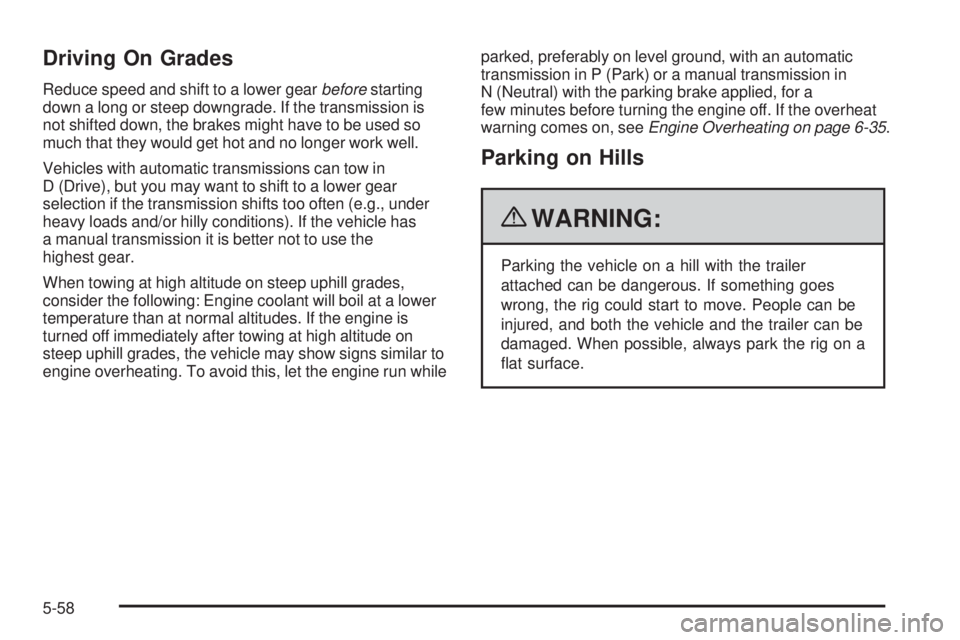
{WARNING:
Parking the vehicle on a hill with the trailer
attached can be dangerous. If something goes
wrong, the rig could start to move. People can be
injured, and both the vehicle and the trailer can be
damaged. When possible, always park the rig on a
flat surface.
5-58
Page 275 of 448
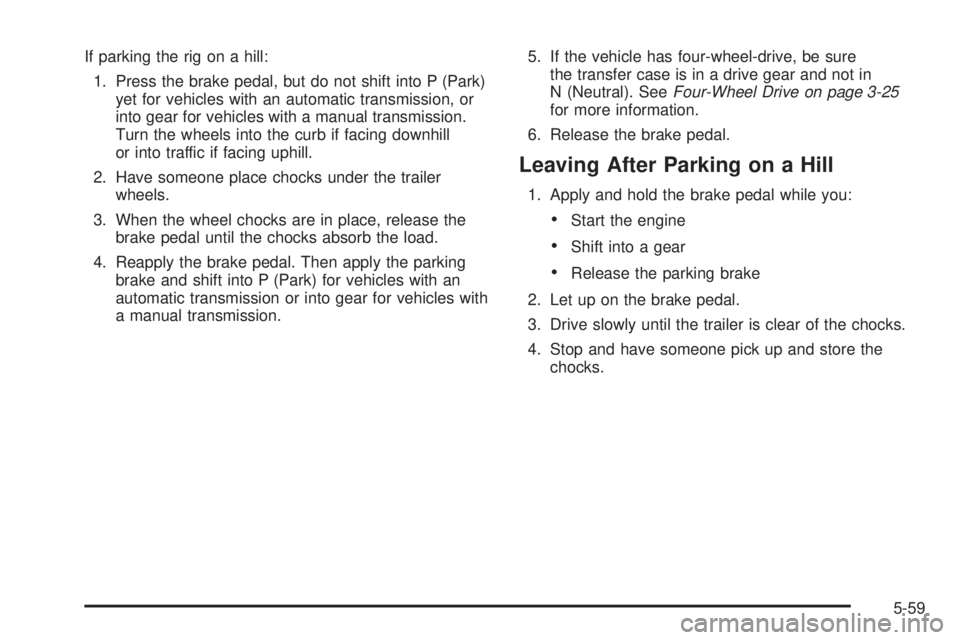
If parking the rig on a hill:
1. Press the brake pedal, but do not shift into P (Park)
yet for vehicles with an automatic transmission, or
into gear for vehicles with a manual transmission.
Turn the wheels into the curb if facing downhill
or into traffic if facing uphill.
2. Have someone place chocks under the trailer
wheels.
3. When the wheel chocks are in place, release the
brake pedal until the chocks absorb the load.
4. Reapply the brake pedal. Then apply the parking
brake and shift into P (Park) for vehicles with an
automatic transmission or into gear for vehicles with
a manual transmission.5. If the vehicle has four-wheel-drive, be sure
the transfer case is in a drive gear and not in
N (Neutral). SeeFour-Wheel Drive on page 3-25
for more information.
6. Release the brake pedal.
Leaving After Parking on a Hill
1. Apply and hold the brake pedal while you:
•Start the engine
•Shift into a gear
•Release the parking brake
2. Let up on the brake pedal.
3. Drive slowly until the trailer is clear of the chocks.
4. Stop and have someone pick up and store the
chocks.
5-59
Page 276 of 448
Maintenance When Trailer Towing
The vehicle needs service more often when pulling a
trailer. SeeScheduled Maintenance on page 7-3or the
Index for more information. Things that are especially
important in trailer operation are automatic transmission
fluid, engine oil, axle lubricant, belts, cooling system
and brake system. It is a good idea to inspect
these before and during the trip.
Check periodically to see that all hitch nuts and bolts
are tight.
Trailer Wiring Harness
The vehicle may be equipped with a four-pin trailer
towing harness. This harness has a four-pin trailer
connector that is attached to a bracket on the hitch
platform. The four-wire harness contains the following
trailer circuits:
•Yellow: Left Stop/Turn Signal
•Green: Right Stop/Turn Signal
•Brown: Taillamps/Park lamps
•White: Ground
Trailer Recommendations
Subtract the hitch loads from the Cargo Weight Rating
(CWR). CWR is the maximum weight of the load
the vehicle can carry. It does not include the weight of
the people inside, but you can figure about 150 lbs.
(68 kg) for each passenger. The total cargo load must
not be more than the vehicles CWR.
Weigh the vehicle with the trailer attached, so the
GVWR or GAWR are not exceeded. If using a
weight-distributing hitch, weigh the vehicle without the
spring bars in place.
The best performance is obtained by correctly spreading
out the weight of the load and choosing the correct
hitch and trailer brakes.
For more information seeTowing a Trailer on page 5-48.
5-60
Page 277 of 448
Service............................................................6-3
Accessories and Modifications..........................6-3
California Proposition 65 Warning.....................6-4
California Perchlorate Materials Requirements.....6-4
Doing Your Own Service Work.........................6-4
Adding Equipment to the Outside of the
Vehicle......................................................6-5
Fuel................................................................6-5
Gasoline Octane............................................6-5
Gasoline Specifications....................................6-6
California Fuel...............................................6-6
Additives.......................................................6-6
Fuels in Foreign Countries...............................6-7
Filling the Tank..............................................6-8
Filling a Portable Fuel Container.....................6-10
Checking Things Under the Hood....................6-10
Hood Release..............................................6-11
Engine Compartment Overview.......................6-12
Engine Oil...................................................6-15
Engine Oil Life System..................................6-18
Engine Air Cleaner/Filter................................6-20
Automatic Transmission Fluid.........................6-21
Manual Transmission Fluid.............................6-25
Hydraulic Clutch...........................................6-26
Cooling System............................................6-27Engine Coolant.............................................6-29
Engine Overheating.......................................6-35
Engine Fan Noise.........................................6-36
Power Steering Fluid.....................................6-37
Windshield Washer Fluid................................6-38
Brakes........................................................6-39
Battery........................................................6-42
Jump Starting...............................................6-43
Rear Axle.......................................................6-47
Four-Wheel Drive
............................................6-48
Front Axle......................................................6-49
Headlamp Aiming...........................................6-50
Bulb Replacement..........................................6-50
Halogen Bulbs..............................................6-50
Headlamps..................................................6-51
Front Turn Signal, Parking and Daytime
Running Lamps (DRL)................................6-52
Center High-Mounted Stoplamp (CHMSL).........6-52
Taillamps, Turn Signal, Stoplamps and
Back-up Lamps.........................................6-53
License Plate Lamp......................................6-54
Replacement Bulbs.......................................6-54
Windshield Wiper Blade Replacement..............6-55
Section 6 Service and Appearance Care
6-1