brake light GMC CANYON 2010 Owner's Guide
[x] Cancel search | Manufacturer: GMC, Model Year: 2010, Model line: CANYON, Model: GMC CANYON 2010Pages: 448, PDF Size: 2.62 MB
Page 237 of 448
Driving Downhill
When off-roading takes you downhill, consider:
•How steep is the downhill? Will I be able to maintain
vehicle control?
•What is the surface like? Smooth? Rough?
Slippery? Hard-packed dirt? Gravel?
•Are there hidden surface obstacles? Ruts? Logs?
Boulders?
•What is at the bottom of the hill? Is there a hidden
creek bank or even a river bottom with large rocks?
If you decide you can go down a hill safely, try to keep
the vehicle headed straight down. Use a low gear
so engine drag can help the brakes so they do not have
to do all the work. Descend slowly, keeping the
vehicle under control at all times.
{WARNING:
Heavy braking when going down a hill can cause
your brakes to overheat and fade. This could
cause loss of control and a serious accident.
Apply the brakes lightly when descending a hill
and use a low gear to keep vehicle speed under
control.Things not to do when driving down a hill:
•When driving downhill, avoid turns that take you
across the incline of the hill. A hill that is not too
steep to drive down might be too steep to drive
across. The vehicle could roll over.
•Never go downhill with the transmission in
N (Neutral), called free-wheeling. The brakes will
have to do all the work and could overheat
and fade.
Vehicles are much more likely to stall when going uphill,
but if it happens when going downhill:
1. Stop the vehicle by applying the regular brakes and
apply the parking brake.
2. Shift to P (Park) and, while still braking, restart the
engine.
3. Shift back to a low gear, release the parking brake,
and drive straight down.
4. If the engine will not start, get out and get help.
5-21
Page 242 of 448
Driving in Rain and on Wet Roads
Rain and wet roads can reduce vehicle traction
and affect your ability to stop and accelerate. Always
drive slower in these types of driving conditions
and avoid driving through large puddles and
deep-standing or flowing water.
{WARNING:
Wet brakes can cause crashes. They might not
work as well in a quick stop and could cause
pulling to one side. You could lose control of the
vehicle.
After driving through a large puddle of water or a
car/vehicle wash, lightly apply the brake pedal until
the brakes work normally.
Flowing or rushing water creates strong forces.
Driving through flowing water could cause your
vehicle to be carried away. If this happens, you
and other vehicle occupants could drown. Do not
ignore police warnings and be very cautious about
trying to drive through flowing water.
Hydroplaning
Hydroplaning is dangerous. Water can build up under
your vehicle’s tires so they actually ride on the
water. This can happen if the road is wet enough and
you are going fast enough. When your vehicle is
hydroplaning, it has little or no contact with the road.
There is no hard and fast rule about hydroplaning. The
best advice is to slow down when the road is wet.
Other Rainy Weather Tips
Besides slowing down, other wet weather driving tips
include:
•Allow extra following distance.
•Pass with caution.
•Keep windshield wiping equipment in good shape.
•Keep the windshield washer fluid reservoir filled.
•Have good tires with proper tread depth. SeeTires
on page 6-57.
•Turn off cruise control.
5-26
Page 317 of 448
Brake Wear
This vehicle has front disc brakes and rear drum
brakes.
Disc brake pads have built-in wear indicators that make
a high-pitched warning sound when the brake pads are
worn and new pads are needed. The sound can come
and go or be heard all the time the vehicle is moving,
except when applying the brake pedal firmly.
{WARNING:
The brake wear warning sound means that soon
the brakes will not work well. That could lead to an
accident. When the brake wear warning sound is
heard, have the vehicle serviced.
Notice:Continuing to drive with worn-out brake
pads could result in costly brake repair.
Some driving conditions or climates can cause a brake
squeal when the brakes are first applied or lightly applied.
This does not mean something is wrong with the brakes.Properly torqued wheel nuts are necessary to help
prevent brake pulsation. When tires are rotated, inspect
brake pads for wear and evenly tighten wheel nuts
in the proper sequence to torque specifications
inCapacities and Specications on page 6-118.
Rear drum brakes do not have wear indicators, but if you
ever hear a rear brake rubbing noise, have the rear brake
linings inspected immediately. Also, the rear brake drums
should be removed and inspected each time the tires are
removed for rotation or changing. When you have the
front brake pads replaced, have the rear brakes
inspected, too.
Brake linings should always be replaced as complete
axle sets.
Brake Pedal Travel
See your dealer/retailer if the brake pedal does not
return to normal height, or if there is a rapid increase in
pedal travel. This could be a sign that brake service
might be required.
Brake Adjustment
Every brake stop, the brakes adjust for wear.
6-41
Page 346 of 448
The TPMS sensor matching procedure is outlined
below:
1. Set the parking brake.
2. Turn the ignition switch to ON/RUN with the
engine off.
3. Turn the exterior lamp switch from AUTO to OFF
four times within three seconds. A double horn chirp
will sound and the TPMS low tire warning light starts
flashing. The double horn chirp and flashing TPMS
warning light indicates the TPMS matching process
has started. The TPMS warning light should continue
flashing throughout the matching procedure.
The LOW TIRE message displays on the Driver
Information Center (DIC).
4. Start with the driver side front tire.
5. Remove the valve cap from the valve cap stem.
Activate the TPMS sensor by increasing or
decreasing the tire’s air pressure for 10 seconds,
then stop and listen for a single horn chirp. The
single horn chirp should sound within 15 seconds,
confirming that the sensor identification code has
been matched to this tire and wheel position. If you
do not hear the confirming single horn chirp, turn the
ignition switch to LOCK and start over beginning with
Step 2.6. Proceed to the passenger side front tire, and repeat
the procedure in Step 5.
7. Proceed to the passenger side rear tire, and repeat
the procedure in Step 5.
8. Proceed to the driver side rear tire, and repeat the
procedure in Step 5.
9. After hearing the confirming horn chirp for the driver
side rear tire, check to see if the TPMS low tire
warning light and the DIC LOW TIRE messages
have turned off. If yes, the TPMS sensors have been
relearned. Turn the ignition switch to LOCK/OFF.
If the low tire warning light and the SERV TPM
message on the DIC are on after completing Step 5
for the driver side rear tire, the sensor relearn
process has not been successful. Turn the ignition
switch to LOCK/OFF and repeat the matching
process beginning with Step 2.
10. Set all four tires to the recommended air pressure
level as indicated on the Tire and Loading
Information label.
11. Put the valve caps back on the valve stems.
6-70
Page 351 of 448
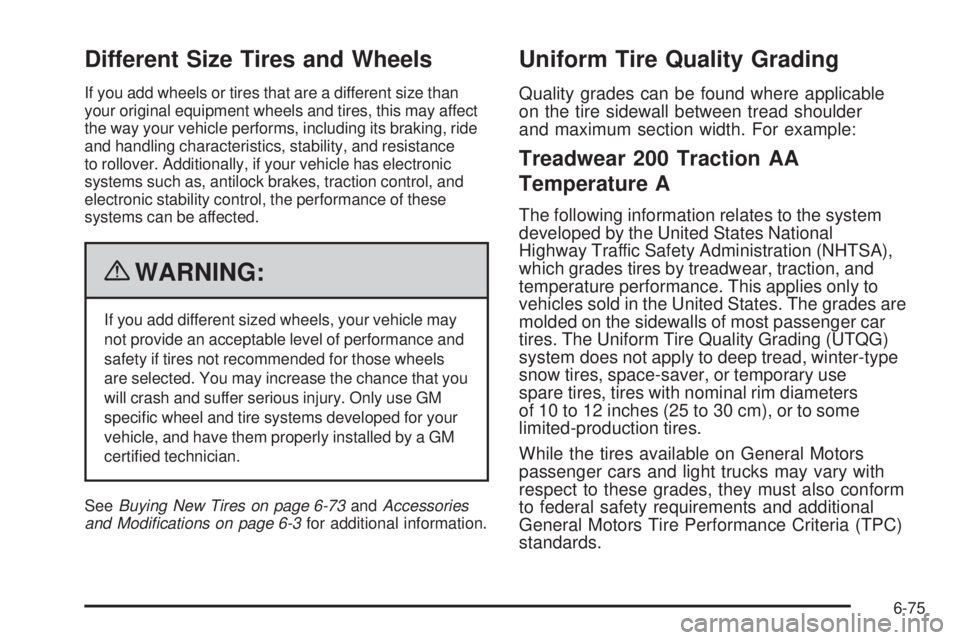
Different Size Tires and Wheels
If you add wheels or tires that are a different size than
your original equipment wheels and tires, this may affect
the way your vehicle performs, including its braking, ride
and handling characteristics, stability, and resistance
to rollover. Additionally, if your vehicle has electronic
systems such as, antilock brakes, traction control, and
electronic stability control, the performance of these
systems can be affected.
{WARNING:
If you add different sized wheels, your vehicle may
not provide an acceptable level of performance and
safety if tires not recommended for those wheels
are selected. You may increase the chance that you
will crash and suffer serious injury. Only use GM
specific wheel and tire systems developed for your
vehicle, and have them properly installed by a GM
certified technician.
SeeBuying New Tires on page 6-73andAccessories
and Modications on page 6-3for additional information.
Uniform Tire Quality Grading
Quality grades can be found where applicable
on the tire sidewall between tread shoulder
and maximum section width. For example:
Treadwear 200 Traction AA
Temperature A
The following information relates to the system
developed by the United States National
Highway Traffic Safety Administration (NHTSA),
which grades tires by treadwear, traction, and
temperature performance. This applies only to
vehicles sold in the United States. The grades are
molded on the sidewalls of most passenger car
tires. The Uniform Tire Quality Grading (UTQG)
system does not apply to deep tread, winter-type
snow tires, space-saver, or temporary use
spare tires, tires with nominal rim diameters
of 10 to 12 inches (25 to 30 cm), or to some
limited-production tires.
While the tires available on General Motors
passenger cars and light trucks may vary with
respect to these grades, they must also conform
to federal safety requirements and additional
General Motors Tire Performance Criteria (TPC)
standards.
6-75
Page 390 of 448
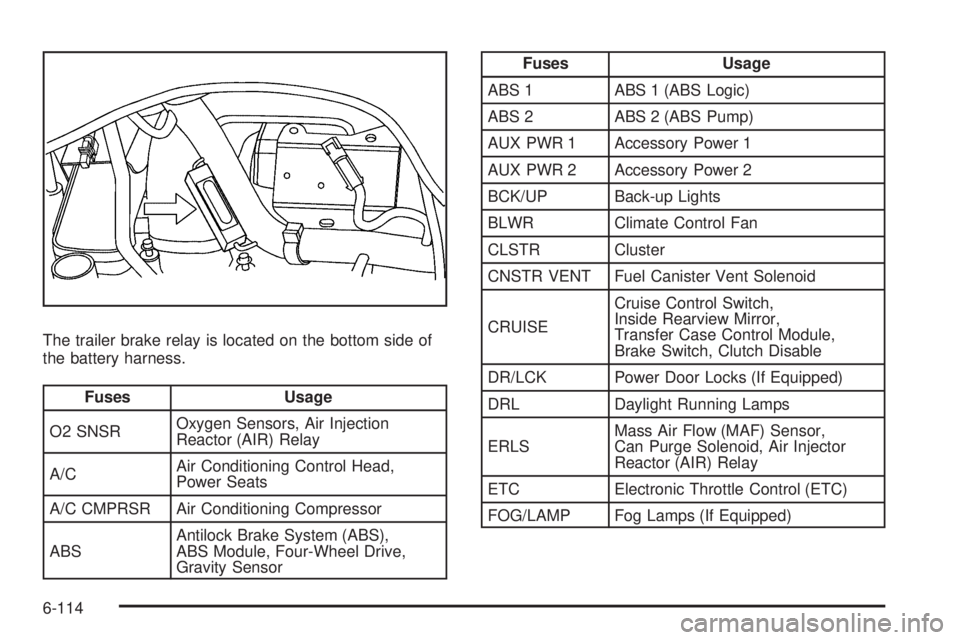
The trailer brake relay is located on the bottom side of
the battery harness.
Fuses Usage
O2 SNSROxygen Sensors, Air Injection
Reactor (AIR) Relay
A/CAir Conditioning Control Head,
Power Seats
A/C CMPRSR Air Conditioning Compressor
ABSAntilock Brake System (ABS),
ABS Module, Four-Wheel Drive,
Gravity Sensor
Fuses Usage
ABS 1 ABS 1 (ABS Logic)
ABS 2 ABS 2 (ABS Pump)
AUX PWR 1 Accessory Power 1
AUX PWR 2 Accessory Power 2
BCK/UP Back-up Lights
BLWR Climate Control Fan
CLSTR Cluster
CNSTR VENT Fuel Canister Vent Solenoid
CRUISECruise Control Switch,
Inside Rearview Mirror,
Transfer Case Control Module,
Brake Switch, Clutch Disable
DR/LCK Power Door Locks (If Equipped)
DRL Daylight Running Lamps
ERLSMass Air Flow (MAF) Sensor,
Can Purge Solenoid, Air Injector
Reactor (AIR) Relay
ETC Electronic Throttle Control (ETC)
FOG/LAMP Fog Lamps (If Equipped)
6-114
Page 391 of 448
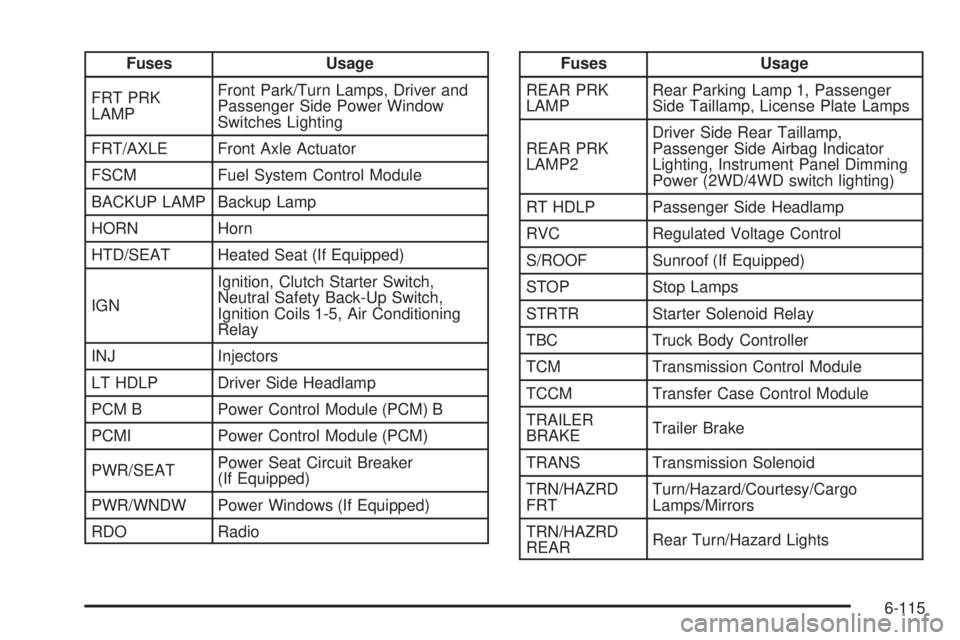
Fuses Usage
FRT PRK
LAMPFront Park/Turn Lamps, Driver and
Passenger Side Power Window
Switches Lighting
FRT/AXLE Front Axle Actuator
FSCM Fuel System Control Module
BACKUP LAMP Backup Lamp
HORN Horn
HTD/SEAT Heated Seat (If Equipped)
IGNIgnition, Clutch Starter Switch,
Neutral Safety Back-Up Switch,
Ignition Coils 1-5, Air Conditioning
Relay
INJ Injectors
LT HDLP Driver Side Headlamp
PCM B Power Control Module (PCM) B
PCMI Power Control Module (PCM)
PWR/SEATPower Seat Circuit Breaker
(If Equipped)
PWR/WNDW Power Windows (If Equipped)
RDO RadioFuses Usage
REAR PRK
LAMPRear Parking Lamp 1, Passenger
Side Taillamp, License Plate Lamps
REAR PRK
LAMP2Driver Side Rear Taillamp,
Passenger Side Airbag Indicator
Lighting, Instrument Panel Dimming
Power (2WD/4WD switch lighting)
RT HDLP Passenger Side Headlamp
RVC Regulated Voltage Control
S/ROOF Sunroof (If Equipped)
STOP Stop Lamps
STRTR Starter Solenoid Relay
TBC Truck Body Controller
TCM Transmission Control Module
TCCM Transfer Case Control Module
TRAILER
BRAKETrailer Brake
TRANS Transmission Solenoid
TRN/HAZRD
FRTTurn/Hazard/Courtesy/Cargo
Lamps/Mirrors
TRN/HAZRD
REARRear Turn/Hazard Lights
6-115
Page 431 of 448
A
ABS (Antilock Brake System) FAULT.................4-37
AC (Air Conditioning) OFF...............................4-37
Accessories and Modifications............................ 6-3
Accessory Power............................................3-18
Accessory Power Outlets.................................4-15
Adding Washer Fluid.......................................6-38
Additional Factors Affecting System Operation.....2-78
Additional Program Information.........................8-11
Additional Required Services.............................. 7-5
Additives, Fuel................................................. 6-6
Add-On Electrical Equipment...........................6-111
Add-On Equipment..........................................5-40
Adjusting the Speakers (Balance/Fade)..............4-48
Adjustment
Chime Level...............................................4-63
Adjustments
Headlamp Range.......................................... 2-8
After Off-Road Driving.....................................5-24
Air Cleaner/Filter, Engine.................................6-20
Air Conditioning..............................................4-16
Airbag
Adding Equipment to Your Airbag-Equipped
Vehicle...................................................2-80Airbag System
How Does an Airbag Restrain?......................2-71
Passenger Sensing System...........................2-73
Servicing Your Airbag-Equipped Vehicle..........2-79
What Makes an Airbag Inflate?......................2-71
What Will You See After an Airbag Inflates?....2-72
When Should an Airbag Inflate?....................2-69
Where Are the Airbags?...............................2-67
Airbags.........................................................2-81
Passenger Status Indicator...........................4-23
Readiness Light..........................................4-22
System Check.............................................2-64
All Overseas Locations...................................... 8-6
AM ...............................................................4-62
AM-FM Radio.................................................4-43
Antenna
Fixed Mast.................................................
4-63
Antenna, XM™ Satellite Radio Antenna System.....4-63
Antilock Brake System (ABS)............................. 5-5
Warning Light.............................................4-26
Appearance Care
Aluminum or Chrome-Plated Wheels.............6-108
Care of Safety Belts...................................6-105
Chemical Paint Spotting..............................6-109
Cleaning Exterior Lamps/Lenses..................6-106
Fabric/Carpet............................................6-103
Finish Care...............................................6-107
1
Page 432 of 448
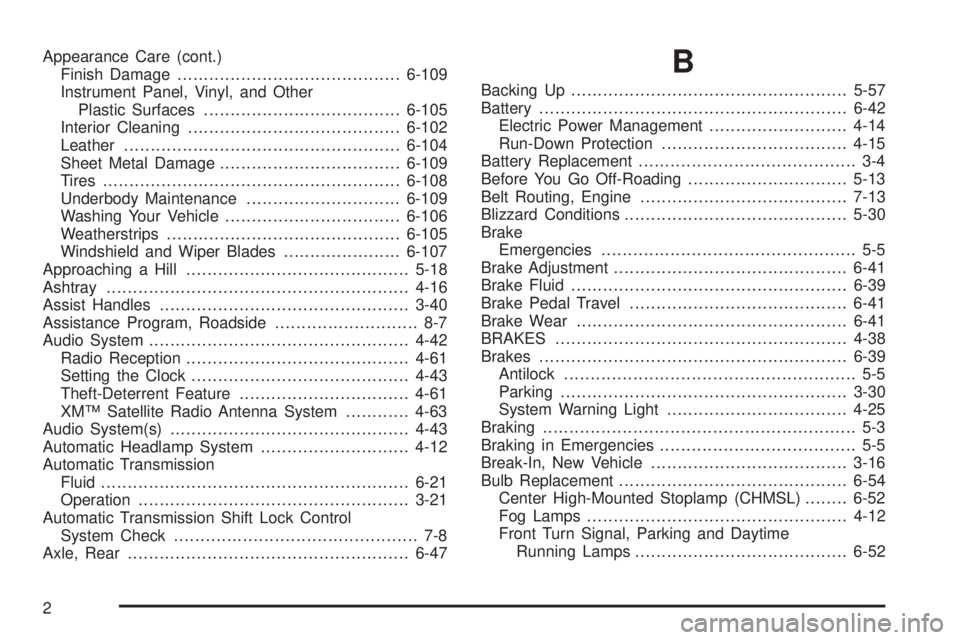
Appearance Care (cont.)
Finish Damage..........................................6-109
Instrument Panel, Vinyl, and Other
Plastic Surfaces.....................................6-105
Interior Cleaning........................................6-102
Leather....................................................6-104
Sheet Metal Damage..................................6-109
Tires........................................................6-108
Underbody Maintenance.............................6-109
Washing Your Vehicle.................................6-106
Weatherstrips............................................6-105
Windshield and Wiper Blades......................6-107
Approaching a Hill..........................................5-18
Ashtray.........................................................4-16
Assist Handles...............................................3-40
Assistance Program, Roadside........................... 8-7
Audio System.................................................4-42
Radio Reception..........................................4-61
Setting the Clock.........................................4-43
Theft-Deterrent Feature................................4-61
XM™ Satellite Radio Antenna System............4-63
Audio System(s).............................................4-43
Automatic Headlamp System............................4-12
Automatic Transmission
Fluid..........................................................6-21
Operation...................................................3-21
Automatic Transmission Shift Lock Control
System Check.............................................. 7-8
Axle, Rear.....................................................6-47B
Backing Up....................................................5-57
Battery..........................................................6-42
Electric Power Management..........................4-14
Run-Down Protection...................................4-15
Battery Replacement......................................... 3-4
Before You Go Off-Roading..............................5-13
Belt Routing, Engine.......................................7-13
Blizzard Conditions..........................................5-30
Brake
Emergencies................................................ 5-5
Brake Adjustment............................................6-41
Brake Fluid....................................................6-39
Brake Pedal Travel.........................................6-41
Brake Wear...................................................6-41
BRAKES.......................................................4-38
Brakes..........................................................6-39
Antilock....................................................... 5-5
Parking......................................................3-30
System Warning Light..................................4-25
Braking........................................................... 5-3
Braking in Emergencies..................................... 5-5
Break-In, New Vehicle.....................................3-16
Bulb Replacement...........................................6-54
Center High-Mounted Stoplamp (CHMSL)........6-52
Fog Lamps .................................................4-12
Front Turn Signal, Parking and Daytime
Running Lamps........................................6-52
2
Page 433 of 448
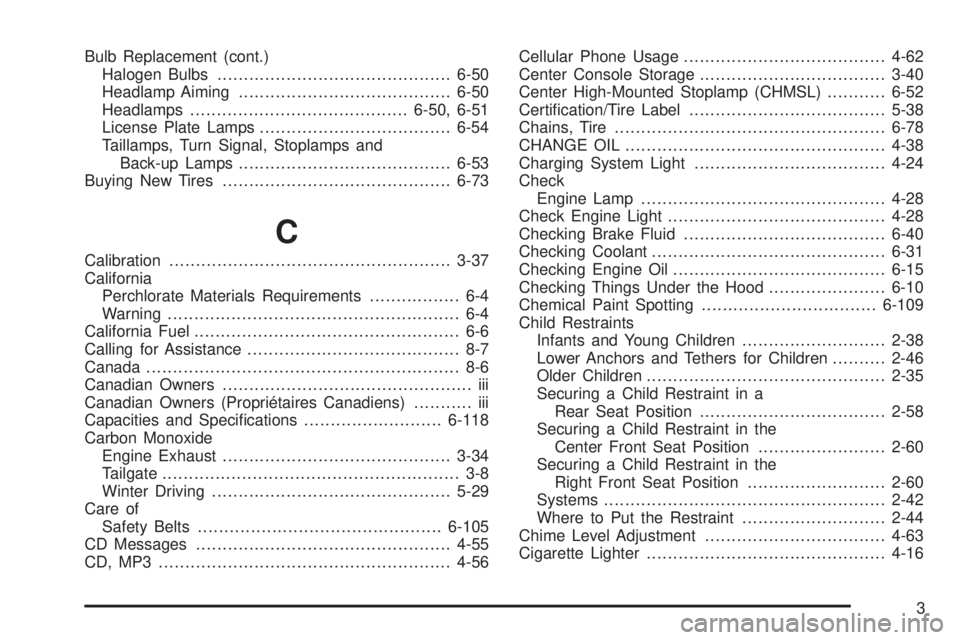
Bulb Replacement (cont.)
Halogen Bulbs............................................6-50
Headlamp Aiming........................................6-50
Headlamps.........................................6-50, 6-51
License Plate Lamps....................................6-54
Taillamps, Turn Signal, Stoplamps and
Back-up Lamps........................................6-53
Buying New Tires...........................................6-73
C
Calibration.....................................................3-37
California
Perchlorate Materials Requirements................. 6-4
Warning....................................................... 6-4
California Fuel.................................................. 6-6
Calling for Assistance........................................ 8-7
Canada........................................................... 8-6
Canadian Owners............................................... iii
Canadian Owners (Propriétaires Canadiens)........... iii
Capacities and Specifications..........................6-118
Carbon Monoxide
Engine Exhaust...........................................3-34
Tailgate........................................................ 3-8
Winter Driving.............................................5-29
Care of
Safety Belts..............................................6-105
CD Messages................................................4-55
CD, MP3 .......................................................4-56Cellular Phone Usage......................................4-62
Center Console Storage...................................3-40
Center High-Mounted Stoplamp (CHMSL)...........6-52
Certification/Tire Label.....................................5-38
Chains, Tire...................................................6-78
CHANGE OIL .................................................4-38
Charging System Light....................................4-24
Check
Engine Lamp..............................................4-28
Check Engine Light.........................................4-28
Checking Brake Fluid......................................6-40
Checking Coolant............................................6-31
Checking Engine Oil........................................6-15
Checking Things Under the Hood......................6-10
Chemical Paint Spotting.................................6-109
Child Restraints
Infants and Young Children...........................2-38
Lower Anchors and Tethers for Children..........2-46
Older Children.............................................2-35
Securing a Child Restraint in a
Rear Seat Position...................................2-58
Securing a Child Restraint in the
Center Front Seat Position........................2-60
Securing a Child Restraint in the
Right Front Seat Position
..........................2-60
Systems.....................................................2-42
Where to Put the Restraint...........................2-44
Chime Level Adjustment..................................4-63
Cigarette Lighter.............................................4-16
3