belt GMC CANYON 2010 Manual PDF
[x] Cancel search | Manufacturer: GMC, Model Year: 2010, Model line: CANYON, Model: GMC CANYON 2010Pages: 448, PDF Size: 2.62 MB
Page 276 of 448
Maintenance When Trailer Towing
The vehicle needs service more often when pulling a
trailer. SeeScheduled Maintenance on page 7-3or the
Index for more information. Things that are especially
important in trailer operation are automatic transmission
fluid, engine oil, axle lubricant, belts, cooling system
and brake system. It is a good idea to inspect
these before and during the trip.
Check periodically to see that all hitch nuts and bolts
are tight.
Trailer Wiring Harness
The vehicle may be equipped with a four-pin trailer
towing harness. This harness has a four-pin trailer
connector that is attached to a bracket on the hitch
platform. The four-wire harness contains the following
trailer circuits:
•Yellow: Left Stop/Turn Signal
•Green: Right Stop/Turn Signal
•Brown: Taillamps/Park lamps
•White: Ground
Trailer Recommendations
Subtract the hitch loads from the Cargo Weight Rating
(CWR). CWR is the maximum weight of the load
the vehicle can carry. It does not include the weight of
the people inside, but you can figure about 150 lbs.
(68 kg) for each passenger. The total cargo load must
not be more than the vehicles CWR.
Weigh the vehicle with the trailer attached, so the
GVWR or GAWR are not exceeded. If using a
weight-distributing hitch, weigh the vehicle without the
spring bars in place.
The best performance is obtained by correctly spreading
out the weight of the load and choosing the correct
hitch and trailer brakes.
For more information seeTowing a Trailer on page 5-48.
5-60
Page 278 of 448
Tires..............................................................6-57
Tire Sidewall Labeling...................................6-58
Tire Terminology and Definitions.....................6-61
Inflation - Tire Pressure.................................6-64
High-Speed Operation...................................6-65
Tire Pressure Monitor System.........................6-66
Tire Pressure Monitor Operation.....................6-67
Tire Inspection and Rotation...........................6-71
When It Is Time for New Tires.......................6-72
Buying New Tires.........................................6-73
Different Size Tires and Wheels......................6-75
Uniform Tire Quality Grading..........................6-75
Wheel Alignment and Tire Balance..................6-77
Wheel Replacement......................................6-77
Tire Chains..................................................6-78
If a Tire Goes Flat........................................6-79
Changing a Flat Tire.....................................6-80
Removing the Spare Tire and Tools................6-81
Removing the Flat Tire and Installing the
Spare Tire................................................6-85
Secondary Latch System...............................6-93
Storing a Flat or Spare Tire and Tools............6-96
Spare Tire.................................................6-101
Appearance Care..........................................6-102
Interior Cleaning.........................................6-102
Fabric/Carpet..............................................6-103Leather......................................................6-104
Instrument Panel, Vinyl, and Other Plastic
Surfaces.................................................6-105
Care of Safety Belts....................................6-105
Weatherstrips.............................................6-105
Washing Your Vehicle..................................6-106
Cleaning Exterior Lamps/Lenses....................6-106
Finish Care................................................6-107
Windshield and Wiper Blades.......................6-107
Aluminum or Chrome-Plated Wheels and Trim . . .6-108
Tires.........................................................6-108
Sheet Metal Damage...................................6-109
Finish Damage...........................................6-109
Underbody Maintenance...............................6-109
Chemical Paint Spotting...............................6-109
Vehicle Identication.....................................6-110
Vehicle Identification Number (VIN)................6-110
Service Parts Identification Label...................6-110
Electrical System..........................................6-111
Add-On Electrical Equipment.........................6-111
Windshield Wiper Fuses...............................6-111
Fuses and Circuit Breakers..........................6-111
Engine Compartment Fuse Block...................6-112
Capacities and Specications........................6-118
Section 6 Service and Appearance Care
6-2
Page 280 of 448
California Proposition 65 Warning
Most motor vehicles, including this one, contain and/or
emit chemicals known to the State of California to cause
cancer and birth defects or other reproductive harm.
Engine exhaust, many parts and systems, many fluids,
and some component wear by-products contain and/or
emit these chemicals.
California Perchlorate Materials
Requirements
Certain types of automotive applications, such as
airbag initiators, seat belt pretensioners, and lithium
batteries contained in remote keyless transmitters,
may contain perchlorate materials. Special handling
may be necessary. For additional information, see
www.dtsc.ca.gov/hazardouswaste/perchlorate.
Doing Your Own Service Work
{WARNING:
You can be injured and the vehicle could be
damaged if you try to do service work on a vehicle
without knowing enough about it.
•Be sure you have sufficient knowledge,
experience, the proper replacement parts,
and tools before attempting any vehicle
maintenance task.
•Be sure to use the proper nuts, bolts, and
other fasteners. English and metric fasteners
can be easily confused. If the wrong fasteners
are used, parts can later break or fall off.
You could be hurt.
If doing some of your own service work, use the proper
service manual. It tells you much more about how to
service the vehicle than this manual can. To order
the proper service manual, seeService Publications
Ordering Information on page 8-15.
6-4
Page 336 of 448
(F) Tire Size:A combination of letters and
numbers define a tire’s width, height, aspect
ratio, construction type and service description.
The letter T as the first character in the tire
size means the tire is for temporary use only.
(G) TPC Spec (Tire Performance Criteria
Specication)
:Original equipment tires designed
to GM’s specific tire performance criteria have a
TPC specification code molded onto the sidewall.
GM’s TPC specifications meet or exceed all federal
safety guidelines.
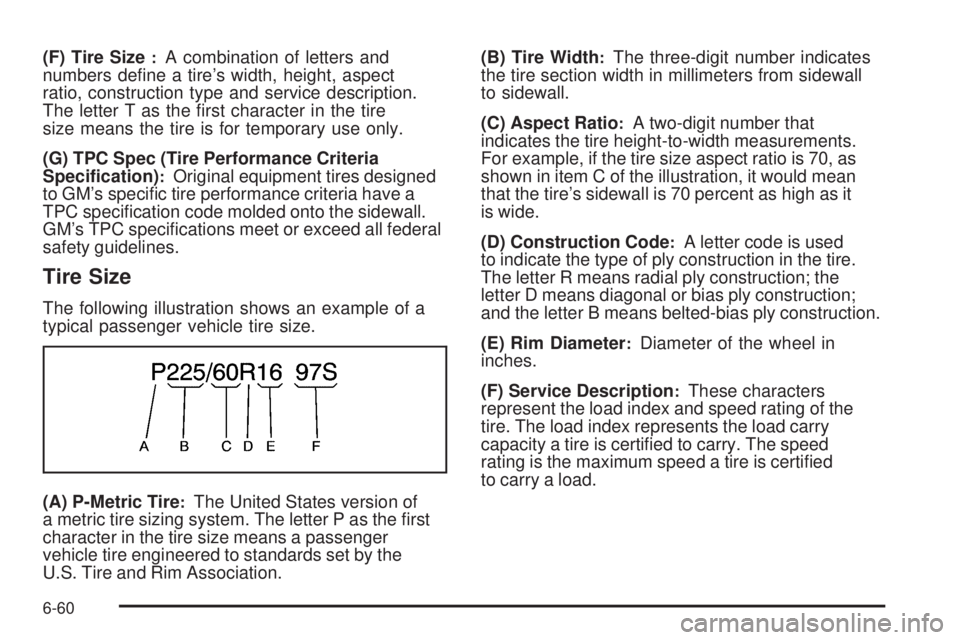
Tire Size
The following illustration shows an example of a
typical passenger vehicle tire size.
(A) P-Metric Tire
:The United States version of
a metric tire sizing system. The letter P as the first
character in the tire size means a passenger
vehicle tire engineered to standards set by the
U.S. Tire and Rim Association.(B) Tire Width
:The three-digit number indicates
the tire section width in millimeters from sidewall
to sidewall.
(C) Aspect Ratio
:A two-digit number that
indicates the tire height-to-width measurements.
For example, if the tire size aspect ratio is 70, as
shown in item C of the illustration, it would mean
that the tire’s sidewall is 70 percent as high as it
is wide.
(D) Construction Code
:A letter code is used
to indicate the type of ply construction in the tire.
The letter R means radial ply construction; the
letter D means diagonal or bias ply construction;
and the letter B means belted-bias ply construction.
(E) Rim Diameter
:Diameter of the wheel in
inches.
(F) Service Description
:These characters
represent the load index and speed rating of the
tire. The load index represents the load carry
capacity a tire is certified to carry. The speed
rating is the maximum speed a tire is certified
to carry a load.
6-60
Page 337 of 448
Tire Terminology and Denitions
Air Pressure:The amount of air inside the
tire pressing outward on each square inch of
the tire. Air pressure is expressed in pounds
per square inch (psi) or kilopascal (kPa).
Accessory Weight
:This means the combined
weight of optional accessories. Some examples of
optional accessories are, automatic transmission,
power steering, power brakes, power windows,
power seats, and air conditioning.
Aspect Ratio
:The relationship of a tire’s height
to its width.
Belt
:A rubber coated layer of cords that is
located between the plies and the tread. Cords
may be made from steel or other reinforcing
materials.
Bead
:The tire bead contains steel wires wrapped
by steel cords that hold the tire onto the rim.
Bias Ply Tire
:A pneumatic tire in which the plies
are laid at alternate angles less than 90 degrees
to the centerline of the tread.Cold Tire Pressure
:The amount of air pressure in
a tire, measured in pounds per square inch (psi) or
kilopascals (kPa) before a tire has built up heat
from driving. SeeInation - Tire Pressure on
page 6-64.
Curb Weight
:The weight of a motor vehicle
with standard and optional equipment including
the maximum capacity of fuel, oil, and coolant,
but without passengers and cargo.
DOT Markings
:A code molded into the sidewall
of a tire signifying that the tire is in compliance
with the U.S. Department of Transportation (DOT)
motor vehicle safety standards. The DOT code
includes the Tire Identification Number (TIN), an
alphanumeric designator which can also identify
the tire manufacturer, production plant, brand, and
date of production.
GVWR
:Gross Vehicle Weight Rating.
SeeLoading the Vehicle on page 5-33.
GAWR FRT
:Gross Axle Weight Rating for the
front axle. SeeLoading the Vehicle on page 5-33.
GAWR RR
:Gross Axle Weight Rating for the
rear axle. SeeLoading the Vehicle on page 5-33.
6-61
Page 350 of 448
GM recommends replacing tires in sets of four. This is
because uniform tread depth on all tires will help keep
your vehicle performing most like it did when the tires
were new. Replacing less than a full set of tires can affect
the braking and handling performance of your vehicle.
SeeTire Inspection and Rotation on page 6-71for
information on proper tire rotation.
{WARNING:
Mixing tires could cause you to lose control of
your vehicle while driving. If you mix tires of
different sizes, brands, or types (radial and
bias-belted tires) the vehicle may not handle
properly, and you could have a crash. Using tires
of different sizes, brands, or types may also cause
damage to your vehicle. Be sure to use the correct
size, brand, and type of tires on all wheels.
Your vehicle may have a compact spare tire and
wheel assembly. It is all right to drive with your
vehicle’s compact spare tire temporarily. It was
developed for use on your vehicle. SeeSpare Tire
on page 6-101.
{WARNING:
If you use bias-ply tires on the vehicle,
the wheel rim flanges could develop cracks
after many miles of driving. A tire and/or
wheel could fail suddenly, causing a crash.
Use only radial-ply tires with the wheels on
the vehicle.
If you must replace your vehicle’s tires with those that do
not have a TPC Spec number, make sure they are the
same size, load range, speed rating, and construction
type (radial and bias-belted tires) as your vehicle’s
original tires.
Vehicles that have a tire pressure monitoring system
could give an inaccurate low-pressure warning if
non-TPC Spec rated tires are installed on your vehicle.
Non-TPC Spec rated tires may give a low-pressure
warning that is higher or lower than the proper warning
level you would get with TPC Spec rated tires. SeeTire
Pressure Monitor System on page 6-66.
Your vehicle’s original equipment tires are listed on
the Tire and Loading Information Label. SeeLoading the
Vehicle on page 5-33, for more information about the
Tire and Loading Information Label and its location
on your vehicle.
6-74
Page 381 of 448
Instrument Panel, Vinyl, and Other
Plastic Surfaces
A soft cloth dampened with water may be used to remove
dust. If a more thorough cleaning is necessary, a clean
soft cloth dampened with a mild soap solution can be
used to gently remove dust and dirt. Never use spot
lifters or removers on plastic surfaces. Many commercial
cleaners and coatings that are sold to preserve and
protect soft plastic surfaces may permanently change
the appearance and feel of the interior and are not
recommended. Do not use silicone or wax-based
products, or those containing organic solvents to
clean the vehicle’s interior because they can alter the
appearance by increasing the gloss in a non-uniform
manner.
Some commercial products may increase gloss on the
instrument panel. The increase in gloss may cause
annoying reflections in the windshield and even make
it difficult to see through the windshield under certain
conditions.
Care of Safety Belts
Keep belts clean and dry.
{WARNING:
Do not bleach or dye safety belts. It may severely
weaken them. In a crash, they might not be able
to provide adequate protection. Clean safety belts
only with mild soap and lukewarm water.
Weatherstrips
Silicone grease on weatherstrips will make them last
longer, seal better, and not stick or squeak. Apply
silicone grease with a clean cloth. During very cold,
damp weather frequent application may be required.
SeeRecommended Fluids and Lubricants on page 7-10.
6-105
Page 397 of 448
Maintenance Schedule......................................7-2
Introduction...................................................7-2
Scheduled Maintenance...................................7-3
Owner Checks and Services............................7-8Recommended Fluids and Lubricants...............7-10
Maintenance Replacement Parts.....................7-12
Engine Drive Belt Routing..............................7-13
Maintenance Record.....................................7-14
Section 7 Maintenance Schedule
7-1
Page 402 of 448
First Engine Oil Change After Every
80 000 km/50,000 Miles
•
Engine air cleaner filter replacement. SeeEngine
Air Cleaner/Filter on page 6-20.
•Automatic transmission fluid change (severe
service) for vehicles mainly driven in heavy
city traffic in hot weather, in hilly or mountainous
terrain, when frequently towing a trailer, or used for
taxi, police, or delivery service. SeeAutomatic
Transmission Fluid on page 6-21.
First Engine Oil Change After Every
160 000 km/100,000 Miles
•
Automatic transmission fluid change (normal
service). SeeAutomatic Transmission Fluid
on page 6-21.
•Spark plug replacement.An Emission Control
Service.
First Engine Oil Change After Every
240 000 km/150,000 Miles
•
Engine cooling system drain, flush, and refill,
cooling system and cap pressure check, and
cleaning of outside of radiator and air conditioning
condenser (or every 5 years, whichever occurs
first). SeeEngine Coolant on page 6-29.An
Emission Control Service.
•Engine accessory drive belt inspection for fraying,
excessive cracks, or obvious damage and
replacement, if needed.An Emission Control
Service.
7-6
Page 409 of 448
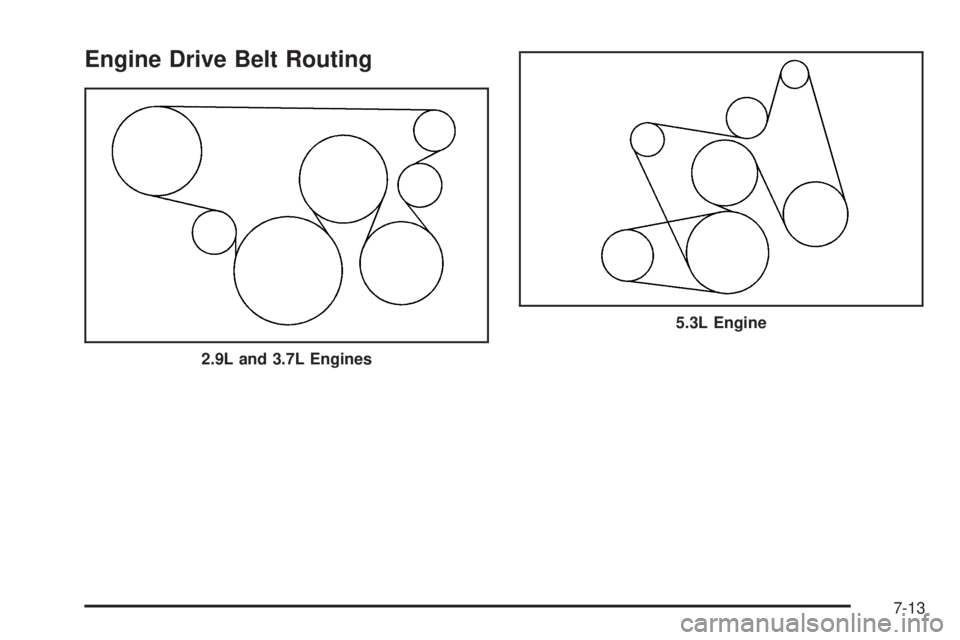
Engine Drive Belt Routing
2.9L and 3.7L Engines
5.3L Engine
7-13