belt GMC CANYON 2010 Owner's Manual
[x] Cancel search | Manufacturer: GMC, Model Year: 2010, Model line: CANYON, Model: GMC CANYON 2010Pages: 448, PDF Size: 2.62 MB
Page 1 of 448
In Brief........................................................... 1-1
Instrument Panel
........................................ 1-2
Initial Drive Information
............................... 1-3
Vehicle Features
......................................1-15
Performance and Maintenance
...................1-17
Seats and Restraint System............................. 2-1
Front Seats
............................................... 2-2
Rear Seats
..............................................2-10
Safety Belts
.............................................2-13
Child Restraints
.......................................2-35
Airbag System
.........................................2-64
Restraint System Check
............................2-81
Features and Controls..................................... 3-1
Keys
........................................................ 3-2
Doors and Locks
....................................... 3-5
Windows
.................................................3-10
Theft-Deterrent Systems
............................3-13
Starting and Operating Your Vehicle
...........3-16
Mirrors
....................................................3-36
Storage Areas
.........................................3-40
Sunroof
..................................................3-42Instrument Panel............................................. 4-1
Instrument Panel Overview
.......................... 4-3
Climate Controls
......................................4-16
Warning Lights, Gages, and Indicators
........4-18
Driver Information Center (DIC)
..................4-33
Audio System(s)
.......................................4-42
Driving Your Vehicle....................................... 5-1
Your Driving, the Road, and the Vehicle
....... 5-2
Towing
...................................................5-41
Service and Appearance Care.......................... 6-1
Service
..................................................... 6-3
Fuel
......................................................... 6-5
Checking Things Under the Hood
...............6-10
Rear Axle
...............................................6-47
Four-Wheel Drive
.....................................6-48
Front Axle
...............................................6-49
Headlamp Aiming
.....................................6-50
Bulb Replacement
....................................
6-50
Windshield Wiper Blade Replacement
.........6-55
Tires
......................................................6-57
2010 GMC Canyon Owner ManualM
Page 5 of 448
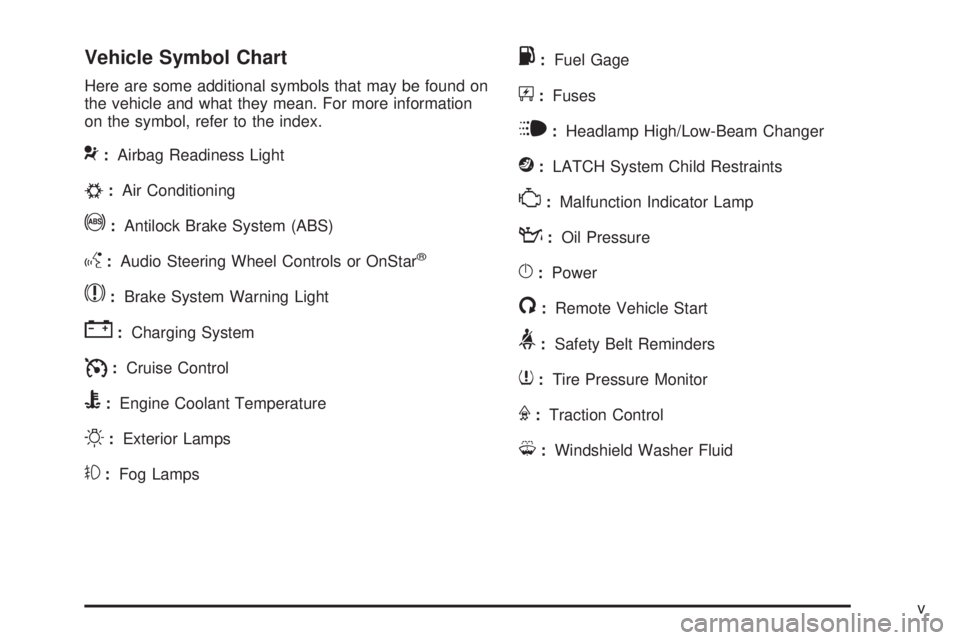
Vehicle Symbol Chart
Here are some additional symbols that may be found on
the vehicle and what they mean. For more information
on the symbol, refer to the index.
9:Airbag Readiness Light
#:Air Conditioning
!:Antilock Brake System (ABS)
g:Audio Steering Wheel Controls or OnStar®
$:Brake System Warning Light
":Charging System
I:Cruise Control
B:Engine Coolant Temperature
O:Exterior Lamps
#:Fog Lamps
.:Fuel Gage
+:Fuses
i:Headlamp High/Low-Beam Changer
j:LATCH System Child Restraints
*:Malfunction Indicator Lamp
::Oil Pressure
}:Power
/:Remote Vehicle Start
>:Safety Belt Reminders
7:Tire Pressure Monitor
F:Traction Control
M:Windshield Washer Fluid
v
Page 7 of 448
Instrument Panel..............................................1-2
Initial Drive Information....................................1-3
Remote Keyless Entry (RKE) System................1-4
Door Locks....................................................1-4
Tailgate........................................................1-5
Windows.......................................................1-6
Seat Adjustment.............................................1-7
Heated Seats.................................................1-9
Head Restraint Adjustment...............................1-9
Safety Belt...................................................1-10
Sensing System for Passenger Airbag.............1-10
Mirror Adjustment.........................................1-11
Steering Wheel Adjustment............................1-12
Interior Lighting............................................1-12
Exterior Lighting...........................................1-13
Windshield Wiper/Washer...............................1-14
Climate Controls...........................................1-14Vehicle Features.............................................1-15
Radio(s)......................................................1-15
Satellite Radio..............................................1-16
Driver Information Center (DIC).......................1-16
Cruise Control..............................................1-17
Power Outlets..............................................1-17
Performance and Maintenance.........................1-17
Traction Control System (TCS).......................1-17
StabiliTrak
®..................................................1-18
Tire Pressure Monitor....................................1-18
Engine Oil Life System..................................1-19
Driving for Better Fuel Economy.....................1-19
Roadside Assistance Program........................1-20
OnStar
®......................................................1-20
Section 1 In Brief
1-1
Page 16 of 448
Safety Belt
Refer to the following sections for important information
on how to use safety belts properly.
•Safety Belts: They Are for Everyone on page 2-13.
•How to Wear Safety Belts Properly on page 2-18.
•Lap-Shoulder Belt on page 2-27.
•Lower Anchors and Tethers for Children (LATCH)
on page 2-46.
Sensing System for Passenger
Airbag
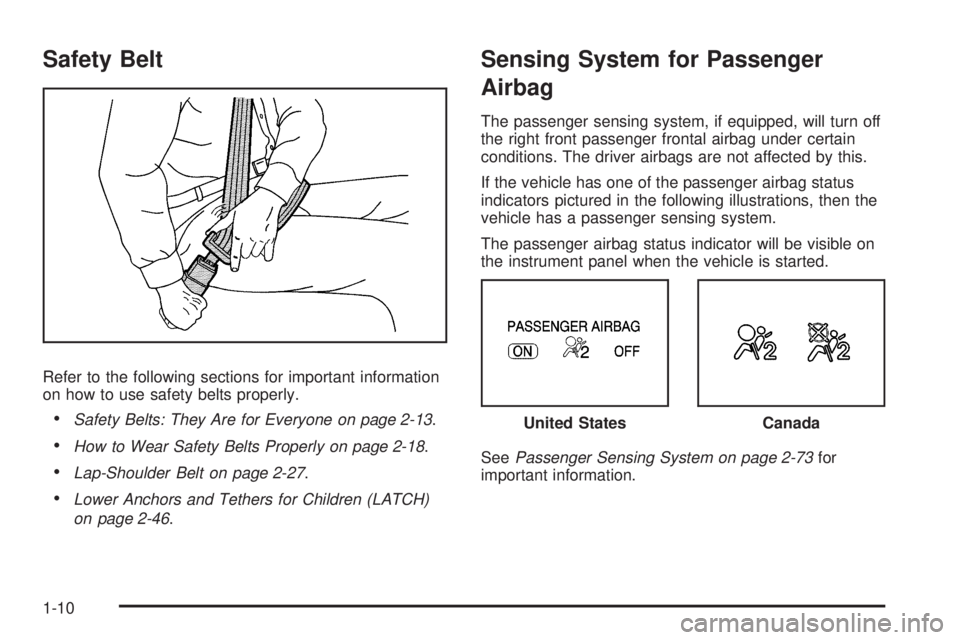
The passenger sensing system, if equipped, will turn off
the right front passenger frontal airbag under certain
conditions. The driver airbags are not affected by this.
If the vehicle has one of the passenger airbag status
indicators pictured in the following illustrations, then the
vehicle has a passenger sensing system.
The passenger airbag status indicator will be visible on
the instrument panel when the vehicle is started.
SeePassenger Sensing System on page 2-73for
important information.
United StatesCanada
1-10
Page 29 of 448
Front Seats......................................................2-2
Manual Seats................................................2-2
Power Seats..................................................2-3
Manual Lumbar..............................................2-3
Power Lumbar ...............................................2-4
Heated Seats.................................................2-4
Reclining Seatbacks........................................2-5
Head Restraints.............................................2-8
Seatback Latches...........................................2-9
Rear Seats.....................................................2-10
Rear Seat Operation (Extended Cab)...............2-10
Rear Seat Operation (Crew Cab)....................2-11
Safety Belts...................................................2-13
Safety Belts: They Are for Everyone................2-13
How to Wear Safety Belts Properly.................2-18
Lap-Shoulder Belt.........................................2-27
Safety Belt Use During Pregnancy..................2-33
Lap Belt......................................................2-33
Safety Belt Extender.....................................2-34
Child Restraints.............................................2-35
Older Children..............................................2-35
Infants and Young Children............................2-38
Child Restraint Systems.................................2-42Where to Put the Restraint.............................2-44
Lower Anchors and Tethers for
Children (LATCH)......................................2-46
Securing a Child Restraint in a
Rear Seat Position....................................2-58
Securing a Child Restraint in the
Center Front Seat Position..........................2-60
Securing a Child Restraint in the
Right Front Seat Position............................2-60
Airbag System...............................................2-64
Where Are the Airbags?................................2-67
When Should an Airbag Inflate?.....................2-69
What Makes an Airbag Inflate?.......................2-71
How Does an Airbag Restrain?......................
.2-71
What Will You See After an Airbag Inflates?.....2-72
Passenger Sensing System............................2-73
Servicing Your Airbag-Equipped Vehicle...........2-79
Adding Equipment to Your
Airbag-Equipped Vehicle.............................2-80
Restraint System Check..................................2-81
Checking the Restraint Systems......................2-81
Replacing Restraint System Parts
After a Crash............................................2-82
Section 2 Seats and Restraint System
2-1
Page 32 of 448
Power Lumbar
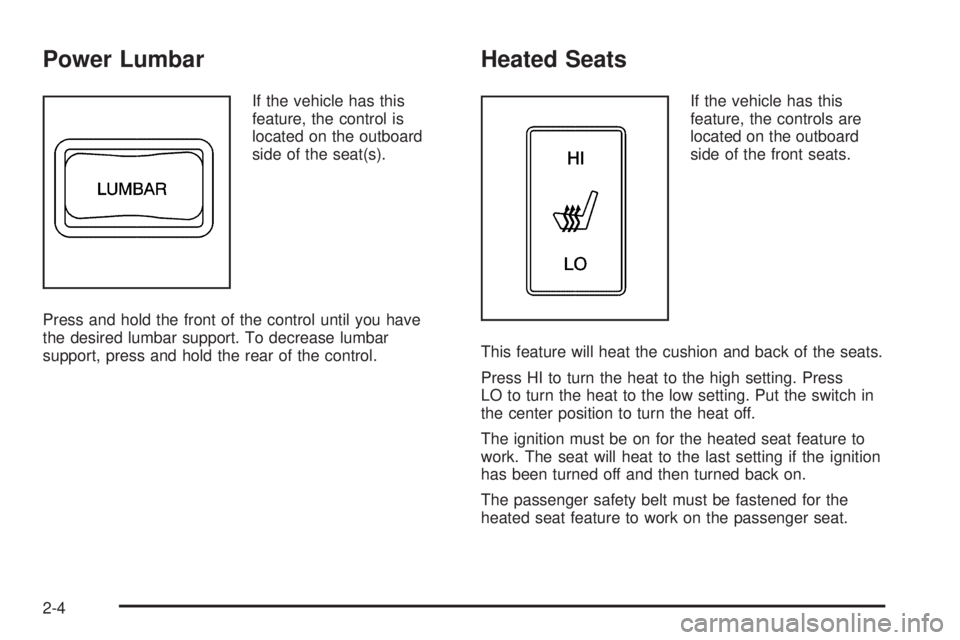
If the vehicle has this
feature, the control is
located on the outboard
side of the seat(s).
Press and hold the front of the control until you have
the desired lumbar support. To decrease lumbar
support, press and hold the rear of the control.
Heated Seats
If the vehicle has this
feature, the controls are
located on the outboard
side of the front seats.
This feature will heat the cushion and back of the seats.
Press HI to turn the heat to the high setting. Press
LO to turn the heat to the low setting. Put the switch in
the center position to turn the heat off.
The ignition must be on for the heated seat feature to
work. The seat will heat to the last setting if the ignition
has been turned off and then turned back on.
The passenger safety belt must be fastened for the
heated seat feature to work on the passenger seat.
2-4
Page 35 of 448
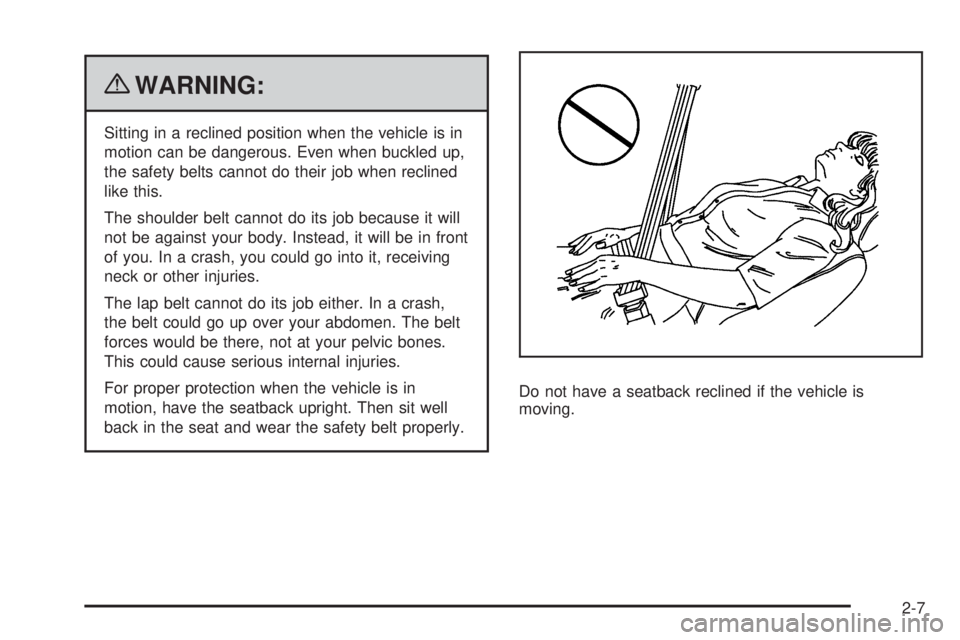
{WARNING:
Sitting in a reclined position when the vehicle is in
motion can be dangerous. Even when buckled up,
the safety belts cannot do their job when reclined
like this.
The shoulder belt cannot do its job because it will
not be against your body. Instead, it will be in front
of you. In a crash, you could go into it, receiving
neck or other injuries.
The lap belt cannot do its job either. In a crash,
the belt could go up over your abdomen. The belt
forces would be there, not at your pelvic bones.
This could cause serious internal injuries.
For proper protection when the vehicle is in
motion, have the seatback upright. Then sit well
back in the seat and wear the safety belt properly.Do not have a seatback reclined if the vehicle is
moving.
2-7
Page 38 of 448
Rear Seats
Rear Seat Operation (Extended Cab)
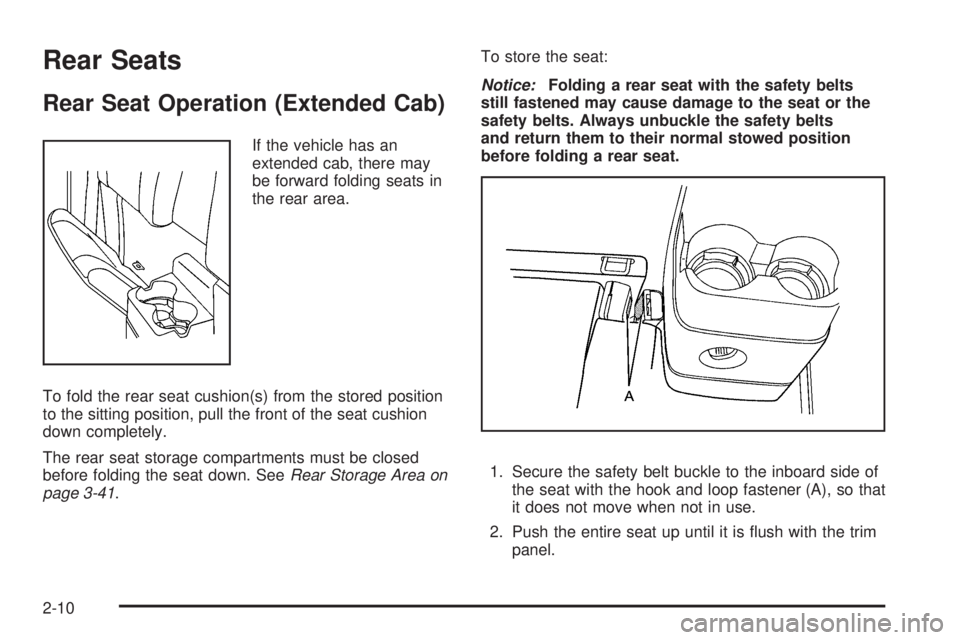
If the vehicle has an
extended cab, there may
be forward folding seats in
the rear area.
To fold the rear seat cushion(s) from the stored position
to the sitting position, pull the front of the seat cushion
down completely.
The rear seat storage compartments must be closed
before folding the seat down. SeeRear Storage Area on
page 3-41.To store the seat:
Notice:Folding a rear seat with the safety belts
still fastened may cause damage to the seat or the
safety belts. Always unbuckle the safety belts
and return them to their normal stowed position
before folding a rear seat.
1. Secure the safety belt buckle to the inboard side of
the seat with the hook and loop fastener (A), so that
it does not move when not in use.
2. Push the entire seat up until it is flush with the trim
panel.
2-10
Page 39 of 448
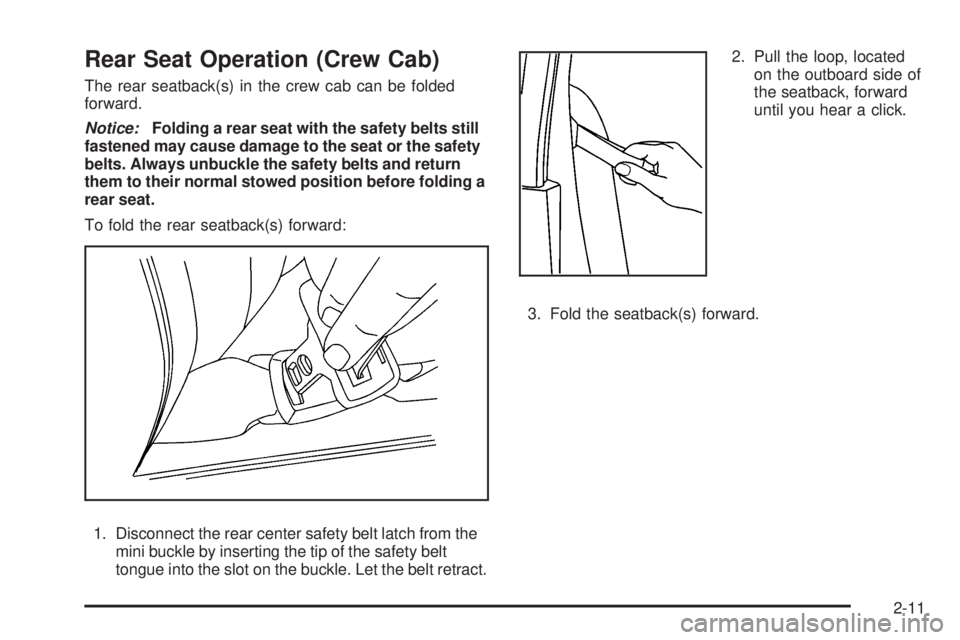
Rear Seat Operation (Crew Cab)
The rear seatback(s) in the crew cab can be folded
forward.
Notice:Folding a rear seat with the safety belts still
fastened may cause damage to the seat or the safety
belts. Always unbuckle the safety belts and return
them to their normal stowed position before folding a
rear seat.
To fold the rear seatback(s) forward:
1. Disconnect the rear center safety belt latch from the
mini buckle by inserting the tip of the safety belt
tongue into the slot on the buckle. Let the belt retract.2. Pull the loop, located
on the outboard side of
the seatback, forward
until you hear a click.
3. Fold the seatback(s) forward.
2-11
Page 40 of 448
To return the seatback(s) to the upright position:
1. Lift the seatback(s) and push it into place.
{WARNING:
If either seatback is not locked, it could move
forward in a sudden stop or crash. That could
cause injury to the person sitting there. Always
push and pull on the seatbacks to be sure they
are locked.
2. Make sure the seatback(s) is locked by pushing
and pulling on it.
{WARNING:
A safety belt that is improperly routed, not properly
attached, or twisted will not provide the protection
needed in a crash. The person wearing the belt
could be seriously injured. After raising the rear
seatback, always check to be sure that the safety
belts are properly routed and attached, and are
not twisted.
3. Reconnect the center safety belt latch plate to the
mini buckle. Make sure the safety belt is not twisted.
4. Push and pull on the latch plate to be sure it is
secure.
When the seatback is not in use, it should be kept in
the upright, locked position.
2-12