coolant temperature GMC CANYON 2010 Owner's Manual
[x] Cancel search | Manufacturer: GMC, Model Year: 2010, Model line: CANYON, Model: GMC CANYON 2010Pages: 448, PDF Size: 2.62 MB
Page 5 of 448
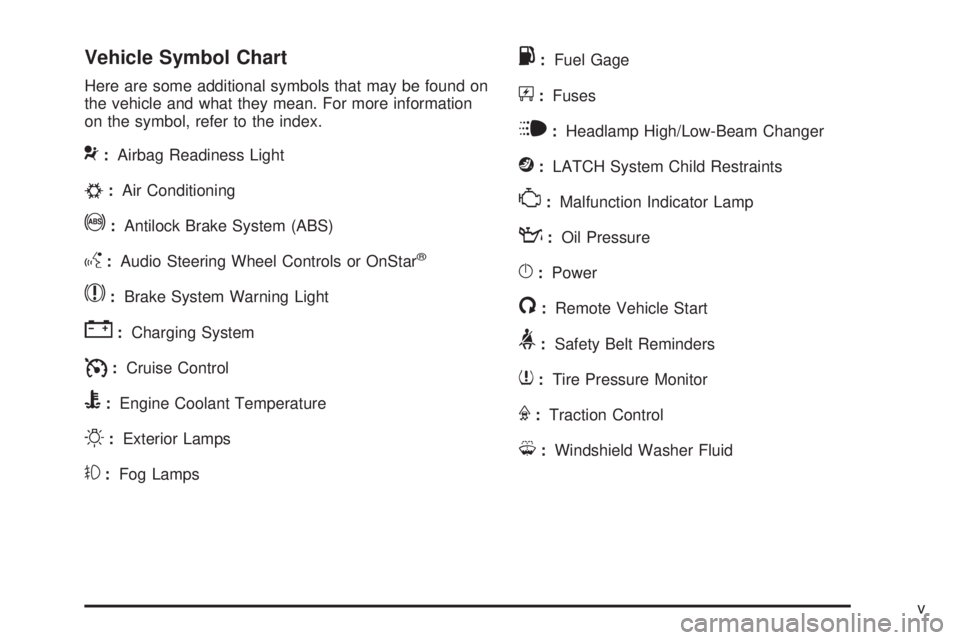
Vehicle Symbol Chart
Here are some additional symbols that may be found on
the vehicle and what they mean. For more information
on the symbol, refer to the index.
9:Airbag Readiness Light
#:Air Conditioning
!:Antilock Brake System (ABS)
g:Audio Steering Wheel Controls or OnStar®
$:Brake System Warning Light
":Charging System
I:Cruise Control
B:Engine Coolant Temperature
O:Exterior Lamps
#:Fog Lamps
.:Fuel Gage
+:Fuses
i:Headlamp High/Low-Beam Changer
j:LATCH System Child Restraints
*:Malfunction Indicator Lamp
::Oil Pressure
}:Power
/:Remote Vehicle Start
>:Safety Belt Reminders
7:Tire Pressure Monitor
F:Traction Control
M:Windshield Washer Fluid
v
Page 130 of 448
Engine Coolant Heater
The engine coolant heater can provide easier starting
and better fuel economy during engine warm-up in cold
weather conditions at or below 0°F (−18°C). Vehicles
with an engine coolant heater should be plugged
in at least four hours before starting. An internal
thermostat in the plug-end of the cord may exist
which will prevent engine coolant heater operation at
temperatures above 0° F (−18°C).
To Use the Engine Coolant Heater
1. Turn off the engine.
2. Open the hood and unwrap the electrical cord.
The cord is located in the engine compartment
behind the underhood fuse block on the driver side
of the vehicle.
3. Plug it into a normal, grounded 110-volt AC outlet.
{WARNING:
Plugging the cord into an ungrounded outlet could
cause an electrical shock. Also, the wrong kind of
extension cord could overheat and cause a fire.
You could be seriously injured. Plug the cord
into a properly grounded three-prong 110-volt
AC outlet. If the cord will not reach, use a
heavy-duty three-prong extension cord rated for
at least 15 amps.
4. Before starting the engine, be sure to unplug and
store the cord to prevent damage.
The length of time the heater should remain plugged in
depends on several factors. Ask a dealer/retailer in
the area where you will be parking the vehicle for the
best advice on this.
3-20
Page 153 of 448
Instrument Panel Overview...............................4-3
Hazard Warning Flashers................................4-3
Horn .............................................................4-3
Tilt Wheel.....................................................4-3
Turn Signal/Multifunction Lever.........................4-4
Turn and Lane-Change Signals........................4-4
Headlamp High/Low-Beam Changer..................4-5
Flash-to-Pass.................................................4-5
Windshield Wipers..........................................4-5
Windshield Washer.........................................4-6
Cruise Control................................................4-7
Exterior Lamps.............................................4-10
Headlamps on Reminder................................4-11
Daytime Running Lamps (DRL).......................4-11
Automatic Headlamp System..........................4-12
Fog Lamps ..................................................4-12
Exterior Cargo Lamps....................................4-13
Instrument Panel Brightness...........................4-13
Dome Lamp .................................................4-13
Dome Lamp Override....................................4-14
Exit Lighting.................................................4-14
Electric Power Management...........................4-14
Battery Run-Down Protection..........................4-15
Accessory Power Outlet(s).............................4-15
Ashtray(s) and Cigarette Lighter......................4-16Climate Controls............................................4-16
Climate Control System.................................4-16
Outlet Adjustment.........................................4-18
Warning Lights, Gages, and Indicators............4-18
Instrument Panel Cluster................................4-19
Speedometer and Odometer...........................4-20
Trip Odometer..............................................4-20
Tachometer.................................................4-20
Safety Belt Reminders...................................4-21
Airbag Readiness Light.................................
.4-22
Passenger Airbag Status Indicator...................4-23
Charging System Light..................................4-24
Up-Shift Light...............................................4-24
Brake System Warning Light..........................4-25
Antilock Brake System (ABS) Warning Light.....4-26
StabiliTrak
®/Traction Control System (TCS)
Warning Light...........................................4-26
Engine Coolant Temperature Gage..................4-27
Tire Pressure Light.......................................4-28
Malfunction Indicator Lamp.............................4-28
Oil Pressure Light.........................................4-31
Security Light...............................................4-32
Cruise Control Light......................................4-32
Highbeam On Light.......................................4-32
Fuel Gage...................................................4-32
Section 4 Instrument Panel
4-1
Page 179 of 448
If the StabiliTrak system and TCS light comes on and
stays on while driving and a TRACTION FAULT or
SERVICE STAB SYS message displays on the DIC,
the vehicle needs service.
The light also comes on steady when the StabiliTrak
system and/or TCS are turned off. The DIC also displays
a TRAC OFF and/or STAB SYS OFF message. If the
TCS is off, wheel spin is not limited. If the StabiliTrak
system is off, the system does not assist the driver with
directional control of the vehicle. The light turns off when
the TCS and StabiliTrak system are turned back on.
SeeStabiliTrak
®System on page 5-6,Traction Control
System (TCS) on page 5-8andDIC Warnings and
Messages on page 4-37for more information.
Engine Coolant Temperature Gage
This gage shows
the engine coolant
temperature.
If the gage pointer is near the top of the gage, the
engine is too hot. It means that the engine coolant has
overheated. If the vehicle has been operating under
normal driving conditions, pull the vehicle off the road,
stop the vehicle and turn off the engine as soon as
possible.
SeeEngine Overheating on page 6-35for more
information.
4-27
Page 189 of 448
DIC Warnings and Messages
Messages are displayed on the DIC to notify the driver
that the status of the vehicle has changed and that some
action may be needed by the driver to correct the
condition. Multiple messages may appear one after
another. The messages are displayed for several
seconds each.
Some messages may not require immediate action, but
you should press and release the trip odometer reset
stem to acknowledge that you received the messages
and to clear them from the display. Each message must
be acknowledged individually.
Some messages cannot be cleared from the DIC
display because they are more urgent. These messages
require action before they can be cleared. You should
take any messages that appear on the display seriously
and remember that clearing the messages only makes
the messages disappear, not correct the problem.
The following are the possible messages that can be
displayed and some information about them.
AC (Air Conditioning) OFF
This message displays when the engine coolant
temperature is too high and the air conditioning in your
vehicle needs to be turned off. SeeEngine Overheating
on page 6-35andClimate Control System on page 4-16
for more information. This message displays along with
the ENG HOT message.
ABS (Antilock Brake System) FAULT
This message displays if there is a problem with the
Antilock Brake System (ABS). Check the ABS as soon as
possible and have your vehicle serviced by your dealer/
retailer. SeeBrakes on page 6-39andAntilock Brake
System (ABS) Warning Light on page 4-26for more
information. Press and release the reset stem to
acknowledge the message and clear it from the display.
4-37
Page 190 of 448
BRAKES
This message displays if there is a problem with the
brakes. Check the brakes as soon as possible and
have your vehicle serviced by your dealer/retailer.
SeeBrakes on page 6-39andBrake System Warning
Light on page 4-25for more information. Press and
release the reset stem to acknowledge the message
and clear it from the display.
CHANGE OIL
This message displays when the oil needs to be
changed. Check the oil in your vehicle as soon as
possible and have your vehicle serviced by your
dealer/retailer. SeeEngine Oil on page 6-15and
Scheduled Maintenance on page 7-3for more
information. Press and release the reset stem to
acknowledge the message and clear it from the
display.
DOORS
This message displays when one or more of the doors
is ajar. Check all the doors on your vehicle to make
sure they are closed. The message clears from
the display after all of the doors are closed.
ENG (Engine) HOT
This message displays when the engine coolant
temperature is hot. Check the engine coolant
temperature gage. SeeEngine Coolant Temperature
Gage on page 4-27. Have your vehicle serviced by your
dealer/retailer as soon as possible if you suspect the
engine is overheating. SeeEngine Overheating on
page 6-35for more information.
FLUID
This message displays if the brake fluid is low. Check
the brake fluid as soon as possible and have your
vehicle serviced by your dealer/retailer. SeeBrakes
on page 6-39for more information. Press and release
the reset stem to acknowledge the message and clear
it from the display.
4-38
Page 274 of 448
Driving On Grades
Reduce speed and shift to a lower gearbeforestarting
down a long or steep downgrade. If the transmission is
not shifted down, the brakes might have to be used so
much that they would get hot and no longer work well.
Vehicles with automatic transmissions can tow in
D (Drive), but you may want to shift to a lower gear
selection if the transmission shifts too often (e.g., under
heavy loads and/or hilly conditions). If the vehicle has
a manual transmission it is better not to use the
highest gear.
When towing at high altitude on steep uphill grades,
consider the following: Engine coolant will boil at a lower
temperature than at normal altitudes. If the engine is
turned off immediately after towing at high altitude on
steep uphill grades, the vehicle may show signs similar to
engine overheating. To avoid this, let the engine run whileparked, preferably on level ground, with an automatic
transmission in P (Park) or a manual transmission in
N (Neutral) with the parking brake applied, for a
few minutes before turning the engine off. If the overheat
warning comes on, seeEngine Overheating on page 6-35.
Parking on Hills
{WARNING:
Parking the vehicle on a hill with the trailer
attached can be dangerous. If something goes
wrong, the rig could start to move. People can be
injured, and both the vehicle and the trailer can be
damaged. When possible, always park the rig on a
flat surface.
5-58
Page 303 of 448
When to Check and What to Use
Refer to the Maintenance Schedule to determine how
often to check the fluid level in the clutch master cylinder
reservoir and for the proper fluid. SeeRecommended
Fluids and Lubricants on page 7-10.
How to Check and Add Fluid
The proper fluid should be added if the level does not
reach the bottom of the diaphragm when it is in place in
the reservoir. See the instructions on the reservoir cap.
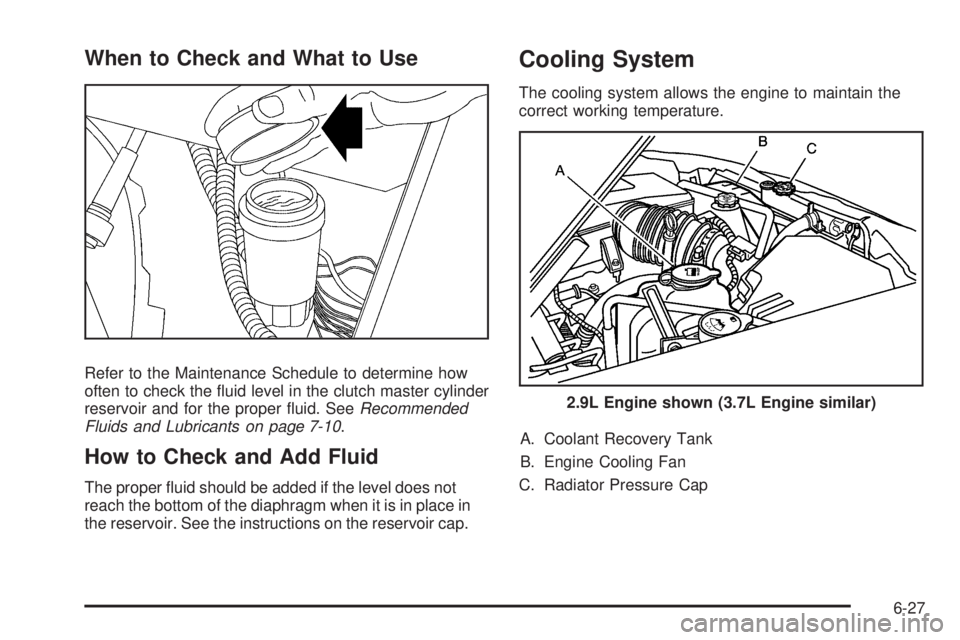
Cooling System
The cooling system allows the engine to maintain the
correct working temperature.
A. Coolant Recovery Tank
B. Engine Cooling Fan
C. Radiator Pressure Cap
2.9L Engine shown (3.7L Engine similar)
6-27
Page 306 of 448
What to Use
{WARNING:
Adding only plain water to the cooling system can
be dangerous. Plain water, or some other liquid
such as alcohol, can boil before the proper coolant
mixture will. The vehicle’s coolant warning system
is set for the proper coolant mixture. With plain
water or the wrong mixture, the engine could get
too hot but you would not get the overheat
warning. The engine could catch fire and you or
others could be burned. Use a 50/50 mixture of
clean, drinkable water and DEX-COOL
®coolant.
Use a 50/50 mixture of clean, drinkable water and
DEX-COOL
®coolant. If using this mixture, nothing
else needs to be added. This mixture:
•Gives freezing protection down to−34°F (−37°C),
outside temperature.
•Gives boiling protection up to 265°F (129°C),
engine temperature.
•Protects against rust and corrosion.
•Will not damage aluminum parts.
•Helps keep the proper engine temperature.
Notice:If an improper coolant mixture is used,
the engine could overheat and be badly damaged.
The repair cost would not be covered by the vehicle
warranty. Too much water in the mixture can freeze
and crack the engine, radiator, heater core, and other
parts.
Notice:If extra inhibitors and/or additives are used
in the vehicle’s cooling system, the vehicle could
be damaged. Use only the proper mixture of
the engine coolant listed in this manual for the
cooling system. SeeRecommended Fluids and
Lubricants on page 7-10for more information.
6-30
Page 311 of 448
Engine Overheating
The vehicle has a coolant temperature gage displayed
on the instrument panel to warn if the engine is
overheating. SeeEngine Coolant Temperature Gage on
page 4-27. If the engine is too hot, the air conditioning
might stop working. This is normal and helps cool
the engine.
You may decide not to lift the hood when the warning
appears, but instead get service help right away.
SeeRoadside Assistance Program on page 8-7.
If you do decide to lift the hood, make sure the vehicle
is parked on a level surface.
Then check to see if the engine cooling fan is running.
If the engine is overheating, the fan should be running.
If it is not, do not continue to run the engine and have the
vehicle serviced.
The engine cooling fan speed should increase when
idle speed is doubled by pushing the accelerator
pedal down. If it does not, the vehicle needs service.
Turn off the engine.
Notice:Engine damage from running the engine
without coolant is not covered by the warranty.
Notice:If the engine catches re because of being
driven with no coolant, your vehicle can be badly
damaged. The costly repairs would not be covered
by the vehicle warranty.
If Steam is Coming from the Engine
Compartment
{WARNING:
Steam from an overheated engine can burn you
badly, even if you just open the hood. Stay away
from the engine if you see or hear steam coming
from it. Just turn it off and get everyone away
from the vehicle until it cools down. Wait until
there is no sign of steam or coolant before you
open the hood.
If you keep driving when your engine is
overheated, the liquids in it can catch fire. You or
others could be badly burned. Stop your engine if
it overheats, and get out of the vehicle until the
engine is cool.
6-35