weight GMC CANYON 2012 User Guide
[x] Cancel search | Manufacturer: GMC, Model Year: 2012, Model line: CANYON, Model: GMC CANYON 2012Pages: 404, PDF Size: 5.25 MB
Page 203 of 404
Black plate (23,1)GMC Canyon Owner Manual - 2012
Driving and Operating 9-23
Two-Tiered Loading
For vehicles with a six foot bed,
an upper load platform can be
created by positioning four 5 cm
(2 inches) by 15 cm (6 inches)
wooden planks across the width
of the pickup box. The planks
must be inserted in the pickup
box depressions.
When using this upper load
platform, be sure the load is
securely tied down to prevent it
from shifting. The load's center
of gravity should be positioned
in a zone over the rear axle.
Any load that extends beyond
the vehicle's taillamp area must
be properly marked according to
local laws and regulations.
Remember not to exceed
the Gross Axle Weight
Rating (GAWR) of the rear axle.Add-On Equipment
When you carry removable
items, you may need to put a
limit on how many people you
carry inside your vehicle. Be
sure to weigh your vehicle
before you buy and install the
new equipment.
Notice:
Overloading the
vehicle may cause damage.
Repairs would not be covered
by the vehicle warranty. Do
not overload the vehicle.
Remember not to exceed the
Gross Axle Weight
Rating (GAWR) of the rear axle.
A reinforcement kit for mounting
a toolbox is recommended.
See your dealer.Truck-Camper Loading
Information
The vehicle was neither
designed nor intended to carry a
slide-in type camper.
Notice: Adding a slide-in
camper or similar equipment
to the vehicle can damage it,
and the repairs would not be
covered by the vehicle
warranty. Do not install a
slide-in camper or similar
equipment on the vehicle.
Page 209 of 404
Black plate (29,1)GMC Canyon Owner Manual - 2012
Driving and Operating 9-29
{WARNING
If you have four-wheel drive, the
vehicle will be free to roll—even
if the shift lever is in P (Park) —if
the transfer case is in Neutral. So,
be sure the transfer case is in a
drive gear, two-wheel high (2H) or
four-wheel high (4H) or
four-wheel low (4L) —not
in Neutral.
2. Move the shift lever into P (Park) by pulling the lever toward you
and moving it up as far as it
will go.
3. Turn the ignition key to LOCK/OFF.
4. Remove the key and take it with you. If you can leave the vehicle
with the key, the vehicle is in
P (Park).
Leaving the Vehicle With the
Engine Running (Automatic
Transmission)
{WARNING
It can be dangerous to leave the
vehicle with the engine running.
The vehicle could move suddenly
if the shift lever is not fully in
P (Park) with the parking brake
firmly set. And, if you leave the
vehicle with the engine running, it
could overheat and even catch
fire. You or others could be
injured. Do not leave the vehicle
with the engine running.
If you have to leave the vehicle with
the engine running, be sure the
vehicle is in P (Park) and the
parking brake is firmly set before
you leave it. After you have moved
the shift lever into P (Park), hold the
regular brake pedal down. Then,
see if you can move the shift lever away from P (Park) without first
pulling it toward you. If you can, the
shift lever was not fully locked into
P (Park).
Torque Lock
(Automatic Transmission)
If you are parking on a hill and you
do not shift the transmission into
P (Park) properly, the weight of the
vehicle may put too much force on
the parking pawl in the
transmission. You may find it difficult
to pull the shift lever out of P (Park).
This is called torque lock. To
prevent torque lock, set the parking
brake and then shift into P (Park)
properly before you leave the driver
seat. To find out how, see
“Shifting
Into Park (Automatic Transmission)”
in this section.
When you are ready to drive, move
the shift lever out of P (Park) before
you release the parking brake.
If torque lock does occur, you may
need to have another vehicle push
yours a little uphill to take some of
Page 234 of 404
Black plate (54,1)GMC Canyon Owner Manual - 2012
9-54 Driving and Operating
Towing
General Towing
Information
Only use towing equipment that has
been designed for the vehicle.
Contact your dealer or trailering
dealer for assistance with preparing
the vehicle for towing a trailer.
See the following trailer towing
information in this section:
.For information on driving while
towing a trailer, see“Driving
Characteristics and
Towing Tips.”
.For maximum vehicle and trailer
weights, see “Trailer Towing.”
.For information on equipment to
tow a trailer, see “Towing
Equipment.”
For information on towing a disabled
vehicle, see Towing the Vehicle on
page 10‑91. For information on
towing the vehicle behind another vehicle such as a motor home, see
Recreational Vehicle Towing on
page 10‑91.
Driving Characteristics
and Towing Tips
Pulling A Trailer
Here are some important points:
.There are many different laws,
including speed limit restrictions,
having to do with trailering.
Make sure the rig will be legal,
not only where you live but also
where you will be driving.
A good source for this
information can be state or
provincial police.
.Consider using a sway control.
See
“Hitches” inTowing
Equipment on page 9‑63.
.Do not tow a trailer at all during
the first 800 km (500 miles) the
new vehicle is driven. The
engine, axle or other parts could
be damaged.
.Then, during the first 800 km
(500 miles) that a trailer is
towed, do not drive over 80 km/h
(50 mph) and do not make starts
at full throttle. This helps the
engine and other parts of the
vehicle wear in at the heavier
loads.
.Vehicles with automatic
transmissions can tow in
D (Drive), but you may want to
shift to a lower gear selection if
the transmission shifts too often
(e.g., under heavy loads and/or
hilly conditions). If the vehicle
has a manual transmission it is
better not to use the
highest gear.
Three important considerations
have to do with weight:
.The weight of the trailer
.The weight of the trailer tongue
.The weight on the vehicle's tires
Page 235 of 404
Black plate (55,1)GMC Canyon Owner Manual - 2012
Driving and Operating 9-55
Driving with a Trailer
{WARNING
When towing a trailer, exhaust
gases may collect at the rear of
the vehicle and enter if the
liftgate, trunk/hatch, or rear-most
window is open.
Engine exhaust contains Carbon
Monoxide (CO) which cannot be
seen or smelled. It can cause
unconsciousness and even death.
To maximize safety when towing
a trailer:
.Have the exhaust system
inspected for leaks and make
necessary repairs before
starting a trip.
.Never drive with the liftgate,
trunk/hatch, or rear-most
window open.(Continued)
WARNING (Continued)
.Fully open the air outlets on
or under the instrument
panel.
.Adjust the Climate Control
system to a setting that
brings in only outside air and
set the fan speed to the
highest setting. See Climate
Control System in the Index.
For more information about
Carbon Monoxide, see Engine
Exhaust on page 9‑31.
Towing a trailer requires a certain
amount of experience. Get to know
the rig before setting out for the
open road. Get acquainted with the
feel of handling and braking with the
added weight of the trailer. And
always keep in mind that the vehicle
you are driving is now longer and
not as responsive as the vehicle is
by itself. Before starting, check all trailer hitch
parts and attachments, safety
chains, electrical connectors, lamps,
tires and mirror adjustments. If the
trailer has electric brakes, start the
vehicle and trailer moving and then
apply the trailer brake controller by
hand to be sure the brakes are
working. This checks the electrical
connection at the same time.
During the trip, check occasionally
to be sure that the load is secure,
and that the lamps and any trailer
brakes are still working.
While towing a trailer or when
exposed to long periods of
sunshine, the floor of the truck bed
may become very warm. Avoid
putting items in the truck bed that
might be affected by high ambient
temperatures.
Page 239 of 404
Black plate (59,1)GMC Canyon Owner Manual - 2012
Driving and Operating 9-59
Notice:Pulling a trailer
improperly can damage the
vehicle and result in costly
repairs not covered by the
vehicle warranty. To pull a trailer
correctly, follow the advice in this
section and see your dealer for
important information about
towing a trailer with the vehicle.
To identify the trailering capacity of
the vehicle, read the information in
“Weight of the Trailer” that appears
later in this section.
Trailering is different than just
driving the vehicle by itself.
Trailering means changes in
handling, acceleration, braking,
durability and fuel economy.
Successful, safe trailering takes
correct equipment, and it has to
be used properly. The following information has many
time-tested, important trailering tips
and safety rules. Many of these are
important for your safety and that of
your passengers. So please read
this section carefully before pulling
a trailer.
Weight of the Trailer
How heavy can a trailer safely be?
It depends on how the rig is used.
For example, speed, altitude, road
grades, outside temperature and
how much the vehicle is used to pull
a trailer are all important. It can
depend on any special equipment
on the vehicle, and the amount of
tongue weight the vehicle can carry.
See
“Weight of the Trailer Tongue”
later in this section for more
information. Maximum trailer weight is calculated
assuming only the driver is in the
tow vehicle and it has all the
required trailering equipment.
The weight of additional optional
equipment, passengers and cargo in
the tow vehicle must be subtracted
from the maximum trailer weight.
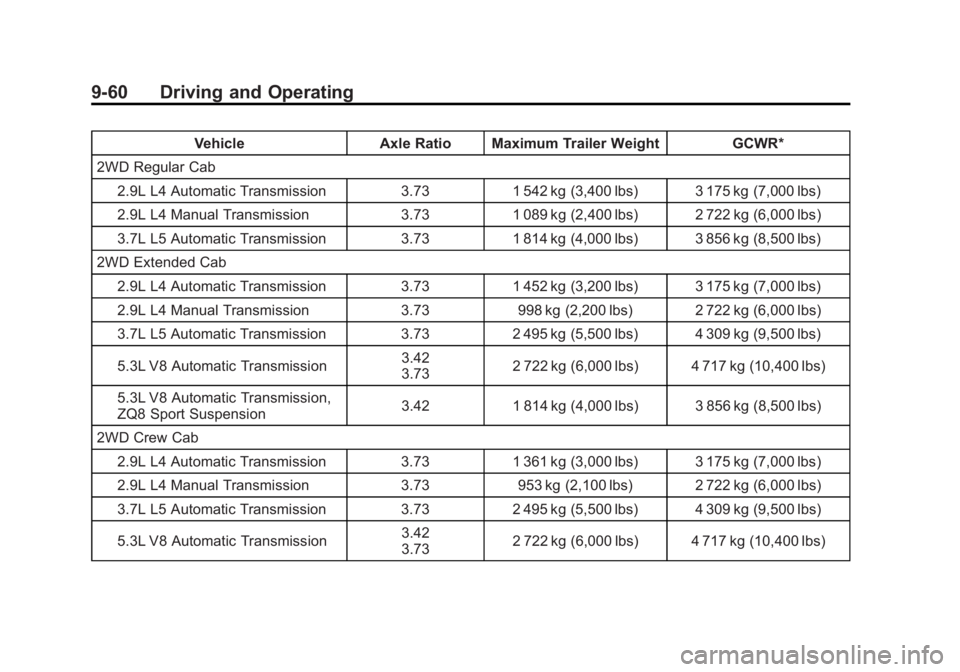
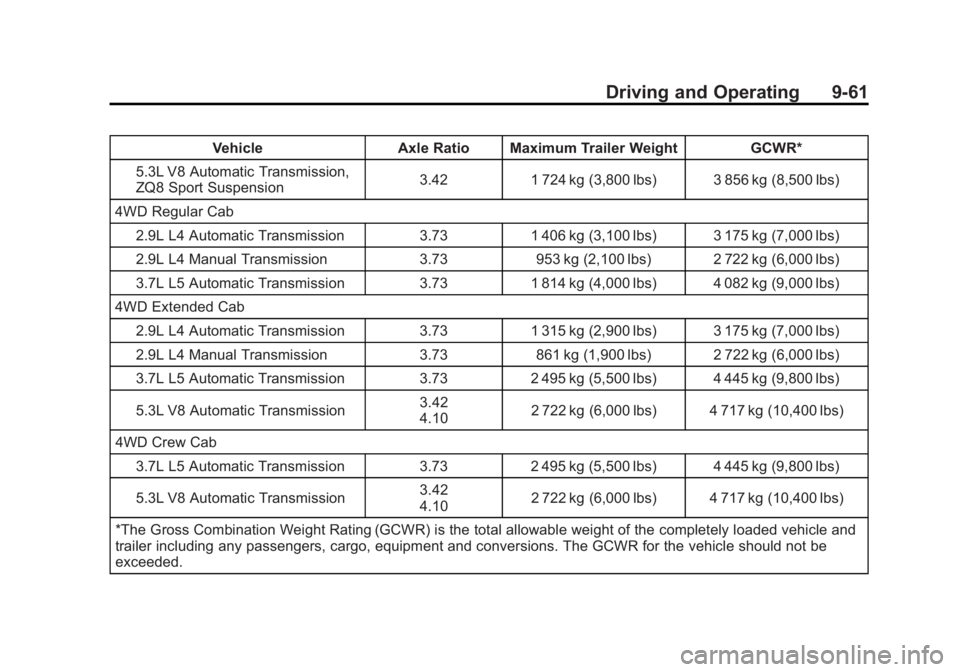
Use the following chart to determine
how much the vehicle can weigh,
based upon the vehicle model
and options.
Page 240 of 404
Black plate (60,1)GMC Canyon Owner Manual - 2012
9-60 Driving and Operating
VehicleAxle Ratio Maximum Trailer Weight GCWR*
2WD Regular Cab 2.9L L4 Automatic Transmission 3.731 542 kg (3,400 lbs) 3 175 kg (7,000 lbs)
2.9L L4 Manual Transmission 3.731 089 kg (2,400 lbs) 2 722 kg (6,000 lbs)
3.7L L5 Automatic Transmission 3.731 814 kg (4,000 lbs) 3 856 kg (8,500 lbs)
2WD Extended Cab
2.9L L4 Automatic Transmission 3.731 452 kg (3,200 lbs) 3 175 kg (7,000 lbs)
2.9L L4 Manual Transmission 3.73998 kg (2,200 lbs) 2 722 kg (6,000 lbs)
3.7L L5 Automatic Transmission 3.732 495 kg (5,500 lbs) 4 309 kg (9,500 lbs)
5.3L V8 Automatic Transmission 3.42
3.732 722 kg (6,000 lbs) 4 717 kg (10,400 lbs)
5.3L V8 Automatic Transmission,
ZQ8 Sport Suspension 3.42
1 814 kg (4,000 lbs) 3 856 kg (8,500 lbs)
2WD Crew Cab 2.9L L4 Automatic Transmission 3.731 361 kg (3,000 lbs) 3 175 kg (7,000 lbs)
2.9L L4 Manual Transmission 3.73953 kg (2,100 lbs) 2 722 kg (6,000 lbs)
3.7L L5 Automatic Transmission 3.732 495 kg (5,500 lbs) 4 309 kg (9,500 lbs)
5.3L V8 Automatic Transmission 3.42
3.732 722 kg (6,000 lbs) 4 717 kg (10,400 lbs)
Page 241 of 404
Black plate (61,1)GMC Canyon Owner Manual - 2012
Driving and Operating 9-61
VehicleAxle Ratio Maximum Trailer Weight GCWR*
5.3L V8 Automatic Transmission,
ZQ8 Sport Suspension 3.42
1 724 kg (3,800 lbs) 3 856 kg (8,500 lbs)
4WD Regular Cab 2.9L L4 Automatic Transmission 3.731 406 kg (3,100 lbs) 3 175 kg (7,000 lbs)
2.9L L4 Manual Transmission 3.73953 kg (2,100 lbs) 2 722 kg (6,000 lbs)
3.7L L5 Automatic Transmission 3.731 814 kg (4,000 lbs) 4 082 kg (9,000 lbs)
4WD Extended Cab 2.9L L4 Automatic Transmission 3.731 315 kg (2,900 lbs) 3 175 kg (7,000 lbs)
2.9L L4 Manual Transmission 3.73861 kg (1,900 lbs) 2 722 kg (6,000 lbs)
3.7L L5 Automatic Transmission 3.732 495 kg (5,500 lbs) 4 445 kg (9,800 lbs)
5.3L V8 Automatic Transmission 3.42
4.102 722 kg (6,000 lbs) 4 717 kg (10,400 lbs)
4WD Crew Cab 3.7L L5 Automatic Transmission 3.732 495 kg (5,500 lbs) 4 445 kg (9,800 lbs)
5.3L V8 Automatic Transmission 3.42
4.10
2 722 kg (6,000 lbs) 4 717 kg (10,400 lbs)
*The Gross Combination Weight Rating (GCWR) is the total allowable weight of the completely loaded vehicle and
trailer including any passengers, cargo, equipment and conversions. The GCWR for the vehicle should not be
exceeded.
Page 242 of 404
Black plate (62,1)GMC Canyon Owner Manual - 2012
9-62 Driving and Operating
Ask your dealer for our trailering
information or advice, or write us at
our Customer Assistance Offices.
SeeCustomer Assistance Offices
(U.S. and Canada) on page 13‑5 or
Customer Assistance Offices
(Mexico) on page 13‑6 for more
information.
Weight of the Trailer Tongue
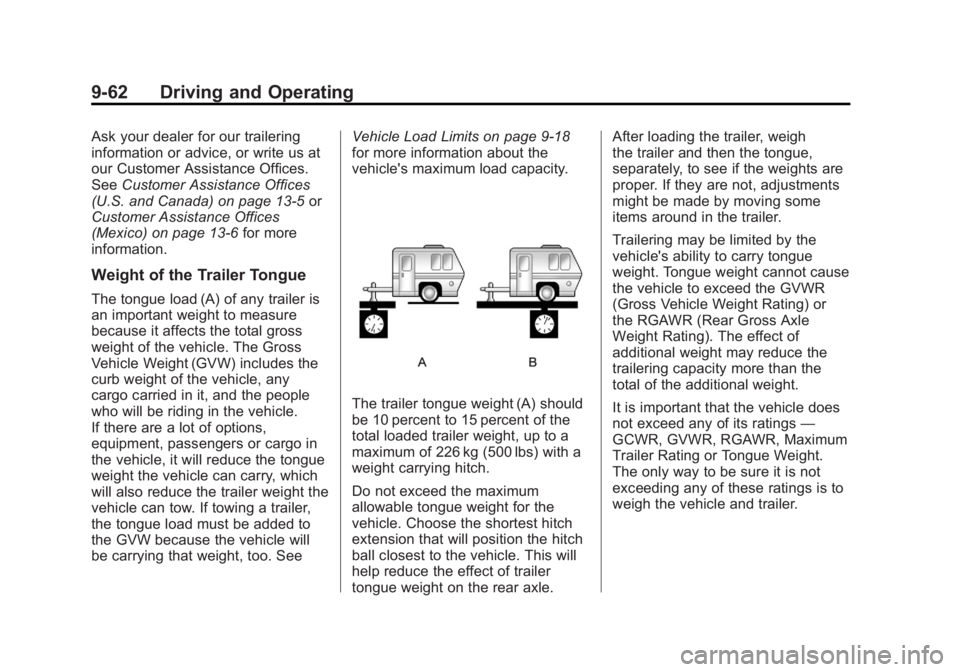
The tongue load (A) of any trailer is
an important weight to measure
because it affects the total gross
weight of the vehicle. The Gross
Vehicle Weight (GVW) includes the
curb weight of the vehicle, any
cargo carried in it, and the people
who will be riding in the vehicle.
If there are a lot of options,
equipment, passengers or cargo in
the vehicle, it will reduce the tongue
weight the vehicle can carry, which
will also reduce the trailer weight the
vehicle can tow. If towing a trailer,
the tongue load must be added to
the GVW because the vehicle will
be carrying that weight, too. See Vehicle Load Limits on page 9‑18
for more information about the
vehicle's maximum load capacity.
The trailer tongue weight (A) should
be 10 percent to 15 percent of the
total loaded trailer weight, up to a
maximum of 226 kg (500 lbs) with a
weight carrying hitch.
Do not exceed the maximum
allowable tongue weight for the
vehicle. Choose the shortest hitch
extension that will position the hitch
ball closest to the vehicle. This will
help reduce the effect of trailer
tongue weight on the rear axle.After loading the trailer, weigh
the trailer and then the tongue,
separately, to see if the weights are
proper. If they are not, adjustments
might be made by moving some
items around in the trailer.
Trailering may be limited by the
vehicle's ability to carry tongue
weight. Tongue weight cannot cause
the vehicle to exceed the GVWR
(Gross Vehicle Weight Rating) or
the RGAWR (Rear Gross Axle
Weight Rating). The effect of
additional weight may reduce the
trailering capacity more than the
total of the additional weight.
It is important that the vehicle does
not exceed any of its ratings
—
GCWR, GVWR, RGAWR, Maximum
Trailer Rating or Tongue Weight.
The only way to be sure it is not
exceeding any of these ratings is to
weigh the vehicle and trailer.
Page 243 of 404
Black plate (63,1)GMC Canyon Owner Manual - 2012
Driving and Operating 9-63
Total Weight on the
Vehicle's Tires
Be sure the vehicle's tires are
inflated to the upper limit for cold
tires. These numbers can be found
on the Certification/Tire label
located at the bottom of the center
pillar on the driver's side of the
vehicle, or seeVehicle Load Limits
on page 9‑18. Make sure not to go
over the GVW limit for the vehicle,
or the GAWR, including the weight
of the trailer tongue. If using a
weight distributing hitch, make sure
not to go over the rear axle limit
before applying the weight
distribution spring bars.
Towing Equipment
Hitches
It is important to have the correct
hitch equipment. Crosswinds, large
trucks going by and rough roads are
a few reasons why the right hitch
is needed.
Weight-Distributing Hitches
and Weight Carrying Hitches
A step bumper hitch can be used for
trailers up to 907 kg (2,000 lbs) total
weight, and 90 kg (200 lbs) tongue
weight.
Notice: If a step-bumper hitch is
used, the bumper could be
damaged in sharp turns. Make
sure there is ample room when
turning to avoid contact between
the trailer and the bumper.
Safety Chains
Always attach chains between the
vehicle and the trailer. Cross the
safety chains under the tongue of
the trailer to help prevent the tongue
from contacting the road if it
becomes separated from the hitch.
Instructions about safety chains
may be provided by the hitch
manufacturer or by the trailer
manufacturer. For trailers up to
907 kg (2,000 lbs) safety chains may
be attached to the attaching points
on the bumper. For heavier trailers,
follow the trailer or hitch
manufacturer's recommendation for
attaching safety chains. Always
leave just enough slack so the rig
can turn. Never allow safety chains
to drag on the ground.
Page 244 of 404
Black plate (64,1)GMC Canyon Owner Manual - 2012
9-64 Driving and Operating
Trailer Brakes
A loaded trailer that weighs more
than 450 kg (1,000 lbs) needs to
have its own brake system that is
adequate for the weight of the
trailer. Be sure to read and follow
the instructions for the trailer brakes
so they are installed, adjusted and
maintained properly.
Since the vehicle is equipped with
StabiliTrak
®, the trailer cannot tap
into the vehicle's hydraulic brake
system.
Trailer Wiring Harness
The vehicle may be equipped
with a four‐pin trailer towing
harness. This harness has a
four‐pin trailer connector that is
attached to a bracket on the hitch
platform. The four‐wire harness
contains the following trailer circuits:
.Yellow: Left Stop/Turn Signal
.Green: Right Stop/Turn Signal
.Brown: Taillamps/Park lamps
.White: Ground
Conversions and
Add-Ons
Add-On Electrical
Equipment
Notice: Do not add anything
electrical to the vehicle unless
you check with your dealer first.
Some electrical equipment can
damage the vehicle and the
damage would not be covered by
the vehicle's warranty. Some
add-on electrical equipment can
keep other components from
working as they should.
Add-on equipment can drain the
vehicle's 12‐volt battery, even if the
vehicle is not operating.
The vehicle has an airbag system.
Before attempting to add anything
electrical to the vehicle, see
Servicing the Airbag-Equipped
Vehicle on page 3‑33 andAdding
Equipment to the Airbag-Equipped
Vehicle on page 3‑34.
Pickup Conversion to
Chassis Cab
We are aware that some vehicle
owners might consider having the
pickup box removed and a
commercial or recreational body
installed. However, we recommend
that conversions of this type not be
done to pickups. Owners should be
aware that, as manufactured, there
are differences between a chassis
cab and a pickup with the box
removed which could affect
vehicle safety.