tow GMC CANYON 2012 Workshop Manual
[x] Cancel search | Manufacturer: GMC, Model Year: 2012, Model line: CANYON, Model: GMC CANYON 2012Pages: 404, PDF Size: 5.25 MB
Page 269 of 404
Black plate (25,1)GMC Canyon Owner Manual - 2012
Vehicle Care 10-25
Engine Fan
This vehicle has a clutched engine
cooling fan. When the clutch is
engaged, the fan spins faster to
provide more air to cool the engine.
In most everyday driving conditions,
the clutch is not engaged. This
improves fuel economy and reduces
fan noise. Under heavy vehicle
loading, trailer towing and/or high
outside temperatures, the fan speed
increases when the clutch engages.
So you may hear an increase in fan
noise. This is normal and should not
be mistaken as the transmission
slipping or making extra shifts.
It is merely the cooling system
functioning properly. The fan will
slow down when additional cooling
is not required and the clutch
disengages.
This fan noise may also be heard
when the engine is started. It will go
away as the fan clutch disengages.
Power Steering Fluid
The power steering fluid reservoir is
located near the front of the engine
compartment, behind the radiator.
SeeEngine Compartment Overview
on page 10‑6 for reservoir location.
When to Check Power Steering
Fluid
It is not necessary to regularly
check power steering fluid unless
there is a leak suspected in the
system or an unusual noise is
heard. A fluid loss in this system
could indicate a problem. Have the
system inspected and repaired.
How to Check Power Steering
Fluid
1. Turn the key off and let the
engine compartment cool down.
2. Wipe the cap and the top of the reservoir clean.
3. Unscrew the cap and wipe the dipstick with a clean rag.
4. Replace the cap and completely tighten it.
5. Then remove the cap again and look at the fluid level on the
dipstick.
The level should be between the
ADD and FULL marks. If necessary,
add only enough fluid to bring the
level up to the proper range.
Page 306 of 404
Black plate (62,1)GMC Canyon Owner Manual - 2012
10-62 Vehicle Care
Reset the Tire Pressure Monitor
System. SeeTire Pressure
Monitor Operation on
page 10‑58.
Check that all wheel nuts are
properly tightened. See “Wheel
Nut Torque” underCapacities
and Specifications on
page 12‑2.
{WARNING
Rust or dirt on a wheel, or on the
parts to which it is fastened, can
make wheel nuts become loose
after time. The wheel could come
off and cause an accident. When
changing a wheel, remove any
rust or dirt from places where the
wheel attaches to the vehicle.
(Continued)
WARNING (Continued)
In an emergency, a cloth or a
paper towel can be used;
however, use a scraper or wire
brush later to remove all rust
or dirt.
Lightly coat the center of the
wheel hub with wheel bearing
grease after a wheel change or
tire rotation to prevent corrosion
or rust build-up. Do not get
grease on the flat wheel
mounting surface or on the
wheel nuts or bolts.
When It Is Time for
New Tires
Factors, such as maintenance,
temperatures, driving speeds,
vehicle loading, and road conditions
affect the wear rate of the tires.
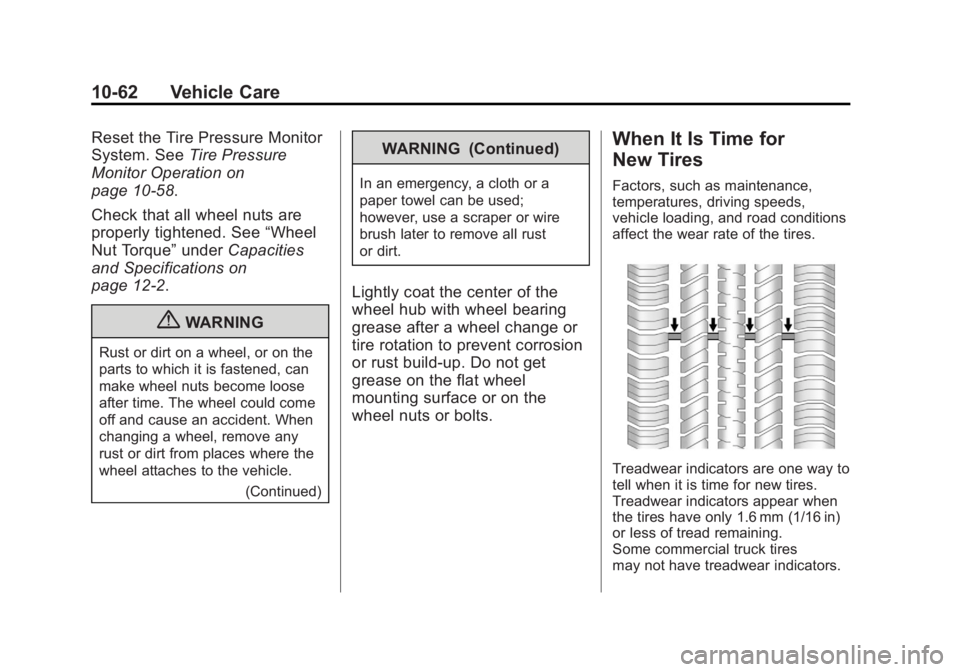
Treadwear indicators are one way to
tell when it is time for new tires.
Treadwear indicators appear when
the tires have only 1.6 mm (1/16 in)
or less of tread remaining.
Some commercial truck tires
may not have treadwear indicators.
Page 313 of 404
Black plate (69,1)GMC Canyon Owner Manual - 2012
Vehicle Care 10-69
If a Tire Goes Flat
It is unusual for a tire to blowout
while driving, especially if the tires
are maintained properly. If air goes
out of a tire, it is much more likely to
leak out slowly. But if there ever is a
blowout, here are a few tips about
what to expect and what to do:
If a front tire fails, the flat tire
creates a drag that pulls the vehicle
toward that side. Take your foot off
the accelerator pedal and grip the
steering wheel firmly. Steer to
maintain lane position, and then
gently brake to a stop, well off the
road, if possible.A rear blowout, particularly on a
curve, acts much like a skid and
may require the same correction as
used in a skid. Stop pressing the
accelerator pedal and steer to
straighten the vehicle. It may be
very bumpy and noisy. Gently brake
to a stop, well off the road,
if possible.
{WARNING
Driving on a flat tire will cause
permanent damage to the tire.
Re-inflating a tire after it has been
driven on while severely
underinflated or flat may cause a
blowout and a serious crash.
Never attempt to re-inflate a tire
that has been driven on while
severely underinflated or flat.
Have your dealer or an authorized
tire service center repair or
replace the flat tire as soon
as possible.
{WARNING
Lifting a vehicle and getting under
it to do maintenance or repairs is
dangerous without the
appropriate safety equipment and
training. If a jack is provided with
the vehicle, it is designed only for
changing a flat tire. If it is used for
anything else, you or others could
be badly injured or killed if the
vehicle slips off the jack. If a jack
is provided with the vehicle, only
use it for changing a flat tire.
If a tire goes flat, avoid further tire
and wheel damage by driving slowly
to a level place, well off the road,
if possible. Turn on the hazard
warning flashers. See Hazard
Warning Flashers on page 6‑4.
Page 320 of 404
Black plate (76,1)GMC Canyon Owner Manual - 2012
10-76 Vehicle Care
{WARNING
Rust or dirt on a wheel, or on the
parts to which it is fastened, can
make wheel nuts become loose
after time. The wheel could come
off and cause an accident. When
changing a wheel, remove any
rust or dirt from places where the
wheel attaches to the vehicle. In
an emergency, a cloth or a paper
towel can be used; however, use
a scraper or wire brush later to
remove all rust or dirt.
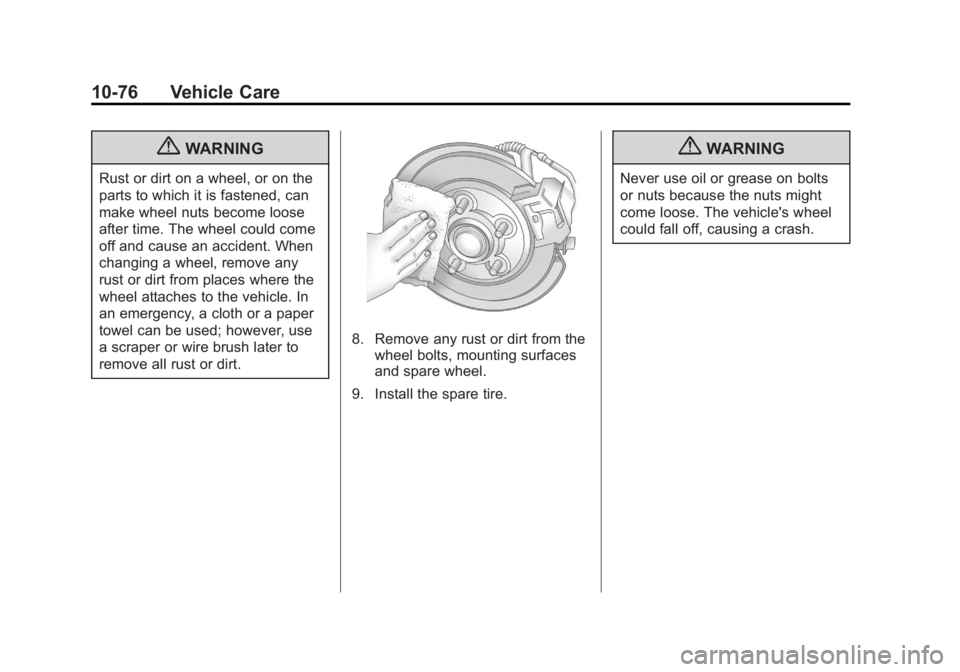
8. Remove any rust or dirt from thewheel bolts, mounting surfaces
and spare wheel.
9. Install the spare tire.
{WARNING
Never use oil or grease on bolts
or nuts because the nuts might
come loose. The vehicle's wheel
could fall off, causing a crash.
Page 321 of 404
Black plate (77,1)GMC Canyon Owner Manual - 2012
Vehicle Care 10-77
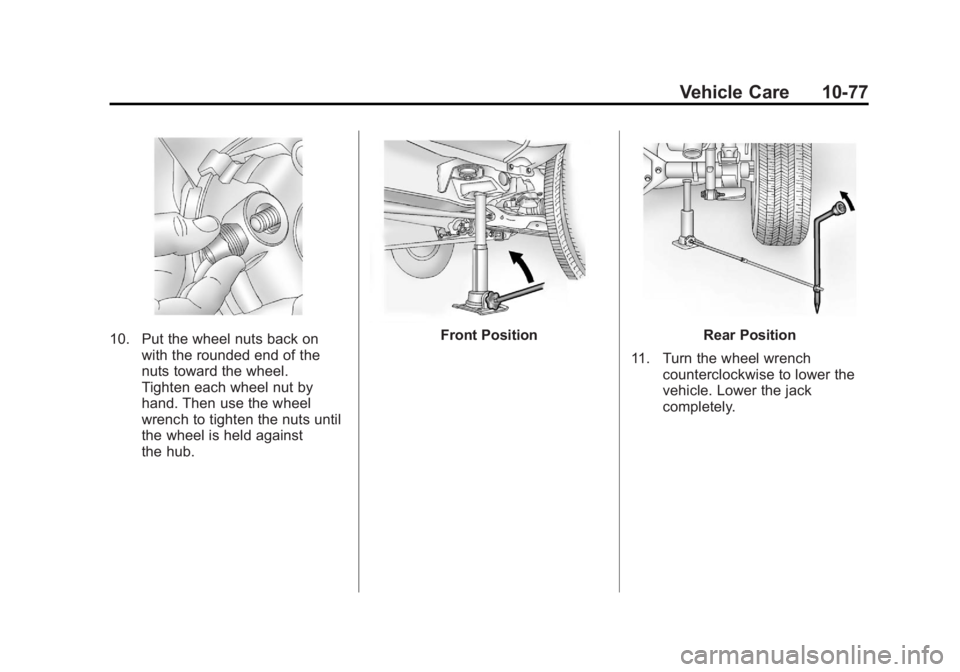
10. Put the wheel nuts back onwith the rounded end of the
nuts toward the wheel.
Tighten each wheel nut by
hand. Then use the wheel
wrench to tighten the nuts until
the wheel is held against
the hub.Front PositionRear Position
11. Turn the wheel wrench counterclockwise to lower the
vehicle. Lower the jack
completely.
Page 322 of 404
Black plate (78,1)GMC Canyon Owner Manual - 2012
10-78 Vehicle Care
{WARNING
Wheel nuts that are improperly or
incorrectly tightened can cause
the wheels to become loose or
come off. The wheel nuts should
be tightened with a torque wrench
to the proper torque specification
after replacing. Follow the torque
specification supplied by the
aftermarket manufacturer when
using accessory locking wheel
nuts. SeeCapacities and
Specifications on page 12‑2 for
original equipment wheel nut
torque specifications.
Notice: Improperly tightened
wheel nuts can lead to brake
pulsation and rotor damage. To
avoid expensive brake repairs,
evenly tighten the wheel nuts in
the proper sequence and to the
proper torque specification. See
Capacities and Specifications on
page 12‑2 for the wheel nut
torque specification.
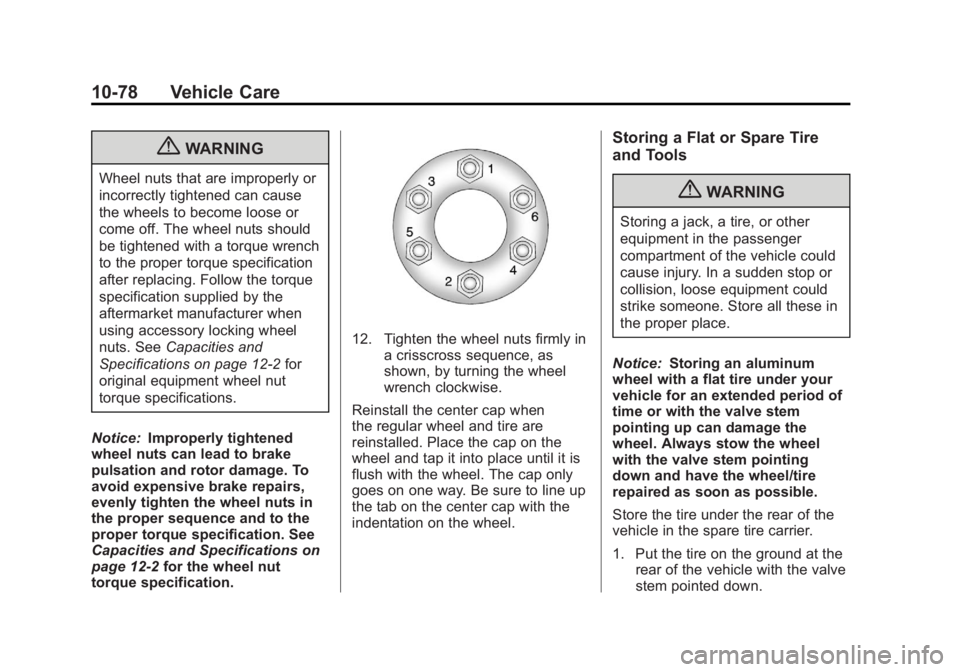
12. Tighten the wheel nuts firmly in a crisscross sequence, as
shown, by turning the wheel
wrench clockwise.
Reinstall the center cap when
the regular wheel and tire are
reinstalled. Place the cap on the
wheel and tap it into place until it is
flush with the wheel. The cap only
goes on one way. Be sure to line up
the tab on the center cap with the
indentation on the wheel.
Storing a Flat or Spare Tire
and Tools
{WARNING
Storing a jack, a tire, or other
equipment in the passenger
compartment of the vehicle could
cause injury. In a sudden stop or
collision, loose equipment could
strike someone. Store all these in
the proper place.
Notice: Storing an aluminum
wheel with a flat tire under your
vehicle for an extended period of
time or with the valve stem
pointing up can damage the
wheel. Always stow the wheel
with the valve stem pointing
down and have the wheel/tire
repaired as soon as possible.
Store the tire under the rear of the
vehicle in the spare tire carrier.
1. Put the tire on the ground at the rear of the vehicle with the valve
stem pointed down.
Page 324 of 404
Black plate (80,1)GMC Canyon Owner Manual - 2012
10-80 Vehicle Care
5. Turn the wheel wrenchclockwise to raise the tire part
way up. Make sure the retainer
is seated in the wheel opening
and the valve stem is
pointed down.
Continue raising the tire, watch
to make sure it does not get
caught on anything on the
underbody. If the tire does get
caught, loosen two or three turns
and push and pull the tire and
then retighten.
Repeat this procedure as many
times as needed to ensure
proper stowage.
6. When the tire is properly seated to the underbody, continue
turning the wheel wrench
clockwise until you hear two
clicks or feel it skip twice. You
cannot overtighten the cable.
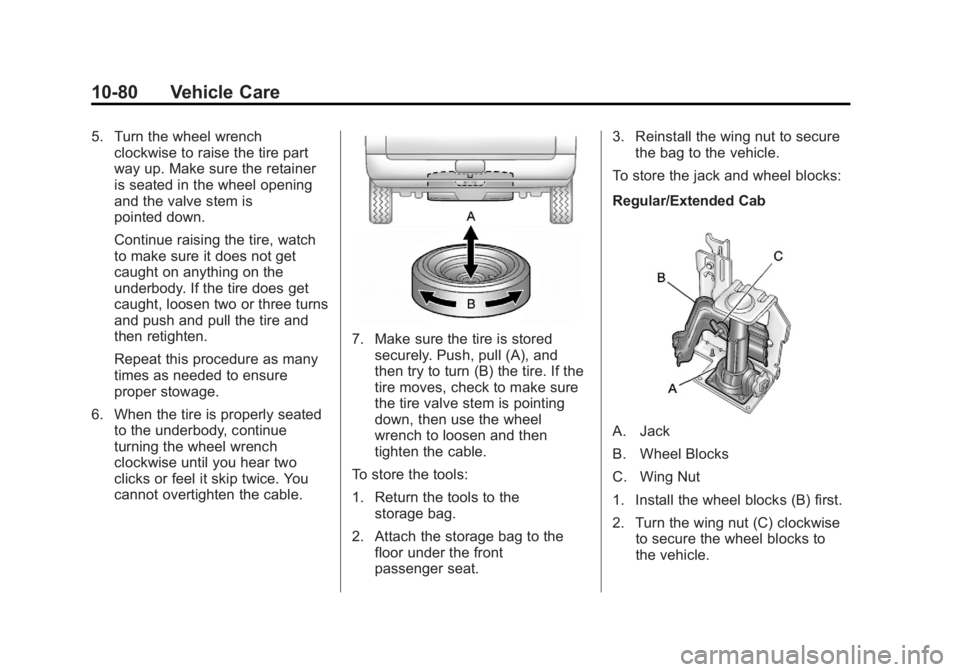
7. Make sure the tire is storedsecurely. Push, pull (A), and
then try to turn (B) the tire. If the
tire moves, check to make sure
the tire valve stem is pointing
down, then use the wheel
wrench to loosen and then
tighten the cable.
To store the tools:
1. Return the tools to the storage bag.
2. Attach the storage bag to the floor under the front
passenger seat. 3. Reinstall the wing nut to secure
the bag to the vehicle.
To store the jack and wheel blocks:
Regular/Extended Cab
A. Jack
B. Wheel Blocks
C. Wing Nut
1. Install the wheel blocks (B) first.
2. Turn the wing nut (C) clockwise to secure the wheel blocks to
the vehicle.
Page 327 of 404
Black plate (83,1)GMC Canyon Owner Manual - 2012
Vehicle Care 10-83
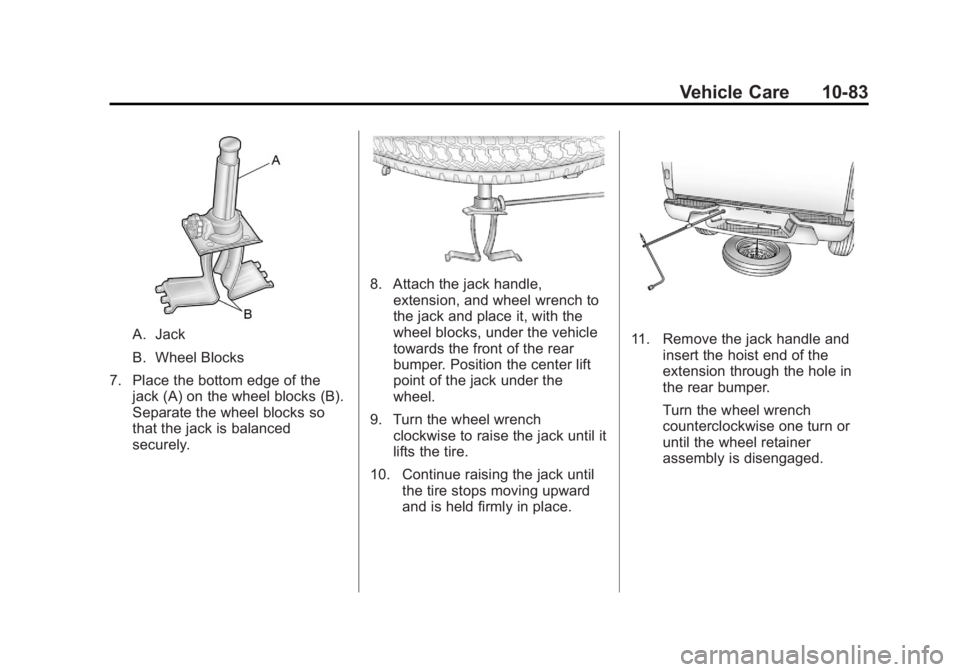
A. Jack
B. Wheel Blocks
7. Place the bottom edge of the jack (A) on the wheel blocks (B).
Separate the wheel blocks so
that the jack is balanced
securely.
8. Attach the jack handle,extension, and wheel wrench to
the jack and place it, with the
wheel blocks, under the vehicle
towards the front of the rear
bumper. Position the center lift
point of the jack under the
wheel.
9. Turn the wheel wrench clockwise to raise the jack until it
lifts the tire.
10. Continue raising the jack until the tire stops moving upward
and is held firmly in place.
11. Remove the jack handle andinsert the hoist end of the
extension through the hole in
the rear bumper.
Turn the wheel wrench
counterclockwise one turn or
until the wheel retainer
assembly is disengaged.
Page 329 of 404
Black plate (85,1)GMC Canyon Owner Manual - 2012
Vehicle Care 10-85
Compact Spare Tire
Your vehicle may have a compact
spare tire. Although the compact
spare tire was fully inflated when
your vehicle was new, it can lose air
over time. Check the inflation
pressure regularly. It should be
60 psi (420 kPa).
Notice:If the vehicle has
four-wheel drive and the compact
spare tire is installed on the
vehicle, do not drive in four-wheel
drive until you can have the flat
tire repaired and/or replaced. You
could damage the vehicle, and
the repair costs would not be
covered by your warranty. Never
use four-wheel drive when the
compact spare tire is installed on
the vehicle. After installing the compact spare
on your vehicle, you should stop as
soon as possible and make sure
your vehicle's spare tire is correctly
inflated. The compact spare is made
to perform well at speeds up to
62 mph (100 km/h) for distances up
to 500 miles (804 km). For heavy
payloads or towing, and for low
traction or four-wheel-drive
conditions, repair or replace the
full-size tire. Of course, it is best to
replace your vehicle's spare with a
full-size tire as soon as you can.
The spare tire will last longer and be
in good shape in case you need
it again.
Notice:
When the compact spare
is installed, do not take the
vehicle through an automatic
car wash with guide rails. The
compact spare can get caught on
the rails which can damage the
tire, wheel, and other parts of
the vehicle. Do not use your compact spare on
other vehicles.
And do not mix your compact spare
tire or wheel with other wheels or
tires. They will not fit. Keep your
spare tire and its wheel together.
Notice:
Tire chains will not fit the
compact spare. Using them can
damage the vehicle and can
damage the chains too. Do not
use tire chains on the compact
spare.
Page 330 of 404
Black plate (86,1)GMC Canyon Owner Manual - 2012
10-86 Vehicle Care
Full-Size Spare Tire
Your vehicle may have a full-size
spare tire, which, when new, was
fully inflated. A spare tire may lose
air over time, so check its inflation
pressure regularly. SeeTire
Pressure on page 10‑54 and
Vehicle Load Limits on page 9‑18
for information regarding proper tire
inflation and loading your vehicle.
For instruction on how to remove,
install, or store a spare tire, see
“Removing the Flat Tire and
Installing the Spare Tire” and
“Storing a Flat or Spare Tire and
Tools” underTire Changing on
page 10‑70. Your vehicle may have a different
size spare tire than the road tires
originally installed on your vehicle.
This spare was developed for use
on your vehicle, so it is alright to
drive on it. If your vehicle has
four-wheel drive and the different
size spare tire is installed, keep the
vehicle in two-wheel drive.
Notice:
If the vehicle has
four-wheel drive and a different
size spare tire is installed, do not
drive in four-wheel drive until the
flat tire is repaired and/or
replaced. The vehicle could be
damaged and the repairs would
not be covered by the warranty.
Never use four-wheel drive when
a different size spare tire is
installed on the vehicle.
After installing the spare tire on your
vehicle, you should stop as soon as
possible and make sure the spare is
correctly inflated. The spare tire is
made to perform well at speeds up
to 62 mph (100 km/h) for distances
up to 500 miles (804 km). For heavy payloads or towing, and
for low traction or four-wheel-drive
conditions, repair or replace the
full-size tire. Have the damaged or
flat road tire repaired or replaced as
soon as you can and installed back
onto your vehicle. This way, the
spare tire will be available in case
you need it again.
Do not mix tires and wheels of
different sizes, because they will not
fit. Keep your spare tire and its
wheel together.